Leonard Cohen Has Passed at Age 82: His New and Now Final Album Is Streaming Free Online
Update on November 10: We just got news that Leonard Cohen has passed, only a short few weeks after releasing his final album, available below. The sad news comes from his Facebook page.
Leonard Cohen’s new album You Want It Darker is streaming free online for a limited time, thanks to NPR’s First Listen site. Now 82 years old, and sensing that time is running short, Cohen offers, writes Rolling Stone, a “gift to music lovers: a realistically grim, spiritually radiant and deeply poetic worldview, generally spiked with a romantic thrum and an existential wink.”
Hear the title track above. And stream the complete album right below. You can purchase your own copy of Cohen’s album on Amazon and iTunes. We’d also encourage you to read this new profile of Cohen, written by The New Yorker’s long-time editor David Remnick. It’s quite poignant.
If you would like to support the mission of Open Culture, consider making a donation to our site. It’s hard to rely 100% on ads, and your contributions will help us continue providing the best free cultural and educational materials to learners everywhere. You can contribute through PayPal, Patreon, and Venmo (@openculture). Thanks!
Related Content:
Young Leonard Cohen Reads His Poetry in 1966 (Before His Days as a Musician Began)
A Day in the Life of Zen Monk Leonard Cohen: A 1996 Documentary
Ladies and Gentlemen… Mr. Leonard Cohen: The Poet-Musician Featured in a 1965 Documentary
Leonard Cohen Reads The Great World War I Poem, “In Flanders Fields”
Read More...An Immersive Audio Tour of the East Village’s Famed Poetry Scene, Narrated by Jim Jarmusch

Image by Michiel Hendryckx, via Wikimedia Commons
A peek at the photos on a realtor’s listing for a New York City one bedroom apartment formerly occupied by Beat poet Allen Ginsberg is a dispiriting reminder of how much the East Village has changed.
And that listing is over six years old!
Daniel Maurer, the editor of Bedford + Bowery, and a Ginsberg fan whom history has compelled to take over a portion of his hero’s formerly sprawling digs, wrote amusingly of shoddy renovations and his upstairs neighbor, punk rock icon Richard Hell:
Orlovsky’s name is still on the mailbox – which is just about the only thing still around from his day. After his death, the place was gut renovated with luxurious modern amenities like a mini fridge that comes up to mid-thigh and a stove that’s so tiny and ineffectual I just use it for cookbook storage. Soon after I moved in I took a trip to Ikea and recognized my kitchen cabinets there.
That’s why I was amused to read a piece in the Wall Street Journal … in which my upstairs neighbor, Richard Hell, talked about his rent-stabilized two-bedroom apartment and its “funkiness that you don’t find in Manhattan much anymore.”
Hell describes his “worn unvarnished wood floors that groan when you walk on them, cracks in the plaster walls, sagging original moldings.” That’s exactly what I was looking for in an apartment two years ago.
Maurer is far from alone in the desire to edge closer to a bygone cultural moment. Radio producer Pejk Malinovski spent three years crafting Passing Stranger, a site-specific audio tour of the East Village poetry scene, below.
A Dane who relocated to New York in 2003, Malinovski was intrigued by the scene-related anecdotes of his friend, poet Ron Padgett, who pointed out his former haunts on strolls about the neighborhood. His interest piqued, Malinovski immersed himself in Daniel Kane’s All Poets Welcome, The Lower East Side Poetry Scene in the 1960’s, another history that comes fortified with archival audio clips.
Filmmaker Jim Jarmusch, a longtime Lower East Side resident who studied with poet Kenneth Koch in his youth, was tapped to provide the audio tour’s narration, with music compliments of composer John Zorn, the artistic director of The Stone, an experimental East Village performance space. Below, Jarmusch explains what attracted him to the project:
No matter if geographic constraints prevent you from downloading Malinovski’s tour for a two mile, 90 minute amble around the much-changed East Village. In some ways, the virtual tour is better. Rather than trying to take it all in in a single, pre-plotted session, you’re free to wander at will, enjoying such interactive features as maps and photos, in addition to interviews, readings, and reminiscences.
The 10th stop on the tour deposits you across the street from 437 East 12th Street, Ginsberg’s aforementioned former residence, on the steps of a church that no longer exists. Mary Help of Christians Roman Catholic Church was demolished shortly after Passing Stranger hit the streets, but its memory lives on thanks to its celebrated appearance in Ginsberg’s work:
Fourth Floor, Dawn, Up All Night Writing Letters
Pigeons shake their wings on the copper church roof
out my window across the street, a bird perched on the cross
surveys the city’s blue-grey clouds. Larry Rivers
‘ll come at 10 AM and take my picture. I’m taking
your picture, pigeons. I’m writing you down, Dawn.
I’m immortalizing your exhaust, Avenue A bus.
O Thought, now you’ll have to think the same thing forever!
- Allen Ginsberg, New York, June 7, 1980
Ginsberg himself is brought to vivid life by his secretary and fellow poet, Bob Rosenthal, who recalls how visitors would call up from the street, then wait for Ginsberg to toss down keys, wrapped in a dirty sock. He also name checks Mr. Buongiorno, the 437 East 12th St neighbor who served as Mary Help of Christians’ bell ringer.
You can hear those bells in the background of your Passing Stranger tour, though producer Malinovski uses ambient sound sparingly, to avoid overwhelming those using the tour on the noisy streets of the actual East Village.
You can download the full walking tour of Passing Stranger—named for Walt Whitman’s opening salutation in “To a Stranger”—here.
Explore Passing Stranger’s trivia-filled interactive website—featuring audio from Amiri Baraka, Hettie Jones, Eileen Myles, and Jack Kerouac, among others—here.
Poems included on the Passing Stranger audio tour of the East Village, in order of appearance:
Kenneth Koch, “To my Audience” (excerpt)
Frank O’Hara, Ode to Joy (To hell with it) (excerpt)
Ted Berrrigan “Dear Margie, Hello”
Ron Padgett “Poema del City from Toujours l’amour”
Walt Whitman, “To a Stranger”
Taylor Mead, “Motorcycles”
Bernadette Mayor, “Sonnet (You jerk, you didn’t call me up)”
Diane Di Prima, “Revolutionary Letters” (excerpt)
Galway Kinnell, “The Avenue Bearing the Initial of Christ” (excerpt)
Miquel Piñero, “A Lower East Side Poem” (excerpt)
Jack Kerouac, “American Haiku” (excerpt)
Bill Berkson / Frank O’Hara, “Song Heard Around St. Bridget’s”
John Ashbery, “Just Walking Around, from A Wave”
Joe Brainard, “I Remember” (excerpt)
Alice Notley, “10 Best Comic Books”
WH Auden, “September 1, 1939” (excerpt)
Anne Waldman, “Fast Speaking Woman” (excerpt)
Lewis Warsh, “Eye Contact” (excerpt)
Dick Gallup / Ted Berrigan, “80th Congress”
Abraham Lincoln, “My Childhood-Home I See Again” (excerpt)
Leroi Jones, “Bang, bang, outishly” (excerpt)
Hettie Jones, “Ode to My Kitchen Sink”
Brenda Coultas, “A Handmade Museum” (excerpt)
ee cummings, ”i was sitting in mcsorley’s…”
Related Content:
Iggy Pop Conducts a Tour of New York’s Lower East Side, Circa 1993
Ayun Halliday is an author, illustrator, theater maker and Chief Primatologist of the East Village Inky zine. Her play Zamboni Godot is opening in New York City in March 2017. Follow her @AyunHalliday.
Read More...Meet the Memphis Group, the Bob Dylan-Inspired Designers of David Bowie’s Favorite Furniture
David Bowie, in his years at Bromley Technical High School before becoming David Bowie, studied not just music but art and design as well. Despite becoming a rock star, he never forgot about the importance of the visual, a sensibility manifest in the performances he put on, the personae he assumed, and the music videos in which he starred right up until his death earlier this year. After his success, the artist also became a full-fledged art connoisseur, and next month Sotheby’s will hold Bowie/Collector, a series of three auctions “encompassing over 350 works from the private collection of the legendary musician.”
The first two auctions will sell Bowie’s modern and contemporary art; the third will focus entirely on his collection of furniture and other pieces of design by Ettore Sottsass and the Memphis Group. Even if you haven’t heard of the Memphis Group, you’ve certainly seen their furniture. “It’s Pee-Wee’s Playhouse meets Miami Vice,” in the words of Alissa Walker at Gizmodo. “It’s Saved By The Bell plus Beetlejuice.” As the postmodern wing of the 1980s Art Deco revival, Memphis “combined overtly geometric shapes from a variety of materials in bright, contrasting colors. Graphic patterns — usually black and white — were not unusual.”

Image by Zanone, via Wikimedia Commons
Memphis, whose influence has extended far beyond the movement’s official lifetime of 1981 to 1988, began “when Ettore Sottsass, one of Italy’s architectural grandees, met with a group of younger architects in his apartment on Milan’s Via San Galdino,” according to Design Museum. (Sottass had made his name with, among other things, Olivetti’s bright-red Valentine portable typewriter.) “They were there to discuss Sottsass’ plans to produce a line of furniture with an old friend, Renzo Brugola, owner of a carpentry workshop,” an idea that turned into “an exuberant two-fingered salute to the design establishment after years in which color and decoration had been taboo.”
Why call it Memphis? During the meeting, the group put on Bob Dylan’s song “Stuck Inside of Mobile (With the Memphis Blues Again),” which gave Sottass the inspiration. “Everyone thought it was a great name,” wrote Memphis member, and later Memphis chronicler, Barbara Radice, with its evocations of “Blues, Tennessee, rock’n’roll, American suburbs, and then Egypt, the Pharoahs’ capital, the holy city of the god, Ptah.” This aesthetic foment eventually produced such items found in the Bowie collection as Michele de Lucchi’s Flamingo side table, Peter Shire’s Bel Air armchair, Achille and Pier Giacomo Castiglioni’s friendly-looking radio-phonograph, and Sottass’ own Carlton room divider, the most popular Memphis object and one still made today.
Always aesthetically polarizing, Memphis has undergone a bit of a revival in recent years: younger designers have looked to the group for ideas, and its surviving members have heard a new call for their special brand of bold colors and striking geometry. In the video at the top of the post, gallerists Leo Koenig, Margaret Liu Clinton, and Joe Sheftel show and tell about Memphis, and in the subsequent videos you can learn more about Sottsass’ life and times and the memories of Memphis designer Mattheo Thun. Call the fruits of the Memphis Group’s labors dated if you like — “it just looks like the 80s,” writes Walker — but they’re dated, like many a Bowie or Dylan record, in the best way: undeniably time-stamped, yet somehow always fresh.
Related Content:
Bauhaus, Modernism & Other Design Movements Explained by New Animated Video Series
Charles & Ray Eames’ Iconic Lounge Chair Debuts on American TV (1956)
David Bowie Paper Dolls Recreate Some of the Style Icon’s Most Famous Looks
Based in Seoul, Colin Marshall writes and broadcasts on cities and culture. He’s at work on a book about Los Angeles, A Los Angeles Primer, the video series The City in Cinema, the crowdfunded journalism project Where Is the City of the Future?, and the Los Angeles Review of Books’ Korea Blog. Follow him on Twitter at @colinmarshall or on Facebook.
Read More...“We Suck” — When Yale Pranked Harvard at the 2004 Big Football Game
On a completely lighter note.
The blurb to the Youtube video above reads as follows: “In 2004, 24 enterprising Yale students created the non-existent “Harvard Pep Squad” for the big Harvard-Yale football game. As the Pep Squad pumped up the Harvard fans, they distributed 1800 pieces of red and white construction papers with the understanding that when all the cards were held up, it would spell “GO HARVARD” See what happens next!”
To get more of the backstory on what happened that day, read this account by the mastermind of the prank as well as this account from a 2005 edition of Yale Daily News.
Related Content:
Princeton v. Yale, 1903: The Oldest College Football Game on Film
The Harvard Classics: Download All 51 Volumes as Free eBooks
Yale Launches an Archive of 170,000 Photographs Documenting the Great Depression
Read More...How Movie Studios Rejected Scripts During the Silent-Film Era: A Cold, 17-Point Checklist Circa 1915
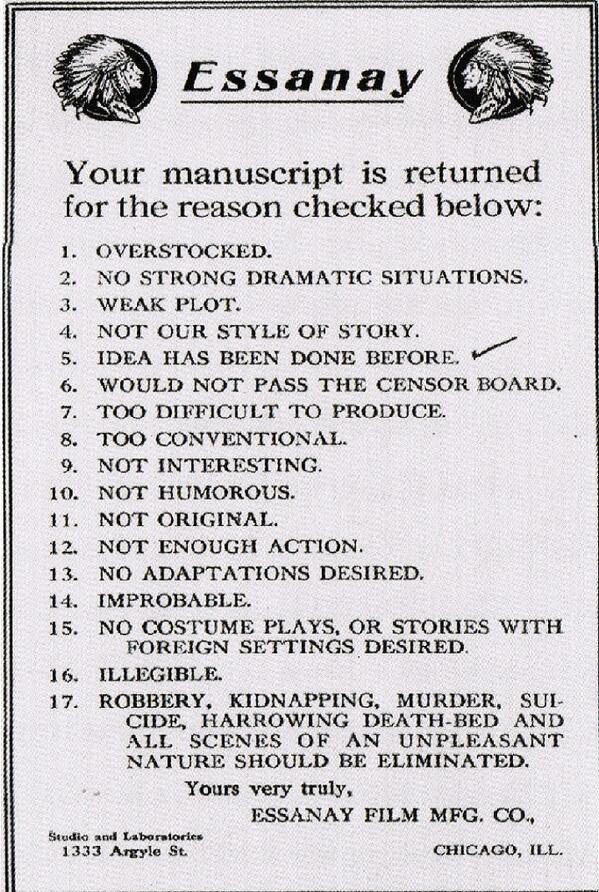
Born during the era of silent movies, the Essanay Film Manufacturing Company produced a series of Charlie Chaplin films in 1915, most notably including The Tramp. The Essanay document above shows us one thing: It didn’t take long for the film industry to master the cold rejection letter. Filmmakers could pour their heart and soul into writing a script. And what did they get in return? A list of 17 possible reasons to reject a manuscript, with a deflating check mark next to a particular item. That’s it. No further explanation offered.
Essanay closed in 1925, probably to the delight of some. You can still find some of Essanay’s films in our collection of 65 Free Charlie Chaplin Films Online.
If you would like to support the mission of Open Culture, consider making a donation to our site. It’s hard to rely 100% on ads, and your contributions will help us continue providing the best free cultural and educational materials to learners everywhere. You can contribute through PayPal, Patreon, and Venmo (@openculture). Thanks!
Related Content:
Gertrude Stein Gets a Snarky Rejection Letter from Publisher (1912)
Read Rejection Letters Sent to Three Famous Artists: Sylvia Plath, Kurt Vonnegut & Andy Warhol
No Women Need Apply: A Disheartening 1938 Rejection Letter from Disney Animation
Read More...MoMA’s Artists’ Cookbook (1978) Reveals the Meals of Salvador Dalí, Willem de Kooning, Andy Warhol, Louise Bourgeois & More
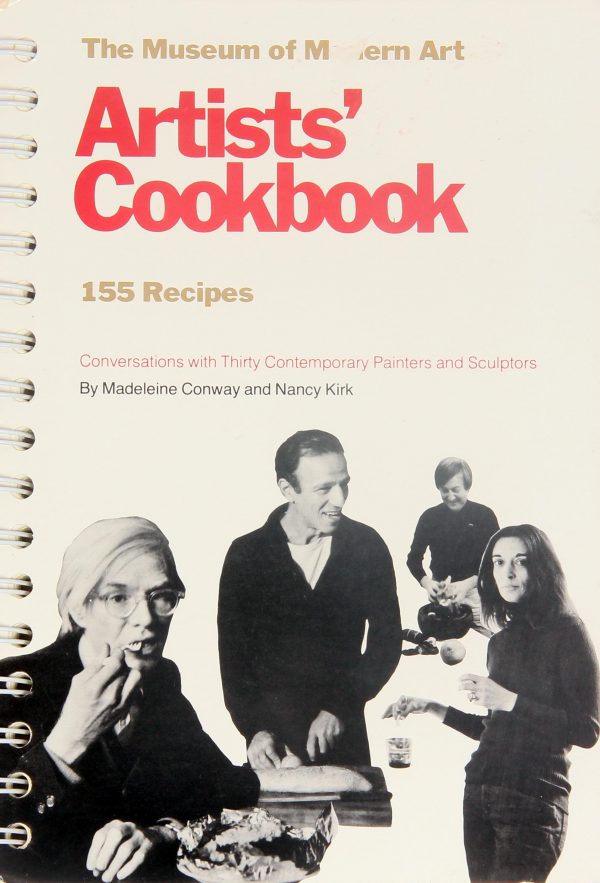
If we can consider some cooks artists, surely we can consider some artists cooks. Madeleine Conway and Nancy Kirk surely operated on that assumption when they put together The Museum of Modern Art Artists’ Cookbook, which collects 155 recipes from 30 such figures not primarily known for their culinary acumen as Salvador Dalí, Willem de Kooning, Louise Bourgeois, Andy Warhol, Helen Frankenthaler, Roy Lichtenstein, and Christo and Jeanne-Claude. (“Strangely,” write the wags at Phaidon, “there are no wraps.”)
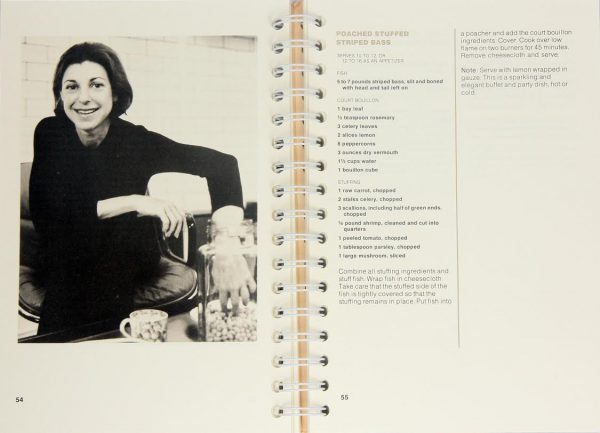
Published in 1978, the Artists’ Cookbook has long since left print, though pricey second-hand copies of the MoMA-issued edition and somewhat more affordable copies of the spiral-bound trade edition still circulate: Nick Harvill Libraries, for instance offers one for $125.
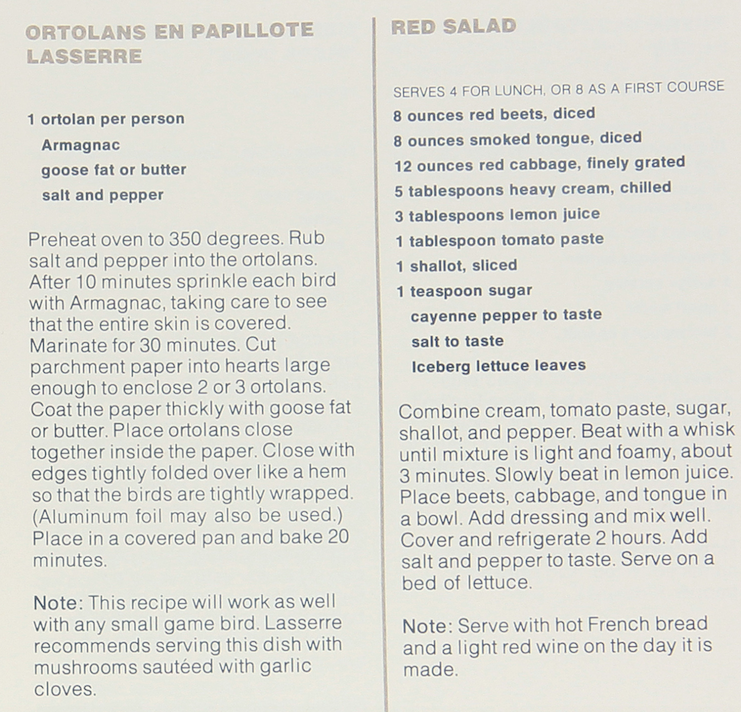
“Simplicity is a recurring theme,” says their site of the recipes contained within, which include Dalí’s red salad, de Kooning’s seafood sauce, Bourgeois’ French cucumber salad, Andy Warhol’s perhaps predictable boiling method for Campbell’s canned soup, Frankenthaler’s poached stuffed striped bass, Lichtenstein’s not entirely serious “primordial soup” (involving “8cc hydrogen” and “5cc ammonia”), and Christo and Jeanne-Claude’s complete “quick and easy filet mignon dinner party.”
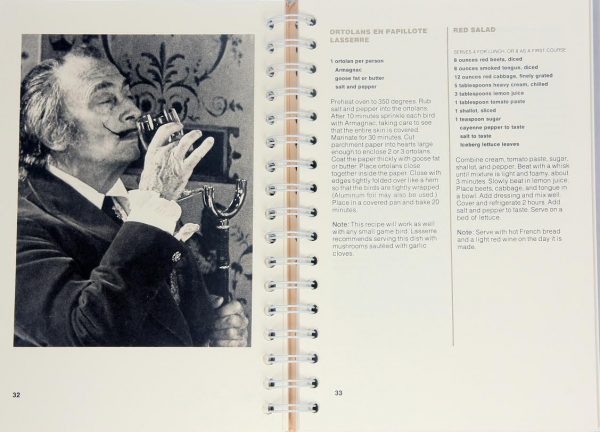
Taken as a whole, the project captures not just a distinctive moment in American culture when you could publish a cookbook with pretty much any theme — we’ve previously featured Dalí’s own, which came out in 1973, and the rock-star-oriented Singers & Swingers in the Kitchen, from 1967 — but an equally distinctive moment, and place, in American art. MoMA, as you might expect, brought in the artists with whom they had the closest connections, which in the mid-1970s meant a particularly influential couple of generations who mostly rose to prominence, and stayed in prominence, in New York City.
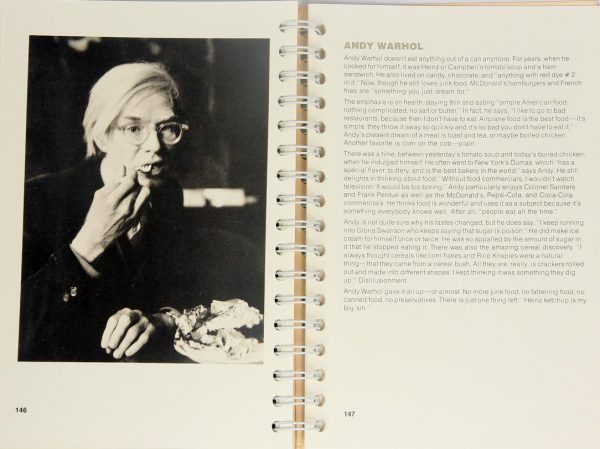
That’s not to say that the contributors to The Museum of Modern Art Artists’ Cookbook were born into the art world. Brain Pickings’ Maria Popova quotes excerpts of the book’s interviews with the artists about their early culinary lives: Bourgeois rues the “wasted hours” spent cooking for her father (“in those days a man had the right to have his food ready for him at all times.” De Kooning recalls his childhood in poverty in Holland where, “when you had dinner, it was always brown beans.” Dalí and Warhol put their eccentricities on display, the former with his all-white table (“white porcelain, white damask, and white flowers in crystal vases”) and the latter with his declaration that “airplane food is the best food.” De gustibus, as they say in food and art alike, non disputandum est.
Related Content:
Salvador Dalí’s 1973 Cookbook Gets Reissued: Surrealist Art Meets Haute Cuisine
The Jean-Paul Sartre Cookbook: Philosopher Ponders Making Omelets in Long Lost Diary Entries
Alice B. Toklas Reads Her Famous Recipe for Hashish Fudge (1963)
Ernest Hemingway’s Summer Camping Recipes
Leo Tolstoy’s Family Recipe for Macaroni and Cheese
1967 Cookbook Features Recipes by the Rolling Stones, Simon & Garfunkel, Barbra Streisand & More
An Archive of 3,000 Vintage Cookbooks Lets You Travel Back Through Culinary Time
Based in Seoul, Colin Marshall writes and broadcasts on cities and culture. He’s at work on a book about Los Angeles, A Los Angeles Primer, the video series The City in Cinema, the crowdfunded journalism project Where Is the City of the Future?, and the Los Angeles Review of Books’ Korea Blog. Follow him on Twitter at @colinmarshall or on Facebook.
Read More...The 4′33″ App Lets You Create Your Own Version of John Cage’s Classic Work

Image via iTunes
John Cage’s 4’33” is one of the most infamous works of the 20th century and which still has the ability to divide people. Three movements of silence, where the performer does nothing, it forces the audience to listen to its surroundings and be present, a distillation of zen thought if there ever was one. In an increasingly distracted age, being silent and present is very difficult for most people. A Mental Floss article on the piece’s legacy referenced a 2014 University of Virginia study where hundreds of people sat in silence for a total of 15 minutes. “25 percent of women and 67 percent of men opted to endure painful electric shocks rather than pass the time without any stimulation,” says the article.
Two years ago, the John Cage Trust launched the 4’33” app, which sounds counterintuitive. How can a phone app make one present?
Well, it doesn’t exactly do that. Instead, it offers a chance for members to record and share their own “performances” of Cage’s famous piece, once again demonstrating Cage’s result-—there is no real silence. (Even in 1951, one year before 4’33”’s composition, when Cage sat in a sound deadening anechoic chamber in Harvard, he could still hear the blood rushing in his veins.)

The iPhone app, which costs 99 cents, is simple and comes with a recording of the piece from John Cage’s New York apartment, which highlights the traffic sounds and police sirens. Tap on the “World of 4’33”” button at the bottom and a world map opens, showing green pushpins in various locations where users recorded their own moments of silence. (The project is similar to the 2008 internet project of field recordings, “One Minute Vacation”).
One user’s Kaloli, Hawaii recording is all tropical insects and birds busy composing their own music. The one somebody recorded downtown in my home city is of our shopping mall at Christmas, with pedestrians, far off carols, and the sounds of commerce. In Japan, there’s a lovely recording of Chitose airport, especially if you find echoey tannoy announcements romantic (I do). From urban to suburban to countryside, this is a portrait of a world that is never silent.
Related Content:
John Cage’s Silent, Avant-Garde Piece 4’33” Gets Covered by a Death Metal Band
John Cage Performs His Avant-Garde Piano Piece 4’33” … in 1’22” (Harvard Square, 1973)
Ted Mills is a freelance writer on the arts who currently hosts the FunkZone Podcast. You can also follow him on Twitter at @tedmills, read his other arts writing at tedmills.com and/or watch his films here.
Read More...The U.S. National Archives Launches an Animated GIF Archive: See Whitman, Twain, Hemingway & Others in Motion
Does it matter to you if some people insist on pronouncing GIF with a hard “g” rather than saying “Jiff,” as if they were telling you when they’d get back from the store? (I freely admit, I’m one of those people.) Well then, you, reader, certainly belong to a core audience for the National Archives and Records Administration’s online library of animated “jiffs.” Clearly NARA knows the correct pronunciation, since they announce their new collection with the dated pun “Getting’ Giphy With It.” And they know what the internet needs most from them in times like these: “quality animated GIFs from a reputable source.”
NARA’s archive of jerky, silent, digital moving pictures resides at their GIPHY channel, and contains an “animated history of all flavors including major historic events, celebrities, National Parks, newsreels, animated patents, dancing sailors,” etc…
“… wait, what’s that?,” you say, “animated patents”? Yes. Admittedly, not all of the collection’s GIFs make the quippiest of reaction shots. The archive does, as Allison Meier writes at Hyperallergic, “tell US history in motion.” But animated images of static photos—some dating from before the days of animation—tend to look a little stiff, as in the GIF below, made from two different exposures of a Walt Whitman portrait. Or the already exceedingly stiff portrait further down of a young Mark Twain and friend.
Meier compares these GIF anachronisms to the New York Public Library’s “Stereogranimator,” a neat online tool that allows us to experience a 19th century mechanical version of the GIF. In that regard, they join antiquarian interest with digital curiosity. But when we think of animated GIFs, we generally think of weird little vignettes, like the image at the top, which shows us architect William Van Alen dressed as his famous Chrysler Building, from a 1931 gathering of the Society of Beaux-Arts Architects (which we’ve featured in a previous post).
You’ll find plenty of nostalgic GIFS, such as (if you’re a GenX’er) that of Woody the “Give a Hoot, Don’t Pollute” public service owl, above.
Naturally, the archive contains its share of images with world historical significance—like the exploding swastika in Nuremberg from the end of World War II, above—and cultural significance, such as the tippling Hemingway and boyish Beatles, below.
Scenes from classic films and TV shows, advertisements and public service campaigns… the resource “currently has over 150 NARA GIFs,” writes Meier, “with more continuing to be added.” Is this a publicity stunt? Absolutely. “GIFs help keep us relevant,” remarks Darren Cole of the National Archives, “but also further the agency’s mission of providing access to our holdings to the public.”
In light of the popularity of “history image accounts” on social media, notes Meier, the NARA GIFs “are a savvy initiative to connect a wider audience with the richness of the National Archives”—a way that allows users to accurately document sources and place images in context. Each GIF on the NARA channel links back to the National Archives Catalog, with various levels of description and sourcing information. Gimmick or no, it’s a pretty cool resource full of some pretty cool GIFs—even, believe it or not, those “animated patents.”
Related Content:
Some of Buster Keaton’s Great, Death-Defying Stunts Captured in Animated Gifs
Josh Jones is a writer and musician based in Durham, NC. Follow him at @jdmagness
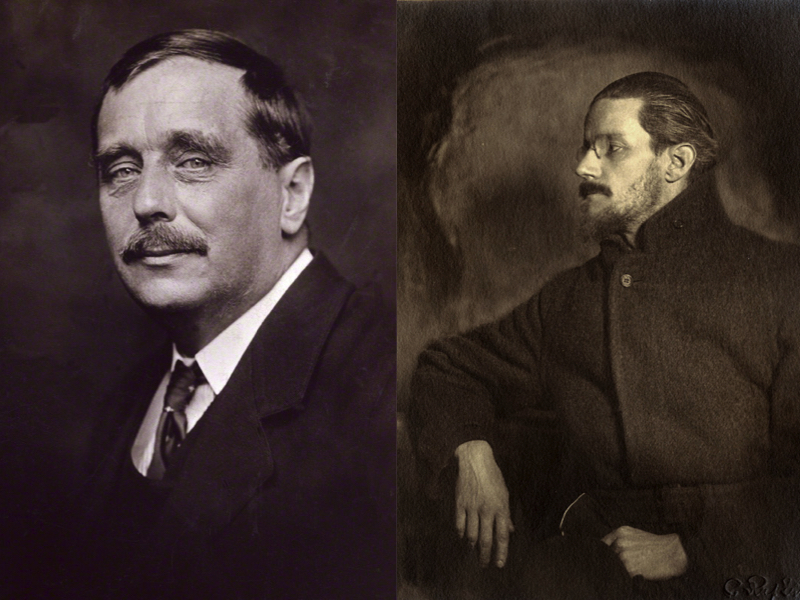
Read More...H.G. Wells Reads Finnegans Wake & Tells James Joyce: It’s “A Dead End,” “You Have Turned Your Back on Common Men” (1928)
Images via Wikimedia Commons
I first heard the phrase “terminal aesthetic” in a class on T.S. Eliot and Ezra Pound, who collaborated on the final version of Eliot’s post World War I edifice, The Waste Land. That poem, went the argument, traveled so far out on the edge, with its fragmented language and incongruous literary and historical references, that it couldn’t possibly serve as a basis for new forms of writing. Instead, Eliot had walked to the end of a promontory, and planted a flag to mark a creative and, perhaps, spiritual dead end.
I’m not sure I agree, but the idea has always fascinated me, that a work of art could be so rarified, so ahead of its readers, so idiosyncratic, inaccessible, and strange, that it might escape all attempts at imitation and domestication. There may be no greater example of such a project than James Joyce’s final work, Finnegans Wake. For all the admiration and obsession it has inspired, for the many artists who have learned from this strange book (including, notably, A Clockwork Orange’s Anthony Burgess), it remains for nearly all of us, in the words of H.G. Wells, a repository of “vast riddles.”
Wells wrote to Joyce in 1928, regarding what was then simply known as the Irish author’s “Work in Progress.” Excerpts were just then appearing piecemeal in journals and being “passed around in literary circles,” writes Letters of Note,” to a largely baffled audience.” It seems that Wells had been asked—perhaps by Joyce himself—to offer public comment or a blurb of some sort. He declined. “I’ve been studying you and thinking over you a lot,” he begins. “The outcome is that I don’t think I can do anything for the propaganda of your work.”
Wells professes a “great personal liking” for Joyce, but then details the “absolutely different courses” their lives and thought had taken: “Your mental existence is obsessed by a monstrous system of contradictions,” Wells writes, and elaborates with some distaste on Joyce’s scatological and theological obsessions. Then he turns to the work at hand, which would become Finnegans Wake:
Now with regard to this literary experiment of yours. It’s a considerable thing because you are a very considerable man and you have in your crowded composition a mighty genius for expression which has escaped discipline. But I don’t think it gets anywhere. You have turned your back on common men — on their elementary needs and their restricted time and intelligence… What is the result? Vast riddles. Your last two works have been more amusing and exciting to write than they will ever be to read. Take me as a typical common reader. Do I get much pleasure from this work? … No. So I ask: Who the hell is this Joyce who demands so many waking hours of the few thousand I have still to live for a proper appreciation of his quirks and fancies and flashes of rendering?
A fair enough question, I suppose, and fair enough critique—one we might expect from the self-described “scientific, constructive” mind of Wells. “To me,” he writes, “it is a dead end.”
Finnegans Wake continues to baffle and frustrate contemporary readers, and writers like Michael Chabon, who once described it as “hulking, chimerical, gibbering to itself in an outlandish tongue, a frightening beast out of legend.” Does Finnegans Wake speak to us common readers, or does it “gibber” only to itself, leaving the rest of us behind? Like Ulysses, it’s best to traverse the book with a guide. Burgess has written a few (and has even audaciously abridged the novel). We must also remember that Finnegans Wake is as much about sound as sense, and should be heard as well as read. (Hear Joyce himself read from the novel here.)
Then there are the “fractal” explications of the novel, like Terrence McKenna’s and that of a recent scientific study of its “multifractality.” I doubt any of this would have moved Wells, who demanded a clarity of thought and expression that was anathema to the later Joyce, immersed as he was in a project to disassemble the roots and branches of language and history and repurpose them for his own means. For all his puzzlement over Joyce’s “experiment,” however, Wells does seem to have found exactly the right word to capture Joyce’s radical literary aims, describing the writer of Ulysses and the inscrutable Finnegans Wake as “insurrectionary.”
Read Wells’ full letter at Letters of Note, who also bring us a letter from a “Vladimir Dixon,” written in imitation of Finnegans Wake, and possibly penned by Joyce himself.
Related Content:
James Joyce Reads ‘Anna Livia Plurabelle’ from Finnegans Wake
Hear All of Finnegans Wake Read Aloud: A 35 Hour Reading
H.G. Wells Pans Fritz Lang’s Metropolis in a 1927 Movie Review: It’s “the Silliest Film”
Josh Jones is a writer and musician based in Durham, NC. Follow him at @jdmagness
Read More...John Cleese & Jonathan Miller Turn Profs Talking About Wittgenstein Into a Classic Comedy Routine (1977)
Everyone interested in philosophy must occasionally face the question of how, exactly, to define philosophy itself. You can always label as philosophy whatever philosophers do — but what, exactly, do philosophers do? Here the English comedians John Cleese of Monty Python and Jonathan Miller of Beyond the Fringe offer an interpretation of the life of modern philosophers in the form of a five-minute sketch set in “a senior common room somewhere in Oxford (or Cambridge).”
There, Cleese and Miller’s philosophers have a wide-ranging talk about Ludwig Wittgenstein, senses of the word “yes,” whether an “unfetched slab” can be said to exist, and the very role of the philosopher in this “heterogeneous, confusing, and confused jumble of political, social, and economic relations we call society.” They come to the tentative conclusion that, just as others drive buses or chop down trees, philosophers “play language games” — or perhaps “games at language” — “in order to find out what game it is that we are playing.”
As intentionally ridiculous as that explanation may sound, it wouldn’t come across as especially outlandish in many philosophy-department common rooms today. Cleese and Miller, no strangers to playing their own kinds of language games, get laughs not so much from mocking the nonsensical complexities of philosophy — and indeed, most of their lines make perfect sense on one level or another — as they do from so vividly expressing the distinctive manner of the “Oxbridge Philosopher” characters they portray. It has everything to do with manner, both verbal and physical, taken to as absurd an extreme as their lines of thinking.
Cleese and Miller’s version of the Oxbridge Philosopher sketch here comes from the 1977 Amnesty International benefit show and television special An Evening Without Sir Bernard Miles (also known as The Mermaid Frolics), but others exist. It goes at least as far back as Beyond the Fringe’s days pioneering their hugely influential brand of British satire on the stage in the 1960s; their earlier performance just above features Miller and fellow troupe member Alan Bennett. It can still make us laugh today, but we might well wonder whether anyone in the history of humanity has ever really sounded like this — in which case, we should watch footage of real-life Oxford philosophers back in those days and judge for ourselves.
Related Content:
Atheism: A Rough History of Disbelief, with Jonathan Miller
Based in Seoul, Colin Marshall writes and broadcasts on cities and culture. He’s at work on a book about Los Angeles, A Los Angeles Primer, the video series The City in Cinema, the crowdfunded journalism project Where Is the City of the Future?, and the Los Angeles Review of Books’ Korea Blog. Follow him on Twitter at @colinmarshall or on Facebook.
Read More...Support Us
We're hoping to rely on loyal readers, rather than erratic ads. Please click the Donate button and support Open Culture. You can use Paypal, Venmo, Patreon, even Crypto! We thank you!

About Us

Open Culture scours the web for the best educational media. We find the free courses and audio books you need, the language lessons & educational videos you want, and plenty of enlightenment in between.
Advertise With Us

FREE UPDATES!
GET OUR DAILY EMAIL
Get the best cultural and educational resources on the web curated for you in a daily email. We never spam. Unsubscribe at any time.
FOLLOW ON SOCIAL MEDIA

Open Culture editor Dan Colman scours the web for the best educational media. He finds the free courses and audio books you need, the language lessons & movies you want, and plenty of enlightenment in between.
Advertise With Us


