How to Fill the Blank Page: Advice from Jonathan Franzen, Margaret Atwood, David Mitchell & 5 Other Authors
A couple months ago we featured a video of eight writers on how to face the blank page produced by Denmark’s Louisiana Museum of Modern Art. (And if you should ever find yourself in Copenhagen with time for a bit of a train ride, I do recommend a visit to the museum itself.) Now, Louisiana has released eight separate videos, each offering one notable writer’s viewpoint on that scariest of all confrontations in their profession. But as The Corrections and Freedom author Jonathan Franzen puts it, “the blank page in the mind has to be filled before you have the courage to face the actual blank page.”
“If you say, ‘I want to write,’ and turn on the computer and look at the blank page, it’s over. It’s not going to happen,” says the man who somehow manages to turn out his weighty, American-zeitgeist-capturing novels faster as the years go by. “It’s when you have had a thought in the shower before, you’ve woken in the middle of the night, and suddenly you have a sentence or two — you have something. You’ve already written it in your mind.” In contrast, the even more experienced and prolific Margaret Atwood, author of The Handmaid’s Tale and Oryx and Crake, sees “something compelling about the blank page that beckons you in to write something on it. It must be filled,” whether or not you’ve filled your mind already.
She likens this phenomenon to “an invitation, but it’s an invitation to something like going swimming in a very cold lake. So you approach it in a similar fashion: you put your toe in, you change your mind, ‘Maybe I won’t do that,’ you put your foot in, ‘Really, do I want to do that?’ You come back, and finally you just run screaming and you plunge in. Unless you plunge in, you’re never going to begin.” The immensely imaginative number9dream and Cloud Atlas author David Mitchell uses a different metaphor: “A blank page is a door. It contains infinity, like a night sky with a supermoon really close to the Earth, with all the stars and the galaxies you can see — it’s very, very clear, maybe at a high altitude. You know how that just makes your heart beat faster?”
If that image doesn’t get you writing, Mitchell has another: “A slightly overweight, bald boss saying, “It’s time to work. Get to work, come on. You’re supposed to be a writer, aren’t you? You can’t just sit around on your fat arse waiting to be inspired, waiting for creativity. You’re stuck? Fine. Why are you stuck? Why isn’t this working? Why can’t you push on with this scene? What are you trying to hold on to what just isn’t working here? Be more honest.’ ” Have a look at the series’ entire playlist (embedded above), which also features Joyce Carol Oates, Lydia Davis, and others, and you’ll find as many strategies for battling the blank page as writers who win that battle. Whether you use ideas thought up in the shower, plunge straight into the lake, or stare up at the night sky or a bothersome boss, only one thing matters: that your page ends up with some words on it.
Related Content:
Stephen King Creates a List of 96 Books for Aspiring Writers to Read
The Daily Habits of Famous Writers: Franz Kafka, Haruki Murakami, Stephen King & More
Ray Bradbury Gives 12 Pieces of Writing Advice to Young Authors (2001)
Based in Seoul, Colin Marshall writes and broadcasts on cities and culture. He’s at work on a book about Los Angeles, A Los Angeles Primer, the video series The City in Cinema, the crowdfunded journalism project Where Is the City of the Future?, and the Los Angeles Review of Books’ Korea Blog. Follow him on Twitter at @colinmarshall or on Facebook.
Read More...21 Artists Give “Advice to the Young:” Vital Lessons from Laurie Anderson, David Byrne, Umberto Eco, Patti Smith & More
Never meet your idols, they say. It can put a cramp in your appreciation of their work. There are always exceptions, but maybe Bill Murray proves the rule. On the other hand, you should always learn from your idols. There’s a reason you admire them, after all. Find out what it is and what they have to teach you. In the series we feature here, Advice to the Young, many an idol of many an aspiring artist and musician offers some broad, existential advice—ways to absorb a little of their process.
Laurie Anderson, above, tells us to “be loose.” Widen our boundaries, “make it vague,” because “there are so many forces that are trying to push us in certain directions, and they’re traps…. Don’t be caught in that trap of definition. It’s a corporate trap…. Be flexible.” Good advice, if you’re as eclectic and loose as Laurie Anderson, or if you seek artistic liberation ahead of sales. “I became an artist because I want to be free,” she says.
Just above, Daniel Lanois, superstar slide guitarist and producer of Bob Dylan, Neil Young, U2, Peter Gabriel, and Emmylou Harris, tells us what he learned from working with Brian Eno. His advice is impressionistic, alluding to the importance of atmosphere and environment, as one might expect. It’s about appreciating the process, he suggests. He does get concrete about a difficulty nearly every artist faces: “if you have a financial limitation, that might be okay. You don’t have to have everything that the other people have. I think a financial limitation or a technological limitation may free up the imagination.” In an age of home studios, that’s always welcome news.
David Byrne has always told it straight, in his cultural criticism and songwriting, and in his segment, above, he steers hopeful musicians and artists away from the dream of Jay Z‑level fame. “Often the artists who are very successful that way” he says, “they don’t have much flexibility. In achieving success, they lose a little bit of their creative freedom. They have to keep making the same thing over and over again.” Byrne’s advice solidly underlines Anderson’s. If you want creative freedom, be prepared to fly under the radar and make much less money than the stars. Ending on a starkly realist note, Byrne admits that in any case, you’ll probably need a day job: “it’s very, very hard to make money in the music business.”
Novelist Umberto Eco also brings us down to earth in his interview, saying “not to think you are inspired,” then slyly dropping a cliché: “genius is 10% inspiration and 90% perspiration.” The old wisdom is truest, I suppose. He also urges writers to take their time with a book. “I cannot understand those novelists who publish a book every year. They lose this pleasure of spending six, seven, eight years to tell a story.” Eco’s advice: rise through the ranks, “go step by step, don’t pretend immediately to receive the Nobel prize, because that kills a literary career.”
Patti Smith, comfortably addressing an audience from an outdoor stage, urges them to “just keep doing your work” whether anyone’s listening, reading, etc. To those people who criticize her success as selling out her punk rock roots, Smith says, to laughs, “fuck you.” She then transmits some advice she received from William S. Burroughs: “build a good name. Keep your name clean. Don’t’ make compromises, don’t worry about making a lot of money or being successful; be concerned with doing good work.”
Easy perhaps for Burroughs the adding machine-heir to say, but good advice nonetheless, and consistent with what each artist above tells us: do it your way, don’t get pigeonholed, work with what you have, don’t worry about success or money, keep your expectations realistic.
You can watch more interviews with Marina Abramović, Wim Wenders, Jonas Mekas, and many more on this Advice to the Young playlist assembled by The Louisiana Channel. All 21 talks in the series can be viewed below:
Related Content:
Ray Bradbury Gives 12 Pieces of Writing Advice to Young Authors (2001)
John Cleese’s Advice to Young Artists: “Steal Anything You Think Is Really Good”
Ursula Le Guin Gives Insightful Writing Advice in Her Free Online Workshop
Akira Kurosawa’s Advice to Aspiring Filmmakers: Write, Write, Write and Read
Josh Jones is a writer and musician based in Durham, NC. Follow him at @jdmagness
Read More...Free Audio Book: Joseph Conrad’s Heart of Darkness, Read by British Actor Hayward Morse

Selected by the Modern Library as one of the 100 best novels of all time, Joseph Conrad’s Heart of Darkness was originally published as a three-part serial story in Blackwood’s Magazine in 1899, then later as a novella in the 1902 collection Youth: A Narrative; and Two Other Stories. A complex and controversial “meditation on colonialism, evil, and the thin line between civilization and barbarity,” Heart of Darkness gained literary stature during the 1950s and 1960s, before peaking in the late 1970s–precisely around when Francis Ford Coppola released Apocalypse Now, a film loosely based on Conrad’s tale. What halted the novella’s momentum was a stinging rebuke from Chinua Achebe, father of modern African literature, who criticized the way it “projects the image of Africa as ‘the other world,’ the antithesis of Europe and therefore of civilization…”
Despite the controversies surrounding the text, Heart of Darkness remains widely read in American high schools and universities. And, notes Harold Bloom, it has “had a striking influence on writers, artists, and thinkers from all over the globe.” Below, you can listen to a reading of Heart of Darkness by British stage and voice actor Hayward Morse. It’s free on Spotify and will be added to our list, 1,000 Free Audio Books: Download Great Books for Free. In November, Kenneth Branagh will release his own version–which you can download for free if you join Audible.com’s 30 free trial program. Other free readings of Conrad’s novella can be found on Librivox.
Related Content
Orson Welles Turns Heart of Darkness Into a Radio Drama, and Almost His First Great Film
800 Free eBooks for iPad, Kindle & Other Devices
Read More...The Incredibly Strange Film Show: Revisit 1980s Documentaries on David Lynch, John Waters, Alejandro Jodorowsky & Other Filmmakers
Every filmmaker, no matter how mainstream or underground, has to get the inspiration to become a filmmaker somewhere. “I used to watch the programme Jonathan Ross did in the late 80s called The Incredibly Strange Film Show and they did a whole hour on Sam Raimi,” remembers Shaun of the Dead and Scott Pilgrim vs. the World director Edgar Wright, who in those days couldn’t imagine what it took to enter the impossibly distant world known as Hollywood. “I definitely hadn’t seen The Evil Dead as it was banned on video at the time – but I saw the Jonathan Ross documentary and I was staggered. I thought, ‘That’s what I want to do.’ ”
Although the show only ran 12 episodes, The Incredibly Strange Film Show featured documentaries on not just Sam Raimi but David Lynch, John Waters, Alejandro Jodorowsky, and other directors with filmographies as distinctive as their personalities. (You’ll find other episodes on this Youtube playlist.) Ross and his team go all out, interviewing not just the auteurs behind Eraserhead, Pink Flamingos, and The Holy Mountain themselves but their friends, family members, and collaborators in various locations important to their work and their lives. (Ross even takes the step of dressing like his subjects, buttoning his shirt all the way up in the Lynch episode and so on.)
The Incredibly Strange Film Show originally aired in 1988 and 1989, but after decades of celebration in cinema culture, does the work of the likes of Lynch, Waters, and Jodorowsky still count as “incredibly strange”? Their movies certainly do endure, but not by sheer oddity alone. We’ve seen plenty of stranger or more extreme images than theirs committed to celluloid in the years since, but we’ve arguably seen far fewer equally coherent and personal visions successfully make the transition from obscurity to influence. These elder statesmen of famous fringe film, in other words, each in his own way made the zeitgeist itself a little more incredibly strange. Long may that achievement inspire.
Related Content:
Moviedrome: Filmmaker Alex Cox Provides Video Introductions to 100+ Classic Cult Films
David Lynch Presents the History of Surrealist Film (1987)
Based in Seoul, Colin Marshall writes and broadcasts on cities and culture. He’s at work on a book about Los Angeles, A Los Angeles Primer, the video series The City in Cinema, the crowdfunded journalism project Where Is the City of the Future?, and the Los Angeles Review of Books’ Korea Blog. Follow him on Twitter at @colinmarshall or on Facebook.
Read More...Hear Steve Reich’s Minimalist Compositions in a 28-Hour Playlist: A Journey Through His Influential Recordings
If you’re of a certain vintage, you may at various times have grooved to The Orb’s chill-out classic “Little Fluffy Clouds,” the spaced-out soundscapes of DJ Spooky, the avant-psych of Sonic Youth, the locked grooves of Tortoise, the bubbling fugues of Björk, or the ominous rumblings of postrock godfathers Godspeed You! Black Emperor. And if so, you very likely know at least some of the work of minimalist composer Steve Reich, which these artists either sampled or drew on for musical inspiration. Like many of his avant-garde colleagues, Reich has “influenced generations of pop, jazz and classical musicians over the last half-century,” writes Tom Service at The Guardian.
While many artists mention minimalists like Terry Riley, Philip Glass, or John Cage as seminal influences, few of those composers have been as directly woven into the fabric of modern music through collaboration, sampling, and remixing as Reich. Service goes so far as to speculate, “if you were to subtract Steve Reich from the total sum of today’s musical culture, I think you’d notice more of a difference than if you took away any other single figure.” That’s debatable—Reich’s influence on popular culture is oblique. But it does describe the degree to which his musical innovations have permeated experimental, indie, and electronic music and “given the contemporary musical world a license to groove” while still getting plenty heady and pushing conceptual boundaries.
Reich’s use of phasing effects, drone notes, polyrhythmic patterns, and “process music” lend each of his compositions a trance-like atmosphere that might be most familiar from his 1976 piece “Music for 18 Musicians” (top). Here, the “percussionists, string players, clarinetists, singers and pianists” create “an ever-changing, kaleidoscopic soundworld” that expands and augments all of Reich’s previous techniques for sculpting in time. If the piece sounds familiar, though you’ve never heard it before, that’s because of the thorough incorporation of Reich into so much modern music, including perhaps several dozen soundalike film scores and Brian Eno’s pioneering first manifestations of what came to be called ambient music.
Reich conceived of music as a “perceptible process,” writing in 1968, “I want to be able to hear the process happening throughout the sounding music… a musical process should happen extremely gradually.” Indeed, students of his music have found ways to take apart and duplicate those processes in their own work, something Reich, who has worked with remix artists and Radiohead, appreciates. (Just above, see Radiohead’s Johnny Greenwood perform a solo version of Reich’s Electric Counterpoint in 2011.) Like many of the artists he appreciates and inspires, much of Reich’s work deals directly with sociopolitical themes, as Service notes, including “the Holocaust, Middle Eastern history and politics, and contemporary conflict” like the beheading of American journalist Daniel Pearl.
In the Spotify playlist further up, you’ll find a broad sampling of performances of Reich’s lesser-known early work—like the 1965 tape loop piece “It’s Gonna Rain”—and more famous compositions like The Cave, Different Trains, Music for 18 Musicians, Electric Counterpoint, Drumming, Clapping Music, and much more. Just as we can hear the musical processes developing within each composition, we can hear the process of Reich’s development over the course of his career as he incorporates influences from Bach to Coltrane to the songs of Kid A. As a consequence of both his grooviness and his appeal to modernists of every decade, Reich, writes Ivan Hewett at The Telegraph, is “both achingly hip and a grand old man”—and a seemingly endless source of musical inspiration since the 1960s.
If you need Spotify’s free software, download it here. Below, you can see Reich talking about his most influential works in a CBC interview recorded earlier this year.
Related Content:
The Music of Avant-Garde Composer John Cage Now Available in a Free Online Archive
Josh Jones is a writer and musician based in Durham, NC. Follow him at @jdmagness
Read More...Aleister Crowley & William Butler Yeats Get into an Occult Battle, Pitting White Magic Against Black Magic (1900)
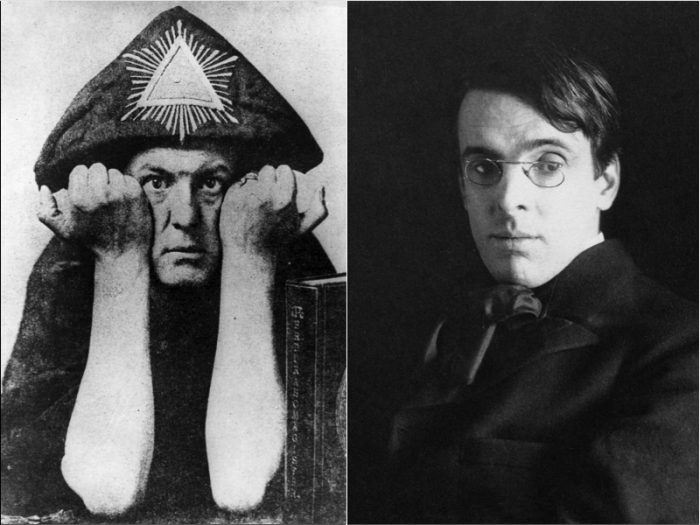
Aleister Crowley—English magician and founder of the religion of Thelema—has been admired as a powerful theorist and practitioner of what he called “Magick,” and reviled as a spoiled, abusive buffoon. Falling somewhere between those two camps, we find the opinion of Crowley’s bitter rival, the Irish poet William Butler Yeats, who once passionately wrote that the study of magic was “the most important pursuit of my life….. The mystical life is the center of all that I do and all that I think and all that I write.”
Crowley would surely say the same, but his magic was of a much darker, more obsessive variety, and his success as a poet insignificant next to Yeats. “Crowley was jealous,” argues the blog Rune Soup, “He was never able to speak the language of poetic symbol with the confidence of a native speaker in the way Yeats definitely could.” In a 1948 Partisan Review essay, literary critic and Yeats biographer Richard Ellmann tells the story differently, drily reporting on the conflict as its participants saw it—as a genuine war between competing forms of practical magic.
Having been ejected from the occult Theosophical society for his magical experiments, writes Jamie James at Lapham’s Quarterly, Yeats joined the Hermetic Order of the Golden Dawn, “an even more exotic cult, which claimed direct descent from the hermetic tradition of the Renaissance and into remote antiquity.” At various times, the order included writers Arthur Machen and Bram Stoker, Yeats’ beloved Irish revolutionary Maud Gonne, and famous magicians Arthur Edward Waite and Crowley. (Just below, see a page from Yeats’ Golden Dawn journal. See several more here.)
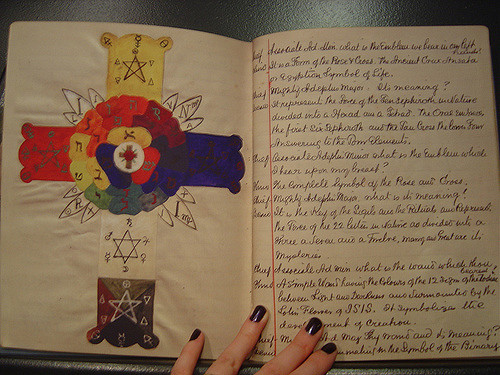
“When Crowley showed a tendency to use his occult powers for evil rather than for good,” Ellmann writes, “the adepts of the order, Yeats among them, decided not to allow him to be initiated into the inner circle; they feared that he would profane the mysteries and unleash powerful magic forces against humanity.” Crowley’s ouster lead to a confrontation in 1900 that might make you think—depending on your frame of reference—of the warring magicians on South Park or of Susanna Clark’s Jonathan Strange & Mr. Norrell, or both. “Crowley refused to accept their decision,” writes Ullmann, and after some astral attacks on Yeats,
.… in Highlander’s tartan, with a black Crusader’s cross on his breast… Crowley arrived at the Golden Dawn temple in London. Making the sign of the pentacle inverted and shouting menaces at the adepts, Crowley climbed the stairs. But Yeats and two other white magicians came resolutely forward to meet him, ready to protect the holy place at any cost. When Crowley came within range the forces of good struck out with their feet and kicked him downstairs.
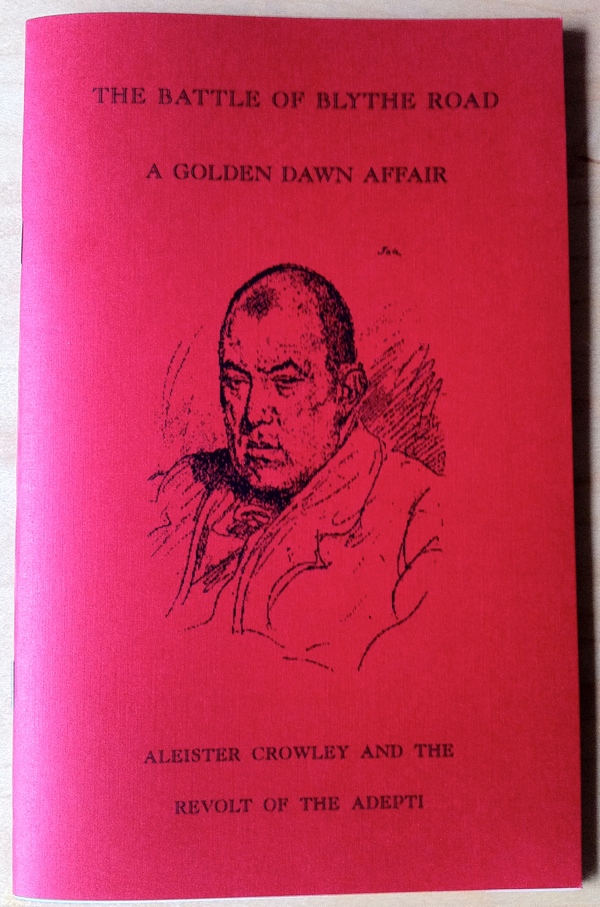
This almost slapstick vanquishing became known as “the Battle of Blythe Road” and has been immortalized in a publication of that very name, with accounts from Crowley, Yeats, and Golden Dawn adepts William Westcott, Florence Farr and others. But the war was not won, Ellmann notes, and Crowley went looking for converts—or victims—in London, while Yeats attempted to stop him with “the requisite spells and exorcisms.” One such spell supposedly sent a vampire that “bit and tore at his flesh” as it lay beside Crowley all night. Despite Yeats’ supernatural interventions, one of Crowley’s targets, a young painter named Althea Gyles, was “finally forced to give way entirely to his baleful fascination.”
Ellmann’s both humorous and unsettling narrative shows us Crowley-as-predator, a characterization the wealthy Englishman had apparently earned, as “responsible governments excluded him from one country after another lest he bring to bear upon their inhabitants his hostile psychic ray.” [Brenda Maddox at The Guardian gives a slightly different account of the Battle, in which “Yeats, with a bouncer, saw him off the premises, called in the police and ended up (victorious) in court.” ] Yeats and the other members’ distaste for Crowley surely had something to do with his predatory behavior. But the rivalry was also indeed a poetic one, albeit extremely one-sided.
As Crowley biographer Lawrence Sutin writes, “the earnestness of the young Crowley could not compensate, in Yeats’ mind, for the technical difficulties and rhetorical excesses of his verse.” Yeats’ opinion “infuriated Crowley,” who indulged in the magic of projection, writing “What hurt him [Yeats] was the knowledge of his own incomparable inferiority.” Crowley’s remarks are both “ridiculous,” Sutin comments, and apply “far more convincingly to Crowley himself.” Nevertheless, Crowley’s “Magick,” continued to make Yeats uneasy, and he may have invoked Crowley in his famous line about the “rough beast” slouching toward Bethlehem in 1919’s “The Second Coming.”
While the magical battle between them might provoke more laughter than curiosity about their different brands of magic, Sutin notes a crucial difference that distinguishes the two men: “whereas Crowley placed himself in the services of the Antichrist ‘the savage God’ of the new cycle, Yeats’s fidelity was to ‘the old king,’ to ‘that unfashionable gyre.’” The gyre, so central an image in “The Second Coming,” stands for Yeats’ theory of time and history, and it belongs to an old mysticism and folklore that for him were synonymous with poetry.
Crowley viewed the occult as a source of personal power—his revelations filled books devoted to explaining the philosophy of Thelema (“Do what thou wilt shall be the whole of the Law. Love is the law, love under will); ” Yeats was certainly more of an “organization man… in his occult activities,” writes Maddox, and sought to practice magic as a holistic activity, fully integrated into his social, political, and aesthetic life. His “public philosophy,” as he called it, writes James, “propounds an extraordinarily convoluted system that aims to integrate the human personality with the cosmos.”
To understand Crowley’s magical thinking, we can probably skip his poetry and attempt as best we can to the decipher his several arcane, technical books full of invented terms and symbols. To understand Yeats, as much as that’s possible, we need to read his poetry, the purest expression of his mystical system and symbolic thought.
Related Content:
Rare 1930s Audio: W.B. Yeats Reads Four of His Poems
W.B. Yeats’ Poem “When You Are Old” Adapted into a Japanese Manga Comic
Josh Jones is a writer and musician based in Durham, NC. Follow him at @jdmagness
Read More...Hear Bill Murray’s Favorite Poems Read Aloud by Murray Himself & Their Authors
I’d be wary of any movie star who invites me to his hotel room to “read poetry” unless said star was documented poetry nut, Bill Murray.
Earlier this year, Leigh Haber, book editor of O, The Oprah Magazine, reached out to Murray to see if he’d share some of his favorite poems in celebration of National Poetry Month. In true Murray-esque fashion, he waited until deadline to return her call, suggesting that they meet in his room at the Carlyle, where he would recite his choices in person.
Such celebrity shenanigans are unheard of at the Chateau Marmont!
Murray’s favorite poems:
“What the Mirror Said” by Lucille Clifton
At the top of the page, Murray reads the poem at a benefit for New York’s Poets House, adopting a light accent suggested by the dialect of the narrator, a mirror full of appreciation for the poet’s womanly body. Clifton said that the “germ” of the poem was visiting her husband at Harvard, and feeling out of place among all the slim young coeds. Thusly does Murray position himself as a hero to every female above the age of … you decide.
“Oatmeal” by Galway Kinnell
Kinnell, who sought to enliven a dreary bowl of oatmeal with such dining companions as Keats, Spenser and Milton, shared Murray’s playful sensibility. In an interview conducted as part of Michele Root-Bernstein’s Worldplay Project he remarked:
… it doesn’t seem like play at the time of doing it, but part of the whole construct of the work, and even though the work might be extremely serious and even morose, still there’s that element of play that is just an inseparable part of it.
“I Love You Sweatheart” by Thomas Lux
Murray told O, which incorrectly reported the poem’s title as “I Love You Sweetheart” that he experienced this one as a vibration on the inside of his ribs “where the meat is most tender.” It would make a terrific scene in a movie, and who better to play the lover risking his life to misspell a term of endearment on a bridge than Bill Murray?
“Famous” by Naomi Shihab Nye
Alas, we could find no footage of Nye reading her lovely poem aloud, but you can read it in full over at The Poetry Foundation. It’s easy to see why it speaks to Murray.
Related Content:
Bill Murray Reads Poetry at a Construction Site: Emily Dickinson, Billy Collins & More
Bill Murray Reads Great Poetry by Billy Collins, Cole Porter, and Sarah Manguso
Bill Murray Gives a Delightful Reading of Twain’s Huckleberry Finn (1996)
Bill Murray Reads Poetry at a Construction Site: Emily Dickinson, Billy Collins & More
Ayun Halliday is an author, illustrator, theater maker and Chief Primatologist of the East Village Inky zine. Her play Zamboni Godot is opening in New York City in March 2017. Follow her @AyunHalliday.
Read More...Henri Matisse Illustrates James Joyce’s Ulysses (1935)
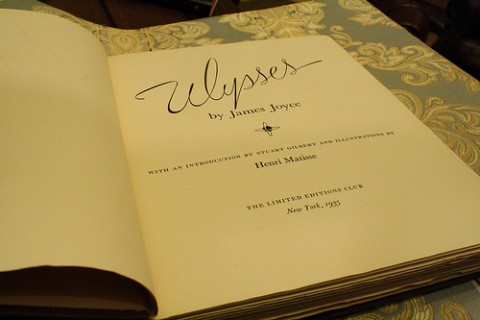
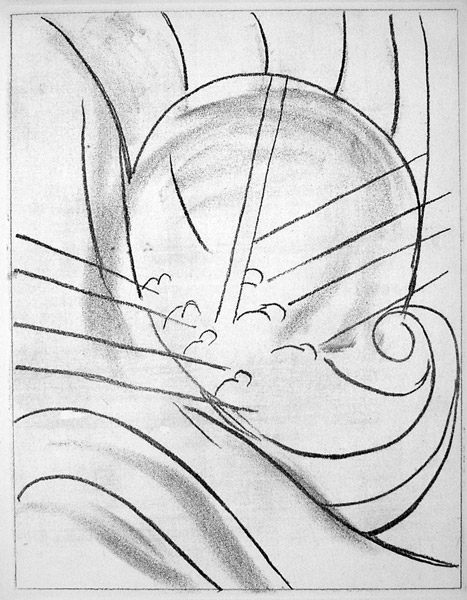
Last year, fans of modernist Irish literature and impressionist art saw a must-own volume go under the hammer at Bonhams. “In 1935 the French artist, Henri Matisse, was commissioned to illustrate an edition of Ulysses for subscribers to the Limited Edition Club in America,” announced Artlyst. “Each of the 1,000 copies was signed by Matisse and 250 were also signed by James Joyce. A copy of the book signed by both men is estimated at £6,000 to £8,000.”
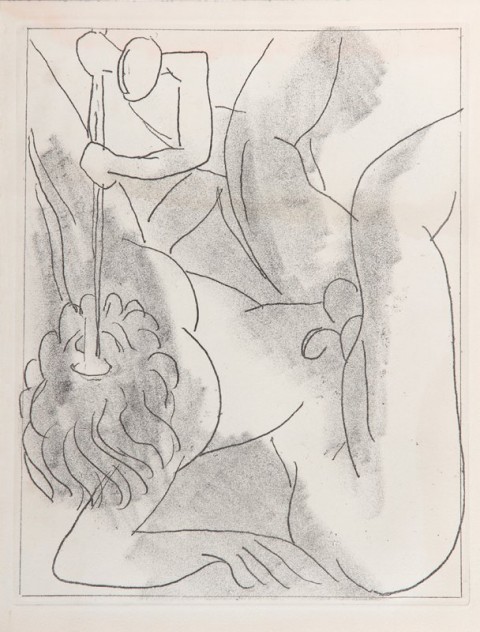
In the event it went for £6,250, not a bad deal considering the hands that wrote those signatures and the rarity, signed or unsigned, of this unusual book itself. (It certainly beats, say, $37,000.) Brainpickings’ Maria Popova writes that, after first spotting the Matisse-illustrated Ulysses here on Open Culture, “I gathered up my year’s worth of lunch money and was able to grab one of the last copies available online — a glorious leather-bound tome with 22-karat gold accents, gilt edges, moire fabric endpapers, and a satin page marker.” Versions signed by Matisse are apparently available–at a steep price–on Amazon.
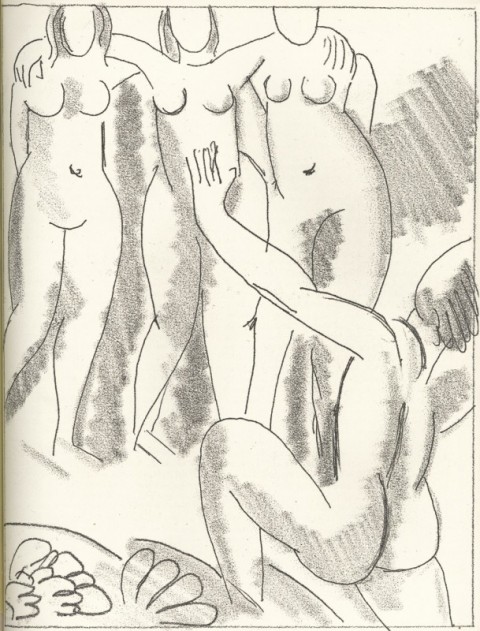
Popova adds that “the Matisse drawings inside it, of course, are the most priceless of its offerings — doubly so because, for all their beauty, they’re a tragicomedy of quasi-collaboration.” From whence the tragicomedy? Publishing lore has it that, despite the provision of a full French translation of the Ulysses text, Matisse made his illustrative etchings — in the fashion of many an undergraduate with a paper due — without ever having got around to reading the book himself.
“I’ve never ‘read’ Joyce’s Ulysses, and it’s quite plausible that I never will,” Matisse’s countryman Pierre Bayard would write seventy years later in his bestselling How to Talk About Books You Haven’t Read. Yet “I feel perfectly comfortable when Ulysses comes up in conversation, because I can situate it with relative precision in relation to other books. I know, for example, that it is a retelling of the Odyssey, that its narration takes the form of a stream of consciousness, that its action unfolds in Dublin over the course of a single day, etc.” — all things that Matisse, too, probably knew about Ulysses.

He certainly knew that it supposedly retold the story of the Odyssey, and so, in a now-ingenious-looking strategy to not just talk about an unread book but to illustrate it, he went to the source. Or rather, he went to one of the countless cultural, literary, historical, and linguistic sources upon which Joyce drew to compose his masterpiece, basing his art directly on Homer’s epic poem, in its own way a work more talked about than read. Joyce himself, who once described much of the textual content of Ulysses as intended to “keep the professors busy for centuries arguing over what I meant,” may well have admired Matisse’s clarity of vision, no matter how much-non reading it took to refine.
Related Content:
James Joyce’s Ulysses: Download as a Free Audio Book & Free eBook
Vladimir Nabokov Creates a Hand-Drawn Map of James Joyce’s Ulysses
Read Ulysses Seen, A Graphic Novel Adaptation of James Joyce’s Classic
Henri Matisse Illustrates Baudelaire’s Censored Poetry Collection, Les Fleurs du Mal
Vintage Film: Watch Henri Matisse Sketch and Make His Famous Cut-Outs (1946)
Based in Seoul, Colin Marshall writes and broadcasts on cities and culture. He’s at work on a book about Los Angeles, A Los Angeles Primer, the video series The City in Cinema, the crowdfunded journalism project Where Is the City of the Future?, and the Los Angeles Review of Books’ Korea Blog. Follow him on Twitter at @colinmarshall or on Facebook.
Read More...Periodic Table Battleship!: A Fun Way To Learn the Elements

Nitrogen.
Phosphorous.
Arsenic.
Milton Bradley’s classic board game, Battleship, can now be added to the roster of fun, creative ways to commit the Periodic Table of Elements to memory.
Karyn Tripp, a homeschooling mother of four, was inspired by her eldest’s love of science to create Periodic Table Battleship. I might suggest that the game is of even greater value to those who don’t naturally gravitate toward the subject.
Faced with the option of learning the elements via shower curtain or coffee mug osmosis, I think I’d prefer to take out an opponent’s submarine.
Rules of engagement are very similar to the original. Rather than calling out positions on a grid, players set their torpedoes for specific element names, abbreviations or coordinates. Advanced players might go for the atomic number. the lingo is the same: “hit,” “miss” and—say it with me—“you sunk my battleship!”
The winner is the player who wipes out the other’s fleet, though I might toss the loser a couple of reinforcement vessels, should he or she demonstrate passing familiarity with various metals, halogens, and noble gases.
To make your own Periodic Table Battleship set you will need:
4 copies of the Periodic Table (laminate them for reuse)
2 file folders
paper clips, tape or glue
2 markers (dry erase markers if playing with laminated tables
To Assemble and Play:
As you know, the Periodic Table is already numbered along the top. Label each of the four tables’ vertical rows alphabetically (to help younger players and those inclined to fruitless searching for the elements designated by their opponent)
Fasten two Periodic Tables to each folder, facing the same direction.
Uses markers to circle the position of your ships on the lower Table:
5 consecutive spaces: aircraft carrier
4 consecutive spaces: battleship
3 consecutive spaces: destroyer or submarine
2 consecutive spaces: patrol boat
Prop the folders up with books or some other method to prevent opponents from sneaking peeks at your maritime strategy.
Take turns calling out coordinates, element names, abbreviations or atomic numbers:
When a turn results in a miss, put an X on the corresponding spot on the upper table.
When a turn results in a hit, circle the corresponding spot on the upper table.
Continue play until the battle is won.
Repeat until the Table of Elements is mastered.
Supplement liberally with Tom Lehrer’s Elements song.
Those not inclined toward arts and crafts can purchase a pre-made Periodic Table Battleship set from Tripp’s Etsy shop.
Related Content:
Learn to Write Through a Video Game Inspired by the Romantic Poets: Shelley, Byron, Keats
Play Mark Twain’s “Memory-Builder,” His Game for Remembering Historical Facts & Dates
200 Free Kids Educational Resources: Video Lessons, Apps, Books, Websites & More
Ayun Halliday is an author, illustrator, theater maker, secular homeschooler and Chief Primatologist of the East Village Inky zine. Her play Zamboni Godot is opening in New York City in March 2017. Follow her @AyunHalliday.
Read More...Learn to Code with Harvard’s Popular Intro to Computer Science Course: The 2016 Edition
This fall, Harvard has been rolling out videos from the 2016 edition of Computer Science 50 (CS50), the university’s introductory coding course designed for majors and non-majors alike. Taught by David Malan, a perennially popular professor (you’ll immediately see why), the one-semester course (taught mostly in C) combines courses typically known elsewhere as “CS1” and “CS2.”
Even if you’re not a Harvard student, you’re welcome to follow CS50 online by heading over to this site here. There you will find video lectures (stream them all above or access them individually here), problem sets, quizzes, and other useful course materials. Once you’ve mastered the material covered in CS50, you can start branching out into new areas of coding by perusing our big collection of Free Online Computer Science Courses, a subset of our larger collection, 1,700 Free Online Courses from Top Universities.
If you would like to support the mission of Open Culture, consider making a donation to our site. It’s hard to rely 100% on ads, and your contributions will help us continue providing the best free cultural and educational materials to learners everywhere. You can contribute through PayPal, Patreon, and Venmo (@openculture). Thanks!
Related Content:
Free Textbooks: Computer Science
Free Online Computer Science Courses
Codecademy’s Free Courses Democratize Computer Programming
Read More...Support Us
We're hoping to rely on loyal readers, rather than erratic ads. Please click the Donate button and support Open Culture. You can use Paypal, Venmo, Patreon, even Crypto! We thank you!

About Us

Open Culture scours the web for the best educational media. We find the free courses and audio books you need, the language lessons & educational videos you want, and plenty of enlightenment in between.
Advertise With Us

FREE UPDATES!
GET OUR DAILY EMAIL
Get the best cultural and educational resources on the web curated for you in a daily email. We never spam. Unsubscribe at any time.
FOLLOW ON SOCIAL MEDIA

Open Culture editor Dan Colman scours the web for the best educational media. He finds the free courses and audio books you need, the language lessons & movies you want, and plenty of enlightenment in between.
Advertise With Us

