Hear Christopher Walken’s Wonderful Reading of Edgar Allan Poe’s “The Raven”
Christopher Walken, writes Arifa Akbar in the Independent, is a “sinister-looking man who has made a living from looking — and acting — sinister,” but he didn’t start out that way. His “career trajectory – starting benignly enough in children’s commercials, musicals, and dance – took a darker turn two years after his near-miss with Star Wars,” when he’d almost landed the Han Solo role that went to Harrison Ford. Instead he played “the emotionally decimated Vietnam veteran in Michael Cimino’s The Deer Hunter, and was immortalized in the ‘Russian roulette’ scene as a gaunt, bug-eyed madman aiming a shaking revolver to his own head. The role won him an Oscar and led to assembly-line casting in an array of deranged, demonic parts.”
Of course, when an actor becomes synonymous with a grim but artful intensity, he must sooner or later interpret the work of a writer synonymous with grim but artful intensity: Edgar Allan Poe. And so on this day, the 167th anniversary of Poe’s death under still-unexplained circumstances, we give you Walken’s performance of “The Raven.”
The 1845 poem stands today as Poe’s best-known work by far, as he seemed to intend: he wrote it, so he later claimed in a magazine essay, with “the intention of composing a poem that should suit at once the popular and the critical taste” and pack an emotional punch as well.
Walken, for his part, has variously appealed to both popular and critical tastes in the roughly 130 roles he has played over his sixty-year career, somehow earning both respect as a serious dramatic actor and almost instinctive audience laughter as a figure of fun. At his best, Walken’s darkness contains a lightness and his lightness a darkness, all of which you can hear in his nine-minute recitation, accompanied by music and sound effects, of the words of this nameless man tormented by a talking bird while pining for his lost love Lenore. If anybody can credibly stare into the abyss Poe’s work opens up, Christopher Walken can — after all, he knows what it means not to fear the reaper.
Related Content:
The Great Stan Lee Reads Edgar Allan Poe’s “The Raven”
Christopher Lee Reads Edgar Allan Poe’s “The Raven,” and From “The Fall of the House of Usher”
James Earl Jones Reads Edgar Allan Poe’s “The Raven” and Walt Whitman’s “Song of Myself”
Lou Reed Rewrites Edgar Allan Poe’s “The Raven.” See Readings by Reed and Willem Dafoe
John Astin, From The Addams Family, Recites “The Raven” as Edgar Allan Poe
Based in Seoul, Colin Marshall writes and broadcasts on cities and culture. He’s at work on a book about Los Angeles, A Los Angeles Primer, the video series The City in Cinema, the crowdfunded journalism project Where Is the City of the Future?, and the Los Angeles Review of Books’ Korea Blog. Follow him on Twitter at @colinmarshall or on Facebook.
Read More...Watch the Proto-Punk Band The Monks Sow Chaos on German TV, 1966: A Great Concert Moment on YouTube
Call them proto-punk, call them avant-garde, but the American ex-pat group the Monks would have been a tiny footnote in rock music history if it wasn’t for a slow rediscovery of the group’s work. The above video is from their summer 1966 appearance on Beat Club, a live pop music show broadcast in Germany.
Enthusiastic teens bop away to the repetitive stomp of “Monk Chant,” with its tribal drums from Roger Johnston, a multi-tamborine attack, and a solo section which features both Larry Clark’s manic organ and three band members attacking the strings of a prone guitar. There’s a sense that anything can happen. These guys are gleefully crazy. (On other songs, band member Dave Day Havliceck would further freak out audiences with his electric banjo.)
Neither ur-hippies nor beatniks, the guys behind the Monks were five American G.I.s who were stationed in Germany and first started a more traditional garage rock band called the Five Torquays (not to be confused with the surf band from Orange County). After one single, they dropped the cover songs and trying to ape popular trends and turned into the Monks, shaving their heads in a monastic style and dressing in monk’s clothing.
Their brutal, repetitive songs and anti-Vietnam war lyrics were ahead of their time, but the latter was one of the main reasons they found it hard to break into the American market after they released Black Monk Time on Polydor Germany. That and internal conflict within the band led to the band breaking up in 1967. You can hear a lot of the Monks in the Velvet Underground, but it’s hard to say one was an influence on the other. It’s more like one great idea was in the air and only certain people had their antennas up.
The influence of the Monks popped up in the abrasive and hypnotic sounds of Krautrock several years later, and by the late 1980s post-punk band The Fall were covering their songs “I Hate You,” “Oh, How to Do Now,” and “Shut Up.”
Jon Spencer, Mike D. of the Beastie Boys, Genesis P. Orridge of Psychic T.V., and Stephen Malkmus of Pavement would all credit the Monks as an influence.
In 1997, their sole album was rereleased and two years later the band reunited for a New York concert to promote a retrospective compilation. In 2004, band member Roger Johnston passed from lung cancer, and after Transatlantic Feedback, a 2006 documentary on the group, several other members had passed away.
Related Content:
The Ramones, a New Punk Band, Play One of Their Very First Shows at CBGB (1974)
Kraftwerk’s First Concert: The Beginning of the Endlessly Influential Band (1970)
Ted Mills is a freelance writer on the arts who currently hosts the FunkZone Podcast. You can also follow him on Twitter at @tedmills, read his other arts writing at tedmills.com and/or watch his films here.
Read More...Monty Python’s “Argument Clinic” Sketch Reenacted by Two Vintage Voice Synthesizers (One Is Stephen Hawking’s Voice)
Feeling irritable, feisty, hostile, even? Feel like getting into an argument? No problem at all! Just hop on the social media platform or comments section of your choice, and within seconds you can be caught in a raging dustup with a total stranger—or several total strangers at once! Isn’t the internet fun?!
But how did the argumentative ever get by before Twitter wars and other contentious online interactions? Needling people in casinos, roadhouses, and cocktail lounges? Ruining holidays with screaming matches over the centerpiece?
Many a barfight and family feud might have been averted had Monty Python’s brilliant idea for an argument clinic existed in real life. In principle, it seems so civilized.
But in the sketch itself, as you can see above, visiting the argument clinic turns out to be a lot like visiting the comments section—only without the racist and sexist slurs and occasional spam. Mild-mannered Michael Palin stops in to have an argument. He first stumbles into the room reserved for “abuse,” where Graham Chapman yells nasty things at him. How familiar. When he reaches the argument room, 12A, he meets John Cleese, who proceeds to flatly contradict everything he says.
Perhaps you’ve had the same experience: Palin patiently explains what an argument is supposed to be, “a connected series of statements intended to establish a proposition.” To which Cleese replies, “no it isn’t!” It’s like arguing with a child, an especially childish adult, or an internet bot with a very limited set of responses. Or—as you can see at the top in the recreation of the sketch by two vintage voice synthesizers—like an argument between two rudimentary machines.
One of these machines will sound very familiar—the small, black DECTalk Express has provided the voice of Stephen Hawking for many years. The other—the older Intex Talker—is a cruder instrument, and much less intelligible. So it’s rightly cast in the John Cleese role. Can machines think? We’ve yet to satisfactorily answer that question. But we know they can argue—if argument means spitting out abusive phrases and contradictions. However, if we define an argument as Palin/DECTalk Express does—as “an intellectual process”—the machines have likely got ways to go. As do most humans.
Sharpen your own skills with some Intro to Critical Thinking videos, or with another humorous example of how not to argue.
via Kottke
Related Content:
Daniel Dennett Presents Seven Tools For Critical Thinking
32 Animated Videos by Wireless Philosophy Teach You the Essentials of Critical Thinking
Josh Jones is a writer and musician based in Durham, NC. Follow him at @jdmagness
Read More...New Handbook for Educators Explains How to Produce & Distribute Free Video for the World
The chicken-and-egg, forest/trees question for those who produce educational and public service media is really who are we producing our content for. MIT’s Director of Digital Learning Sanjay Sarma has said that “we” – universities in particular (but also museums, libraries, and other educational and cultural institutions) – “are all sort of Disney, and Sony, and MGM – we produce movies.” But who are we producing our movies for?
The answer is – perhaps obviously – that we are producing for multiple stakeholders, but that many of us are really producing these productions for the world. At a time when so much crap is happening around the globe, it is ever more clear that our real responsibility is to improve the planet while we are on it, and if we can help effect that by sharing our knowledge, so much the better.
Much as U.S. and other national industries of research and scholarly publishing have begun to mandate some form of open or free licensing for the output of grant-funded written work, so now the question arises should video and educational video in particular find its way, too, into the commons. Here, too, the answer is: of course.
On the occasion of the third LEARNING WITH MOOCS conference at the University of Pennsylvania, Intelligent Television is releasing a new guide: MOOCs and Open Educational Resources: A Handbook for Educators. The guide is a step-by-step manual to how to produce and distribute educational video content under the freest of licenses, with an emphasis on Creative Commons.
The Handbook situates educational video production in the context of more than 100 years of moving-image work at universities and beyond. Indeed, the booklet draws on the work of educational producers from the early 1900s – works such as Charles Urban, The Cinematograph in Science, Education, and Matters of State and the 1920s journal Visual Education.
The impulse to share knowledge in a free environment also is not new. In many ways MOOCs and Open Courseware and Wikipedia and Creative Commons and Google/YouTube are all part of the same project – envisioned by visionaries such as Richard Stallman, media producers behind the start of public broadcasting here and abroad, much earlier, even, by publishers active centuries ago in the Enlightenment, and even earlier, in ancient Alexandria under the Ptolemaic kings. The vision? A giant rich resource: a gigantic global encyclopedia, or Encyclopédie, or library or museum, contributing to universal access to human knowledge. With the Internet upon us now, we can help realize it.
Does the rest of the world have any right to the knowledge that we produce at universities and other cultural and educational institutions? And do we have any obligation to share it? We live once, but our problems live on. And if the work of Richard Hofstadter (an expert on “anti-intellectualism” and what he called “the paranoid style in American politics”) and Edward Said (so wise on the collapse of colonialism and media bias), just to pick two Columbia University examples, could have been recorded and shared – and shared openly – we’d be the richer for it. Disseminating knowledge now through the world’s most powerful medium could be our highest calling.
Start reading MOOCs and Open Educational Resources: A Handbook for Educators here.
Peter B. Kaufman is an author, educator, and film producer and the founder of Intelligent Television in New York. Twice serving as associate director of Columbia University’s Center for Teaching and Learning, he produces films and educational video in close association with universities, museums, and archives, and he publishes, produces, and organizes numerous projects at the intersection of video, education, and open educational resources. He is executive director of a foundation to promote Russian literature and culture and runs a summer documentary filmmaking institute for high school students every year in Connecticut.
Read More...Some of Buster Keaton’s Great, Death-Defying Stunts Captured in Animated Gifs

In the days of silent comedy, jokes by necessity consisted of physical routines. Charlie Chaplin’s mournful expressions, slumped shoulders, and funny walks immediately come to mind, as well as his slapstick bits and pratfalls. Just as memorable are the daredevil, death-defying stunts of Harold Lloyd and Buster Keaton, who competed with each other throughout their careers. The stonefaced Keaton “suffered most when the talkies arrived,” notes Jana Prikryl in The New York Review of Books, and “never commanded the wealth or popularity” of Chaplin or Lloyd in his day.

Nonetheless, as Tony Zhou demonstrated recently in his video essay series Every Frame a Painting, Keaton has since become one of those filmmakers who are “so influential that no matter where you look, you see traces of them everywhere.” His framing crops up in Wes Anderson’s careful set-pieces; his “acrobatics and stunts” in Jackie Chan’s action sequences; and his deadpan demeanor in Bill Murray’s endearing sad-sack performances. Keaton was, said Orson Welles, “the greatest of all the clowns in the history of the cinema.” In the silent era, that also meant he was the greatest of all the stuntmen.
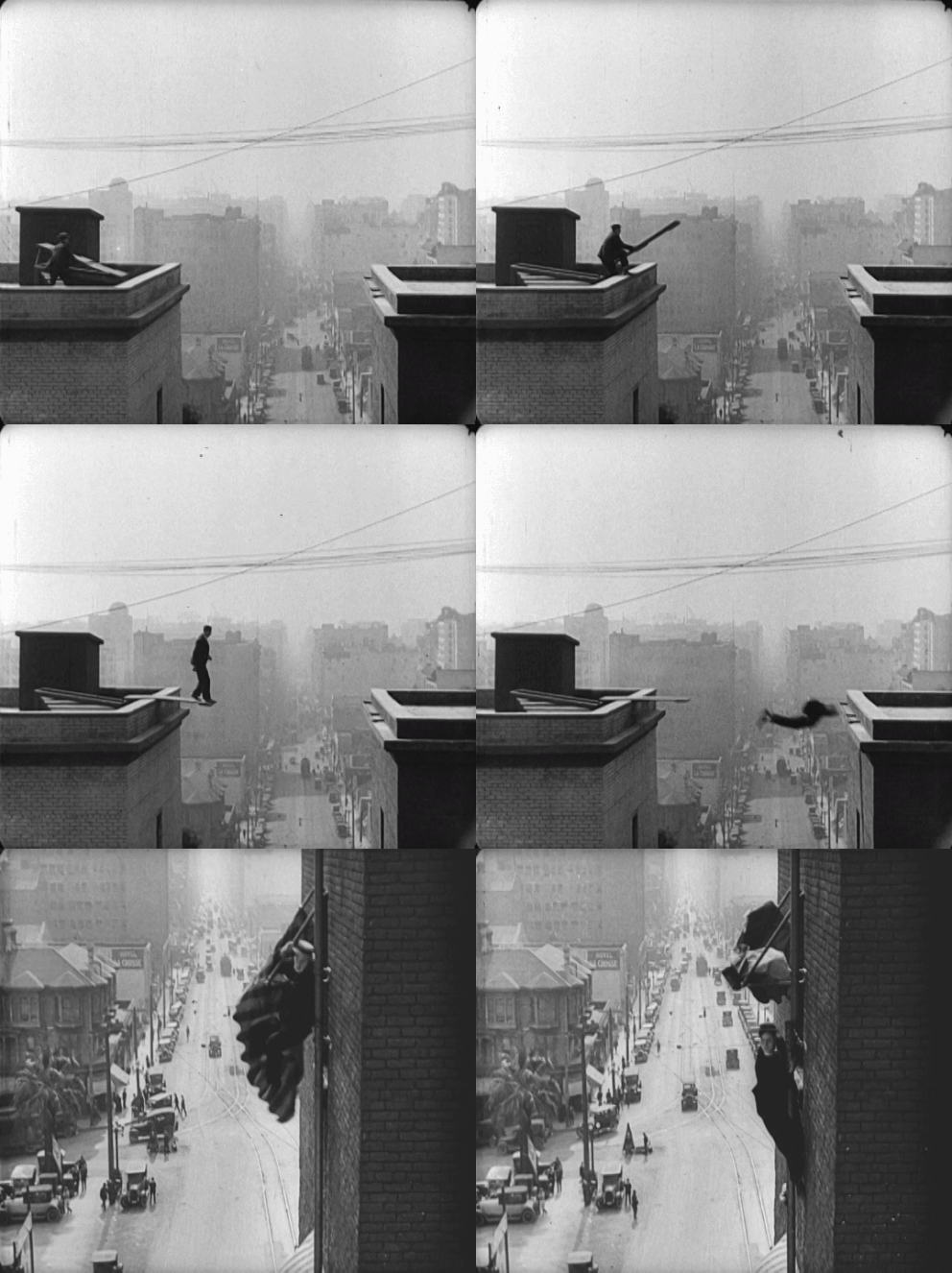
“No silent star did more dangerous stunts than Buster Keaton,” Roger Ebert wrote with deep admiration. Even Harold Lloyd’s vertigo-inducing clock scenes in 1923’s Safety Last used trick sets to lessen the risks. Keaton not only took on the full risk himself in his most famous stunt scenes—many of which you can see in gif form here—he also “doubled for some of his actors, doing their stunts as well as his own.” In Steamboat Bill, Jr. (1928, top), Keaton stands in the exact spot of an upper window of the façade of a house that comes down around him. In his 1926 classic The General, further down, he performs a jaw-dropping feat—using one railroad tie to push aside another while riding on the cow catcher of a moving locomotive.

Further up, in 1923’s Three Ages—the first film Keaton wrote, directed, and starred in—he performs an authentically terrifying stunt that gives acrophobic viewers instant chills. Just above, from the following year’s Sherlock Jr., we see a similarly heart-racing feat as Keaton clutches a roadblock gate and falls two stories into a speeding car. And in 1928’s The Cameraman, below, he goes down with a tall collapsing platform. Keaton’s visual comedy was superb; “he’s airily nimble,” Charlie Fox writes in a Cabinet essay on the silent star’s fall into alcoholism after the talkies left his career stranded; “Nobody else’s body yielded so smoothly to the sublime mindlessness that the best physical comedy requires.”
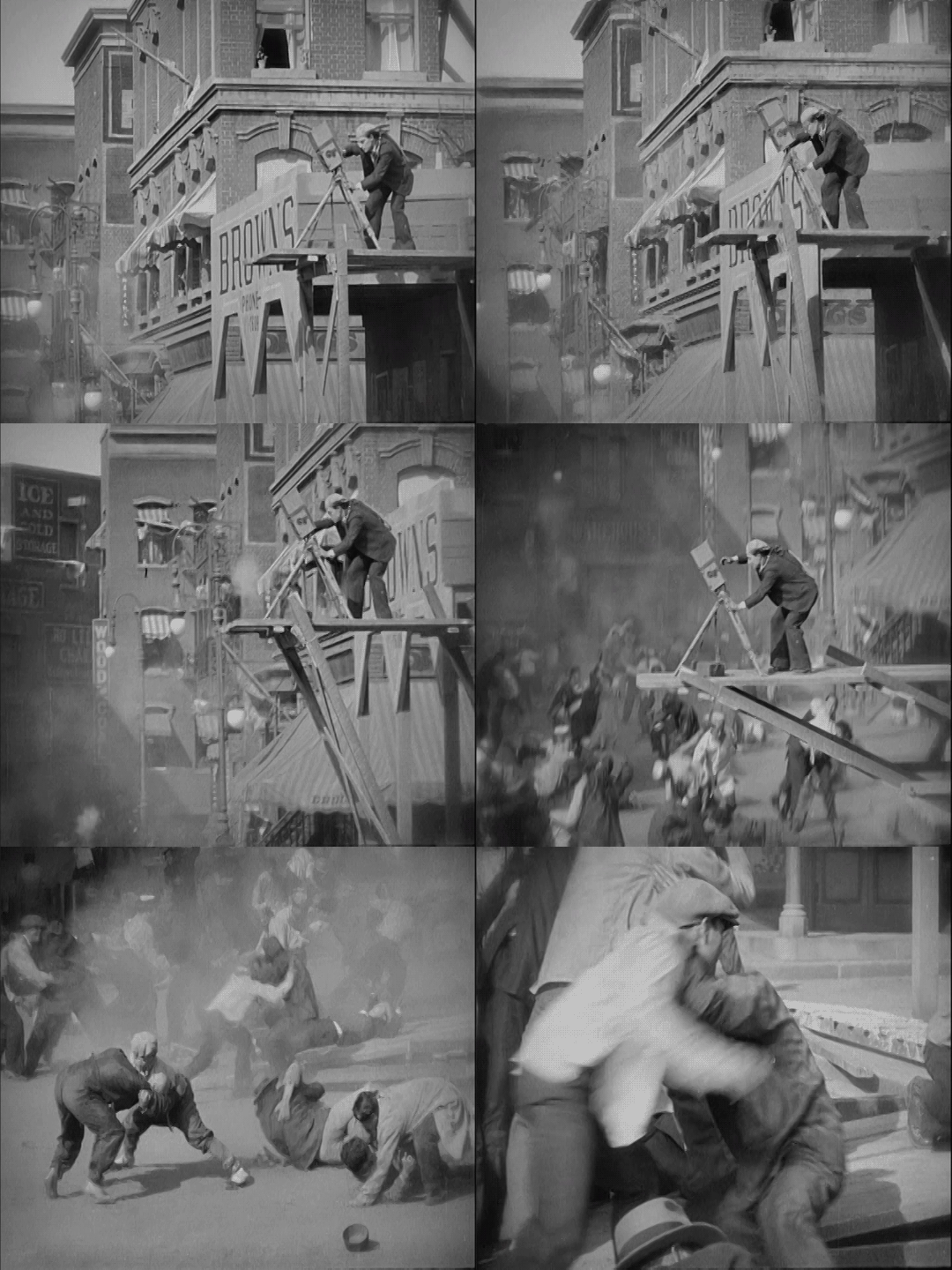
In just these few key scenes, we see how Keaton’s stunts stripped away what Prikryl calls the “sappy, blatant slapstick [he] disdained” in other actors’ work (“I didn’t like overacting,” he remarked). But part of the dryness of Keaton’s high-wire visual comedy came from the fact that many of these scenes were unrehearsed first takes, which “gave the action sequences a documentary flavor… because what was captured on film was a bold attempt at something really dangerous or difficult, not a practiced slam dunk.”
In his later years, Keaton’s career saw something of a resurgence after he beat his chronic drinking. “His job,” late in life, Fox writes, “became making quick appearances in unexpected places”—a Smirnoff Vodka ad in 1957, a brief role in Sunset Boulevard. “Always, in these later performances, he arrives from and returns to a becalmed region of the past.” Perhaps nowhere was Keaton’s physical expressiveness put to more use in this period than in a role which, in many ways, he found at least as challenging as his early silent-era stuntwork: a 1965 collaboration with Samuel Beckett in the modernist writer’s only foray into film (excerpt above): a short tribute to the silent era that is unsurprisingly, “far more complex” conceptually than its forebears, but no less evocative of the existential plight embodied by Keaton’s lonely, embattled-yet-stoic characters.
Related Content:
Buster Keaton: The Wonderful Gags of the Founding Father of Visual Comedy
101 Free Silent Films: The Great Classics
Josh Jones is a writer and musician based in Durham, NC. Follow him at @jdmagness
Read More...Anthony Burgess Names the 99 Best Novels in English Between 1939 & 1983: Orwell, Nabokov, Huxley & More
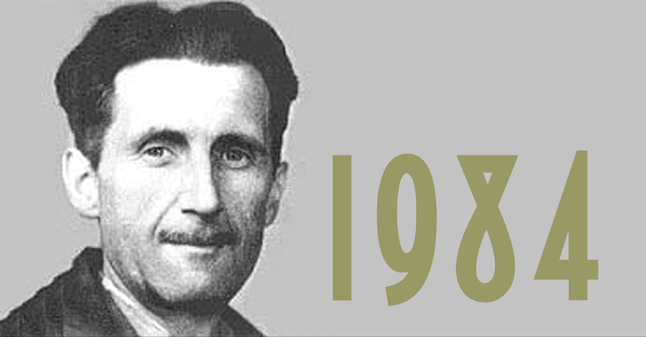
Image via Wikimedia Commons
In 1983, Anthony Burgess took up a commission from a Nigerian publishing company and, in two weeks, delivered to them the manuscript for Ninety-Nine Novels: The Best in English since 1939 — A Personal Choice. Published the following year, the book delivers exactly what its title, subtitle, and sub-subtitle promises: the finest novels English-language writers produced between the years 1939 and 1983, according to the preferences of the writer of more than a few novels himself, including A Clockwork Orange, Earthly Powers, and 1985.
Burgess wrote that last one, so its own title may suggest, as a tribute to George Orwell’s 1984, one of those 99 novels. “Nineteen eighty four has arrived, but George Orwell’s glum prophecy has not been fulfilled,” Burgess declared in a New York Times piece published as that year began. Yet “for 35 years a mere novel, an artifact meant primarily for diversion, has been scaring the pants off us all. Evidently the novel is a powerful literary form which is capable of reaching out into the real world and modifying it. It is a form which even the nonliterary had better take seriously.”
Prolific in his literary consumption as well as production, Burgess got plenty of practice taking the novel seriously in his capacity as a book reviewer. “It was clear that certain novels had to be reviewed whether I wished to review them or not,” he writes. “A new Graham Greene or Evelyn Waugh — this was the known brand-name which would grant an expected satisfaction. But the unknown had to be considered as well. After all, both Greene and Waugh produced first novels. V. S. Naipaul’s first novel went totally unreviewed.” Greene appears among the 99 for The Power and the Glory and The Heart of the Matter, Waugh for Brideshead Revisited and Sword of Honor, and Naipaul for A Bend in the River.
What makes these novels, and Burgess’ other 93 picks, so good? “The primary substance I have considered in making my selection is human character,” meaning that their authors have created “human beings whom we accept as living creatures filled with complexities and armed with free will” — and who thus, to a great extent, shape the story independently of authorial intention. “At best there will be a compromise between the narrative line you have dreamed up and the course of action preferred by the characters,” writes Burgess, as if addressing his colleagues in the enterprise of presenting “the preoccupations of real human beings through invented ones.”
You can see Burgess’ full list of 99 novels below, which includes such other favorite writers here at Open Culture as J.G. Ballard, Aldous Huxley (who scores three hits), James Joyce, and Vladimir Nabokov, all of whom, beyond their duty to character, “have managed language well, have clarified the motivations of action, and have sometimes expanded the bounds of imagination. And they entertain or divert, which means to turn our faces away from the repetitive patterns of daily life and look at humanity and the world with a new interest and even joy.” Only one question remains: why exactly 99? “The reader can decide on his own 100th,” Burgess replies. “He may even choose one of my own novels.”
Note: you can purchase online used copies of Ninety-Nine Novels: The Best in English since 1939 — A Personal Choice. It runs about 160 pages. Now here’s the basic list.
Achebe, Chinua — A Man of the People — (1966)
Aldiss, Brian — Life in the West (1980)
Amis, Kingsley — Lucky Jim (1954)
Amis, Kingsley — The Anti-Death League (1966)
Baldwin, James — Another Country (1962)
Ballard, J.G. — The Unlimited Dream Company (1979)
Barth, John — Giles Goat-Boy (1966)
Bellow, Saul — The Victim (1947)
Bellow, Saul — Humboldt’s Gift (1975)
Bowen, Elizabeth — The Heat of the Day (1949)
Bradbury, Malcolm — The History Man (1975)
Braine, John — Room at the Top (1957)
Cary, Joyce — The Horse’s Mouth (1944)
Chandler, Raymond — The Long Goodbye (1953)
Compton-Burnett, Ivy — The Mighty and Their Fall (1961)
Cooper, William — Scenes from Provincial Life (1950)
Davies, Robertson — The Rebel Angels (1982)
Deighton, Len — Bomber (1970)
Durrell, Lawrence — The Alexandria Quartet (1957)
Ellison, Ralph — Invisible Man (1952)
Faulkner, William — The Mansion (1959)
Fleming, Ian — Goldfinger (1959)
Fowles, John — The French Lieutenant’s Woman (1969)
Frayn, Michael — Sweet Dreams (1973)
Golding, William — The Spire (1964)
Gordimer, Nadine — The Late Bourgeois World (1966)
Gray, Alasdair — Lanark (1981)
Green, Henry — Party Going (1939)
Greene, Graham — The Power and the Glory (1940)
Greene, Graham — The Heart of the Matter (1948)
Harris, Wilson — Heartland (1964)
Hartley, L.P. — Facial Justice (1960)
Heller, Joseph — Catch-22 (1961)
Hemingway, Ernest — For Whom the Bell Tolls (1940)
Hemingway, Ernest — Old Man and the Sea (1952)
Hoban, Russell — Riddley Walker (1980)
Hughes, Richard — The Fox in the Attic (1961)
Huxley, Aldous — After Many a Summer (1939)
Huxley, Aldous — Ape and Essence (1948)
Huxley, Aldous — Island (1962)
Isherwood, Christopher — A Single Man (1964)
Johnson, Pamela Hansford — An Error of Judgement (1962)
Jong, Erica — How to Save Your Own Life (1977)
Joyce, James — Finnegans Wake (1939)
Lessing, Doris — The Golden Notebook (1962)
Lodge, David — How Far Can You Go? (1980)
Lowry, Malcolm — Under the Volcano (1947)
MacInnes, Colin — The London Novels (1957)
Mailer, Norman — The Naked and the Dead (1948)
Mailer, Norman — Ancient Evenings (1983)
Malamud, Bernard - The Assistant (1957)
Malamud, Bernard — Dubin’s Lives (1979)
Manning, Olivia — The Balkans Trilogy (1960)
Maugham, Somerset — The Razor’s Edge (1944)
McCarthy, Mary — The Groves of Academe (1952)
Moore, Brian — The Doctor’s Wife (1976)
Murdoch, Iris — The Bell (1958)
Nabokov, Vladimir — Pale Fire (1962)
Nabokov, Vladimir — The Defence (1964)
Naipaul, V.S. — A Bend in the River (1979)
Narayan, R.K. — The Vendor of Sweets (1967)
Nye, Robert — Falstaff (1976)
O’Brien, Flann — At Swim-Two-Birds (1939)
O’Connor, Flannery — Wise Blood (1952)
O’Hara, John — The Lockwood Concern (1965)
Orwell, George — Nineteen Eighty-Four (1949)
Peake, Mervyn — Titus Groan (1946)
Percy, Walker — The Last Gentleman (1966)
Plunkett, James — Farewell Companions (1977)
Powell, Anthony — A Dance to the Music of Time (1951)
Priestley, J.B. — The Image Men (1968)
Pynchon, Thomas — Gravity’s Rainbow (1973)
Richler, Mordecai — Cocksure (1968)
Roberts, Keith — Pavane (1968)
Roth, Phillip — Portnoy’s Complaint (1969)
Salinger, J.D. — The Catcher in the Rye (1951)
Sansom, William — The Body (1949)
Schulberg, Budd — The Disenchanted (1950)
Scott, Paul — Staying On (1977)
Shute, Nevil — No Highway (1948)
Sillitoe, Alan — Saturday Night and Sunday Morning (1958)
Snow, C.P. - Strangers and Brothers (1940)
Spark, Muriel — The Girls of Slender Means (1963)
Spark, Muriel — The Mandelbaum Gate (1965)
Styron, William — Sophie’s Choice (1979)
Theroux, Alexander — Darconville’s Cat (1981)
Theroux, Paul — The Mosquito Coast (1981)
Toole, John Kennedy — A Confederacy of Dunces (1980)
Updike, John — The Coup (1978)
Vidal, Gore — Creation (1981)
Warner, Rex — The Aerodrome (1941)
Waugh, Evelyn — Brideshead Revisited (1945)
Waugh, Evelyn — Sword of Honor (1952)
White, T.H. — The Once and Future King (1958)
White, Patrick — Riders in the Chariot (1961)
Williamson, Henry — A Chronicle of Ancient Sunlight (1951)
Wilson, Angus — The Old Men at the Zoo (1961)
Wilson, Angus — Late Call (1964)
Wouk, Herman — The Caine Mutiny (1951)
Related Content:
Anthony Burgess’ Lost Introduction to Joyce’s Dubliners Now Online
Vladimir Nabokov Names the Greatest (and Most Overrated) Novels of the 20th Century
The 100 Best Novels: A Literary Critic Creates a List in 1898
Based in Seoul, Colin Marshall writes and broadcasts on cities and culture. He’s at work on a book about Los Angeles, A Los Angeles Primer, the video series The City in Cinema, the crowdfunded journalism project Where Is the City of the Future?, and the Los Angeles Review of Books’ Korea Blog. Follow him on Twitter at @colinmarshall or on Facebook.
Read More...Great Courses Plus Now Offers a 30-Day Free Trial: 7,000 Video Lectures Covering Philosophy, Photography & More

We’ve told you about the Great Courses Plus (now called Wondrium) before–a new video subscription service that lets you watch free courses (about 8,000 lectures in total) across a wide range of subjects, all taught by some of the best lecturers in the country. The topics cover everything from History, Philosophy, Literature, and Economics, to Math, Science, Professional Development, Cooking, and Photography. And you can binge-watch entire college courses in a matter of days by watching videos on your TV, tablet, laptop and smart phone, with the help of apps designed for Apple, Google Play, Kindle Fire, and Roku.
Interested in trying out this service? Right now, the Great Courses Plus/Wondrium is offering a special deal for Open Culture readers. If you click here, and sign up for a free trial, you can use this service for 30 days … for free. And then, if you would like, you can continue to subscribe and pay their normal prices. If you have time on your hands, this is a great way to keep your mind engaged and stream what PC Magazine has called “an excellent library of college-level lectures.”
Note: The Great Courses is a partner with Open Culture. So if you sign up for a free trial, it benefits not just you and Great Courses Plus. It benefits Open Culture too. So consider it win-win-win.
Read More...The New York Public Library Lets Patrons Download 300,000 eBooks

A quick heads up for readers in NYC. This summer, The New York Public Library released a new app, called SimplyE, which gives its cardholders the ability to “browse, borrow, and read more than 300,000 e‑books from the Library’s collections in just a few easy steps.” If you’re among the 3.4 million people the NYPL exists to serve, you can download SimplyE for iPhone/iPad or Android, log in with your NYPL card barcode and PIN, and start reading. Down the road, NYPL plans to make the app available on Kindle Fire, and also to make books available in mp3 format.
For more information on the app, click here. To discover the best art books available in SimplyE app, see this handy post by Hyperallergic.
As always, you can download free books from our twin collections: 1,000 Free Audio Books: Download Great Books for Free and 800 Free eBooks for iPad, Kindle & Other Devices.
Related Content:
Foodie Alert: New York Public Library Presents an Archive of 17,000 Restaurant Menus (1851–2008)
New York Public Library Puts 20,000 Hi-Res Maps Online & Makes Them Free to Download and Use
Read More...Salvador Dalí’s 1973 Cookbook Gets Reissued: Surrealist Art Meets Haute Cuisine
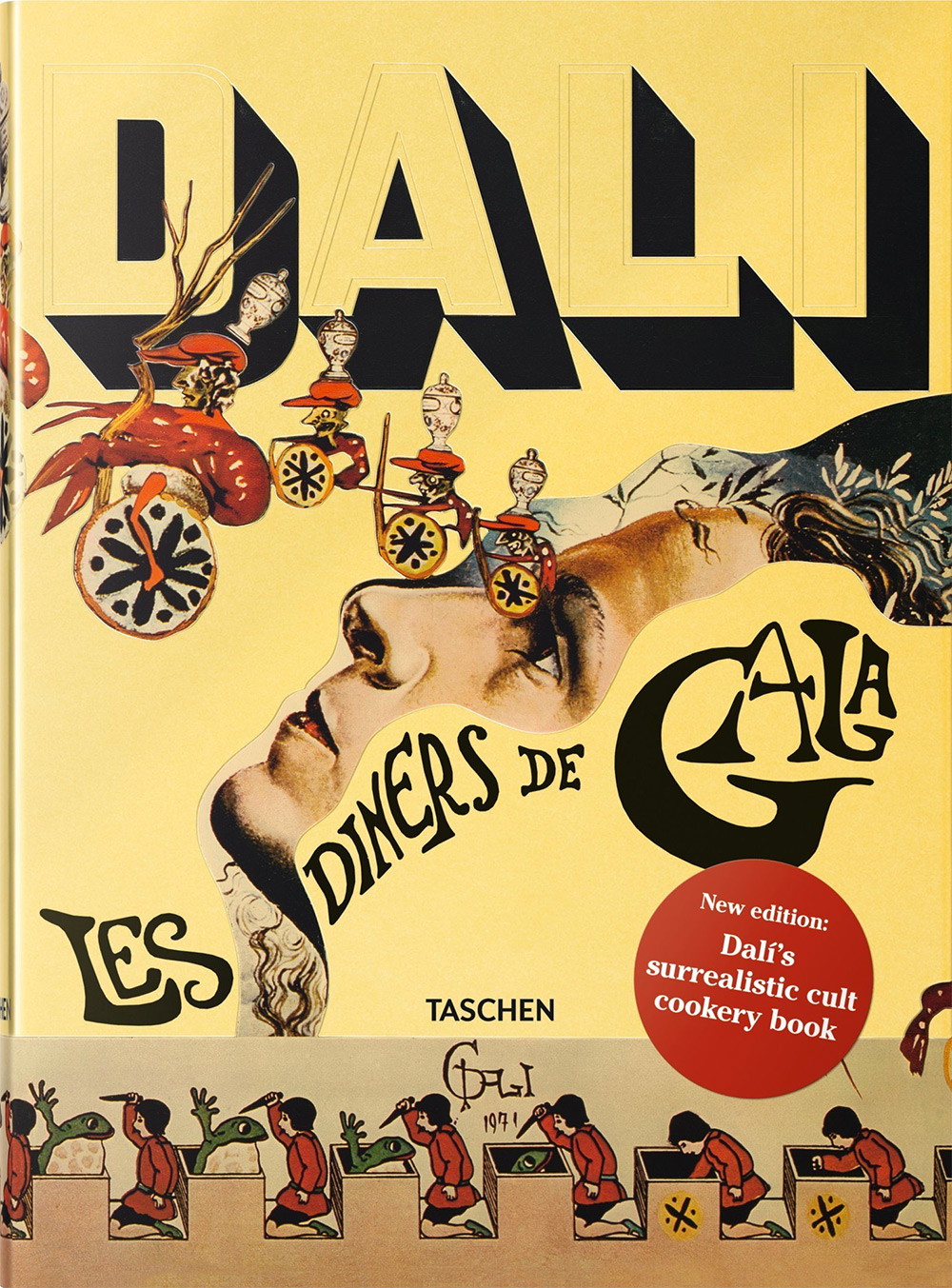
The skilled chef has always held a place of honor amongst gourmands and the fine dining elite. But it took television to bring us the celebrity chef: Julia Childs and Jacques Pepin; Dom DeLuise and Paul Prudhomme. Those were the good old days, before reality TV turned cooking into a competitive sport. Still, we’ve got many quality cooks on the tube, entertaining and hugely informative: Alton Brown, Anthony Bourdain, Gordon Ramsay, Jamie Oliver…. Many of us who take cooking seriously have at one time or another apprenticed under one of these food gurus.
My personal favorite? Well, I’m a fan of haute cuisine as fashioned by Salvador Dalí. Sure, the surrealist painter and all-around weirdo has been dead since 1989, and never had anything approaching a cooking show in his lifetime (though he did make a few TV ads and an appearance on What’s My Line?). Nor is Dalí known for his cooking. As you might guess, there’s good reason for that.
Dishes like “Veal Cutlets Stuffed with Snails,” “Thousand Year Old Eggs,” and “Toffee with Pine Cones” were never going to catch on widely. But when it comes to food as art—as an especially strange and imaginative form of art—it’s hard to beat Dalí’s rare, legendary 1973 cookbook Les Diners de Gala, just reissued by Taschen.
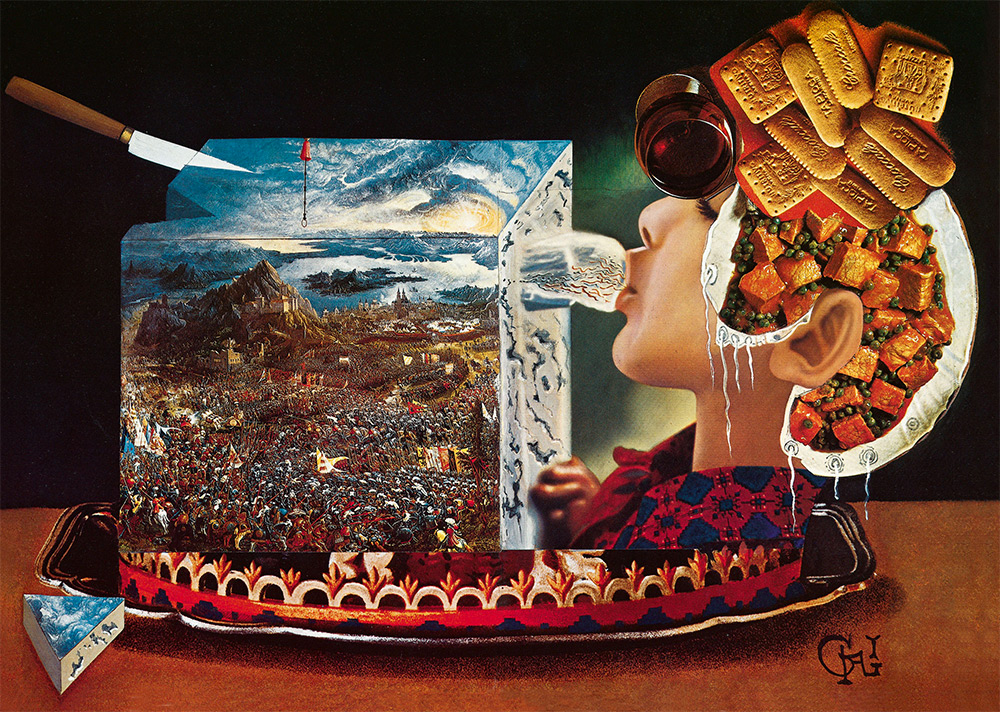
The book, writes This is Colossal, represented “a dream fulfilled” for Dalí, “who claimed at the age of 6 that he wanted to be a chef.” As is sometimes the case when a life’s goal goes unmet—it is perhaps for the best that the Spanish painter never seriously attempted to interest the general public in his sometimes inedible concoctions. He did, however, entertain his coterie of admirers, friends, and celebrity acquaintances with “opulent dinner parties thrown with his wife Gala.” As the cookbook suggests, these events “were almost more theatrical than gustatory.” In addition to the bizarre dishes he and Gala prepared, the guests “were required to wear completely outlandish costumes and an accompaniment of wild animals often roamed free around the table”…..
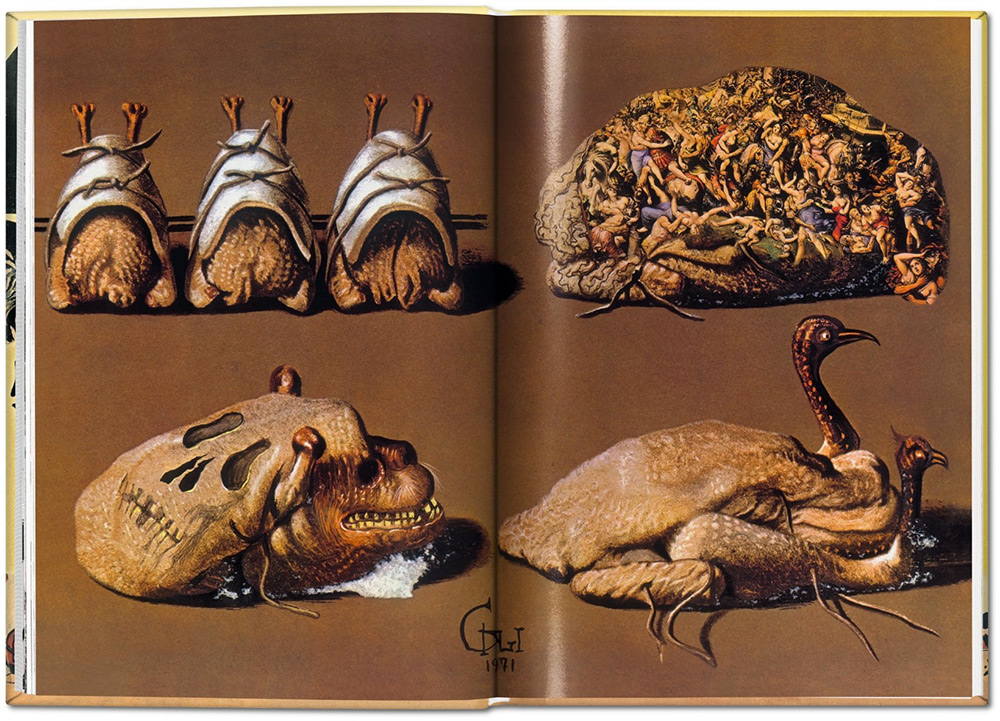
If only Dalí had lived into the age of the Kardashians. Likely he would have leapt at the chance to turn these art parties into great TV. Or maybe not. In any case, we can now reconstruct them ourselves with what design site It’s Nice That calls “a delicious combination of elaborately detailed oil paintings and kitsch 1970s food photography.” Along the way, Dalí drops aphorisms like “the jaw is our best tool to grasp philosophical knowledge” (recalling Nietzsche’s preoccupation with digestion). And despite the absurdity of many of these dishes—and paintings like that above which make the turducken look like casual fare—many of the actual recipes, This is Colossal notes, “originated in some of the top restaurants in Paris at the time including Lasserre, La Tour d’Argent, Maxim’s, and Le Train Bleu.”

However, even as far back as 1973, home cooks had begun to fret about the healthiness of their food. Dalí gives such people fair warning; Les Diners de Gala, he writes, “is uniquely devoted to the pleasures of Taste. Don’t look for dietetic formulas here.”
We intend to ignore those charts and tables in which chemistry takes the place of gastronomy. If you are a disciple of one of those calorie-counters who turn the joys of eating into a form of punishment, close this book at once; it is too lively, too aggressive, and far too impertinent for you.
As if you thought Dalí would bow to something as quotidian as nutrition. See many more surreally sensual food illustrations and quotes from the book at Brain Pickings, where you’ll also find the full, extravagant recipe for “Conger of the Rising Sun.” You can order Les Diners de Gala online.
If you would like to support the mission of Open Culture, consider making a donation to our site. It’s hard to rely 100% on ads, and your contributions will help us continue providing the best free cultural and educational materials to learners everywhere. You can contribute through PayPal, Patreon, and Venmo (@openculture). Thanks!
Related Content:
Salvador Dalí Takes His Anteater for a Stroll in Paris, 1969
Salvador Dalí Goes Commercial: Three Strange Television Ads
Salvador Dalí’s Melting Clocks Painted on a Latte
Josh Jones is a writer and musician based in Durham, NC. Follow him at @jdmagness
Read More...Experience Queen’s “Bohemian Rhapsody” in Virtual Reality: Download the Free App Created by Queen & Google
You don’t just listen to “Bohemian Rhapsody”; you experience it. Anyone who’s ever heard Queen’s signature progressive rock epic knows it, and anyone who’s ever performed all six minutes of it at a karaoke bar understands it more deeply still. The song, which rumor holds to have cost more to record than any single to date, made use of the latest studio techniques; now, technology barely imaginable when the song hit the charts in 1975 has given us a whole new way to experience “Bohemian Rhapsody”: in virtual reality, through either the Google Cardboard app or as a 360° video.
A collaboration between Queen, Google Play, and VR developer Enosis, The Bohemian Rhapsody Experience offers a three-dimensional audiovisual journey featuring “interactive elements and spatial sound, allowing you to step inside the music.” The Creators Project’s Kara Weisenstein describes it as “peering into Freddie Mercury’s brain. The musician was famously coy about the song’s meaning, and while it doesn’t give anything away, this experience renders Mercury’s imagination in resplendent purples and blues. The ballad is a playful wonderland of bicycling skeletons and animated globes. During the opera, the scene is a spooky cave. The rock section is a neon trip through space, and the coda is a drippy, intergalactic aurora.”
“ ‘Bohemian Rhapsody’ is unusual, isn’t it?” asks Queen’s lead guitarist and self-described VR proponent Brian May in the video on the making of The Bohemian Rhapsody Experience above. “Even 40 years later, or whatever it is, [the 1975 song] still sounds innovative.” And it began inspiring innovation right after its recording, when it led to the six-minute film that, years before MTV, practically invented the form of the music video. Does this new project herald an era when every single must, by necessity, come accompanied by a full-fledged VR journey? For the moment, that question remains among the unanswered, right alongside the one Queen has been asking for over four decades now: “Is this the real life? Is this just fantasy?”
Enter the The Bohemian Rhapsody Experience here.
Related Content:
Guitarist Brian May Explains the Making of Queen’s Classic Song, ‘Bohemian Rhapsody’
Queen Documentary Pays Tribute to the Rock Band That Conquered the World
The Music of Queen Re-Imagined by “Extraordinary” Classical Pianist, Natalia Posnova
Based in Seoul, Colin Marshall writes and broadcasts on cities and culture. He’s at work on a book about Los Angeles, A Los Angeles Primer, the video series The City in Cinema, the crowdfunded journalism project Where Is the City of the Future?, and the Los Angeles Review of Books’ Korea Blog. Follow him on Twitter at @colinmarshall or on Facebook.
Read More...Support Us
We're hoping to rely on loyal readers, rather than erratic ads. Please click the Donate button and support Open Culture. You can use Paypal, Venmo, Patreon, even Crypto! We thank you!

About Us

Open Culture scours the web for the best educational media. We find the free courses and audio books you need, the language lessons & educational videos you want, and plenty of enlightenment in between.
Advertise With Us

FREE UPDATES!
GET OUR DAILY EMAIL
Get the best cultural and educational resources on the web curated for you in a daily email. We never spam. Unsubscribe at any time.
FOLLOW ON SOCIAL MEDIA

Open Culture editor Dan Colman scours the web for the best educational media. He finds the free courses and audio books you need, the language lessons & movies you want, and plenty of enlightenment in between.
Advertise With Us


