Marshall McLuhan, W.H. Auden & Buckminster Fuller Debate the Virtues of Modern Technology & Media (1971)
45 years ago, four eminences took the stage at the University of Toronto: Irish actor Jack MacGowran, best known for his interpretations of Samuel Beckett; English poet and dramatist W.H. Auden; American architect and theorist of humanity’s way of life Buckminster Fuller; and Canadian literary scholar turned media technology oracle Marshall McLuhan. Now only did all four men come from different countries, they came from very different points on the intellectual and cultural map. The CBC recorded them for broadcast on its long-running series Ideas, prefacing it with an announcement that “the ostensible subject of their discussion is theatre and the visual arts.”
Key word: ostensible. “That topic is soon forgotten as two modes of perception clash,” says the announcer, “that of Professor McLuhan, who is one of the most famous interpreters of contemporary 20th-century cultural trends, and that of W.H. Auden, who cheerfully admits to being ‘a 19th-century man’ and sees no reason to change.” And so, though Fuller and MacGowan do occasionally provide their perspective, the panel turns into a rollicking debate between McLuhan and Auden, more or less from the point where the former — making one of his characteristically compelling proclamations — declares that modern media brings us to a world in which “there is no audience. There are only actors.” But the latter objects: “I profoundly disapprove of audience participation.”
By the early 1970s, television had long since found its way into homes all across America, Canada, and Britain, but the thinkers of the time had only just begun to grapple with its consequences. “We’ve just seen Apollo 14, which has some visual effects going with it. It’s a new type of theater, obviously,” says McLuhan, drawing one of many audience laughs. On the subject of television’s conflation of fact and fiction, Auden doesn’t mince words: “I think TV is a very, very wicked medium. That’s all I can say.” McLuhan emphasizes that, as a professional observer of these phenomena, “I have steadfastly reserved moral judgment on all media matters.” Auden: “I don’t.”
Yet the author of The Age of Anxiety and the author of The Gutenberg Galaxy turn out to have more in common than their conflict might suggest. Both in their 60s by the time of this discussion (“Thank God I can remember the world before World War I,” says the poet) and both 1930s converts to Catholicism, they also both harbored deep suspicions of technologies like television. Auden, who insists he would never dream of owing a TV set himself, seems to look down on it as merely lowbrow, but McLuhan has darker suspicions: “You are missing the name of the game, sir. You are actually imagining that those little images you see on TV are TV. They are not. What is TV is that fire stream pouring out of that tube into your gut.”
Even while predicting still-unheard-of advances in televisual technology (at one point attempting to engage MacGowran on “the immediate prospect of four- and five-dimensional TV”), McLuhan also foresees it as the potential spark for such cataclysms as a global race war, going so far as to suggest that “if you want to save a fantastic bloodbath on this planet, which will be very traumatic, very cathartic, and very tragic — in the Greek sense — we turn off TV totally. For good.” Auden, of course, actually approves of that particular idea of McLuhan’s, though he evinces little optimism about its feasibility. “Why won’t it happen?” asks McLuhan. “Because people like the damn things,” he replies.
Related Content:
Marshall McLuhan on the Stupidest Debate in the History of Debating (1976)
The Visionary Thought of Marshall McLuhan, Introduced and Demystified by Tom Wolfe
McLuhan Said “The Medium Is The Message”; Two Pieces Of Media Decode the Famous Phrase
W.H. Auden Recites His 1937 Poem, ‘As I Walked Out One Evening’
Everything I Know: 42 Hours of Buckminster Fuller’s Visionary Lectures Free Online (1975)
Bertrand Russell & Buckminster Fuller on Why We Should Work Less, and Live & Learn More
Based in Seoul, Colin Marshall writes and broadcasts on cities and culture. He’s at work on a book about Los Angeles, A Los Angeles Primer, the video series The City in Cinema, the crowdfunded journalism project Where Is the City of the Future?, and the Los Angeles Review of Books’ Korea Blog. Follow him on Twitter at @colinmarshall or on Facebook.
Read More...Pete Seeger Teaches You How to Play Guitar for Free in The Folksinger’s Guitar Guide (1955)
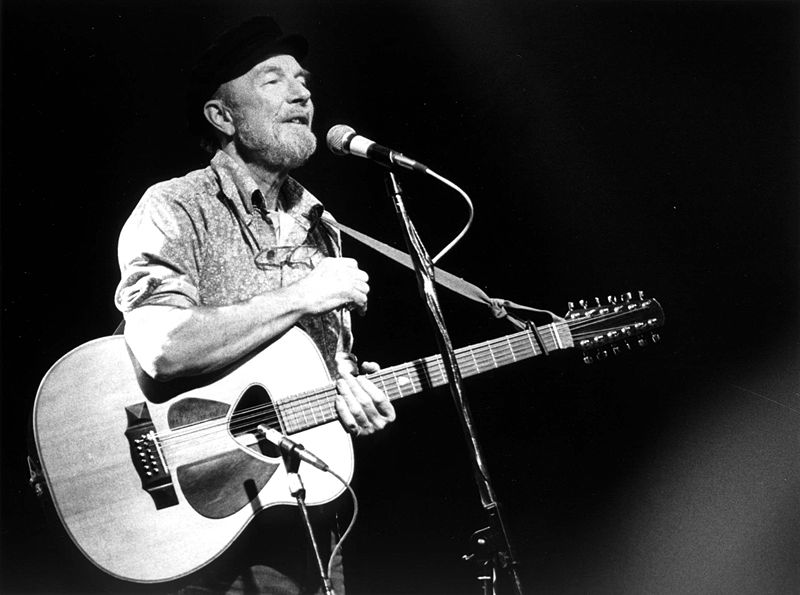
Image by Josef Schwarz, via Wikimedia Commons
Along with earnest political populism and a renewed interest in regional cultures, the folk revival of the fifties and sixties brought with it a liberating sense of possibility, as young writers, singers, and artists discovered that, truly, anyone can play guitar. Or rather, anyone can pick up most any stringed instrument and, with a few fundamentals, enjoy the experience of writing and playing music in a way that seemed unavailable or forbidding before people like Pete Seeger and Bob Dylan appeared on the scene.
Both popularizers of Woody Guthrie’s Depression-era ballads and of obscure blues and folk artists, Dylan and Seeger took very different approaches to their art. The former cultivated a mystique that seems impossible to penetrate, and that has made him seem—as Todd Haynes’ masterful film I’m Not There dramatizes—like a series of different people. But Seeger has always been Seeger, from his gentle, aw-shucks demeanor and warm accessibility to his staunchly progressive messages that speak to children and regular folks as well as to those with more sophisticated tastes and talents.
So it seems only natural that Seeger released an album of guitar instruction, The Folksinger’s Guitar Guide, addressed to both beginners and more advanced players. “I guess any musical instrument can be as hard to play as you want to make it,” Seeger begins, in one of his characteristically fluid transitions from song to speech: “If you wanted to be a person like Andres Segovia or Merle Travis, why it would take a lifetime of training. But for most of us, playing a guitar can be about as simple as walking.” After that reassuring comparison, he does remind us, however, that “it took us all a couple years to learn how to walk.”
Seeger begins with first steps—tuning the instrument—and patiently leads his listeners through some basic chord shapes, strumming techniques, and then more advanced picking methods, alternate tunings, and styles like Flamenco, “Rhumba Rhythm,” and “Mexican Blues.” You can listen to the album track-by-track on Spotify, further up. (You can also find it kicking around on YouTube.) Like the great educator he was, Seeger also includes some helpful visual aids in the album’s liner notes (see them here), including drawings of chord fingerings, musical notation, and guitar tablature for those who don’t read music. In addition to his readable instructions, he also includes the lyrics to all of the folk songs referenced throughout.
“Practice each small section over and over,” he writes in his introduction, “until it comes easy. Actually, if you enjoy playing the guitar, you shouldn’t think of it as practicing, in the formal sense. Rather simply play for your own enjoyment and that of your friends.” He also recommends that his listeners “beg, borrow, or steal” the records he references in the booklet, for “they will be of help to you in giving you an idea of the scope and possibilities of the instrument.” I can’t think of a music teacher more inviting than Seeger, nor a method more relaxed.
A second volume featuring Jerry Silverman appeared soon after, and upped the ante a good bit. “Musical standards are on the rise,” Silverman says in his introduction, “the virtuoso folk guitarist is on the scene.” He promises to help the “strumming population… keep pace with the upward spiral.” You can be the judge of how successful he is in that effort. Unfortunately, we don’t have Silverman’s supplementary materials available, but you can listen to the complete Folksinger’s Guitar Guide: Volume 2 above.
Related Content:
James Taylor Gives Free Acoustic Guitar Lessons Online
Paul McCartney Offers a Short Tutorial on How to Play the Bass Guitar
Josh Jones is a writer and musician based in Durham, NC. Follow him at @jdmagness
Read More...Watch Soviet Avant-Garde Composers Create Synthesized Music with Hand-Drawn Animations (1934)
The Russian Revolution not only radically reshaped social and political institutions in the soon-to-be Soviet Union, but it also radicalized the arts. “The Romanovs, who ruled Russia for 300 years,” comments Glenn Altschuler at The Boston Globe, used “culture as an instrument of political control.” As the Bolsheviks swept away lumbering czarist elitism, they brought with them an avant-gardism that also sought to be populist and proletarian—spearheaded by such experimental artists as filmmaker Dziga Vertov, poet, futurist actor, and artist Vladimir Mayakovsky, and “suprematist” painter Kazimir Malevich. While many of these artists were denounced as bourgeois obscurantists when the dogmas of socialist realism became their own instruments of political control, for several years, the nascent Communist state produced some of the most forward-thinking art, music, dance, and film the world had yet seen.
That includes some of the first fully synthetic music ever made, created by innovative methods that predated synthesizers by several decades. We’ve likely all heard of the Theremin, for example, invented in 1919 by Soviet engineer Leon Theremin. By the 1930s, other inventive technologists and composers had begun to experiment with oscilloscopes and magnetic tape, cutting or drawing waveforms by hand to create synthetic sounds.
One avant-garde Soviet composer, Arseny Avraamov became inspired by the advent of sound recording technology in film. The process of optical sound uses an audio track recorded on a separate negative that runs parallel with the film (see it explained above). After the development of this technology, writes Paul Gallagher at Dangerous Minds, Bauhaus artist László Moholy-Nagy suggested that “a whole new world of abstract sound could be created from experimentation with the optical film sound track.”
Taking up the challenge after the first Russian sound film—1929’s The Five Year Plan—Avraamov “produced (possibly) the first short film with a hand-drawn synthetic soundtrack.” One very short example of his technique, at the top of the post, may not sound like much to us, but it preserves a fascinating technique and a look at what might have been had this technique, and others like it, borne more fruit. Monoskop describes Avraamov as “a composer, music theorist, performance instigator, expert in Caucusian folk music, [and] outspoken critic of the classical twelve-tone system.” He was also the commissar of a ministry set up to encourage “the development of a distinctly proletarian art and literature.” It’s not entirely clear how what he called “ornamental sound” techniques fit that purpose. But along with innovators like Evgeny Sholpo and Nikolai Voinov—whose fascinating experiments you can hear above and below—Avraamov showed that technologies generally used to deliver entertainment and propaganda to passive mass audiences could be manipulated by hand to create something entirely unique.
The experiments of these sound pioneers perhaps held little appeal for the average Russian, but they were enthusiastically written up in a 1936 issue of American magazine Modern Mechanix. “Voinov and Avraamov,” notes Gallagher, “briefly formed a research institute in Moscow, where they hoped to create synthetic voices and understand the musical language of geometric shapes. It didn’t last and, alas, closed within a year.”
Related Content:
Eight Free Films by Dziga Vertov, Creator of Soviet Avant-Garde Documentaries
Josh Jones is a writer and musician based in Durham, NC. Follow him at @jdmagness
Read More...Hear a Playlist of the 336 Songs Mentioned in Bruce Springsteen’s New Memoir, Born to Run
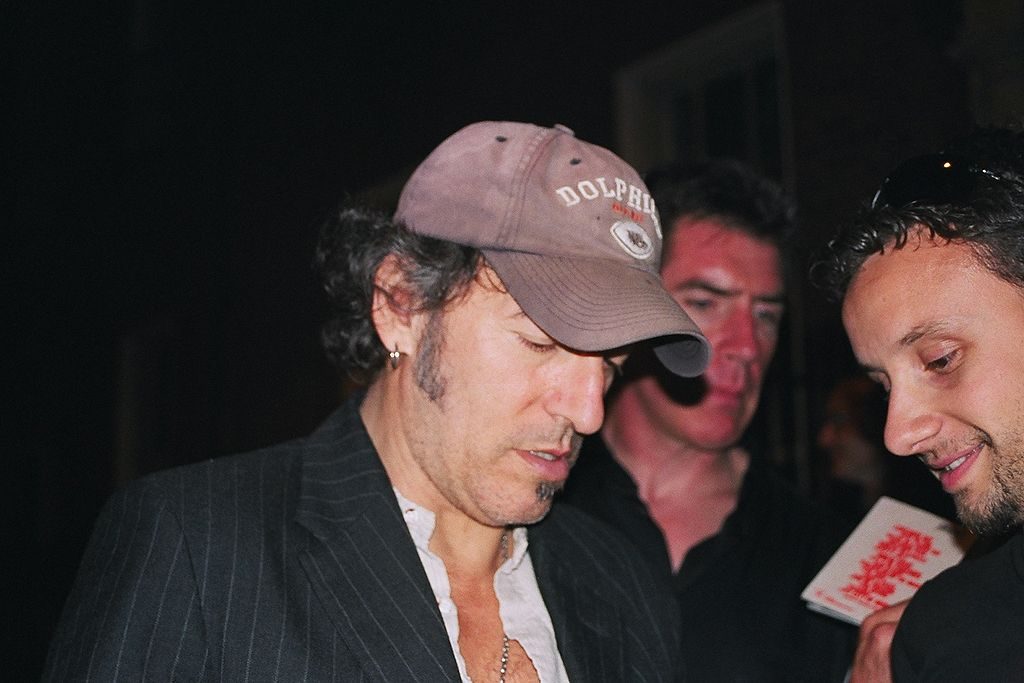
Image by Michele Lucon, via Wikimedia Commons
FYI: Earlier this week, Bruce Springsteen released his highly-anticipated memoir, Born to Run. It comes accompanied by a companion album, Chapter and Verse. And now a Spotify playlist that features every single song referenced in the pages of the book–his own or others’. There’s lots of Springsteen–most of his discography, in fact–but also great tracks from Aretha Franklin, Van Morrison, Cream, Lou Reed, Bob Dylan and more. If you need Spotify’s free software, download it here. Then settle in and enjoy 22 hours of music. You can start streaming the music below:
For anyone interested, the novelist Richard Ford has a review of Born to Run (the autobiography) in The New York Times. Ford’s Bascombe trilogy appears on Springsteen’s List of His 20 Favorite Books.
Looking for free, professionally-read audio books from Audible.com? Here’s a great, no-strings-attached deal. If you start a 30 day free trial with Audible.com, you can download two free audio books of your choice. Get more details on the offer here.
If you would like to support the mission of Open Culture, consider making a donation to our site. It’s hard to rely 100% on ads, and your contributions will help us continue providing the best free cultural and educational materials to learners everywhere. You can contribute through PayPal, Patreon, and Venmo (@openculture). Thanks!
Related Content:
Heat Mapping the Rise of Bruce Springsteen: How the Boss Went Viral in a Pre-Internet Era
Springsteen’s Favorite Books & Reading List
Read More...Chris Rock Creates a List of His 13 Favorite Standup Comedy Specials
We know Ellen DeGeneres as the superstar host of her own talk show and the voice of cuddly, forgetful fish Dory. No doubt many of her younger fans have no idea she was a standup comic, before The Ellen DeGeneres Show, before even the 90s sitcom Ellen, which mostly gets mentioned for the “coming out” episode that supposedly ended her career almost two decades ago. But even if all the TV and movie stardom had never come her way, comedians like Chris Rock might still remember Ellen as one of their favorite standup comics.
Rock adds DeGeneres to his list of “Favorite Standup Specials” for her 2003 HBO performance Here and Now, which you can see in part above. “Most comics just talk about what they see,” he writes, “This is the first time I heard somebody talk about what they felt.” Ellen works clean, and in that respect she’s in a minority on Rock’s list (she’s also the only woman). Even the comedian Rock compares to Andy Griffith— “Blue Collar” comic Ron White—gets a raunchy asterisk next to that reference. And indeed, he’s both down home and dirty. So what connects the comedians on Rock’s list?
Aside from the fact that they’re all big names, not much, it seems. In choosing these 13 specials, Rock seems drawn not to a particular genre or brand of humor, but to the skillful, moving performance of comedy: dirty, clean, political, topical, observational—it’s all good as long as it’s funny. A good comic can make ‘em laugh by riffing on the mundane annoyances of daily life, or by telling uncomfortable truths with a smile like Dave Chappelle, above, whose special Killin’ Them Softly also appears on Rock’s list of favorites.
Like Rock, Chappelle knows his comedy history, and fans of The Chappelle Show know too—at least when it comes to the legendary Paul Mooney, a comedian’s comedian and onetime writer for Richard Pryor. Mooney’s special Jesus is Black. So Was Cleopatra. Know Your History makes the list for “more edge than anything you are ever going to see.” And his onetime boss Pryor gets top billing for the “perfect” Live in Concert 1979—“what every comic is striving for,” says Rock, “and we all fall very short.”
Speaking of truth-tellers, the great George Carlin makes the list for his special Jammin’ in New York. Carlin spared no one, and comedians love him for it, even if few people have the courage or the wit to do what he did. Rock has come close, with routines that make people laugh as they squirm in their seats. His delivery is all his own, but we can see Carlin’s bristling social critique in his act as much as Richard Pryor’s riffs on race and sex.
Other big names on the list include Steve Harvey, Eddie Murphy, the-once-beloved Bill Cosby, George Lopez (“the Mexican Richard Pryor and Bill Cosby at the same time”), and even Andrew Dice Clay for his The Day the Laughter Died, “a comedy album only a comedian could love.”
But it isn’t solely about laughter or candor for Rock; as he noted in his Ellen pick, it’s also about feeling, and in the case of one special, Billy Crystal’s one-man-show 700 Sundays, the comedy sits side-by-side with pathos. Drawn from a bittersweet autobiography of the same title, Crystal’s show premiered in 2004 and was revived in 2013 and filmed by HBO (trailer above). “Brilliant, touching and f*cking funny,” says Rock, “First time in my life I cried at a comedy show.”
Rounding out the list is Sam Kinison, whose unforgettably unhinged role in Rodney Dangerfield’s Back to School brought thousands of curious new fans to his classic album Louder than Hell. “The last original comic,” says Rock. “Most comics are derivatives of Pryor, Cosby, or Seinfeld. Sam reminded you of Billy Graham.” I’d say he was more Jimmy Swaggart, if Jimmy Swaggart screamed obscenities at starving children. See Rock’s full list below.
- Richard Pryor Live In Concert 1979
- Paul Mooney: Jesus Is Black. So Was Cleopatra
- Dave Chappelle: Killin’ Them Softly
- Eddie Murphy: Delirious
- Bill Cosby: Himself
- George Carlin: Jammin’ in New York
- George Lopez: America’s Mexican
- Steve Harvey: One Man
- Billy Crystal: 700 Sundays
- Andrew Dice Clay: The Day the Laughter Died
- Ron White: They Call Me Tater Salad
- Ellen DeGeneres: Here and Now
- Sam Kinison: Louder Than Hell
via Austin Kleon
Related Content:
Hear 30 of the Greatest Standup Comedy Albums: A Playlist Chosen by Open Culture Readers
Bill Hicks’ 12 Principles of Comedy
Josh Jones is a writer and musician based in Durham, NC. Follow him at @jdmagness
Read More...When an Octopus Caused the Great Staten Island Ferry Disaster (November 22, 1963)
Where were you on November 22, 1963?
I had yet to be born, but am given to understand that the events of that day helped shape a generation.
Documentarian Melanie Juliano knows this too, though she’s still a few months shy of the legal drinking age. The 2014 recipient of the New Jersey Filmmakers of Tomorrow Festival’s James Gandolfini Best of Fest Award uses primary sources and archival footage to bring an immediacy to this dark day in American history, the day a giant octopus—“a giant fuckin’ octopus” in the words of maritime expert Joey Fazzino—took down the Cornelius G. Kolff and all 400 hundred souls aboard.
What did you think I was talking about, the Kennedy assassination?

Image via the Facebook page of the Staten Island Ferry Octopus Disaster Memorial Museum
Those who would question this tragedy’s authenticity need look no further than a recently dedicated bronze memorial in Lower Manhattan’s Battery Park. To require more proof than that is unseemly, nay, cruel. If an estimated 90% of tourists stumbling across the site are willing to believe that a giant octopus laid waste to a Manhattan-bound Staten Island ferry several hours before John F. Kennedy was shot, who are you to question?
The memorial’s artist, Joe Reginella, of the Staten Island-based Super Fun Company, is finding it hard to disengage from a disaster of this magnitude. Instead the craftsman, whose previous work includes a JAWS tribute infant crib, lingers nearby, noting visitors’ reactions and handing out literature for the (non-existent) Staten Island Ferry Disaster Memorial Museum.
(New York 1 reports that an actual museum across the street from the address listed on Reginella’s brochures is not amused, though attendance is up.)
A Staten Island Octopus Disaster website is there for the edification of those unable to visit in person. Spend time contemplating this horrific event and you may come away inspired to learn more about the General Slocum disaster of 1904, a real life New York City ferry boat tragedy, that time has virtually erased from the public consciousness.
(The memorial for that one is located in an out of the way section of Tompkins Square Park.)
H/T to reader Scott Hermes/via Colossal
Related Content:
The Dancer on the Staten Island Ferry
“Moon Hoax Not”: Short Film Explains Why It Was Impossible to Fake the Moon Landing
Ayun Halliday is an author, illustrator, theater maker and Chief Primatologist of the East Village Inky zine. Her play Zamboni Godot is opening in New York City in March 2017. Follow her @AyunHalliday.
Read More...Watch Benedict Cumberbatch Sing Pink Floyd’s “Comfortably Numb,” with David Gilmour Live on Stage
Around here, when we talk about Benedict Cumberbatch, we usually talk about his knack for reading classic texts–Kafka’s Metamorphosis, Melville’s Moby-Dick, a poignant letter by Alan Turing, even passages from a Guantánamo prisoner’s diary. But today we’re putting another one of his talents on display.
Above, watch Cumberbatch join David Gilmour live on stage to perform Pink Floyd’s 1979 song, “Comfortably Numb.” The performance took place last night at London’s Royal Albert Hall. Enjoy.
Note: You can download free audiobooks read by Benedict Cumberbatch if you sign up for a 30-Day Free Trial with Audible.com. That includes readings of Sherlock Holmes, Jane Austen and Neil Gaiman. Find more information on Audible’s Free Trial program here.
Related Content:
Pink Floyd’s David Gilmour Sings Shakespeare’s Sonnet 18
Ultra Orthodox Rabbis Sing Pink Floyd’s “Wish You Were Here” on the Streets of Jerusalem
Read More...Sci-Fi Icon Robert Heinlein Lists 5 Essential Rules for Making a Living as a Writer
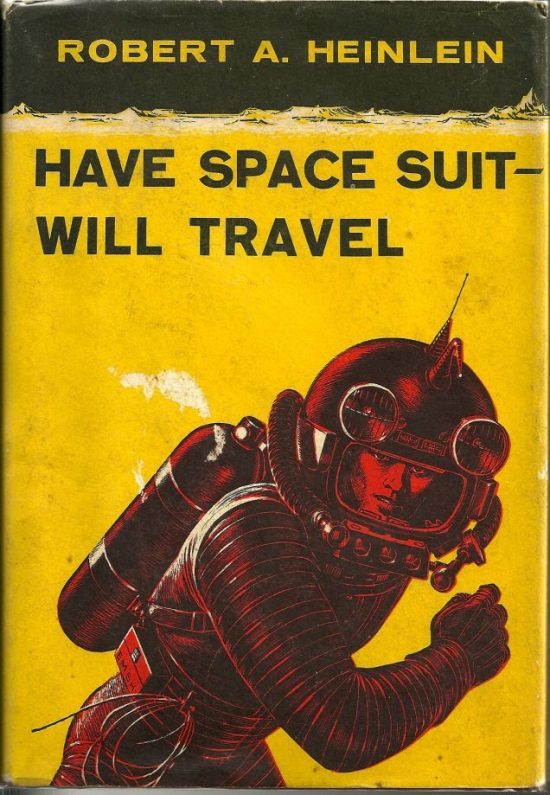
So you want to be a writer? Good, you’ll find plenty of advice from the best here at Open Culture. Oh, you want to be a science fiction writer? The great Ursula K. Le Guin has offered readers a wealth of writing advice, though she won’t tell us “how to sell a ship, but how to sail one.” But wait, you also want to know how to publish, and make a living? For that, you’d better see Robert Heinlein, one of the acknowledged masters of the Golden Age of science fiction and a hugely prolific author who pioneered both popular hard sci-fi and what he called “speculative fiction,” a more serious, literary form incorporating social and political themes.
In his 1947 essay “On the Writing of Speculative Fiction,” Heinlein refers to these “two types” of science fiction as “the gadget story and the human interest story.” The latter kind of story, writes Heinlein “stands a better chance with the slicks than a gadget story does” because it has wider appeal. This advice sounds rather utilitarian, doesn’t it? What about passion, inspiration, the muse? Eh, you don’t have time for those things. If you want to be successful like Robert Heinlein, you’ve got to write stories, lots of ‘em, stories people want to publish and pay for, stories people want to read.
Heinlein spends the bulk of his essay advising us on how to write such stories, with a proviso, in an epigram from Rudyard Kipling, that “there are nine-and-sixty ways / Of constructing tribal lays / And every single one of them is right.” After, however, describing in detail how he writes a “human interest” science fiction story, Heinlein then gets down to business. He assumes that we can type, know the right formats or can learn them, and can spell, punctuate, and use grammar as our “wood-carpenter’s sharp tools.” These prerequisites met, all we really need to write speculative fiction are the five rules below:
1. You must write.
2. You must finish what you start.
3. You must refrain from rewriting except to editorial order.
4. You must put it on the market.
5. You must keep it on the market until sold.
You might think Heinlein has lapsed into the language of the realtor, not the writer, but he is deadly serious about these rules, which “are amazingly hard to follow—which is why there are so few professional writers and so many aspirants.” Anyone who has tried to write and publish fiction knows this to be true. But what did Heinlein mean in giving us such an austere list? For one thing, as he notes many times, there are perhaps as many ways to write sci-fi stories as there are people to write them. What Heinlein aims to give us are the keys to becoming professional writers, not theorists of writing, lovers of writing, dabblers and dilettantes of writing.
Award-winning science fiction writer Robert J. Sawyer has interpreted Heinlein’s rules with commentary of his own, and added a sixth: “Start Working on Something Else.” Good advice. Heinlein’s rule number three, however—“the one that got Heinlein in trouble with creative-writing teachers”—seems to contradict what most every other writer will tell us. Sawyer suggests we take it to mean, “Don’t tinker endlessly with your story.” Writer Patricia C. Wrede agrees, but also suggests that “Heinlein was of the school of thought that felt that ‘good enough’ was all that was necessary, ever.”
Like 19th century writers who churned out novels as serialized stories for the papers and magazines, Heinlein and his fellow Golden Age writers made their living selling story after story to the “pulps” and the “slicks” (preferably the slicks). One had to be prolific, and being “’prolific enough’ often involved not having time to polish and revise much (if at all).” So rule number three may or may not apply, depending on our constraints. The literary market has changed dramatically since 1947, but the rest of Heinlein’s rules still seem nonnegotiable if we intend not only to write—speculative fiction or otherwise—but also to make a career doing so.
Related Content:
Writing Tips by Henry Miller, Elmore Leonard, Margaret Atwood, Neil Gaiman & George Orwell
Ray Bradbury Gives 12 Pieces of Writing Advice to Young Authors (2001)
Stephen King’s Top 20 Rules for Writers
Josh Jones is a writer and musician based in Durham, NC. Follow him at @jdmagness
Read More...Watch John Malkovich Portray David Lynch and Lynch’s Famous Characters from Eraserhead, Blue Velvet, Twin Peaks & More
John Malkovich’s filmography includes not Wild at Heart but Places in the Heart, not Inland Empire but Empire of the Sun, not Mulholland Drive but Mulholland Falls. This respected actor, in short, has never appeared in a David Lynch film, but he recently demonstrated that he could have starred in all of them — and can even portray the director himself. In Psychogenic Fugue, Malkovich slips into a variety of Lynchian personas, from heroes like Eraserhead’s iconically pillar-haired Henry Spencer and Twin Peaks’ squarely coffee-loving Special Agent Dale Cooper to villains like Blue Velvet’s Frank Booth and Lost Highway’s Mystery Man, to even the Ladies Log and in the Radiator.
Those names, I assure filmgoers not so up on their Lynch, will mean a great deal to fans, whether of the director or of the actor. Though both are American men of cinema, both of the same generation, Lynch and Malkovich would at first appear to have little in common: the former, who’s made ten features in the past forty years, has spent his career diving deeper and deeper into stranger and more personal (but ultimately, somehow, accessible) psychological waters, while the latter, prolific in his screen acting with almost 100 appearances to his credit, hops between hugely disparate personalities, time periods, and intellectual levels without seeming to break a sweat. But both of them do tend to attract the same descriptor: intense.
The versatile Malkovich also knows what it means to look inside himself, having starred in Spike Jonze’s Being John Malkovich, which famously includes a scene where every human being has turned into a version of John Malkovich. This minute-long trailer for Psychogenic Fugue may remind you of that unforgettable viewing experience, but if you want the full, twenty-minute version, it comes with only a ten-dollar donation (accompanied by more goodies at higher donation levels) to the David Lynch Foundation, which you can make at playinglynch.com. The fact that the money won’t go to fund another Lynch feature may disappoint some, but at least if he eventually decides to make a not just psychologically but literally autobiographical film, he’ll know exactly who to cast in the lead.
Related Content:
Hear John Malkovich Read From Breakfast of Champions, Then Hear Kurt Vonnegut Do the Same
David Lynch Directs a Mini-Season of Twin Peaks in the Form of Japanese Coffee Commercials
A Young David Lynch Talks About Eraserhead in One of His First Recorded Interviews (1979)
David Lynch’s Surreal Commercials
Based in Seoul, Colin Marshall writes and broadcasts on cities and culture. He’s at work on a book about Los Angeles, A Los Angeles Primer, the video series The City in Cinema, the crowdfunded journalism project Where Is the City of the Future?, and the Los Angeles Review of Books’ Korea Blog. Follow him on Twitter at @colinmarshall or on Facebook.
Read More...Hear the First Recording of Computer Generated Music: Researchers Restore Music Programmed on Alan Turing’s Computer (1951)

However you feel about electronic music, you’ll still find yourself listening to it most places you go. For better or worse, it has become mood music, soothing the jangled nerves of customers in coffee shops and lulling boutique shoppers into a pleasant sense of hip. Some computer music pioneers have moved on from composing their own music to making computers do it for them. It’s precisely the kind of thing I imagine Alan Turing might have pursued had the computer science giant also been a musician.
In fact, Turing did inadvertently create a computer that could play music when he input a sequence of instructions into it, which relayed sound to a loudspeaker Turing called “the hooter.” By varying the “hoot” commands, Turing found that he could make the hooter produce different notes, but he was “not very interested in programming the computer to play conventional pieces of music,” note Jack Copeland and Jason Long at the British Library’s Sound and Vision blog. Turing “used the different notes” as a rudimentary notification system, “to indicate what was going on in the computer.”
Instead, the task fell to schoolteacher, pianist, and future computer scientist Christopher Strachey to create the first computer-generated music, using Turing’s gigantic Mark II, its programming manual, and “the longest computer program ever to be attempted.” After an all-night session, Strachey had taught the computer to hoot out “God Save the Queen.” Upon hearing the composition the next morning, Turing exclaimed, “good show,” and Strachey received a job offer just a few weeks later.
Once the BBC heard of the achievement, they visited Turing’s Computing Machine Laboratory and made the recordings above in 1951, which include a version of Strachey’s “God Save the Queen” program and renditions of “Baa Baa Black Sheep” and Glenn Miller’s “In the Mood.” The “original 12-inch disc the melodies were recorded on,” writes The Verge, “has been known about for a while, but when Copeland (a professor) and Long (a composer) listened to it, they found the audio was not accurate.” The two describe in their blog post how they went about restoring the audio and how it came to exist in the first place.
While the music Turing’s computer produced sounds painfully primitive, it would be several more years before composers began to really experiment with computer-generated music beyond the rudimentary first steps, and well over a decade before the design of systems that could operate in real time.
Now, although they still require human input (“the singularity isn’t upon us,” writes Spin), computers have begun to compose their own music, like “Daddy’s Car,” a Beatles-esque song generated by a SONY CSL Research Laboratory AI called Flow Machine. Here, a composer mixes and matches different elements, a style, melody, lyrics, etc. from various databases. The machine produces the sounds. SONY labs have been generating computer-made jazz and classical music for some time now—some of which we may have already heard as background music.
As Spin points out, already a new startup called Jukedeck promises to “generate a song in the genre and mood of your choosing…” perhaps as “background music for advertisements or YouTube vlogs.” True to the spirit of the man who inadvertently invented computer music, and who theorized how a computer might demonstrate consciousness, the software will ask you to confirm that you are not a robot.
Related Content:
The Enigma Machine: How Alan Turing Helped Break the Unbreakable Nazi Code
Josh Jones is a writer and musician based in Durham, NC. Follow him at @jdmagness
Read More...Support Us
We're hoping to rely on loyal readers, rather than erratic ads. Please click the Donate button and support Open Culture. You can use Paypal, Venmo, Patreon, even Crypto! We thank you!

About Us

Open Culture scours the web for the best educational media. We find the free courses and audio books you need, the language lessons & educational videos you want, and plenty of enlightenment in between.
Advertise With Us

FREE UPDATES!
GET OUR DAILY EMAIL
Get the best cultural and educational resources on the web curated for you in a daily email. We never spam. Unsubscribe at any time.
FOLLOW ON SOCIAL MEDIA

Open Culture editor Dan Colman scours the web for the best educational media. He finds the free courses and audio books you need, the language lessons & movies you want, and plenty of enlightenment in between.
Advertise With Us


