Behold the “3Dvarius,” the World’s First 3‑D Printed Violin
There is a perpetual argument among stringed instrument aficionados about the esoteric value of so-called “tonewoods.” Certainly, to most discriminating ears, the differences between an acoustic guitar, mandolin, or violin made of solid spruce or maple and one made of plywood seem sonically obvious. When it comes to electric guitars, the distinctions between materials can seem more negligible. In blind tests many of us might have some difficulty telling the difference between an electric guitar made of the finest woods and one made of cheap balsa, lucite, or even an oil can. (Not that differences don’t exist!) It’s hardly controversial to point out that acoustic instruments depend upon their materials and workmanship in ways electric instruments don’t.
So how might discriminating ears respond to an electric, digitally 3‑D printed acrylic violin, based loosely on a real Stradivarius? Can such an instrument replicate the sweet sustain of an acoustic violin, Strad or otherwise? You can judge for yourself in the demonstrations here. Created by French engineer and musician Laurent Bernadac, the “3Dvarius”—the world’s first 3‑D printed violin—is perhaps, reports Wired, “a harbinger of what’s to come for musical instruments.” Critics have shown how it falls far short of recreating the sound of a traditional instrument. (See violinist Joanna Wronko compare the two at a TEDx Amsterdam talk here). And yes, the 3Dvarius may look “more like an avian skeleton than a stringed instrument.” But it does have some advantages over traditional violins made of wood.
For one thing, synthetic instruments are highly durable and lightweight (violins and cellos made of carbon fiber have been on the market for several years). For another, the 3Dvarius can indeed make some pretty sweet sounds when plugged into Bernadac’s rig, consisting of various effects pedals and loopers. At the top, see how he uses his setup to create jazzy multi-layered, multi-track arrangements of popular songs with the 3Dvarius. And hear a few of those songs here, along with snazzy videos—including U2’s “With or Without You,” the Game of Thrones and X‑Files themes, and “Se Bastasse Una Canzone” by Italian singer/songwriter Eros Ramazzotti. (See many more on Youtube.) The 3Dvarius website has a step-by-step explanation of how the instrument is made, from initial design to surface treatment and final assembly.
Despite its name and inspiration, the 3Dvarius doesn’t claim to actually duplicate a Stradivarius, a feat long thought impossible by even the finest modern luthiers. Even computer scientists admit: no matter how good machines get at replication, replacing traditional, handmade violins with printed copies “would lead to digitally cloned instruments,” writes Wired, “and the loss of sonic character that makes music, well, music.” And it isn’t only sonic character that matters to musicians. Surprisingly enough, in blind tests, many violinists can’t tell the difference between a Stradivarius and a high-quality newer model violin, but these findings do not diminish the Stradivarius mystique. The look and feel of an instrument and its make and pedigree matter. As musician and writer Clemency Burton-Hill points out, much of our fascination with the Stradivarius violin has to do with the “story of Stradivari,” as well as those of the musicians who have owned and played his instruments.
And though it may be possible to come close to their tones with cheaper modern copies and digital technology, we still gush over Jimi Hendrix’s Stratocaster or Jimmy Page’s Les Paul. The 3Dvarius, I’ll admit, is a very cool idea, but it’s hard to imagine a digitally-produced plastic artifact ever acquiring the same intangible aura of not only the most famous instruments in the world, but also of unique, hand-crafted new instruments on their way to making history. As Walter Benjamin argued in “The Work of Art in the Age of Mechanical Reproducibility,” it’s the authenticity of “aura”—the specific traces of history and the fingerprints of artists and master craftsmen—that we treasure in art. These are qualities that elude the most advanced technological processes.
Related Content:
Why Violins Have F‑Holes: The Science & History of a Remarkable Renaissance Design
Musician Plays the Last Stradivarius Guitar in the World, the “Sabionari” Made in 1679
Josh Jones is a writer and musician based in Durham, NC. Follow him at @jdmagness
Read More...Hear a Radio Drama of George Orwell’s 1984, Starring Patrick Troughton, of Doctor Who Fame (1965)
Take two of the most prominent English cultural properties of the past several decades, bring them together, and what have you got? You’ve got Patrick Troughton, better known as the Second Doctor in TV’s Doctor Who, in a 1965 BBC Radio adaptation of George Orwell’s 1984. Troughton was not yet the Doctor; the honor would not fall to him until the following year when he replaced William Hartnell (with the latter’s full approval, it seems). But he was a well-known character actor, the first to play Robin Hood on television (in a 1953 BBC mini-series), and a figure who inspired a good deal of respect in the British entertainment industry. Troughton was also a decorated World War II veteran (who, when the year 1984 finally arrived, suffered his second major heart attack).
Troughton brings to the role of everyman Winston Smith a gravitas shared by a number of actors who have inherited the role since the very first radio adaptation in 1949, starring David Niven. Of course Orwell’s story is not an ongoing series like Doctor Who, but it has remained remarkably relevant to every generation post-World War II, and like the Doctor’s character, has been constantly re-imagined in adaptations on radio, film, and television. The conditions of government repression, censorship, and mass surveillance Orwell foresaw have seemed imminent, if not fully realized, in the decades following the novel’s 1948 publication, though the adjective “Orwellian” and many of the novel’s coinages have suffered a good deal through overuse and misapplication.
Just as the first radio play of 1984 warned of a “disturbing broadcast,” this 1965 version begins, “The following play is not suitable for those of a nervous disposition.” It’s interesting that even this long after the novel’s publication, and in the midst of the swinging sixties, Orwell’s dystopian fable still had the power to shock. Or at least the producers of this broadcast thought so. Perhaps we’ve been so thoroughly inured to the prospects Orwell warned of that revelations of the NSA’s massive data collection, or of the global expropriation disclosed by the Panama Papers, or of any number of nefarious government dealings often elicit a cynical shrug from the average person. Those who do express alarm at such documented abuses are often branded… well, alarmists.
But then again, we keep returning to Orwell.
Continuing in the tradition begun by David Niven and carried forward by Patrick Troughton (and on film by Edmond O’Brien and John Hurt), another respected British actor recently took on the role of Winston Smith in a BBC 4 radio adaptation three years ago. This time the actor was Christopher Eccleston, who also, it turns out, once played Doctor Who.
Related Content:
What “Orwellian” Really Means: An Animated Lesson About the Use & Abuse of the Term
The Cover of George Orwell’s 1984 Becomes Less Censored with Wear and Tear
Josh Jones is a writer and musician based in Durham, NC. Follow him at @jdmagness
Read More...Hermeneutics of Toilets by Slavoj Žižek: An Animation About Finding Ideology in Unlikely Places
It’s been part of Slavoj Žižek’s schtick for years. He’s mentioned it in talks about Donald Rumsfeld and America’s misadventures in Iraq. In lectures about architecture in Spain. In English-language talks. And other languages too. Maybe you’ve never heard Žižek’s spiel about finding ideology in the unlikeliest of places. Yes, toilets. If you’ve missed out, this new animation has you covered.
If you would like to support the mission of Open Culture, consider making a donation to our site. It’s hard to rely 100% on ads, and your contributions will help us continue providing the best free cultural and educational materials to learners everywhere. You can contribute through PayPal, Patreon, and Venmo (@openculture). Thanks!
Related Content:
Slavoj Žižek Calls Political Correctness a Form of “Modern Totalitarianism”
Slavoj Žižek: What Fulfils You Creatively Isn’t What Makes You Happy
Slavoj Žižek Names His Favorite Films from The Criterion Collection
Read More...Download 6600 Free Films from The Prelinger Archives and Use Them However You Like
Features, commercials, art pieces, stock footage, home movies, propaganda: the history of cinema so far has produced countless individual forms, all of which also count as documentaries. Watch any kind of film made sufficiently long ago and you look through a window onto the attitudes, aesthetics, and accoutrements of another time.
And if it’s one made long enough ago or of obscure enough ownership to fall into the public domain, you can incorporate that piece of history into your own modern, era-spanning work in any way you like. Now, Prelinger Archives has made that easier than ever by making more than 6600 films free on the Internet Archive to download and use.
“Prelinger Archives was founded in 1983 by Rick Prelinger in New York City,” says the collection’s about page. “Over the next twenty years, it grew into a collection of over 60,000 ‘ephemeral’ (advertising, educational, industrial, and amateur) films. In 2002, the film collection was acquired by the Library of Congress, Motion Picture, Broadcasting and Recorded Sound Division,” and now holds “approximately 11,000 digitized and videotape titles (all originally derived from film) and a large collection of home movies, amateur and industrial films acquired since 2002.” Its mission? “To collect, preserve, and facilitate access to films of historic significance that haven’t been collected elsewhere.”
And what can you find amid these 6000-odd pieces of ephemera hosted on Archive.org? At first glance, they may really strike you as 6000 odd pieces. We’ve previously featured 1958’s Have I Told You Lately That I Love You?, a UCLA student short Ayun Halliday described as the tale of “a white-collar dad and housewife mom… marooned in their individual existential hells, unable to connect” due to the labor-saving devices of the day. 1965’s equally cautionary (as well as often unintentionally hilarious) Perversion for Profit, offers a stern two-part warning against the “pornography which may appear at the local newsstand, malt shop or drugstore.”
Midcentury moralism manifests in countless entertaining forms across the Prelinger Archives collection, including in Make Mine Freedom, a Cold War cartoon treatment of the various treacherous “-isms” out to undermine truth, justice, and the American Way. That came out in 1948, just as fears started roiling again after the United States’ victory in the Second World War. The year before, the husband-and-wife experimental filmmaking team of Alexander Hammid and Maya Deren completed The Private Life of a Cat. “Using their own cats in their own apartment,” writes Dangerous Minds’ Amber Frost, “they chronicle the interior world of a cat ‘family,’ and it’s just insanely compelling, even outside of the cat-lady milieu!” Further down, we have House in the Middle (1954), which suggests that a clean, tidy house can help you survive an atomic blast.
But you don’t have to watch everything you dig up from the Prelinger Archives collection in an ironic or avant-garde frame of mind. Some pieces, like amateur filmmaker and inventor Tullio Pellegrini’s 1955 Cinemascope homage to the city of San Francisco just above, offer much in the way of pure historical interest. You can find a few more suggestions about where to start from Tim Brookes at MakeUseOf, who highlights even earlier footage of the City by the Bay, perhaps the most generic film ever made, and instructions on what to do on a date as well as what to do in the event of a nuclear attack — all valuable material for those of us remixing history, one ephemeral clip at a time.
One final thing worth keeping in mind, the Archive comes with this invitation:
You are warmly encouraged to download, use and reproduce these films in whole or in part, in any medium or market throughout the world. You are also warmly encouraged to share, exchange, redistribute, transfer and copy these films, and especially encouraged to do so for free. Any derivative works that you produce using these films are yours to perform, publish, reproduce, sell, or distribute in any way you wish without any limitations.
If you happen to get creative with the films in the Archive, please feel free to share your creations in the comments section below.
Related Content:
4,000+ Free Movies Online: Great Classics, Indies, Noir, Westerns, Documentaries & More
This is Coffee!: A 1961 Tribute to Our Favorite Stimulant
Free: British Pathé Puts Over 85,000 Historical Films on YouTube
1,000,000 Minutes of Newsreel Footage by AP & British Movietone Released on YouTube
The Public Domain Project Makes 10,000 Film Clips, 64,000 Images & 100s of Audio Files Free to Use
Based in Seoul, Colin Marshall writes and broadcasts on cities, language, and style. He’s at work on a book about Los Angeles, A Los Angeles Primer, the video series The City in Cinema, the crowdfunded journalism project Where Is the City of the Future?, and the Los Angeles Review of Books’ Korea Blog. Follow him on Twitter at @colinmarshall or on Facebook.
Read More...T.S. Eliot Reads From “The Waste Land,” “The Love Song of J. Alfred Prufrock” & “The Hollow Men”: His Apocalyptic Post WWI Poems
The T.S. Eliot of the post-World War I period was a poet who stood Janus-faced on the threshold of old and new worlds. He looked backward to the mountain ranges of European tradition and marveled at their alpine peaks. At the same time, he seemed acutely aware of what a ridiculous figure he sometimes cut in his self-serious, pedantic veneration for the past. Eliot acknowledged the inexorable movement of time in poems like “The Waste Land,” “The Love Song of J. Alfred Prufrock,” and “The Hollow Men,” even if time only moved forward into entropy and mediocrity. When Eliot looked ahead, after the horrors of war and the increasing speed of modernization, what he saw was fragmentation, wreckage, and waste. I have heard his strategy in “The Waste Land” described as a “terminal aesthetic”—a beautifully destructive poetics, and one which could go no further.
Eliot’s high modernist poems stand in very different relation to the post-WWI world than the work of forward-looking 20th century avant-garde artists of the period. As James Martin Harding notes in Adorno and “A Writing of the Ruins,” what “distinguishes Eliot from the avant-garde is that… the politics of the avant-garde evinced a faith in revolutionary progress…. One would have to ally Eliot’s imagery with the dawning of the postmodern”—with ideas, that is, of the “end of history.” In terms of form—characterized by pastiche, irony, self-referentiality, and a blending of high and low culture—Eliot’s poetics were distinctly post-modern.
But postmodernists have generally celebrated the fragmenting of tradition and the loss of grand narratives. Eliot cherished the old, destroyed world, and mostly despaired of anything of value replacing it. His immediate predecessors, whom he imitated and referenced often, were the French symbolists and decadents; modernist aesthetes who mourned unnamed catastrophes and catalogued absurd correspondences. Critic Cleanth Brooks singles out one poem that Eliot quotes at the end of “The Waste Land,” Gerard de Nerval’s “El Desdichado,” for its suggestion that “the protagonist of the poem has been disinherited, robbed of his tradition.” Even in translation, we can hear in Nerval’s lines the darkly comic, cosmically ironic, despair of Eliot’s Prufrock:
My very supernova’s been snuffed out, and my one
shiny-tendoned lute has been silenced by DEPRESSION.
I think you can hear that same world-weary depression and sense of cultural exhaustion in Eliot’s voice as he reads from both “The Waste Land” and “The Love Song of J. Alfred Prufrock” above and from “The Hollow Men” below (unfortunately drowned out near the end by some added music). I don’t mean to suggest that Eliot himself suffered from some form of clinical depression. But his poetic speakers—and in the case of “The Waste Land” his jumble of competing voices—all join in an apocalyptic chorus as though witnessing the world’s end. Perhaps the poetry exaggerates Eliot’s own personal attitudes for effect, perhaps it acts as a series of guises for the philosophical and critical ideas he explained without artifice in his essays.
This is how many people have read Eliot’s poems, myself included: as containers for abstract ideas about cultural decay and the nature of art and tradition. But Eliot and his sometime editor and friend Ezra Pound would likely object to this kind of approach to poetry. Added at the insistence of his publisher, Eliot’s footnotes to “The Waste Land” seem to mock readers anxious to leap to interpretation. Instead, the poet would ask us to attend not to ideas, but to the images, and the emotions they evoke—and in this case, to attend also to the poet’s voice.
Related Content:
1,000 Free Audio Books: Download Great Books for Free
Listen to T.S. Eliot Recite His Late Masterpiece, the Four Quartets
Josh Jones is a writer and musician based in Durham, NC. Follow him at @jdmagness
Read More...The Making of Japanese Handmade Paper: A Short Film Documents an 800-Year-Old Tradition
For many of us, washi paper is the art supply equivalent of a dish that’s “too pretty to eat.” I love to look at it, but would be loathe to mar its beauty with my amateur creative efforts.
Originally intended for use in lanterns and shoji screens in Japan, its simplicity makes it a stand out among the far more ornamental decorative sheets populating the fancy international paper selections. Though there is no shortage of machine-produced washi on the market these days, the loveliest examples are still handmade in Kurotani, a small town near Kyoto.
Kurotani has the distinction of being Japan’s oldest paper-making town, and as documented by filmmaker Kuroyanagi Takashi, above, the washi process has changed little in 800 years.
In the pre-industrial age, washi-making was seasonal. Farmers planted the paper mulberry (kozo), mitsumata, and gampi plants essential to the process along with their food crops. Come havest-time, they would soak these plants’ fibrous inner barks until they were soft enough to be cleaned and pounded.
Then as now, the resulting pulp was added mixed with liquid and a mucilage to yield a (not particularly delicious sounding, and definitely not too pretty to eat…) spreadable paste.
The sheets are formed on bamboo screens, then stacked and pressed until dry.
The end result is both strong and flexible, making it a favorite of bookbinders. Its absorbency is prized by printmakers, including Rembrandt.
If you have a yen to witness the labor-intensive, traditional process up close, Dutch washi craftsman Rogier Uitenboogaart runs a guest house as part of his studio in nearby Kamikoya.
The rest of us must content ourselves with Takashi’s meditative 5‑minute documentary.
Related Content:
How Ink is Made: A Voluptuous Process Revealed in a Mouth-Watering Video
Ayun Halliday is an author, illustrator, and Chief Primatologist of the East Village Inky zine. She writes a monthly column about people who love their jobs for Mainichi Weekly, a bilingual Japanese newspaper. Follow her @AyunHalliday
Read More...Walt Whitman’s Unearthed Health Manual, “Manly Health & Training,” Urges Readers to Stand (Don’t Sit!) and Eat Plenty of Meat (1858)
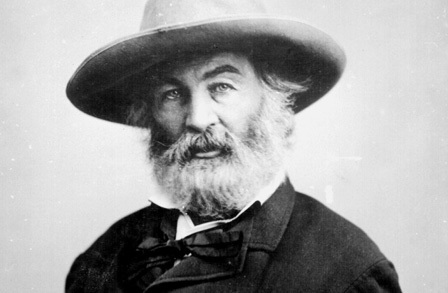
The idea of “the author,” wrote Roland Barthes, “rules in manuals of literary history, in biographies of writers, in magazine interviews, and even in the awareness of literary men, anxious to unite, by their private journals, their person and their work.” We see this anxiety of authorship in much of Walt Whitman’s personal correspondence. The poet, “could be surprisingly anxious about his own disappearance,” writes Zachary Turpin in the introduction to a recently re-discovered series of Whitman essays called “Manly Health and Training.”
Whitman, however, was just as often anxious to disassociate his person from his work, whether juvenile short stories or his copious amount of journalism and occasional pieces. Originally published in the New York Atlas between 1858 and 1860, “Manly Health and Training”—“part guest editorial, part self-help column”—may indeed represent some of the work Whitman wished would disappear in his late-in-life attempts at “careerist revisionism.” As it happens, reports The New York Times, these articles did just that until Turpin, a graduate student in English at the University of Houston, found the essays last summer while browsing articles written under various journalistic pseudonyms Whitman used.
The work in question appeared under the name “Mose Velsor,” and it’s worth asking, as Barthes might, whether we should consider it by the poetic figure we call “Whitman” at all. Though we encounter in these occasionally “eyebrow-raising” essays the “more-than-typically self-contradictory Whitman,” Turpin comments, “these contradictions display little of the poetic dialecticism of Leaves of Grass”—first published, without the author’s name, in 1855.
The essays are piecemeal distillations of “a huge range of topics” of general interest to male readers of the time—in some respects, a 19th century equivalent of Men’s Health magazine. And yet, argues Ed Folsom, editor of The Walt Whitman Quarterly—which has published the nearly 47,000 word series of essays online—“One of Whitman’s core beliefs was that the body was the basis of democracy. The series is a hymn to the male body, as well as a guide to taking care of what he saw as the most vital unit of democratic living.” These themes are manifest along with the robust homoeroticism of Whitman’s poetry:
We shall speak by and by of health as being the foundation of all real manly beauty. Perhaps, too, it has more to do than is generally supposed, with the capacity of being agreeable as a companion, a social visitor, always welcome—and with the divine joys of friendship. In these particulars (and they surely include a good part of the best blessings of existence), there is that subtle virtue in a sound body, with all its functions perfect, which nothing else can make up for, and which will itself make up for many other deficiencies, as of education, refinement, and the like.
David Reynolds, professor of English at the Graduate Center of the City University of New York, concurs: “there’s a kind of health-nut thing about ‘Leaves of Grass’ already. This series sort of codifies it and expands on it, giving us a real regimen.” To that end, two of “Mose Velsor”’s prominent topics are diet and exercise, and whether we consider “Manly Health and Training” a prose addendum to Whitman’s first book or mostly work-for-hire on a range of topics in his general purview, some of the advice, like the poetry, can often sound particularly modern, while at the same time preserving the quaintness of its age.
Anticipating the Paleo craze, for example, Whitman writes, “let the main part of the diet be meat, to the exclusion of all else.” His diet advice is far from systematic from essay to essay, yet he continually insists upon lean meat as the foundation of every meal and refers to beef and lamb as “strengthening materials.” The “simplest and most natural diet,” consists of eating mainly meat, Whitman asserts as he casts aspersions on “a vegetarian or water-gruel diet.” Whitman issues many of his dietary recommendations in the service of vocal training, recommending that his readers “gain serviceable hints from the ancients” in order to “give strength and clearness to their vocalizations.”
Aspirants to manliness should also attend to the ancients’ habit of frequenting “gymnasiums, in order to acquire muscular energy and pliancy of limbs.” Many of Whitman’s training regimens conjure images from The Road to Wellville or of stereotypical 19th-century strong men with handlebar mustaches and funny-looking leotards. But he does intuit the modern identification of a sedentary lifestyle with ill health and premature death, addressing especially “students, clerks, and those in sedentary or mental employments.” He exhorts proto-cubical jockeys and couch potatoes alike: “to you, clerk, literary man, sedentary person, man of fortune, idler, the same advice. Up!”
Whitman’s “warnings about the dangers of inactivity,” writes The New York Times, “could have been issued from a 19th-century standing desk,” a not unlikely scenario, given the many authors from the past who wrote on their feet. But should we picture Whitman himself issuing these proclamations on “Health and Training”? No image of the man himself, with cocked elbow and cocked hat, is affixed to the essays. The pseudonymous byline may be no more than a convention, or it may be a desire to inhabit another persona, and to distance the words far from those of “Walt Whitman.”
Did Whitman consider the essays hackwork—populist pabulum of the kind struggling writers today often crank out anonymously as “sponsored content”? The series, Turpin writes “is un-Whitmanian, even unpoetic,” its function “fundamentally utilitarian, a physiological and political document rooted in the (pseudo)sciences of the era.” Not the sort of thing one imagines the highly self-conscious poet would have wanted to claim. “During his lifetime,” Whitman “wasted no time reminding anyone of this series,” likely hoping it would be forgotten.
And yet, it’s interesting nonetheless to compare the exaggerated masculinity of “Manly Health and Training” with much of the belittling personal criticism Whitman received in his lifetime, represented perfectly by one Thomas Wentworth Higginson. This critic and harsh reviewer included Whitman’s “priapism,” his serving as a nurse during the Civil War rather than “going into the army,” and his “not looking… in really good condition for athletic work” as reasons why the poet “never seemed to me a thoroughly wholesome or manly man.”
In addition to thinly veiled homophobia, many of Higginson’s comments suggested, write Robert Nelson and Kenneth Price, that “as a social group, working-class men did not and could not possess the qualities of true manliness.” Perhaps we can read these early Whitman editorials, pseudonymous or not, as democratic instructions for using masculine health as a great social leveler and means to “make up for many other deficiencies, as of education, refinement, and the like.” Or perhaps “Manly Health and Training” was just another assignment—a way to pay the bills by peddling popular male wish-fulfillment while the poet waited for the rest of the world to catch up with his literary genius.
Related Content:
Free Online Literature Courses
Orson Welles Reads From America’s Greatest Poem, Walt Whitman’s “Song of Myself” (1953)
Mark Twain Writes a Rapturous Letter to Walt Whitman on the Poet’s 70th Birthday (1889)
Josh Jones is a writer and musician based in Durham, NC. Follow him at @jdmagness
Read More...President Obama’s 2016 Stand-Up Comedy Routine
One thing I’ll miss about President Obama is his ability to deliver a good joke at the White House Correspondents’ Dinner. My favorite line from Saturday night:
And then there’s Ted Cruz. Ted had a tough week. He went to Indiana –- Hoosier country –- stood on a basketball court, and called the hoop a “basketball ring.” What else is in his lexicon? Baseball sticks? Football hats? But sure, I’m the foreign one.
Bern!
And it’s always nice to see John Boehner and Obama sharing a good joke around a smoke. Fast forward to the 27 minute mark for that.
Below, we also have Larry Wilmore’s cutting routine:
Related Content:
Hear 30 of the Greatest Standup Comedy Albums: A Playlist Chosen by Open Culture Readers
Lenny Bruce: Hear the Performances That Got Him Arrested (NSFW)
Richard Pryor Does Early Stand-Up Comedy Routine in New York, 1964
Seinfeld, Louis C.K., Chris Rock, and Ricky Gervais Dissect the Craft of Comedy (NSFW)
Read More...Discover Harvard’s Collection of 2,500 Pigments: Preserving the World’s Rare, Wonderful Colors
If modern paint companies’ pretentiously-named color palettes gall you to the point of an exclusively black-and-white existence, the Harvard Art Museums’ Forbes pigment collection will prove a welcome balm.
The hand and typewritten labels identifying the collection’s 2500+ pigments boast none of the flashy “creativity” that J. Crew employs to peddle its cashmere Boyfriend Cardigans.
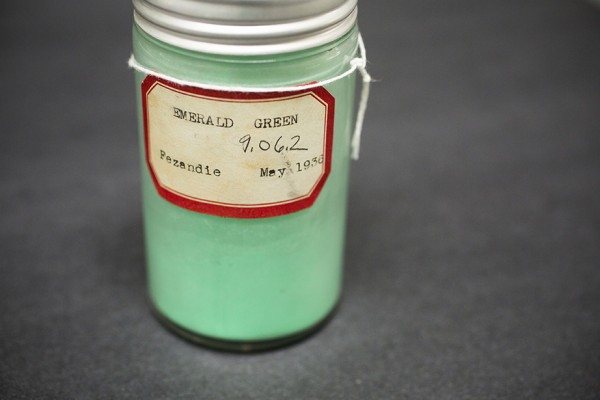
Images by Harvard News
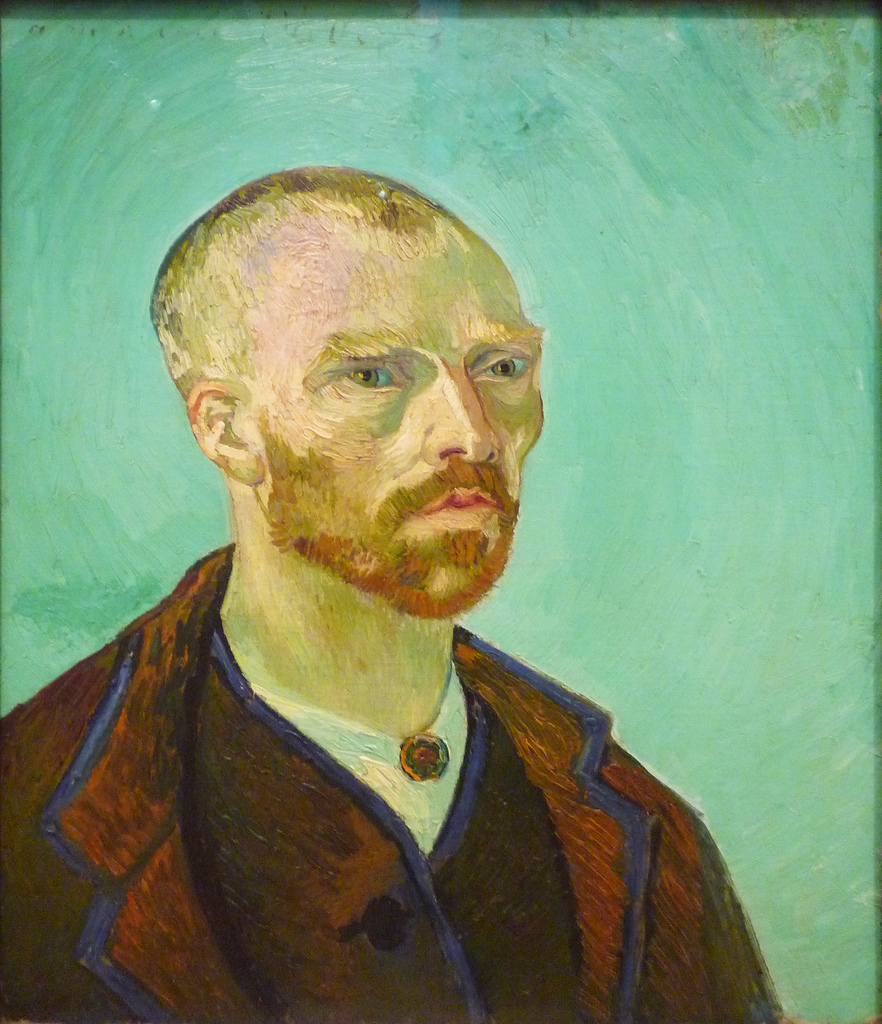
The benign, and wholly unexciting-sounding “emerald green” is —unsurprisingly—the exact shade legions of Oz fans have come to expect. The thrills here are chemical, not conferred. A mix of crystalline powder copper acetoarsenite, this emerald’s fumes sickened penniless artists as adroitly as they repelled insects.
Look how nicely it goes with Van Gogh’s ruddy hair…
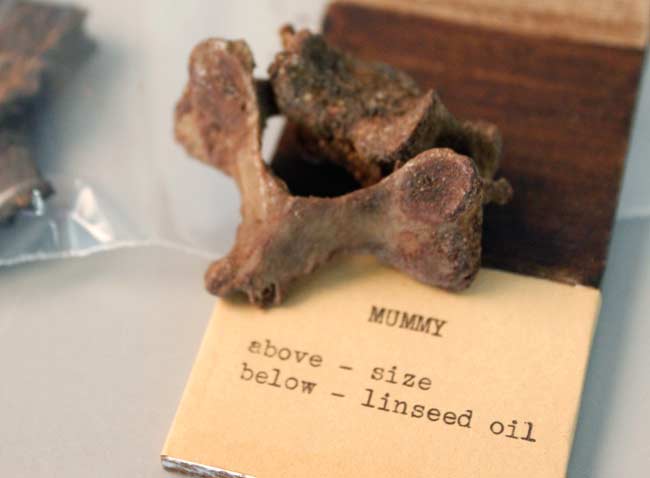
“Mummy” is perhaps the closest the Forbes collection comes to 21st- century pigment naming. As Harvard’s Director of the Straus Center for Conservation and Technical Studies, Narayan Khandekar, notes in the video above, its mushroom shade is no great shakes. The source—the resin used to seal mummies’ bandages—is what distinguishes it.
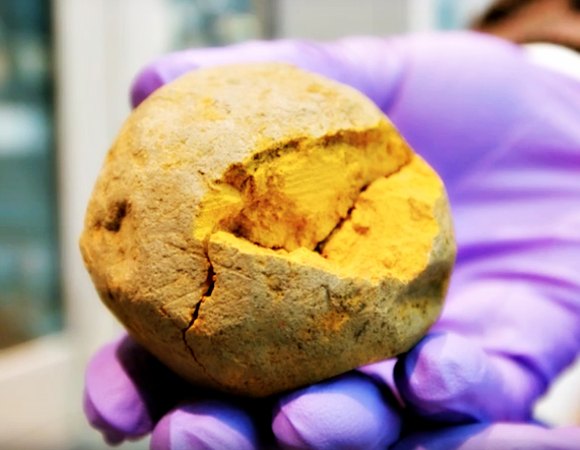
The collection’s crown jewel is a rich ball of mustard‑y Indian Yellow. This pigment comes not from maize, nor earth, but from the dehydrated urine of a cow subsisting exclusively on mango leaves. I’m drawn to it like a moth to the living room walls. I’m sure Benjamin Moore had his reasons for dubbing its urine-free facsimile “Sunny Days.”
The images above, save the Van Gogh painting, comes courtesy of by Harvard News. The video above was created by Great Big Story.
Related Content:
How Ink is Made: A Voluptuous Process Revealed in a Mouth-Watering Video
Watch the First 10 Seasons of Bob Ross’ The Joy of Painting Free Online
Ayun Halliday is an author, illustrator, and Chief Primatologist of the East Village Inky zine. Follow her @AyunHalliday
Read More...Watch Animated Introductions to 35 Philosophers by The School of Life: From Plato to Kant and Foucault
Philosophy as an academic subject is regularly maligned in popular discourse. Philosophy majors get told that their studies are useless. Philosophy professors find their budgets cut, their courses scrutinized, and their character grossly impeached in propagandistic religious feature films. It’s enough to make one despair over the turgid air of anti-intellectualism that stifles conversation.
But before we start pining for bygone golden ages of rigorous critical thought, let us remember that philosophers have been a thorn in the side of the powerful since the inception of Western philosophy. After all, Socrates, the ancient Greek whose name we associate with philosophy’s most basic maxims and methods, was supposedly put to death for the crime of which today’s professorate so often stand accused: corrupting the youth.
We mostly know of Socrates’ life and death through the written dialogues of his star pupil, Plato, whom Alain de Botton calls in the first video above, “the world’s first true, and perhaps greatest, philosopher.” De Botton quickly explains in his animated School of Life introduction that the core of Plato’s philosophy constitutes a “special kind of therapy” geared toward Eudaimonia, or human fulfillment and well-being. From Plato, De Botton’s series of quick takes on famous philosophers continues, moving through the Enlightenment and the 19th and 20th centuries.
Key to Plato’s thought is the critical examination of Doxa, or the conventional values and “popular opinions” that reveal themselves as “riddled with errors, prejudice, and superstition.” Plato’s most famous illustration of the profound state of ignorance in which most of us live goes by the name “The Allegory of the Cave,” and receives a retelling with commentary by De Botton just above. The parable doesn’t only illustrate the utility of philosophy, as De Botton says; it also serves as a vivid introduction to Plato’s theory of the Forms—an ideal realm of which our phenomenal reality is only a debased copy.
The dualism between the real and the ideal long governed philosophical thought, though many competing schools like the Stoics expressed a healthy degree of skepticism. But we might say that it wasn’t until Immanuel Kant, whom you can learn about above, that Plato really met his match. Along with his famous ethical dictum of the “categorical imperative,” Kant also posited two distinct realms—the noumenal and the phenomenal. And yet, unlike Plato, Kant did not believe we can make any assertions about the properties or existence of the ideal. Whatever lies outside the cave, we cannot access it through our faulty senses.
These central questions about the nature of knowledge and mind not only make philosophy an immanently fascinating discipline—they also make it an increasingly necessary endeavor, as we move further into the realm of constructing artificial minds. Software engineers and video game developers are tasked with philosophical problems related to consciousness, identity, and the possibility of ethical free choice. And at the cutting edge of cognitive science—where evolutionary biology and quantum mechanics rub elbows—we may find that Plato and Kant both intuited some of the most basic problems of consciousness: what we take for reality may be nothing of the kind, and we may have no way of genuinely knowing what the world is like outside our senses.
As 17th century French philosopher and mathematician Rene Descartes feared, but found impossible to believe, our perception of the world may in fact be a deceptive, if useful, illusion. Learn more about Descartes above, and see De Botton’s full School of Life philosophy series at the top of the post. Or watch the series on Youtube.
There are 35 videos in total, which let you become acquainted with, and perhaps corrupted by, a range of thinkers who question orthodoxy and common sense, including Aristotle, Epicurus, Georg Wilhelm Friedrich Hegel, Friedrich Nietzsche, Michel Foucault, Arthur Schopenhauer, Albert Camus, Soren Kierkegaard, Jean-Paul Sartre, and Baruch Spinoza. Watch all of the videos in the playlist right below.
Related Content:
Free Online Philosophy Courses (140+ Free Courses)
An Animated Introduction to Goethe, Germany’s “Renaissance Man”
Alain de Botton Shows How Art Can Answer Life’s Big Questions in Art as Therapy
Josh Jones is a writer and musician based in Durham, NC. Follow him at @jdmagness
Read More...Support Us
We're hoping to rely on loyal readers, rather than erratic ads. Please click the Donate button and support Open Culture. You can use Paypal, Venmo, Patreon, even Crypto! We thank you!

About Us

Open Culture scours the web for the best educational media. We find the free courses and audio books you need, the language lessons & educational videos you want, and plenty of enlightenment in between.
Advertise With Us

FREE UPDATES!
GET OUR DAILY EMAIL
Get the best cultural and educational resources on the web curated for you in a daily email. We never spam. Unsubscribe at any time.
FOLLOW ON SOCIAL MEDIA

Open Culture editor Dan Colman scours the web for the best educational media. He finds the free courses and audio books you need, the language lessons & movies you want, and plenty of enlightenment in between.
Advertise With Us

