The Periodic Table of Elements Scaled to Show The Elements’ Actual Abundance on Earth
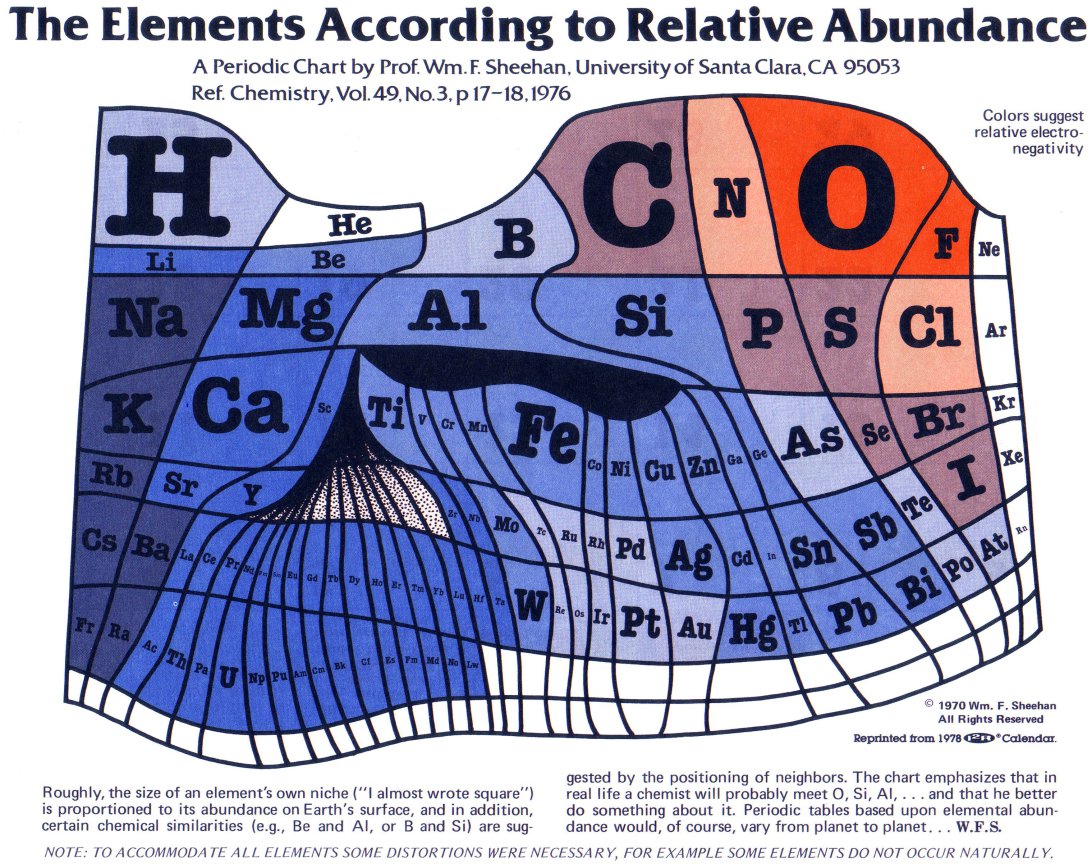
When you learned about The Periodic Table of Elements in high school, it probably didn’t look like this. Above, we have a different way of visualizing the elements. Created by Professor William F. Sheehan at Santa Clara University in 1970, this chart takes the elements (usually shown like this) and scales them relative to their abundance on the Earth’s surface. In the small print beneath the chart, Sheehan notes “The chart emphasizes that in real life a chemist will probably meet O, Si, Al [Oxygen, Silicon and Aluminum] and that he better do something about it.” Click here to see the chart — and the less abundant elements — in a larger format. Below we have a few more creative takes on the Periodic Table.
Follow Open Culture on Facebook and Twitter and share intelligent media with your friends. Or better yet, sign up for our daily email and get a daily dose of Open Culture in your inbox.
Related Content:
“The Periodic Table Table” — All The Elements in Hand-Carved Wood
World’s Smallest Periodic Table on a Human Hair
“The Periodic Table of Storytelling” Reveals the Elements of Telling a Good Story
Chemistry on YouTube: “Periodic Table of Videos” Wins SPORE Prize
Free Online Chemistry Courses
Read More...
100 Overlooked Films Directed by Women: See Selections from Sight & Sound Magazine’s New List
UK film monthly magazine Sight & Sound’s most recent issue is dedicated to “The Female Gaze: 100 Overlooked Films Directed by Women.” The list of 100 films runs some 20 pages, and the edition also collects mini essays from actors like Greta Gerwig, Isabelle Huppert, and Tilda Swinton; directors like Jane Campion and Claire Denis, and critics like Amy Taubin and Camille Paglia, all focusing on female-directed films that deserve a second look.
Many of the filmmakers are fairly obscure, but even better known directors are represented here with lesser-known selections, like Ida Lupino’s Outrage (and not her noir classic The Hitchhiker) and Kathryn Bigelow’s The Loveless, her first feature co-directed with Monty Montgomery and featuring a young Willem Dafoe. (Fact: Until Bigelow won for The Hurt Locker in 2010, no woman had earned a Best Director Oscar).
Presented in chronological order, the list of 100 Overlooked Films Directed by Women features many landmarks in film history, like Lotte Reiniger’s 1926 The Adventures of Prince Achmed, the first feature-length animated film, which we recently highlighted here. Open Culture has also previously discussed Germaine Dulac’s 1928 surrealist film The Seashell and the Clergyman.
Lois Weber’s 1913 Suspense, her short film co-directed with Philippe Smalley (view it at the top of the post), is one of the first examples of cross-cutting to create tension, and it even features a three-way split frame. Cross-cutting is a technique all thrillers have used since. (And Weber stars in the film as well.)
Sight & Sound also profiles Stephanie Rothman, the first female director to work for Roger Corman, and her 1971 film The Velvet Vampire, a West Coast take on a gothic genre. Jessie Maple, who made Will in 1981, was the first African-American woman to become a part of New York’s camera operator’s union.
Then there’s the careers of filmmakers whose lives were cut short: Soviet director Larisa Shepitko died in a car crash at 40, leaving behind two masterpieces, while Elia Kazan’s wife Barbara Loden made her debut with Wanda in 1970 and passed away soon after, too young.
Many of these films are difficult or impossible to find, and Sight & Sound includes an online article of eight more films that might be lost for good, like the aforementioned Lois Weber’s only color film White Heat, or the only film actor Lillian Gish directed, Remodeling Her Husband.
The Sight & Sound issue is available on newsstands and as a digital edition to subscribers. As noted at the end of the article’s introduction, “a season related to this project will take place next year at BFI Southbank, London.”
Readers interested in the contributions of women filmmakers will want to explore the Women Film Pioneers website hosted by Columbia University.
Related Content:
An Ambitious List of 1400 Films Made by Female Filmmakers
Ted Mills is a freelance writer on the arts who currently hosts the FunkZone Podcast. You can also follow him on Twitter at @tedmills, read his other arts writing at tedmills.com and/or watch his films here.
Read More...Innovative Film Visualizes the Destruction of World War II: Now Available in 7 Languages
Back in June we highlighted Neil Halloran’s 15 minute film, The Fallen of World War II, which used “innovative data visualization techniques to put the human cost of WW II into perspective, showing how some 70 million lives were lost within civilian and military populations across Europe and Asia, from 1939 to 1945.” It’s a pretty staggering illustration of the deadliest war. As the film went viral, Halloran raised money that would enable him to develop new films exploring “other trends of war and peace — from drones and terrorism to democracy and peacekeeping.” He has also translated the film into six different languages. They all went online in the last few weeks. Here they are: Russian, Japanese, Polish, French, German, and Serbian.
Above, you can watch the original in English (certainly worth doing if you were vacationing in June), and you might also explore the accompanying interactive web site here.
Follow Open Culture on Facebook and Twitter and share intelligent media with your friends. Or better yet, sign up for our daily email and get a daily dose of Open Culture in your inbox. And if you want to make sure that our posts definitely appear in your Facebook newsfeed, just follow these simple steps.
Related Content:
Free Online History Courses
Watch World War II Rage Across Europe in a 7 Minute Time-Lapse Film: Every Day From 1939 to 1945
31 Rolls of Film Taken by a World War II Soldier Get Discovered & Developed Before Your Eyes
Dramatic Color Footage Shows a Bombed-Out Berlin a Month After Germany’s WWII Defeat (1945)
Read More...1902 French Trading Cards Imagine “Women of the Future”
The lag time between our imagining of social equality and its arrival can be significantly long indeed, or it least it can seem so, given the limitations of human mortality. 113 years may not be an especially long time for a tree, say, or even a very healthy Galapagos tortoise, but if you or I had been alive in 1902, chances are we’d never know that in 2015 the president of Europe’s most powerful nation is a woman, as are two major presidential candidates in the United States. Given the amount of inequality we still see worldwide, this may not always feel like a triumph. In 1902, it might have seemed like “nothing but fantasy.”
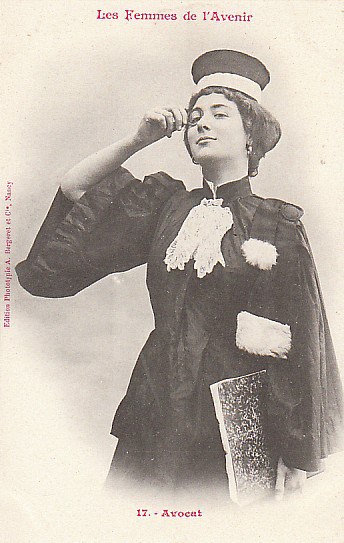
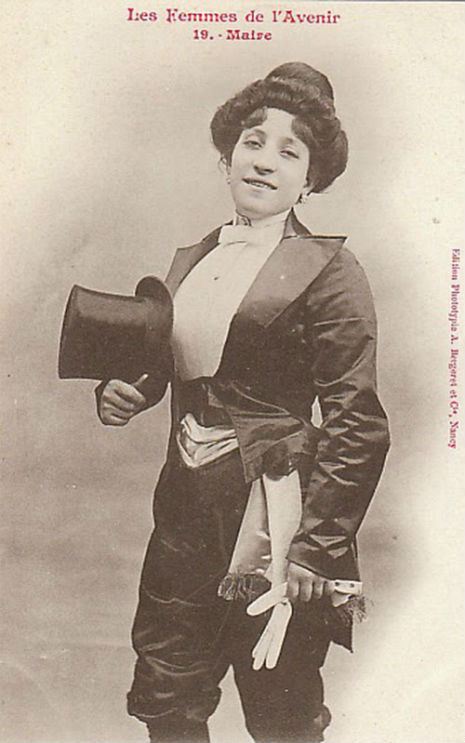
And yet even then, it was certainly possible to foresee women occupying all the roles that men did, through the lenses, writes Laura Hudson at Boing Boing, of “fantasy and science fiction,” which “can often help us open our minds behind the limitations of the world we live in and imagine a better one instead.” In 1902, artist Albert Bergeret was commissioned to create the trading cards you see here—just a small selection of twenty total photographs called “Les Femmes de l’Avenir”—Women of the Future. Only one theme among many in a series of different sets of cards, this “retrofuturistic attempt to expand the role of women in society” showed us a “small and fashionable world” where “women were given a more equal role in society, not to mention spectacular hats.”
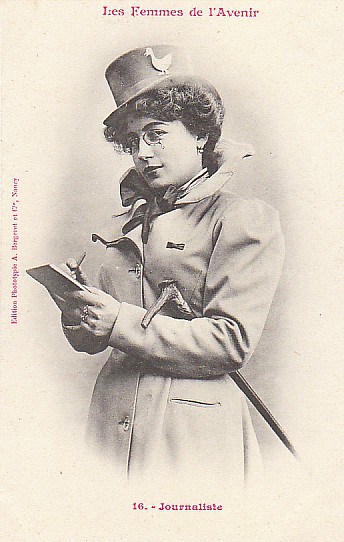
That may be so, but just as we can never accurately see the future, we can also never reach consensus on the meaning of the past. The Daily Mail’s Maysa Rawi agrees with Hudson about the “pin-up quality to many of the images,” which show “an awful lot of arm.” And yet Rawi disparages the entire set as “meant to capture men’s fantasies rather than be part of any feminist movement.” I’ll admit, I don’t see the cards this way at all, nor do I think the categories are mutually exclusive. Pin-up girls have also represented social power, albeit mainly sexual power. Scantily-clad female superheroes like Wonder Woman, though crafted to appeal to the fantasies of teenage boys, are also powerful because… well, they have superpowers.
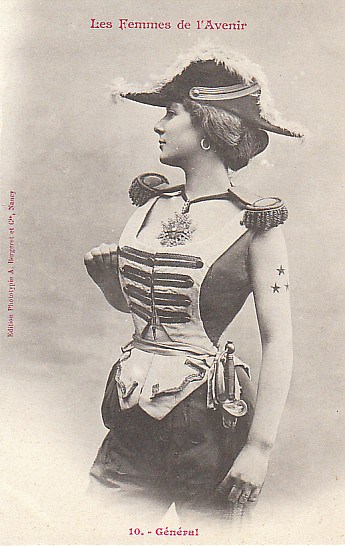
Perhaps that’s one way to look at Bergeret’s cards. He is not mocking his subjects, nor hyper-sexualizing them, but presenting, as each card indicates, advanced futuristic beings who didn’t yet exist in his time. The Daily Mail captions several of the photos with factoids about women’s advances in French history. In some cases, Bergeret did not have to extrapolate far. Women could practice law in 1900; women served in the army during the French Revolution, but did not fight. Colleges had been open to women since 1879. A few women worked as doctors and journalists in Bergeret’s time. Marie Curie, you’ll recall, had discovered polonium, coined the term “radioactivity,” and would win the Nobel Prize in 1903. Queen Victoria had ruled over half the world.
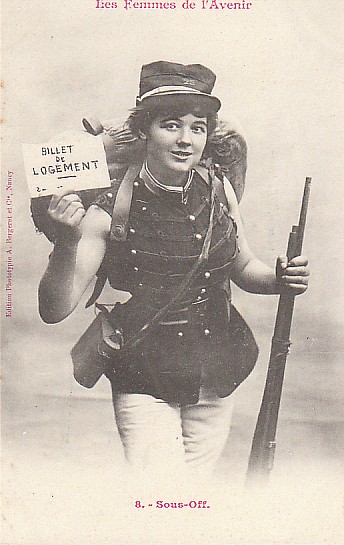
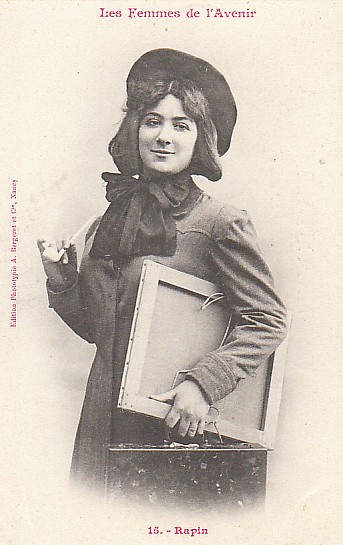
But French women would have to wait several more decades to enter most of the professions represented. No matter how sexy—and in some cases ridiculous—some of the costumes in these photos, Bergeret shot the models with poise, style, and dignity. Perhaps he and many in his audience could easily imagine female generals, mayors, firewomen, soldiers, etc. Yet one particular card stands out. It portrays a self-satisfied, Bohemian model labeled “rapin”—which a reader below informs us is “an argot word for (bad) painter.”
Related Content:
In 1900, Ladies’ Home Journal Publishes 28 Predictions for the Year 2000
How French Artists in 1899 Envisioned Life in the Year 2000: Drawing the Future
Josh Jones is a writer and musician based in Durham, NC. Follow him at @jdmagness
Read More...Watch Noam Chomsky & Lawrence Krauss Talk About Education, Political Activism, Technology & More Before a Sold-Out Crowd
Founded and directed by physicist Lawrence Krauss, Arizona State’s Origins Project has for several years brought together some of the biggest minds in the sciences and humanities for friendly debates and conversations about “the 21st Century’s greatest challenges.” Previous all-star panels have included Krauss, Neil DeGrasse Tyson, Bill Nye, Brian Greene, and Richard Dawkins. Stephen Hawking has graced the ASU Origins Project stage, as has actor and science communicator Alan Alda. And this past March, in a sold-out, highly-anticipated Origins Project event, Krauss welcomed Noam Chomsky to the stage for a lengthy interview, which you can watch above.
Although Krauss says he’s wary of hero worship in his laudatory introduction, he nonetheless finds himself asking “What Would Noam Chomsky Do” when faced with a dilemma. He also points out that Chomsky has been “marginalized in U.S. media” for his anti-war, anarchist political views. Those views, of course, come widely into play during the conversation, which ranges from the theory and purpose of education—a subject Chomsky has expounded on a great deal in books and interviews—to the fate of political dissidents throughout history.
Chomsky also gives us his views on science and technology, particularly in the Q&A portion of the talk above, in which he answers questions about artificial intelligence—another subject he’s touched on in the past—and animal experimentation, among a great many other topics. Krauss mostly hangs back during the initial discussion but takes a more active role in the session above, offering views on medical and scientific ethics that will be familiar to those who follow his atheist activism and championing of rationality over religious dogma.
What you won’t see in the video above is a conversation Chomsky and Krauss had with Motherboard’s Daniel Oberhaus, who caught up with both thinkers during the ASU event to get their take on what he calls “another great space race.” As Oberhaus makes clear, the current competition is not necessarily between global superpowers, but—as with so much modern research and development—between public and private entities, such as NASA and Space X. As we briefly discussed in a post yesterday on the huge amount of public domain space photography freely available for use, private space exploration makes research proprietary, mitigating the potential public benefits of government programs.
As Chomsky puts it, “the environment, the commons… they’re a common possession, but space is even more so. For individuals to allow institutions like corporations to have any control over it is devastating in its consequences. It will also almost certainly undermine serious research.” He refers to the example of most modern computing—developed under publicly-funded government programs, then marketed and sold back to us by corporations. Krauss makes a case for unmanned space exploration as the cost-effective option, and both thinkers discuss the problem of militarizing space, the ultimate goal of Cold War space programs before the fall of the Soviet Union. The conversation is rich and revealing and makes an excellent supplement to the already rich discussion Krauss and Chomsky have in the videos above.
Related Content:
Noam Chomsky Spells Out the Purpose of Education
Noam Chomsky Explains Where Artificial Intelligence Went Wrong
Josh Jones is a writer and musician based in Durham, NC. Follow him at @jdmagness
Read More...Bob Dylan Appears in Rare TV Ad: Watch IBM’s Super Computer Offer a Literary Analysis of His Songs
To my knowledge, Bob Dylan has only appeared in a handful of TV commercials over the decades, including most notably a bizarre ad for Victoria’s Secret back in 2004. Now you can add another to the small list. Last night, IBM debuted a new ad with the iconic singer-songwriter. And this time around, Dylan isn’t peddling bras. Rather, it’s IBM’s cognitive system called “Watson,” which promises to analyze data for corporations in all kinds of interesting ways. Says IBM:
Humans create a staggering amount of information. Poetry, equations, films, selfies, diagnoses, discoveries. Data pours from our mobile devices, social networks, from every digitized and connected system we use. 80% of this data is virtually invisible to computers—including nearly all the information captured in language, sight and sound. Until now.
IBM Watson applies its cognitive technologies to help change how we approach and understand all of this information. Everything that is digital has the potential to become cognitive, and, in a sense, be able to “think.”
Watson can bring cognition to everything and everyone. To evolve in this data-driven culture, every business will need to become a cognitive business.
To demonstrate its analytical powers, IBM asked Watson to analyze Dylan’s lyrics, and it concluded that the major themes of Dylan’s songs are “time passes and love fades”. It’s a conclusion, I’m sure, that never dawned on casual or ardent fans of Dylan’s music.
Related Content:
“They Were There” — Errol Morris Finally Directs a Film for IBM
Andy Warhol’s ‘Screen Test’ of Bob Dylan: A Classic Meeting of Egos
Bob Dylan Reads From T.S. Eliot’s Great Modernist Poem The Waste Land
Bob Dylan and The Grateful Dead Rehearse Together in Summer 1987. Listen to 74 Tracks.
Read More...Discover the Cinematic & Comedic Genius of Charlie Chaplin with 60+ Free Movies Online
“One of the many remarkable things about Charlie Chaplin,” wrote Roger Ebert, “is that his films continue to hold up, to attract and delight audiences.” Richard Brody described Chaplin as not just “alone among his peers of silent-comedy genius,” but also as a maker of “great talking pictures.” Jonathan Rosenbaum asked, “Has there ever been another artist — not just in the history of cinema, but maybe in the history of art — who has had more to say, and in such vivid detail, about what it means to be poor?” Andrew Sarris called Chaplin “arguably the single most important artist produced by the cinema, certainly its most extraordinary performer and probably still its most universal icon.” “For me,” wrote Leonard Maltin, “comedy begins with Charlie Chaplin.”
And so we see that Chaplin, nearly forty decades after his death, maintains his high critical reputation — while also having enjoyed the absolute height of movie-stardom back in the silent era.
Vanishingly few artists of any kind manage to combine such blockbusting commercial success with such flying-colors critical success. That alone might give you good enough reason to plunge into Chaplin’s filmography, but know that you can begin that cinematic adventure for free right here on Open Culture in our archive of more than 60 Charlie Chaplin films on the web.
There you’ll find short comedies like 1914’s Kids Auto Race at Venice, which introduced his famous penniless protagonist “The Tramp”; the following year’s The Tramp, which made it into a phenomenon; 1919’s Sunnyside, in which we find out what happens when Chaplin’s gracefully hapless comedic persona winds up on the farm; and 1925’s The Gold Rush, the film Chaplin most wanted to be remembered for.
But though Chaplin’s oeuvre couldn’t be easier to start watching and laughing at, coming to appreciate the full scope of his craft — in the way that the critics quoted above have spent careers doing — may take time. After all, the man made 80 movies over his 75-year entertainment career, a kind of productivity that, even leaving the considerable artistry aside, cinema may never see again. You can dive into our collection of Chaplin films here.
Related Content:
101 Free Silent Films: The Great Classics
Colorized Photos Bring Walt Whitman, Charlie Chaplin, Helen Keller & Mark Twain Back to Life
Charlie Chaplin Does Cocaine and Saves the Day in Modern Times (1936)
4,000+ Free Movies Online: Great Classics, Indies, Noir, Westerns, Documentaries & More
Colin Marshall writes elsewhere on cities, language, Asia, and men’s style. He’s at work on a book about Los Angeles, A Los Angeles Primer, the video series The City in Cinema, and the crowdfunded journalism project Where Is the City of the Future? Follow him on Twitter at @colinmarshall or on Facebook.
Read More...Stream 100+ Free Movies from Paramount Pictures on YouTube: Hamlet, Ironweed & More
We got a nice tip from one of our readers, and wanted to pass it along. Paramount Pictures has launched an official, verified YouTube channel — called The Paramount Vault — where you can watch full length films for free [update: if you’re based in the US]. You won’t find Paramount’s best-known films in The Vault, but nonetheless there are some quality, if not entertaining, picks among the 150 films.
The movies are grouped into the following playlists: Classics, Comedy, Action/Adventure, Drama, Horror, Westerns, Science Fiction, and Thrillers. And they include motion pictures like 1987’s Ironweed with Jack Nicholson and Meryl Streep, Hamlet (1990) with Glenn Close and Mel Gibson, Paris When It Sizzles (1964) with William Holden and Audrey Hepburn, Elvis in King Creole (1958), Charlton Heston in the 1950 noir film Dark City, Gene Wilder in Funny About Love (1990), and Margot at the Wedding (2007) with Nicole Kidman, Jack Black and Jennifer Jason Leigh.
The Paramount Vault has been verified by YouTube, so it looks like it’s the real deal. There is also an accompanying verified Facebook page.
If you stream the playlist embedded at the top, you can watch 43 dramas in a row, starting with Ironweed and Hamlet.
The selections above will be added to our list, 4,000+ Free Movies Online: Great Classics, Indies, Noir, Westerns, Documentaries & More. Enjoy!
Update: it looks like you need to be based in the US to view these films — something that wasn’t apparent to me beforehand since I’m based here. My apologies to anyone who’s geoblocked.
h/t David
Related Content:
101 Free Silent Films: The Great Classics
Columbia U. Launches a Free Multimedia Glossary for Studying Cinema & Filmmaking
Read More...8,400 Stunning High-Res Photos From the Apollo Moon Missions Are Now Online
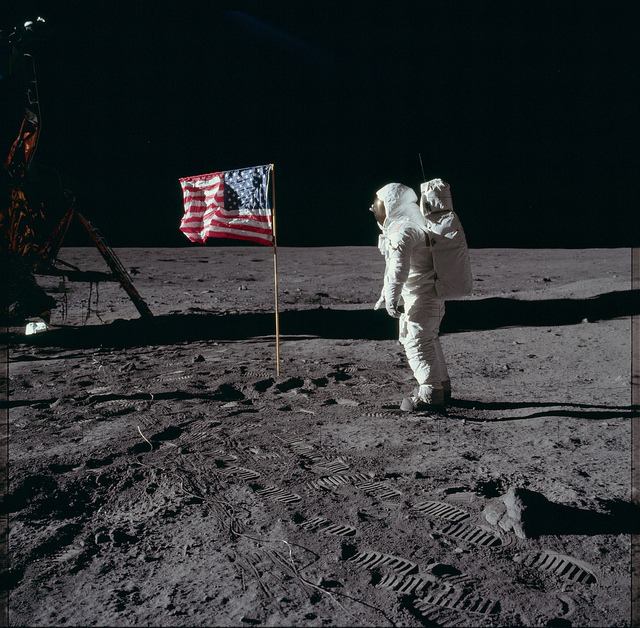
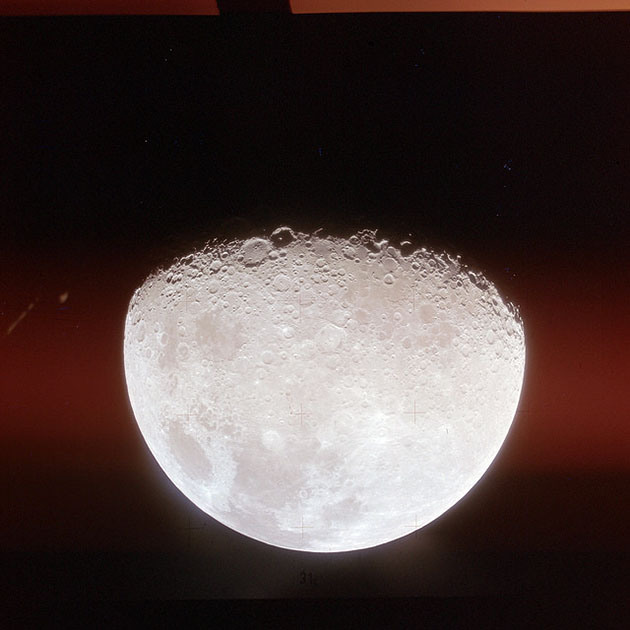
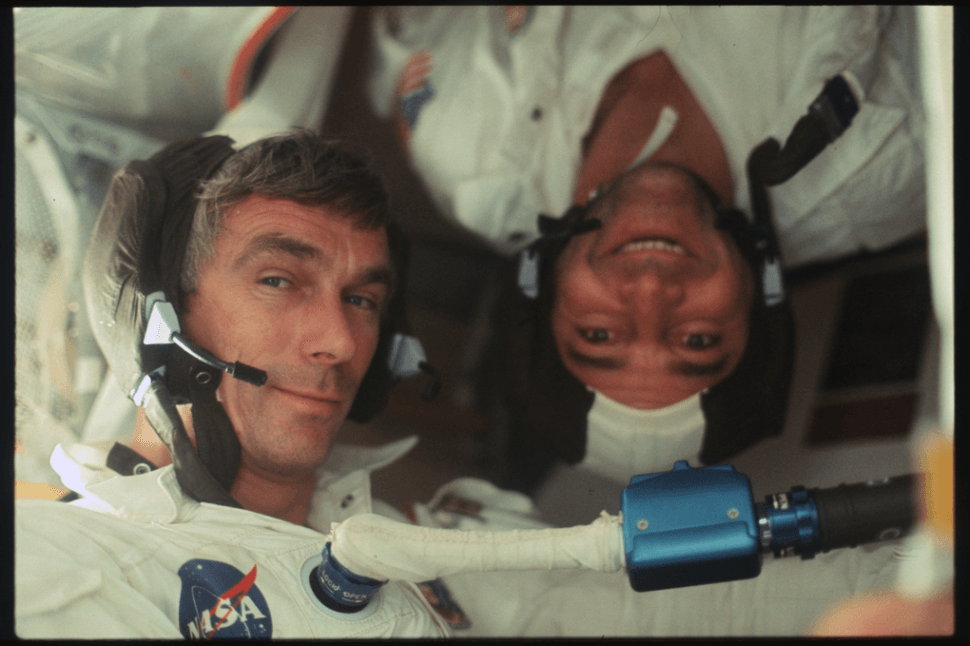
The Apollo program, launched in 1961 by John F. Kennedy, flew its first manned mission in 1968, and the following summer, Neil Armstrong, Michael Collins, and Buzz Aldrin met the program’s mandate, making their historic Apollo 11 Moon Landing. In the ensuing few years, several more spacecraft and crews either orbited or landed on the Moon, and for a brief moment, popular magazines and newspapers regularly featured photographs of those expeditions on their covers and front pages. Looking every bit the authentic vintage Hasselblad photos they are, the images you see here were taken by Apollo astronauts on their various missions and sent home in rolls of hundreds of similar pictures.
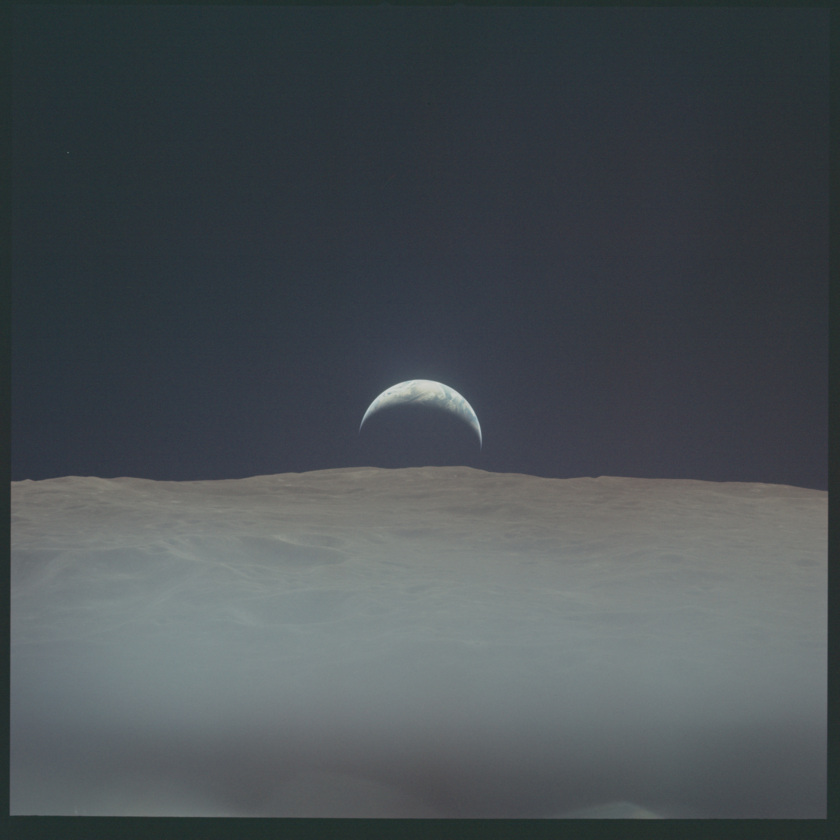
These astronauts snapped photos inside and outside the spacecraft, in orbit and on the moon’s surface, and in 2004 NASA began digitizing the resulting cache of film. Luckily for the public, devoted space enthusiast and archivist, Kipp Teague—an IT director at Lynchburg College in Virginia—has posted a huge number of these photos (8,400 to be exact) on his Project Apollo Archive Flickr account.

Teague initially began acquiring the photos in collaboration with Eric Jones’ Apollo Lunar Surface Journal, “a record of the lunar surface operations conducted by the six pairs of astronauts who landed on the Moon from 1969 to 1972.” Understandably, so many people expressed interest in the photographs that Teague reformatted them in higher resolution and gave them their own home on the web. The Planetary Society informs us, “every photo taken on the lunar surface by astronauts with their chest-mounted Hasselblad cameras is included in the collection.”
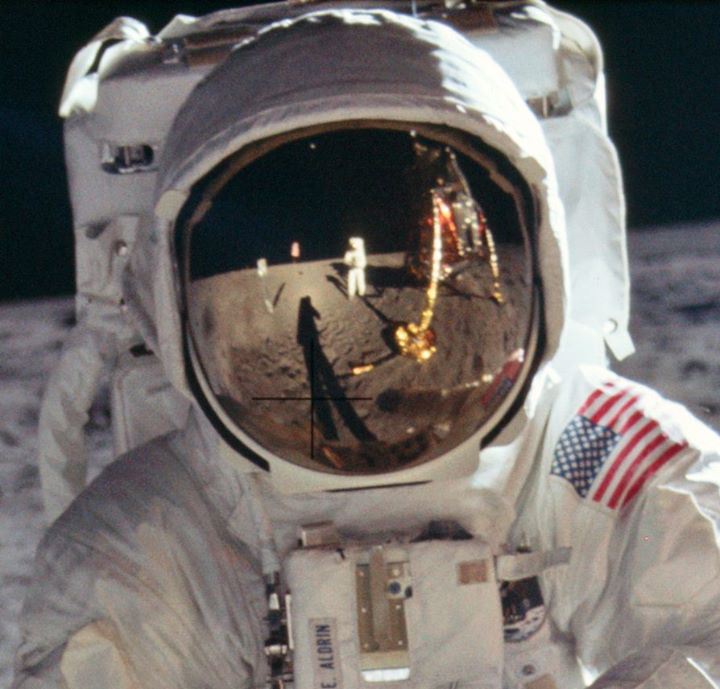
While Teague and Jones’ other sites use photos that have been processed to increase their clarity, lighting, and color, the photos on Project Apollo Archive remain in their original state. “Browsing the entire set,” writes the Planetary Society, “takes on the feeling of looking through an old family photo album.” Indeed, especially if you grew up in the late-sixties/early-seventies at the height of the space program’s popularity.
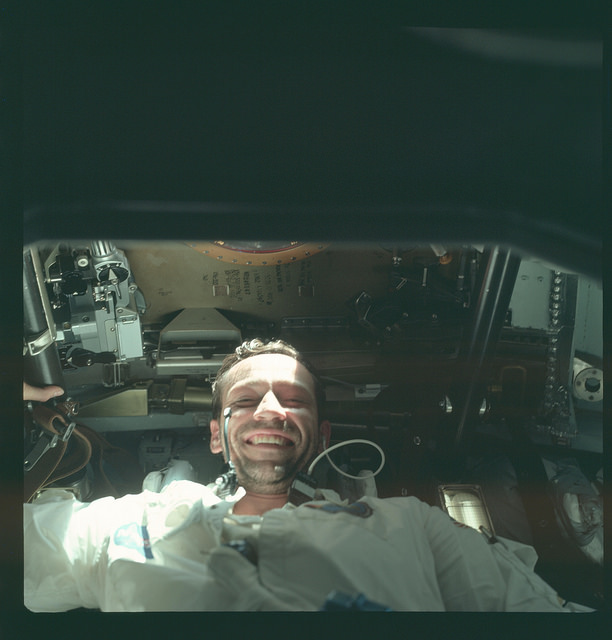
A good many of the photos are rather procedural shots of craters and clouds, especially those from earlier missions. But quite a few frame the breathtaking vistas, technical details, and awestruck, if exhausted, faces you see here. So many photos were taken and uploaded in succession that clicking rapidly through a photostream can produce an almost flipbook effect. You can browse the archive by album, each one representing a reel from different Apollo missions—including that famous 11th (top, and below)—though Teague has yet to post high resolution images from Apollo 8 and 13.
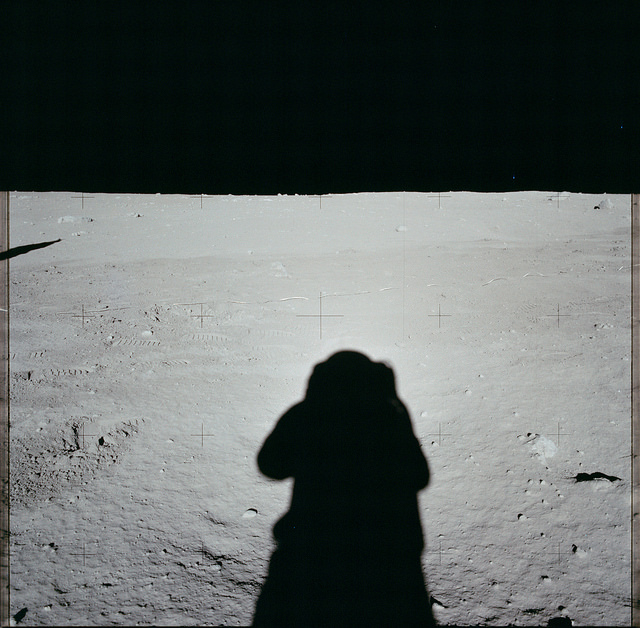
It seemed after Apollo’s demise in the mid-seventies that photographs like these documented a lost age of NASA exploration, and that the once-great government agency would cede its innovative role to private companies like Elon Musk’s Space X, who have been much less forthcoming about releasing media to the public, making proprietary claims over their space photography in particular. But thanks in part to Space X and the cooperation of Canadian, European, Russian, and Japanese space programs, NASA’s International Space Station has raised the agency’s public profile considerably in the past several years. Though still painfully underfunded, NASA’s cool again.
Even more profile-raising is the Mars Rover program, whose recent finding of water has refueled speculations about life on the Red Planet. As films like the recent, astronaut-approved The Martian and a raft of others show, our collective imagination has long bent toward human exploration of Mars. Establishing a base on Mars, after all, is Space X’s stated mission. Looking at these stunning vintage photos of the Apollo Lunar missions makes me long to see what the first astronauts to walk on Mars send back. We probably won’t have to wait long once they’re up there. We’ll likely get Instagram uploads, maybe even some with fake vintage Hasselblad filters. It won’t be quite the same; few current events can compete with nostalgia. But I like to think we can look forward in the near future to a renaissance of manned—and woman-ed—space exploration.
See many hundreds more Apollo Lunar Mission photos at Project Apollo Archive and follow the archive on Facebook for updates.
Related Content:
Landing on the Moon: July 20, 1969
Mankind’s First Steps on the Moon: The Ultra High Res Photos
Josh Jones is a writer and musician based in Durham, NC. Follow him at @jdmagness
Read More...What “Orwellian” Really Means: An Animated Lesson About the Use & Abuse of the Term
In all of our minds, the word “Orwellian” conjures up a certain kind of setting: a vast, fixed bureaucracy; a dead-eyed public forced into gray, uniform living conditions; the very words we use mangled in order to better serve the interests of power. We think, on the whole, of the kind of bleakness with which George Orwell saturated the future England that provides the setting for his famous novel Nineteen Eighty-Four. Almost seventy years after that book’s publication, we now use “Orwellian” to describe the views of the political party opposite us, the Department of Motor Vehicles — anything, in short, that strikes us as brutish, monolithic, implacable, deliberately stripped of meaning, or in any way authoritarian.
We use the word so much, in fact, that it can’t help but have come detached from its original meaning. “I can tell you that we live in Orwellian times,” writes the Guardian’s Sam Jordison. Or that “America is waging Orwellian wars, that TV is Orwellian, that the police are Orwellian, that Amazon is Orwellian, that publishers are Orwellian too, that Amazon withdrew copies of Nineteen Eighty-Four, which was Orwellian (although Orwell wouldn’t like it), that Vladimir Putin, George W. Bush, David Cameron, Ed Milliband, Kim Jong-un and all his relatives are Orwellian, that the TV programme Big Brother is both Orwellian and not as Orwellian as it claims to be, that Obama engages in Obamathink, that climate-change deniers and climate change scientists are Orwellian, that neoclassical economics employs Orwellian language. That, in fact, everything is Orwellian,” Jordison continues.
Here to restore sense to our usage of the most common word derived from the name of a writer, we have the Ted-Ed video at the top of the post. In it, and in the associated lesson on Ted-Ed’s site, Noah Tavlin breaks down the term’s meaning, its origin, the failings of our modern interpretation of it, and how truly Orwellian phenomena continue to invade our daily life without our even realizing it. “The next time you hear someone say ‘Orwellian,’ ” says Tavlin, “pay close attention. If they’re talking about the deceptive and manipulative use of language, they’re on the right track. If they’re talking about mass surveillance and intrusive government, they’re describing something authoritarian, but not necessarily Orwellian. And if they use it as an all-purpose word for any ideas they dislike, it’s possible that their statements are more Orwellian than whatever it is they’re criticizing” — an outcome Orwell himself might well have foreseen.
Related Content:
George Orwell Explains in a Revealing 1944 Letter Why He’d Write 1984
Huxley to Orwell: My Hellish Vision of the Future is Better Than Yours (1949)
George Orwell and Douglas Adams Explain How to Make a Proper Cup of Tea
For 95 Minutes, the BBC Brings George Orwell to Life
Colin Marshall writes elsewhere on cities, language, Asia, and men’s style. He’s at work on a book about Los Angeles, A Los Angeles Primer, the video series The City in Cinema, and the crowdfunded journalism project Where Is the City of the Future? Follow him on Twitter at @colinmarshall or on Facebook.
Read More...Support Us
We're hoping to rely on loyal readers, rather than erratic ads. Please click the Donate button and support Open Culture. You can use Paypal, Venmo, Patreon, even Crypto! We thank you!

About Us

Open Culture scours the web for the best educational media. We find the free courses and audio books you need, the language lessons & educational videos you want, and plenty of enlightenment in between.
Advertise With Us

FREE UPDATES!
GET OUR DAILY EMAIL
Get the best cultural and educational resources on the web curated for you in a daily email. We never spam. Unsubscribe at any time.
FOLLOW ON SOCIAL MEDIA

Open Culture editor Dan Colman scours the web for the best educational media. He finds the free courses and audio books you need, the language lessons & movies you want, and plenty of enlightenment in between.
Advertise With Us

