The 321 Books in David Foster Wallace’s Personal Library: From Blood Meridian to Confessions of an Unlikely Bodybuilder
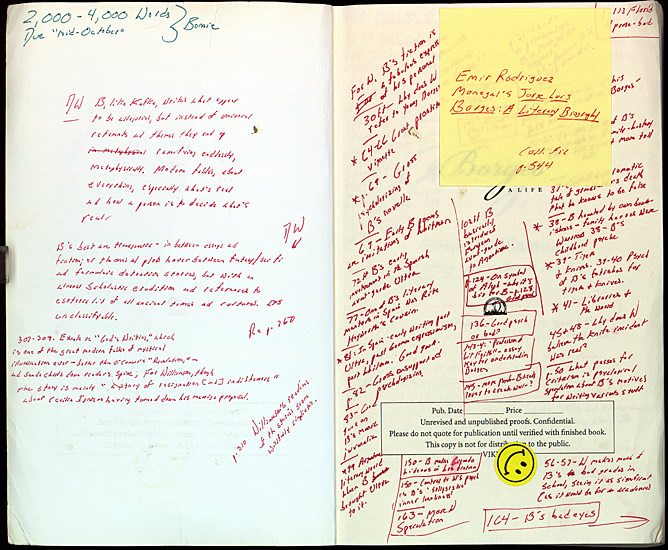
Not long after David Foster Wallace died, his fans found themselves with a new place of pilgrimage: not his tombstone, in the manner of a Jim Morrison or a Kurt Cobain, but his literary archives. You’ll find them at the Harry Ransom Center at the University of Texas at Austin. From their collection, we’ve previously featured Wallace’s fall 1994 English 102 syllabus from when he taught at Illinois State University, his English 183A handout breaking down (in the way that only he could) five common usage mistakes, and the language books contained in his personal library.
Any reader even casually acquainted with Wallace’s novels and essays will immediately sense his deep interest in language. But if you browse through the Ransom Center’s collection of 321 books from the author of Infinite Jest and A Supposedly Fun Thing I’ll Never Do Again’s own shelves (most of them seemingly well-annotated), you’ll find a good deal of evidence about what else interested him. The Awl’s Maria Bustillos did a post on the surprising variety of self-help books found therein. Other represented types of books include:
- Mass-market thrillers like Thomas Harris’ The Silence of the Lambs, Hannibal and Hannibal Rising, and Stephen King’s Carrie
- The novels of his peers like Rick Moody’s The Diviners, Richard Powers’ Gain, Galatea 2.2, and Operation Wandering Soul, Mark Leyner’s Et Tu, Babe and My Cousin, My Gastroenterologist, Jonathan Franzen’s Strong Motion, Cormac McCarthy’s Blood Meridian and Nicholson Baker’s Room Temperature
- Books he wrote about like Bryan Garner’s A Dictionary of Modern American Usage, Edwin Williamson’s Borges: A Life, John Updike’s Toward the End of Time
- Books on his own work like William C. Dowling’s A Reader’s Companion to Infinite Jest
- Books on the midwest from which he came like A Place of Sense: Essays in Search of the Midwest
- Books clearly used as research materials for his final, incomplete, IRS-centric novel The Pale King like Michael J. Graetz’s The U.S. Income Tax: What It Is, How It Got That Way, and Where We Go from Here, William L. Raby’s The Reluctant Taxpayer, and Marty Kaplan’s What the IRS Doesn’t Want You to Know: A CPA Reveals the Tricks of the Trade
- My own favorite novels like Joseph Heller’s Something Happened, Richard Yates’ Revolutionary Road, and Alexander Theroux’s Darconville’s Cat
Have a look, and maybe you too can find a few of your own current or future favorite books. We could all do worse, after all, than to read like David Foster Wallace did, even if it leads us to the occasional volume like Muscle: Confessions of an Unlikely Bodybuilder; Barbed Wire: A Political History; or Jack B. Nimble’s The Construction and Operation of Clandestine Drug Laboratories. And for a weekend activity, we could do worse than comparing Wallace’s personal library to that of Marilyn Monroe, which we featured last year.
Related Content:
David Foster Wallace’s 1994 Syllabus: How to Teach Serious Literature with Lightweight Books
David Foster Wallace’s Love of Language Revealed by the Books in His Personal Library
David Foster Wallace Breaks Down Five Common Word Usage Mistakes in English
David Foster Wallace: The Big, Uncut Interview (2003)
30 Free Essays & Stories by David Foster Wallace on the Web
Colin Marshall writes on cities, language, Asia, and men’s style. He’s at work on a book about Los Angeles, A Los Angeles Primer, and the video series The City in Cinema. Follow him on Twitter at @colinmarshall or on Facebook.
Read More...CERN’s Cosmic Piano and Jazz Pianist Jam Together at The Montreux Jazz Festival
The Montreux Jazz Festival — the second largest jazz festival in the world — has seen many acts come and go since it kicked off in 1967. Miles Davis, Keith Jarrett, Nina Simone, Bill Evans and Ella Fitzgerald have all played there. And now we have the first concert performed by a jazz pianist (Al Blatter) and The Cosmic Piano, an instrument created by particle physicists at CERN, the home of the Large Hadron Collider, in Switzerland. The Cosmic Piano works something like this: “When a cosmic ray passes through one of four separate detector pads of the Cosmic Piano, it triggers a musical note and a colourful flash of light.” The rays arrive in random intervals, and once they’re combined with Blatter’s notes, you get some interesting polyrhythmic jazz. Catch a few highlights above, and get more background information and video clips on CERN’s web site.
via @matthiasrascher
Related Content:
NASA & Grateful Dead Drummer Mickey Hart Record Cosmic Sounds of the Universe on New Album
The Soundtrack of the Universe
CERN Physicist Explains the Origins of the Universe for Beginners with a Short Animated Video
Higgs Boson, the Musical: CERN Data Turned into Melody
Free Stanford Course Explains Particle Physics & the Large Hadron Collider
The Higgs Boson, AKA the God Particle, Explained with Animation
Read More...Neil Gaiman & Famous Friends Read Aloud the Entirety of Coraline (and The Graveyard Book Too)
One of the many pleasures of hearing a children’s author reading his or her own work is their overwhelming lack of vocal sentiment. When my children were young, I always opted for the horse’s mouth, over the more histrionic characterizations of a hired narrator, regardless of what sitcom or Broadway play he or she may have starred in. It might have taken author E.B. White 17 takes to lay down a track for Charlotte’s Web’s titular character’s death scene, but he eventually achieved the healthy remove that lets the listener—not the reader—wallow in the valley of deep emotions.
Neil Gaiman’s Coraline is not a weepie, like White’s best loved work. Instead, it revels in a sort of understated creepiness en route to the horrifically bizarre. It’s a tone his fellow literary celebs are blissfully well equipped to deliver, reading chapters aloud in honor of the book’s 10th anniversary. You can see them read all of the chapters here and also above and below.
Gaiman himself bookends the proceedings by claiming the first (above) and final chapter. Lucky that. One shudders to think of the myriad ways in which a narrator of cutesier sensibilities could have screwed up phrases like “oompah oompah” and “squidy brown toadstools” (thus blighting the entire book).
I conceive of these readings as a multiple narrator audiobook because the performers are reading, rather than attempting to act out the text in their hands, but really it’s more of a video storytime. Gaiman is definitely on point in front of the camera—his large brown eyes, prominent proboscis and stringy sternocleidomastoid muscles adding to the proceedings.
Sandwiched in between the master’s performances, you will find such luminaries as authors R.L. Stine, John Hodgman, and Daniel “Lemony Snicket” Handler, framed so that he has no head. Former child star Fairuza Balk would’ve made a gimcrack Coraline back in the day, but her rendition of the book’s penultimate chapter suggests that she’s even better suited to the role of Coraline’s “Other Mother,” or rather her disembodied hand. Bedlam, indeed.
Listen to the 10th Anniversary Celebration of the book in its entirety here.
Should that leave you wanting more, Harper Collins has compiled a stem to stern playlist of Gaiman reading 2008’s The Graveyard Book, culled from various videos of the author on tour. You can watch it above, or find it in our collection, 1,000 Free Audio Books: Download Great Books for Free.
Related Content:
Neil Gaiman’s Free Short Stories
Neil Gaiman Reads “The Man Who Forgot Ray Bradbury”
Where Do Great Ideas Come From? Neil Gaiman Explains
Ayun Halliday is an author, illustrator, and Chief Primatologist of the East Village Inky zine. Follow her @AyunHalliday
Read More...How to Make Sure You Get Open Culture in Your Facebook Newsfeed: Now You Can Take Control
For the longest time, Facebook gave you no ability to control what content you see in your Facebook newsfeed. Some 378,000 people have “liked” our Facebook page. But only a fraction actually see Open Culture posts in their newsfeed. That’s because a Facebook algorithm started making the decisions for you, showing you material from some people/publishers, and not others.
Now, Facebook has finally introduced a new feature that will let you control what you see. Please check out the instructions below. When you’re done reading them, consider giving us a Like on Facebook, and then set your newsfeed accordingly. (You get bonus points if you Follow us on Twitter too!)
- If you’re using a mobile phone, open the Facebook app, click the “More” icon along the bottom of the app, then scroll down and click “Newsfeed preferences,” then click “Prioritize who to see first,” and make your picks. (You can select more than one item.)
- If you’re using Facebook on a computer, click on the downward facing arrow on the top nav bar, then click “Newsfeed preferences,” locate one of the people or publishers you follow, and change the setting from “Following” to “See First.”
Hope all of that makes sense.
Read More...A Dreamily Animated Introduction to Haruki Murakami, Japan’s Jazz and Baseball-Loving Postmodern Novelist
If the impressionistic animation style of psychologist, writer, and filmmaker Ilana Simons’ “About Haruki Murakami”—a short video introduction to the jazz bar owning, marathon running, Japanese novelist—puts you in mind of Richard Linklater’s Waking Life, then the elliptical, lucid dream narration may do so even more. “He didn’t use too many words,” Simons tells us. “Too many words is kinda… too many words. Someone’s always losing their voice. Someone’s hearing is acute. Haruki Murakami.” Like Roger Ebert said of Linklater’s film, Simons’ ode to Murakami—and the novelist’s work itself—is “philosophical and playful at the same time.”
Simons reads us Murakami’s existentialist account of how he became a novelist, at age 29, after having an epiphany at a baseball game: “The idea struck me,” he says, “I could write a novel…. I could do it.” And he did, sitting down every night after working the bar he owned with his wife, writing by hand and drinking beer. “Before that,” he has said in an interview with singer/songwriter John Wesley Harding, “I didn’t write anything. I was just one of those ordinary people. I was running a jazz club, and I didn’t create anything at all.” And it’s true. Besides suddenly deciding to become a novelist, “out of the blue” at almost 30, then suddenly becoming an avid marathon runner at age 33, Murakami’s life was pretty unremarkable.
It’s not entirely surprising that he became a novelist. Both of Murakami’s parents taught Japanese literature, though he himself was not a particularly good student. But the author of such beloved books as Norwegian Wood, The Wind-Up Bird Chronicle, Kafka on the Shore and dozens of short stories (read six free here), has mostly drawn his inspiration from outside his national tradition—from American baseball and jazz, from British invasion rock and roll, from Fitzgerald, Kafka, and Hollywood films. As Colin Marshall wrote in a previous post on the BBC Murakami documentary below, “he remained an author shaped by his favorite foreign cultures—especially America’s. This, combined with his yearning to break from established norms, has generated enough international demand for his work to sell briskly in almost every language.”
Murakami’s desire to break with norms, Simons tells us in her charming, visually accomplished animated short, is symptomatic of his “detachment” and “introspection.” Murakami “liked escape, or he just doesn’t like joining groups and investing too many words in places where words have been too often.” The thought of “organized activities,” Murakami has said, like “holding hands at a demonstration… gives me the creeps.” Murakami’s love of solitude makes him seem mysterious, “elusive,” says presenter Alan Yentob in the film above. But one of the extraordinary things about Murakami—in addition to his running a 62-mile “ultramarathon” and conquering the literary world on a whim—is just how ordinary he is in many ways. Both Simons’ increasingly surrealist, bebop-scored short and the BBC’s cool jazz-backed exploration make this contrast seem all the more remarkable. It’s Murakami’s ability to stretch and bend the ordinary world, Simons suggests near the end of her lyrical tribute, that makes his readers feel that “somehow, magically… he does something very private and intimate with their brains”
Related Content:
Read 6 Stories By Haruki Murakami Free Online
Haruki Murakami’s Passion for Jazz: Discover the Novelist’s Jazz Playlist, Jazz Essay & Jazz Bar
Josh Jones is a writer and musician based in Durham, NC. Follow him at @jdmagness
Read More...178 Beautifully-Illustrated Letters from Artists: Kahlo, Calder, Man Ray & More
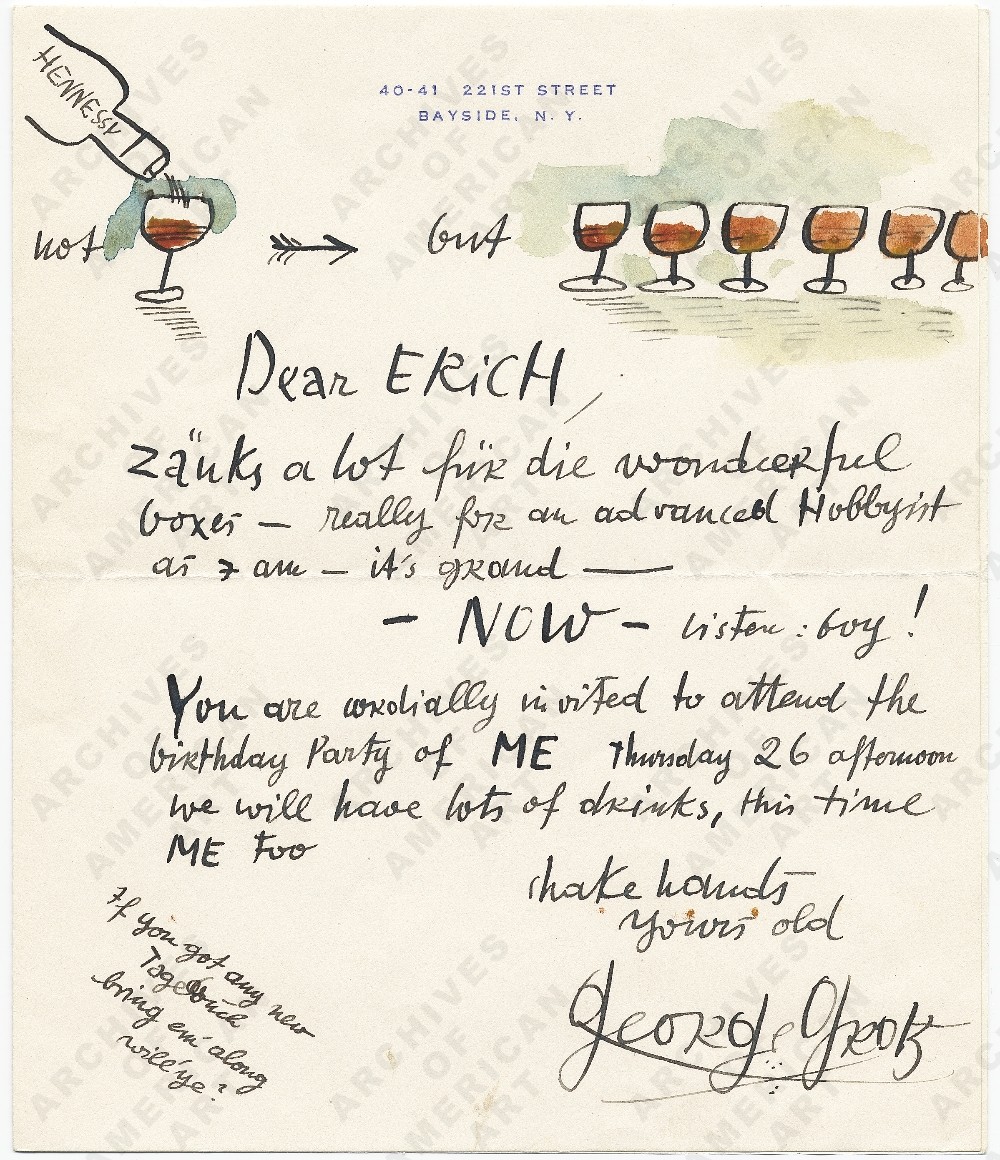
Eight years ago—that’s something like five decades in Internet time—the Smithsonian held an exhibition, “More than Words: Illustrated Letters from the Smithsonian’s Archives of American Art,” which featured a curated selection of 178 hand-illustrated letters, love notes, driving directions, and jottings of current events, from various artists. The selections can still be found online, even though Liza Kirwin’s selections for the exhibit can now also be found in an accompanying book.
The illustrated letters make for humanizing insights into the private world of artists that we usually only experience through their work.
The 1945 letter from George Grosz to Erich S. Herrmann (above) is to invite his friend (and art dealer) to his birthday party, promising not just one glass of Hennessy, but six (and more). “Listen: boy!” he declares. “You are cordially invited to attend the birthday party of ME.” This was when Grosz was in his 50s and living in Huntington, New York. It should be noted that Grosz met his end falling down a flight of stairs while drunk, but the man knew how to party.
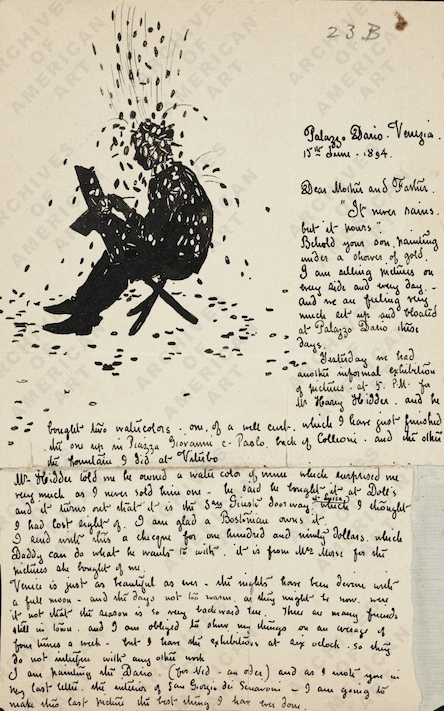
Joseph Lindon Smith was an American illustrator best known for being the artist who traveled to Egypt and documented the excavations at Giza and the Valley of the Kings, very faithful in their representation. But in 1894, this letter finds Smith, 31 years old, living in Paris, trying to make a go of it as an artist, and having enough success to tell his parents: “Behold your son painting under a shower of gold,” he writes. Check out that handwriting: it’s beautiful.
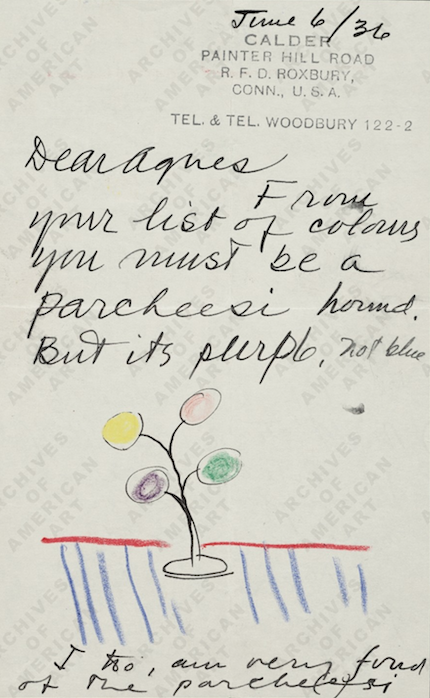
Sculptor Alexander Calder wrote this note to Vassar colleague and friend Agnes Rindge Claflin in 1936, continuing some conversation they were having about color, and noting her choices mark her as a “Parcheesi hound,” and adding that he’s a fan of the game too. The little illustration, which is straight Calder, is cute too. Claflin would later go on to narrate one of MOMA’s first films to accompany an exhibit, Herbert Matter’s 1944 film on Calder, Sculpture and Constructions.
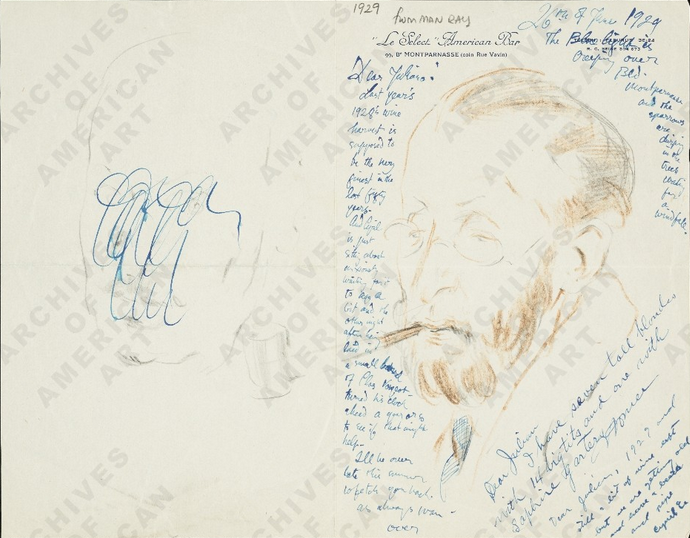
This Man Ray letter to painter Julian E. Levi looks like it has been worried over or recycled—-“Dear Julian” appears several times on the stationery from Le Select American Bar in Montparnasse. It’s a bit difficult to make out all his writing: he starts mentioning “Last year’s 1928 wine harvest is supposed to be the very finest in the last fifty years” at the beginning, but I’m more fascinated with the bottom right: “I have seven tall blondes with 14 big tits and one with sapphire garters.”
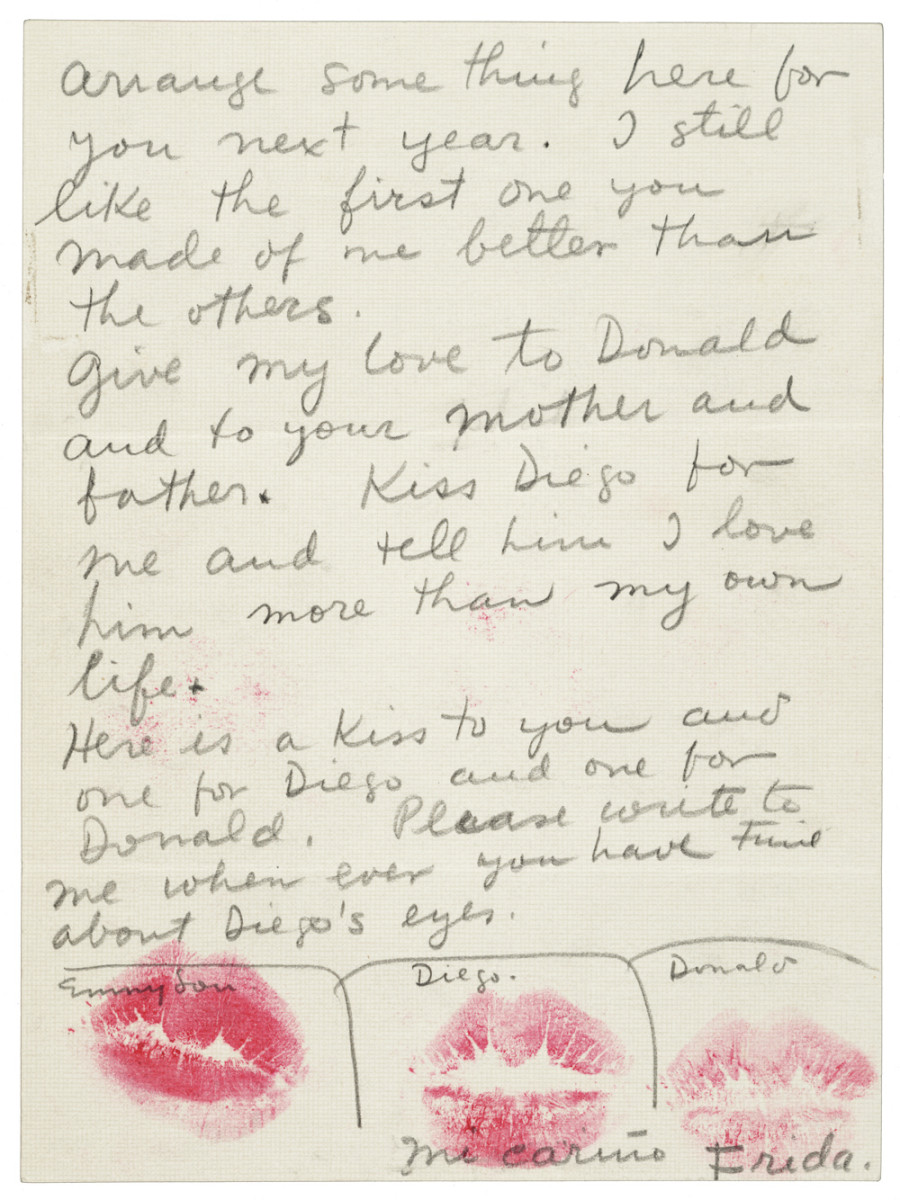
Finally, we close out with a letter Frida Kahlo sent to her friend Emmy Lou Packard in 1940, where she thanked Packard for taking care of Diego during an illness. The letter gets sealed, Priscilla Frank notes at HuffPo, with three lipstick kisses — “one for Diego, one for Emmy Lou, and one for her son.”
There’s plenty more illustrated letters to explore at the Smithsonian site and in Kirwin’s handsome book, featuring artists well known and obscure, but all who knew how to compose a good letter.
Related Content:
Franz Kafka’s Kafkaesque Love Letters
Six Postcards From Famous Writers: Hemingway, Kafka, Kerouac & More
James Joyce’s “Dirty Letters” to His Wife (1909)
Read Rejection Letters Sent to Three Famous Artists: Sylvia Plath, Kurt Vonnegut & Andy Warhol
Ted Mills is a freelance writer on the arts who currently hosts the FunkZone Podcast. You can also follow him on Twitter at @tedmills, read his other arts writing at tedmills.com and/or watch his films here.
Read More...Meditation 101: A Short, Animated Beginner’s Guide
Katy Davis (AKA Gobblynne) created an immensely popular video animating Dr. Brené Brown’s insights on The Power of Empathy. Now, she returns with another animal-filled animation that could also put you on the right mental track. Narrated by Dan Harris, this one lays out the basics of meditation and deals with some common misconceptions and points of frustration. Give it a quick watch, and if you want to give meditation a first, second or third try, check out these Free Guided Meditations From UCLA. If you know of other helpful meditation resources, feel free to let us know in the comments.
Follow us on Facebook, Twitter, Google Plus and LinkedIn and share intelligent media with your friends. Or better yet, sign up for our daily email and get a daily dose of Open Culture in your inbox.
Related Content:
Sonny Rollins Describes How 50 Years of Practicing Yoga Made Him a Better Musician
David Lynch Explains How Meditation Enhances Our Creativity
Alan Watts Introduces America to Meditation & Eastern Philosophy (1960)
Read More...Pico Iyer on “the Art of Stillness”: How to Enrich Your Busy, Distracted Life by Unplugging and Staying Put
Having known Pico Iyer for quite some time, on paper and in person, as a perpetual example and occasional mentor in the writing of place, it delights me to watch him attract more listeners than ever with the talks he’s given in recent years, the most popular of which advocate something called “stillness.” But at first I wondered: did this shift in subject mean that Iyer—a California-grown Brit from an Indian family who mostly lives in Japan (“a global village on two legs,” as he once called himself), known for books like Video Night in Kathmandu, Falling off the Map, and The Global Soul—had put his signature hard-traveling ways behind him?
Hardly. But he did start telling the world more about his long-standing habit of routinely seeking out the most quiet, least “connected” places he can—the seaside no-speech-allowed Catholic hermitage, the rural village outside Kyoto—in order to reflect upon the time he has spent circling the globe, transposing himself from culture to alien culture. “24 years ago, I took the most mind-bending trip across North Korea,” he tells us, “but the trip lasted a few days. What I’ve done with it sitting still—going back to it in my head, trying to understand it, finding a place for it in my thinking—that’s lasted 24 years already, and will probably last a lifetime.”
If we want to follow Pico’s example, we must strike a balance: we must process the time we spend doing something intensely—traveling, writing, programming, lifting weights, what have you—with time spent not doing that something, a pursuit in its own way as intense. He connects all this with the 21st-century technology culture in which we find ourselves, citing the example of folks like Wired co-founder Kevin Kelly and even certain enlightenment-minded Googlers who regularly and rigorously detach themselves from certain kinds of modern devices, going “completely offline in order to gather the sense of direction and proportion they’ll need when they go online again.”
Achieving such a proper intellectual, psychological, social, and technological compartmentalization in life may seem like a rare trick to pull off. But if you ever doubt its possibility, just revisit the last talk from Pico we featured, in which he describes his encounter with Leonard Cohen, the only man alive who has successfully combined the lifestyles of rock star and Zen monk.
Related Content:
The Best Writing Advice Pico Iyer Ever Received
Pico Iyer on “The Joy of Less”
How Leonard Cohen’s Stint As a Buddhist Monk Can Help You Live an Enlightened Life
Colin Marshall writes on cities, language, Asia, and men’s style. He’s at work on a book about Los Angeles, A Los Angeles Primer, and the video series The City in Cinema. Follow him on Twitter at @colinmarshall or on Facebook.
Read More...Behind-the-Scenes Footage of Jerry Lewis’ Ill-Conceived Holocaust Movie The Day The Clown Cried
The auteur responsible for The Disorderly Orderlies might not be the obvious choice to make a movie about the Holocaust but that’s apparently what happened. For the handful of people who have seen Jerry Lewis’s The Day the Clown Cried – his unreleased 1972 film about a washed-up clown named Helmut Doork who amuses a boxcar of Jewish children all the way to an Auschwitz gas chamber — say that the movie is far, far worse than you might imagine.
“This film was really awe-inspiring, in that you are rarely in the presence of a perfect object,” said Harry Shearer in a 1992 Spy Magazine article about the movie. “This was a perfect object. This movie is so drastically wrong, its pathos and its comedy are so wildly misplaced, that you could not, in your fantasy of what it might be like, improve on what it really is. “Oh My God!” — that’s all you can say.” (Below you can hear Shearer tell Howard Stern more about the film.)
There is reportedly only one copy of the movie and that print is under lock and key. Lewis is adamant that the movie is never going to be seen by the public while he still has a say in the matter. “It was all bad and it was bad because I lost the magic,” Lewis told an audience at the 2013 Cannes Film Festival. “You will never see it, no-one will ever see it, because I am embarrassed at the poor work.”
Its mind-boggling awfulness and its inaccessibility has placed The Day the Clown Cried into that rarified pantheon of legendary lost films like the original cut of Erich von Stroheim’s Greed. Only the film is purposefully kept in obscurity. Every once in a while, a new fragment of the movie will pop up on the internet only to be quickly quashed.
The latest glimpse of this famously wrong-headed production comes in the form of a seven-minute clip of a making-of documentary on the film that aired on Flemish TV. You can watch it above. There’s a longer section here.
The clip opens with Lewis in clown face doing his rubber-faced slapstick shtick. It’s not especially funny out of context. In context one can only imagine that the routine would be about as hilarious as a whoopie cushion during the My Lai massacre.
Later, the documentary shows Lewis behind the camera and he seems every bit the auteur. The voice over notes that Lewis is working “as a clown, actor, director, conductor and producer.” Lewis is even seen telling his French sound engineer how to use his Nagra tape recorder.
But perhaps the most surprising moment in the clip is when that 1960s power couple Jane Birkin and Serge Gainsbourg are seen hanging around the set. There really does seem to be something with the French and Jerry Lewis.
Related Content:
Anne Frank: The Only Existing Video Now Online
Jonathan Crow is a Los Angeles-based writer and filmmaker whose work has appeared in Yahoo!, The Hollywood Reporter, and other publications. You can follow him at @jonccrow. And check out his blog Veeptopus, featuring lots of pictures of vice presidents with octopuses on their heads. The Veeptopus store is here.
Read More...
Watch Fear & Loathing in Las Vegas and 2001: A Space Odyssey Get Run Through Google’s Trippy Deep Dream Software
Last week, The Guardian reported:
Google has made its “inceptionism” algorithm available to all, allowing coders around the world to replicate the process the company used to create mesmerising dreamscapes with its image processing neural-network.
The system, which works by repeatedly feeding an image through an AI which enhances features it recognises, was first demonstrated by Google two weeks ago. It can alter an existing image to the extent that it looks like an acid trip, or begin with random noise to generate an entirely original dreamscape.
Since then a coder, Roelof Pieters, began messing around with the publicly-available software, and decided to take the “Great San Francisco Acid Wave” scene from Terry Gilliam’s Fear and Loathing in Las Vegas (1998) and run it through “Deep Dream,” as the software is known. The results (below), now going viral across the internet, are pretty trippy and intense. Just when you thought Hunter S. Thompson couldn’t get more “out there,” this comes along.
We noticed that Pieters ran a similar experiment with pieces of Kubrick’s 2001: A Space Odyssey, and we couldn’t help but put them on display. Watch above.
If you would like to support the mission of Open Culture, consider making a donation to our site. It’s hard to rely 100% on ads, and your contributions will help us continue providing the best free cultural and educational materials to learners everywhere. You can contribute through PayPal, Patreon, and Venmo (@openculture). Thanks!
Related Content:
Free Online: Hunter S. Thompson’s Fear and Loathing in Las Vegas
Read 18 Lost Stories From Hunter S. Thompson’s Forgotten Stint As a Foreign Correspondent
Read 10 Free Articles by Hunter S. Thompson That Span His Gonzo Journalist Career (1965–2005)
Read More...
Support Us
We're hoping to rely on loyal readers, rather than erratic ads. Please click the Donate button and support Open Culture. You can use Paypal, Venmo, Patreon, even Crypto! We thank you!

About Us

Open Culture scours the web for the best educational media. We find the free courses and audio books you need, the language lessons & educational videos you want, and plenty of enlightenment in between.
Advertise With Us

FREE UPDATES!
GET OUR DAILY EMAIL
Get the best cultural and educational resources on the web curated for you in a daily email. We never spam. Unsubscribe at any time.
FOLLOW ON SOCIAL MEDIA

Open Culture editor Dan Colman scours the web for the best educational media. He finds the free courses and audio books you need, the language lessons & movies you want, and plenty of enlightenment in between.
Advertise With Us


