Rare Video: Georges Bataille Talks About Literature & Evil in His Only TV Interview (1958)
“Where other transgressive figures of the past have mostly been tamed,” wrote Josh Jones in a post here last year, “[Georges] Bataille, I submit, is still quite dangerous.” You can get a sense of that in the documentary featured there, À perte de vue, which introduces the transgressive French intellectual’s life and thought, which from the 1920s to the 1960s produced books like The Solar Anus, The Hatred of Poetry, and The Tears of Eros, all part of a body of work that captivated the likes of Susan Sontag, Michel Foucault, and Jacques Derrida.
At the top of this post, you can enjoy another, straighter shot of Bataille through his 1958 appearance opposite interviewer Pierre Dumayet — the only television interview he ever did. The occasion: the publication of his book Literature and Evil, a title that, Bataille says, refers to “two opposite kinds of evil: the first one is related to the necessity of human activity going well and having the desired results, and the other consists of deliberately violating some fundamental taboos — like, for example, the taboo against murder, or against some sexual possibilities.”
Bataille’s fans expect from him a certain amount of taboo violation, though executed in a specific literary form — not just prose, but the distinctive sort of prose, whether spoken or written, brought to perfection by midcentury French intellectuals. In this ten-minute clip, Bataille elaborates on his conviction that we can’t separate literature from evil: if the former stays away from the latter, “it rapidly becomes boring.” He also gets into a discussion of Baudelaire, Kafka (“both of them knew they were on the side of evil”), Shakespeare, the importance of eroticism and childishness in literature, and the inherently anti-work nature of writing. However relevant you find Bataille’s ideas today, you have to give the man this: he never gets boring.
Related Content:
Extensive Archive of Avant-Garde & Modernist Magazines (1890–1939) Now Available Online
Jacques Lacan’s Confrontation with a Young Rebel: Classic Moment, 1972
Free Online Philosophy Courses
Download 55 Free Online Literature Courses: From Dante and Milton to Kerouac and Tolkien
Colin Marshall writes on cities, language, Asia, and men’s style. He’s at work on a book about Los Angeles, A Los Angeles Primer, and the video series The City in Cinema. Follow him on Twitter at @colinmarshall or on Facebook.
Read More...Hayao Miyazaki’s Magical Animated Music Video for the Japanese Pop Song, “On Your Mark”
On this site, we’ve featured music videos by such acclaimed filmmakers as David Lynch, David Fincher, Jim Jarmusch and even Andy Warhol. Now add to this list the legendary Japanese animator Hayao Miyazaki.
Back in 1994, Miyazaki was stuck on the script for his next feature Princess Mononoke. So he decided to do a video for the song “On Your Mark” by Japanese pop duo Chage & Aska. The resulting piece is a gorgeous, dense, enigmatic work that not only recalls Miyazaki’s earliest works like Nausicaa of the Valley of the Wind, but also the edgier visions of the future seen in films like Akira or Ghost in the Shell. In fact, the short is such a magical, memorable piece of filmmaking that it overwhelms the song.
The video unfolds in a non-linear fashion, jumping forward and back, forking into multiple versions of the same scene. Miyazaki isn’t concerned about you not getting the story. As he said in a 1995 interview, you can “interpret [the film] anyway you want.”
The piece opens with a giant structure that looms over an otherwise beautiful, bucolic landscape. Miyazaki, who is never especially forthcoming when talking about his work, describes the world of “On Your Mark” like this: “There is so much radiation on the Earth’s surface, humans can no longer live there. But, there is flora, just like there is one around Chernobyl. It became a sanctuary for nature, with the humans living in the underground city.”
The video then shifts abruptly to a scene straight out of Akira. Down in that underground city, the police attack the highrise headquarters of a spooky religious cult and rescue a young girl with broad, feathered wings. An angel? Who knows. A lot of viewers have noted the cult echoes that of Aum Shinrikyo, the doomsday cult that released Sarin gas into the subways of Tokyo in March 1995. Of course, the video was made before the attack. Mamoru Oshii’s 1993 animated feature Patlabor 2 also had eerie similarities to Aum, so much so that it was featured in the 1995 Yamagata Documentary Film Festival. Both filmmakers, it seems, tapped into that ugly undercurrent in the zeitgeist of Japanese culture at that time.
As Miyazaki’s short progresses, it shows two cops who decide to do the right thing and break the girl out of the laboratory where she is being held. The first time they try, the cops (and presumably the angel) plunge to their deaths. The second time they try – and it’s not really clear how they get this do-over – they manage to escape. The cops drive to the irradiated surface of the earth and watch in awe as the angel flies way.
In Miyazaki’s mind, the winged girl represents hope:
If you don’t completely give up on the situation and you keep your hope, not letting anyone touch it, and then you have to let it go, you let it go where no one can touch it. It’s just that. Maybe there was a bit of exchange in the moment of letting her
go. That’s fine, that’s enough. …Probably they’ll go back to being the policemen. I don’t know if they could go back, though. [laughs]
Related Content:
How to Make Instant Ramen Compliments of Japanese Animation Director Hayao Miyazaki
Japanese Cartoons from the 1920s and 30s Reveal the Stylistic Roots of Anime
Watch Sherlock Hound: Hayao Miyazaki’s Animated, Steampunk Take on Sherlock Holmes
Jonathan Crow is a Los Angeles-based writer and filmmaker whose work has appeared in Yahoo!, The Hollywood Reporter, and other publications. You can follow him at @jonccrow. And check out his blog Veeptopus, featuring pictures of vice presidents with octopuses on their heads. The Veeptopus store is here.
Read More...Italian Astronaut Reads The Hitchhiker’s Guide to the Galaxy on the International Space Station
On Friday, to help celebrate Dante’s 750th birthday, Colin Marshall presented for you Samantha Cristoforetti, Italy’s first female astronaut, reading lines from The Divine Comedy aboard the International Space Station. Little did we know that, just a few days later, we could serve up a new video of Cristoforetti reading lines (this time in English) from a much more modern text — Douglas Adams’ The Hitchhiker’s Guide to the Galaxy (1979). The video was filmed as part of Towel Day, a celebration held every May 25th, where fans across the universe carry a towel in Adams’ honour. Above you can see Cristoforetti, floating upside down, doing just that, and reading the section of the book that touches on towels, the “most massively useful thing an interstellar hitch hiker can have.”
Follow us on Facebook, Twitter, Google Plus and LinkedIn and share intelligent media with your friends. Or better yet, sign up for our daily email and get a daily dose of Open Culture in your inbox.
Related Content:
William Shatner Narrates Space Shuttle Documentary
Wonderfully Kitschy Propaganda Posters Champion the Chinese Space Program (1962–2003)
Read More...Robert De Niro Tells Graduating NYU Arts Grads, “You Made It… And You’re F*cked”
I’ve attended my share of graduations and hence my share of graduation speeches—from politicians more interested in stumping than inspiring their audience; to local TV personalities assuring graduates they too could become local TV personalities; to the real Patch Adams, who wasn’t nearly as funny as Robin Williams in his less-than-funny turn as Patch Adams. My experience has taught me that graduation speeches generally suck.
But not for the most recent batch of graduates of NYU’s Tisch School of the Arts, who got both bracing honesty and career validation from a speaker most likely to give it to you straight. With his trademark foul-mouth gruffness, De Niro told the graduating class what every aspiring artist needs to know: “You made it,” he said, “and you’re f*cked.” The world, De Niro told his audience, is not opening its arms to embrace art school grads. For all our pop cultural celebration of creativity, the so-called “creative class”—as we’re told again and again—is mostly in decline.
Of course it’s never been an easy road for artists. De Niro knows this full well not only through his own early experiences before superstardom but from his upbringing: both his mother and father were bohemian painters with turbulent, fascinating lives. And so he also knows of what he speaks when he tells the NYU grads that they “didn’t have a choice.” Where pragmatic accounting grads may be “passionate about accounting,” De Niro says, “it’s more likely that they used reason and logic and common sense to reach for a career that could give them the expectation of success and stability.”
Not the arts grads, the famous actor says: “You discovered a talent, developed an ambition and recognized your passion.” Their path, he suggests, is one of self-actualization:
When it comes to the arts, passion should always trump common sense. You aren’t just following dreams, you’re reaching for your destiny. You’re a dancer, a singer, a choreographer, a musician, a filmmaker, a writer, a photographer, a director, a producer, an actor, an artist. Yeah, you’re f***ed. The good news is that that’s not a bad place to start.
Maybe not. And maybe, for those driven to sing, dance, paint, write, etc., it’s the only place to start. Granted, NYU students are already a pretty select and privileged bunch, who certainly have a leg up compared to a great many other struggling artists. Nevertheless, given current economic realities and the U.S.’s depressing aversion to arts education and funding, these grads have a particularly difficult road ahead, De Niro says. And who better to deliver that hard truth with such conviction and good humor?
h/t @sheerly
Related Content:
Jim Carrey Commencement Speech: It’s Better to Fail at What You Love Than Fail at What You Don’t
‘This Is Water’: Complete Audio of David Foster Wallace’s Kenyon Graduation Speech (2005)
Josh Jones is a writer and musician based in Durham, NC. Follow him at @jdmagness
Read More...Mœbius Illustrates Paulo Coelho’s Inspirational Novel The Alchemist (1998)
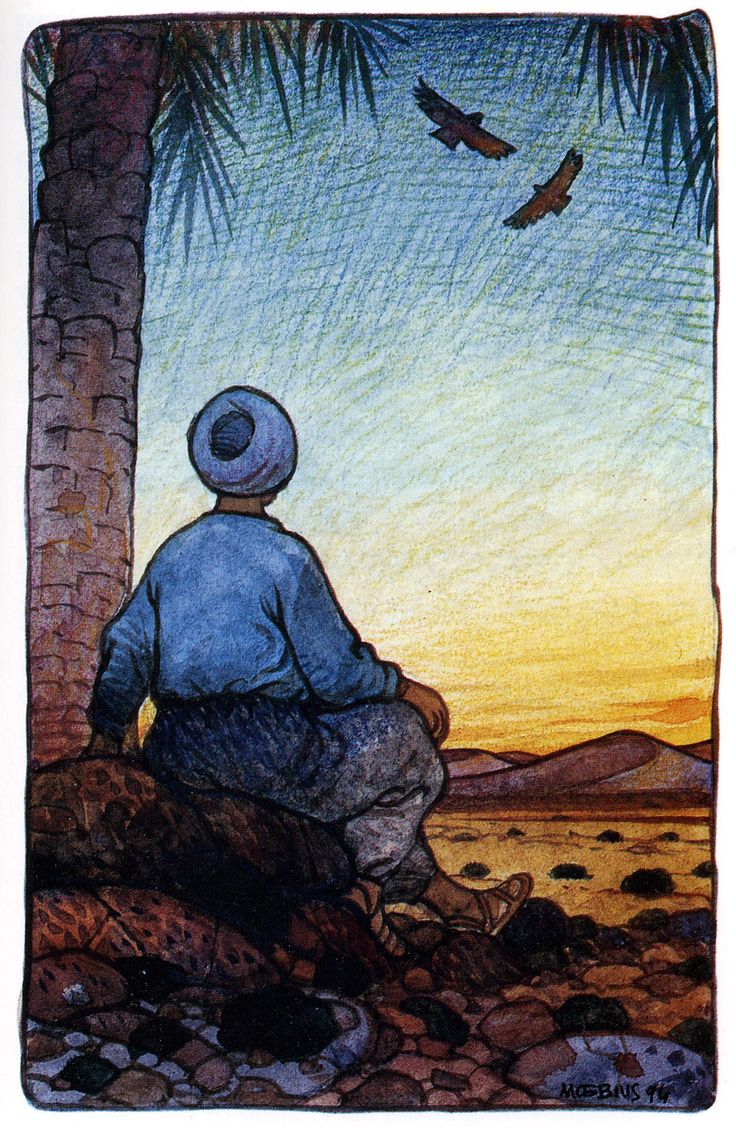
When Paulo Coelho’s novel The Alchemist came out in English, the level of popularity it eventually attained seriously impressed me. Then I went to Latin America, where the Spanish version seemed to have won a vaster readership still. I haven’t yet gone to Brazil to gauge the book’s popularity on the streets of Coelho’s homeland since its first publication to relatively little interest, but it surely hasn’t gone unknown there. As many fans as The Alchemist has, though, the inspiration-and-destiny-inflected appeal of the text entirely escapes some readers, in whichever language they read it. Perhaps they’d prefer an edition illustrated by Mœbius?
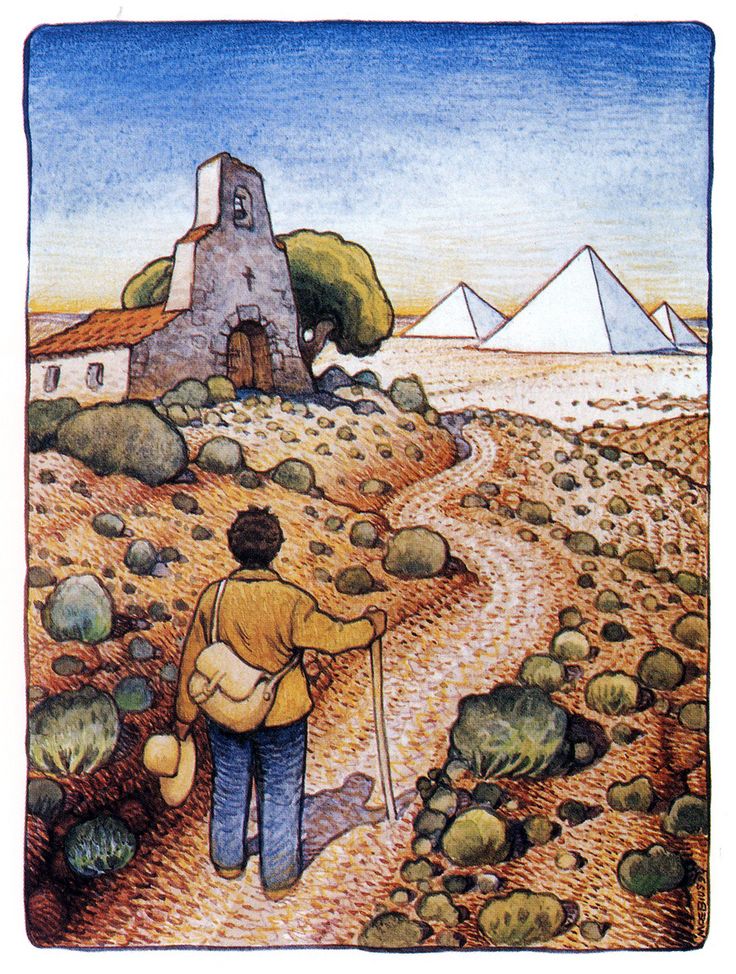
Born Jean Giraud, Mœbius’ career guarantees him a permanent place as one of the most influential comic artists ever to live. Even apart from the achievements in the medium in which he became famous — his founding work on Heavy Metal, his creation of nontraditional western outlaw Blueberry — he did a good deal of work that brought his singularly imaginative aesthetic into other creative realms, such as concept art from Alejandro Jodorowky’s Dune and illustrations for Dante’s Paradiso. In some sense, it might have seemed natural for him to lend his hand to Coelho’s fantasy tale of an Andalusian shepherd boy on a treasure-hunting journey to Egypt.
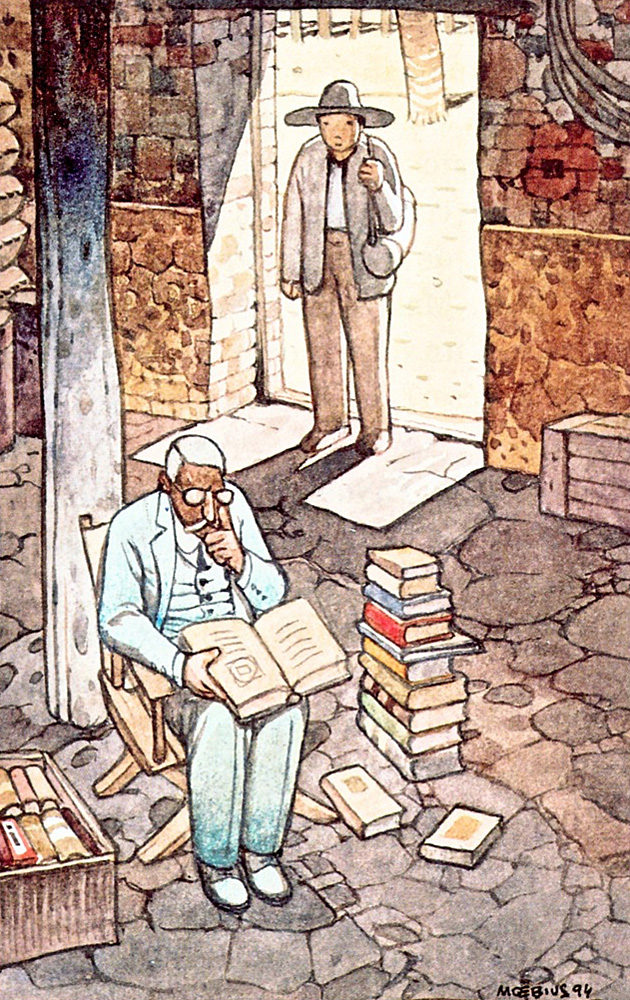
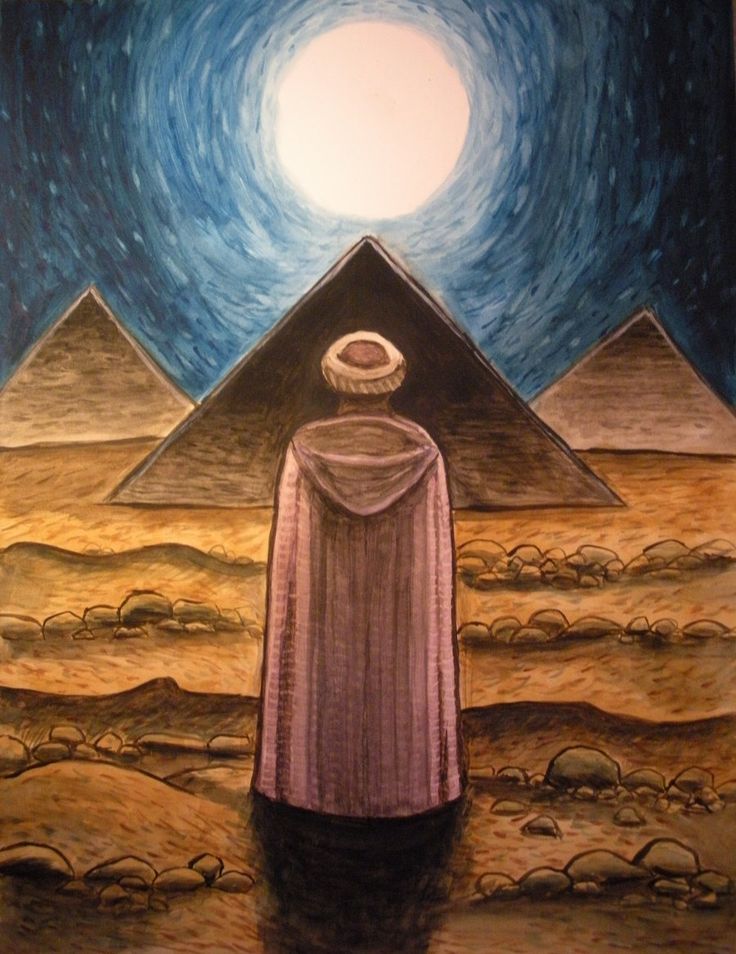
The Illustrated Alchemist: A Fable About Following Your Dream came out in 1998, and it included 35 Mœbius illustrations, four of which you see here. The artist’s signature style, which he usually used in the service of dark, complex fusions of past and present, might at first sound ill-suited for Coelho’s simple fable, but Mœbius adapts well to the material. Even if you put down the book unconvinced by Coelho’s arguments about following your dream, you might consider looking to Mœbius instead with our post on his tips for aspiring artists. Either way, The Illustrated Alchemist itself showcases a collaboration between two well-known creators who most definitely paid their dues.
Related content:
How Paulo Coelho Started Pirating His Own Books (And Where You Can Find Them)
Paulo Coelho on the Fear of Failure
The Inscrutable Imagination of the Late Comic Artist Mœbius
Mœbius’ Storyboards & Concept Art for Jodorowsky’s Dune
Mœbius Illustrates Dante’s Paradiso
Moebius Gives 18 Wisdom-Filled Tips to Aspiring Artists (1996)
Colin Marshall writes on cities, language, Asia, and men’s style. He’s at work on a book about Los Angeles, A Los Angeles Primer, and the video series The City in Cinema. Follow him on Twitter at @colinmarshall or on Facebook.
Read More...Discover Japan’s Earthquake Proof Underground Bike Storage System: The Future is Now
Behold, the ingenious underground bicycle storage of Japan! What a vision of futurist efficiency — the only thing missing is Raymond Scott’s Powerhouse (aka Bugs Bunny factory music).
Japanese cultural commentator Danny Choo strapped a camera to his seat to capture a bike’s eye view of the robotic Eco Cycle Anti-Seismic Underground Bicycle Park. It takes an average of 8 seconds for two-wheelers to make the journey — human involvement stops at the street level card reader.
(One internet commenter wondered what happens if the system malfunctions…and all I can say is I once spent what felt like an eternity, trapped in Disney’s Haunted Mansion.)

As futuristic visions go, it’s a finite one. The environmentally-friendly design allows for fairly easy de-installation, should public demand for safe, subterranean bike parking wane.
It’s also earthquake-proof, a feature which gives rise to all sorts of dystopian Planet of the Apes-style fantasies (replace Apes with Bikes).
Cities from London and Paris to New York and Hangzhou have embraced bikesharing schemes, but the Japanese model allows cyclists to keep their own rides. Signs posted at street level remind riders to remove personal effects like pets (!) before using the system.) Unlimited parking and retrieval comes in at under 20 bucks a month.
It’s an idea whose time has come. As of this writing, the cycle-friendly Netherlands is plotting the world’s largest bike park — underderground — to be launched in 2018.
Hat tip to Danny Choo.
- Ayun Halliday is an author, illustrator, and Chief Primatologist of the East Village Inky zine. Follow her @AyunHalliday
Related Content:
Turn Your Bike into an Electric Hybrid with MIT’s “Copenhagen Wheel”
How Leo Tolstoy Learned to Ride a Bike at 67, and Other Tales of Lifelong Learning
Read More...Six Books (and One Blog) Bill Gates Wants You to Read This Summer
Bill Gates — Microsoft CEO turned philanthropist, lifelong learner and fan of The Great Courses — is recommending seven texts you should read this summer. They’re not exactly light beach reading. But you’ll learn a lot, and you’ll get more dialed into issues on Gates’ mind. On his website, the video above comes accompanied by reasons for reading each work.:
Hyperbole and A Half , by Allie Brosh:The Book, based on Brosh’s wildly popular website, consists of brief vignettes and comic drawings her young About Life. The adventures she recounts are mostly inside her head, where we hear and see the kind of inner thoughts most of us are too timid to let out in public. You will rip through it in three hours, tops. But you’ll wish it went on longer, because it’s funny and smart as hell. I must have interrupted Melinda a dozen times to read to her passages that made me laugh out loud.
The Magic of Reality, by Richard Dawkins. Dawkins, an evolutionary biologist at Oxford, has a gift for making science enjoyable. This Book is as accessible as the TV series Cosmos is for Younger Audiences-and as Relevant for OldEr Audiences. It’s an engaging, well-illustrated science textbook offering compelling answers to big questions, like “how did the universe form?” And “what causes earthquakes?” It’s also a plea for readers of all ages to approach mysteries with rigor and curiosity.Dawkins’s antagonistic (and, to me, overzealous) view of religion has earned him a lot of angry critics, but I consider him to be one of the great scientific writer / explainers of all time.
If what?, by Randall Munroe. The subtitle of the book is “Serious Scientific Answers to Absurd Hypothetical Questions,” and that’s exactly what it is. People write Munroe with questions that range over all fields of science: physics, chemistry, biology. Questions like, “From what height would you need to drop a steak for it to be cooked when it hit the ground?” (The answer, it turns out, is “high enough that it would disintegrate before it hit the ground.”) Munroe’s explanations are funny, but the science underpinning his answers is very accurate. It’s an entertaining read, and you’ll also learn a bit about things like ballistics, DNA, the oceans, the atmosphere, and lightning along the way.
XKCD, by Randall Munroe. A collection of posts from Munroe’s Blog XKCD, which is made up of Cartoons he Draws making fun of things-Mostly Scientists and Computers, But lots of Other things too. There’s One About Scientists holding A Press Conference to Reveal Their discovery That Life is arsenic-based. They research press conferences and find out that sometimes it’s good to serve food that’s related to the subject of the conference. The last panel is all the reporters dead on the floor because they ate arsenic. It’s that kind of humor, which not everybody loves, but I do.
On Immunity , by Eula Biss. When I stumbled across this book on the Internet, I thought it might be a worthwhile read. I had no idea what a pleasure reading it would be. Biss, an essayist and university lecturer, examines what lies behind people’s fears of vaccinating their children. Like many of us, she concludes that vaccines are safe, effective, and almost miraculous tools for protecting children against needless suffering. But she is not out to demonize anyone who holds opposing views. This is a thoughtful and beautifully written book about a very important topic.
How to Lie With Statistics , by Darrell Huff. I Picked up this Short, Easy-to-Read Book after Seeing it on A Wall Street Journal list of good Books for Investors . I enjoyed it so much That it WAS One of A Handful of Books I recommended to everyone at TED this year. It was first published in 1954, but aside from a few anachronistic examples (it has been a long time since bread cost 5 cents a loaf in the United States), it does not feel dated. One chapter shows you how visuals can be used to exaggerate trends and give distorted comparisons‑a timely reminder, given how often infographics show up in your Facebook and Twitter feeds these days. A useful introduction to the use of statistics, and a helpful refresher for anyone who is already well versed in it.
Should We Eat Meat?, by Vaclav Smil. The richer the world gets, the more meat it eats. And the more meat it eats, the bigger the threat to the planet. How do we square this circle? Vaclav Smil takes his usual clear-eyed view of the whole landscape, from meat’s role in human evolution to hard questions about animal cruelty. While it would be great if people wanted to eat less meat, I do not think we can expect large numbers of people to make drastic reductions. I’m betting on innovation, including higher agricultural productivity and the development of meat substitutes, to help the world meet its need for meat. A timely book, though probably the least beach-friendly one on this list.
You can get more ideas from Bill Gates at Gates Notes.
If you’re looking to do some more DIY education this summer, don’t miss the following rich collections:
1,000 Free Audio Books: Download Great Books for Free.
800 Free eBooks for iPad, Kindle & Other Devices.
1,700 Free Online Courses from Top Universities.
Read More...Norman Rockwell Illustrates Mark Twain’s Tom Sawyer & Huckleberry Finn (1936–1940)
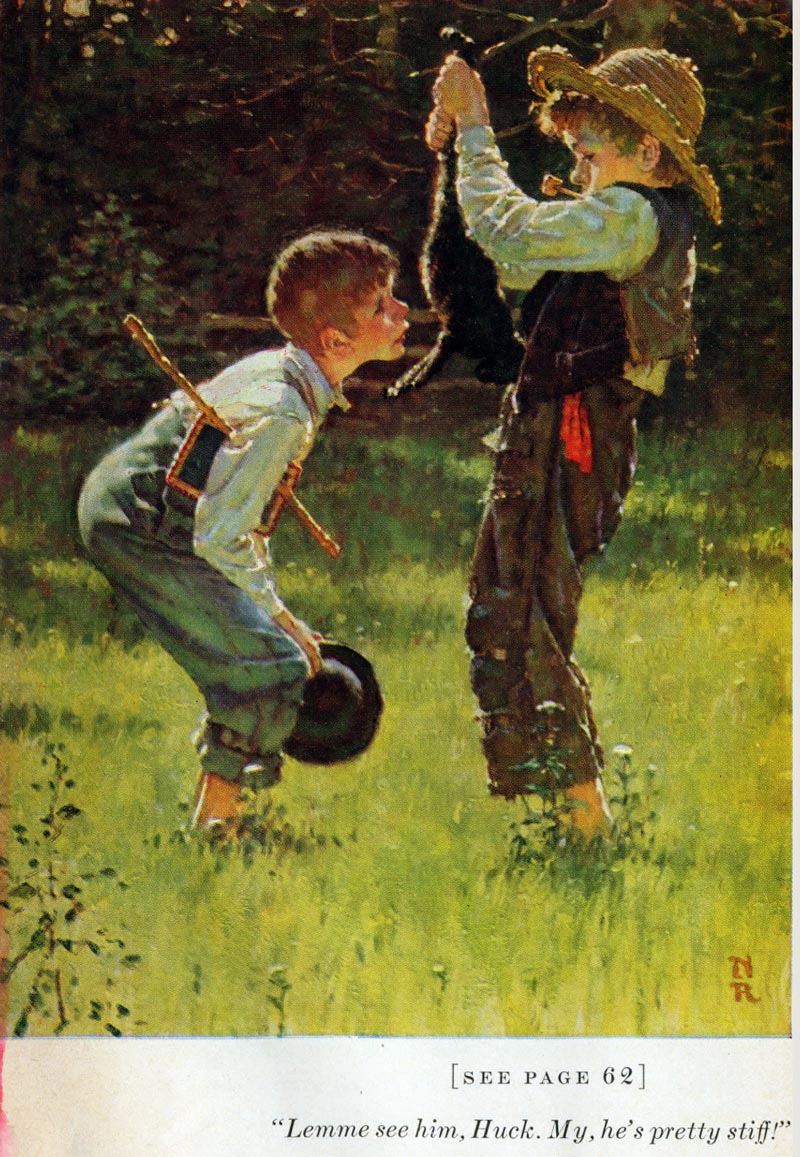
There’s no getting around it: Norman Rockwell was a square. There’s also no getting around the fact that his career helped define the way mainstream Americans saw themselves for decades. And while an artist like Rockwell—so steeped in nostalgia, so lacking in irony and a taste for transgression—might have faded into complete irrelevance amidst the tumult of the sixties, the opposite in fact occurred. Instead of pale, freckle-faced scamps and neighborly civil servants, Rockwell painted likenesses of world leaders like Nehru and Nasser, as well as a now iconic symbol of the Civil Rights struggle on a 1964 Look magazine cover.
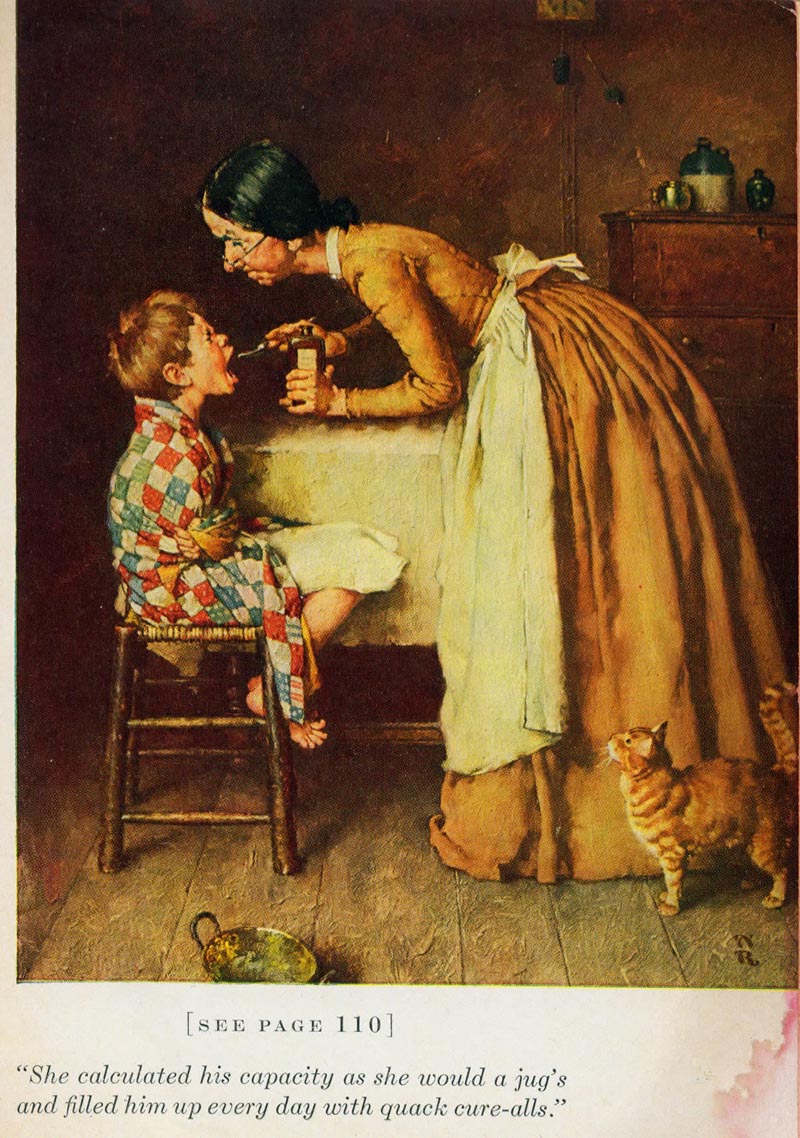
The sixties Rockwell, though still very much a purveyor of small town Americana, became a somewhat weightier figure, even if he never gained (or sought) acceptance in the art world. But we might think of Rockwell as working on two registers throughout his career—as the PG-rated painter of mischievous, childish niceness, and the earnest commentator on mores and values in adult society. In a way, these two sides of America’s most popular illustrator mirror those of the nation’s most popular writer, Mark Twain. Though separated by a generation, the two, writes the Mark Twain House & Museum’s website, are “twinned in many ways in the public consciousness.”
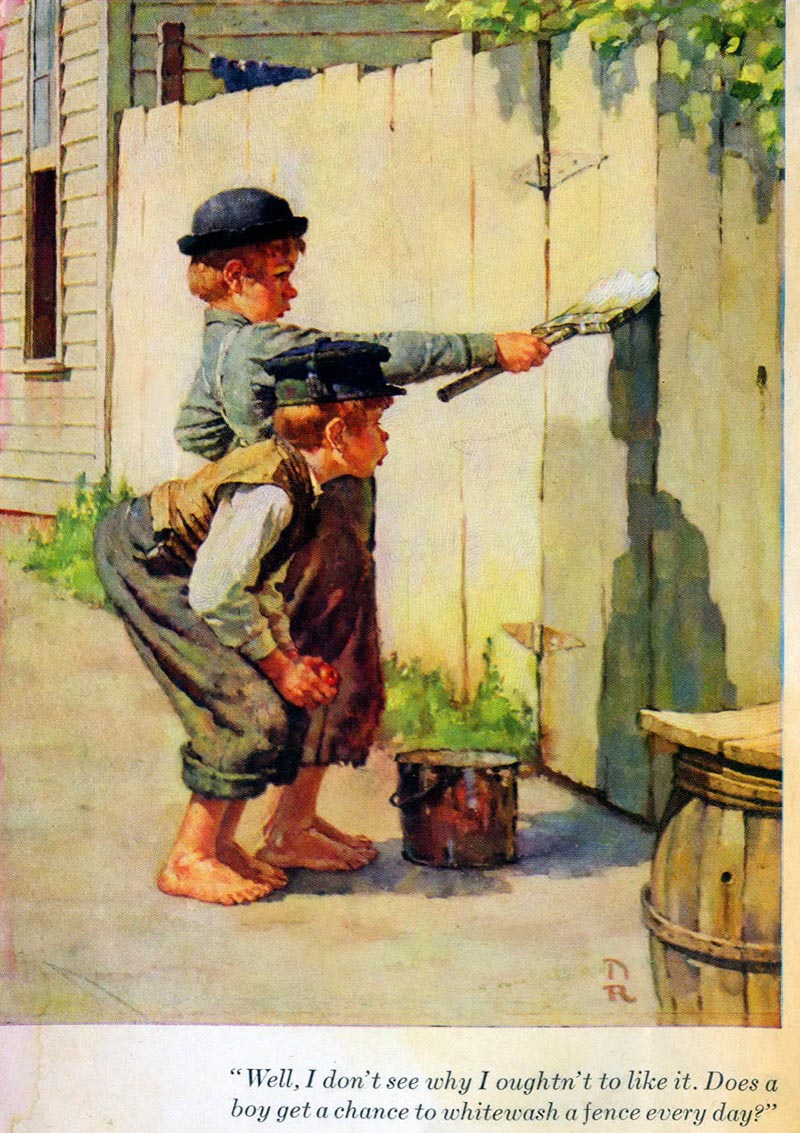
In part, this is because Rockwell illustrated for Heritage Press two of Twain’s most famous books, The Adventures of Tom Sawyer in 1936 and The Adventures of Huckleberry Finn in 1940. Above, see three of Rockwell’s illustrations from Tom Sawyer and, below, one from his Huck Finn. The differences between the two books (so hilariously contrasted by Louis CK), could stand for the two sides of both Twain and Rockwell. As the Mark Twain House puts it, “some critics have dismissed [Twain and Rockwell’s] work as lightweight, blithely ignoring the important statements they made on race.” Tom Sawyer is a lightweight book, the work of Twain the popular humorist. (Twain himself would say, “my books are water: those of the great geniuses are wine. Everybody drinks water.”) Huck Finn on the other hand is a serious adult novel with serious adult themes. For all of its flaws, it makes an admirable attempt to identify with and faithfully render the plight of enslaved people.
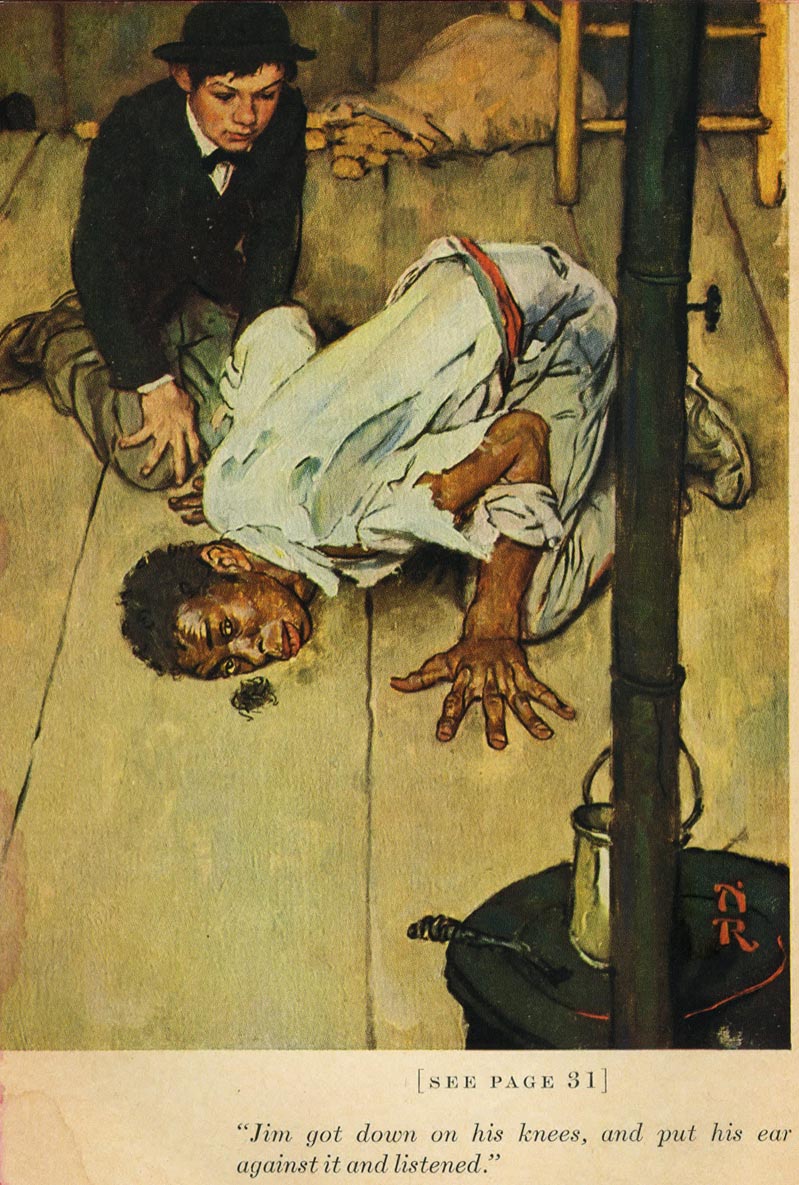
Twain’s great strength as a serious writer was his wealth of empathy, a quality Rockwell manifested as well. In fact, in order to best represent Twain’s books, the illustrator traveled to their setting, Hannibal, Missouri, where he “acquired a new respect for the characters,” writes the Norman Rockwell Museum. “The longer I worked at the task,” Rockwell wrote, “the more in love with the different personalities I became.” Illustration and design blog Today’s Inspiration points out that Rockwell purchased old clothes from the Hannibal locals to “soak up the atmosphere”: “Of all the illustrators (and there were quite a few) that illustrated these novels in the past, Rockwell was the first to visit Mark Twain’s home town. In typical Rockwell fashion, no amount of detail or research was ignored, faked or quickly glossed over.”

Today’s Inspiration zooms in on details from several of the Tom Sawyer paintings to show the fine, almost Vermeer-like attention Rockwell lavished on each illustration. The extensive examination of these early Rockwell classics makes a good case for the folksy illustrator as a “storytelling genius with pallet and brush.” Rockwell may be dismissed as a creator of kitsch, and in some cases the charge is justified, but—like Twain—even his lighter work depended on a fine attention to details of setting and characterization that make his work memorable and moving, in its corniest and its weightiest moments.
Related Content:
50,000 Norman Rockwell Photographs Now Digitized and Available Online
Bill Murray Gives a Delightful Dramatic Reading of Twain’sHuckleberry Finn (1996)
Mark Twain Writes a Rapturous Letter to Walt Whitman on the Poet’s 70th Birthday (1889)
Josh Jones is a writer and musician based in Durham, NC. Follow him at @jdmagness
Read More...The Art of Collotype: See a Near Extinct Printing Technique, as Lovingly Practiced by a Japanese Master Craftsman
When I was a kid, I spent a lot of time at the Indianapolis Star, where my mother worked in what was then referred to as the “women’s pages.” She kept me busy returning the photos that accompanied marriage and engagement announcements, using the SASEs the young brides had supplied. After that, I’d hit the printing floor, where veteran workers sported square caps folded from the previous day’s edition, as that day’s issue clacked on tracks overhead. If I was lucky, someone would make me a gift of my name, set in hot type.
The Star still publishes — I shudder to report that its website seems to have renamed it IndyStar… — but cultural and digital advances have relegated all of the particulars mentioned above to the scrap pile.
They came rushing back with wild, Proustian urgency when Osamu Yamamoto, a master printer at Benrido Collotype Atelier in Kyoto, mentions the smell of the ink, in the short documentary above, how over the years, it has seeped into his skin, and become a part of his being.
Collotype, defined by the Getty Conservation Institute as “a screenless photomechanical process that allows high-quality prints from continuous-tone photographic negatives,” has been on the way out since the 70s. As master printer Yamamoto notes, it’s a low-efficiency, small batch operation, involving messy matrixes, hand-operated presses, and heavy iron machines that give off a sort of animal warmth when working.
Rather than pressmen’s caps, Benrido’s shirtless printers wear hachimaki, rubber aprons, and purple disposable gloves.
Filmmaker Fritz Schumann (whose film on the oldest hotel in Japan we previously featured before) evokes the workplace — one of two remaining collotype companies in the world — through small details like the plastic-wrapped digital Hamtaro clock and also by drawing viewers’ attention to the number of years logged by each employee. The art of collotype takes a long time to master and novices appear to be in short supply.
Should we conceive of this operation as a quaint relic, creeping along thanks to the whimsy of a few nostalgia buffs?
Surprisingly, no. The laborious collotype process remains the best way to duplicate precious artworks and historic documents. The way the ink interacts with reticulations in the gelatin surface atop results in subtleties that pixellated digital images cannot hope to achieve.
Visitors to the studio may support the enterprise by picking up a handful of collotype-printed postcards in the gift shop, but the office of the Japanese Emperor is the one who’s really keeping them in business, with orders to copy hundreds of delicate, centuries old scrolls, paintings and letters.
Like a circle in a circle…cultural preservation via cultural preservation! Perhaps the smell of the ink will prevail.
Related Content:
Hōshi: A Short Film on the 1300-Year-Old Hotel Run by the Same Family for 46 Generations
Mark Twain Wrote the First Book Ever Written With a Typewriter
- Ayun Halliday is an author, illustrator, and Chief Primatologist of the East Village Inky zine. Follow her @AyunHalliday
Read More...
Astronaut Reads The Divine Comedy on the International Space Station on Dante’s 750th Birthday
“On April 24th,” writes The New Yorker’s John Kleiner, “Samantha Cristoforetti, Italy’s first female astronaut, took time off from her regular duties in the International Space Station to read from the Divine Comedy.” You can watch a clip of that reading of the first canto of the Paradiso above. “As Cristoforetti spun around the globe at the rate of seventeen thousand miles an hour, her reading was beamed back to earth and shown in a movie theater in Florence.”
While that stands alone as a neat event in and of itself, more celebration of the epic Italian poem followed. “Ten days later,” Kleiner continues, “the actor Roberto Benigni recited the last canto of Paradiso in the Italian Senate” to a standing ovation. Benigni, one of world cinema’s best-known representatives of Italian culture, seems to have a particularly strong appreciation for Dante Alighieri, the best-known representative of Italian literature; you can see him recite the first canto of the Inferno just above.
The occasion? Dante’s 750th birthday. Though you’ll find no unsuitable occasion to celebrate the Divine Comedy (find it in our collection of 700 Free eBooks), this past month has proven a particularly rich one. Today we’ve gathered a few more pieces of Danteiana so you can conduct your own personal appreciation. You might consider as a first stop the Princeton Dante Project, which “combines a traditional approach to the study of Dante’s Comedy with new techniques of compiling and consulting data, images, and sound,” featuring a searchable new verse translation, texts of Dante’s minor works (with translations), historical and interpretive lectures, more than seventy commentaries, and links to Dante sites from all over the world.
“When Dante began work on the Comedy [circa 1308], none of the different dialects spoken in Italy’s many city-states had any particular claim to preeminence,” writes Kleiner for The New Yorker. “Such was the force and influence of the Comedy that the Tuscan dialect became Italy’s literary language and, eventually, its national one.” But if you don’t speak Italian (as much as the linguistic importance of the Divine Comedy might inspire you to learn it), you might prefer an English reading, which you’ll find here.
Dante has, for so many of us, shaped our very notions of heaven and hell, but perhaps more impressively, as the poet’s 750th birthday passes, his major work shows no signs of falling into irrelevance. No matter how many of us now have different visions of the afterlife than he did, and no matter how many of us have no visions of it at all, we keep reading Dante — whether in Italian or English, whether in the Senate or on the internet, whether on Earth or in space.
Related Content:
A Free Course on Dante’s Divine Comedy from Yale University
The Death Masks of Great Authors: Dante, Goethe, Tolstoy, Joyce & More
Physics from Hell: How Dante’s Inferno Inspired Galileo’s Physics
Colin Marshall writes on cities, language, Asia, and men’s style. He’s at work on a book about Los Angeles, A Los Angeles Primer, and the video series The City in Cinema. Follow him on Twitter at @colinmarshall or on Facebook.
Read More...Support Us
We're hoping to rely on loyal readers, rather than erratic ads. Please click the Donate button and support Open Culture. You can use Paypal, Venmo, Patreon, even Crypto! We thank you!

About Us

Open Culture scours the web for the best educational media. We find the free courses and audio books you need, the language lessons & educational videos you want, and plenty of enlightenment in between.
Advertise With Us

FREE UPDATES!
GET OUR DAILY EMAIL
Get the best cultural and educational resources on the web curated for you in a daily email. We never spam. Unsubscribe at any time.
FOLLOW ON SOCIAL MEDIA

Open Culture editor Dan Colman scours the web for the best educational media. He finds the free courses and audio books you need, the language lessons & movies you want, and plenty of enlightenment in between.
Advertise With Us

