3D Printed Zoetrope Animates Rubens’ Famous Painting, “The Massacre of the Innocents”
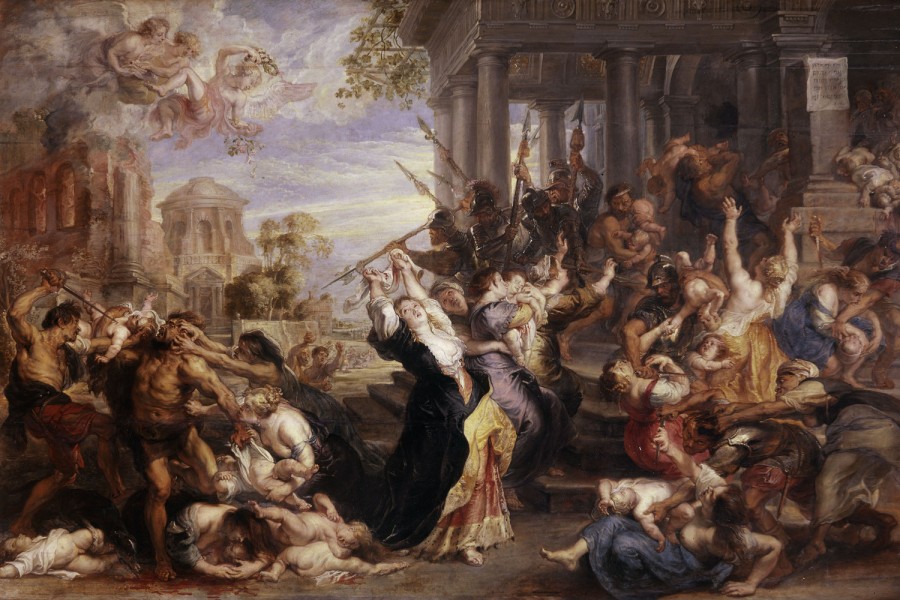
In the 17th century, the Flemish Baroque painter Peter Paul Rubens painted “The Massacre of the Innocents” (see below), an artistic depiction of a very brief Biblical passage in The Gospel of Matthew. The passage recounts the story of how Herod the Great, a Roman client king of Judea, ordered the execution of young male children in Bethlehem, hoping to avoid losing his throne to a newly-born King of the Jews. And it reads like this:
Then Herod, when he saw that he was deceived by the wise men, was exceedingly angry; and he sent forth and put to death all the male children who were in Bethlehem and in all its districts, from two years old and under, according to the time which he had determined from the wise men. Then was fulfilled what was spoken by Jeremiah the prophet, saying:
“A voice was heard in Ramah,
Lamentation, weeping, and great mourning,
Rachel weeping for her children,
Refusing to be comforted,
Because they are no more.”
In the 21st century, Sebastian Burdon and Mat Collishaw have now come along and created “All Things Fall,” a 3d zoetrope that brings the “Massacre of the Innocents” to life. Using a 19th century optical technique that produces the illusion of motion, the zoetrope virtually animates the gruesome Biblical scene. You can watch it play out, eerily, above.
According to Burdon, it took “6 months to do all the 3d modeling and animations” and involved “creating over 350 character figures, environment elements and architecture. A pretty stunning effort.
Related Content:
Download Over 250 Free Art Books From the Getty Museum
Watch Art on Ancient Greek Vases Come to Life with 21st Century Animation
5‑Minute Animation Maps 2,600 Years of Western Cultural History
Read More...The Music of Avant-Garde Composer John Cage Now Available in a Free Online Archive
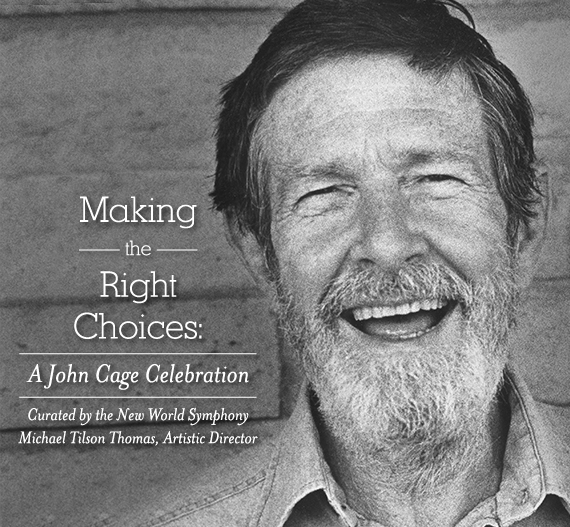
You don’t know avant-garde music unless you know John Cage. And now we have another rich, easily accessible online resource that can help us get to know John Cage better. The new site is called Making the Right Choices: A John Cage Celebration, and it has its origins in the celebration of Cage’s 100th birthday put on by conductor Michael Tilson Thomas and the New World Symphony in February 2013.
This Cage-devoted, Knight Foundation-funded site, in the words of Hyperallergic’s Allison Meier, “presents a comprehensive overview of his career, from a watering can poured on national television to a rhythmic solo piano performance inspired by lost love,” material from Cage’s life and career as well as material inspired by it, and of course “video and audio from the 2013 performances in Miami Beach, including some familiar and some obscure pieces from [Cage’s] influential and experimental career of both music and staged silence.”
You may remember when we featured Cage’s 1960 performance of Water Walk on I’ve Got a Secret. The site doesn’t fail to include that classic television clip, but it also offers videos on the staging of Water Walk today, from its direction and background to its rehearsal to the theatricality of its performance to the placement of the cameras filming it. You can find these and many other audiovisual explorations of the nuts and bolts of Cage’s work at Making the Right Choices’ catalog of videos.
“John Cage genuinely wanted to open up the beauteous experience of sound for everyone,” writes Tilson Thomas in a piece on the composer. “Much of his work could be described as kits to be used in the creation of a performance that relies on the perceptions, imaginations and choices of the musicians. It was a spiritual mission for him to create the opportunity for the performance to exist while at the same time to interfere with it as little or as subtly as possible.” That challenge Cage set for himself keeps his work fascinating to us to this day — and as Tilson Thomas and the New World Symphony surely found out, it remains as much of a challenge as ever for those who pick it up today.
Visit Making the Right Choices: A John Cage Celebration .
via Hyperallergic
Related Content:
John Cage Performs Water Walk on US Game Show I’ve Got a Secret (1960)
10 Rules for Students and Teachers Popularized by John Cage
Hear Joey Ramone Sing a Piece by John Cage Adapted from James Joyce’s Finnegans Wake
Watch a Surprisingly Moving Performance of John Cage’s 1948 “Suite for Toy Piano”
Colin Marshall writes on cities, language, Asia, and men’s style. He’s at work on a book about Los Angeles, A Los Angeles Primer, and the video series The City in Cinema. Follow him on Twitter at @colinmarshall or on Facebook.
Read More...Watch the Hardcore Original Ending to Kevin Smith’s 1994 Cult Hit Clerks
I’m not sure if it’s still the case today, in fact, I’m almost sure it isn’t, but in my day the ethos of an entire generation could be tidily summed up by reference to a handful of movies. Or at least that’s what we were led to believe, those of us who came of age in the early-to-mid 90s, when films like Richard Linklater’s Slacker (watch free online), Ben Stiller’s Reality Bites, and Kevin Smith’s Clerks achieved almost instant cult status as totems of middle class ennui—that of overeducated narcissists and directionless dreamers and cynics with serial romantic disasters and a gnawing sense of the dwindling returns on their heavy investment in cultural capital.
Of this ad hoc trilogy of 90s slackerdom, it’s Smith’s 1994 low-budget, black and white paean to the lives of low-wage convenience and video store clerks, their clueless customers, and a comic duo of stoned hangers-on that perhaps holds up best, and this is because the film’s comedy—ranging from gallows humor to gross-out slapstick to observational geekery—seems most grounded in the everyday experiences of real, absurdly bored, working stiffs everywhere. So it’s for the best that Smith decided not to finish the film with the original ending he shot, which you can see above. In it, the movie’s main character, Quick Stop clerk Dante Hicks, is killed in a robbery. The last image we see in this version’s harrowing dénouement is of his corpse, awkwardly wedged behind the Quick Stop counter.
It’s an ending that makes little sense tonally. Despite the movie’s detours into the macabre, it never gets serious enough to justify this kind of heaviness. As Mental Floss puts it, “the alternate ending to Kevin Smith’s breakthrough film turned a lighthearted vulgar comedy [see above] into a dark tragedy of Ingmar Bergman-ish proportions.” Actor Brian O’Halloran, who played Dante, thought as much. “I hated that ending,” Rolling Stone quotes him as saying, “I just thought it was too quick of a twist.” I guess it’s a good thing for Smith (and O’Halloran) that he finally agreed, since without the Clerks universe’s main character, there may have been no Clerks 2, for what it’s worth, though Jay and Silent Bob would certainly have gone on to their post-Clerks revenge.
Smith’s choice to keep it light also speaks to the spirit of the time—or the spirit of these filmed representations of the time, which are ultimately about a lack of resolution, a meta-lack of resolution, that becomes its own brand of tragicomedy. Clerks is loosely modeled on Dante’s vision of purgatory, but feels more like Samuel Beckett transposed to suburban New Jersey. The characters in Smith’s films forever live their lives in what post-hardcore band Fugazi so anthemically called the “waiting room”—the kind of place where, in the midst of a personal crisis, the most logical thing to do is debate the ethics of killing off independent contractors on Return of the Jedi’s Death Star.
The Clerks alternate ending appears on the 10th anniversary DVD of the film. You’ll probably agree the movie works much better without this fatally abrupt turn, but watching it gives us a glimpse of a world where death—always hovering on the edges of slackerdom—intrudes to break the spell of terminal inaction and emotional paralysis.
Related Content:
Watch Kevin Smith’s Clever First Film, Mae Day: The Crumbling of a Documentary (1992)
The Always-NSFW Kevin Smith and Jason Mewes Catch Up in Jay and Silent Bob Get Old Podcast
Hear Kevin Smith’s Three Tips For Aspiring Filmmakers (NSFW)
Watch Free Online: Richard Linklater’s Slacker, the Classic Gen‑X Indie Film
Josh Jones is a writer and musician based in Durham, NC. Follow him at @jdmagness
Read More...Take a Free Course on Film Noir; Then Watch Oodles of Free Noir Films Online
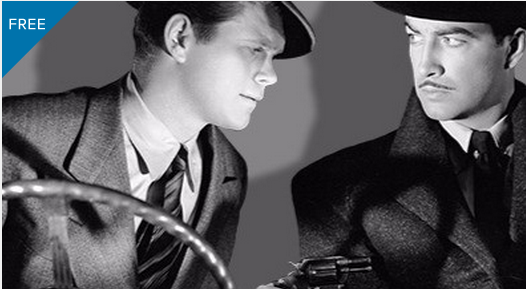
Cinephiles, if you have some spare time in the coming months and feel like watching, say, over 100 film noir movies from the Turner Classic Movie (TCM) vaults, then you will be delighted with Summer of Darkness, which will devote every Friday, from June through July, to 24 hours of noir classics and rarities. And suppose you’d like a reward, like a certificate that proves you not only watched those movies, but properly studied them? Well TCM has that covered too, offering a free nine-week course in “The Case of Film Noir” to run concurrent with the series. It’s free to sign up, and the course runs June 1 — August 4. Says TCM:
This is the deepest catalog of film noir ever presented by the network (and perhaps any network), and provides an unprecedented opportunity for those interested in learning more to watch over 100 classic movies as they investigate “The Case of Film Noir.”
The course is being taught by Richard L. Edwards, Ph.D. who co-hosts the Out of the Past: Investigating Film Noir podcast and also teaches at Ball State University in Muncie, Indianapolis.
For those who don’t have TCM, or even cable, don’t worry. The network promises to post links to online public domain films. Or, better yet, you could jump right into our collection of 60 Free Noir Films Online, which features public domain classics by Orson Welles, Fritz Lang, John Huston, and many more.
Have a hazy, dangerous summer and watch out for femme fatales!
via Flavorwire
Related Content:
The 5 Essential Rules of Film Noir
25 Noir Films That Will Stand the Test of Time: A List by “Noirchaelogist” Eddie Muller
Kansas City Confidential: Did This 1952 Noir Film Inspire Quentin Tarantino’s Reservoir Dogs?
Ted Mills is a freelance writer on the arts who currently hosts the FunkZone Podcast. You can also follow him on Twitter at @tedmills, read his other arts writing at tedmills.com and/or watch his films here.
Read More...French Student Sets Internet on Fire with Animation Inspired by Moebius, Syd Mead & Hayao Miyazaki
The internet over in Japan was lit ablaze last month by a student film. Titled “Celles et Ceux des Cimes et Cieux” (“Girls and Guys from the Summits and the Skies”), the short is a gorgeously animated trailer for what looks like an amazing yet-to-be-made feature film. Created by Gwenn Germain, who is studying at the French art school Créapole, the animation is also a love letter to legendary filmmaker Hayao Miyazaki. You can watch it above.
“I’ve been told by a friend of mine that all the movies that I’ve made are essentially the same!” That’s what Miyazaki said to me during a roundtable for his children’s movie Ponyo. Though the stories vary from movie to movie, his world is immediately recognizable and remarkably consistent. He creates universes that are wondrous and mystical.
He has an almost shamanistic reverence for nature; rocks, trees, rivers, and oceans all seem to be alive and aware. And he populates his world with shape-shifting creatures like the ravenous masked blob No-Face in Spirited Away; the Great Forest Spirit in Princess Mononoke, which looks like it was yanked straight out of Japanese mythology; and perhaps his most delightful creation, the Cat Bus from My Neighbor Totoro, complete with headlight eyes, a Cheshire grin and a warm, womb-like interior. It was this whimsical creation that reportedly impressed The Emperor himself – Akira Kurosawa.
It’s no wonder why Japanese netizens went crazy for “Celles et Ceux des Cimes et Cieux.” Germain’s short seems sprung from the same world as Miyazaki. The giant bugs look like something out of Nausicaa of the Valley of the Wind. The ambiguously European architecture looks like something from Kiki’s Delivery Service and those purple amorphous worms look like something from Spirited Away. Heck, Miyazaki himself even seems to be in Germain’s short – that bearded old guy at the end of the movie is a spitting image of the famed animator.
Germain credits other influences aside from Miyazaki: Syd Mead, the concept artist who created those flying cars in Blade Runner and the city of the future in the upcoming Tomorrowland, and particularly the boundlessly imaginative French illustrator Moebius. Their influence might not be as obvious as Miyazaki’s, however.
In any case, I am seriously looking forward to seeing a feature length version of “Celles et Ceux des Cimes et Cieux.”
Related Content:
How to Make Instant Ramen Compliments of Japanese Animation Director Hayao Miyazaki
Moebius Gives 18 Wisdom-Filled Tips to Aspiring Artists (1996)
Moebius’ Storyboards & Concept Art for Jodorowsky’s Dune
Japanese Cartoons from the 1920s and 30s Reveal the Stylistic Roots of Anime
Jonathan Crow is a Los Angeles-based writer and filmmaker whose work has appeared in Yahoo!, The Hollywood Reporter, and other publications. You can follow him at @jonccrow. And check out his blog Veeptopus, featuring pictures of vice presidents with octopuses on their heads. The Veeptopus store is here.
Read More...Mesmerizing Timelapse Film Captures the Wonder of Bees Being Born
From National Geographic comes this: A short timelapse film that lets you watch “the eerily beautiful growth of larvae into bees.” Shot by photographer Anand Varma, the mesmerizing video starts with the larvae of worker bees just hatching from eggs, then follows their maturation into adult bees. The video covers an 11-day process in one short minute.
You can get a behind-the-scenes account of the making of this video over at Nat Geo. When you’re there, you might also want to check out these pretty amazing portraits of bees.
Follow us on Facebook, Twitter, Google Plus and LinkedIn and share intelligent media with your friends. Or better yet, sign up for our daily email and get a daily dose of Open Culture in your inbox.
Read More...
Watch Sherlock Hound: Hayao Miyazaki’s Animated, Steampunk Take on Sherlock Holmes
With such majestic, painstakingly crafted films as Nausicaä of the Valley of the Wind, My Neighbor Totoro, and Princess Mononoke, Hayao Miyazaki has made his name as Japanese animation’s preeminent artistic visionary — and quite possibly animation’s preeminent artistic visionary as well. But before he co-founded Studio Ghibli, the house that has become synonymous with Miyazaki’s kind of lush, universally appealing, and award-winning films, he worked on various kinds of animation, for different media and pitched at different levels of seriousness. One of the most notable projects of the end of that chapter of his career transposed the adventures of Sherlock Holmes into a world of anthropomorphic dogs.
The Italian-Japanese co-production Sherlock Hound aired as a television series between 1984 and 1985. Of its 26 episodes, which sent the corgi Sherlock Hound and terrier Doctor Watson after a variety of thieves and on all sorts of adventures across a steampunk London, Miyazaki directed six.
In the Miyazaki-directed episode “Treasure Under the Sea” at the top of the post, for instance, the detecting duo go after a submarine purloined by recurring antagonist of both Holmes and Hound, Professor Moriarty, who here takes the form of a wolf.
“The Sovereign Gold Coins” finds Hound and Watson in pursuit of that seemingly more traditional stripe of criminal known as a safecracker, and in “Mrs. Hudson is Taken Hostage,” their landlady (who seems considerably more youthful in Miyazaki’s vision than the matron in Sir Arthur Conan Doyle’s) goes missing, though her kidnapper badly underestimates the difficulty of pulling off his plan under Hound’s watch. Miyazaki would direct three more episodes (“The Stormy Getaway,” “The Crown of Mazalin,” and “The Four Signatures”) before a rights dispute with Conan Doyle’s estate threw a wrench into production. The show later went on under other creators, and U.S. viewers can see the whole, still-delightful run on Hulu, but Miyazaki didn’t look back — and seeing as Nausicaä had come out that same year, he didn’t need to.
Related Content:
Download the Complete Sherlock Holmes, Arthur Conan Doyle’s Masterpiece
Arthur Conan Doyle Discusses Sherlock Holmes and Psychics in a Rare Filmed Interview (1927)
Hear the Voice of Arthur Conan Doyle After His Death
Colin Marshall writes on cities, language, Asia, and men’s style. He’s at work on a book about Los Angeles, A Los Angeles Primer, and the video series The City in Cinema. Follow him on Twitter at @colinmarshall or on Facebook.
Read More...Peter Sellers Covers the Beatles’ “A Hard Day’s Night,” “She Loves You” & “Help!”
In the early sixties, Peter Sellers, one of the greatest comic actors of his generation, met perhaps the greatest musicians of the age, the Beatles, through their mutual producer George Martin. The particularly British sensibilities of the band and the actor—slapstick and wordplay, accent and costume changes—had surprisingly broad appeal in the sixties, and a common history in their mutual admiration of English comedian and writer Spike Milligan.
Sellers rose to prominence on the Milligan-created BBC radio program The Goon Show, which the Beatles cited as a major influence on their work. Their constant patter in interviews, films, even rehearsals, their tendency to break into music hall song and dance, comes right out of Sellers in a way (see, for example, the great comic actor in a rare interview here), but was also very much an expression of their own extroverted personalities. It stands to reason then that Sellers and the Beatles, as we wrote in an earlier post, “became fast friends.”
And as the Beatles had paid tribute to Sellers’ comedy, he would return the favor, covering three of their most popular songs as only he could. At the top of the post, see Sellers do a spoken word version of “A Hard Day’s Night” as Lawrence Olivier’s Richard III. And above and below, he gives us several renditions of “She Loves You,” in several different accents, “in the voice of Dr. Strangelove, again with cockney and upper-crusty accents, and finally with an Irish twist. The recordings were all released posthumously between 1981 and 1983 on albums no longer in circulation.”
There are many more Beatles/Sellers connections. Before taping his “Hard Day’s Night” skit for Granada television special “The Music of Lennon & McCartney,” Sellers had presented the band with a Grammy for the song, which won “Best Performance of a Vocal Group” in 1965. “Incidentally,” writes Mersey Beat’s Bill Harry, “the [Grammy] presentation was made on the studio set of ‘Help!’ and, interestingly, Sellers had originally been offered the script of ‘Help!’ (Obviously under a different title) but turned it down.” Sellers and the Goon Show cast had previously worked with Richard Lester, director of the Beatles films and the John Lennon-starring How I Won the War.
Completists out there may have also heard the recorded conversation between Sellers and the Beatles that appears at the end of a bootleg version of the White Album, which circulated for years under the title The Peter Sellers Tape. That the band and the comedian got along so famously is no great surprise, nor that Sellers had so much fun reworking the rather silly, and infectiously catchy, pop songs of the Beatles’ early career, bringing to them his battery of characters and voices. We’ve saved what may be Sellers’ best Beatles cover for last. Below, hear him—in the voice of a lecturing vicar and with a backing choir—deliver “Help!” as a 45 RPM sermon.
Related Content:
Peter Sellers Presents The Complete Guide To Accents of The British Isles
The Beatles Perform a Fun Spoof of Shakespeare’s A Midsummer Night’s Dream (1964)
John Cleese, Ringo Starr and Peter Sellers Trash Priceless Art (1969)
John Lennon’s Appearances in How I Won the War, the Absurdist 1967 Film
Josh Jones is a writer and musician based in Durham, NC. Follow him at @jdmagness
Read More...David Lynch’s Twin Peaks Title Sequence, Recreated in an Adorable Paper Animation
Yea, and there was a rejoicing all round the land last week when Showtime and David Lynch finally worked out a deal to bring back Twin Peaks after initial reports that Lynch had backed out.
So while we wait for 2016, check out Matthew Fuller’s re-creation of the Twin Peaks title sequence in animated paper cut outs. Fuller’s rough hewn creation is adorable, staying true to the languid pace and dreamy objects of the original. (I had kind of forgetten that very large log on display at the one minute mark.)
Fuller just started this YouTube channel And the World Was Paper two weeks ago, kicking it off with a recreation of the new Star Wars trailer. He is also promising a new paper video every fortnight, so be sure to subscribe.
Meanwhile, this paper version of Twin Peaks isn’t the first time the titles has been recreated. Check out Filthy Frackers 8‑bit version here:
Related content:
Play the Twin Peaks Video Game: Retro Fun for David Lynch Fans
David Lynch’s Music Videos: Nine Inch Nails, Moby, Chris Isaak & More
David Lynch Presents the History of Surrealist Film (1987)
Ted Mills is a freelance writer on the arts who currently hosts the FunkZone Podcast. You can also follow him on Twitter at @tedmills, read his other arts writing at tedmills.com and/or watch his films here.
Read More...William S. Burroughs — Alternative Rock Star — Sings with Kurt Cobain, Tom Waits, REM & More

Image via Christiaan Tonnis
Like many of the best countercultural icons, William S. Burroughs had at least two separate periods of underground fame. The first came in the late 1950s and 60s when he wrote such classics-to-be of Beat literature as Junkie, Naked Lunch, and the “cut-up” trilogy of The Soft Machine, The Ticket That Exploded, and Nova Express. The second came in the 1980s and 90s, when a new wave of countercultural icons, themselves raised on Burroughs’ writing, came of age and sought out their hero for collaboration.
“How a novelist with no musical background who began his career in the 1940s became so popular an alternative music figure that Kurt Cobain backed him up on one of Cobain’s last recordings is one of the odder, more fascinating footnotes in this otherwise heavily examined musical era,” says Music for Maniacs.
Many rockers who looked up to Burroughs attended his live readings, but for some, “it wasn’t enough to just listen to Burroughs read his own works, with increasingly elaborate musical backings, but to hire him to perform on recordings. And that is what we have here: not Burroughs’ own releases, but his various miscellaneous appearances on other bands’ songs.”
Above, hear Burroughs with Tom Waits on jazz tune “T’Ain’t No Sin” and with Ministry on “Quick Fix.” You can listen to all of these recordings, in which Burroughs records with or covers the material of REM, The Doors, Laurie Anderson, Marlene Dietrich, Kurt Cobain, and others, at Ubuweb. The playlist runs as follows. Click to listen:
- Fuck Me Kitten (with REM, from “Songs in the Key of X: Music from and Inspired by ‘the X‑Files’ ” — 1996)
- Is Everybody In? (with The Doors, reciting Jim Morrison poetry, from “Stoned Immaculate: The Music of the Doors”)
- Sharkey’s Night (with Laurie Anderson, from “Mister Heartbreak” — 1983)
- What Keeps Mankind Alive (from Kurt Weill tribute album “September Songs”)
- ‘T ‘Aint No Sin (1920s jazz song, performed on Tom Waits’ “The Black Rider” — 1993)
- Quick Fix (w/Ministry, “Just One Fix” b‑side — 1992)
- Old Lady Sloan (w/The Eudoras, covering a song by a Lawrence, Kansas punk band from “The Mortal Micronotz Tribute!” — 1995
- Ich Bin Von Kopf Bis Fub Auf Liebe Eingestellt (Falling In Love Again) — Marlene Deitrich cover, from “Dead City Radio” — 1988
- The “Priest” They Called Him — (w/Kurt Cobain, 1992)
Not only do performers like Burroughs rarely enjoy a two-act career like his, they hardly ever put out material as odd in their last act as they did in their first. But nothing in the life of the “rock star to rock stars,” as Music for Maniacs calls him, happened in the traditional matter. And once you get through his stint as an alternative rock star, do have a look at his stint as an alternative performer on the silver screen.
via Ubuweb
Related Content:
William S. Burroughs “Sings” R.E.M. and The Doors, Backed by the Original Bands
Patti Smith Shares William S. Burroughs’ Advice for Writers and Artists
The Making of Drugstore Cowboy, Gus Van Sant’s First Major Film (1989)
Gus Van Sant Adapts William S. Burroughs: An Early 16mm Short
Colin Marshall writes on cities, language, Asia, and men’s style. He’s at work on a book about Los Angeles, A Los Angeles Primer, and the video series The City in Cinema. Follow him on Twitter at @colinmarshall or on Facebook.
Read More...Support Us
We're hoping to rely on loyal readers, rather than erratic ads. Please click the Donate button and support Open Culture. You can use Paypal, Venmo, Patreon, even Crypto! We thank you!

About Us

Open Culture scours the web for the best educational media. We find the free courses and audio books you need, the language lessons & educational videos you want, and plenty of enlightenment in between.
Advertise With Us

FREE UPDATES!
GET OUR DAILY EMAIL
Get the best cultural and educational resources on the web curated for you in a daily email. We never spam. Unsubscribe at any time.
FOLLOW ON SOCIAL MEDIA

Open Culture editor Dan Colman scours the web for the best educational media. He finds the free courses and audio books you need, the language lessons & movies you want, and plenty of enlightenment in between.
Advertise With Us

