Yoko Ono Lets Audience Cut Up Her Clothes in Conceptual Art Performance (Carnegie Hall, 1965)
Back before it was common practice to preface one’s web posts with the phrase “trigger warning” (which, BTW, might well apply here)…
Before the Internet…
And slightly before the public revelation of her relationship with John Lennon turned a Japanese avant-garde artist into an American household name…
Yoko Ono maintained an aura of imperviousness onstage at Carnegie Hall, as audience members accepted the challenge to cut away her clothing one piece at a time.
This now-famous conceptual performance was documented by filmmakers Albert and David Maysles, who captured nervous laughter and audience commentary along with the onstage action. (Ono had previously performed the piece twice in Japan where—with the exception of one man who wielded the scissors as if intending to stab her—audiences proved reticent and respectful.)
What does Cut Piece mean?
The motionlessness Ono imposed upon herself (and all subsequent performers of the work) keeps things open to interpretation.
It’s been hailed as a deeply symbolic feminist work and represented in the press of the time as an uninhibited, interactive strip show. Many an academic paper has been written.
With so much control ceded to the audience, even the performer couldn’t predict for certain whether the intention of the piece would synch with the reality.
Cut Piece cannot be mistaken for pure improvisation, however. Like John Cage’s 4’33”, it has a score, complete with variations:
Cut Piece
First Version for single performer:
Performer sits on stage with a pair
of scissors placed in front of him.
It is announced that members of the audience
may come on stage–one at
a time–to cut a small piece of the
performer’s clothing to take with them.
Performer remains motionless
throughout the piece.
Piece ends at the performer’s
option.
Ono has said that the impulse for Cut Piece came from the desire to create art free from ego, the “mentality of saying, ‘here you are, take anything you want, any part you want,’ rather than pushing something you chose on someone else.”
She also took inspiration from a familiar childhood story about the Buddha selflessly giving his own body to provide food for a hungry tiger. It seems an apt metaphor, given the facial expressions of certain audience participants. Were they faking a confidence they didn’t feel, or were they just jerks?
Did I mention the trigger warning?
Documentation, as any performance artist will tell you, is not quite the same as being there. Reenactments, too, may fall short of the original.
Ono reprised the work in 2003, at the age of 70, noting that her motivation had shifted from rage to love, and a desire for world peace.
When artist Jon Hendricks performed it in 1968, he did so in a thrift store suit, thus ignoring its creator’s conviction that part of its power came from starting out in one’s best clothes.
It’s all very ballsy, and horrifying, and compelling, and a little hard to watch.
Would you consider trying it in your local library, community hall, or as part of a school fundraiser?
A longer analysis and history of Yoko Ono’s Cut Piece can be found here courtesy of Kevin Concannon.
Related Content:
Download the John Lennon/Yoko Ono “War is Over (If You Want It)” Poster in 100+ Languages
John Lennon & Yoko Ono’s Two Appearances on The Dick Cavett Show in 1971 and 72
Ayun Halliday is an author, illustrator, and Chief Primatologist of the East Village Inky zine. Follow her @AyunHalliday
Read More...Learn to Write Through a Video Game Inspired by the Romantic Poets: Shelley, Byron, Keats
Can a computer game teach writing and free up the creative mind? Elegy for a Dead World, a Kickstarter-funded game for Steam PC, Mac and Linux systems, hopes to do so. The creators Ichiro Lambe and Ziba Scott brought the game to E3 last year and debuted it with a brief introductory walkthrough.
The game contains three post-apocalyptic worlds based on the works of a trio of Romantic poems: Ozymandias by Percy Bysshe Shelley, Darkness by Lord Byron, and When I Have Fears That I May Cease to Be by John Keats.
Players explore the world by walking and flying through it like a regular platform game, but encounter writing prompts that begin to flesh out the backstory with the help of the player’s imagination. The developers hope that by the third or forth prompt, the player will be invested in the tale they are telling and perhaps ignore the prompts altogether.
Players can share their stories with friends. They can also print out their finished work through sites like Blurb and Lulu.
It’s hard to know without spending the $14.99 whether or not Elegy really can lead you to some decent writing. Experienced writers may find the worlds too limiting, but perhaps for a beginning writer it might help with the fear of the blank page. A lot was promised in the Kickstarter campaign:
You can read other players’ works, browsing through the most-recent, the best-loved, and recently-trending stories. In our gameplay tests so far, players have expressed a variety of thoughts about what happened in each world — the silhouette of what looks like a telescope to one player looks like a rocket ship to another, and a planet-destroying weapon to yet another.
In a larger context, Elegy is another attempt by game designers to free players from the determination of goal-based, narrative video games. Leave a comment if you’ve played Elegy for a Dead World and if you created something out of it. In the meantime, watch game reviewer NateWantsToBattle for his own experience, and just revel in the beautiful graphics. We’re a long way from Type!
Related Content:
William S. Burroughs Teaches a Free Course on Creative Reading and Writing (1979)
The Internet Arcade Lets You Play 900 Vintage Video Games in Your Web Browser (Free)
Seven Tips From Ernest Hemingway on How to Write Fiction
George Plimpton, Paris Review Founder, Pitches 1980s Video Games for the Mattel Intellivision
Ted Mills is a freelance writer on the arts who currently hosts the FunkZone Podcast. You can also follow him on Twitter at @tedmills, read his other arts writing at tedmills.com and/or watch his films here.
Read More...6 Political Theorists Introduced in Animated “School of Life” Videos: Marx, Smith, Rawls & More
“It may come as a surprise to some academics,” writes leftist political theorist Michael Parenti in his sprawling textbook Democracy for the Few, “but there is a marked relationship between economic power and political power.” Parenti exaggerates—I have never met such an academic in a humanities department, though it may be true in the worlds of political philosophy and political science.
Yet in centuries past, philosophers and scholars had no trouble drawing conclusions about the intertwining of the political and the economic. One may immediately think of Karl Marx, who—according to the above video from a new School of Life series on famous political theorists—was “capitalism’s most famous and ambitious critic.” The practical effects of Marx’s political ideas may be anathema for good reason, Alain de Botton admits, but his economic analysis deserves continued attention.
“Capitalism is going to have to be reformed,” de Botton says, “and Marx’s analyses are going to be part of any answer.” One might imagine many academics objecting to his certainty. Marx’s relevance is in question across the political spectrum, in part because the kind of capitalism he so painstakingly documented is hardly recognizable to us now.
70 years before Marx diagnosed the social and economic ills of Victorian capitalism, Scottish philosopher Adam Smith made similar observations of its 18th century precursor. Regularly cited in defense of so-called free market principles, Smith’s Wealth of Nations as often shows how little freedom actually exists in capitalist societies because of the undue influence of “the masters” and the hyper-specialization of the work force, who were unable in Smith’s time, and often in ours, to organize for their mutual interests.
Smith may not have gone as far as Marx in his conclusions, but he did advocate progressive taxation and a robust welfare state. In the 20th century, John Rawls argued for a stricter standard of political and economic equality than Smith’s appeal to sympathy. Rawls’ 1971 Theory of Justice introduced a “simple, economical, and polemical way to show people how their societies were unfair”: the “veil of ignorance.”
This thought experiment asks us to eliminate unfairness by presuming we might potentially have been born into the circumstances of any other living person on earth. Though it may not be particularly apparent, Rawls’ ideas have had some influence on policy. As de Botton points out above, he dined regularly at the Clinton White House. But his principles haven’t much changed the way we live our economic lives, in part because of his critique of the rags-to-riches story, almost a sacred myth in American society.
Like Adam Smith, Henry David Thoreau’s politics seem a little harder to pin down. A contemporary of Marx, Thoreau thought in terms of the individual, penning perhaps a founding text for both hippie homesteaders and survivalists. In Walden—written while he lived alone in a cabin on land owned by his friend and patron Ralph Waldo Emerson—Thoreau makes the case for near total self-reliance. In his Civil Disobedience, he writes, “I heartily accept the motto—‘That government is best which governs least.’”
Thoreau also believed “That government is best which governs not at all.” Yet, despite its author’s fierce libertarian bent (he refused to pay his taxes on principle), Civil Disobedience has served a founding text of progressive social and environmental movements worldwide. Speaking “practically and as a citizen, unlike those who call themselves no-government men,” Thoreau went on, “I ask for, not at once no government, but at once a better government.”
De Botton’s series on political theory profiles two more Victorian-era thinkers—poet and writer on political economy William Morris, above, and art and literary critic John Ruskin, below. Both thinkers—with rarified focus on craft and aesthetics—made their own critiques of capitalism from positions of relative luxury. Though the School of Life series doesn’t say so directly, it seems as though the six philosophers it surveys—very cursorily, I should add—were chosen as historical counterexamples to the idea that political theorists don’t observe the relationship between the political and the economic. It may be the case today in certain academic departments, but it certainly was not for over the first two hundred years of capitalism’s existence.
Related Content:
David Harvey’s Course on Marx’sCapital: Volumes 1 & 2 Now Available Free Online
Eastern Philosophy Explained with Three Animated Videos by Alain de Botton’s School of Life
Leo Strauss: 15 Political Philosophy Courses Online
Free Online Philosophy Courses
Josh Jones is a writer and musician based in Durham, NC. Follow him at @jdmagness
Read More...The 10 Favorite Films of Avant-Garde Surrealist Filmmaker Luis Buñuel (Including His Own Collaboration with Salvador Dalí)
You may remember that when we featured the favorite films of Federico Fellini, the 8 1/2 director’s top-ten list included… well, 8 1/2. But then, no filmmaker before Fellini or after him has had quite the same sensibility, so if Fellini made the kind of movies he himself wanted to watch — and I suspect he made only that kind of movie — then we might wonder why his list didn’t include even more of his own work. And maybe we should wonder the same about this list of favorites from Luis Buñuel, the Spanish surrealist who started doing for vivid, dreamlike, and grotesque European cinema in the 1920s what Fellini kept doing for it until the 1990s:
- Underworld (1927, Josef von Sternberg)
- The Gold Rush (1925, Charles Chaplin)
- The Bicycle Thief (1947, Vittorio De Sica)
- Battleship Potemkin (1925, Sergei Eisenstein)
- Portrait of Jennie (1948, William Dieterle)
- Cavalcade (1933, Frank Lloyd)
- White Shadows in the South Seas (1928, W.S. Van Dyle/Robert Flaherty)
- Dead of Night (1945, Alberto Cavalcanti/Charles Crichton/Basil Deardon/Robert Hamer)
- L’Age d’Or (1930, Luis Bunuel/Salvador Dali)
- I Am a Fugitive from a Chain Gang (1932, Mervyn LeRoy)
At the top of the post, you can watch Buñuel’s number-one pick, Josef von Sternberg’s silent proto-gangster picture Underworld. Just above, you’ll find his number-nine pick, and the one he had a hand in himself: L’Age d’Or, the 1930 societal satire on which he collaborated with the Spanish artist Salvador Dalí. It came as the follow-up to their 1929 silent short Un Chien Andalou, a work widely recognized as the foundation stone of surrealist cinema (see also our post on both films), and it came with much greater ambitions.
Neither Buñuel’s own directorial style nor the medium of cinema itself had quite found their form yet; those conditions produced a film that still retains many striking and even cutting qualities today, albeit not, perhaps, to the same degree that they caused contemporary right-wingers to toss ink at the screen and start brawls in the aisles. Watch the pre-1930 films on the list, like Battleship Potemkin and The Gold Rush, to understand what formed Buñuel’s cinematic sensibility; watch L’Age d’Or to understand why, when it comes to his own work, he prefers the early stuff.
Related Content:
Two Vintage Films by Salvador Dalí and Luis Buñuel: Un Chien Andalou and L’Age d’Or
Read Filmmaker Luis Buñuel’s Recipe for the Perfect Dry Martini, and Then See Him Make One
Federico Fellini’s List of His 10 Favorite Films … Includes One of His Own
Colin Marshall writes on cities, language, Asia, and men’s style. He’s at work on a book about Los Angeles, A Los Angeles Primer, and the video series The City in Cinema. Follow him on Twitter at @colinmarshall or on Facebook.
Read More...Comics Inspired by Waiting For Godot, Featuring Tintin, Roz Chast, and Beavis & Butthead
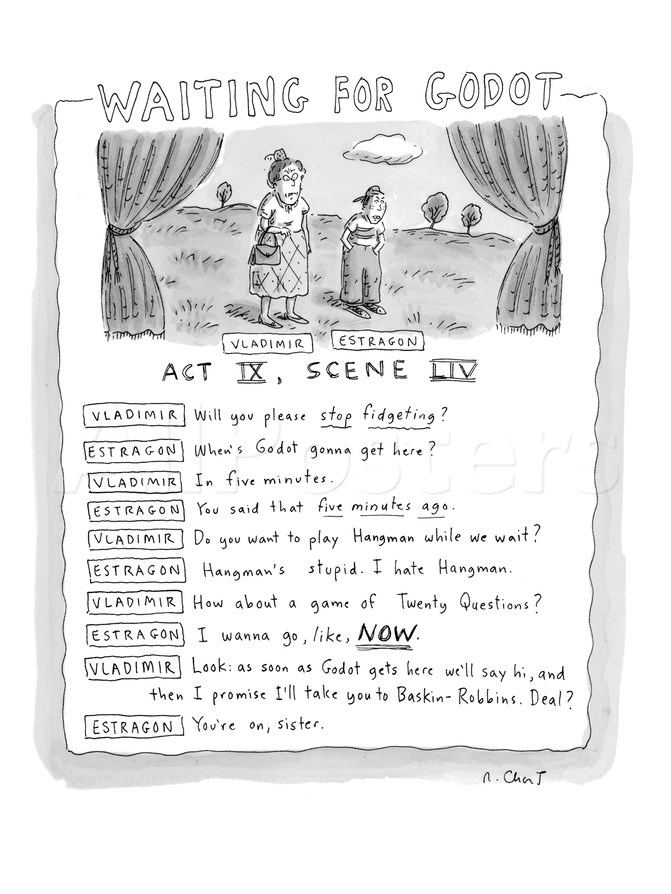
Is Samuel Beckett’s Waiting for Godot funny?
Yes. It’s a comedy about life’s tragedies, great and small.
Are cartoons inspired by Waiting for Godot funny?
…mostly not. Especially when they’re set in waiting rooms (or airport arrivals areas).
Godot’s a hard trope for a cartoonist on the prowl for something fresh. Dogs, psychiatrists, castaways on desert islands are more elastic subjects, universal, but capable of being spun any number of ways.
To wring a comic worthy of The New Yorker out of Godot, you probably have to be an actual New Yorker cartoonist, like Roz Chast, whose instantly recognizable work can be seen above.
Other New Yorker cartoonists who’ve taken a crack include Danny Shanahan, Jack Ziegler and Benjamin Schwartz.
Not to imply that New Yorker cartoonists are the only source for inspired Godot-inspired comics– the late, great Hergé, creator of Tintin made one.
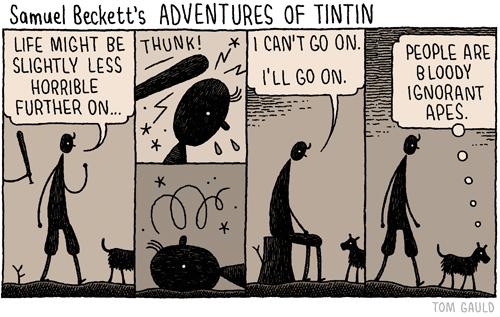
(Oh wait, that’s not Hergé, it’s Tom Gauld who illustrates the Guardian’s Saturday Review letters page, scoring major points by relocating the terminally upbeat boy detective so outside his comfort zone that even Snowy is a negative image.)

Cartoonist Richard Thompson summoned Godot for a strip within a strip installment of his popular syndicated Cul de Sac. (Click the image above to view it in a larger format.) Will readers get the reference? Alice, his preschool-aged heroine, seems to, astutely echoing critic Vivian Mercier’s assessment of Godot as a play where “nothing happens…twice”.
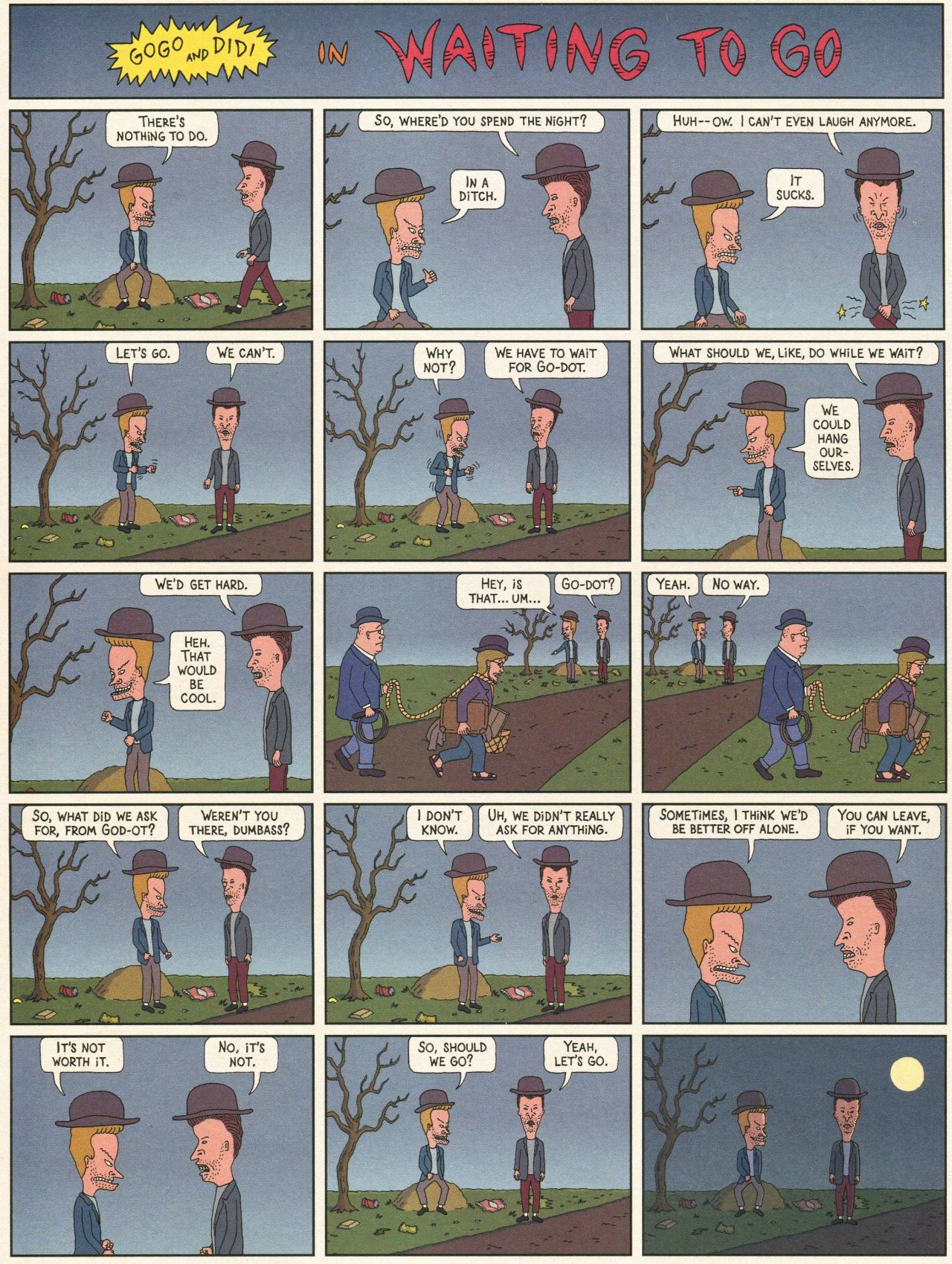
I reserve my highest praise for the inspired casting of Beavis and Butthead in R. Sikoryak’s “Waiting to Go.” (.) Here we find a Vladimir and Estragon who truly embody the final lines of Norman Mailer’s notorious “A Public Notice on Waiting for Godot”:
Man’s nature, man’s dignity, is that he acts, lives, loves, and finally destroys himself seeking to penetrate the mystery of existence, and unless we partake in some way, as some part of this human exploration… then we are no more than the pimps of society and the betrayers of our Self.
Related Content:
Samuel Beckett Directs His Absurdist Play Waiting for Godot (1985)
Samuel Beckett Draws Doodles of Charlie Chaplin, James Joyce & Hats
Watch the Opening Credits of an Imaginary 70s Cop Show Starring Samuel Beckett
- Ayun Halliday is an author, illustrator, and Chief Primatologist of the East Village Inky zine. Follow her @AyunHalliday
Read More...Hear Benedict Cumberbatch Read Kafka’s The Metamorphosis
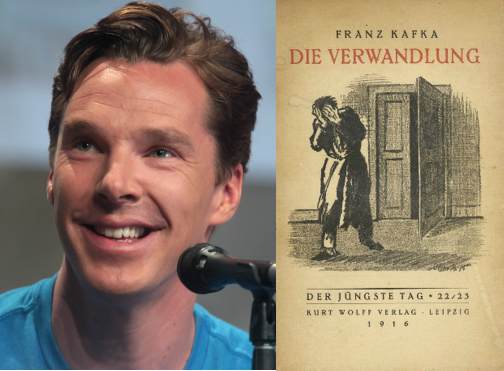
If, on the 100th anniversary of its publication, you want to do a radio broadcast of a novella famously appreciated for its surface weirdness and more rarely appreciated for its sharp sense of humor, it only stands to reason that you’d hire a famous reader with famously appreciated surface oddness and more rarely appreciated sharp sense of humor of his own. I can only assume BBC Radio 4 followed a similar line of thinking when, to record Franz Kafka’s The Metamorphosis (find the text in our collection of Free eBooks), they brought in Sherlock and The Imitation Game star Benedict Cumberbatch.
They’ll air the reading in four parts. The first and second episodes, in which luckless salesman Gregor Samsa inexplicably wakes up as an insect and faces the wrath and fear of his family, have already come available online for your listening pleasure; the next two episodes, when the insectified Samsa grows accustomed to his new form only to come into mortal conflict with his father and the newly dire financial straits of his household, will appear over the next two weeks on the production’s episode guide.
And if the idea of this mundane and monstrous tale told in the voice of Benedict Cumberbatch appeals to you, don’t delay. The BBC’s site will only let you stream it until June 10th (though currently you can find it online here.)
If you still have doubts, see also “Why Benedict Cumberbatch Is the Perfect Actor to Read Kafka’s Metamorphosis” by Slate’s Rebecca Schuman. “Cumberbatch’s trademark style is a withering, perfectly enunciated deadpan whose inflections somehow betray, three-fourths of the way through any sentence, sincere doubts that everyone will be in on the joke,” she writes. “Even better, this is poker face the way Kafka wrote it: tinged with at least some amount of creepiness, thanks to Cumberbatch’s unique ability to both look and sound like a very genteel sociopath.”
For less Cumberbatch-inclined Kafka enthusiasts, we also have this free audiobook of The Metamorphosis, which should remain available indefinitely. It’s recorded by Librivox.
If you would like to support the mission of Open Culture, consider making a donation to our site. It’s hard to rely 100% on ads, and your contributions will help us continue providing the best free cultural and educational materials to learners everywhere. You can contribute through PayPal, Patreon, and Venmo (@openculture). Thanks!
Related Content:
Dominic West, Stephen Fry & Benedict Cumberbatch Read From a Guantánamo Prisoner’s Diary
Vladimir Nabokov Makes Editorial Tweaks to Franz Kafka’s Novella The Metamorphosis
Colin Marshall writes on cities, language, Asia, and men’s style. He’s at work on a book about Los Angeles, A Los Angeles Primer, and the video series The City in Cinema. Follow him on Twitter at @colinmarshall or on Facebook.
Read More...The Letter Between Stanley Kubrick & Arthur C. Clarke That Sparked the Greatest SciFi Film Ever Made (1964)
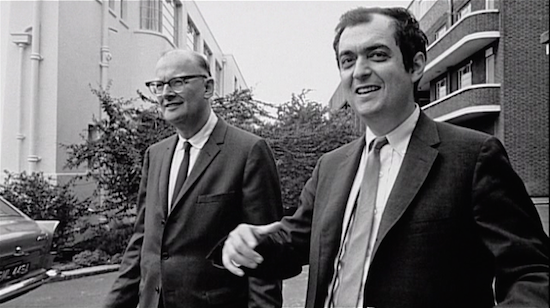
Image courtesy of 2001Italia
Origin stories are all the rage these days given the ubiquity of superhero films and television series. But for all their smash-em-up spectacle and breakneck pacing, they generally feel overstuffed and disposable. As with the Age of Ultron, there is an age, every summer, of some Marvel or DC hero or other. Or all of them at once, at this point, in a perpetual onslaught. On the other hand, we still have the quietly ominous, thoughtful science fiction film, the offspring of Nicolas Roeg and Andrei Tarkovsky, in movies like Ex Machina. These come and go, some better than others, but also always with us. Different as these two types of films can be, in style and tone, neither would likely look and feel the way they do without Stanley Kubrick’s intensely introspective and profoundly epic 2001: A Space Odyssey.
The origin story of this incredible 1968 film begins on March 31, 1964 when Kubrick wrote the letter below to Arthur C. Clarke, proposing that the two collaborate on “the proverbial ‘really good’ science fiction film.” “I had been a great admirer of your books for quite a time,” writes Kubrick, and gives Clarke three “broad areas” of interest, “naturally assuming great plot and character.” Naturally.
“Clarke’s response,” writes BFI, “was immediately enthusiastic, expressing a mutual admiration.” Kubrick, Clarke told their mutual friend Roger Caras, “is obviously an astonishing man.” In his response to the director himself, Clarke wrote on April 8, ““For my part, I am absolutely dying to see Dr. Strangelove; Lolita is one of the few films I have seen twice – the first time to enjoy it, the second time to see how it was done.” The two met in New York and talked for hours, and from Clarke’s short story “The Sentinel of Eternity” was born perhaps the best “really good” science fiction film ever made.
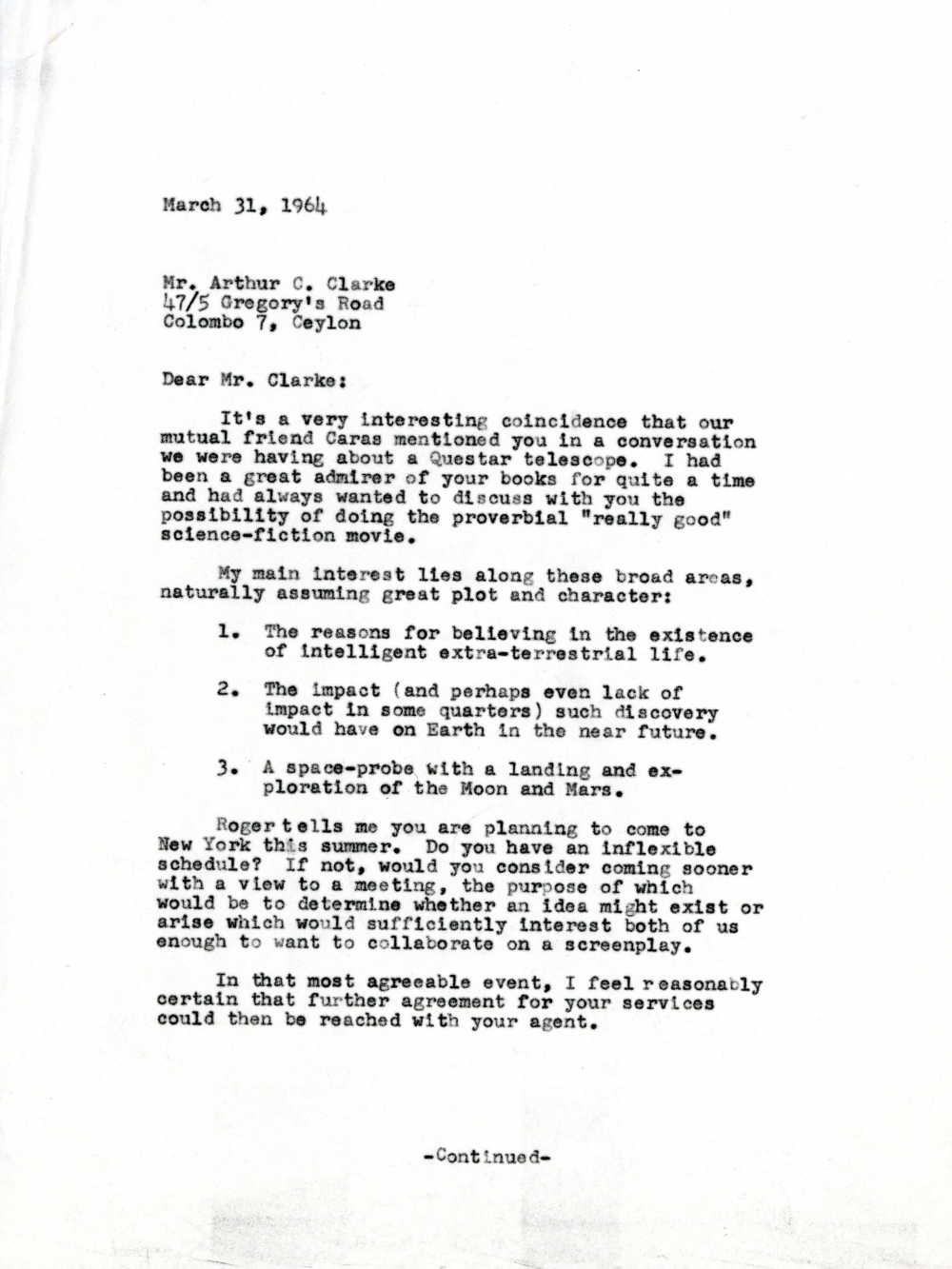
Clarke would compare the differences between the story and the film to those between an acorn and an oak tree, according to Italian Kubrick site 2001Italia. After that meeting, the two would spend almost four years writing the screenplay together and envisioning the harrowing voyage to Jupiter that ends so tragically—and strangely—for the two astronauts left to experience it. It’s a collaborative success Kubrick clearly foresaw when he approached Clarke, but in his letter, above, with transcript below—courtesy of Letters of Note—he plays it cool, using the pretext of a telescope Clarke owned to slip in discussion about the film project. We are almost led to believe,” writes 2001Italia, “that the movie was an excuse” to discuss the gadget. But of course we know better.
Dear Mr Clarke:
It’s a very interesting coincidence that our mutual friend Caras mentioned you in a conversation we were having about a Questar telescope. I had been a great admirer of your books for quite a time and had always wanted to discuss with you the possibility of doing the proverbial “really good” science-fiction movie.
My main interest lies along these broad areas, naturally assuming great plot and character:
- The reasons for believing in the existence of intelligent extra-terrestrial life.
- The impact (and perhaps even lack of impact in some quarters) such discovery would have on Earth in the near future.
- A space probe with a landing and exploration of the Moon and Mars.
Roger [Caras ]tells me you are planning to come to New York this summer. Do you have an inflexible schedule? If not, would you consider coming sooner with a view to a meeting, the purpose of which would be to determine whether an idea might exist or arise which could sufficiently interest both of us enough to want to collaborate on a screenplay?
Incidentally, “Sky & Telescope” advertise a number of scopes. If one has the room for a medium size scope on a pedestal, say the size of a camera tripod, is there any particular model in a class by itself, as the Questar is for small portable scopes?
Best regards,
Kubrick pursued his projects very deliberately and passionately, motivated by great personal interest. Though his films can feel detached and cold, and he himself seems like a very aloof character, the opposite was true, according to those who knew him best. Below, see a short video from The University of the Arts London’s Stanley Kubrick Archive profiling the way Kubrick went about choosing his films, best summed up by Jan Harlon, Kubrick’s brother-in-law and producer: “No love, no quality, and in Stanley’s case, no love, no film.”
Related Content:
Stanley Kubrick’s Annotated Copy of Stephen King’s The Shining
Stanley Kubrick’s Rare 1965 Interview with The New Yorker
Arthur C. Clarke Predicts the Future in 1964 … And Kind of Nails It
Josh Jones is a writer and musician based in Durham, NC. Follow him at @jdmagness
Read More...Chris Burden (R.I.P.) Turns Late-Night TV Commercials Into Conceptual Art
Chris Burden got shot with a rifle, closed up in a locker for five days, made to crawl across fifty feet of broken glass, crucified on a Volkswagen Beetle, and wedged for an extended period under a large piece of non-broken glass. But he did it all voluntarily, surviving these and other threats to life and limb, all undertaken in the name of art, only dying this past Sunday. That concluded a long and astonishingly varied career in which Burden produced work not just of the grim trapped-in-a-box and bullet-in-the-arm variety, but elaborate, even whimsical sculptures, models, and machines that captivate their viewers to this day.
Burden also, between the years of 1973 and 1977 (a period after the shooting and the locker entrapment), worked in the medium of television commercials, producing work that, aired late at night, surely captivated their own viewers (who, given the era, may have already entered their own states of altered consciousness). At the top of the post, you can watch all of them in a row, a program accompanied by textual commentary from Burden himself which details the nature of his self-assigned mission “to break the omnipotent stranglehold of the airwaves that broadcast television held.”
The 2013 video from the Museum of Contemporary Art just above features Burden remembering this daring project of buying and artistically repurposing Los Angeles commercial airtime. But Burden’s interest in television didn’t stop, or indeed start, with these commercials. At East of Borneo, Nick Stillman has an essay putting all the artist’s TV-related work in context. “By situating the television set and by using the commercial form as implicit vessels of authority,” Stillman writes, “Burden’s work about how television influences behavior asked the most penetrating and ethical question of any artist I can think of who used the medium: Do you believe in television?”
Though Burden’s commercials haven’t seen regular broadcast in nearly forty years, his spirit nevertheless enjoys strong prospects of living on through his later work, which reflects and inhabits not the mediated world around us, but the concrete one. In 2011, we featured his Metropolis II, a kinetic sculpture modeling the city of the future in swooping ramps, architecturally fantastical towers, and countless toy cars on display at the Los Angeles County Museum of Art.
And if you so much as pass by the museum on Wilshire Boulevard, you’ll see his installation of vintage lampposts known as Urban Light. Odds are you’ll also take a picture with it; from what I’ve seen, it has to rank has the most photographed place in the city. “Heat is life,” Burden blankly intoned in his 1975 commercial Poem for L.A. — but light seems to have a pretty fair claim as well.
Related Content:
Metropolis II: Chris Burden’s Amazing, Frenetic Mini-City
Salvador Dalí Goes Commercial: Three Strange Television Ads
Fellini’s Fantastic TV Commercials
Colin Marshall writes on cities, language, Asia, and men’s style. He’s at work on a book about Los Angeles, A Los Angeles Primer, and the video series The City in Cinema. Follow him on Twitter at @colinmarshall or on Facebook.
Read More...Mark Twain & Helen Keller’s Special Friendship: He Treated Me Not as a Freak, But as a Person Dealing with Great Difficulties
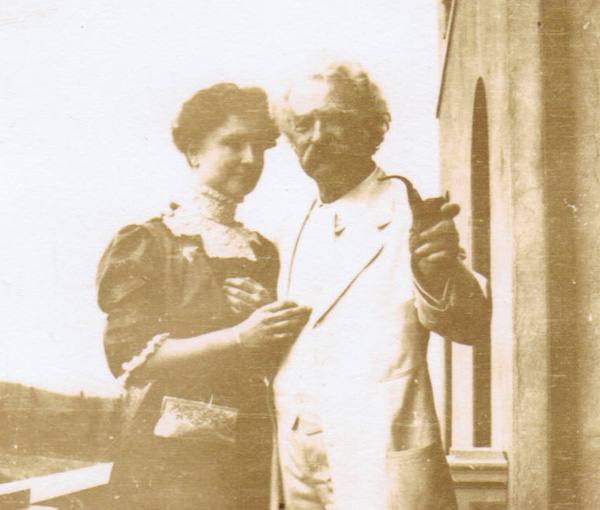
Sometimes it can seem as though the more we think we know a historical figure, the less we actually do. Helen Keller? We’ve all seen (or think we’ve seen) some version of The Miracle Worker, right?—even if we haven’t actually read Keller’s autobiography. And Mark Twain? He can seem like an old family friend. But I find people are often surprised to learn that Keller was a radical socialist firebrand, in sympathy with workers’ movements worldwide. In a short article in praise of Lenin, for example, Keller once wrote, “I cry out against people who uphold the empire of gold…. I am perfectly sure that love will bring everything right in the end, but I cannot help sympathizing with the oppressed who feel driven to use force to gain the rights that belong to them.”
Twain took a more pessimistic, ironic approach, yet he thoroughly opposed religious dogma, slavery, and imperialism. “I am always on the side of the revolutionists,” he wrote, “because there never was a revolution unless there were some oppressive and intolerable conditions against which to revolute.” While a great many people grow more conservative with age, Twain and Keller both grew more radical, which in part accounts for another little-known fact about these two nineteenth century American celebrities: they formed a very close and lasting friendship that, at least in Keller’s case, may have been one of the most important relationships in either figure’s life.
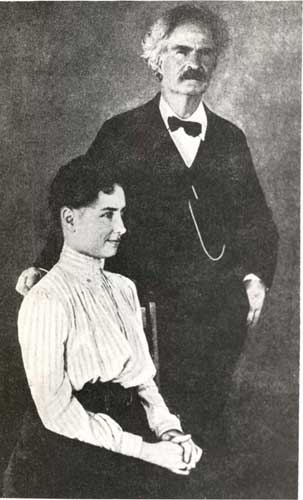
Twain’s importance to Keller, and hers to him, begins in 1895, when the two met at a lunch held for Keller in New York. According to the Mark Twain Library’s extensive documentary exhibit, Keller “seemed to feel more at ease with Twain than with any of the other guests.” She would later write, “He treated me not as a freak, but as a handicapped woman seeking a way to circumvent extraordinary difficulties.” Twain was taken as well, surprised by “her quickness and intelligence.” After the meeting, he wrote to his benefactor Henry H. Rogers, asking Rogers to fund Keller’s education. Rogers, the Mark Twain Library tells us, “personally took charge of Helen Keller’s fortunes, and out of his own means made it possible for her to continue her education and to achieve for herself the enduring fame which Mark Twain had foreseen.”
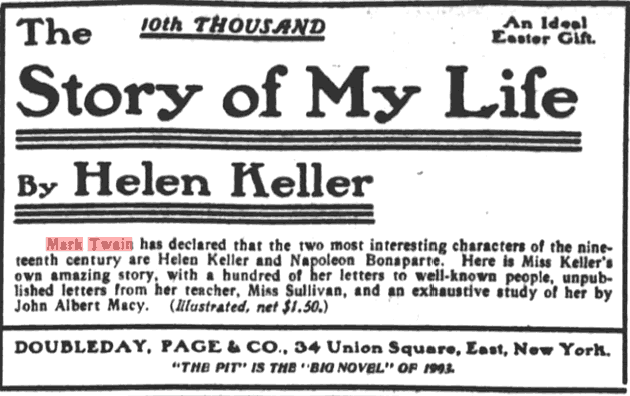
Twain wrote to his wealthy friend, “It won’t do for America to allow this marvelous child to retire from her studies because of poverty. If she can go on with them she will make a fame that will endure in history for centuries.” Thereafter, the two would maintain a “special friendship,” sustained not only by their political sentiments, but also by a love of animals, travel, and other personal similarities. Both writers came to live in Fairfield County, Connecticut at the end of their lives, and she visited him at his Redding home, Stormfield, in 1909, the year before his death (see them there at the top of the post, and more photos here). Twain was especially impressed by Keller’s autobiography, writing to her, “I am charmed with your book—enchanted.” (See his endorsement in a 1903 advertisement, below.)
Twain also came to Keller’s defense, ten years later, after reading in her book about a plagiarism scandal that occurred in 1892 when, at only twelve years old, she was accused of lifting her short story “The Frost King” from Margaret Canby’s “Frost Fairies.” Though a tribunal acquitted Keller of the charges, the incident still piqued Twain, who called it “unspeakably funny and owlishly idiotic and grotesque” in a 1903 letter in which he also declared: “The kernel, the soul—let us go further and say the substance, the bulk, the actual and valuable material of all human utterance—is plagiarism.” What differs from work to work, he contends is “the phrasing of a story”; Keller’s accusers, he writes protectively, were “solemn donkeys breaking a little child’s heart.” (The exquisitely-worded letter is well worth reading in full at Letters of Note).
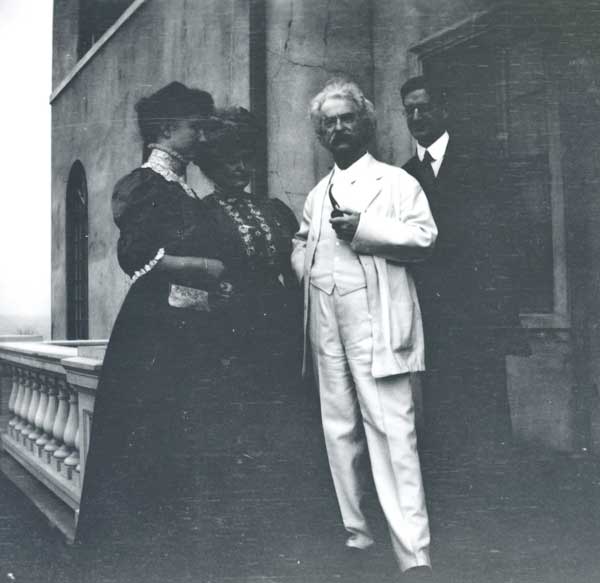
We also have Twain—not playwright William Gibson—to thank for the “miracle worker” title given to Keller’s teacher, Anne Sullivan. (See Keller, Sullivan, Twain, and Sullivan’s husband John Macy above at Twain’s home). As a tribute to Sullivan for her tireless work with Keller, he presented her with a postcard that read, “To Mrs. John Sullivan Macy with warm regard & with limitless admiration of the wonders she has performed as a ‘miracle-worker.’” In his 1903 letter to Keller, he called Sullivan “your other half… for it took the pair of you to make complete and perfect whole.”
Twain praised Sullivan effusively for “her brilliancy, penetration, originality, wisdom, character, and the fine literary competencies of her pen.” But he reserved his highest praise for Keller herself. “You are a wonderful creature,” he wrote, “The most wonderful in the world.” Keller’s praise of her friend Twain was no less lofty. “I have been in Eden three days and I saw a King,” she wrote in his guestbook during her visit to Stormfield, “I knew he was a King the minute I touched him though I had never touched a King before.” The last words in Twain’s autobiography, the first volume anyway—which he only allowed to be published in 2010—are Keller’s; “You once told me you were a pessimist, Mr. Clemons,” he quotes her as saying, “but great men are usually mistaken about themselves. You are an optimist.”
Related Content:
The Only Footage of Mark Twain: The Original & Digitally Restored Films Shot by Thomas Edison
Mark Twain Writes a Rapturous Letter to Walt Whitman on the Poet’s 70th Birthday (1889)
Helen Keller Speaks About Her Greatest Regret — Never Mastering Speech
Helen Keller & Annie Sullivan Appear Together in Moving 1930 Newsreel
Josh Jones is a writer and musician based in Durham, NC. Follow him at @jdmagness
Read More...The Death Masks of Great Authors: Dante, Goethe, Tolstoy, Joyce & More
Charles Guiteau, the man who assassinated James Garfield, tried to argue in court that he just shot the president — the doctors actually killed him. Though Guiteau was ultimately hanged for his crime in 1882, he did have a point. Garfield’s doctor, William Bliss, jammed his unsterilized fingers in the presidential wound in an attempt to pull out the bullet. So did a host of other specialists. President Garfield died 80 days later of, among other things, sepsis. It was later concluded that the president would have likely survived if the doctors had kept their hands to themselves.

Garfield’s death was one of the catalysts that helped popularize Joseph Lister’s ideas about bacteria, a concept that vastly improved the quality of medical care. A hundred years later, for example, Ronald Reagan suffered from almost an identical bullet wound and was back to work within weeks.
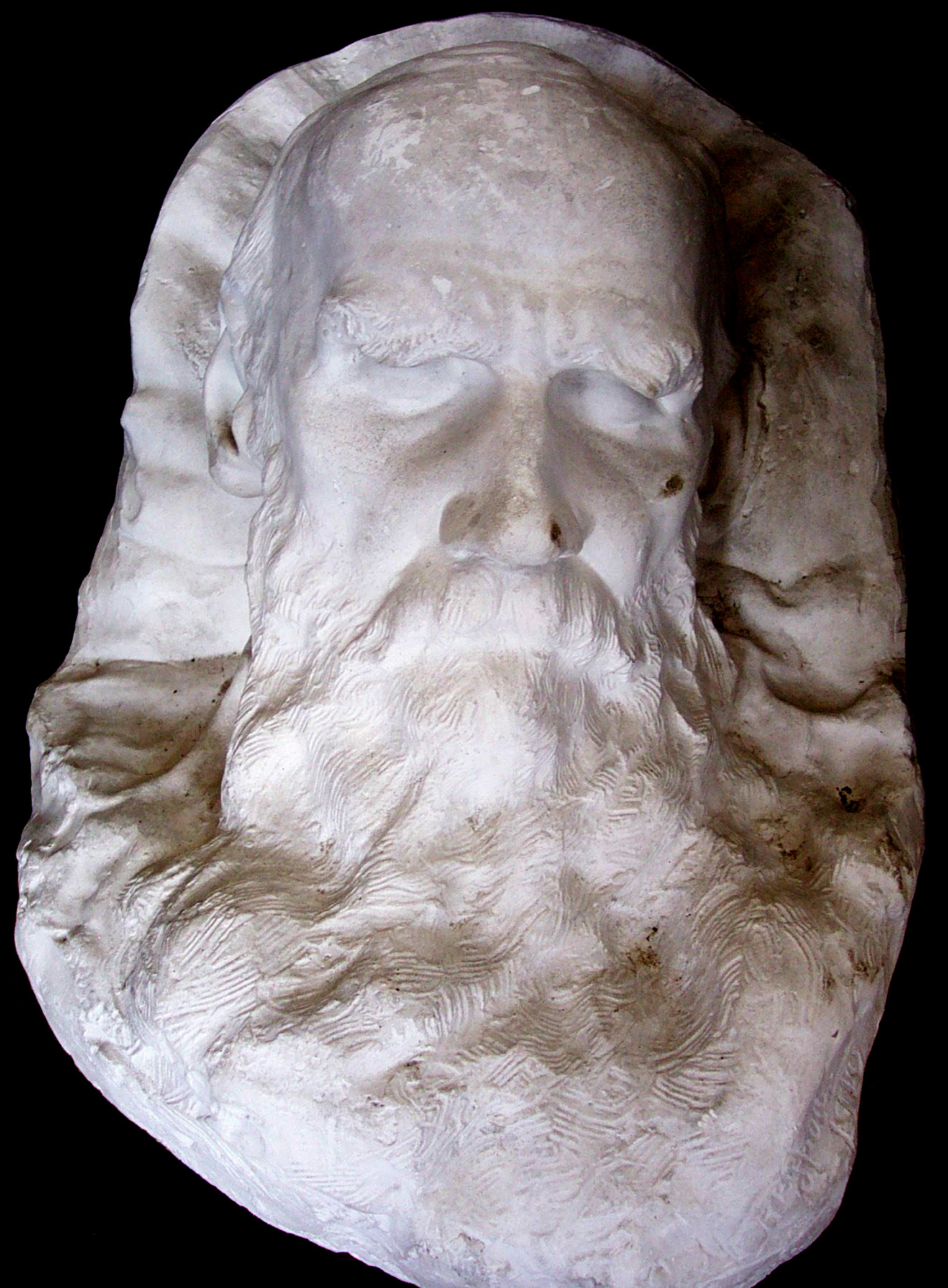
In the 19th century and centuries before, diseases weren’t well understood and death was mysterious and divine. In the evangelical revivals of the mid-19th century, the end of life was seen as something to embrace. After all, God was calling his believers back home. Then with a growing understanding of germs, that sense of wonder with our mortality changed. “God hadn’t called the individual to him,” writes Deborah Lutz, scholar of Victorian culture, in The New York Times this week. “Rather, a malady had overtaken the body. Rather than dying at home, the sick were carted off to hospitals.” Death, in other words, became divorced from everyday life.

So from our 21st century viewpoint, the Victorians’ (and their predecessors’) tendency to collect mementos of the dead, like death masks, might seem gruesome. But from their point of view, our panicked denial of death would probably seem foolish and perverse. Mortality, after all, is a fact of life.

Princeton University’s Laurence Hutton Collection has dozens of death masks of famous politicians, philosophers and authors. People like Isaac Newton, Abraham Lincoln and Leo Tolstoy. There’s something humbling about seeing these titans of Western culture captured at such an intimate moment. Stripped of all the markers of class and rank, they look like people you might see on the street.

Aside from a rather unconvincing effigy of Queen Elizabeth, the collection features few masks of great women. No Jane Austens or Emily Dickinsons here. The collection also, sadly, lacks a mask of James Garfield.
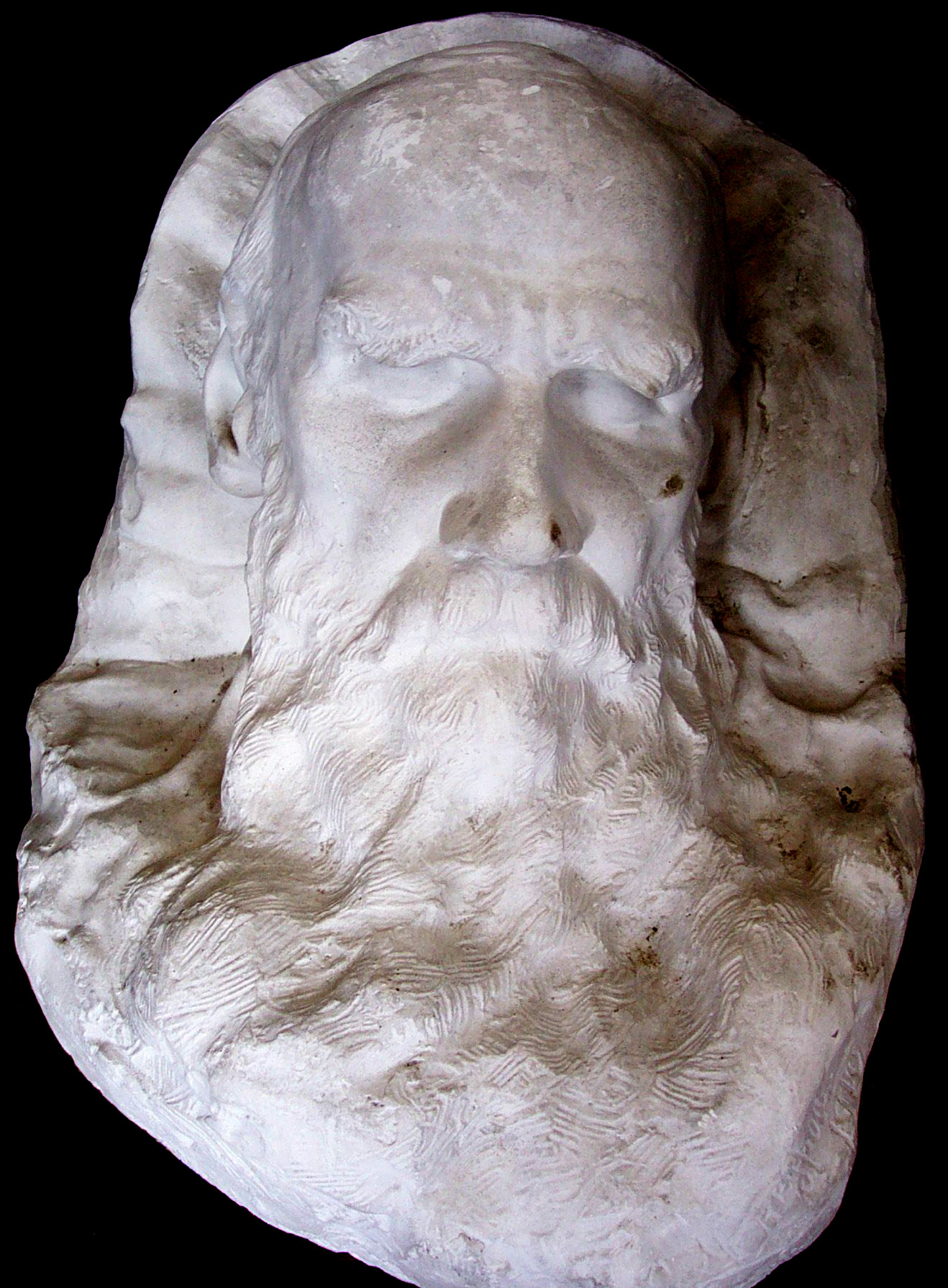
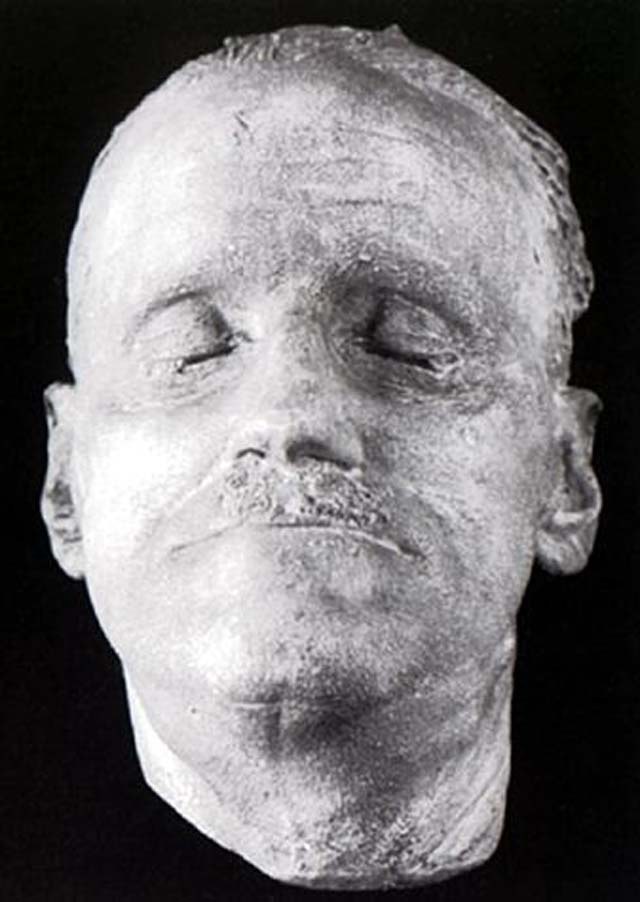
Above you can find death masks of literary figures from the 14th to early 20th centuries. From top to bottom, you will see James Joyce, Goethe, Leo Tolstoy, Samuel Taylor Coleridge, Dante and William Wordsworth.
Jonathan Crow is a Los Angeles-based writer and filmmaker whose work has appeared in Yahoo!, The Hollywood Reporter, and other publications. You can follow him at @jonccrow. And check out his blog Veeptopus, featuring lots of pictures of vice presidents with octopuses on their heads.
Read More...Support Us
We're hoping to rely on loyal readers, rather than erratic ads. Please click the Donate button and support Open Culture. You can use Paypal, Venmo, Patreon, even Crypto! We thank you!

About Us

Open Culture scours the web for the best educational media. We find the free courses and audio books you need, the language lessons & educational videos you want, and plenty of enlightenment in between.
Advertise With Us

FREE UPDATES!
GET OUR DAILY EMAIL
Get the best cultural and educational resources on the web curated for you in a daily email. We never spam. Unsubscribe at any time.
FOLLOW ON SOCIAL MEDIA

Open Culture editor Dan Colman scours the web for the best educational media. He finds the free courses and audio books you need, the language lessons & movies you want, and plenty of enlightenment in between.
Advertise With Us