Hear Samuel Beckett’s Avant-Garde Radio Plays: All That Fall, Embers, and More
Think of radio plays, and you most likely think (or I most likely think) of the form’s American “golden age” in the first half of the 20th century. That time and place in radio drama conjures up a certain more or less defined set of sensibilities: rocketships hurtling toward unknown worlds, hard-bitten detectives sticking to their cases, suburban couples bickering about the behavior of their jalopy-driving children. By the 1950s, the conventions of radio plays had ossified too much even for old-time radio audiences. Who best to call to tear up the form and start it over again? Why, Samuel Beckett, of course.
“In 1955 the BBC, intrigued by the international attention being given to the Paris production of Samuel Beckett’s Waiting for Godot (see a version here), invited the author to write a radio play,” says the short history provided in the program of the Beckett festival of Radio Plays. Though hesitant, Beckett nevertheless wrote the following to a friend: “Never thought about radio play technique but in the dead of t’other night got a nice gruesome idea full of cartwheels and dragging of feet and puffing and panting which may or may not lead to something.’ ” That “gruesome idea” led, according to the program, not just to Beckett’s 1956 radio-play debut All That Fall, but four more to follow over the next twenty years.
At the top of the post, you can listen to that first 70-minute sonic tale of an old, obese Irish housewife, the blind husband she meets at the train station as a birthday surprise, and all the children, eccentrics, weather, and thoroughly Beckettian dialogue that give texture to the death-obsessed journeys from home and back to it. All That Fall received critical acclaim, but the later radio play just above, the next year’s 45-minute Embers, found a more mixed reception — to the delight, one imagines, of most Beckett fans, who tend to prefer the divisive stuff to an agreed-upon canon anyway.
Built out of two monologues, a dialogue, and the sounds of the sea, Embers’ “rather ragged” script (in the words of Beckett himself, who later took the blame for the“too difficult” text) presents us with an inarticulate protagonist who leaves us with many more questions than answers. But just as in the work acknowledged as Beckett’s best, the questions we come away with send us in more interesting directions than do the answers provided in mainstream radio drama — or in mainstream anything else, for that matter. And amid all this writing for tape rather than stage, what noted work did he come with in 1958 for the stage? Why, Krapp’s Last Tape, of course.
Samuel Beckett’s radio plays available online:
- All That Fall (1957)
- Embers (1959)
- Words and Music (1962)
- Cascando (1963)
Related Content:
Samuel Beckett Directs His Absurdist Play Waiting for Godot (1985)
Monsterpiece Theater Presents Waiting for Elmo, Calls BS on Samuel Beckett
Rare Audio: Samuel Beckett Reads Two Poems From His Novel Watt
Colin Marshall writes on cities, language, Asia, and men’s style. He’s at work on a book about Los Angeles, A Los Angeles Primer, and the video series The City in Cinema. Follow him on Twitter at @colinmarshall or on Facebook.
Read More...An Animated John Coltrane Explains His True Reason for Being: “I Want to Be a Force for Real Good”
Last week, we posted an interview with the late, great Ray Bradbury that was brilliantly animated by the folks over at Blank on Blank. This week, they unveil a new piece featuring John Coltrane. You can watch it above.
Coltrane is, of course, one of the true giants of 20th century music. He first got attention playing with the Miles Davis Quintet in the mid-1950s on albums like Relaxin’, Cookin’ and Steamin’ before he released his seminal solo album Blue Train. But his career quickly faltered. He was hooked on heroin and Davis, a former junkie himself, fired him from the Quintet. When he cleaned himself up, Coltrane found he was a changed man. “In the year of 1957,” he writes in the liner notes for his masterpiece A Love Supreme, “I experienced, by the grace of God, a spiritual awakening, which was to lead me to a richer, fuller, more productive life.”
Throughout the 60s, Coltrane sought to express his rapidly evolving sense of spirituality through music that grew ever more complex and avant-garde. Late period Coltrane is a far cry from the moody grace of Blue Train; it’s a cascade of frenzied notes that can be as sublime as it is discordant and challenging.
The piece above is a recording by Pacifica Radio reporter Frank Kofsky who talked with Coltrane in November 1966, just eight months before he died at the age of 40 of liver cancer.
At one point in the piece, Kofsky asks him how much he practices. Trane was famous for the manic intensity with which he played. He once reportedly spent ten hours perfecting the sound of a single note. 12-hour practice sessions were the routine. In the interview, however, Coltrane is nonchalant. “I find that it’s only when something is trying to come through you know that I really practice and then it’s just, I don’t know how many hours, it’s just all day. “
Later in the video, when Coltrane discusses switching from a tenor sax to a soprano, you get a glimpse of how driven he was by his muse.
The sound of that soprano was actually so much closer to me in my ear. I didn’t want admit this damn thing because I said well the tenor’s my horn, this is my baby but the soprano, there’s still something there, just the voice of it that I can’t… It’s just really beautiful. I really like it.
But the most poignant moment comes at the end of video when he describes what kind of person he wants to be.
I mean I want to be a force for real good. In other words, I know that there are bad forces. I know that there are forces out here that bring suffering to others and misery to the world, but I want to be the opposite force. I want to be the force, which is truly for good.
For Jazz fans everywhere, there is no question that he was a force for good. And it was all embodied in his music.
Related Content:
John Coltrane Performs A Love Supreme and Other Classics in Antibes (July 1965)
John Coltrane’s Handwritten Outline for His Masterpiece A Love Supreme
Watch John Coltrane Turn His Handwritten Poem Into a Sublime Musical Passage on A Love Supreme
Jonathan Crow is a Los Angeles-based writer and filmmaker whose work has appeared in Yahoo!, The Hollywood Reporter, and other publications. You can follow him at @jonccrow. And check out his blog Veeptopus, featuring lots of pictures of badgers and even more pictures of vice presidents with octopuses on their heads. The Veeptopus store is here.
Read More...Van Gogh’s 1888 Painting, “The Night Cafe,” Animated with Oculus Virtual Reality Software
Vincent van Gogh’s 1888 painting, “The Night Cafe,” now hangs at the Yale University Art Gallery, accompanied by this description:
In a letter to his brother written from Arles in the south of France, van Gogh described the Café de l’Alcazar, where he took his meals, as “blood red and dull yellow with a green billiard table in the center, four lemon yellow lamps with an orange and green glow. Everywhere there is a clash and contrast of the most disparate reds and greens.” The clashing colors were also meant to express the “terrible passions of humanity” found in this all-night haunt, populated by vagrants and prostitutes. Van Gogh also felt that colors took on an intriguing quality at night, especially by gaslight: in this painting, he wanted to show how “the white clothing of the café owner, keeping watch in a corner of this furnace, becomes lemon yellow, pale and luminous green.”
The canvas, though dry and mostly flat, does a perfectly good job of capturing the life force that ran through that 19th century French café. That’s an understatement, of course. But I suppose there’s no harm in animating the already animated scene with some new-fangled technology. Above, you can see Mac Cauley’s “immersive virtual reality” tribute to Van Gogh, which he created for Oculus’ Mobile VR Jam 2015. On a page dedicated to the project, Cauley writes:
My main goal with this project was to see what kinds of stylized 3D rendering could be experienced through VR. I have always been drawn to the paintings of Van Gogh and I imagined it would be amazing to be inside one of these colorful worlds. While the GearVR offered certain challenges with its technical limitations compared with a PC, it forced me to prioritize and really define what makes a Van Gogh painting unique.
While creating the environments of these paintings in 3D space I’ve had to expand on areas that can’t be seen; rooms behind doors, objects hidden from view, people turned away from the viewer. It’s been an interesting process in using reference material from Van Gogh and other expressionist painters but also imagining what might have been there, just off the edges of the canvas.
The winners of the Oculus Mobile VR Jam will be announced in June. More creative takes on famous paintings can be found below.
Related Content:
A 3D Tour of Picasso’s Guernica
Edvard Munch’s Famous PaintingThe Scream Animated to the Sound of Pink Floyd’s Primal Music
Dripped: An Animated Tribute to Jackson Pollock’s Signature Painting Technique
Late Rembrandts Come to Life: Watch Animations of Paintings Now on Display at the Rijksmuseum
Van Gogh’s ‘Starry Night’ Re-Created by Astronomer with 100 Hubble Space Telescope Images
Read More...Watch Miles Davis Improvise Music for Elevator to the Gallows, Louis Malle’s New Wave Thriller (1958)
The modal experimentation in Miles Davis’ classic albums Milestones and, especially, 1959’s Kind of Blue seemed to come out of nowhere. Along with similarly groundbreaking releases at the end of the fifties, these records irrevocably changed the sound of jazz. But hardcore jazz fans, and cinephiles, would have seen the development coming, having heard Davis’ soundtrack to Louis Malle’s 1958 crime thriller Elevator to the Gallows (Ascenseur pour l’Echafaud—trailer below). As the story goes, Davis happened to be in Paris in 1957 during the film’s postproduction to perform at the Club Saint-Germain. Malle’s assistant—perhaps inspired by the moody jazz soundtracks of films like Roger Vadim’s Does One Ever Know and Alexander Mackendrick’s Sweet Smell of Success—suggested Davis to the director. After a private screening of the film, the trumpeter and composer agreed to take the gig. It was Davis’ first soundtrack and Malle’s first feature film.
At the top of the post, we have the great privilege of seeing—and hearing—Miles and his four sidemen record the soundtrack, live. The two-day session took place at Le Post Parisien Studio in Paris on December 4th and 5th. According to Discogs, “Davis only gave the musicians a few rudimentary harmonic sequences he had assembled in his hotel room, and once the plot was explained, the band improvised without any precomposed theme, while edited loops of the musically relevant film sequences were projected in the background.”
The filmed session is captivating; Davis and band stare intently at the screen and, on the spot, create the film’s mood. (In the second half of the clip, the filmmakers banter in French about the production while Davis plays in the background.) Seeing this footage, writes Dangerous Minds, is akin to “watching Picasso paint.” Furthermore, “it could be argued that Malle’s cinematic style and the unique pacing and character of this particular film—which Miles obviously had to conform to in order to score it properly—had a noticeable influence on his music.”
Miles would say as much, claims his biographer Ian Carr, telling Malle “a year or two later” that “the experience of making the music for the film had enriched him.” Critic Jean-Louis Ginibre wrote in Jazz magazine at the time that Davis “raised himself to greater heights” during the sessions, “and became aware of the tragic character of his music which, until then, had been only dimly expressed.” For his part, Malle remarked, “Miles’s commentary—which is of extreme simplicity—gives a really extraordinary dimension to the visual image.” Fans of the film will surely agree. Fans of Miles Davis may want to rush out and get their hands of a copy of the score. (You can find a diminished copy on Youtube here). It was never released in the U.S., but ten songs appeared stateside on an album called Jazz Track. While the soundtrack may not work as well without the images (Allmusic describes some numbers as “rather sterile”), it nonetheless provides us with a kind of missing link between Davis’ fifties hard bop and the cool jazz he pioneered the following decade in his most-lauded, best-selling album, Kind of Blue.
via Dangerous Minds/Discogs/
Related Content:
The Miles Davis Story, the Definitive Film Biography of a Jazz Legend
Josh Jones is a writer and musician based in Durham, NC. Follow him at @jdmagness
Read More...Dementia Patients Find Some Eternal Youth in the Sounds of AC/DC
Last April, Malcolm Young left AC/DC, the band he co-founded with his brother Angus in 1973. Only 61 years old, the guitarist found himself unable to remember his famous licks and riffs. The cause, doctors discovered, was dementia. Young now lives in a nursing home where he receives full-time care.
Above, you can watch a video created by the Brazilian radio station 89FM, where, touchingly, elderly Brazilians, also suffering from dementia, listen to the sounds of AC/DC and summon to mind their younger, carefree days, when rock provided their soundtrack to their youth. Long live rock…
To understand why music seems to trigger memories in unusual ways, and how music therapy can be used to improve the lives of those with dementia, see the research covered at Live Science.
Follow us on Facebook, Twitter, Google Plus and LinkedIn and share intelligent media with your friends. Or better yet, sign up for our daily email and get a daily dose of Open Culture in your inbox.
Read More...New Web Site, “The Opera Platform,” Lets You Watch La Traviata and Other First-Class Operas Free Online
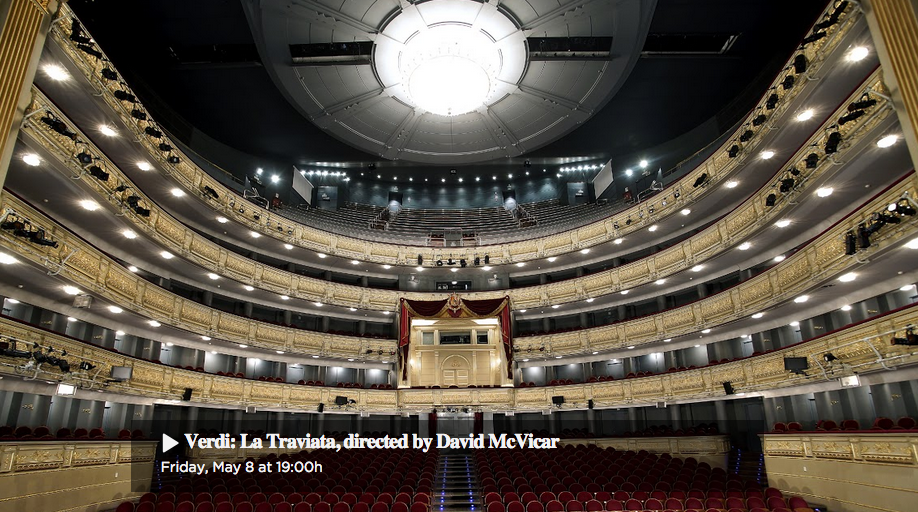
Click the image above to watch Verdi’s La Traviata.
Opera has always had its appreciators, and fervent ones at that, but in recent decades the form has had to extend its appeal beyond its inner circle of die-hard fans. Some of these efforts, such as the Metropolitan Opera’s high-definition broadcasts to movie theaters around the world, have proven surprisingly successful, encouraging the lowering of opera’s barrier to entry. Now, thanks to a site called The Opera Platform, you don’t have to go to a theater of any kind; you can watch full-length performances anywhere with an internet connection.
In order to promote itself as “the online destination for the promotion and enjoyment of opera” designed to “appeal equally to those who already love opera and to those who may be tempted to try it for the first time,” The Opera Platform offers one “showcase opera” per month, viewable free, in full, with subtitles available in six different languages. It also provides a host of supplementary materials, including documentary and historical materials that put the month’s featured opera in context.
“The Opera Platform is a partnership between Opera Europa, which represents opera companies and festivals; Arte, the Franco-German cultural broadcasting channel, and the participating opera companies,” writes the New York Times’ Michael Cooper. “It has a $4.5 million budget,” Reuters reported, “with about half coming from the European Union’s cultural budget.” So the site certainly has its resources in order, but what of its content?
The Opera Platform has come strong out of that particular gate with Verdi’s La Traviata, produced at Madrid’s Teatro Real, which you can watch for free until August 11. This tale of “the short and hectic life and tragic death of a high-society courtesan in 19th century Paris,” as the site’s notes put it, comes told through Verdi’s “music of profound humanity” and the staging of famed Scottish opera director David McVicar, “who, with his usual elegance, sets the drama in a world of romantic references while retaining an up-to-date perspective.”
Opera-lovers of previous generations could scarcely have imagined that technology would bring this degree of viewing convenience to their art form of choice. And now that The Opera Platform has got up and running, would-be opera-lovers have no excuse not to get into it, in the comfort of their own homes or anywhere else. And if you want to have some popcorn while you watch, go for it — nobody’s going to shake their opera glasses at you.
Related Content:
Ludwig Wittgenstein’s Tractatus Gets Adapted Into an Avant-Garde Comic Opera
Colin Marshall writes on cities, language, Asia, and men’s style. He’s at work on a book about Los Angeles, A Los Angeles Primer, and the video series The City in Cinema. Follow him on Twitter at @colinmarshall or on Facebook.
Read More...A Vintage Wine Course (UC Davis, 1973)
Rummage through our collection of 1700 Free Online Courses, and you’ll find many recently-recorded courses from great universities, covering topics like “How Hannibal Crossed the Alps,” “Existentialism in Literature & Film,” and “Introduction to Computer Coding.” But you’ll also find on our list of Free Online Courses some vintage lectures recorded during generations past.
Take for example Walter Kaufmann’s Classic Lectures on Nietzsche, Kierkegaard and Sartre (1960), which sit nicely alongside Michel Foucault’s UC Berkeley Lectures on Truth, Discourse & The Self (circa 1980). Or perhaps even Leo Strauss’ numerous political philosophy courses recorded at The University of Chicago between 1959 and 1973. You can also dig into “Quantum Physics Made Relatively Simple,” a Mini Course from Nobel Prize-Winning Physicist Hans Bethe. Endearingly, Bethe presented the course at a retirement home in 1999 when he, himself, was pretty long in the tooth.
Then, above, you can watch, UC Davis Professor Maynard Amerine present a course on Wine (YouTube — iTunes). It’s a vintage 1973.
California is wine country, and the place to study wine there is UC Davis. As for Professor Amerine, he was widely considered “the father of American wine,” an influential scientist who taught generations of winemakers and students how to evaluate wine according to appearance, flavor and aroma. As he lectures on Californian, Italian, and French wines, you can almost see the US coming into its own as a respectable wine-drinking, wine-producing nation.
Find Professor Amerine’s “Wine” course in our collection, 1,700 Free Online Courses from Top Universities.
If you would like to support the mission of Open Culture, consider making a donation to our site. It’s hard to rely 100% on ads, and your contributions will help us continue providing the best free cultural and educational materials to learners everywhere. You can contribute through PayPal, Patreon, and Venmo (@openculture). Thanks!
Related Content:
Harvard’s Free Computer Science Course Teaches You to Code in 12 Weeks
Take First-Class Philosophy Courses Anywhere with Free Oxford Podcasts
Download 55 Free Online Literature Courses: From Dante and Milton to Kerouac and Tolkien
Read More...Charles Mingus’ Sigmund Freud-Inspired Song Dedicated to Mothers Everywhere (1961)
“All the Things You Could Be by Now If Sigmund Freud’s Wife Was Your Mother” appeared on Charles Mingus Presents Charles Mingus (1961). And it begins with this cryptic, hard-to-decipher dedication to mothers everywhere:
And now, ladies and gentleman, you have been such a wonderful audience. We have a special treat in store for you. This is a composition dedicated to all mothers. And it’s titled “All The Things You Could Be By Now If Sigmund Freud’s Wife Was Your Mother.” Which means if Sigmund Freud’s wife was your mother, all the things you could be by now. Which means nothing, you got it? Thank you.
Or was that a cryptic, hard-to-decipher non-dedication to mothers everywhere? With Mingus, you never can tell.
Rounding out Mingus’ quartet is Ted Curson on trumpet, Eric Dolphy on alto saxophone and bass clarinet, and Dannie Richmond on drums.
Related Content:
Charles Mingus’ Instructions For Toilet Training Your Cat, Read by The Wire’s Reg E. Cathey
Charles Mingus Explains in His Grammy-Winning Essay “What is a Jazz Composer?”
Charles Mingus and His Eviction From His New York City Loft, Captured in Moving 1968 Film
Classic Charles Mingus Performance on Belgian Television, 1964
Read More...Music for a String Quartet Made from Global Warming Data: Hear “Planetary Bands, Warming World”
In 2013, we featured Daniel Crawford, an undergrad at the University of Minnesota, playing “A Song of Our Warming Planet” on his cello. The song, produced in collaboration with geography professor Scott St. George, was created using a method called “data sonification,” which converts global temperature records into a series of musical notes. (More on that here.)
Now, two years later, we have a brand new video by Crawford and St. George. This one is a composition for a string quartet called “Planetary Bands, Warming World,” and it’s based on temperature data gathered over time by NASA’s Goddard Institute for Space Studies. As Crawford explains in the video, “Each instrument represents a specific part of the Northern Hemisphere. The cello matches the temperature of the equatorial zone. The viola tracks the mid latitudes. The two violins separately follow temperatures in the high latitudes and in the arctic.” Each note’s pitch “is tuned to the average annual temperature in each region, so low notes represent cold years and high notes represent warm years.” As you listen, keep in mind one observation made by Prof. St. George says. “Listening to the violin climb almost the entire range of the instrument is incredibly effective at illustrating the magnitude of change — particularly in the Arctic which has warmed more than any other part of the planet.” The time period covered here moves from 1880 to present.
Related Content:
A Song of Our Warming Planet: Cellist Turns 130 Years of Climate Change Data into Music
Global Warming: A Free Course from UChicago Explains Climate Change
132 Years of Global Warming Visualized in 26 Dramatically Animated Seconds
How Climate Change Is Threatening Your Daily Cup of Coffee
Read More...Learn to Play Guitar for Free: Intro Courses Take You From The Very Basics to Playing Songs In No Time
Like many people of my generation, I got my first electric guitar as a teenage birthday gift, took a few lessons and learned a few chords, and immediately started a band that bashed out angry punk rock at breakneck speeds. Some of my favorite bands made it seem accessible, and I didn’t have much patience for real musical training on the instrument anyway. Though I’d played brass and strings in school, the guitar had an entirely different mojo. It stood alone, even in a group—primal, wild, and uncomplicated; as Radiohead once observed, anyone can play it.
Well, anyone can play it badly. There wasn’t necessarily anything wrong with the way I learned—it was great fun. But as my musical tastes broadened, so did my desire to play different styles, and years of playing with little formal training meant I had to un- and re-learn a lot of technique, no easy feat without access to a good teacher. Private instruction, however, can be costly and good teachers difficult to come by. Pre-Youtube, that is. These days, anyone can learn to play guitar, from scratch, the right (fun) way, and the wrong (also fun) way, with great teachers, innumerable online mini-tutorials, and some very thorough beginner lessons.
We’ve highlighted a few celebrity lessons here and there, and as far as they go, they’re great ways to pick up some tricks from your favorite musicians. But while people like Paul McCartney and Brian May don’t have a whole lot of time on their hands to make free guitar videos, a number of high quality teachers do, at least as promotional tools for paying gigs. At the top of the post, an instructor named Ravi presents the first ten lessons of his 21-day beginner course, offered on Truefire, an online guitar course service featuring for-pay lessons from such greats as Frank Vignola, David Grissom, and Dweezil Zappa.
This hour-long video functions in and of itself as a complete introductory course that’ll definitely get you started on the instrument. To further help you get the basics down, you can spend hours working through the other free videos here, a “quick start” series offered by Guitarlessons.com and taught by an instructor named Nate Savage. These short videos take you from rudiments like “How to Strum on a Guitar” and “8 Guitar Chords You Must Know” to the slightly more sophisticated but still beginner-worthy “Dominant 7th Blues Chords.” You’ll learn scales and power chords, the bricks and mortar of lead and rhythm playing. You’ll even get a corrective like “7 Mistakes Guitar Players Make,” if, like me, you learned a few things the wrong way, on purpose or otherwise.
Of course mistakes are a necessary part of learning, and often the keys to innovation, so don’t be afraid to make ‘em. But with so much quality, free guitar instruction online, you can also learn techniques that will set you up for success in a variety of different styles. Above, you can watch JustinGuitar’s much-praised videos, which will give you a multipart introduction to playing blues guitar. The key, as with any skill, is practice.
And per the suggestion of our editor, we’re also giving a mention to Guitar Jamz, which features tons of instructional videos that will show you how to play classic songs. In fact, you can find a playlist of 182 easy acoustic songs for beginners right above.
As another, very patient instructor—the host of series “Metal Method”—explains, “learning guitar doesn’t need to be complicated. You don’t need to understand how an internal combustion engine works to drive a car, and you don’t need to understand complex music theory to become an incredible guitarist.” So get to work, guitarists out there, beginners and lifelong students. And please share with us your favorite free online guitar resources in the comments.
Related Content:
The Story of the Guitar: The Complete Three-Part Documentary
Oxford Scientist Explains the Physics of Playing Electric Guitar Solos
The Evolution of the Rock Guitar Solo: 28 Solos, Spanning 50 Years, Played in 6 Fun Minutes
Josh Jones is a writer and musician based in Durham, NC. Follow him at @jdmagness
Read More...Support Us
We're hoping to rely on loyal readers, rather than erratic ads. Please click the Donate button and support Open Culture. You can use Paypal, Venmo, Patreon, even Crypto! We thank you!

About Us

Open Culture scours the web for the best educational media. We find the free courses and audio books you need, the language lessons & educational videos you want, and plenty of enlightenment in between.
Advertise With Us

FREE UPDATES!
GET OUR DAILY EMAIL
Get the best cultural and educational resources on the web curated for you in a daily email. We never spam. Unsubscribe at any time.
FOLLOW ON SOCIAL MEDIA

Open Culture editor Dan Colman scours the web for the best educational media. He finds the free courses and audio books you need, the language lessons & movies you want, and plenty of enlightenment in between.
Advertise With Us

