Hear a Great Radio Documentary on William S. Burroughs Narrated by Iggy Pop
Images via Wikimedia Commons
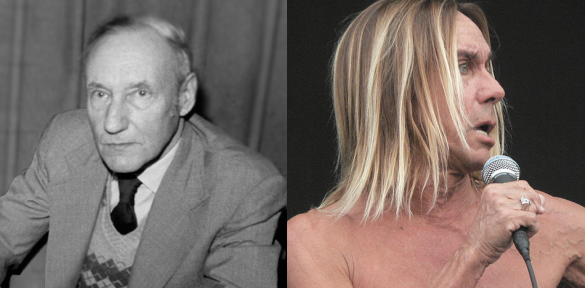
William S. Burroughs is one of the most mythologized American authors of the 20th century. When you recall the details of his life, they read like the biography of a fictional character. He was an unabashed heroin addict yet he dressed like a dapper insurance salesman. He was openly, militantly gay at a time when homosexuality wasn’t even mentioned in polite society. He shot his wife, Joan Vollmer, in Mexico City while playing an ill-conceived game of William Tell and then spent years in Tangiers indulging in every possible vice while writing Naked Lunch, which happened to be one of the most controversial books of the century. And his writing influenced just about everyone you consider cool.
This week is the 101st birthday of Burroughs. To mark the occasion, This American Life aired a BBC documentary on Burroughs’s life. The show is narrated by Iggy Pop whose voice, in announcer mode, bears an uncanny resemblance to Sam Elliot. Pop relates how Burroughs influenced Kurt Cobain, punk rock and Bob Dylan, and how he himself lifted lyrics from Burroughs for his most popular song, and unlikely Carnival Cruise jingle, “Lust for Life.”
As Ira Glass notes, the documentary paints a clear picture of why he is such a revered figure – going into detail about his writing, his hugely influential “Cut Up” method, his obsession with cats – while never buying into his mystique. In fact, one of the most interesting parts of the doc is a damning appraisal of Burroughs’s cool junkie persona by author Will Self, who was himself an addict for a couple of decades. You can listen to the whole episode above.
If you would like to support the mission of Open Culture, consider making a donation to our site. It’s hard to rely 100% on ads, and your contributions will help us continue providing the best free cultural and educational materials to learners everywhere. You can contribute through PayPal, Patreon, and Venmo (@openculture). Thanks!
Related Content:
William S. Burroughs Reads His First Novel, Junky
William S. Burroughs on the Art of Cut-up Writing
William S. Burroughs Explains What Artists & Creative Thinkers Do for Humanity
550 Free Audio Books: Download Great Books for Free
William S. Burroughs on Saturday Night Live, 1981
Jonathan Crow is a Los Angeles-based writer and filmmaker whose work has appeared in Yahoo!, The Hollywood Reporter, and other publications. You can follow him at @jonccrow. And check out his blog Veeptopus, featuring lots of pictures of badgers and even more pictures of vice presidents with octopuses on their heads. The Veeptopus store is here.
Read More...Junot Díaz’s Syllabi for His MIT Writing Classes, and the Novels on His Reading List
We can probably all agree that it’s a little premature, but all the same, the BBC has barreled ahead with its list of “The 21st Century’s 12 greatest novels.” Topping the list of excellent, if not especially surprising, picks is The Brief Wondrous Life of Oscar Wao, Junot Díaz’s Pulitzer Prize-winning debut novel about, as he puts it in the interview above, “a closeted nerd writing about an absolutely out nerd, and using their shared mutual language to tell the story.” The book has connected with such a wide swath of readers for more than its appeal to fellow nerds, though that’s no small thing. A great many readers have seen their own lives reflected in Díaz’s characters—Dominican immigrants growing up in New Jersey—or have found their experiences illuminating. And even though Yunior and Oscar’s very male point of view might have alienated female readers in the hands of a lesser author, Díaz has the sensitivity and self-awareness to—as Joe Fassler argues in The Atlantic—write sexist characters, but not sexist books. As the author himself says above, “if it wasn’t for women readers, I wouldn’t have a career.”
Díaz’s ear for dialogue and idiom and his facility for constructing completely believable characters with completely distinctive voices are matched by his commitment to representing the experiences of people who still get routinely left out of the contemporary canon. Despite the attention given to such stellar non-white, non-male writers as Toni Morrison, Maxine Hong-Kingston, Arundhati Roy, and Jamaica Kincaid, most MFA programs, Diaz argued in a recent essay for The New Yorker, are still “too white,” reproducing “exactly the dominant culture’s blind spots and assumptions around race and racism (and sexism and heteronormativity, etc).” In his own MFA workshop experiences at Cornell, he found that “the default subject position of reading and writing—of Literature with a capital L—was white, straight and male.”
The problem is more than just personal, though he certainly found the experience personally alienating, and it isn’t a matter of redressing historical wrongs or enforcing an abstract PC notion of diversity. Instead, as Díaz told Salon, it’s a problem of accurately representing reality. “If race or gender (or any other important social force) are not part of your interpretive logic—if they’re not part of what you consider the real—then you’re leaving out most of what has made our world our world.” In his own role at a professor at MIT, teaching undergraduate writing courses for the Comparative Media Studies/Writing Department, Díaz is very thoughtful about his approach, emphasizing, “it’s not the books you teach, but how you teach them.” In addition to novels by authors like Haitian-born Edwidge Danticat and Zimbabwean author NoViolet Bulawayo, he has his students read “classic Gothic texts which are themselves not very diverse by our standards,” but, he says, “the critical lens I deploy helps my students understand how issues of race, gender, coloniality etc. are never far.”
Salon tracked down the syllabi and reading lists for two of Díaz’s MIT courses, “World-Building” and “Advanced Fiction.” We do find one classic Gothic text—Bram Stoker’s Dracula—and also much of what we might expect from the self-confessed nerd, including work from such well-regarded comic writers as Frank Miller and Alan Moore and classic sci-fi from Tarzan creator Edgar Rice Burroughs. In addition to these white, male writers, we have fiction from African-American sci-fi authors Octavia Butler and N.K. Jemisin. Díaz’s “Advanced Fiction” list is even more wide-ranging, inclusive of writers from Chile, Zimbabwe, China, and Haiti, as well as the U.S. See both lists below.
World-Building:
Description: “This class concerns the design and analysis of imaginary (or constructed) worlds for narrative media such as roleplaying games, films, comics, videogames and literary texts. … The class’ primary goal is to help participants create better imaginary worlds – ultimately all our efforts should serve that higher purpose.”
Prerequisites: “You will need to have seen Star Wars (episode four: A New Hope) and read The Lord of the Rings by JRR Tolkien.”
Reading List:
“A Princess of Mars” by ER Burroughs
“Dracula” by Bram Stoker
“Batman: The Dark Knight Returns” by Frank Miller
“Sunshine” by Robin McKinley
“V for Vendetta” by Alan Moore
“The Hunger Games” by Suzanne Collins
“The Hundred Thousand Kingdoms” by NK Jemisin
“Lilith’s Brood” by Octavia Butler
“Perdido Street Station” by China Miéville
“Snow Crash” by Neal Stephenson (Recommended)Some things to consider always when taking on a new world: What are its primary features—spatial, cultural, biological, fantastic, cosmological? What is the world’s ethos (the guiding beliefs or ideals that characterize the world)? What are the precise strategies that are used by its creator to convey the world to us and us to the world? How are our characters connected to the world? And how are we the viewer or reader or player connected to the world?
Advanced Fiction
Description: “An advanced workshop on the writing and critiquing of prose.”
Reading List:
“Clara” by Roberto Bolaño
“Hitting Budapest” by NoViolet Bulawayo
“Whites” by Julie Otsuka
“Ghosts” by Edwidge Danticat
“My Good Man” by Eric Gansworth
“Gold Boy, Emerald Girl” by Yiyun Li
“Bounty” by George Saunders
For more from Díaz himself on his approach to writing fiction, listen to his interview with NPR’s Teri Gross. And just below, hear Díaz read from The Brief Wondrous Life of Oscar Wao at the Key West Literary Seminar in 2008.
Related Content:
Free Online Literature Courses
Junot Díaz Annotates a Selection of The Brief Wondrous Life of Oscar Wao for “Poetry Genius”
David Foster Wallace’s 1994 Syllabus: How to Teach Serious Literature with Lightweight Books
Donald Barthelme’s Syllabus Highlights 81 Books Essential for a Literary Education
Josh Jones is a writer and musician based in Durham, NC. Follow him at @jdmagness.
Read More...The Origins of Pleasure: Paul Bloom Explains Why We Like Expensive Wines & Original Paintings
Let’s say you spend a considerable amount of money for a painting by a noted artist. Or maybe you get it for a steal. Either way, the painting hangs prominently in your home, where it is admired by guests and brings you pleasure every time you look at it, which is often. Years later, you accidentally discover that your painting is not the work of the artist whose signature graces the lower right hand corner of the canvas, but rather a heretofore anonymous forger. How do you react?
Do you laugh and say, “When I think of all the happiness that living with this beautiful image has brought me over the years, I feel I have gotten my money’s worth many times over. I don’t care who painted it!”
Or do you look as though you’ve just realized that evil exists in the world, which is how Hitler’s right hand man, Hermann Göring, reputedly looked when, as a prisoner at Nuremberg, he was informed that his beloved Vermeer, ”Christ with the Woman Taken in Adultery” (below), was actually the work of the Dutch dealer who had sold it to him.

Göring’s reaction may have been the most human thing about him. According to Yale psychologist Paul Bloom, the pleasure we take in the things we love is deeply informed by their perceived origins. Forget monetary value. Forget bragging rights. We need to believe that our painting was not just painted by Vermeer, but handled by him, breathed upon him. If only that Vermeer of mine could talk…I bet it could settle once and for all the exact nature of his relationship with that little serving girl. Remember? The one with the pearl earring?
Oh, wait. She was fictional. I forgot.
But that’s the sort of provenance we crave. The kind that comes with a story we can sink our teeth into.
The story must also fit the circumstances, as Bloom makes plain in his wonderfully entertaining TED talk on the Origins of Pleasure.
Unknowingly hopping in the sack with a blood relative or eating rat meat are intriguing narratives, provided they happen to someone else. Knowledge of such stories could deepen your connection to a particular piece of art.
(Can’t you feel the sexual anguish oozing out of my Vermeer? Did you know he had to choose between buying brushes and buying food?)
Not the sort of origin story you’d want to find at the bottom of your own personal soup bowl, however.
Ergo, let us say that when it comes to pleasure emanating from food, we savor tastes we perceive as coming from wholesome organic farms, artisanal operations, restaurants that are known to have passed the Board of Health’s sanitary inspection with flying colors.
And when it comes to drink, we will willingly believe in the superior flavor of anything poured under the auspices of an acclaimed label. Scientific evidence confirms this.
(On a related note, I once hung on to a bottle after drinking the luxury vodka it once contained, thinking I’d refill it with a cheap liquor hack I had read about. The experiment ended when my husband complained that the water in our Brita pitcher tasted funny.)
Speaking of romantic partners, it turns out that beauty truly is not so much in the eye, but the brain of the beholder. And it’s probably not a bad idea to make sure you’ve got the facts regarding a potential lover’s age, gender, and bloodlines. Caveat emptor, as anyone who’s ever seen the Crying Game will attest.
Note: Paul Bloom has taught a free course through Yale called “Introduction to Psychology,”. It’s available in our collection of Free Online Psychology Courses, part of our larger collection, 1,700 Free Online Courses from Top Universities.
Related Content:
Why We Love Repetition in Music: Explained in a New TED-Ed Animation
A Darwinian Theory of Beauty, or TED Does Its Best RSA
1756 TED Talks Listed in a Neat Spreadsheet
Ayun Halliday is an author, homeschooler, and Chief Primatologist of the East Village Inky zine. Follow her @AyunHalliday
Read More...Start Your Day with Werner Herzog Inspirational Posters

Werner Herzog is the wild man of cinema. His movies are stark and elemental and ecstatic and are usually about a crazed dreamer who struggles to achieve an impossible task in the face of a chaotic, indifferent universe. Think Aguirre, Wrath of God, about a conquistador who goes crazy while adrift along an Amazonian river. Think Stroszek, about a German grifter who goes mental in the forbidding landscape of Wisconsin while struggling to find the American dream. That film famously, inexplicably, ends with shots of a dancing chicken.
The ecstatic truths seen in his movies are reflected in the man himself. At the age of 14, Herzog struck out from his native Germany for Albania and then Sudan. In 1972, he once walked from Munich to Paris to visit an ailing friend. In 1977, he shot footage at the lip of a volcano at the brink of eruption. He’s a filmmaker who seems to go out of his way to choose locations that are remote and difficult — Antarctica, the Sahara and the Amazonian rain forest — and his shoots always seem to be bedeviled by intrigue and catastrophe. His first feature was nearly derailed because of a coup d’état. While shooting Fata Morgana in Cameroon, he was mistaken for a wanted criminal and thrown in jail. Once during a TV interview in the hills of Los Angeles, he was shot by a random crazy person. Watch it here.
“A BBC television crew came to see me in Laurel Canyon,” as he recounted for The New Yorker. “They wanted to interview me for the British première of ‘Grizzly Man.’ I didn’t want them to film right outside my house, so we went up to Skyline Drive. In the middle of the interview, I was shot with a rifle by someone standing on his balcony. I seem to attract the clinically insane.”
Instead of stopping the interview, running for protection and perhaps going to the hospital, Herzog just continued with the interview saying simply, “It was not a significant bullet. I am not afraid.”
Herzog’s improbable penchant for disaster, his collaboration with the brilliant, but batshit crazy, Klaus Kinski, and of course, his singular, uncompromising work have turned him into almost a mythic figure in some circles. But it’s these mad, macho declarations like those above that have really fed the cult of Herzog.
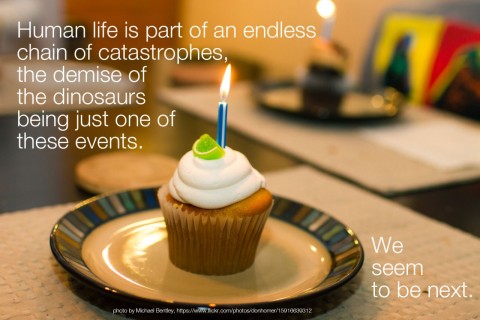
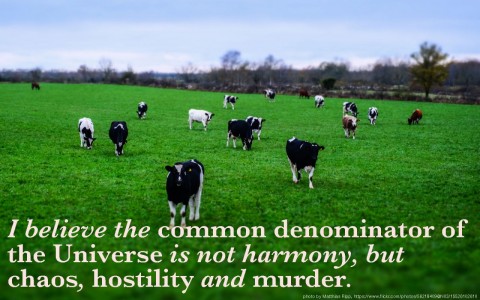
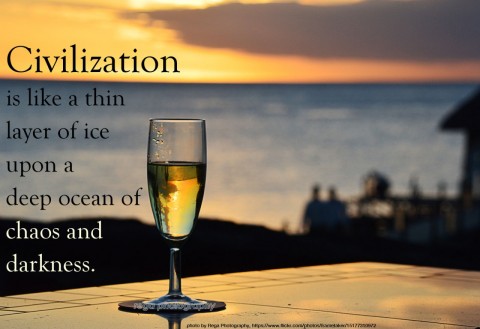
Recently, some unknown genius turned some of Herzog’s more extreme quotations into inspirational posters. Lines like “Civilization is like a thin layer of ice upon a deep ocean of chaos and darkness” are placed along side a shot of a glass of white wine and a sunset.
So gaze upon them. Absorb the pearls of wisdom. Find cold comfort in their bleak, nihilist pronouncements. They make fine additions to any cubicle.
Related Content:
Werner Herzog Picks His 5 Top Films
Werner Herzog Offers 24 Pieces of Filmmaking & Life Advice
Werner Herzog Loses a Bet to Errol Morris, and Eats His Shoe (Literally)
Jonathan Crow is a Los Angeles-based writer and filmmaker whose work has appeared in Yahoo!, The Hollywood Reporter, and other publications. You can follow him at @jonccrow. And check out his blog Veeptopus, featuring lots of pictures of badgers and even more pictures of vice presidents with octopuses on their heads. The Veeptopus store is here.
Read More...Hear Albums from Brian Eno’s 1970s Label, Obscure Records
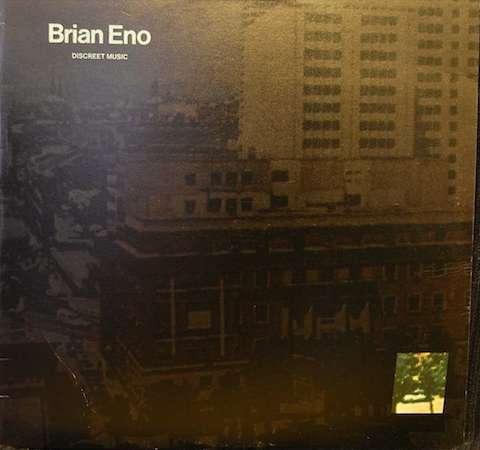
Given his celebrity status in the realms of both music and visual art, I don’t know that we can really call anything Brian Eno does obscure. But at one point, he did call his own efforts obscure — or at least those efforts required to establish and run the label Obscure Records, which he did between 1975 and 1978. In that short period, Obscure Records managed to put out ten albums, from Gavin Bryars’ The Sinking of the Titanic (catalog no. 1) to Michael Nyman’s Decay Music (no. 6) to Harold Budd’s Pavilion of Dreams (no. 10), all of which we might broadly categorize as “contemporary classical music,” with a strong bent toward new compositional techniques and what we’d now call ambient textures.
“The label provided a venue for experimental music,” says Ubuweb’s Obscure Records page, “and its association with Eno gave increased public exposure to its composers and musicians.” There, you freely can listen to all ten Obscure releases — which, I suppose, effectively makes them obscure no more — although they don’t include the famously detailed original liner notes “analyzing the compositions and providing a biography of the composer.”
Though he mostly acted as producer on Obscure recordings, Eno also used the label to put out his seminal 1975 solo album Discreet Music (no. 3), which contains a composition made using the then unheard-of technique of running several tape loops simultaneously and letting the sound recorded on them run gradually out of sync. Obscure’s fifth release, Jan Steele and John Cage’s 1976 Voices and Instruments, features “The Wonderful Widow Of Eighteen Springs,” previously featured here on Open Culture as interpreted by Joey Ramone.
This may seem colorful enough for any label’s lifetime, but Eno did have an eleventh Obscure record planned. It ultimately made more sense, however, to found an entirely new operation to put out this work, a certain Music for Airports. It came out as the flagship release from Eno’s Ambient Records — and the rest, my friends, is popular-experimental music history.
Albums from Obscure Records can be sampled over at UBU.
Related Content:
David Bowie & Brian Eno’s Collaboration on “Warszawa” Reimagined in Comic Animation
Jump Start Your Creative Process with Brian Eno’s “Oblique Strategies”
Brian Eno on Creating Music and Art As Imaginary Landscapes (1989)
How David Byrne and Brian Eno Make Music Together: A Short Documentary
Hear Joey Ramone Sing a Piece by John Cage Adapted from James Joyce’s Finnegans Wake
Colin Marshall hosts and produces Notebook on Cities and Culture as well as the video series The City in Cinema and writes essays on cities, language, Asia, and men’s style. He’s at work on a book about Los Angeles, A Los Angeles Primer. Follow him on Twitter at @colinmarshall or on Facebook.
Read More...Take a Super Slow Motion Look at What Happens Inside a DSLR Camera
With the naked eye, it’s nearly impossible to see what happens inside a DSLR camera when the shutter activates. But all of that changes when you use a high speed camera — the Phantom Flex — to slow things down to 10,000fps. Above, you can see The Slow Mo Guys do their thing. It’s fun to watch, and you’ll probably learn a few things about how a camera works.
If you would like to support the mission of Open Culture, consider making a donation to our site. It’s hard to rely 100% on ads, and your contributions will help us continue providing the best free cultural and educational materials to learners everywhere. You can contribute through PayPal, Patreon, and Venmo (@openculture). Thanks!
Read More...In Lost Letter, Allen Ginsberg Tells The Paris Review He Tried LSD Again & Experienced “No Snake Universe Hallucinations” (1966)
(click for larger version)
In June 1965, Allen Ginsberg was interviewed at length by fellow poet Tom Clark. They touched on such topics as poetic meter, William S. Burroughs, and Blake’s “The Sick Rose.” When the conversation turned to hallucinogens, Ginsberg, a famously early adopter of LSD, describes a vision so ominous it could’ve turned an entire generation off drugs:
If I close my eyes on hallucinogens, I get a vision of great scaly dragons in outer space, they’re winding slowly and eating their own tails. Sometimes my skin and all the room seem sparkling with scales, and it’s all made out of serpent stuff. And as if the whole illusion of life were made of reptile dream.
He also mentioned that drugs made him barf. That alone seems a persuasive reason to stop taking them.
Despite his strong desire to continue his pursuit of ever higher levels of consciousness, the cons were beginning to outweigh the pros.
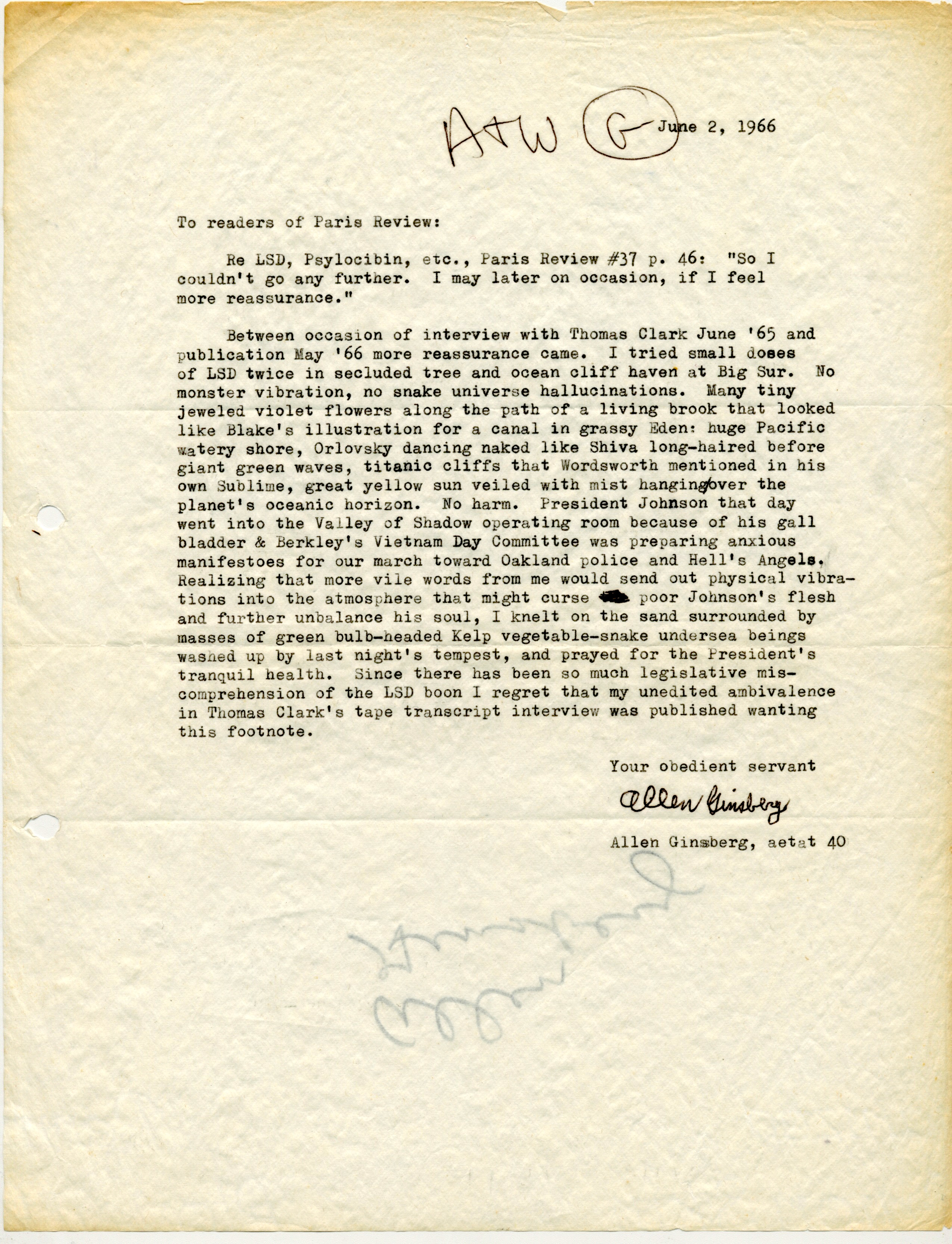
It took nearly a year for the Paris Review to publish the interview. So long that the subject felt the need to revise his earlier statements, via the typewritten letter above.
His post-interview psychedelic excursions appear to have transpired in the sort of benign universe typically imagined by a preschooler with a big box of crayons: “tiny jeweled violet flowers,” “giant green waves,” a “great yellow sun.” Otherwise known as Big Sur on acid.
The level of goodness present in those later trips was such strong medicine, Ginsberg decided to experiment further, directing some of his good vibes toward then-President Lyndon Johnson, who was undergoing surgery to remove his gall bladder. Love thy enemy, and all of that.
I wonder if Johnson ever found out he had a rabidly anti-war Beat Poet (and “masses of green bulb-headed Kelp vegetable-snake undersea beings”) praying for his recovery.
Apparently it worked.
The complete June 1965 interview can be read in the Paris Review’s archives. Those who’ve grown unaccustomed to reading courier font as executed by a midcentury manual typewriter will find the complete text of Ginsberg’s letter below.
June 2, 1966
To readers of Paris Review:
Re LSD, Psylocibin [sic], etc., Paris Review #37 p. 46: “So I couldn’t go any further. I may later on occasion, if I feel more reassurance.”
Between occasion of interview with Thomas Clark June ’65 and publication May ’66 more reassurance came. I tried small doses of LSD twice in secluded tree and ocean cliff haven at Big Sur. No monster vibration, no snake universe hallucinations. Many tiny jeweled violet flowers along the path of a living brook that looked like Blake’s illustration for a canal in grassy Eden: huge Pacific watery shore, Orlovsky dancing naked like Shiva long-haired before giant green waves, titanic cliffs that Wordsworth mentioned in his own Sublime, great yellow sun veiled with mist hanging over the planet’s oceanic horizon. No harm. President Johnson that day went into the Valley of Shadow operating room because of his gall bladder & Berkley’s Vietnam Day Committee was preparing anxious manifestoes for our march toward Oakland police and Hell’s Angels. Realizing that more vile words from me would send out physical vibrations into the atmosphere that might curse poor Johnson’s flesh and further unbalance his soul, I knelt on the sand surrounded by masses of green bulb-headed Kelp vegetable-snake undersea beings washed up by last night’s tempest, and prayed for the President’s tranquil health. Since there has been so much legislative mis-comprehension of the LSD boon I regret that my unedited ambivalence in Thomas Clark’s tape transcript interview was published wanting this footnote.
Your obedient servant
Allen Ginsberg, aetat 40
Related Content:
Allen Ginsberg Reads His Famously Censored Beat Poem, Howl (1959)
Allen Ginsberg Reads a Poem He Wrote on LSD to William F. Buckley
Ayun Halliday is an author, illustrator, and Chief Primatologist of the East Village Inky zine. Follow her @AyunHalliday
Read More...Cinematic Experiment: What Happens When The Bicycle Thief’s Director and Gone With the Wind’s Producer Edit the Same Film
When we get deep enough into our enthusiasm for film, cinephiles start speculating in ways that might strike non-cinephiles as, well, unusual. The video essayist koganada, for example, states in the video above his desire to “build a time machine and travel to Italy circa 1952” and “ask Vittorio de Sica to make a film using Hollywood actors like Montgomery Clift and Jennifer Jones, and then team de Sica up with a Hollywood producer, the kind that likes to impose his will and sensibility onto a film — someone like David O. Selznick. In bringing these two worlds of cinema together, I’d hope for a clash in cinema so great that it would result in two cuts of the same film, one by de Sica and the other by Selznick.”
This may sound like the speculation of a fanboy, albeit a highbrow fanboy, but you can hardly call it idle speculation. This video essay, as you can see, actually manages to screen, side-by-side, scenes from what really do look like two different versions of the same early-1950s film, one cut in the classic Hollywood style, and one cut in the Italian neorealist style. This “experiment” in cinema illuminates the rhythms, emphases, and values of both kinds of filmmaking, adding nuance to the conception of one as clear-eyed, methodical, and uncompromising, and the other as idealized, flamboyant, and crowd-pleasing.
So has kogonada actually built this time machine and commissioned two cuts of the same picture from the director of Bicycle Thieves and the producer of Gone with the Wind? Not quite, but film history has provided him with the next best thing: 1954’s Terminal Station and The Indiscretion of an American Wife. De Sica “was one of the world’s most celebrated filmmakers when David O. Selznick commissioned Terminal Station from him and his screenwriting partner, Cesare Zavattini,” writes critic Dave Kehr in a Criterion Collection essay. But the production soon hit some serious snags. Criterion goes on to add:
The troubled collaboration between director Vittorio De Sica and producer David O. Selznick resulted in two cuts of the same film. De Sica’s version, Terminal Station, was screened at a length of one-and-a-half hours, but after disappointing previews, Selznick severely re-edited it and changed the title to Indiscretion of an American Wife without De Sica’s permission.
Though Kehr finds de Sica’s take on the material “immeasurably superior” to Selznick’s, he adds that “both have quite distinct emotional and dramatic qualities, and it is fascinating to see how identical material can be pushed and pulled, wholly through the postproduction process, in two radically different directions.” Even casual cinephiles stand to learn a lot from a back-to-back viewing of Terminal Station and The Indiscretion of an American Wife, but only in this video essay’s five minutes can we see them so carefully compared and contrasted side-by-side. Briefly but densely, it reveals to us the nature of both classic Hollywood and Italian neorealism — no time travel required.
Related Content:
The Perfect Symmetry of Wes Anderson’s Movies
Critics Pick the Top 100 Movies of All Time in the Pages of Cahiers du Cinéma
Signature Shots from the Films of Stanley Kubrick: One-Point Perspective
Colin Marshall hosts and produces Notebook on Cities and Culture as well as the video series The City in Cinema and writes essays on cities, language, Asia, and men’s style. He’s at work on a book about Los Angeles, A Los Angeles Primer. Follow him on Twitter at @colinmarshall or on Facebook.
Read More...What Questions Would Stephen Fry Ask God at the Pearly Gates?
Several years ago, an interviewer asked Stephen Fry to look backward — to reflect on his life and answer this question, “What do you wish you had known when you were 18”? What lessons would you draw in hindsight? Some of his answers included:
- Don’t set goals for yourself, particularly material ones. They’re disastrous and will keep you from becoming who you really are.
- Keep your ego in check. You’ll be better liked, and more opportunities will come your way.
- Get outside your comfort zone by traveling to distant lands and reading books in a serendipitous way.
- Be a giver, not a taker. It’s more rewarding.
In the clip above, Gay Byrne, a broadcaster with RTÉ, now asks Fry to look forward and answer another question: Suppose there is a God, and you arrive at the Pearly Gates, what would you say to him, her or it? Fry, an avowed secular humanist, isn’t throwing God any softballs: Why create a world where kids have bone cancer? Why create insects that burrow into children’s eyes and render them blind? Why create a world with so much pain, misery and injustice in it? As he answers these questions, and concludes that such a God (were it to exist) would be nothing short of maniacal, Byrne’s face contorts, revealing his discomfort. You can watch other scenes from the interview here, and catch Fry’s animated primers on secular humanism here.
Related Content:
Stephen Fry: What I Wish I Knew When I Was 18
Free Online Religion Courses
Read More...
Marlene Dietrich Plays the Musical Saw (aka the Singing Saw) to Entertain the Troops During WWII
It’s not my favorite Marlene Dietrich gem on the internet. No, that would be her temperamental screen test for The Blue Angel (1930). But it’s still a precious find. Above, we have an audio clip featuring Dietrich, one of the towering movie stars of early cinema, playing the musical saw. Andrea James writes over at BoingBoing: “Dietrich always wanted to be a classical musician. Since her cabaret act and film career left little time for her to do the required practice, she played the musical saw instead. Throughout World War II she wowed USO audiences with the novelty.” And that’s what we get a taste of here. In other clips available on Youtube, you can find Dietrich playing her “singing saw,” and again playing the musical saw on the radio, circa 1945.
Follow us on Facebook, Twitter and Google Plus and share intelligent media with your friends. Or better yet, sign up for our daily email and get a daily dose of Open Culture in your inbox.
Related Content:
Ernest Hemingway’s “Love Letter” to His “Dearest Kraut,” Marlene Dietrich (1955)
Marlene Dietrich’s Temperamental Screen Test for The Blue Angel
101 Free Silent Films: The Great Classics
Read More...Support Us
We're hoping to rely on loyal readers, rather than erratic ads. Please click the Donate button and support Open Culture. You can use Paypal, Venmo, Patreon, even Crypto! We thank you!

About Us

Open Culture scours the web for the best educational media. We find the free courses and audio books you need, the language lessons & educational videos you want, and plenty of enlightenment in between.
Advertise With Us

FREE UPDATES!
GET OUR DAILY EMAIL
Get the best cultural and educational resources on the web curated for you in a daily email. We never spam. Unsubscribe at any time.
FOLLOW ON SOCIAL MEDIA

Open Culture editor Dan Colman scours the web for the best educational media. He finds the free courses and audio books you need, the language lessons & movies you want, and plenty of enlightenment in between.
Advertise With Us


