How Famous Writers Deal With Writer’s Block: Their Tips & Tricks
Nearly everyone—from the most minimally educated to the most academically accomplished—has experienced at least once that panicked loss for words colloquially known as “writer’s block.” Faced with the glacial expanse of a blank page, or screen, the fingers fumble, heart races, and the brain seizes up. And, for those who write for a living, for whom writing is a defining characteristic of their very existence, it can seem like one’s very soul becomes imperiled, abandoned by the muses or whatever fickle personification of creative inspiration.
The malady is seemingly universal, even, writes The Independent, among “some of history’s most famous, and prodigiously fluent, authors,” like Leo Tolstoy, Virginia Woolf, Ernest Hemingway, and Joseph Conrad. One particularly perfectionistic strain of writer’s block—the search for le mot juste—is forever associated with Madame Bovary author Gustave Flaubert, who described the sickness to a friend as “stay[ing] a whole day with your head in your hands, trying to squeeze your unfortunate brain so as to find a word.” Clearly, such illustrious names as the above found some sort of cure for the block, or we may not know their names at all.
Some writers deny the very existence of writer’s block. Novelist Kathy Lette belittles the notion as sounding like a “prison wing for authors who make too many puns—a punitentiary,” and she claims that “women writers don’t have time for writer’s block.” Jeffrey Archer says he has never had writer’s block, even though he named his Majorca home “Writer’s Block.” I diagnose these authors with a severe form of psychological repression, perhaps brought on by extreme and traumatic bouts of writer’s block.
From even a cursory survey of those who openly admit to the pain of running out of things to say from time to time, it seems there are as many ways to get going again as there are writers. The Independent quotes novelists like Philip Hensher, who takes “the Tube to the end of the line,” then walks back into central London—a very geographically exclusive fix, to be sure. A Flavorwire list brings us remedies from Maya Angelou, who would “write for two weeks ‘the cat sat on the mat, that is that, not a rat’” until the muse returned to save her from insanity. Neil Gaiman takes an entirely different approach—he gets up and walks away to “do other things.” Though it may seem in moments of severe writer’s block that nothing else could possibly matter, his tactic—research suggests—may be just the thing to get the creative unconscious going again.
Speaking of the unconscious, Anne Lamott recommends to her students that they commit to writing three hundred words on how much they hate writing, then “on bad days and weeks, let things go at that… Your unconscious can’t work when you are breathing down its neck. You’ll sit there going, ‘Are you done in there yet, are you done in there yet?’” Not helpful. In the videos above, see how popular best-selling novelist Dan Brown deals with a laggardly unconscious. Love, hate, or be indifferent to his work, but you must admit, his is a very novel method: Every hour, Brown gets up and does some pushups and sit-ups to “get the blood moving,” since it’s very hard to write the kind of “fast-paced plots” he does “if your blood pressure’s dropped too far.” Brown also gives his brain a daily supply of fresh blood by hanging upside down each day, either in gravity boots or, as The Telegraph video directly above details, an “inversion table.”
Strange, but no more so than many other writers’ rituals. Laurence Sterne, the eighteenth century author of Tristram Shandy, had what may be my favorite design for conquering writer’s block: he would shave his beard, change his shirt and coat, send for a “better wig,” put on a topaz ring, and dress “after his best fashion.” Mock if you must, but it seems to me that no method of combating writer’s block is too outlandish for those whose lives and livelihoods depend upon turning out the words. We may not always like what we write—some days we may positively hate it—but there may be no worse, more useless, feeling for a writer than being unable to write anything at all.
If you have your own suggestions for getting over writer’s block, please let us know in the comments below. We’d love to try them out.
Related Content:
Why You Do Your Best Thinking In The Shower: Creativity & the “Incubation Period”
Writing Tips by Henry Miller, Elmore Leonard, Margaret Atwood, Neil Gaiman & George Orwell
Ray Bradbury Gives 12 Pieces of Writing Advice to Young Authors (2001)
Seven Tips From Ernest Hemingway on How to Write Fiction
Josh Jones is a writer and musician based in Durham, NC. Follow him at @jdmagness
Read More...Hear James Joyce’s Great Short Story “The Dead,” Performed by Cynthia Nixon & Colum McCann
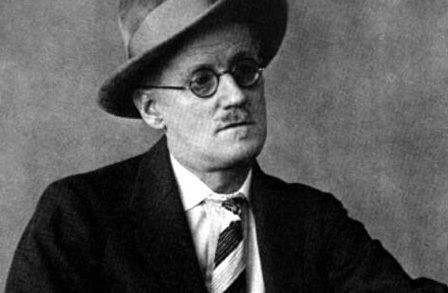
“The Dead” is the last – and most memorable – short story in James Joyce’s first book, Dubliners. Set during a New Year’s feast in 1904, the story focuses on Gabriel Conroy, a plump, bespectacled young man who is painfully aware of his own social ineptitude. As he navigates one minor faux pas after the next – making a poorly received joke here, clumsily parrying a barbed joke there – he comes to realize over the course of the party that his beautiful, distant wife has a past he never knew.
James’s story is filled with such humor, attention to character and musicality of language that it seems to cry out to be read aloud. The NPR series Selected Shorts heeded that call and presents the entire story performed live by Cynthia Nixon, of Sex and the City fame, who reads the first half, and by Irish author Colum McCann, who reads part of the second.
The reading will be added to our collection of Free Audio Books. Also find the text of James’ great story in our collection, 800 Free eBooks for iPad, Kindle & Other Devices. To learn about the long and difficult publication of Dubliners, check out Sean Hutchinson’s post over at Mental Floss.
Note: you can download the audio as MP3s by clicking the download arrow at the top of each audio clip above.
Related Content:
James Joyce’s Dublin Captured in Vintage Photos from 1897 to 1904
James Joyce, With His Eyesight Failing, Draws a Sketch of Leopold Bloom (1926)
James Joyce’s Ulysses: Download the Free Audio Book
Hear All of Finnegans Wake Read Aloud: A 35 Hour Reading
See our list of Free Online Literature Courses
Jonathan Crow is a Los Angeles-based writer and filmmaker whose work has appeared in Yahoo!, The Hollywood Reporter, and other publications. You can follow him at @jonccrow. And check out his blog Veeptopus, featuring lots of pictures of badgers and even more pictures of vice presidents with octopuses on their heads. The Veeptopus store is here.
Read More...Posters Promoting the 1970s L.A. Punk Scene: Black Flag, The Plimsouls, The Runaways & More
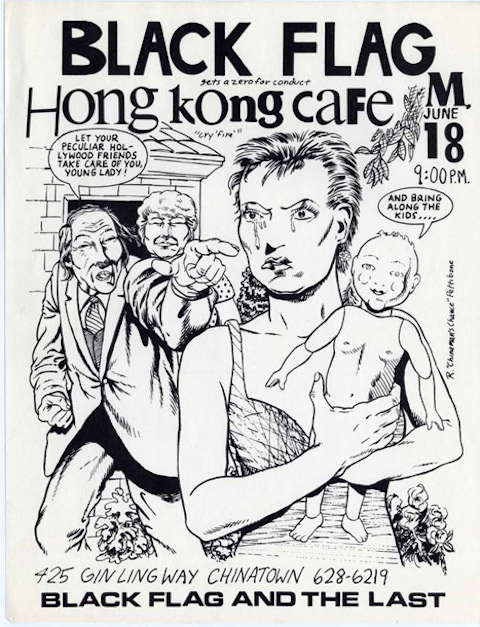
Fred Patterson, aka Phast Phreddie, Senior Archivist of the ARChive of Contemporary Music, DJ, music journalist and former punk rock zinester has undeniable street cred.
He also has a handful of flyers documenting the late ‘70s LA punk scene.
Talk about ephemera!
Man, psychedelic concert posters of the period were suitable for framing, and the utilitarian boxing style window cards’ cool quotient ensured their longevity. Amateur whip outs (such as those Patterson managed to preserve) rarely survived beyond a season or two on a fan’s fridge door.
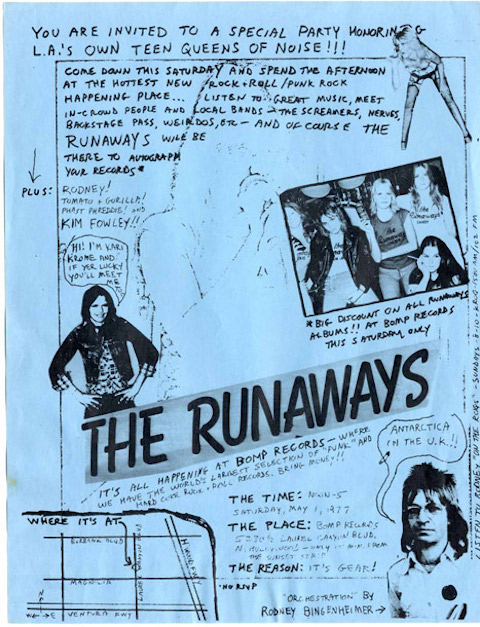
His ragtag collection is what self-promotion looked like in the predigital age. The Plimsouls, the Runaways, and Black Flag excepting, few of these bands achieved the sort of status that would have allowed them to move away from the realm of the murky photocopy.
The amateurish aesthetic of these homemade efforts was anchored with a spiky humor that went nicely with the outrageous band names. Sketchy locations were heralded as the sorts of places where the popular teen set gathered. Word bubbles abounded.
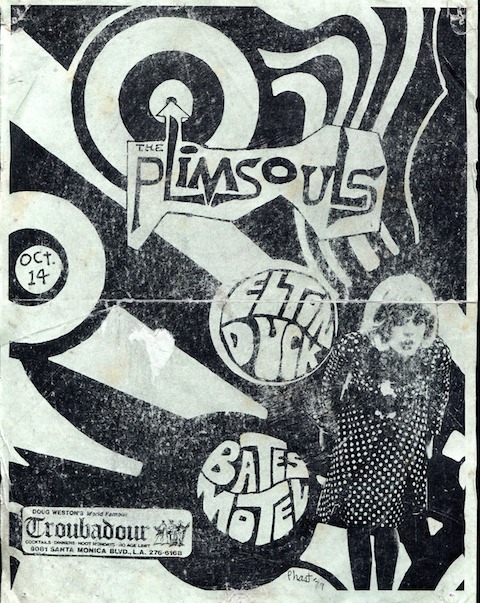
Cut and paste collage, Letraset, and scratchy hand lettering were the hallmark of necessity. Nowadays, these obsolete elements are co-opted for their implied authenticity, even if the final product is likely assembled in Photoshop.
See more of Phast Preddie’s collection here.
Related Content:
The Art of Punk, MOCA’s Series of Punk Documentaries, Begins with Black Flag
Four Female Punk Bands That Changed Women’s Role in Rock
Ayun Halliday is an author, homeschooler, and Chief Primatologist of the East Village Inky zine. Follow her @AyunHalliday
Read More...Existential Philosophy of Kierkegaard, Sartre, Camus Explained with 8‑Bit Video Games
By this point in history, many of us grown-ups did our growing up while playing video games. Most memorably, we did it while playing the colorful, pixelated video games of the mid 1980s through the early 1990s, the heyday of the “eight-bit” consoles. These titles and their characters — the Marios, the Zeldas, the Mega Men — remain cultural touchstones not just for those of us who have landed solidly in adulthood, but also for those of us too young to have played them while they were new. Many of us have put away these childish things, but many more of us have kept them out, keeping them right alongside our grown-up pursuits, resulting in projects like the video series 8‑Bit Philosophy, which we featured in November.
These grown-up pursuits include not just the study of philosophy, but reflection upon the serious existential questions that the subject reveals: Does rationality give life meaning? Do we enjoy being free? Why shouldn’t we commit suicide? Luckily, 8‑Bit Philosophy has come up with episodes dealing with exactly these topics. For the first question they turn to the ideas of Søren Kierkegaard, the 19th century thinker considered the father of existentialism, as illustrated by Shatterhand, a slightly obscure platformer I greatly enjoyed in my own youth. For the second, we see how two formidable bodies of work — that of Jean-Paul Sartre, and that of the Final Fantasy role-playing games — come to bear on the issue. For the third, they bring out none other than Albert Camus (who died 55 years ago yesterday), placing his trenchcoated, Gauloise-smoking avatar into the suitably Sisyphean Donkey Kong.
If you’ve put in the hours playing both eight-bit video games and reading the relevant philosophical texts, you’ll surely find these videos’ Nintendonian aesthetics as impeccable as their encapsulations of Kierkegarrd, Sartre, and Camus’ positions are concise. You can find more from 8‑Bit Philosophy on Youtube, including their vintage gamer-friendly renditions of Friedrich Nietzsche on time as a flat circle and what science has to do with truth. They cover other areas of philosophy, too, but something about old video games themselves — with their endless cycles of death, regeneration, and not inherently meaningful challenges — leads my mind straight into existentialism every time.
Related Content:
8‑Bit Philosophy: Plato, Sartre, Derrida & Other Thinkers Explained With Vintage Video Games
Existentialism with Hubert Dreyfus: Four Free Philosophy Courses
Friedrich Nietzsche & Existentialism Explained to Five-Year-Olds (in Comical Video by Reddit)
Walter Kaufmann’s Classic Lectures on Nietzsche, Kierkegaard and Sartre (1960)
Colin Marshall hosts and produces Notebook on Cities and Culture as well as the video series The City in Cinema and writes essays on cities, language, Asia, and men’s style. He’s at work on a book about Los Angeles, A Los Angeles Primer. Follow him on Twitter at @colinmarshall or on Facebook.
Read More...Bound by Law?: Free Comic Book Explains How Copyright Complicates Art
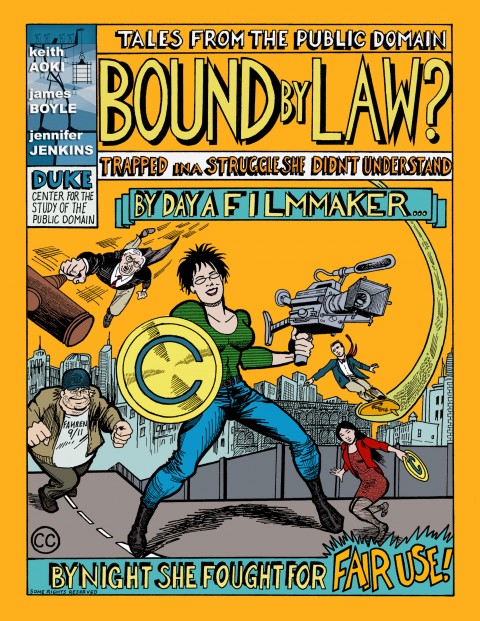
Let’s say you’re a filmmaker shooting a documentary in New York City. You wander through Times Square, through museums, through other destinations, letting your camera roll along the way. Only later do you wonder: Do I need to clear the copyright on the Andy Warhol and Jackson Pollock paintings that came into my camera’s field of view when I was shooting at the MoMA? Or do I need to get clearance on a Miles Davis song that a busker, caught on film, happened to be playing?
Those are the difficult kinds of questions that filmmakers face, and they get sorted out in a pretty unique comic book written by Keith Aoki, James Boyle and, Jennifer Jenkins. Sponsored by Duke’s Center for the Study of the Public Domain, the comic is called Bound By Law? (Tales from the Public Domain). And it’s available as a free PDF file (8mb — 16mb), in html format, and also as a flash animation. There are also translations in Portuguese, French, and Italian. And wait, there’s more: the comic comes with a Foreword by Oscar-winning filmmaker Davis Guggenheim, and an Introduction by BoingBoing blogger Cory Doctorow, who calls Bound by Law? not just “a treatise on copyright,” but also “a loving tribute to the form of comics.”
Bound By Law? — which has been released under a Creative Commons license — will be added to our collection, 800 Free eBooks for iPad, Kindle & Other Devices. Harvard also has a MOOC on Copyright — one of 260 MOOCS getting started in January 2015.
Related Content:
Download 15,000+ Free Golden Age Comics from the Digital Comic Museum
Download Over 22,000 Golden & Silver Age Comic Books from the Comic Book Plus Archive
Read More...Kurt Cobain’s Home Demos: Early Versions of Nirvana Hits, and Never-Released Songs
When our favorite musicians leave us, whether they die young or live to ripe old age, we’re guaranteed to keep discovering new material from them. Sometimes this happens through the questionable remixing of their unfinished work, and the results can be disappointing, if not downright disrespectful. More often, we’re treated to hours of rough demos, home and concert recordings, and alternate takes. And while these may not always live up to the polished studio versions, they nonetheless open intriguing windows into the creative process of artists we love and admire.
In the case of Kurt Cobain, we’ve heard for a couple of years about unreleased demos for a solo album the Nirvana frontman supposedly had in the works before his suicide in 1994. What might it have sounded like?
Well, it might have sounded something like Cobain’s wife’s band, Hole—or at least like their song “Old Age,” released that same year with the single “Violet.” Cobain wrote the song and recorded his own acoustic demo, which you can hear at the top. Dissatisfied, he gave it away to Courtney Love. Just above, hear another acoustic home demo, “Do Re Mi,” that Hole co-founder Eric Erlandson told Fuse offers a hint of what might have been.
Until, if ever, the actual recordings of Cobain’s planned solo album come out, we can only speculate. But whether or not the notoriously introverted singer would approve, we do have many more acoustic demos and home recordings of songs we know and songs we probably don’t. Many of these appear on the Nirvana box set With the Lights Out, which, in addition to containing “Old Age” and “Do Re Mi,” has acoustic versions of In Utero’s “Rape Me,” “Pennyroyal Tea,” and “All Apologies” (above).
What you won’t hear on the box set is the song above, “Creation,” a home demo Cobain made in the late eighties, using a 4‑track recorder to mix his vocals with a bassline and drumming on suitcases. This track appears on an unofficial 4 CD bootleg set called Nirvana: The Chosen Rejects alongside a good many demo tracks from Cobain’s first band, the obnoxiously-named Fecal Matter, which he formed with future Melvins drummer Dale Crover in Aberdeen, Washington.
“Creation” presages the droning, rhythmic melodicism that became the hallmark of Cobain’s Nirvana songwriting. But as for that sadly aborted solo album, it seems the singer may have been moving into some very eclectic territory indeed. Cobain, says Erlandson, “was headed in a direction that was really cool. It would have been his White Album.” Alas.
Related Content:
Nirvana Plays in a Radio Shack, the Day After Recording its First Demo Tape (1988)
Nirvana’s Home Videos: An Intimate Look at the Band’s Life Away From the Spotlight (1988)
Hear Dave Grohl’s First Foo Fighters Demo Recordings, As Kurt Cobain Did in 1992
Josh Jones is a writer and musician based in Durham, NC. Follow him at @jdmagness
Read More...The Ramones’ First Press Release: We’re Part Musicians, Dentists & Degenerates (1975)
We have a thing for the early days of The Ramones.
Exhibit A: We’ve featured footage of one of their earliest live shows performed at CBGB in 1974. And then comes another from 1977.
Exhibit B: We’ve also dug up raw demo recordings from their debut album (1975).
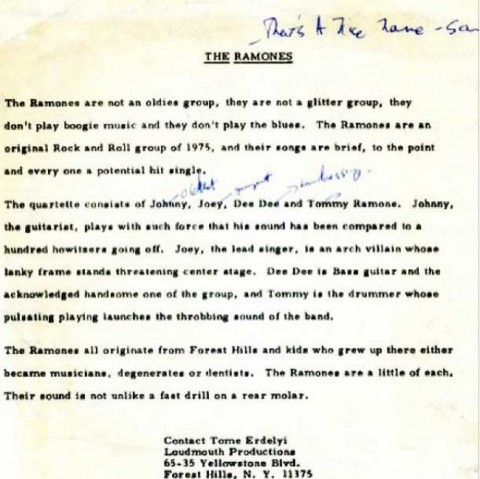
Now Exhibit C: It’s a no-bs press release that announced the arrival of the band, and what it’s all about. Written by Tommy Ramone (the drummer who died last summer, but only after outliving all of the other original band members), the one-pager describes The Ramones succinctly: “The Ramones are an original Rock and Roll group of 1975, and their songs are brief, to the point and every one a potential hit single.” And with a little bit of humor. “The Ramones all originate from Forest Hills and kids who grew up there either became musicians, degenerates or dentists. The Ramones are a little of each. Their sound is not unlike a fast drill on a rear molar.”
You can click the press release above to read it in a larger format. Or read the transcript below.
The Ramones are not an oldies group, they are not a glitter group, they don’t play boogie music and they don’t play the blues. The Ramones are an original Rock and Roll group of 1975, and their songs are brief, to the point and every one a potential hit single.
The quartette consists of Johnny, Joey, Dee Dee, and Tommy Ramone, Johnny, the guitarist, plays with such force that his sound has been compared to a hundred howitzers going off. Joey, the lead singer, is an arch villain whose lanky frame stands threatening center stage. Dee Dee is Bass guitar and the acknowledged handsome one of the group, and Tommy is the drummer whose pulsating playing launches the throbbing sound of the band.
The Ramones all originate from Forest Hills and kids who grew up there either became musicians, degenerates or dentists. The Ramones are a little of each. Their sound is not unlike a fast drill on a rear molar.
If you would like to support the mission of Open Culture, consider making a donation to our site. It’s hard to rely 100% on ads, and your contributions will help us continue providing the best free cultural and educational materials to learners everywhere. You can contribute through PayPal, Patreon, and Venmo (@openculture). Thanks!
Related Content
Hear The Ramones’ Raw Demo Recordings For Their Debut Album (1975)
Hear Joey Ramone Sing a Piece by John Cage Adapted from James Joyce’s Finnegans Wake
Read More...Rare Footage of Allen Ginsberg, Jack Kerouac & Other Beats Hanging Out in the East Village (1959)
We don’t often think of the Beats as family men, and that’s because the most prominent of them weren’t, except William Burroughs for a time (a tragic story or two for another day). But friends of Ginsberg and Kerouac like Lucien and Francesca Carr and Robert and Mary Frank brought children into the poets’ lives, and you can see them all above, relaxing at the Harmony Bar & Restaurant in New York’s East Village in 1959.
This rare silent footage unites the three Carr and two Frank children in a rare appearance of the Beats together on film. The mustachioed Lucien Carr —a character with his own dark story—can be seen seated next to Kerouac. The Franks, père and mère, were both artists in their own right—London-born Mary a trained dancer, sculptor, and painter, and Robert an important American photographer and documentary filmmaker.
Dangerous Minds speculates that it’s Robert Frank behind the camera, both because we don’t see him in front of it and because Frank would that same year direct the short film Pull My Daisy (above), featuring both Ginsberg and Kerouac and adapted from Kerouac’s play Beat Generation. (Frank apparently denies he shot the footage at the top). Pull My Daisy also includes famous Beats like Gregory Corso, musician David Amram, and Ginsberg’s partner, poet Peter Orlovsky. In a previous post on that film, Open Culture’s Colin Marshall described it as crafted with “great deliberateness, albeit the kind of deliberateness meant to create the impression of thrown-together, ramshackle spontaneity.”
To learn more about the Beats’ appearances on film—as themselves, in character, and through their adapted work, see this excellent filmography. And just above, watch a mash-up of most of those various cinematic appearances in a trailer produced by Cinefamily for the IFC and Sundance series “Beats on Film.”
via The Wall Breakers/Dangerous Minds
Related Content:
Pull My Daisy: 1959 Beatnik Film Stars Jack Kerouac and Allen Ginsberg, Shot by Robert Frank
William S. Burrough’s Avant-Garde Movie ‘The Cut Ups’ (1966)
Bob Dylan and Allen Ginsberg Visit the Grave of Jack Kerouac (1975)
Josh Jones is a writer and musician based in Durham, NC. Follow him at @jdmagness
Read More...Kandinsky, Mondrian, Munch & Fleming Entered Public Domain in 2015 — But Welles, Achebe, and “Purple People Eater” Didn’t

As you faithful readers of Open Culture know, we love nothing more than when important works of humankind fall into the public domain. According to current United States copyright law, a work stays out of the public domain for 70 years after its author’s death; for corporate “works-for-hire,” 95 years after its publication. This means that, theoretically, new things arrive in the public domain each and every year. Since we’ve just started a new one, what has the public domain gained?
On January 1, 2015, according to Duke University’s Center for the Study of the Public Domain, public-domain readers received “the writings of Rachel Carlson, Ian Fleming, and Flannery O’Connor” — in Canada, that is. As for Europeans, they can now freely enjoy “the works of Antoine de Saint-Exupéry, Wassily Kandinsky, Piet Mondrian, Edvard Munch, and hundreds of others.” But what of the Americans? Alas, “no published works will enter our public domain until 2019,” owing to an extension of U.S. copyright law legislation that pushed up retroactive copyright by 95 years for anything created between 1923 and 1977 — a legal event that may, some whisper, have had the endorsement of a certain corporation in possession of a certain highly lucrative cartoon mouse.
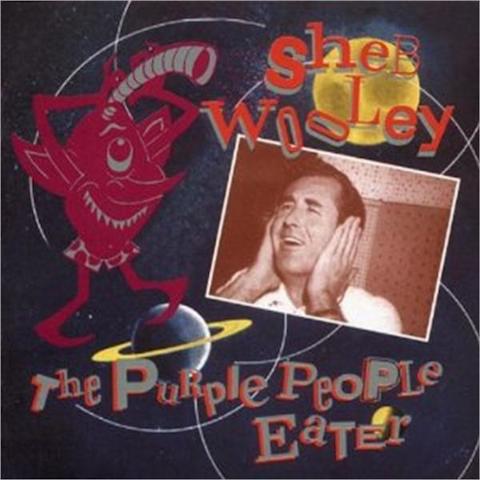
For a sense of what this has cost us, the CSPD has put together a tantalizing list of still-vital works of literature, film, music, and science that could have gone public domain this year, if not for that meddling extension. It includes Chinua Achebe’s Things Fall Apart, Simone de Beauvoir’ Mémoires d’une jeune fille rangée, Graham Greene’s Our Man in Havana, Orson Welles’ Touch of Evil, Jacques Tati’s Mon Oncle, Nathan H. Juran’s Attack of the 50-Foot Woman, Chuck Berry’s “Johnny B. Goode,” Sheb Wooley’s “Purple People Eater.”
To learn more about the art that some parts of the world have newly welcomed into the public domain, see also Hyperallergic’s Public Domain Day post by Allison Meier. Though we could easily feel frustrated by the richness of the material that America has refused, in the words of Justice Louis Brandeis, to let “free as the air to common use,” do remember the existence of a little something we citizens of 2015 like to call the internet. The increasingly few boundaries and little friction with which it has enabled us to connect and communicate will certainly continue to alleviate the cramp regulations like these have put in our style. So even if Americans won’t enjoy a meaningful Public Domain Day for four years yet, I’d say we still have reason to celebrate.
via Hyperallergic
Related Content:
Sherlock Holmes Is Now in the Public Domain, Declares US Judge
A Cabinet of Curiosities: Discover The Public Domain Review’s New Book of Essays
Colin Marshall hosts and produces Notebook on Cities and Culture and writes essays on cities, language, Asia, and men’s style. He’s at work on a book about Los Angeles, A Los Angeles Primer. Follow him on Twitter at @colinmarshall or on Facebook.
Read More...We Are Wired to Be Kind: How Evolution Gave Us Empathy, Compassion & Gratitude
Empathy, compassion and gratitude — these traits don’t usually spring to mind when you think about Darwinism and natural selection. No, your mind more immediately drifts toward anti-social characteristics like competition, survival of the fittest, and selfishness (as in the “selfish gene”). But above, on the first day of 2015, UC Berkeley psychologist Dacher Keltner reminds us that evolution can bring out the best in us, and Darwin recognized that. As Darwin wrote in The Descent of Man, the strengthening of our capacity for “sympathy” played a central role in human evolution:
With mankind, selfishness, experience, and imitation, probably add .… to the power of sympathy; for we are led by the hope of receiving good in return to perform acts of sympathetic kindness to others; and sympathy is much strengthened by habit. In however complex a manner this feeling may have originated, as it is one of high importance to all those animals which aid and defend one another, it will have been increased through natural selection; for those communities, which included the greatest number of the most sympathetic members, would flourish best, and rear the greatest number of offspring.
That’s not to say that we don’t have a dual nature — a capacity for being unsympathetic, selfish, power hungry. That’s something Keltner studies too, and, indeed a while back, we told you about his studies showing that the wealthy tend to be less sympathetic and giving than the poor. You can find courses taught by Keltner on Human Emotion and Human Happiness in our collection of Free Online Psychology Courses, part of our larger collection, 1,700 Free Online Courses from Top Universities.
Follow us on Facebook, Twitter and Google Plus and share intelligent media with your friends. Or better yet, sign up for our daily email and get a daily dose of Open Culture in your inbox.
Read More...Support Us
We're hoping to rely on loyal readers, rather than erratic ads. Please click the Donate button and support Open Culture. You can use Paypal, Venmo, Patreon, even Crypto! We thank you!

About Us

Open Culture scours the web for the best educational media. We find the free courses and audio books you need, the language lessons & educational videos you want, and plenty of enlightenment in between.
Advertise With Us

FREE UPDATES!
GET OUR DAILY EMAIL
Get the best cultural and educational resources on the web curated for you in a daily email. We never spam. Unsubscribe at any time.
FOLLOW ON SOCIAL MEDIA

Open Culture editor Dan Colman scours the web for the best educational media. He finds the free courses and audio books you need, the language lessons & movies you want, and plenty of enlightenment in between.
Advertise With Us

