The Long-Lost Illustrated Production Stills from the Set of Kubrick’s 2001: A Space Odyssey
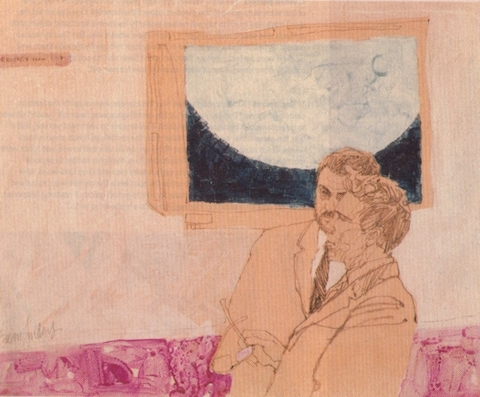
Remember courtroom sketch artists? The mere fact that they did what they did captured my imagination as a kid, representing as it seemed one of the few remaining vestiges of an older, more askew America, one bound by fewer yet stricter rules and all the more fascinating a component of history for it. These drawings of the shoot of Stanley Kubrick’s 2001: A Space Odyssey remind me of courtroom sketches, albeit on some stylistic levels more than others. And interestingly, just as court reporters once had to use sketch artists because of the supposed disturbance cameras would cause in the courtroom, these drawings result from the pursuit of something less troublesome to a set than a regular still photographer.
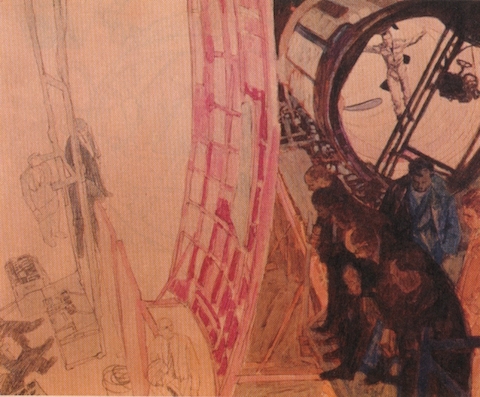
From 2001 onwards, Kubrick created illustrated production stills of what happened on his set, rather than having a photographer take noisy and distracting photographs. The illustrations, documenting for the media what happened in front of the camera as well as behind it, would then be sent out in press kits to publications and other media outlets that could promote the film.
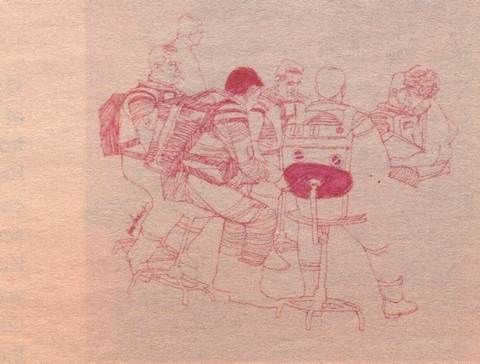
Enter, in 1966, English magazine illustrator Brian Sanders (now perhaps best known for the pastiches of that decade he’s done for Mad Men), hired to turn up to the 2001 shoot and quietly draw what he saw. None of these images, however — or the rest of those featured at Kubrickonia — appeared anywhere until the actual year 2001, when The Independent’s magazine used them in an article. Cinephiles now and again wish for the return of illustrated movie posters, and sometimes we do occasionally see a new one, but looking at what Sanders came up with for 2001, I can’t help but ponder the still-unrealized potential of the illustrated production still. You can see more illustrations — once lost and now found — here.

Related Content:
Howard Johnson’s Presents a Children’s Menu Featuring Kubrick’s 2001: A Space Odyssey (1968)
Kubrick’s 2001: A Space Odyssey Gets a Brand New Trailer to Celebrate Its Digital Re-Release
1966 Film Explores the Making of Kubrick’s 2001: A Space Odyssey (and Our High-Tech Future)
James Cameron Revisits the Making of Kubrick’s 2001: A Space Odyssey
Colin Marshall hosts and produces Notebook on Cities and Culture as well as the video series The City in Cinema and writes essays on cities, language, Asia, and men’s style. He’s at work on a book about Los Angeles, A Los Angeles Primer. Follow him on Twitter at @colinmarshall or on Facebook.
Read More...A Look Inside Charlie Hebdo, Their Creative Process & the Making of a Fateful Cartoon
A week ago, Charlie Hebdo was anything but a household name. On Wednesday, after the appalling terrorist attacks in Paris, all of that changed.
We all now have Charlie Hebdo on the tip of our tongues. We’ve seen samples of their satirical cartoons. And we’ve read about the news outlets too afraid to print them. But what do we still know about Charlie Hebdo — about the actual cartoonists who made the newspaper tick, their satirical ambitions and their creative process? Not very much.
The short documentary above, filmed at Charlie Hebdo in 2006 by Jerôme Lambert and Philippe Picard, helps fill in some of these blanks. The clip shows several of the cartoonists and editors murdered earlier this week — Jean Cabut (aka Cabu), Bernard Verlhac (aka Tignous) and Georges Wolinski — making a fateful decision: Would they put a satirical image of Muhammad on the cover of their newspaper?
The Charlie Hebdo cartoonists turned “provocation and bad taste” (to use Lambert and Picard’s words) into a particularly French form of political satire. As the French translator Arthur Goldhammer explained it earlier this week, “There is an old Parisian tradition of cheeky humour that respects nothing and no one,” which goes back to the French Revolution. “It’s an anarchic populist form of obscenity that aims to cut down anything that would erect itself as venerable, sacred or powerful,” and it is directed against “authority in general, against hierarchy and against the presumption that any individual or group has exclusive possession of the truth.” That tradition will continue next week when Charlie Hebdo and its surviving staff plan to publish one million copies of their next edition.
The video above, put online by The New York Times, is coupled with a short op-ed by Lambert and Picard. You can read it here.
Follow us on Facebook, Twitter and Google Plus and share intelligent media with your friends. Or better yet, sign up for our daily email and get a daily dose of Open Culture in your inbox.
Read More...Wonderfully Kitschy Propaganda Posters Champion the Chinese Space Program (1962–2003)

A joint operation of five participating countries and the European Space Agency, the International Space Station is an enormous achievement of human cooperation across ideological and national boundaries. Generations of people born in the nineties and beyond will have grown up with the ISS as a symbol of the triumph of STEM education and decades of space travel and research. What they will not have experienced is something that seems almost fundamental to the cultural and political landscape of the Boomers and Gen Xers—the Cold War space race. But it is worth noting that while Russia is one of the most prominent partners in ISS operations, current Communist republic China has virtually no presence on it at all.
But this does not mean that China has been absent from the space race—quite the contrary. While it seems to those of us who witnessed the exciting interstellar competition between superpowers that the only players were the big two, the Chinese entered the race in the 1960s and launched their first satellite in 1970. This craft, writes space history enthusiast Sven Grahn, “would lead to China being a major player in the commercial space field.”
Since its launch into orbit, the satellite has continuously broadcast a song called Dong Fang Hong, a eulogy for Mao Zedong (which “effectively replaced the National Anthem” during the Cultural Revolution—hear the broadcast here). The satellite, now referred to, after its song, as DFH‑1 (or CHINA‑1), marked a significant breakthrough for the Chinese space program, spearheaded by rocket engineer Qian Xuesen, who had been previously expelled from the Jet Propulsion Lab in Pasadena for suspected Communist sympathies.

Before DFH‑1, the national imagination was primed for the prospect of Chinese space flight by images like the poster just above, titled “Roaming outer space in an airship,” and designed by Zhang Ruiheng in 1962. This striking piece of work comes to us from Chinese Posters, a compendium of images of “propaganda, politics, history, art.” Images like this one and that of a Chinese taikonaut at the top—“Bringing his playmates to the stars”—from 1980, appropriate imagery from the traditional nianhua, or New Years picture.

This fanciful style, which “catered to the tastes and beliefs in the countryside,” became the “most important influence on the propaganda posters produced by the Chinese Communist Party,” who began using it in the 1940s. The poster above, “Little guests in the Moon Palace,” dates from the early 1970s, after the launch of DFH‑1 and its sister satellite SJ‑I (CHINA‑2).

As you can see from the 1989 poster above—“Heaven increases the years, man gets older”—the CCP continued to use the nianhua style well into the eighties, but in the following decades, they began to move away from it and toward more militaristic imagery, like that in the image below from 2002. With different colors and symbols, it would look right at home on the wall of an armed forces recruiting station in any small town, U.S.A.

Like many U.S. advocates for space travel and exploration, such as the increasingly visible Neil deGrasse Tyson, the CCP has used space as a means of promoting scientific literacy. In the poster below, “Uphold science, eradicate superstition,” space imagery is used to bring much-persecuted Falon Gong adherents “back into the fold” and to oppose science to religious superstition.

Although some of the imagery may suggest otherwise, the Chinese space program has developed along similar lines as the U.S.’s, and has been put to similar uses. These include the use of space exploration as a means of unifying nationalist sentiment, driving support for science and technology funding and research, and pushing a vision of scientific progress as the national ethos. In 2012, the same year that Sally Ride—first American woman in space—passed away, China began selecting its first female taikonaut, making their space program a venue for increasing gender equality as well.

It was only very recently that the Chinese space program successfully completed its first manned mission, sending its first taikonaut, Yang Liewei, abord the Shenzhou 5 in a low earth orbit mission. Although the achievement—as you can see in the poster above commemorating a visit of the taikonaut to Hong Kong—marked a moment of significant national pride, there was one encouraging sign for the future of international cooperation: though you cannot see it in the photo, Yang wore the flag of the United Nations in addition to that of the People’s Republic of China.
See more of these fascinating works of propaganda at Chinese Posters
Related Content:
Soviet Artists Envision a Communist Utopia in Outer Space
Astronaut Sunita Williams Gives an Extensive Tour of the International Space Station
Josh Jones is a writer and musician based in Durham, NC. Follow him at @jdmagness
Read More...You’ve Never Heard Carl Sagan Say “Billions” Like This Before
Nobody likes the way an entire human life can get reduced to a sound bite, but even if you know absolutely nothing else about Carl Sagan, you know that he said the words “billions and billions.” Or rather, you think you know it; in reality (and in accordance with the “Play it again, Sam” principle), the famous astronomer and science popularizer never actually said quite those words on television. A posthumous essay collection used them as its title, but the public only latched on to the catchphrase — or catch half-phrase, anyway — in 1980, when Johnny Carson used it in a Tonight Show parody of Sagan’s broadcast persona. But if you want to hear the real Sagan invoking very large numbers in his characteristic intonation, have we got the video for you.
At the top of the post, you’ll find a supercut of each and every one of his uses of “million,” “billion,” “trillion,” and even “quadrillion” during the entirety of his acclaimed television series Cosmos — to a beat. Alternatively, using similar source material to an entirely different aesthetic end, the sound clip above contains just one instance of Sagan saying “billion” — but stretched out to an hour in length, which turns it into a sort of dronelike ambient music. A not just outward- but forward-thinking scientific visionary like Sagan surely understood more about what lies ahead for humanity than the rest of us do, but could he possibly have foreseen us using our technology for stuff like this? Still, he probably would’ve dug it.
Related Content:
Carl Sagan Presents Six Lectures on Earth, Mars & Our Solar System … For Kids (1977)
Carl Sagan Explains Evolution in an Eight-Minute Animation
Carl Sagan’s Undergrad Reading List: 40 Essential Texts for a Well-Rounded Thinker
Carl Sagan, Stephen Hawking & Arthur C. Clarke Discuss God, the Universe, and Everything Else
Colin Marshall hosts and produces Notebook on Cities and Culture as well as the video series The City in Cinema and writes essays on cities, language, Asia, and men’s style. He’s at work on a book about Los Angeles, A Los Angeles Primer. Follow him on Twitter at @colinmarshall or on Facebook.
Read More...Three Essential Dadaist Films: Groundbreaking Works by Hans Richter, Man Ray & Marcel Duchamp
Iconoclastic art movements need manifestos—to explain themselves, perhaps, to announce themselves, surely, but also, perhaps, to soften the blow of the work that is to come. In the case of Dadaism, the manifesto issued by Tristan Tzara in 1918 presents us with a curious paradox. Tzara expounds at length in several thousand words on the idea that “DADA DOES NOT MEAN ANYTHING.” In so doing, he tells us quite a bit about what Dada is, and what it is not. It is decidedly not, he writes, unified by any formal theory: “We have enough cubist and futurist academies: laboratories of formal ideas.” It is no friend to the artistic establishment: “Is the aim of art to make money and cajole the nice nice bourgeois?” It is certainly not “art for art’s sake”: “A work of art should not be beauty in itself, for beauty is dead.”
So what is this anti art about then? “Spontaneity,” “Active simplicity,” “Disgust,” “to lick the penumbra and float in the big mouth filled with honey and excrement.” And many more such provocations and images. No manifesto is any substitute for the work itself, but if any comes close to replicating its subject, it is Tzara’s. Immerse yourself in it, and you may be better prepared for Dada artists like Hans Richter, Man Ray, and Marcel Duchamp. All three represent Dadaism—whatever it is—in at least two ways: 1. Each rejected “nice nice bourgeois” cultural conventions, opposing them forcefully, and playfully, in ways both political and aesthetic. 2. Neither confined himself to any one medium or school—experimenting freely with painting, sculpture, photography, performance and conceptual art, and—for our purposes today—with film.
At the top of the post, see Hans Richter’s 1927 short film Ghosts Before Breakfast. Here, writes Lori Zimmer of Art Nerd, “flying hats, floating neck ties, [and] stacked guns” illustrate the statement at the film’s opening that “even objects revolt against regimentation.” We have here a silent cut because, the title informs us, “The Nazis destroyed the sound version of this film as ‘degenerate art.’” (The film’s original sound consisted of a soundtrack by composer Paul Hindemith.) The use of stop-motion animation and ingenious editing accords with the Museum of Modern Art’s contention that “the confluence of technology and aesthetic experimentation” that film offered “suited the Dadaists’ passion for the machine-made object.” In Richter’s short, such objects refuse to cooperate and play nice with their makers.
Just above, see Man Ray’s short film Le Retour à la Raison (“Return to Reason”). (The piano score, recorded live in 2011 in St. Petersburg, is by Dmitri Shubin.) The title of this film, I think, should be read ironically. Man Ray’s “pure cinema” actively resisted the “reason” of conventional film production, with its linear narrative logic and realist complacency. One might watch his films with the words of Tzara’s manifesto in mind: “Logic is a complication. Logic is always wrong. It draws the threads of notions, words, in their formal exterior, toward illusory ends and centres. Its chains kill, it is an enormous centipede stifling independence.” In a previous post, Mike Springer described the film as “basically a kinetic extension of Man Ray’s still photography,” utilizing “animated photograms, a technique in which opaque, or partially opaque, objects are arranged directly on top of a sheet of photographic paper and exposed to light.”
Man Ray shared a “fraternal friendship” and an artistic sensibility with perhaps the most renowned, or infamous, of the Dadaists, Marcel Duchamp. In addition to starring as himself in a few films, and co-writing the feature length Dadaist film Dreams That Money Can Buy, Duchamp made his own directorial contributions, beginning in 1926 with Anémic Cinéma, above. (I suggest viewing it with the added, non-original music muted.) Created in Man Ray’s studio, the film consists of a series of spinning disks, some containing French phrases which may be untranslatable. The whole reel is reminiscent of stock scenes of hypnotism in sensationalist “bourgeois” movies.
Are Richter, Man Ray, and Duchamp’s films—in Tzara’s words—“like a raging wind that rips up the clothes of clouds and prayers… preparing the great spectacle of disaster, conflagration and decomposition”? Such hyperbolic expressions only serve to underline what Duchamp’s disks set in motion: progress is an illusion: “after all everyone dances to his own personal boomboom, and… the writer is entitled to his boomboom.” If Dadaism champions solipsism, it also champions the right of artists to their own personal “boomboom.” In its anarchic rejection of codes of “progress, law, morality and all other fine qualities,” Dada opened the door for personal freedom of expression as wide as it would swing, preparing the way for all the situationists, yippies, and punks to come.
You can find the films above listed in our collection, 4,000+ Free Movies Online: Great Classics, Indies, Noir, Westerns, Documentaries & More.
Related Content:
Man Ray and the Cinéma Pur: Four Surrealist Films From the 1920s
The ABCs of Dada Explains the Anarchic, Irrational “Anti-Art” Movement of Dadaism
Extensive Archive of Avant-Garde & Modernist Magazines (1890–1939) Now Available Online
Josh Jones is a writer and musician based in Durham, NC. Follow him at @jdmagness
Read More...Three Actresses from Downton Abbey Play a Raunchy Card Game (NSFW)
Over the holidays, the cast of Downton Abbey let their hair down a bit when they released a nine-minute parody of the ITV show. It stars George Clooney, and there’s even a little cameo by Jeremy Piven. It’s quite funny. Don’t miss it.
Now comes something even more relaxed. The video above features three actresses from Downton Abbey — Laura Carmichael (Lady Edith), Lesley Nicol (Mrs. Patmore), and Phyllis Logan (Mrs. Hughes) — playing “Cards Against Humanity.” The game’s own web site bills it as “a party game for horrible people.” While I’m sure that Mr. Carson would be completely scandalized by the scene above — it’s definitely Not Safe for Work — I guess we could mildly celebrate the fact that “Cards Against Humanity” has been released under a Creative Commons license, and you can download the game for free.
Related Content:
New Parody of Downton Abbey Features George Clooney & the Cast of the Show
Willie Nelson Shows You a Delightful Card Trick
Read More...Three Films Capture 1940s New York, Chicago & Los Angeles in Vivid Color
“Citizenship of this city in itself made for a bond beyond class,” writes the redoubtable Welsh writer of place Jan Morris in Manhattan ’45, her book-length love letter to New York City in the immediate aftermath of the Second World War. “To be a citizen of Manhattan was an achievement in itself — it had taken guts and enterprise, if not on your own part, at least on your forebears.’ The pressures of the place, its competition, its pace, its hazards, even the fun of it, demanded special qualities of its people, and gave them a particular affinity for one another. They were all an elite!”
Four years into the time of which Morris so rapturously writes, out came Metro Goldwyn Mayer’s Mighty Manhattan – New York’s Wonder City, a fine Technicolor accompaniment to her textual appreciation. The clip at the top of the post, narrated by “Voice of the Globe” James Patrick, shifts straight into full midcentury triumphal gear, extolling such classic works of Manhattan Man as Wall Street, the Flatiron Building, the elevated train, the Brooklyn Bridge, the New York Public Library, and of course, the Empire State Building. (It also shows a sight that, for all the gee-whizzing it must have elicited at the time, we all hope will never return: Central Park with cars in it.)
“Not so long ago Chicagoans were convinced that their city would soon be the greatest and most famous on Earth, outranking New York, London, and Paris, the centre of a new world, the boss city of the universe,” Morris writes elsewhere. Today, “the blindest lover of Chicago would not claim for the place the status of a universal metropolis. Too much of the old grand assertiveness has been lost. Nobody pretends Chicago has overtaken New York; instead there is a provincial acceptance of inferiority, a resignation, coupled with a mild regret for the old days of brag and beef.”
For a sense of that brag and beef — and given the footage of the stockyards, take the latter literally — have a look at the half-hour film above: Chicago, produced by the Chicago board of education in 1945 or 1946. After Chicagoan Jeff Altman, who works in film post-production, found it at a south side estate sale, he did a bit of a restoration on it and posted it to the internet. “It’s hard to say the purpose of the film,” Altman writes. “It could be geared towards tourism or to entice companies to come to Chicago. This film could have just been used in the classroom. I’m not entirely sure. The great thing is all the different views of the city they give.”
“Los Angeles is the know-how city,” Morris writes in another essay. “Remember know-how? It was one of the vogue words of the forties and fifties, now rather out of fashion. It reflected a whole climate and tone of American optimism. It stood for skill and experience indeed, but it also expressed the certainty that America’s particular genius, the genius for applied logic, for systems, was inexorably the herald of progress.” At that time, Los Angeles didn’t need so much boosterism — it was boosterism. The Southern Californian metropolis began booming in the early 20th century, and that boom wouldn’t end until well after the war, if indeed it has ended yet.
Many of its new arrivals, the vast majority of whom came from elsewhere in the United States until the late 1960s, couldn’t have helped but felt enticed by scenes like the ones in the clip just above, which shows off the Sunset Strip in the late 40s or early 50s. Los Angeles has changed, as has every American city: buildings have grown taller, populations have densified, and you see a wider variety of faces and hear a wider variety of languages on the streets than ever before. Some, especially Youtube commenters, bemoan this, but to my mind, things have got considerably more interesting as a result. Vintage footage like this — and especially vintage footage in unusually vivid color like this — reminds us that, as fascinating a past as our cities have, their future looks richer still.
Related Content:
Prize-Winning Animation Lets You Fly Through 17th Century London
London Mashed Up: Footage of the City from 1924 Layered Onto Footage from 2013
Paris Through Pentax: Short Film Lets You See a Great City Through a Different Lens
Berlin Street Scenes Beautifully Caught on Film (1900–1914)
1927 London Shown in Moving Color
A Drone’s Eye View of Los Angeles, New York, London, Bangkok & Mexico City
Colin Marshall hosts and produces Notebook on Cities and Culture as well as the video series The City in Cinema and writes essays on cities, language, Asia, and men’s style. He’s at work on a book about Los Angeles, A Los Angeles Primer. Follow him on Twitter at @colinmarshall or on Facebook.
Read More...The Origins of Spinal Tap: Watch the 20 Minute Short Film Created to Pitch the Classic Mockumentary
When This is Spinal Tap came out over 30 years ago, it went over a lot of people’s heads. “Everybody thought it was a real band,” recalled director Rob Reiner. “Everyone said, ‘Why would you make a movie about a band that no one has heard of?’”
It’s hard to believe that lines like “You can’t dust for vomit” failed to come off as anything but a joke. But, to be fair, Hollywood comedies were generally straight-forward affairs in the ‘80s. Think Blues Brothers or Fletch. Fake documentaries weren’t a thing. And This is Spinal Tap looks and feels exactly like a rock documentary– the hagiographic voiceover, the shaky camera, the awkward interviews.
The movie was just as unscripted as rock docs like Don’t Look Back, The Song Remains the Same and The Kids Are All Right. The film is not only a parody of the generally overblown silliness of rock and roll, it is also, as Newsweek’s David Ansen notes, “a satire of the documentary form itself, complete with perfectly faded clips from old TV shows of the band in its mod and flower-child incarnations.”
And then there’s the fact that, for a fake band, Spinal Tap knew how to rock — albeit to completely idiotic lyrics. Christopher Guest, Michael McKean and Harry Shearer, the actors who make up the core of the band, actually played all the music in the movie. And after the cult success of the film, they went on to play concerts. Can you really call Spinal Tap a fake band if they wowed audiences in Wembley Stadium?
But the genius stroke of the movie was to mix in pain and dread with the humor. As we’re laughing at David St. Hubbins and company fretting over an 18-inch Stonehenge prop, we also wince in sympathy. Sting reportedly told Rob Reiner that he watches the movie every time he is about to go on tour. “Every time I watch it, I don’t know whether I should laugh or cry.”
Spinal Tap made its first appearance in 1979, five years before the movie premiered. It was on a short-lived ABC SCTV-like comedy series called The T.V. Show that starred Reiner. You can see Guest, McKean and Shearer and company rocking out to the tune “Rock n Roll Nightmare” right above. Though the performance is not nearly as tight or funny as their subsequent appearances, all of the ideas are there. The bloated pretentiousness. The silly lyrics. The sillier outfits. By the way, that bottle-wielding keyboardist in the clip is Loudon Wainwright III.
A couple years later, Reiner and company decided to revisit Spinal Tap with the idea of making a mockumentary. As Reiner recounted in an interview with Sound Opinions:
They gave us the money and we realized that there was no way in screenplay form that we could capture what this would be. Because it was going to be a documentary. So I said to the guy, give us the money you were going to give us to write the screenplay and I’ll make you a little bit of the film. And we made like 20 minutes of this film. We had backstage footage. We had concert footage. Interview stuff.
You can watch the whole demo film (Spinal Tap: The Final Tour) up top in two parts. The hair might be different and some of the gags might not land with the same punch, but the chemistry, the concept and the comedy are all there. In fact, some clips from the demo, particularly the interviews, made their way into the final cut of the movie.
Sadly, the demo failed to impress the production company. “The guy [at the production company] said, ‘I don’t like this.’ So we went around for years to get it made. And finally, we were able to put it together for a couple of million bucks.”
You can watch Reiner recount the making and legacy of This is Spinal Tap below. Spinal Tap: The Final Tour will be added to our collection, 4,000+ Free Movies Online: Great Classics, Indies, Noir, Westerns, Documentaries & More.
Related Content:
Ian Rubbish (aka Fred Armisen) Interviews the Clash in Spinal Tap-Inspired Mockumentary
Spinal Tap’s Nigel Tufnel Promotes World’s Largest Online Guitar Lesson
Jonathan Crow is a Los Angeles-based writer and filmmaker whose work has appeared in Yahoo!, The Hollywood Reporter, and other publications. You can follow him at @jonccrow. And check out his blog Veeptopus, featuring lots of pictures of badgers and even more pictures of vice presidents with octopuses on their heads. The Veeptopus store is here.
Read More...
Free: Play 2,400 Vintage Computer Games in Your Web Browser
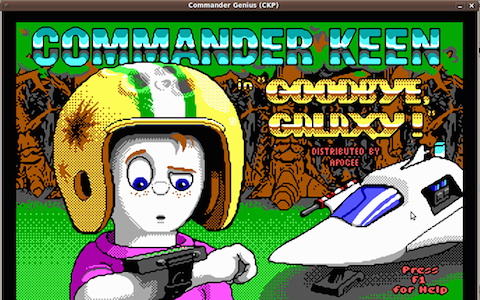
Had I known as a grade-schooler that the day would come when I could play all the computer games I then wanted to, anywhere I wanted to, without paying for them, installing them, or even waiting any significant amount of time for them, I would have simply put myself into cryogenic sleep, setting the year of awakening to 2015. The Internet Archive, which had already made over 900 classic arcade and console games available, has made all this possible with their MS-DOS games collection, which contains much, if not everything, you remember from childhood — if your childhood, like mine, revolved around computer games released between the mid-1980s and mid-1990s. The youth-reliving gamers of Metafilter have already descended upon the collection, pulling out such acknowledged classics as Prince of Persia, Lemmings, Scorched Earth, and Wasteland. (More than a few have also dug up true obscurities — Tongue of the Fatman, anyone?)
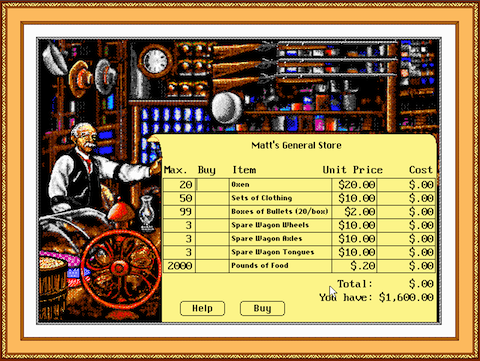
Right there at the Internet Archive, you can play genre-defining first-person shooters like Wolfenstein 3D, platformers like Commander Keen, driving games like Lamborghini American Challenge, simulators like SimCity (which played surprisingly little part in making me into the city-obsessed adult whose words you now read, though I wouldn’t mind revisiting it), strategy games like Dune and its more popular sequel, and classroom favorites/cultural touchstones like The Oregon Trail.
At this point, even those not experiencing a Proustian onrush of childhood memory may feel a tad overwhelmed, so why not have a look at the Internet Archive’s MS-DOS Showcase, “a hand-picked set of selections from the MS-DOS Software Library of the Internet Archive,” chosen because “they represent major parts of the MS-DOS story, because they are particularly impressive, and” — in the case of the best of these games, the most legitimate reason of all — “because they’re fun.” The games can all be played in your browser. If you run into any problems, please read the Internet Archive’s FAQ.

h/t to our loyal reader Daniel B.
Related Content:
The Internet Arcade Lets You Play 900 Vintage Video Games in Your Web Browser (Free)
Play The Hitchhiker’s Guide to the Galaxy Video Game Free Online, Designed by Douglas Adams in 1984
Learn to Write Through a Video Game Inspired by the Romantic Poets: Shelley, Byron, Keats
Colin Marshall hosts and produces Notebook on Cities and Culture as well as the video series The City in Cinema and writes essays on cities, language, Asia, and men’s style. He’s at work on a book about Los Angeles, A Los Angeles Primer. Follow him on Twitter at @colinmarshall or on Facebook.
Read More...Mœbius Illustrates Dante’s Paradiso

Salvador Dalí, Gustave Doré, Alberto Martini, Sandro Botticelli, the earlier and less-recognized Priamo della Quercia and Giovanni di Paolo — all of these artists have tried their hand at illustrating Dante Alighieri’s Divine Comedy. We have, in turn, featured all their efforts, each of a strikingly different sensibility and aesthetic interpretation of the harrowing journey out of the mortal realm and into the underworld described by this much-studied, much-translated, and just plain much-read 14th-century text. But none of those artists, despite the richness of their visions, spoke directly to the late 20th and early 21st century. For a truly modern Divine Comedy, behold the work of Jean Giraud, better known as Mœbius.

Mœbius, who passed out of this mortal realm himself in 2012, made his name with comics like Blueberry, Arzach, and The Airtight Garage of Jerry Cornelius — though to call these works, which belong simultaneously to the fields of science fiction and fantasy while transcending the both of them, nothing more than “comics” belies the artist’s ability to escape their conventions of storytelling and composition as if he’d never encountered them in the first place.
The distinctive results attracted a fair few collaborators, both actual and hopeful; you may remember our post on his storyboards and concept art for Alejandro Jodorowsky’s never-realized adaptation of Dune, but he also lent his hand to such completed motion pictures as Alien, The Abyss, and The Fifth Element.
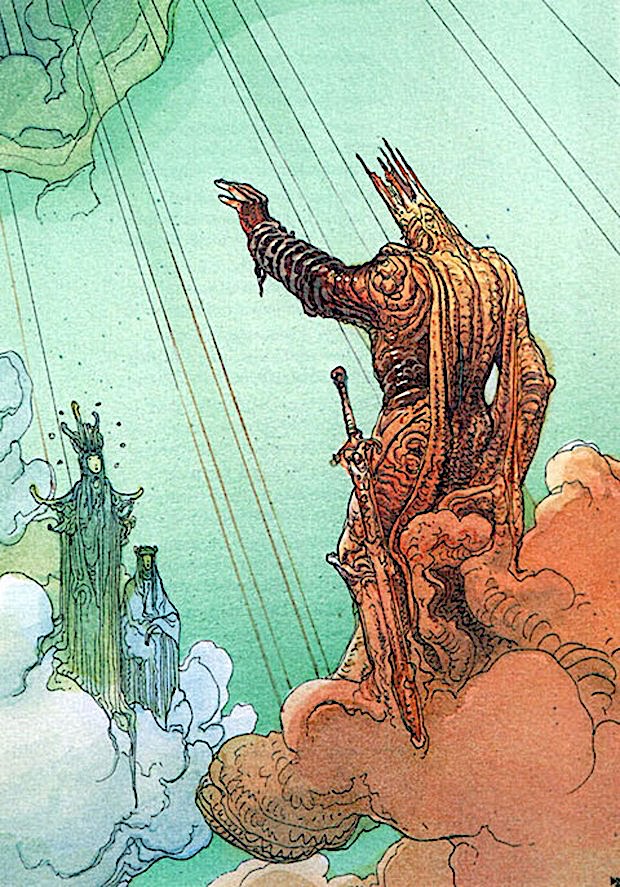
“In 1999, Nuages Gallery in Milan published three illustrated editions of Inferno, Purgatorio, and Paradiso,” says Bowdoin’s Dante Today. Nuages selected a different illustrator for each, resulting in L’Inferno di Lorenzo Mattotti, Il Purgatorio di Milton Glaser (who, though he would have preferred the Inferno, still produced an also strikingly modern take on Dante), and, finally, Il Paradiso di Mœbius. We’ve included three pieces of the latter’s artwork here, but if you’d like more insight into the mind that created them, have a look at In Search of Mœbius, the BBC documentary we featured after the artist’s death — a death that means, among other losses, that our world will never see the Divine Comedy animated film it needs.
You can find works by Dante in our Free Audio Books and Free eBooks collections. A Yale course called Dante in Translation appears on our mega list, 1,700 Free Online Courses from Top Universities.
Related Content:
Botticelli’s 92 Illustrations of Dante’s Divine Comedy
Gustave Doré’s Dramatic Illustrations of Dante’s Divine Comedy
Alberto Martini’s Haunting Illustrations of Dante’s Divine Comedy (1901–1944)
Salvador Dalí’s 100 Illustrations of Dante’s The Divine Comedy
Colin Marshall hosts and produces Notebook on Cities and Culture as well as the video series The City in Cinema and writes essays on cities, language, Asia, and men’s style. He’s at work on a book about Los Angeles, A Los Angeles Primer. Follow him on Twitter at @colinmarshallor on Facebook.
Read More...Support Us
We're hoping to rely on loyal readers, rather than erratic ads. Please click the Donate button and support Open Culture. You can use Paypal, Venmo, Patreon, even Crypto! We thank you!

About Us

Open Culture scours the web for the best educational media. We find the free courses and audio books you need, the language lessons & educational videos you want, and plenty of enlightenment in between.
Advertise With Us

FREE UPDATES!
GET OUR DAILY EMAIL
Get the best cultural and educational resources on the web curated for you in a daily email. We never spam. Unsubscribe at any time.
FOLLOW ON SOCIAL MEDIA

Open Culture editor Dan Colman scours the web for the best educational media. He finds the free courses and audio books you need, the language lessons & movies you want, and plenty of enlightenment in between.
Advertise With Us

