How to Draw Bugs Bunny: A Primer by Legendary Animator Chuck Jones
Bugs Bunny, that carrot-chomping, cross-dressing rascal, might have been created by Tex Avery in the 1940 cartoon A Wild Hare, but he really came into his own under the direction of Chuck Jones. In cartoons like What’s Opera, Doc and Rabbit Season, Jones refined Bugs’ character, turning him into someone who was witty, resourceful and, most of all, cool. Whether or not he was going up against Elmer Fudd, Yosemite Sam or Marvin the Martian, Bugs always seemed to have the upper hand. Jones once compared Bugs with his vain, self-aggrandizing rival Daffy Duck by saying, “Bugs is who we want to be. Daffy is who we are.”
In the video above, Jones shows you how to draw Bugs, and, of course, he makes it look like a cinch. “If you were to draw Bugs,” says Jones in his clipped, precise diction, “the best way to do it is learn how to draw a carrot and then you can hook a rabbit on to it.” Not the most helpful advice for aspiring animators. Yet watching Jones sketch out the world’s most famous rabbit in a mere couple of minutes is a joy to see.
The trick to drawing Bugs, apparently, is the nose. After roughing out a circle for the head and a reniform oval for the body, Jones draws a tiny triangle for the nose. From there, he sketches out two lines, radiating outward from the nose, which determines the location of Bugs’ ears and eyes. As Jones fills in the rest of the face, he reveals that the inspiration of Bugs’ broad, toothy grin was Norwegian figure skater turned 1930s Hollywood star Sonia Henie. Not, perhaps, the first person to come to mind.
To see the Bugs in action, be sure to watch one of Jones’s greatest cartoons, Hare-Way to the Stars. It features Bugs squaring off against Marvin the Martian in his quest to blow up the Earth with his Illudium Q‑36 Explosive Space Modulator. More great animations can be found in our collection, 4,000+ Free Movies Online: Great Classics, Indies, Noir, Westerns, Documentaries & More.
via Kottke
Related Content:
The Strange Day When Bugs Bunny Saved the Life of Mel Blanc
Jonathan Crow is a Los Angeles-based writer and filmmaker whose work has appeared in Yahoo!, The Hollywood Reporter, and other publications. You can follow him at @jonccrow.
Read More...Stephen Hawking Shows His Funny Side in John Oliver’s Series “Great Minds: People Who Think Good”
John Oliver kicked off his new series “Great Minds: People Who Think Good” with an extended interview with Stephen Hawking. For a moment there, it all feels a bit like a classic Ali G interview. (Remember Sacha Baron Cohen’s priceless interview with Noam “Norman” Chomsky?) But, soon enough, you realize that Hawking is in on the joke. And he delivers some good lines, with the hint of a smile.
Related Content:
A Brief History of Time, Errol Morris’ Film About the Life & Work of Stephen Hawking
Stephen Hawking’s Universe: A Visualization of His Lectures with Stars & Sound
Stephen Hawking: Abandon Earth Or Face Extinction
Read More...X Minus One: Hear Classic Sci-Fi Radio Stories from Asimov, Heinlein, Bradbury & Dick

Though I seldom long for my native culture when abroad, when the need for a hit of Americana does arise (and I say this currently writing from Seoul, South Korea), I fill my iPod with old time radio. Many shows from America’s “Golden Age” of wireless broadcasting can fill this need, but one could do much worse than Dimension X, the early-1950s science-fiction program we featured earlier this month, or its late-1950s successor X Minus One, whose episodes you can also find at the Internet Archive. Both showcase American culture at its mid-20th-century finest: forward-looking, temperamentally bold, technologically adept, and saturated with earnestness but for the occasional surprisingly knowing irony or bleak edge of darkness. That last comes courtesy of these shows’ writing talent, a group which includes such canonical names as Philip K. Dick, Ray Bradbury, Isaac Asimov, and Robert Heinlein.
X Minus One’s run, which lasted from April 1955 to January 1958, included a heaping helping of the evidently highly radio-adaptable Ray Bradbury: his stories “And The Moon Be Still As Bright,” “Mars is Heaven,” “The Veldt,” “Dwellers in Silence,” “Zero Hour,” “To the Future,” and “Marionettes, Inc.,” all appeared as episodes. From Robert A. Heinlein’s harder-bitten body of work the show produced “Universe,” “Requiem,” and “The Roads Must Roll.” Isaac Asimov, one of the most scientific of that era’s science-fiction writers, wrote the source material for “Nightfall,” “C‑Chute,” and “Hostess.” The pen of Philip K. Dick, surely the most purely imaginative of the bunch, for its part produced “The Defenders” and “Colony.” America let fly all sorts of visions of the future back then, from the optimistic to the pessimistic, the utopian to the dystopian, the progressive to the regressive. The aforementioned writers did it best by mixing all those sensibilities into each of their visions, which you can hear, along with those of many others, in X Minus One’s robust archive. You can stream several of the episodes below.
“The Defenders” (Philip K. Dick)
“Nightfall” (Isaac Asimov)
“Zero Hour” (Ray Bradbury)
Related Content:
Orson Welles Vintage Radio: The War of the Worlds That Petrified a Nation
Isaac Asimov’s Science Fiction Classic, The Foundation Trilogy, Dramatized for Radio (1973)
Colin Marshall hosts and produces Notebook on Cities and Culture and writes essays on cities, language, Asia, and men’s style. He’s at work on a book about Los Angeles, A Los Angeles Primer. Follow him on Twitter at @colinmarshall or on Facebook.
Read More...Marcel Proust Fills Out a Questionnaire in 1890: The Manuscript of the ‘Proust Questionnaire’
Marcel Proust, the author of the great modernist work À la recherche du temps perdu (Remembrance of Things Past), was the very definition of the sensitive artist. Perpetually battling bouts of depression and ill health, Proust lived at home with his parents until their deaths. Though he became a recluse later in life, sleeping by day and writing feverishly at night, he poured his soul into his epic novel, detailing his struggles in a manner that has connected deeply with generations of readers. Proust has become over the years an icon of artistic sincerity.
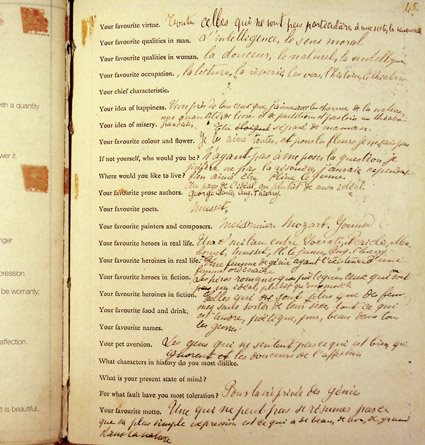
In the late nineteenth century, the confession book was all the rage in England. It asked readers to answer a series of personal questions designed to reveal their inner characters. In 1890, Proust, still a teenager, took this questionnaire, answering the questions with frank sincerity. The original manuscript was uncovered in 1924, two years after Proust’s death, and in 2003, it was auctioned off for roughly $130,000. You can see the original 1890 manuscript above and, if your French isn’t up to snuff, we have a translation below.
Many decades later, French TV host Bernard Pivot started using this exact type of questionnaire to interview thinkers, leaders and celebrities. It proved to be a great device for getting a glimpse into the inner workings of a star’s mind. James Lipton adapted the questionnaire for his own show, Inside the Actors Studio (watch above), while misattributing its origins to Proust. Nonetheless, the name ‘The Proust Questionnaire” stuck. The quiz is also a regular feature in the magazine Vanity Fair. You can read the responses from the likes of Rachel Maddow, Harrison Ford and Louis CK, whose answers read like an extension of his stand up routine. And if you’re eager to take the test yourself, you can do so here.
The principal aspect of my personality:
The need to be loved; more precisely, the need to be caressed and spoiled much more than the need to be admired.The quality that I desire in a man:
Manly virtues, and frankness in friendship.The quality that I desire in a woman:
Feminine charms.Your chief characteristic:
[Left Blank]What I appreciate most about my friends:
To have tenderness for me, if their personage is exquisite enough to render quite high the price of their tenderness.My main fault:
Not knowing, not being able to “want”.My favorite occupation:
Loving.My dream of happiness:
I am afraid it be not great enough, I dare not speak it, I am afraid of destroying it by speaking it.What would be my greatest misfortune?
Not to have known my mother or my grandmother.What I should like to be:
Myself, as the people whom I admire would like me to be.The country where I should like to live:
A country where certain things that I should like would come true as though by magic, and where tenderness would always be reciprocated.My favorite color:
The beauty is not in the colors, but in their harmony.My favorite bird:
The swallow.My favorite prose authors:
Currently, Anatole France and Pierre Loti.My favorite poets:
Baudelaire and Alfred de Vigny.My heroes in fiction:
Hamlet.My favorite heroines in fiction.
Bérénice.My favorite composers:
Beethoven, Wagner, Schumann.My favorite painters:
Leonardo da Vinci, Rembrandt.My heroes in real life:
Mr. Darlu, Mr. Boutroux.My heroines in history:
Cleopatra.My favorite names:
I only have one at a time.What I hate most of all:
What is bad about me.Historical figures that I despise the most:
I am not educated enough.The military event that I admire most:
My military service!The gift of nature that I would like to have:
Will-power, and seductiveness.How I want to die:
Improved—and loved.My present state of mind:
Boredom from having thought about myself to answer all these questions.Faults for which I have the most indulgence:
Those that I understand.My motto:
I should be too afraid that it bring me misfortune.
Related Content:
Watch Monty Python’s “Summarize Proust Competition” on the 100th Anniversary of Swann’s Way
Listening to Proust’s Remembrance of Things Past, (Maybe) the Longest Audio Book Ever Made
Free eBooks: Read All of Proust’s Remembrance of Things Past on the Centennial of Swann’s Way
Jonathan Crow is a Los Angeles-based writer and filmmaker whose work has appeared in Yahoo!, The Hollywood Reporter, and other publications. You can follow him at @jonccrow.
Read More...Tim Burton’s Hansel and Gretel Shot on 16mm Film with Amateur Japanese Actors (1983)
The Disney Channel aired Tim Burton’s Hansel and Gretel only once, on Halloween night in 1983, but it must have given those few who saw the broadcast much to ponder over the following three decades. For all that time, the 35-minute adaptation of that old German folktale stood as perhaps the hardest-to-see item in the Edward Scissorhands and The Nightmare Before Christmas auteur’s catalog. Of course, back in 1983, the 25-year-old Burton hadn’t yet made either of those movies, nor any of the other belovedly askew features for which we know him today. He had to his name only a couple of animated shorts made at CalArts and a stop-motion homage to his hero Vincent Price. Still, that added up to enough to land him this project, his first live-action film made as an adult, which he used as an outlet for his fascination with Japan.
Using an all-Japanese cast, shooting with the 16-millimeter aesthetic of old martial arts movies, and taking a special-effects technique or two from the Godzilla manual, Burton’s Hansel and Gretel looks (and sounds) like no version of the story you’ve seen before, or will likely ever see again. But at least you can now watch it as often as you like, owing to its recent sudden appearance on Youtube after that long absence from public viewability, broken only by screenings at the Museum of Modern Art and the Cinémathèque Française. In it we expereince the intersection of the grotesque as represented by Grimm’s Fairy Tales, the grotesque as represented by the Burtonian sensibility, the new and strange freedom of early cable television, and the sheer audacity of a young filmmaker — not to mention a heck of a hand-to-hand combat session between Hansel, Gretel, and the Witch who would make them dinner. Her dinner, that is.
If you would like to support the mission of Open Culture, consider making a donation to our site. It’s hard to rely 100% on ads, and your contributions will help us continue providing the best free cultural and educational materials to learners everywhere. You can contribute through PayPal, Patreon, and Venmo (@openculture). Thanks!
Related Content:
Tim Burton’s Early Student Films
Vincent, Tim Burton’s Early Animated Film
Colin Marshall hosts and produces Notebook on Cities and Culture and writes essays on cities, language, Asia, and men’s style. He’s at work on a book about Los Angeles, A Los Angeles Primer. Follow him on Twitter at @colinmarshall or on Facebook.
Read More...Carl Jung Writes a Review of Joyce’s Ulysses and Mails It To The Author (1932)
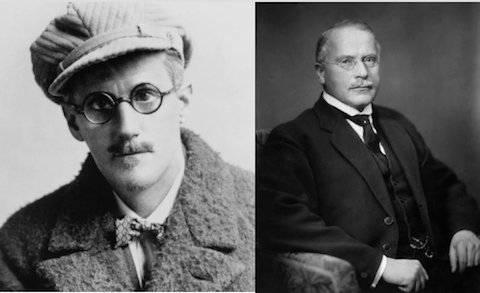
Feelings about James Joyce’s Ulysses tend to fall roughly into one of two camps: the religiously reverent or the exasperated/bored/overwhelmed. As popular examples of the former, we have the many thousand celebrants of Bloomsday—June 16th, the date on which the novel is set in 1904. These revelries approach the level of saints’ days, with re-enactments and pilgrimages to important Dublin sites. On the other side, we have the reactions of Virginia Woolf, say, or certain friends of mine who left wry comments on Bloomsday posts about picking up something more “readable” to celebrate. (A third category, the scandalized, has more or less died off, as scatology, blasphemy, and cuckoldry have become the stuff of sitcoms.) Another famous reader, Carl Jung, seems at first to damn the novel with some faint praise and much scathing criticism in a 1932 essay for Europäische Revue, but ends up, despite himself, writing about the book in the language of a true believer.
A great many readers of Jung’s essay may perhaps nod their heads at sentences like “Yes, I admit I feel I have been made a fool of” and “one should never rub the reader’s nose into his own stupidity, but that is just what Ulysses does.” To illustrate his boredom with the novel, he quotes “an old uncle,” who says “’Do you know how the devil tortures souls in hell? […] He keeps them waiting.’” This remark, Jung writes, “occurred to me when I was plowing through Ulysses for the first time. Every sentence raises an expectation which is not fulfilled; finally, out of sheer resignation, you come to expect nothing any longer.” But while Jung’s critique may validate certain hasty readers’ hatred of Joyce’s nearly unavoidable 20th century masterwork, it also probes deeply into why the novel resonates.
For all of his frustration with the book—his sense that it “always gives the reader an irritating sense of inferiority”—Jung nonetheless bestows upon it the highest praise, comparing Joyce to other prophetic European writers of earlier ages like Goethe and Nietzsche. “It seems to me now,” he writes, “that all that is negative in Joyce’s work, all that is cold-blooded, bizarre and banal, grotesque and devilish, is a positive virtue for which it deserves praise.” Ulysses is “a devotional book for the object-besotted white man,” a “spiritual exercise, an aesthetic discipline, an agonizing ritual, an arcane procedure, eighteen alchemical alembics piled on top of one another […] a world has passed away, and is made new.” He ends the essay by quoting the novel’s entire final paragraph. (Find longer excerpts of Jung’s essay here and here.)
Jung not only wrote what may be the most critically honest yet also glowing response to the novel, but he also took it upon himself in September of 1932 to send a copy of the essay to the author along with the letter below. Letters of Note tells us that Joyce “was both annoyed and proud,” a fittingly divided response to such an ambivalent review.
Dear Sir,
Your Ulysses has presented the world such an upsetting psychological problem that repeatedly I have been called in as a supposed authority on psychological matters.
Ulysses proved to be an exceedingly hard nut and it has forced my mind not only to most unusual efforts, but also to rather extravagant peregrinations (speaking from the standpoint of a scientist). Your book as a whole has given me no end of trouble and I was brooding over it for about three years until I succeeded to put myself into it. But I must tell you that I’m profoundly grateful to yourself as well as to your gigantic opus, because I learned a great deal from it. I shall probably never be quite sure whether I did enjoy it, because it meant too much grinding of nerves and of grey matter. I also don’t know whether you will enjoy what I have written about Ulysses because I couldn’t help telling the world how much I was bored, how I grumbled, how I cursed and how I admired. The 40 pages of non stop run at the end is a string of veritable psychological peaches. I suppose the devil’s grandmother knows so much about the real psychology of a woman, I didn’t.
Well, I just try to recommend my little essay to you, as an amusing attempt of a perfect stranger that went astray in the labyrinth of your Ulysses and happened to get out of it again by sheer good luck. At all events you may gather from my article what Ulysses has done to a supposedly balanced psychologist.
With the expression of my deepest appreciation, I remain, dear Sir,
Yours faithfully,
C. G. Jung
With this letter of introduction, Jung was “a perfect stranger” to Joyce no longer. In fact, two years later, Joyce would call on the psychologist to treat his daughter Lucia, who suffered from schizophrenia, a tragic story told in Carol Loeb Schloss’s biography of the novelist’s famously troubled child. For his care of Lucia and his careful attention to Ulysses, Joyce would inscribe Jung’s copy of the book: “To Dr. C.G. Jung, with grateful appreciation of his aid and counsel. James Joyce. Xmas 1934, Zurich.”
via Letters of Note
Related Content:
Everything You Need to Enjoy Reading James Joyce’s Ulysses on Bloomsday
The Very First Reviews of James Joyce’s Ulysses: “A Work of High Genius” (1922)
Josh Jones is a writer and musician based in Durham, NC. Follow him at @jdmagness
Read More...The Oldest Known Illustration of Circumcision (2400 B.C.E.)
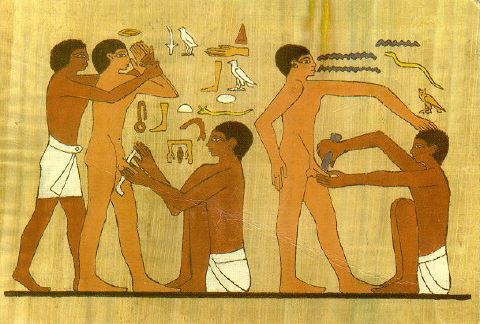
What do we have here? Just the oldest known illustration of circumcision being performed. Actually, it’s a colorful re-creation of a bas-relief (see original here) found in an Egyptian tomb built for Ankhmabor in Sakkara, Egypt. It dates back to around 2400 B.C.E.
The origins of circumcision remain unclear. According to this online essay, a stele (carving on stone) from the 23rd century B.C.E. suggests that an author named “Uha” was circumcised in a mass ritual. He wrote:
“When I was circumcised, together with one hundred and twenty men, there was none thereof who hit out, there was none thereof who was hit, and there was none thereof who scratched and there was none thereof who was scratched.”
By the time you get to 4,000 B.C.E., you start to find exhumed Egyptian bodies that show signs of circumcision. And then come the artistic depictions. The Sakkara depiction comes with the perhaps helpful written warning,“Hold him and do not allow him to faint.”
via Elif Batuman
Related Content:
How the Egyptian Pyramids Were Built: A New Theory in 3D Animation
Read More...The Famous Letter Where Freud Breaks His Relationship with Jung (1913)
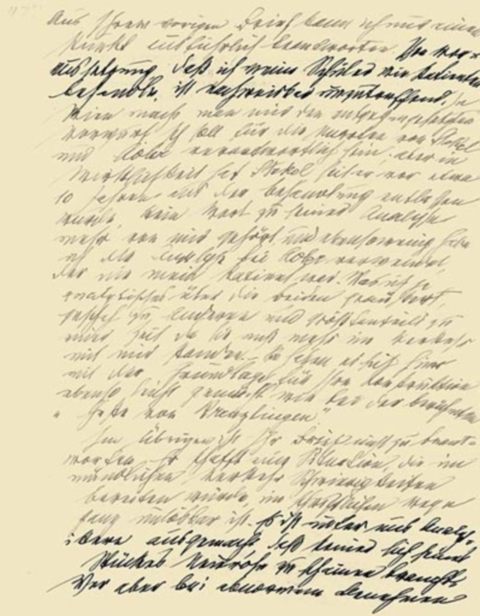
Freud and Jung. Jung and Freud. History has closely associated these two who did so much examination of the mind in early 20th-century Europe, but the simple connection of their names belies a much more complicated relationship between the men themselves. At the top of the post, you can see the letter that Sigmund Freud, father of psychoanalysis, wrote to Carl Gustav Jung, founder of analytical psychology, in order to end that relationship entirely. “At first Freud saw in Jung a successor who might lead the psychoanalytic movement into the future,” say the curator’s comments at the Library of Congress’ web site, “but by 1913 relations between the two men had soured.
While Freud claims in his letter that it is ‘demonstrably untrue’ that he treats his followers as patients, in the very same letter we find him alluding to Jung’s ‘illness.’ ” Freud calls it “a convention among us analysts that none of us need feel ashamed of his own neurosis. But one [meaning Jung] who while behaving abnormally keeps shouting that he is normal gives ground for the suspicion that he lacks insight into his illness. Accordingly, I propose that we abandon our personal relations entirely.”
“I shall lose nothing by it,” he continues, “for my only emotional tie with you has been a long thin thread — the lingering effect of past disappointments — and you have everything to gain, in view of the remark you recently made to the effect that an intimate relationship with a man inhibited your scientific freedom.” This relationship, writes Lionel Trilling in a review of The Correspondence Between Sigmund Freud and C.G. Jung, “had its bright beginning in 1906 and came to its embittered end in 1913,” when Freud wrote this letter. “Freud and Jung were not good for one another; their connection made them susceptible to false attitudes and ambiguous tones. [ … ] The intellectual and professional differences between the two men, profound as these eventually became, would perhaps not of themselves have brought about a break so drastic as did take place had not their alienating tendency been reinforced by personal conflicts.” Only a comparative study of Freud and Jung’s methods would yield a complete understanding of their roles in the struggle for the soul of psychoanalysis. But on a more basic level, this hardly counts as the first nor the last collapse, in any field of human endeavor, of a perhaps overdetermined succession between an eminence and his would-be protege — though it may count as one of the most eloquently documented ones.
Related Content:
Sigmund Freud Speaks: The Only Known Recording of His Voice, 1938
Face to Face with Carl Jung: ‘Man Cannot Stand a Meaningless Life’
Carl Gustav Jung Ponders Death
Colin Marshall hosts and produces Notebook on Cities and Culture and writes essays on cities, language, Asia, and men’s style. He’s at work on a book about Los Angeles, A Los Angeles Primer. Follow him on Twitter at @colinmarshall or on Facebook.
Read More...Ultra Violet — Artist and Friend of Salvador Dalí and Andy Warhol — Dies at 78
“When I got off the boat from France years ago, the first person I met was Salvador Dalí, and I realized I was born surrealist,” said Isabelle Collin Dufresne, better known by her artistic nom-de-plume Ultra Violet. Dufresne died Saturday in New York City after years of battling cancer. She may have been inspired by Dalí, but she was also a legitimate artist in her own right.
Though perhaps not as well known as other “superstars” linked to Andy Warhol such as Edie Sedgwick or the Velvet Underground, Ultra Violet worked in a similar pop style. Her creations were symbolic, approachable and vibrant. Of course, she associated strongly with the color in her namesake—violet was one of the most important colors in her palette.
“It’s in my color, my signature, but it’s also in the color of mourning, the royal color,” she said of a violet memoriam to the events of September 11.
A New Yorker by choice, Ultra Violet was one of probably thousands to create art after the September 11, 2001 terrorist attacks. “IXXI” was distinctly non-political. It neither attacks nor defends; it only memorializes. It portrays the Roman numerals for nine and 11. A palindrome, she noted.
Once allegedly “exorcised” in her hometown in France, Dufresne grew up in a conservative, religious household. It wasn’t until she came to the United States that she became a serious participant in the art world.
She is probably best known for her 1988 life reflection, Famous for 15 Minutes: My Years with Andy Warhol.
The youthful energy around many of the Factory artists didn’t always age well. As an older woman, Ultra Violet sometimes looked strange with her violet hair and flamboyant clothing, and she was sometimes criticized for producing sloppy work instead of developing a tighter style with age.
Pieces like 2007’s “Electric Love Chair” even reference the glory days of Pop Art, but Ultra Violet spent most of her life experimenting with new ideas and technologies for the production of art.
“I’m interested more in the future than in the past,” she told Ernie Manouse in a 2005 interview.
This is a guest post from Zach Lindsey, an English as a Second Language Teacher living in Austin, Texas. He’s written about artists’ muses before, for Lehigh Valley Style and Be About It.
Read More...The Making of Queen and David Bowie’s 1981 Hit “Under Pressure”: Demos, Studio Sessions & More
Before “Ice Ice Baby” became the most ubiquitous earworm of 1989, its sampled groove drove a song recorded 8 years earlier, Queen and David Bowie’s brilliant collaboration “Under Pressure.” Stylus magazine—who declared Queen bassist John Deacon’s three-note riff the number one bassline of all time—called the song “possessed of understated cool […] minimal and precise.” And if somehow you’ve never heard it, have a listen; you’ll surely agree. Bowie and Freddie Mercury’s traded lines and melodic scatting build to powerful crescendos then pull back into deeply moving harmonies. Lyrically the song competes with anything written by either artist. As it turns out, Queen and Bowie wrote the song in a day, or as Bowie has it, “one evening flat.” “Quite a feat,” “for what is actually a fairly complicated song,” he wrote in response to a fan’s question on his official website.
Bowie remembers that “the riff had already been written by Freddie and the others” when he joined them in the studio in Montreux, Switzerland. In fact, “Under Pressure” evolved out of another song entirely, “Feel Like,” written by drummer Roger Taylor, which you can hear above in a very rough demo recording. A great many of the elements are there—Brian May’s restrained guitar work, Taylor’s midtempo clockwork drumming, and many of the vocal melodies that would end up on “Under Pressure.” But that iconic bassline is missing, as is, of course, the later song’s other big star. You can see the influence Bowie had on the thematic direction of the new song. “Feel Like” is a classic Queen lament over lost love, “Under Pressure” an apocalyptic cry of both fear and empathy.
And that bassline? Everyone recalls that John Deacon himself came up with it. But Deacon, ever modest, credited it to Bowie in a 1984 interview. In either case, Deacon apparently forgot the riff, and May had to remind him of it—a funny moment you can hear above in a recording of studio sessions for the song. Brian May recalls that Bowie lived near the studio and that they “went out for a meal or some drinks or something.” This may well be, but he doesn’t tell us that Bowie originally joined the band in the studio to sing backing vocals for an eventually scrapped R&B song called “Cool Cat.” An earlier Open Culture post featuring the isolated vocal tracks from “Under Pressure” (below) quotes both Taylor and May’s descriptions of what was, somewhat contrary to Bowie’s understatement, actually a 24-hour-long session, powered by wine and cocaine.
Their reminisces, recorded in Mark Blake’s book Is This the Real Life?: The Untold Story of Freddie Mercury and Queen, also inform us that Bowie and Mercury “swap[ped] verses blind, which helped give the song its cut-and-paste feel.” Though the band sounds lighthearted enough in the studio sessions, the songwriting, May remembers, was fraught with tension. “It was very hard,” he said in 2008, “because you already had four precocious boys and David, who was precocious enough for all of us.” Bowie, says May, “took over the song lyrically” and insisted on presiding over the final mix session, which “didn’t go well,” according to Queen engineer Reinhold Mack. For his part, May has said he would “love to sit down quietly on my own and re-mix it.”
While he hasn’t necessarily followed through on that desire, May and Roger Taylor did contribute a dance mix of “Under Pressure”—the so-called “Rah Mix”—to 1999’s Greatest Hits III (hear it above). The remix was a top 20 hit, but I, for one, think it’s impossible to improve on the original.
Related Content:
Guitarist Brian May Explains the Making of Queen’s Classic Song, ‘Bohemian Rhapsody’
The Story of Ziggy Stardust: How David Bowie Created the Character that Made Him Famous
Josh Jones is a writer and musician based in Durham, NC. Follow him at @jdmagness.
Read More...Support Us
We're hoping to rely on loyal readers, rather than erratic ads. Please click the Donate button and support Open Culture. You can use Paypal, Venmo, Patreon, even Crypto! We thank you!

About Us

Open Culture scours the web for the best educational media. We find the free courses and audio books you need, the language lessons & educational videos you want, and plenty of enlightenment in between.
Advertise With Us

FREE UPDATES!
GET OUR DAILY EMAIL
Get the best cultural and educational resources on the web curated for you in a daily email. We never spam. Unsubscribe at any time.
FOLLOW ON SOCIAL MEDIA

Open Culture editor Dan Colman scours the web for the best educational media. He finds the free courses and audio books you need, the language lessons & movies you want, and plenty of enlightenment in between.
Advertise With Us