Restored Footage from the First World Cup: Uruguay, 1930
The 19th FIFA World Cup is now underway in Brazil, and that gives us an excuse to revisit the first World Cup, played in July, 1930 in Uruguay. Only 13 teams participated in the tournament, and all matches were played in Montevideo, Uruguay’s capital. In the semi-finals, the United States lost to Argentina, 6–1. Uruguay crushed Yugoslavia by the same score. In the end, Uruguay, the favorites all along, triumphed over Argentina (4–2) before a home crowd of 93,000, to become the winner of the inaugural FIFA World Cup.
Recently restored by FIFA, the 13-minute video above lets you revisit the action from the 1930 tournament, and particularly from the championship game. Argentina led going into halftime, but then José Pedro Cea, Victoriano Santos Iriarte (aka “El Canario”), and Héctor Castro went to work and sealed the deal for Uruguay. The footage is bittersweet to watch — sweet, because it’s fun to watch the moves of those historic footballers; bitter, because it’s hard not to think wistfully about those athletes, then in their prime, who have long since passed.
Related Content:
Terry Gilliam, Guy Ritchie & Alejandro González Iñárritu Direct Soccer Ads for Nike
Stephen Hawking Reveals the Conditions That Could Lead to England’s Victory at The World Cup
Rare Video Shows FDR Walking: Filmed at the 1937 All-Star Game
Read More...Everything You Need to Enjoy Reading James Joyce’s Ulysses on Bloomsday
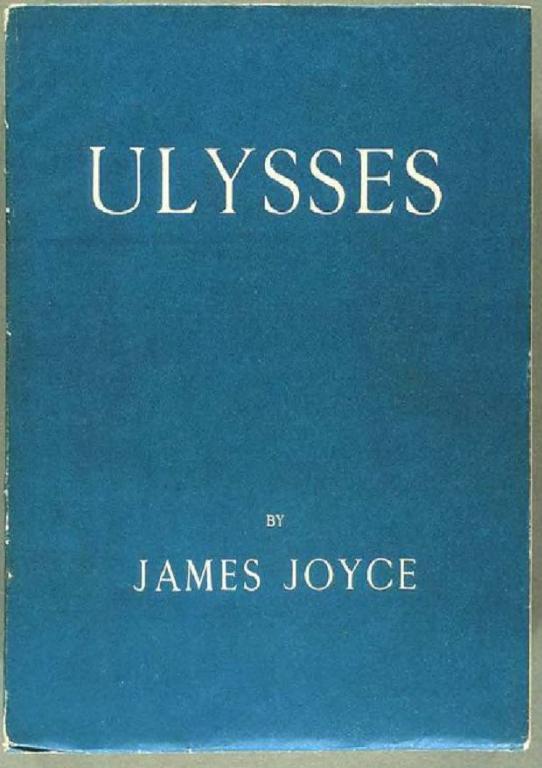
Since its publication in 1922, James Joyce’s Ulysses has enjoyed a status, in various places and in various ways, as The Book to Read. Alas, this Modernist novel of Dublin on June 16, 1904 has also attained a reputation as The Book You Probably Can’t Read — or at least not without a whole lot of work on the side. In truth, nobody needs to turn themselves into a Joyce scholar to appreciate it; the uninitiated reader may not enjoy it on every possible level, but they can still, without a doubt, get a charge from this piece of pure literature.
Today, on this Bloomsday 2014, we offer you everything that may help you get that charge, starting with Ulysses as a free eBook (iPad/iPhone — Kindle + Other Formats — Read Online Now). Or perhaps you’d prefer to listen to the novel as a free audio book; you can even hear a passage read by Joyce himself.
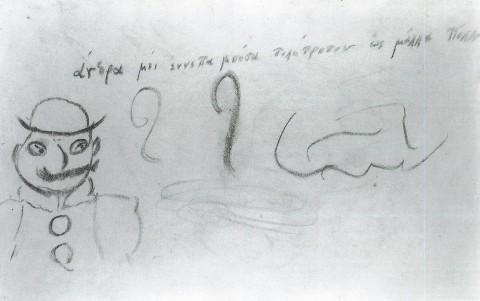
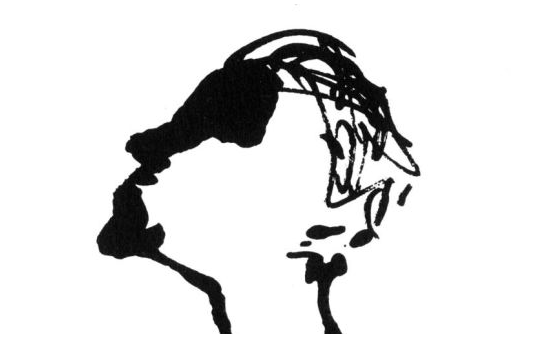
The work may stand as a remarkably rich textual achievement, but it also has a visual history: we’ve previously featured, for instance, Henri Matisse’s illustrated 1935 edition of the book, Joyce’s own sketch of protagonist Leopold Bloom (below), and Ulysses “Seen,” a graphic novel adaptation-in-progress.
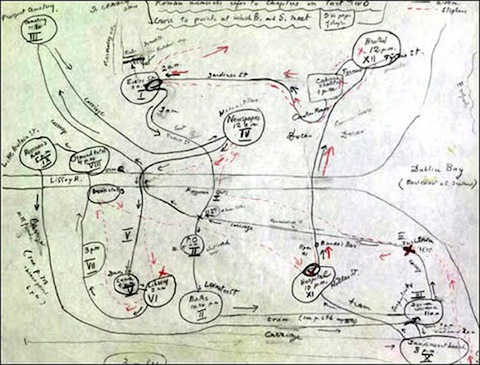
Even Vladimir Nabokov, obviously a formidable literary power himself, added to all this when he sketched out a map of the paths Bloom and Stephen Dedalus (previously seen in Joyce’s A Portrait of the Artist as a Young Man) take through Dublin in the book.
Other high-profile Ulysses appreciators include Stephen Fry, who did a video expounding upon his love for it, and Frank Delaney, whose podcast Re: Joyce, as entertaining as the novel itself, will examine the entire text line-by-line over 22 years. Still, like any vital work of art, Ulysses has drawn detractors as well. Irving Babbitt, among the novel’s early reviewers, said it evidenced “an advanced stage of psychic disintegration”; Virginia Woolf, having quit at page 200, wrote that “never did any book so bore me.” But bored or thrilled, each reader has their own distinct experience with Ulysses, and on this Bloomsday we’d like to send you on your way to your own. (Or maybe you have a different way of celebrating, as the first Bloomsday revelers did in 1954.) Don’t let the towering novel’s long shadow darken it. Remember the whole thing comes down to an Irishman and his manuscripts — many of which you can read online.
Related Content:
James Joyce’s Ulysses: Download the Free Audio Book
James Joyce Reads From Ulysses and Finnegans Wake In His Only Two Recordings (1924/1929)
Henri Matisse Illustrates 1935 Edition of James Joyce’s Ulysses
Read Joyce’s Ulysses Line by Line, for the Next 22 Years, with Frank Delaney’s Podcast
James Joyce, With His Eyesight Failing, Draws a Sketch of Leopold Bloom (1926)
Colin Marshall hosts and produces Notebook on Cities and Culture and writes essays on cities, language, Asia, and men’s style. He’s at work on a book about Los Angeles, A Los Angeles Primer. Follow him on Twitter at @colinmarshall or on Facebook.
Read More...Samuel Beckett Draws Doodles of Charlie Chaplin, James Joyce & Hats
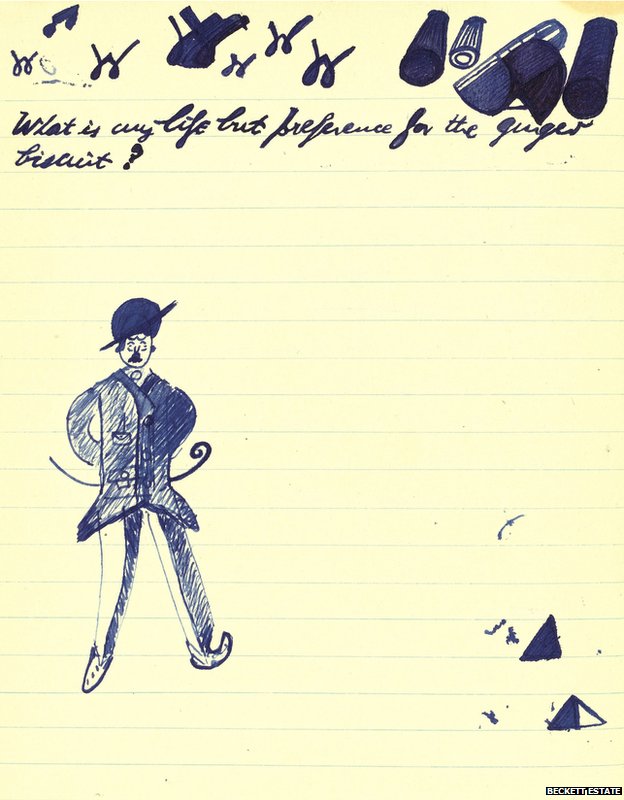
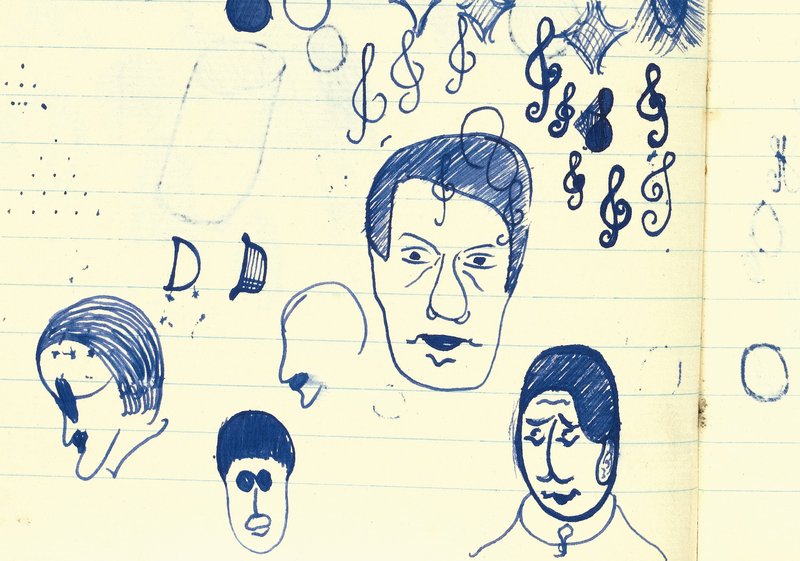
Samuel Beckett was a playwright, a novelist, a Nobel Prize winner and the chauffeur for a school-aged André the Giant. He was also, apparently, a compulsive doodler. The original manuscripts of his first and second novels, Murphy and Watt respectively, are covered in marginalia.
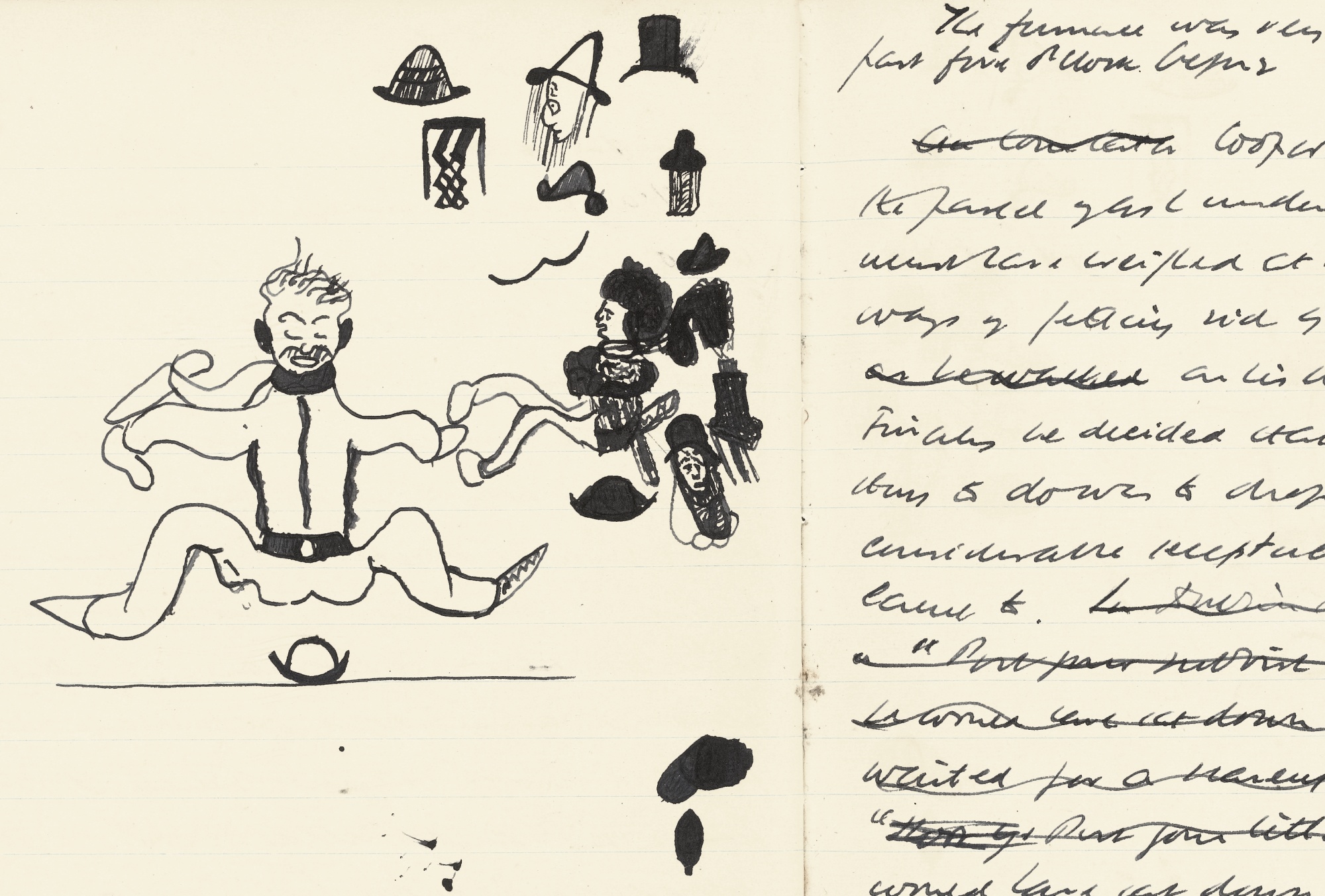
The manuscript for Murphy, comprising six notebooks, was auctioned off last year by Sotheby’s to the tune of £962,500 (or over $1.6 million). The book was written between the years of 1935 to 1936 and the manuscript shows numerous revisions. It also contains this doodle (above) of Charlie Chaplin, who would later influence his seminal play Waiting for Godot. Beckett’s doodle of James Joyce appears beneath it.
For someone who made a career exploring heavy themes like nothingness and futility, his drawings are nothing like the stark, angular doodles of Franz Kafka. Beckett’s pictures are curvy, light-hearted and whimsical. Look at the drawing below. I really don’t know what’s going on there but it sort of looks like a man in earmuffs giving birth to a hat.
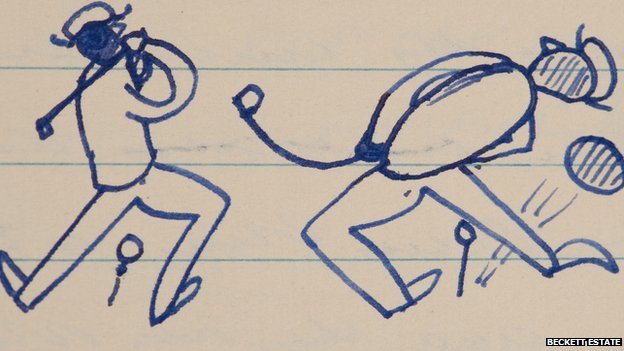
And this one is of a couple golfers.
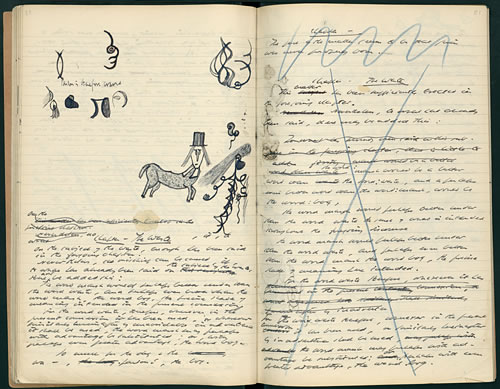
Beckett’s second novel Watt, the last book he wrote in English, also took up six notebooks. According to Beckett’s recollections, Watt was written “in drips and drabs” while he was in living in France during WWII. In the first notebook, alongside an X‑ed out page of text is this odd drawing of a long-haired centaur in a top hat.
And this page, in the second notebook, features a bunch of terrific, strikingly graphic doodles including one that looks like Morley Safer in an Asian cone hat. (Again with the hats.)
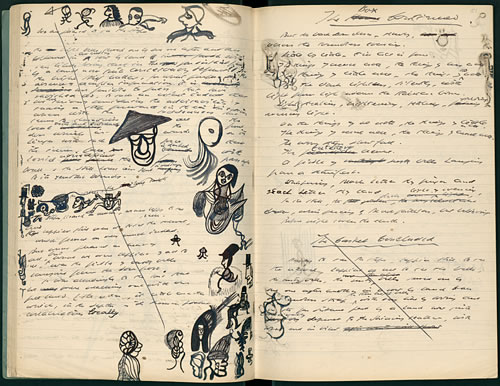
via @SteveSilberman/BrainPickings/Harry Ransom Center
Related Content:
Samuel Beckett Directs His Absurdist Play Waiting for Godot (1985)
Monsterpiece Theater Presents Waiting for Elmo, Calls BS on Samuel Beckett
Rare Audio: Samuel Beckett Reads Two Poems From His Novel Watt
Jonathan Crow is a Los Angeles-based writer and filmmaker whose work has appeared in Yahoo!, The Hollywood Reporter, and other publications. You can follow him at @jonccrow.
Read More...
Anthony Burgess’ Lost Introduction to Joyce’s Dubliners Now Online
Quick note: Written in 1986 as the introduction to a Dolmen Press edition of James Joyce’s Dubliners, but never used, this essay by Anthony Burgess, author of A Clockwork Orange, was found among the papers he left behind. And it now appears in The Irish Times for the first time. You can read it online here. Copies of Joyce’s Dubliners can be found in our book collections:
800 Free eBooks for iPad, Kindle & Other Devicesand
1,000 Free Audio Books: Download Great Books for FreeRelated Content:
James Joyce Reads From Ulysses and Finnegans Wake In His Only Two Recordings (1924/1929)
James Joyce’s Dublin Captured in Vintage Photos from 1897 to 1904
James Joyce, With His Eyesight Failing, Draws a Sketch of Leopold Bloom (1926)
Read More...
Michael Palin’s Tour of the Best Loved Monty Python Sketch Locations
In 1999, travel presenter and founding member of Monty Python, Michael Palin, led viewers on a tour of Pythonland, a collection of unremarkable London locations where some of the comedy troupe’s most famous sketches were filmed.
Unlike fellow Python Terry Jones, the pleasant woman who responds to Palin’s knock at 94 Thorpebank Road is not expecting a new gas cooker, though judging from the way she is dressed, she is awaiting a television crew. Having spent several decades listening to boys (and then men) incessantly reciting their fave Python bits, it’s a trifle hard for me to believe that anyone could claim zero knowledge of the show’s existence. Maybe things are different here in the States…
Fortunately for the television audience, old Joe, next door at no. 92, does remember the show’s takeover of the neighborhood, including John Cleese’s silly walk out of no. 107, back when it was a shop.
The star betrays his age at the West London home that was the setting of the Seduced Milkman skit. Palin is less shocked that the scantily clad Donna Reading has been replaced by a disinterested young bloke in an apron than that the small size of the room served as a holding pen for the punchline’s five other wayward milkmen. Me too. I can’t imagine a 21st-century crew agreeing to lug their equipment up a flight of stairs, let alone shoot in a room that’s no bigger than it appears to be on film.
Palin also swings by Teddington Lock to demonstrate his fabled Fish Slapping Dance with a uniformed attendant and no fish. At the end of every call, Palin presents the current occupant with a facsimile English Heritage plaque. (More than ten years later, Palin toasted the installation of a fake blue plaque honoring his late colleague Graham Chapman at the latter’s favorite pub.)
If you’re a Python pilgrim looking to make a day of it, here are a few more spots that will round things up to an even dozen. The no-longer-in-print Japanese guidebook that Palin relies on in the videos is something of a grail, but only to those who speak Japanese.
Related Content:
Monty Python’s Best Philosophy Sketches
Watch All of Terry Gilliam’s Monty Python Animations in a Row
Watch Monty Python’s “Summarize Proust Competition” on the 100th Anniversary of Swann’s Way
Ayun Halliday is a Brooklyn-based author, performer, director and the Chief Primatologist of the East Village Inky zine. Follow her@AyunHalliday
Read More...Isolated Drum Tracks From Six of Rock’s Greatest: Bonham, Moon, Peart, Copeland, Grohl & Starr
“Drums, eh,” says Keith Richards in answer to a fan question on the subject. “Without it you’re kinda nowhere.” He’s got a point. An ace drummer can be the spine, muscle, and even soul of a great band. Pounding, swinging, and smashing away behind showy guitarists and flamboyant frontmen, drummers sometimes have problems being seen, but never heard. But while John Bonham or Keith Moon never got lost in the mix, it’s a rare thing to hear them out of it. The proliferation of rock band video games and isolated tracks posted to Youtube allow us to listen to the nuances of drum grooves we may feel we know by heart, such as Bonham’s driving beat behind Led Zeppelin’s “Whole Lotta Love.”
In a previous post, we brought you a rough mix of the song and Jimmy Page describing its creation. Page wanted Bonham’s drum track to “really stand out, so that every stick stroke sounded clear and you could really feel them.” It certainly does that. The drum track above is all about feeling. As a result of the recording techniques of the time, writes producer/engineer Bobby Owinski, drum tracks tended to sound “like a single instrument,” since they were recorded with only two or three mics capturing the space around the kit, rather than the sound of individual pieces. “Still,” Owinski writes of this track, “there’s plenty of power in [Bonham’s] kick and snare, because he played them hard!” In addition to his power, Bonham is known for his laid-back groove, due to his tendency for playing slightly behind the beat, a quality Youtube drum instructor Terry Keating of Bonzoleum ascribes to “temperament.”
Bonham’s style consisted mainly of creative uses of triplets, so much so that McSweeny’s had a good laugh about his constant use a similar pattern. One of my favorite drummers—crankiest man in rock Ginger Baker—also disparages Bonham’s playing, as well as that of another alcoholic drum star, Keith Moon. But Ginger Baker doesn’t tend to like anyone, and Moon’s playing, while maybe not virtuosic or especially disciplined, was, like his persona, insane. Drum Magazine describes Moon’s style as “tribal, primitive, and impulsive, with him often stomping the bass drums and pounding his wall of toms like a madman” (clearly Moon inspired the Muppets’ Animal). Moon’s many kits often consisted of double bass drums and double rows of toms, and he played them as hard as possible almost all the time. Hear him above thrashing with abandon through “Won’t Get Fooled Again.”
Seemingly miles away from the madness of Keith Moon, Rush’s Neil Peart is a highly technical drummer with impeccable on-the-beat timing and a drum setup that has grown so extensive and complicated over the years that he almost disappears into its depths. Peart’s playing combines the power and stamina of Bonham with complex patterns whose rhythmic dynamics shift subtly several times throughout each song. Check out the isolated drum track for “Tom Sawyer” above as a classic example of Peart’s technique and you may see why he’s classed as one of the all-time best rock drummers (though I wouldn’t class him as one of rock’s greatest lyricists).
Although I’m an admirer of Neil Peart’s drumming, I can’t say I’m much of a Rush fan. Police drummer Stewart Copeland feels the same. In an interview with Music Radar, he jokes about “pull[ing] Neil’s chain at every possible opportunity” for the self-indulgent excess of drum solos (though Copeland gamely played one during David Letterman’s “Drum Solo Week” in 2011). Copeland talks about “a time when bands like Rush were the epitome of what The Police were theoretically against, which was an overemphasis on musicality.” Nonetheless, Copeland is one of the most musical of drummers, making use of odd time signatures and polyrhythmic syncopation to create a thoroughly unique and instantly recognizable style (which has even inspired neuroscience studies). The drum track above comes from “Next to You,” a song on the band’s debut album, during their decidedly anti-Rush phase. While the song itself is uptempo punk rock, Copeland’s Gene Krupa-like drumming, heard in isolation, presages the unusual quirks to come as the band stretched out into jazz and reggae territory.
The sheer number of bands Foo Fighters frontman and former Nirvana drummer Dave Grohl has drummed for is impressive, and a testament to his machine-like speed and timing. Drummer and Portlandia star Fred Armisen may be Grohl’s biggest fan. “Every drum part he does is a masterpiece,” says Armisen, “He’s never just heavy for heavy’s sake or rock for rock’s sake—it’s all so musical, with an incredible sense of dynamics. Every generation has their drumming guy, and Dave is ours.” Even Kurt Cobain, never one to overpraise, once called Grohl “the best drummer in the world.” Maybe a bit of hyperbole, but Grohl’s damned good, even at his most straightforward, as above in his pounding drumbeat for “Smells Like Teen Spirit.” Grohl’s powerhouse playing isn’t the most versatile. He had some trouble adjusting to quieter environs, and Cobain nearly banned him from the band’s legendary “Unplugged” performance for his too-aggressive playing in rehearsals. Nonetheless, when it comes to punk, hardcore, and serious rock, Grohl’s the man.
I can’t resist ending with the isolated track of what maybe be my all-time favorite drum part, Ringo Starr’s wildly funky business at the end of “Strawberry Fields Forever.” Some of the drums here are overdubbed, with several different percussion parts blended with Starr’s full-kit freak out. Starr has taken a lot of completely undeserved flak for his supposed limitations as a drummer, but as Samuel Belkin writes at The Examiner, “his latter day drum patterns are […] often sophisticated, and always idiosyncratic […] nobody has ever been able to sound quite like Ringo.” Ultimately, in my book, what distinguishes a truly great drummer from thousands of technically proficient players is a quality no one can teach or emulate: Personality.
Related Content:
7 Female Bass Players Who Helped Shape Modern Music: Kim Gordon, Tina Weymouth, Kim Deal & More
Listen to The John Bonham Story, a Radio Show Hosted by Dave Grohl
Keith Moon’s Final Performance with The Who (1978)
Hear the Isolated Vocal Tracks for The Beatles’ Climactic 16-Minute Medley on Abbey Road
Josh Jones is a writer and musician based in Durham, NC. Follow him at @jdmagness.
Read More...Stanley Kubrick Talks Cinema, Chess, ESP, Vietnam & His Cat in Interviews with Michel Ciment (1975–1987)
Cinephiles certainly know the name of Stanley Kubrick, and die-hard cinephiles just as certainly know the name of Michel Ciment, the French critic behind celebrated volumes on such auteurs as Elia Kazan, Joseph Losey, John Boorman, Theo Angelopoulos, Fritz Lang, and, yes Kubrick himself. Ciment has placed the director’s work, which includes the likes of Dr. Strangelove, 2001: A Space Odyssey, and A Clockwork Orange, “among the most important contributions to world cinema in the twentieth century.” In an attempt to do justice to the mind of his subject while writing Kubrick, he put in no small amount of time with the man himself. At the top of the post, you can hear an assemblage of material from a five-part interview between Ciment and Kubrick originally aired on the French radio program A voix nue, itself pieced together from a series of conversations between critic and director recorded between 1975 and 1987. So we ultimately have here, as the person who put the clip on Youtube notes, “a reconstructed hour of Kubrick talking about cinema, chess, ESP, art, writing, Vietnam, his cat, the 18th century, and even Fear and Desire.”
But with this fascinating material comes a caveat: “As the interviews were broadcast for French audiences, a French voice-over was added throughout the entire audio in post-edit. This meant that you’d hear Kubrick talk for about three or four seconds and then have a translator jump in and repeat what he said in French at a louder volume. Usually the translator would step in and cut off the first or last words that Kubrick was saying, or sometimes just talk over the top of him.” The result, with the French mostly excised and the English remains stitched into a solidly Kubrickian hour, does make for “a very demanding and irritating way to listen to the interviews” which “involves a lot of concentration to filter out the interpreter and keep piecing together the flow of what Kubrick says.” Yet he does say plenty worth hearing, especially for those already familiar with his filmography. But if this audio does indeed wear down your patience, feel free to check out one of the less taxing ways to get a dose of Kubrick and Ciment: for example, the three conversations on Barry Lyndon, The Shining, and A Clockwork Orange so conveniently transcribed — in English! — at The Kubrick Site. You can also listen to Stanley Kubrick’s 1965 Interview with The New Yorker here.
Related Content:
Fear and Desire: Stanley Kubrick’s First and Least-Seen Feature Film (1953)
Stanley Kubrick’s Daughter Shares Photos of Herself Growing Up on Her Father’s Film Sets
Stanley Kubrick’s List of Top 10 Films (The First and Only List He Ever Created)
Colin Marshall hosts and produces Notebook on Cities and Culture and writes essays on cities, language, Asia, and men’s style. He’s at work on a book about Los Angeles, A Los Angeles Primer. Follow him on Twitter at @colinmarshall or on Facebook.
Read More...Archive of 5,000 Images Document the History of San Francisco and the Vehicles That Put It in Motion
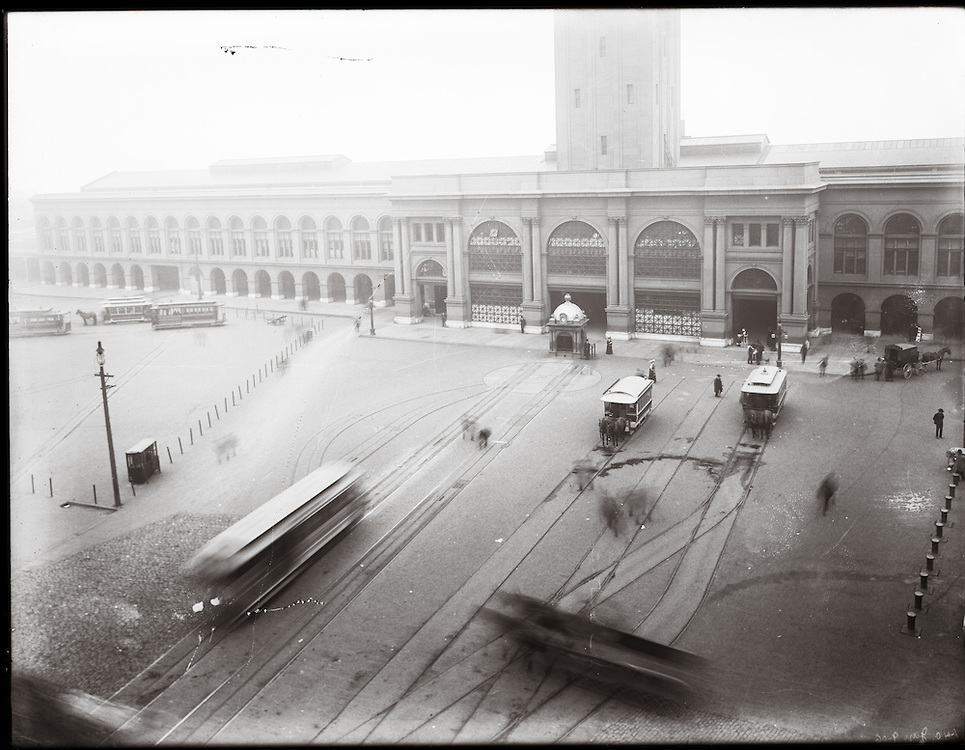
Taken at the fog-shrouded Ferry Building in San Francisco in January 1906, just months before a massive earthquake leveled the up-and-coming city, the striking image above comes from The San Francisco Municipal Transportation Agency Photographic Archive, an archive that provides a “visual history of the city’s public transportation history dating back to the early 20th Century.”
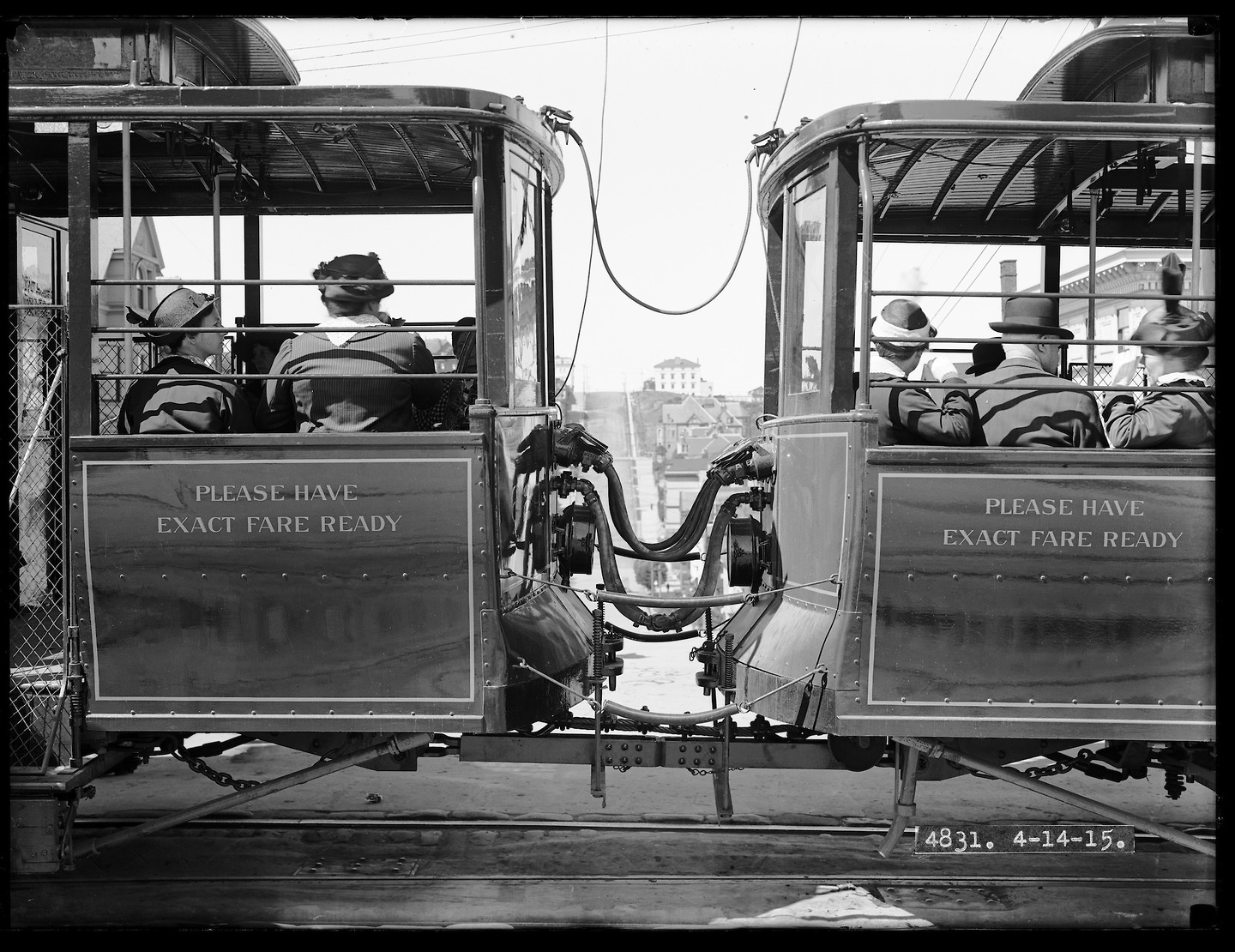
Featuring a collection of glass plate, nitrate and acetate negatives, the living archive tells “the story of San Francisco, its transition from a stretch of sand dunes to an internationally acclaimed city, it’s rise from the rubble of the devastating earthquake of 1906 and the vital role public transportation played and continues to play in revitalizing the city.” The archive contains nearly 5,000 images, all neatly divided into 14 collections. You can enter the archive and start perusing here.
via Metafilter
Related Content:
The 1906 San Francisco Earthquake: Before and After
Designer Massimo Vignelli Revisits and Defends His Iconic 1972 New York City Subway Map
Vintage Video: A New York City Subway Train Travels From 14th St. to 42nd Street (1905)
Read More...Famous Writers’ Report Cards: Ernest Hemingway, William Faulkner, Norman Mailer, E.E. Cummings & Anne Sexton
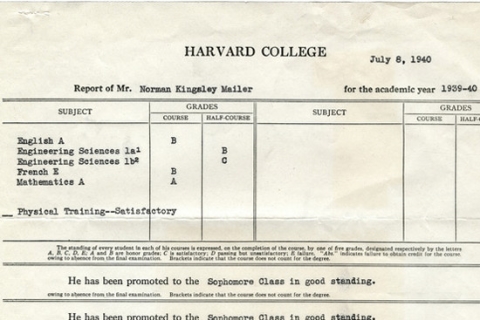
“It’s not about the grade,” I’d say to perturbed students asking me to change theirs: “it’s about what you learned.” No one will care what you got in first-year English Composition; they’ll care if you can write a sentence, a paragraph, a professional, elegant, or moving text. All of this is true, and yet (of course I never told them this) I still remember every grade I earned in every class I took in high school, college, and graduate school. Obsessive? Maybe. But it’s also symptomatic of that same compulsion that drives students to try, by any means, to get professors to bump their grades up at the end of the semester—fear of the “permanent record.” Like Seinfeld’s Elaine, struggling to expunge a black mark from her medical chart, we all fear the reams of documents—or archives of data—that catalogue our every misstep, stumble, failure or faux pas.
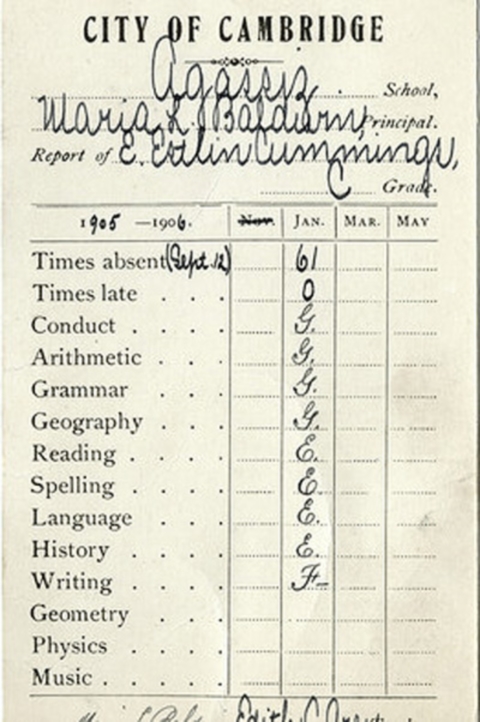
In many cases, this anxiety is justifiable, but as you can see here, the occasional bad mark didn’t stop famed writers Norman Mailer or E.E. Cummings from achieving literary greatness, even if those grades remain, in ink, on record today. See Mailer’s first-year Harvard College report card at the top of the post, academic year 1939–40. The bearish novelist did well, but for the C in his second semester of Engineering Science. Just above, we have Cummings’ report card from what is likely his fifth grade year given his age of 11 at the time. The 1905-06 grading system looks foreign to us now, but the C that Cummings received that year probably did not put him at the top of the class. Nor, I’m sure, did his 61 absences.
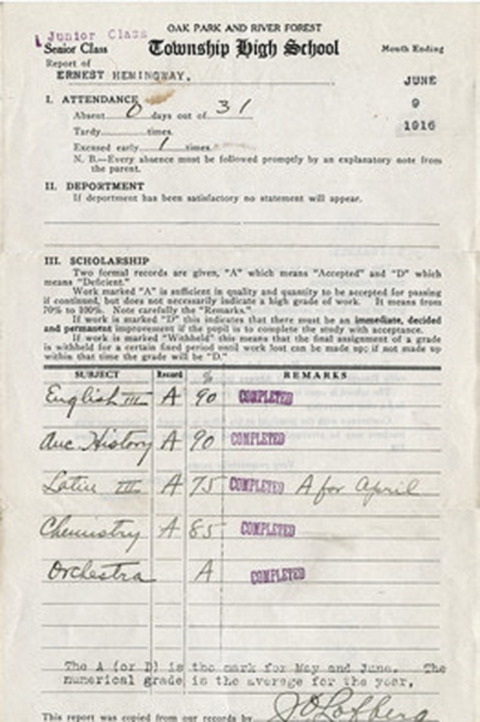
Ernest Hemingway, on the other hand, had little reason to hide the high school report card above, but if you look closely, you’ll see that the column of straight A’s does not mean what we might think. The Oak Park and River Forest Township High School only gave two letter grades, A for “Accepted” and D for “Deficient.” Still, Hemingway’s numerical percentages show his scholarly aptitude, though his 75 in Latin may have haunted him.
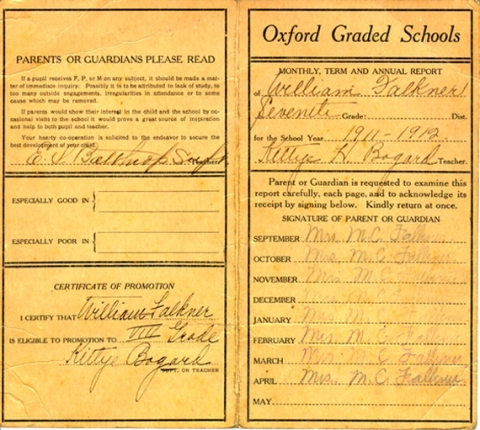
Hemingway’s modernist contemporary William Faulkner, you may know, struggled in school after the fourth grade, and eventually dropped out of high school after the 11th (though his father’s job at Ole Miss meant he could enroll there for the three semesters he attended). The seventh grade report card above does not show us his grades, and Faulkner’s teacher neglected to fill in the “Especially Good In” and “Especially Poor In” boxes. Nevertheless, Faulkner (then William Falkner), did well enough to move up, and his mother signed off on each month of the term but the last.
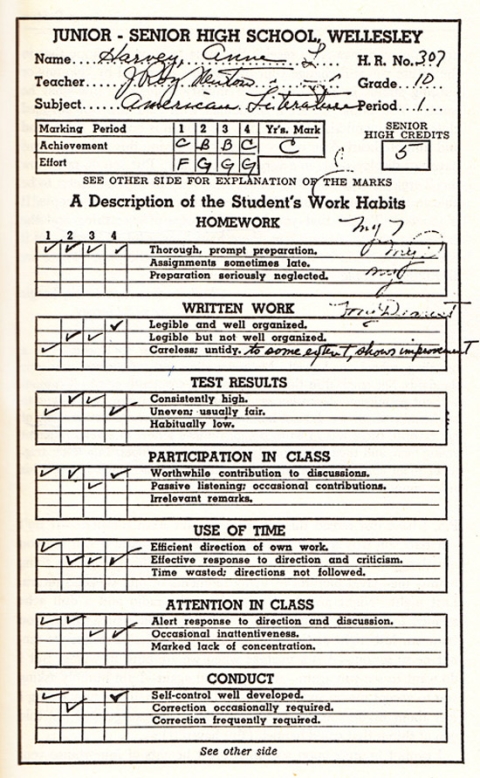
Finally we bring you the report card of Anne Sexton—née Harvey—for a 10th grade American Literature class at the Junior-Senior High School in Wellesley, Massachusetts, from which Sylvia Plath also graduated. As you can see, Sexton received a C in the class, with an F for effort in the first quarter. According to Beth Hinchliffe—a Wellesley native who conducted one of Sexton’s final interviews—the poet remembered the grade. She also remembered her teenage self as “ ‘a pimply, boy-crazy thing’ who was obsessed with flirting.”
Most of these report cards come from collections at the University of Texas’ Harry Ransom Center, a trove of historical and literary documents that, unlike some other archives, I’m very glad keeps permanent records. Anne Sexton’s report card comes to us via the always information-rich Brain Pickings.
Related Content:
Ernest Hemingway Creates a Reading List for a Young Writer, 1934
The Art of William Faulkner: Drawings from 1916–1925
Two Childhood Drawings from Poet E.E. Cummings Show the Young Artist’s Playful Seriousness
Anne Sexton, Confessional Poet, Reads “Wanting to Die” in Ominous 1966 Video
How Famous Writers — From J.K. Rowling to William Faulkner — Visually Outlined Their Novels
Josh Jones is a writer and musician based in Durham, NC. Follow him at @jdmagness.
Read More...John Lennon Illustrates Two of His Books with Playful Drawings (1964–1965)
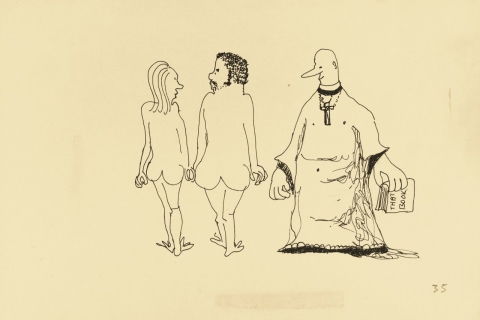
Upon his tragic early death at 40, John Lennon left behind a body of work few popular artists could hope to equal. And that’s only the published stuff. As we pointed out in a recent post on his home demos, the former Beatle also left hundreds of hours of tape recordings for his fans to sift through, and, as if that weren’t enough, Sotheby’s recently auctioned off a storehouse of original manuscripts and autographed drawings for two books Lennon wrote in the mid-sixties, In His Own Write (1964) and A Spaniard in the Works (1965), a Sherlock Holmes parody.
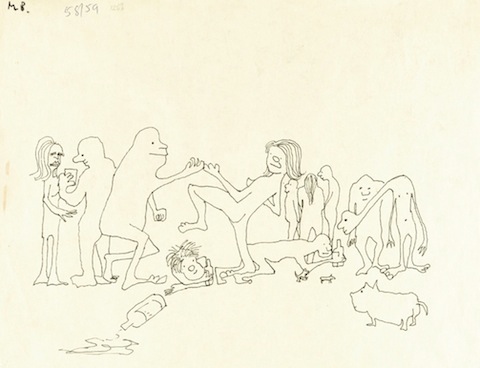
Lennon’s playful sense of humor and surreal imagination shine through the stories and poems in both books, as does his more moody broody side. If anything, Lennon’s wordplay and out-there line drawings closely resemble the work of Shel Silverstein, who was probably not an influence but certainly a kindred spirit. Sotheby’s specialist Gabriel Heaton cites as Lennon’s influence “the nonsense tradition of English literature,” and indeed Lewis Carroll comes to mind when reading his work. See, for example, “About The Awful,” his author’s statement for In His Own Write:
I was bored on the 9th of Octover 1940 when, I believe, the Nasties were still booming us led by Madolf Heatlump (who only had one). Anyway they didn’t get me. I attended to varicous schools in Liddypol. And still didn’t pass — much to my Aunties supplies. As a member of the most publified Beatles my (P, G, and R’s) records might seem funnier to some of you than this book, but as far as I’m conceived this correction of short writty is the most wonderfoul larf I’ve every ready.
God help and breed you all.
And then there’s the artwork. At the top, see an untitled ink drawing of a vicar leering at a nude couple (and holding in his hand “That Book”). The drawing above shows a clique of naked partiers, with the caption “Puffing and globbering they drugged theyselves rampling or dancing with wild abdomen, stubbing in wild postumes amonst themselves…”
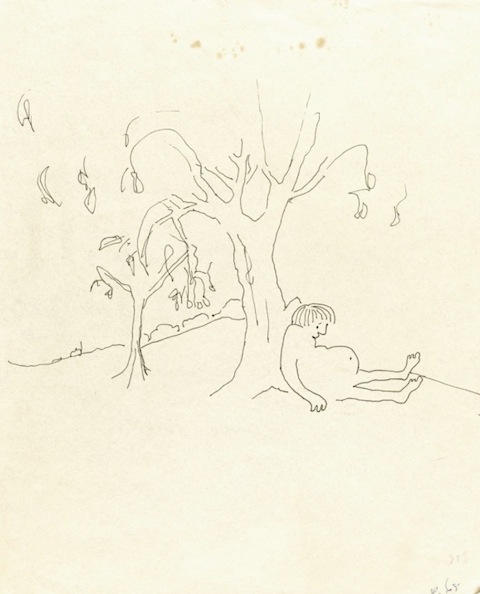
Recalling the artwork in Silverstein’s The Giving Tree, directly above we have a simple illustration for a poem called “I Sat Belonely,” captioned with the poem’s first two lines: “I Sat Belonely Down a Tree, Humbled Fat and Small” (read the full poem here).
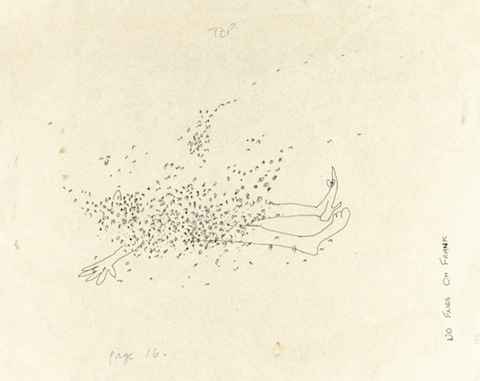
Another Silversteinian drawing is titled “A Lot of Flies on His Wife” from a short story called “No Flies on Frank,” whose title character speaks in an argot right out of James Joyce: “I carn’t not believe this incredible fact of truth about my very body which has not gained fat since mother begat me at childburn. Yea, though I wart through the valet of thy shadowy hut I will feed no norman. What grate qualmsy hath taken me thus into such a fatty hardbuckle.”
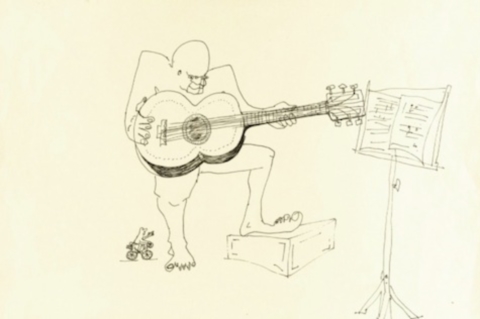
Just above, Lennon sketches a Picasso-like four-eyed guitarist in this untitled drawing (notice the tiny cyclist at his feet)—estimated by Sotheby’s between $15,000 and $25,000. The eighty nine lots that went up for auction included many other drawings (see more here) and some handwritten notes from Paul McCartney. All told, the sale netted close to $3 million, though for Lennon devotees, these artifacts are priceless. .
via The Daily Beast
Related Content:
John Lennon Plays Basketball with Miles Davis and Hangs Out with Allen Ginsberg & Friends
Josh Jones is a writer and musician based in Durham, NC. Follow him at @jdmagness.
Read More...Support Us
We're hoping to rely on loyal readers, rather than erratic ads. Please click the Donate button and support Open Culture. You can use Paypal, Venmo, Patreon, even Crypto! We thank you!

About Us

Open Culture scours the web for the best educational media. We find the free courses and audio books you need, the language lessons & educational videos you want, and plenty of enlightenment in between.
Advertise With Us

FREE UPDATES!
GET OUR DAILY EMAIL
Get the best cultural and educational resources on the web curated for you in a daily email. We never spam. Unsubscribe at any time.
FOLLOW ON SOCIAL MEDIA

Open Culture editor Dan Colman scours the web for the best educational media. He finds the free courses and audio books you need, the language lessons & movies you want, and plenty of enlightenment in between.
Advertise With Us


