The Kinks’ Ray Davies Reviews the Beatles’ 1966 Album Revolver; Calls It “A Load of Rubbish”
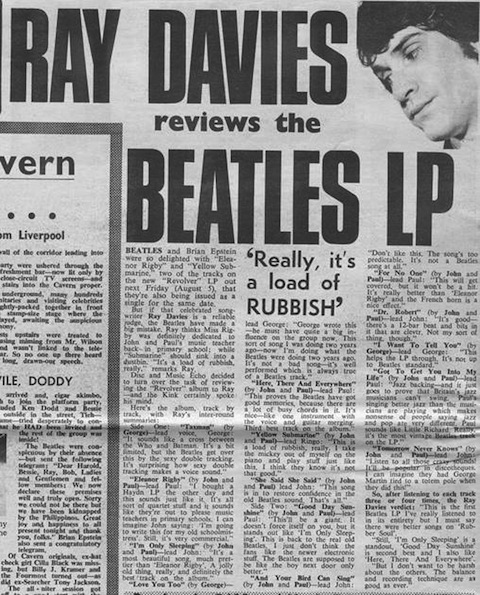
The Beatles’ Revolver has garnered some of the highest praises rock critics can offer. But not everyone loved the record when it came out. In a 1966 issue of Disc and Music Echo magazine, the Kinks’ Ray Davies wrote a snarky, unsparing review of the album, tackling each song in a few sentences. In high contrast to the current sentiments of Rolling Stone or Allmusic, Davies only seems to have liked a few tracks, and those the most traditionally upbeat: He called “I’m Only Sleeping,” “a most beautiful song” and “the best track on the album.” He also quite liked “Good Day Sunshine,” writing “this is back to the real old Beatles. I just don’t like the electronic stuff. The Beatles were supposed to be like the boy next door only better.” And “Here There and Everywhere” Davies calls the “third best track on the album.”
That’s mostly the end of Davies’ felicity. His review savages some of the most popular songs on the record. Of “Eleanor Rigby” he writes. “it sounds like they’re out to please music teachers in primary schools.” The best he can bring himself to say of the track is that “it’s very commercial.” “Yellow Submarine,” Davies writes, “is a load of rubbish, really.” And his take on the trippy “Tomorrow Never Knows” cuts the song’s ambitions down to size: “Listen to all those crazy sounds! It’ll be popular in discotheques. I can imagine they had George Martin tied to a totem pole when they did this.” Maybe the cranky Davies was motivated by professional jealousy; maybe he’s one of the most honest reviewers of the record—his take uncolored by starstruckness. Who knows? He does admit that it’s “the first Beatles LP I’ve really listened to in its entirety.” Read Davies’ full review here.
Related Content:
Hear the Isolated Vocal Tracks for The Beatles’ Climactic 16-Minute Medley on Abbey Road
The 10-Minute, Never-Released, Experimental Demo of The Beatles’ “Revolution” (1968)
The Beatles: Unplugged Collects Acoustic Demos of White Album Songs (1968)
Josh Jones is a writer and musician based in Durham, NC. Follow him at @jdmagness
Read More...George Orwell’s Five Greatest Essays (as Selected by Pulitzer-Prize Winning Columnist Michael Hiltzik)

Image via Wikimedia Commons
Every time I’ve taught George Orwell’s famous 1946 essay on misleading, smudgy writing, “Politics and the English Language,” to a group of undergraduates, we’ve delighted in pointing out the number of times Orwell violates his own rules—indulges some form of vague, “pretentious” diction, slips into unnecessary passive voice, etc. It’s a petty exercise, and Orwell himself provides an escape clause for his list of rules for writing clear English: “Break any of these rules sooner than say anything outright barbarous.” But it has made us all feel slightly better for having our writing crutches pushed out from under us.
Orwell’s essay, writes the L.A. Times’ Pulitzer-Prize winning columnist Michael Hiltzik, “stands as the finest deconstruction of slovenly writing since Mark Twain’s “Fenimore Cooper’s Literary Offenses.” Where Twain’s essay takes on a pretentious academic establishment that unthinkingly elevates bad writing, “Orwell makes the connection between degraded language and political deceit (at both ends of the political spectrum).” With this concise description, Hiltzik begins his list of Orwell’s five greatest essays, each one a bulwark against some form of empty political language, and the often brutal effects of its “pure wind.”
One specific example of the latter comes next on Hiltzak’s list (actually a series he has published over the month) in Orwell’s 1949 essay on Gandhi. The piece clearly names the abuses of the imperial British occupiers of India, even as it struggles against the canonization of Gandhi the man, concluding equivocally that “his character was extraordinarily a mixed one, but there was almost nothing in it that you can put your finger on and call bad.” Orwell is less ambivalent in Hiltzak’s third choice, the spiky 1946 defense of English comic writer P.G. Wodehouse, whose behavior after his capture during the Second World War understandably baffled and incensed the British public. The last two essays on the list, “You and the Atomic Bomb” from 1945 and the early “A Hanging,” published in 1931, round out Orwell’s pre- and post-war writing as a polemicist and clear-sighted political writer of conviction. Find all five essays free online at the links below. And find some of Orwell’s greatest works in our collection of Free eBooks.
1. “Politics and the English Language”
3. “In Defense of P.G. Wodehouse”
5. “A Hanging”
Related Content:
George Orwell’s Rules for Making the Perfect Cup of Tea: A Short Animation
The Only Known Footage of George Orwell (Circa 1921)
George Orwell and Douglas Adams Explain How to Make a Proper Cup of Tea
Josh Jones is a writer and musician based in Durham, NC. Follow him at @jdmagness
Read More...Charles Bukowski Takes You on a Very Strange Tour of Hollywood
The world tends to think rather loosely about the concepts of Los Angeles, Hollywood, and the motion picture industry, throwing them around, running them together, naming one when they mean another — still, nothing a bracing splash of Charles Bukowski can’t sort out. Above, the famous Los Angeles-resident poet, a figure as shambolically glorious and stealthily inspiring as much of the city itself, gives a brief back-seat tour of Hollywood. No, he doesn’t take us past the movie studios, nor the Walk of Fame, nor the site of Schwab’s Pharmacy. He stays closer to home — his home, the storied bungalow at 5124 De Longpre Avenue. We see his neighborhood, his neck of Hollywood, the northwestern district of vast Los Angeles that contains much less of the capital‑I Industry than you’d think, but more of genuine (if often grotesque) interest.
“That’s a lady fortune teller there,” Bukowski says, gesturing toward one of the modest houses around him. “I went in there one time. She read my palm. She said, ‘You’re an alcoholic.’ ‘Really? Do I gamble, too?’ ‘Yes, you gamble. That’ll be five dollars.’ ” The driver continues down Hollywood’s eponymous boulevard, passing Western Avenue, which gets the poet remembering more: “There used to be cement benches out front, and all the insane people would sit there. The street people. They’d talk to each other all day long.” We pass important landmarks as well: “There’s the old Sex Shop. Keeps changing hands.” He even points out the wheelers and dealers living amid this stretch of bars, brothels, and burger stands: “There’s a woman who’s not a hooker. There’s a dope dealer.” Give me Bukowski’s Hollywood tour over those double-decker buses you see around town, their conductors barking about minor celebrity sightings, any day. “I’ve been to this liquor store many a time,” Bukowski notes. “Many a time.”
If you would like to support the mission of Open Culture, consider making a donation to our site. It’s hard to rely 100% on ads, and your contributions will help us continue providing the best free cultural and educational materials to learners everywhere. You can contribute through PayPal, Patreon, and Venmo (@openculture). Thanks!
Related Content:
Charles Bukowski Tells the Story of His Worst Hangover Ever
“Don’t Try”: Charles Bukowski’s Concise Philosophy of Art and Life
Five Cultural Tours of Los Angeles
The Last (Faxed) Poem of Charles Bukowski
Colin Marshall hosts and produces Notebook on Cities and Culture and writes essays on literature, film, cities, Asia, and aesthetics. He’s at work on a book about Los Angeles, A Los Angeles Primer. Follow him on Twitter at @colinmarshall.
Read More...“Wear Sunscreen”: The Story Behind the Commencement Speech That Kurt Vonnegut Never Gave
On June 1, 1997, Mary Schmich, Chicago Tribune columnist and Brenda Starr cartoonist, wrote a column entitled “Advice, like youth, probably just wasted on the young.” In her introduction to the column she described it as the commencement speech she would give to the class of ’97 if she were asked to give one.
The first line of the speech: “Ladies and gentlemen of the class of ’97: Wear sunscreen.”
If you grew up in the 90s, these words may sound familiar, and you would be absolutely right. Australian film director Baz Luhrmann used the essay in its entirety on his 1998 album Something for Everybody, turning it into his hit single “Everybody’s Free (To Wear Sunscreen).” With spoken-word lyrics over a mellow backing track by Zambian dance music performer Rozalla, the song was an unexpected worldwide hit, reaching number 45 on the Billboard Hot 100 in the United States and number one in the United Kingdom.
The thing is, Luhrmann and his team did not realize that Schmich was the actual author of the speech until they sought out permission to use the lyrics. They believed it was written by author Kurt Vonnegut.
For Schmich, the “Sunscreen Controversy” was “just one of those stories that reminds you of the lawlessness of cyberspace.” While no one knows the originator of the urban legend, the story goes that Vonnegut’s wife, the photographer Jill Krementz, had received an e‑mail in early August 1997 that purported to reprint a commencement speech Vonnegut had given at MIT that year. (The actual commencement speaker was the United Nations Secretary General Kofi Annan.) “She was so pleased,” Mr. Vonnegut later told the New York Times. “She sent it on to a whole of people, including my kids – how clever I am.”
The purported speech became a viral sensation, bouncing around the world through e‑mail. This is how Luhrmann discovered the text. He, along with Anton Monsted and Josh Abrahams, decided to use it for a remix he was working on but was doubtful he could get Vonnegut’s permission. While searching for the writer’s contact information, Luhrmann discovered that Schmich was the actual author. He reached out to her and, with her permission, recorded the song the next day.
What happened between June 1 and early August, no one knows. For Vonnegut, the controversy cemented his belief that the Internet was not worth trusting. “I don’t know what the point is except how gullible people are on the Internet.” For Schmich, she acknowledged that her column would probably not had spread the way it did without the names of Vonnegut and MIT attached to it.
In the end, Schmich and Vonnegut did connect after she reached out to him to inform him of the confusion. According to Vonnegut, “What I said to Mary Schmich on the telephone was that what she wrote was funny and wise and charming, so I would have been proud had the words been mine.” Not a bad ending for a column that was written, according to Schmich, “while high on coffee and M&Ms.”
Related Content:
The Shape of A Story: Writing Tips from Kurt Vonnegut
22-Year-Old P.O.W. Kurt Vonnegut Writes Home from World War II: “I’ll Be Damned If It Was Worth It”
Kurt Vonnegut Reads from Slaughterhouse-Five
Read More...George Saunders’ Lectures on the Russian Greats Brought to Life in Student Sketches

Click for larger image
We’ve seen plenty of post-modern decay in writers before George Saunders—in Don DeLillo, J.G. Ballard—but never has it been filled with such puckish warmth, such whimsical detail, and such empathy, to use a word Saunders prizes. As a writer, Saunders draws readers in close to a very human world, albeit a fragmented, burned out, and frayed one, and it seems that he does so as a teacher as well. Since 1997, Saunders has taught creative writing at Syracuse University, where he received his M.A. in 1988, and where he remains, despite being awarded a MacArthur “Genius” Fellowship in 2006 and publishing steadily throughout the last decade and a half. To sit in a class with Saunders, according to his onetime student Rebecca Fishow, is to visit with a daring practitioner of the short form, one whose “words seem a lot like the transfer of secrets through a chain-link of writers.”

While attending one of Saunders’ semester-length writing seminars, writer and artist Fishow compiled the notes and sketches you see here (and several more at The Believer’s Logger site). In each sketch, Saunders teaches from one of his favorite classic Russian short story writers. At the top, see him expound on Turgenev’s method, proffering epiphanies, keen observations on craft, and writerly advice in word bubbles—“You are allowed to manipulate,” “Tecnician vs. Artist” [sic], “Instantaneous micro-re-evaluation (@end of story)”—while surrounded by a fringy aura. Above, Fishow reconstructs Saunders’ take on Chekhov’s “Lady with the Pet Dog” around a portrait of a pensive Saunders (looking a bit like Chekhov).
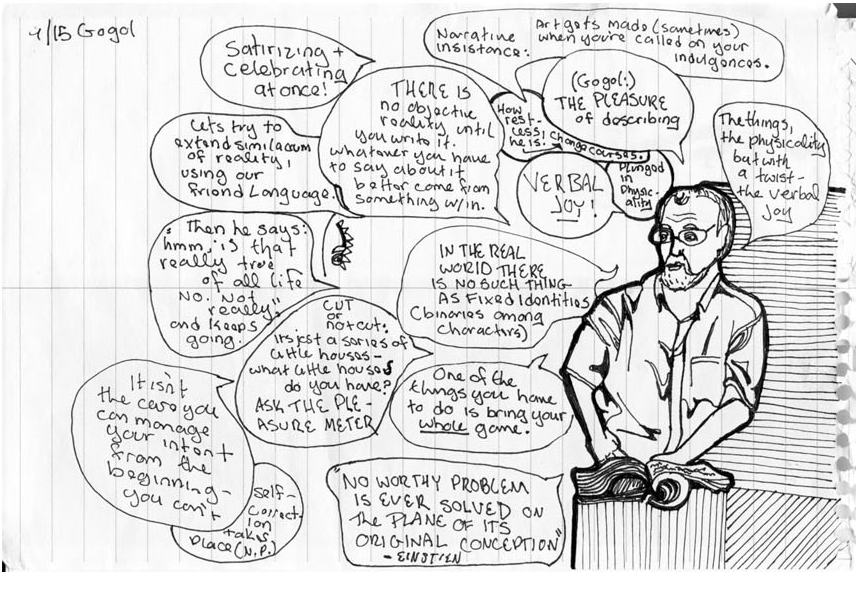
Fishow’s reconstructions are obviously very partial, and it’s not clear if she took them down on the spot or scribbled from memory (the misspellings make me think the former). In the sketch above, Saunders’ explicates Gogol, with phrases like “VERBAL JOY!” and an Einstein quote: “No worthy problem is ever solved on the plane of its original conception.” The latter is an interesting moment of Saunders’ scientific background slipping into his pedagogy. Before he was a MacAurthur winner and an enthusiastic teacher, Saunders worked as an environmental engineer. Of his science background, he has said:
…any claim I might make to originality in my fiction is really just the result of this odd background: basically, just me working inefficiently, with flawed tools, in a mode I don’t have sufficient background to really understand. Like if you put a welder to designing dresses.
As a teacher, at least in Fishow’s notes, Saunders celebrates “working inefficiently.” As she puts it: “His wisdom confirms that flaw and uncertainty and variety and empathy (especially empathy) are positive aspects of the writing process.” Fishow’s portraits go a long way toward conveying those qualities in Saunders as a presence in the classroom.
Find more sketches at The Believer’s Logger site.
Also Read 10 Free Stories by George Saunders Online.
Related Content:
George Saunders Extols the Virtues of Kindness in 2013 Speech to Syracuse University Grads
Vladimir Nabokov (Channelled by Christopher Plummer) Teaches Kafka at Cornell
James Joyce, With His Eyesight Failing, Draws a Sketch of Leopold Bloom (1926)
Josh Jones is a writer and musician based in Durham, NC. Follow him at @jdmagness
Read More...Developing iOS 7 Apps for iPhone and iPad: A Free Online Course by Stanford

FYI: Apple officially released iOS7, the latest operating system for the iPhone and iPad, on September 18. Almost simultaneously, Stanford began offering a course teaching students how to design apps in the new environment. Although the course is still in progress, the initial video lectures are now available online, you guessed it, on iTunesU.
This course, along with other top-flight coding courses, appears in the Computer Science section of our big collection of 775 Free Online Courses, where you’ll also find courses on Philosophy, History, Physics and other topics.
Looking for tutorials on building apps in Android? Find them here.
Related Content:
Learn to Code with Harvard’s Intro to Computer Science Course And Other Free Tech Classes
Codecademy’s Free Courses Democratize Computer Programming
The Art of Living: A Free Stanford Course Explores Timeless Questions
Biology That Makes Us Tick: Free Stanford Course by Robert Sapolsky
Read More...Watch Jimi Hendrix: Hear My Train A Comin’, the New PBS Documentary (Free for a Limited Time)
Definitely worth a quick mention. For a limited time, PBS is making available its latest film from its great American Masters documentary series. My Train A Comin’ traces Jimi Hendrix’s “remarkable journey from his hardscrabble beginnings in Seattle, through his stint as a US Army paratrooper and as an unknown sideman, to R&B stars until his discovery and ultimate international stardom.” It features “previously unseen footage of the 1968 Miami Pop Festival, home movies, and interviews with those closest to Jimi Hendrix.” From what we can tell, PBS will keep this film online for only a matter of days. So watch it while you can.
Related Content:
In 1969 Telegram, Jimi Hendrix Invites Paul McCartney to Join a Super Group with Miles Davis
Jimi Hendrix Wreaks Havoc on the Lulu Show, Gets Banned From BBC
‘Electric Church’: The Jimi Hendrix Experience Live in Stockholm, 1969
See Jimi Hendrix’s First TV Appearance, and His Last as a Backing Musician (1965)
575 Free Movies Online: Great Classics, Indies, Noir, Documentaries & Westerns, etc.
Read More...James Joyce’s Dublin Captured in Vintage Photos from 1897 to 1904
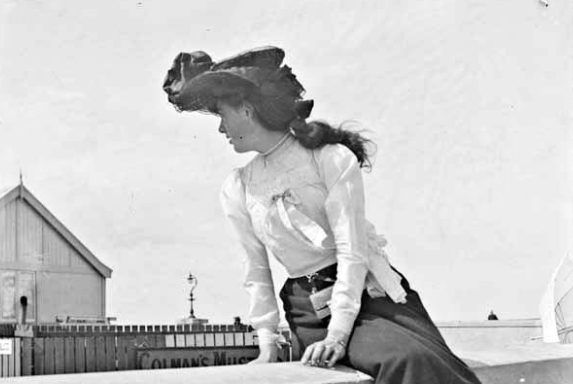
The Google Cultural Institute has drawn our attention before, with its virtual exhibitions on the rise of the Eiffel Tower, the fall of the Iron Curtain, and many other notable chapters of human history. Today, take a look at a Google Cultural Institute gallery that has a foot in literature as well as in history, Dubliners: the Photographs of J.J. Clarke from the National Library of Ireland. Subtitled “a glimpse of James Joyce’s Dublin,” the online show presents pictures taken by this fellow Clarke at the turn of the 20th century, when he came to the Irish capital to study medicine. His “photojournalistic approach to his subjects allowed him to capture vivid scenes from the daily lives of Dublin’s men, women and children.”

This made Clarke a contemporary of Joyce, and so his “images also show us how the city looked” to the writer “whose best known works — the short story collection Dubliners, and the novels A Portrait of the Artist as a Young Man and Ulysses — are all set around that time, when Joyce too was a young student fascinated by the world around him.”
Both the photographer and the novelist, in their separate forms, set about capturing the city, the era, and the culture around them, and the pictures of Clarke’s featured at the Google Cultural Institute could easily illustrate any of Joyce’s books.
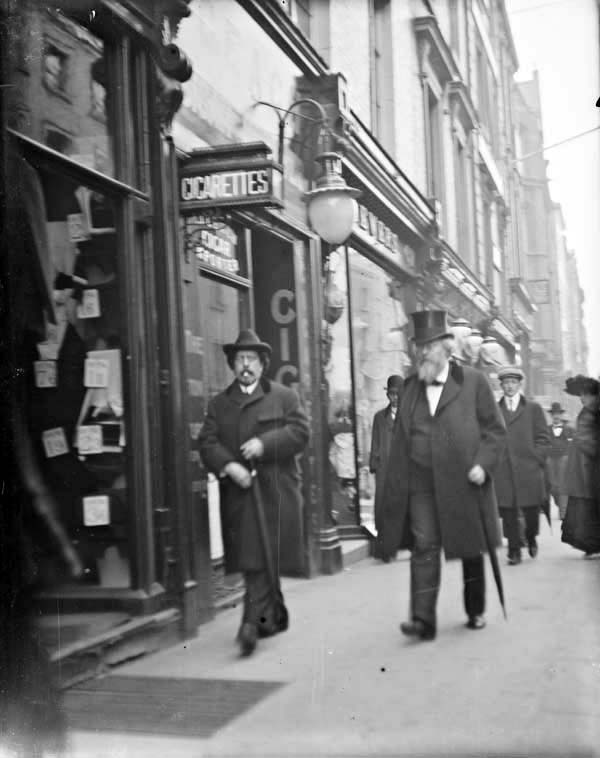
I’ve long enjoyed repeating the observation that, had the real Dublin crumbled, we could rebuild it from the details given in Ulysses — or at least we could rebuild the Dublin of 1904. But I now accept that having on hand Clarke’s photographs, about which you can learn much more at the National Library of Ireland’s site, they would greatly speed the reconstruction process as well. All of the Joycean texts mentioned above can be found in our collection of Free Audio Books and Free eBooks.
Related Content:
Vladimir Nabokov Creates a Hand-Drawn Map of James Joyce’s Ulysses
James Joyce, With His Eyesight Failing, Draws a Sketch of Leopold Bloom (1926)
James Joyce Reads ‘Anna Livia Plurabelle’ from Finnegans Wake
Colin Marshall hosts and produces Notebook on Cities and Culture and writes essays on literature, film, cities, Asia, and aesthetics. He’s at work on a book about Los Angeles, A Los Angeles Primer. Follow him on Twitter at @colinmarshall.
Read More...Jerry Garcia Talks About the Birth of the Grateful Dead & Playing Kesey’s Acid Tests in New Animated Video
Before the Grateful Dead recorded their classic eponymous country psych album, before they were the Grateful Dead, they were the Warlocks, “playing the divorcees bars up and down the peninsula,” Jerry Garcia tells us above. Their booking agent “used to book strippers and dog acts and magicians and everybody else.” Their first few gigs “sounded like hell,” says Garcia, “very awful.” In this Blank-on-Blank-animated 1988 interview with former Capital-EMI record executive Joe Smith, Garcia gets into the origin of their name (a story involving the East Coast Warlocks, who might have sued. What he doesn’t mention is that the Velvet Underground—inventors of East Coast psych—also played at that time as the Warlocks.)
Smith was with Warner Bros. when the Dead were signed in 1967. His relationship with the band then was frustrated, and he went so far as to call the recording of their second album “the most unreasonable project with which we have ever involved ourselves.” But this conversation is a funny, cordial exchange between two very affable people with surprisingly good memories of the time (Smith also once said the Dead “could have put me in the hospital for the rest of my life”). Jerry tells the story of their invitation to Merry Prankster and psychedelic genius Ken Kesey’s acid test parties in La Honda, California. It’s more or less the history of the West Coast acid rock scene and its apotheosis at Haight-Ashbury, so kind of essential watching, I’d say, but at less than six minutes, you can afford to be the judge.
Related Content:
Ken Kesey Talks About the Meaning of the Acid Tests in a Classic Interview
UC Santa Cruz Opens a Deadhead’s Delight: The Grateful Dead Archive is Now Online
The Grateful Dead Rock the National Anthem at Candlestick Park: Opening Day, 1993
Library of Congress Releases Audio Archive of Interviews with Rock ‘n’ Roll Icons
Josh Jones is a writer and musician based in Durham, NC. Follow him at @jdmagness
Read More...T.S. Eliot’s “The Love Song of J. Alfred Prufrock” Gets Adapted As a Comic Book
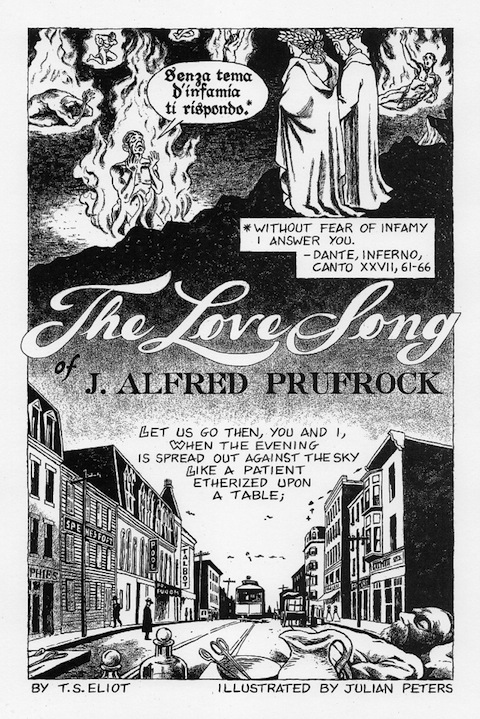
Poetry is as close as written language comes to the visual arts but, aside from narrative poems, it is not a medium easily adapted to visual forms. Perhaps some of the least adaptable, I would think, are the high modernists, whose obsessive focus on technique renders much of their work opaque to all but the most careful readers. The major poems of T.S. Eliot perhaps best represent this tendency. And yet comic artist Julian Peters is up to the challenge. Peters, who has previously adapted Poe, Keats, and Rimbaud, now takes on Eliot’s “The Love Song of J. Alfred Prufrock,” and you can see the first nine pages at his site.
Written in 1910 and published five years later, “Prufrock” has become a standard reference for Eliot’s doctrine of the “objective correlative,” a concept he defines in his critical essay, “Hamlet and His Problems,” as “a set of objects, a situation, a chain of events which shall be the formula of that particular emotion.” It’s a theory he elaborates in “Tradition and the Individual Talent” in his discussion of Dante. And Dante is where “Prufrock” begins, with an epigraph from the Inferno. Peters’ first page illustrates the agonized speaker of Dante’s lines, Guido da Montefeltro, a soul confined to the eighth circle, whom you can see at the top of the title page shown above. Peters’ visual choices place us firmly in the hellish emotional realm of “Prufrock,” a seeming catalogue of the mundane that harbors a darker import. Peters gives us no hint of when we might expect new pages, but I for one am eager to see more.
via The Rumpus
Related Content:
Hear Gertrude Stein Read Works Inspired by Matisse, Picasso, and T.S. Eliot (1934)
Josh Jones is a writer and musician based in Durham, NC. Follow him at @jdmagness
Read More...Support Us
We're hoping to rely on loyal readers, rather than erratic ads. Please click the Donate button and support Open Culture. You can use Paypal, Venmo, Patreon, even Crypto! We thank you!

About Us

Open Culture scours the web for the best educational media. We find the free courses and audio books you need, the language lessons & educational videos you want, and plenty of enlightenment in between.
Advertise With Us

FREE UPDATES!
GET OUR DAILY EMAIL
Get the best cultural and educational resources on the web curated for you in a daily email. We never spam. Unsubscribe at any time.
FOLLOW ON SOCIAL MEDIA

Open Culture editor Dan Colman scours the web for the best educational media. He finds the free courses and audio books you need, the language lessons & movies you want, and plenty of enlightenment in between.
Advertise With Us


