Hear All of Finnegans Wake Read Aloud: A 35 Hour Reading
After the publication and eventual triumph of Ulysses, James Joyce spent the remainder of his life working secretively on a “Work in Progress” that he would publish in 1939 as Finnegans Wake, a novel that largely abandons the trappings of the novel and should better be called, as Anthony Burgess called it, a prose-poem—a beast that strikes the common reader as, in Burgess’ words, “too literary” and “horribly opaque.” My first encounter with this most intimidating book felt like something between hearing Italian comedian Adriano Celentano’s rapturously gibberish approximation of the sound of English in song and Michael Chabon’s detection of a “faintly Tolkienesque echo.” Like Chabon, I too could “hear the dreaming suspirations of the princess who lay sleeping in its keep.” Yet I was a bit too old for fantasy, I thought, and far too out of my depth in Joyce’s invented language, built, Burgess writes, “on the freshly uncovered roots of English.”
I’ve never lost my fear of the book, and never found it accommodating to any narrative sense. And it is fearful and unaccommodating if one approaches it like a conventional novel that will yield its secrets eventually and reward the diligent reader with some sort of singular payoff. Nevertheless, the sheer pleasure one can derive—conventional expectations duly set aside—from the almost tactile quality of Joyce’s prose, its earthy, ancient, elven sounds, seems more to the point of appreciating this odd, frustrating work. Perhaps, like any well-written poem, one simply needs to hear it read aloud. Joyce himself said so, and so you can. Ubuweb brings us the entirety of Patrick Healy’s reading of the text, recorded over a four-day period in 1992 at Dublin’s Bow Lane Recording Studios. (You can hear a small opening segment above.) Healy’s reading is not without its faults—he rushes and stumbles at times—but that seems a mean commentary on a recording of this length and difficulty. Listen to the first installment above and the rest here. You may just have an epiphany or two.
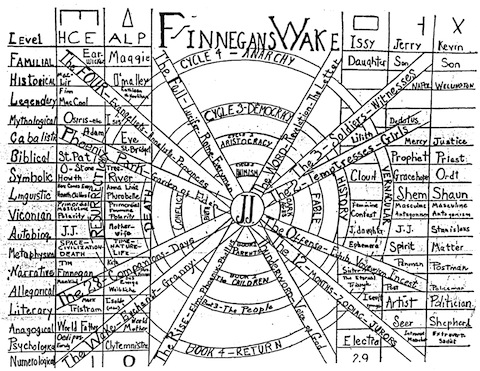
(Diagram above by Hungarian artist László Moholy-Nagy)
Related Content:
James Joyce Reads ‘Anna Livia Plurabelle’ from Finnegans Wake
See What Happens When You Run Finnegans Wake Through a Spell Checker
Hear Joey Ramone Sing a Piece by John Cage Adapted from James Joyce’s Finnegans Wake
Free eBooks: Read All of Proust’s Remembrance of Things Past on the Centennial of Swann’s Way
550 Free Audio Books: Download Great Books for Free
Josh Jones is a writer and musician based in Durham, NC. Follow him at @jdmagness
Read More...Free eBooks: Read All of Proust’s Remembrance of Things Past
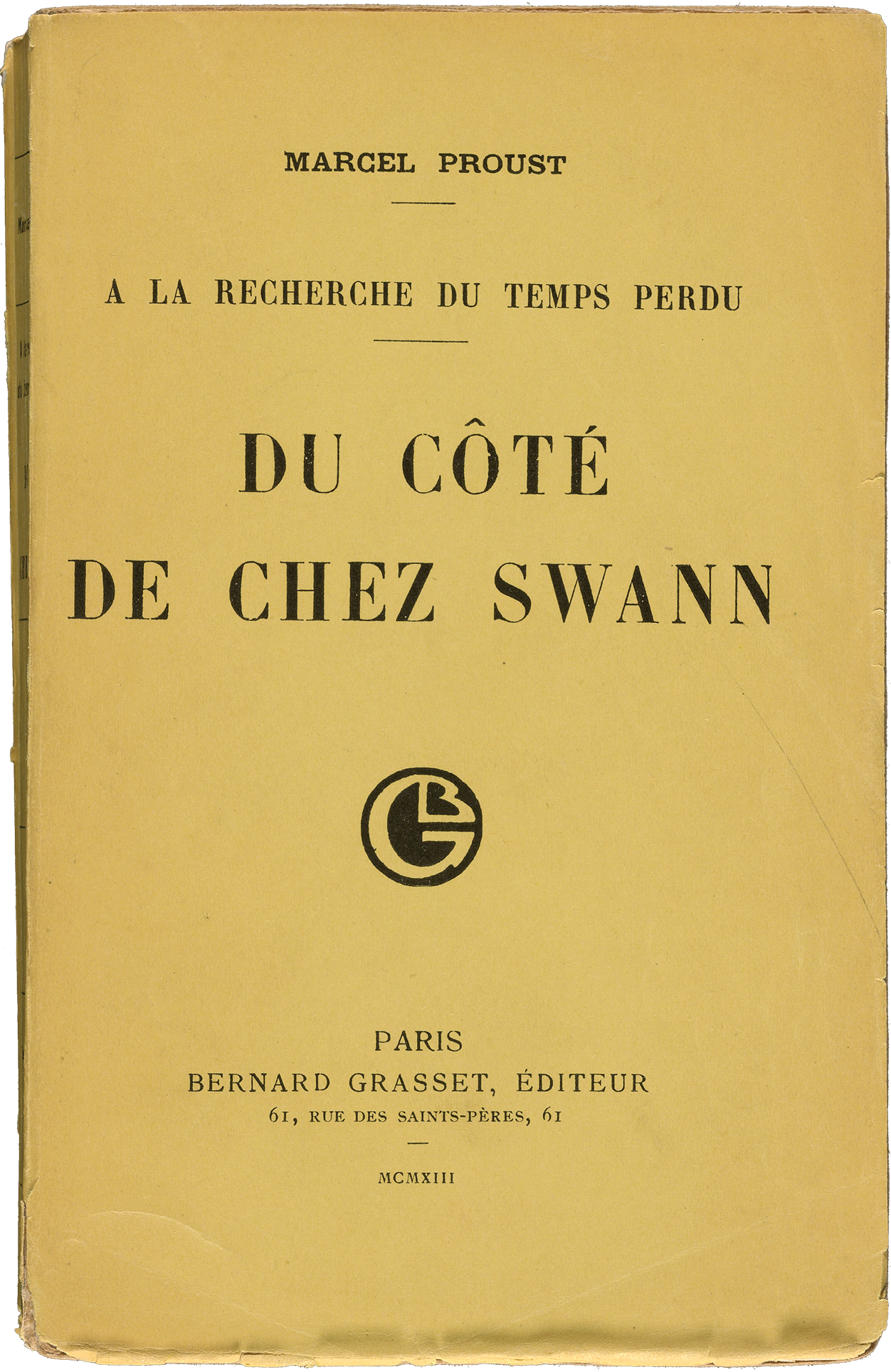
“We seem to be reaching a point in history where Ulysses (1922) is talked or written about more than read,” writes Wayne Wolfson at Outsideleft in an essay on James Joyce and Marcel Proust, whose Swann’s Way, the first in his seven-volume cycle Remembrance of Things Past (À la recherche du temps perdu), turns 100 today. This observation might have applied to Proust’s enormous modernist feat at all times in its history. Though Proust was fêted by high culture patrons and writers like Violet and Sydney Schiff, it’s hard to imagine these busy socialites secluding themselves for several months to catch up with a 4,000-page modernist masterwork. As French crime novelist Frédérique Molay glibly observes, “[Remembrance of Things Past] corresponds to a lot of lost time.”
Molay also points out that Proust’s friend and rival André Gide “didn’t like the manuscript, calling it ‘incomprehensible.’” Gide only saw volume one, Swann’s Way, though whether he actually read it or not is in some dispute. In any case, after Gide’s rejection, Proust’s publishing options narrowed to Bernard Grasset (Proust footed the bill for printing), with whom, notes The Independent, the author “engaged in a tortuous pas de deux… for most of 1913.” The back and forth included the “elaborate to-and-fro of his labyrinthine galley-proofs” (see an example above, and more here). And yet, The Independent goes on,
Swann’s Way at last appeared on 14 November in an edition of 1,750 copies (for which Proust paid more than 1,000 francs). A familiar kind of literary myth would suggest that, after a difficult birth, such a groundbreaking work must sink without trace. On the contrary.
Indeed. As a young grad student, I once walked in shame because—gasp—I had read no Proust. Not a word. I vaguely associated the name with French modernism, with a languorous, self-indulgent kind of writing that a reader like myself at the time, with a taste for the knotty, gnarled, and grotesque—for Faulkner and O’Connor, Hardy, Melville, and yes, Joyce—found disagreeable. I’d avoided Proust thus far, I reasoned, no need to rend my veil of ignorance now. Later, I defaulted to Molay’s glibness. Shrug, who has the time?
But today I feel I should revise that conclusion, at the very least because a bandwagon full of highly respected names has turned up to celebrate Proust’s achievement—or its nominal birthdate—including Ira Glass, pastry chef Dominique Ansel, who will bake madeleines (and who invented the Cronut), and novelist Rick Moody. These are but three of a cloud of “Proust fans of all kinds” participating in a “nomadic reading” of Swann’s Way in New York. It’s a showy affair, with readers gathering “over madeleines and champagne, in hotel rooms, gardens and nightclubs, from the Bronx to Brooklyn.”
By contrast, Antonin Baudry, one of the event’s organizers tells us, “In France, ordinary people are more likely just to read Proust at home.” (You can see clips of everyday French people reading Proust here, in fact.) Given the famously hypochondriac and reclusive author’s penchant, I may also spend the day at home, reading Proust, in bed, inspired also by Rick Moody’s observation: “As a young writer, I felt there were two kinds of people: Joyce people and Proust people.… For a long time, I would’ve asserted my allegiance to Joycean qualities. But in my galloping middle age, Proust calls to me more fervently.”
If you feel likewise inspired today, you can read all of Proust’s literary feast—or just sample it in bites. Find links to all seven volumes of Remembrance of Things Past below. They’re otherwise housed in our collection, 800 Free eBooks for iPad, Kindle & Other Devices.
- Swann’s Way
- Within a Budding Grove
- The Guermantes Way
- Cities on the Plain
- The Captive
- The Sweet Cheat Gone
- Time Regained
And you francophones can read the novel in its original language online here. Or listen to an audio version here.
Related Content:
Listening to Proust’s Remembrance of Things Past, (Maybe) the Longest Audio Book Ever Made
Watch Monty Python’s “Summarize Proust Competition” on the 100th Anniversary of Swann’s Way
Hear All of Finnegans Wake Read Aloud: A 35 Hour Reading
Josh Jones is a writer and musician based in Durham, NC. Follow him at @jdmagness
Read More...The Art & Science of Bike Design: A 5‑Part Introduction from the Open University
In 2012, Bradley Wiggins became the first English cyclist to win the granddaddy of all cycling races, the Tour de France. In 2013, Chris Froome became the second. After back-to-back victories, the Brits have every reason to celebrate, and perhaps that’s why the Open University created The Science Behind the Bike earlier this year — a series of four short videos exploring how science has changed the physics, technology and physiology of cycling. Now, still giddy, they’ve followed up with a five-part video series called The Design Behind the Bike. Even if you’re down on cycling as a professional sport, you can still appreciate the artistry that goes into making an elegant bike. Watch the entire series in one sitting above, or catch the individual installments here: History of Bikes & Bikes Design, The Aesthetics, Wheels, Materials, and Frame Design. All clips can be found on YouTube and iTunes too.
Related Content:
Science Behind the Bike: Four Videos from the Open University on the Eve of the Tour de France
Brussels Express: The Perils of Cycling in Europe’s Most Congested City
David Byrne: From Talking Heads Frontman to Leading Urban Cyclist
Read More...16-Year-Old Marcel Proust Tells His Grandfather About His Misguided Adventures at the Local Brothel
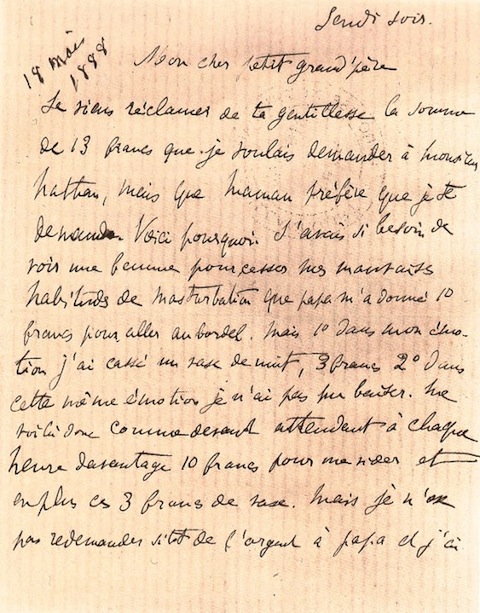
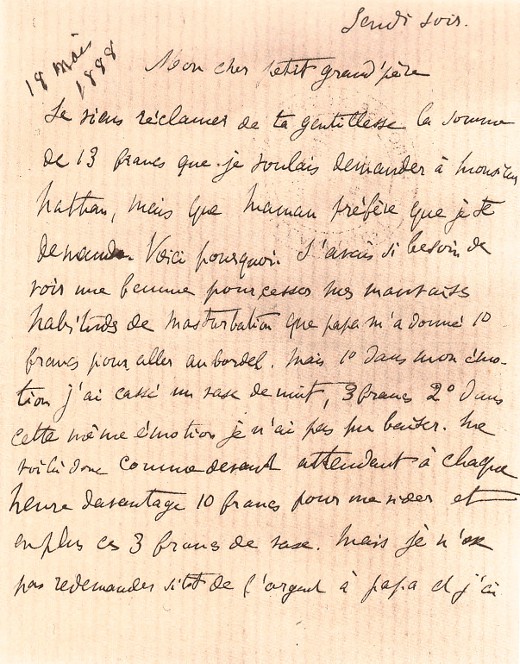
“One can say anything so long as one does not say ‘I.’ ” Marcel Proust wrote these words to his fellow Frenchman of letters André Gide, and they constitute valuable advice for any novelist as well as a useful key to understanding Proust’s own work. We think of Proust — especially today, the hundredth anniversary of Swann’s Way, which opens his masterwork Remembrance of Things Past (À la recherche du temps perdu) — as an important French novelist, an important modern novelist, an important fin-de-siècle novelist, and so on. We also think of Proust as an important gay novelist. And we owe that, in some sense, to Gide, who revealed the closeted Proust’s homosexuality in their published correspondence after Proust’s death. Sexuality has since become a major element of the robust field of Proust criticism, and the letter above surely gives its scholars material — or at least those scholars willing to examine the author’s biography alongside his work.
The author of Remembrance of Things Past once suffered, according to Letters of Note, from an obsession with masturbation. “As a teenager this caused problems for his family, not least his father, a professor of hygiene, who like many of the day believed that such a worrying habit could cause homosexuality if left unchecked.” Given 10 francs by Proust père, Marcel went off to the neighborhood brothel to, in theory, get himself set straight. And the outcome of this “cure”? We defer to the sixteen-year-old Proust himself, who in the letter above tells the whole sordid story to his grandfather:
18 May 1888
Thursday evening.
My dear little grandfather,
I appeal to your kindness for the sum of 13 francs that I wished to ask Mr. Nathan for, but which Mama prefers I request from you. Here is why. I so needed to see if a woman could stop my awful masturbation habit that Papa gave me 10 francs to go to a brothel. But first, in my agitation, I broke a chamber pot: 3 francs; then, still agitated, I was unable to screw. So here I am, back to square one, waiting more and more as hours pass for 10 francs to relieve myself, plus 3 francs for the pot. But I dare not ask Papa for more money so soon and so I hoped you could come to my aid in a circumstance which, as you know, is not merely exceptional but also unique. It cannot happen twice in one lifetime that a person is too flustered to screw.
I kiss you a thousand times and dare to thank you in advance.
I will be home tomorrow morning at 11am. If you are moved by my situation and can answer my prayers, I will hopefully find you with the amount. Regardless, thank you for your decision which I know will come from a place of friendship.
Marcel.
Many thanks to Letters of Note for uncovering this illuminating and — intentionally? unintentionally? — comedic piece of correspondence from literary history, and to Fabien Bonnet and Larst Onovich, to whom Letters of Note, in turn, gives credit.
Related Content:
Watch Monty Python’s “Summarize Proust Competition” on the 100th Anniversary of Swann’s Way
Listening to Proust’s Remembrance of Things Past, (Maybe) the Longest Audio Book Ever Made
Free eBooks: Read All of Proust’s Remembrance of Things Past on the Centennial of Swann’s Way
Colin Marshall hosts and produces Notebook on Cities and Culture and writes essays on literature, film, cities, Asia, and aesthetics. He’s at work on a book about Los Angeles, A Los Angeles Primer. Follow him on Twitter at @colinmarshall.
Read More...The Black Rider: A Theatrical Production by Tom Waits, William S. Burroughs & Robert Wilson (1990)
Yes, you read correctly: there exists a piece of theater whose production brought together three of the most ardently-followed, iconoclastic creators of recent decades. First staged in 1990 at Hamburg’s Thalia Theater, The Black Rider: The Casting of the Magic Bullets appeared as the fruit of multidisciplinary labor from renowned avant-garde director Robert Wilson, best known for extra-long-form productions like Einstein on the Beach, created with Philip Glass; raggedly American singer-songwriter Tom Waits, a musician with no small theatrical bent himself; and William S. Burroughs, writer of Naked Lunch, Junkie, and other texts that have blown away generations of counterculturally inclined reading minds. They based their tale of a hapless young file clerk in love and his fateful pact with the devil on the German folktale-cum-opera Der Freischütz. Hence the work’s premiere in Germany, and the German dialogue in the television version of the full production above.
But worry not, non-Germanophones; the Waits-composed songs remain in English, and as with anything directed by Wilson, you buy the ticket as much to a striking pure visual experience as to anything else. You can hear and see more from Waits and Wilson about what went into The Black Rider in the half-hour TV documentary just above. (The narrator may speak German, but everyone else involved speaks English.) For a pure musical experience of The Black Rider, pull up Waits’ eponymous album, released in 1993. (See also the bootleg The Black Rider Outtakes.) And now, with twenty years’ distance from The Black Rider’s American debut, maybe we can put the question to ourselves of whether it counts as a streak of poor taste or a stroke of artistic genius to have Burroughs, of all people, pen his own version of a story that — spoiler alert — ends with the protagonist fated to shoot his own bride.
Related Content:
Johnny Depp: A Voom Portrait by Robert Wilson
Watch Big Time, the Concert Film Capturing Tom Waits on His Best Tour Ever (1988)
Colin Marshall hosts and produces Notebook on Cities and Culture and writes essays on literature, film, cities, Asia, and aesthetics. He’s at work on a book about Los Angeles, A Los Angeles Primer. Follow him on Twitter at @colinmarshall.
Read More...Everything You Wanted to Know About the L.A. Aqueduct That Made Roman Polanski’s Chinatown Famous: A New UCLA Archive

Next year marks the 40th anniversary of a modern classic, Roman Polanski’s Chinatown. And surely no other film has even come close to making the construction of an aqueduct so thrilling.
For sure, the sizable servings of incest, corruption, and greed help carry Robert Towne’s brilliant screenplay. But under Towne’s script are the bones of another story, the story of an engineering feat that eclipsed the Panama Canal. Yes we’re talking about the building of the great Los Angeles aqueduct starting in 1908.
In the preface to the script Towne wrote this, “the great crimes in California have been committed against the land—and against the people who own it and future generations. It was only natural that the script should evolve into the story of a man who raped the land and his own daughter.”
Towne didn’t worry about sticking to the facts (he set the action of Chinatown in the 1930s—an inherently more glamorous period, especially in Los Angeles). Some even argue that the film creates an entirely different (and wrong) history of the project that is remembered as fact.
UCLA has created the Los Angeles Aqueduct Digital Platform, a collection of articles, maps, images and general history of the project and time that sets the record straight. Among its greatest resources are those about the film that made Southern California’s water issues famous. In fact, there is an abundance of information about the film itself, even if it wasn’t historically accurate.
There are links to, among other resources, a conversation with Robert Towne where he discusses his inspiration for the screenplay.
Kate Rix writes about digital media and education. Follow her on Twitter.
Read More...Designers of the Invisible Bike Helmet Describe Their Revolutionary Product in Short Documentary
It’s been all over the news recently: two Swedish design students, Anna Haupt and Terese Alstin, have created what they call an “invisible bike helmet.” This description is a little misleading. The Hövding, as it’s been branded, is not invisible so much as it’s contained, in a puffy, high tech collar, as an airbag that deploys upon impact and protects the wearer from the typical head trauma cyclists suffer in accidents.
Working with a head trauma specialist and staging accidents to collect movement patterns, Haupt and Alstin defiantly took on what they saw as a male-dominated design establishment. “Easy,” they say, “it only took us seven years.” They raised ten million dollars and pushed forward with a certain amount of Scandinavian bravado. The short doc above opens with a few quotes from the pair. “We’re going to save the world,” they tell us, “it’s chicken to be a realist.” Upon seeing their design, they say, a professor remarked (in English), “I have to sit down… you’re going to be millionaires.”
Haupt and Alstin’s bombast is seductive, but the product may not live up to the hype quite yet. As Tech Crunch reported last year, “Hövding costs $600 and only works once. There’s also been some complaints about the design and an early version had trouble with the zipper.” Nonetheless, it’s still an amazing invention that will only improve with future real world testing. At present, it could save the lives of those well-heeled cyclists who can’t stand to wear clunky, traditional bike helmets. In Europe, at least, where the helmet is currently for sale and safety approved.
The video above was made by director Fredrik Gertton, who has successfully Kickstarted an advocacy film he calls Bikes Vs. Cars that seems well worth a look for those concerned about the future of urban transportation.
Related Content:
Science Behind the Bike: Four Videos from the Open University on the Eve of the Tour de France
Brussels Express: The Perils of Cycling in Europe’s Most Congested City
David Byrne: From Talking Heads Frontman to Leading Urban Cyclist
Josh Jones is a writer and musician based in Durham, NC. Follow him at @jdmagness
Read More...Timothy Leary Plans a Neuromancer Video Game, with Art by Keith Haring, Music by Devo & Cameos by David Byrne
Few science fiction novels have resonated as strongly with popular culture as William Gibson’s Neuromancer (1984). The book, wherein the first trickles of Internet culture coalesced into the gritty film noir world so dear to readers of Philip K. Dick, became one of the seminal reads of the 1980s. The cyberpunk genre was born.
Since its appearance, Gibson’s work has continuously echoed in popular culture. While movies have tried to distill his impending, tech-filled dystopianism, the most appropriate, if not the most striking tributes, have come in the form of video games. From 1993’s Shadowrun, to the somber mix of conspiracy and technology of the Deus Ex trilogy, video games were inherently suited to the visual portrayal of cyberpunk. The most ambitious of these was spearheaded by one of counterculture’s most prominent proponents: Dr. Timothy Leary.
Leary is best known as the psychologist who championed LSD and psilocybin use, engaging in meticulous research—both personal and professional—of their effects. By the 1980s, the same Leary who had popularized the phrase “turn on, tune in, drop out” was now proselytizing computer use with the phrase “turn on, boot up, jack in.” To those who doubted his about-face, Leary declared, “the PC is the LSD of the 1990s.”

In addition to having created several transcendental computer games of his own design (a version of Mind Mirror, where players improve their personalities, sold 65,000 copies under Electronic Arts, and is available on Facebook), Leary had plans to build a formidable version of Neuromancer. As you can see in this clip, he was an ardent Gibson fan; not surprising, considering the self-betterment that emerged from the fusion of technology and humanity in Gibson’s work.
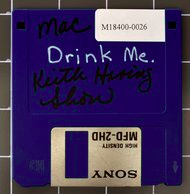 In the clip above, the New York Public Library’s Donald Mennerich discusses his archival work on Leary’s unfinished game, which was recently unearthed by Leary’s estate. Although he had made little headway, Leary had a grandiose design for his “mind movie:” Devo would handle the music, Keith Haring would take care of the visuals, and Helmut Newton would include his photography. Two characters were based on Grace Jones and David Byrne. The story was to be written by Leary, alongside William S. Burroughs.
While Leary’s Neuromancer failed to materialize, a version of the game was later made by Interplay. Although most of the big names had dropped off the roster, Devo’s “Some Things Never Change” was still used as the theme. And, while Leary’s oeuvre lies in the archives, the gameplay from Interplay’s version, seen here, is still good for a hit of ‘80s nostalgia.
Via Kotaku
Related Content:
How to Operate Your Brain: A User Manual by Timothy Leary (1993)
Free Philip K. Dick: Download 13 Great Science Fiction Stories
Beyond Timothy Leary: 2002 Film Revisits History of LSD
Read More...Watch Animated Sheet Music for Miles Davis’ “So What,” Charlie Parker’s “Confirmation” & Coltrane’s “Giant Steps”
Miles Davis’ Kind of Blue changed jazz. It changed music, period. So I take it very seriously. But when I see the animated sheet music of the first cut, “So What,” I can’t help but think of Charles Schultz’s Peanuts cartoons, and their Vince Guaraldi compositions. I mean no offense to Miles. His modal jazz swings, and it’s fun, as fun to listen to as it is to watch in rising and falling arpeggios. The YouTube uploader, Dan Cohen, gives us this on his channel Animated Sheet Music, with apologies to Jimmy Cobb for the lack of drum notation.
Also from Cohen’s channel, we have Charlie Parker’s music animated. Never one to keep up with his admin, Parker left his estate unable to recuperate royalties from compositions like “Confirmation” (above).
Nonetheless, everyone knows it’s Bird’s tune, and to see it animated above is to see Parker dance a very different step than Miles’ post-bop cool, one filled with complex melodic paragraphs instead of chordal phrases.
And above, we have John Coltrane’s massive “Giant Steps,” with its rapid-fire bursts of quarter notes, interrupted by half-note asides. Coltrane’s iconic 1960 composition displays what Ira Gitler called in a 1958 Downbeat piece, “sheets of sound.” Gitler has said the image he had in his head was of “bolts of cloth undulating as they unfurled,” but he might just as well have thought of sheets of rain, so multitude and heavy is Coltrane’s melodic attack.
See Cohen’s Animated Sheet Music channel for two more Charlie Parker pieces, “Au Privave” and “Bloomdido.”
If you would like to support the mission of Open Culture, consider making a donation to our site. It’s hard to rely 100% on ads, and your contributions will help us continue providing the best free cultural and educational materials to learners everywhere. You can contribute through PayPal, Patreon, and Venmo (@openculture). Thanks!
Related Content:
John Coltrane’s Handwritten Outline for His Masterpiece A Love Supreme
Josh Jones is a writer and musician based in Durham, NC. Follow him at @jdmagness
Read More...Joseph Brodsky’s List of 83 Books You Should Read to Have an Intelligent Conversation
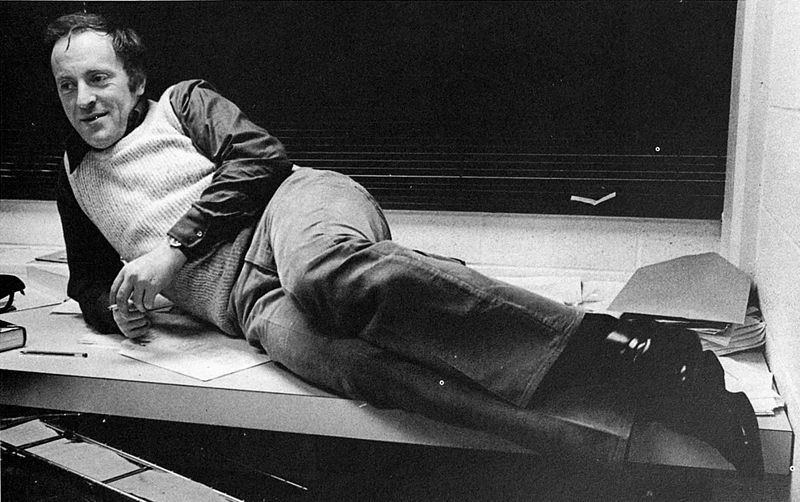
Image via Wikimedia Commons
In 1955, a mere two months into eighth grade, a 15-year-old teenager dropped out of a Leningrad school. He had already repeated seventh grade; the thought of another boring year was unbearable. He wandered into work at a factory, but only lasted six months. For the next seven years, he drifted in and out of menial jobs at a lighthouse, a crystallography lab, and a morgue. For a time, he worked as a manual laborer on geological expeditions and as a stoker at a public bathhouse. Still, it wasn’t a wholly inauspicious start—by the end of his life, he had taught at Yale, Columbia, Cambridge, Michigan, and Mount Holyoke. He had also been awarded the Nobel Prize for literature.
Despite spurning his own formal education, Russian poet and Soviet dissident Joseph Brodsky immediately rose to the highest academic echelon when he arrived in America in 1972. By all accounts, the autodidact held his classes to a high standard, frequently dismissing any student arguments about literary greatness unless they centered on Milosz, Lowell, or Auden.
Monica Partridge, a former student in his class, told Open Culture, “I took a poetry class with [Joseph Brodsky] at Mount Holyoke College my freshman year… It was all 19th [century] Russian poetry, and he would give us four pages of poems to memorize overnight. We would have to come in the next [morning] and transcribe the poems we had memorized. Very Russian.”
No less impressive was the list of books that Brodsky distributed to Partridge’s class.
1. Bhagavad Gita
2. Mahabharata
3. Gilgamesh
4. The Old Testament
5. Homer: Iliad, Odyssey
6. Herodotus: Histories
7. Sophocles: Plays
8. Aeschylus: Plays
9. Euripides: Plays (Hippolytus, The Bachantes, Electra, The Phoenician Women)
10. Thucydides: The Peloponnesian War
11. Plato: Dialogues
12. Aristotle: Poetics, Physics, Ethics, De Anima
13. Alexandrian Poetry: The Greek Anthology
14. Lucretius: On the Nature of Things
15. Plutarch: Lives [presumably Parallel Lives]
16. Virgil: Aeneid, Bucolics, Georgics
17. Tacitus: Annals
18. Ovid: Metamorphoses, Heroides, Amores
19. The New Testament
20. Suetonius: The Twelve Caesars
21. Marcus Aurelius: Meditations
22. Catullus: Poems
23. Horace: Poems
24. Epictetus: Discourses
25. Aristophanes: Plays
26. Claudius Aelianus: Historical Miscellany, On the Nature of Animals
27. Apollonius Rhodius: Argonautica
28. Michael Psellus: Fourteen Byzantine Rulers
29. Edward Gibbon: The Rise and Fall of the Roman Empire
30. Plotinus: The Enneads
31. Eusebius: Ecclesiastical History
32. Boethius: Consolations of Philosophy
33. Pliny the Younger: Letters
34. Byzantine verse romances
35. Heraclitus: Fragments
36. St. Augustine: Confessions
37. Thomas Aquinas: Summa Theologica
38. St. Francis of Assisi: The Little Flowers
39. Niccolò Machiavelli: The Prince
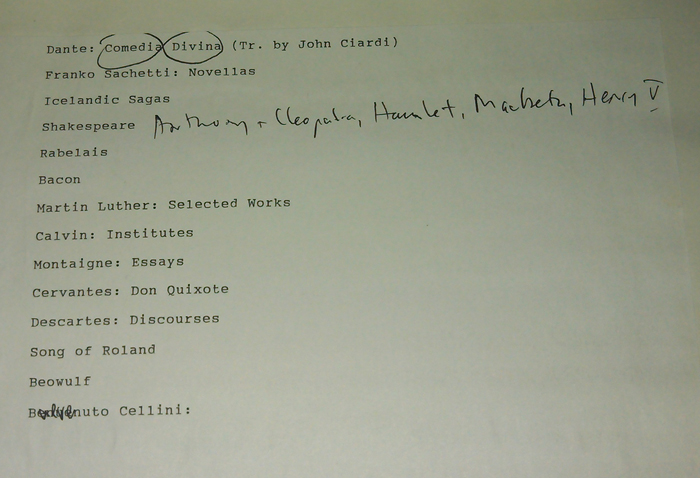
40. Dante Alighieri: Divine Comedy (Tr. By John Ciardi)
41. Franco Sacchetti: Novelle
42. Icelandic sagas
43. William Shakespeare (Anthony and Cleopatra, Hamlet, Macbeth, Henry V)
44. François Rabelais
45. Francis Bacon
46. Martin Luther: Selected Works
47. John Calvin: Institutio Christianae religionis
48. Michel de Montaigne: Essays
49. Miguel de Cervantes: Don Quixote
50. René Descartes: Discourses
51. Song of Roland
52. Beowulf
53. Benvenuto Cellini
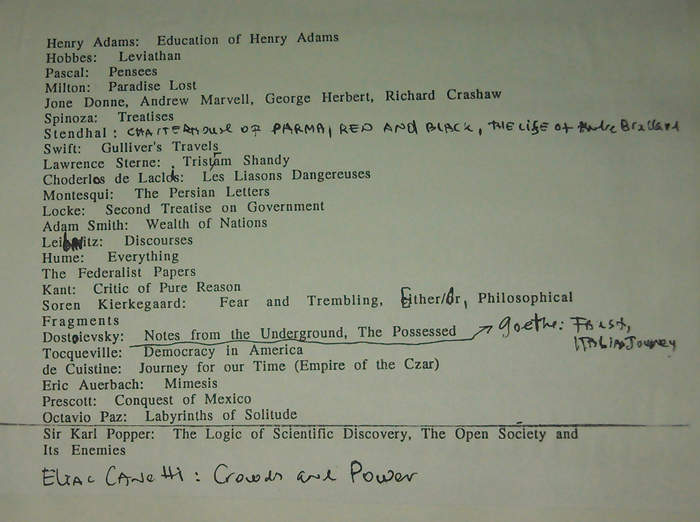
54. Henry Adams: Education of Henry Adams
55. Thomas Hobbes: The Leviathan
56. Blaise Pascal: Pensées
57. John Milton: Paradise Lost
58. John Donne
59. Andrew Marvell
60. George Herbert
61. Richard Crashaw
62. Baruch Spinoza: Treatises
63. Stendhal: Charterhouse of Parma, Red and Black, The Life of Henry Brulard
64. Jonathan Swift: Gulliver’s Travels
65. Laurence Sterne: Tristram Shandy
66. Choderlos de Laclos: Les Liaisons Dangereuses
67. Baron de Montesquieu: Persian Letters
68. John Locke: Second Treatise on Government
69. Adam Smith: The Wealth of Nations
70. Gottfried Wilhelm Leibniz: Discourse on Metaphysics
71. David Hume: Everything
72. The Federalist Papers
73. Immanuel Kant: Critique of Pure Reason
74. Søren Kierkegaard: Fear and Trembling, Either/Or, Philosophical Fragments
75. Fyodor Dostoevsky: Notes From the Underground, The Possessed
76. Alexis de Tocqueville: Democracy in America
77. Johann Wolfgang von Goethe: Faust, Italian Journey
78. Astolphe-Louis-Léonor, Marquis de Custine: Empire of the Czar: A Journey Through Eternal Russia
79. Eric Auerbach: Mimesis
80. William H. Prescott: Conquest of Mexico
81. Octavio Paz: Labyrinths of Solitude
82. Sir Karl Popper: The Logic of Scientific Discovery, The Open Society and Its Enemies
83. Elias Canetti: Crowds and Power
“Shortly after the class began, he passed out a handwritten list of books that he said every person should have read in order to have a basic conversation,” Partridge writes on the Brodsky Reading Group blog. “At the time I was thinking, ‘Conversation about what?’ I knew I’d never be able to have a conversation with him, because I never thought I’d ever get through the list. Now that I’ve had a little living, I understand what he was talking about. Intelligent conversation is good. In fact, maybe we all need a little more.”
In addition to the poet’s 1988 University of Michigan commencement address that we posted last week, we bring you Joseph Brodsky’s requisite reading list, annotated with the poet’s handwritten notes.
Note: You can click each image to read them in a larger format.

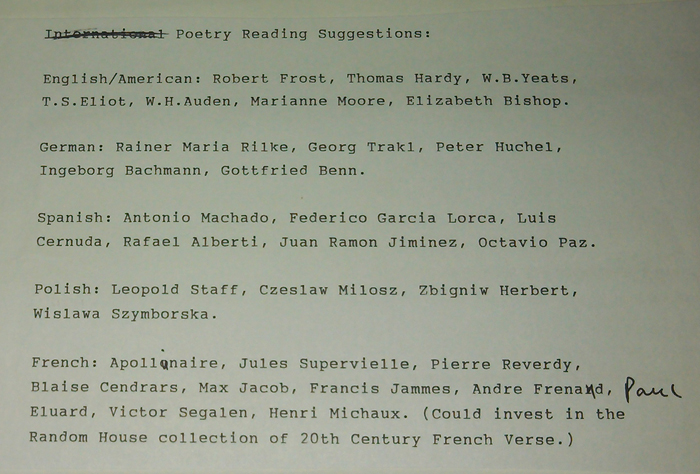
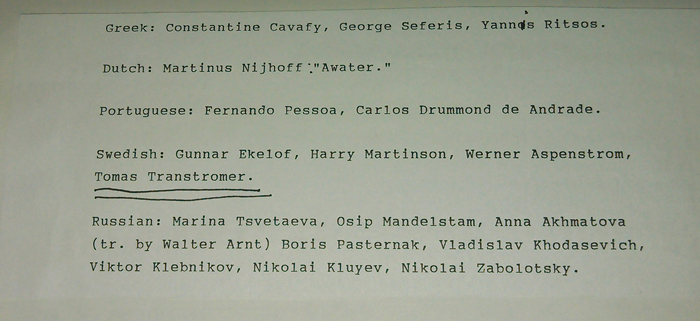
Get reading, friends.
Via Brodsky Reading Group, and with the deepest gratitude to Monica Partridge, who provided photographs of the original. Props go to Stanford for the typed out list of books.
Related Content:
Neil deGrasse Tyson Lists 8 (Free) Books Every Intelligent Person Should Read
Ernest Hemingway’s List for a Young Writer
Carl Sagan’s Undergrad Reading List: 40 Essential Texts for a Well-Rounded Thinker
David Foster Wallace’s 1994 Syllabus: How to Teach Serious Literature with Lightweight Books
Ilia Blinderman is a Montreal-based culture and science write. Follow him at @iliablinderman.
Read More...Support Us
We're hoping to rely on loyal readers, rather than erratic ads. Please click the Donate button and support Open Culture. You can use Paypal, Venmo, Patreon, even Crypto! We thank you!

About Us

Open Culture scours the web for the best educational media. We find the free courses and audio books you need, the language lessons & educational videos you want, and plenty of enlightenment in between.
Advertise With Us

FREE UPDATES!
GET OUR DAILY EMAIL
Get the best cultural and educational resources on the web curated for you in a daily email. We never spam. Unsubscribe at any time.
FOLLOW ON SOCIAL MEDIA

Open Culture editor Dan Colman scours the web for the best educational media. He finds the free courses and audio books you need, the language lessons & movies you want, and plenty of enlightenment in between.
Advertise With Us