Stephen Colbert & Louis CK Recite The Gettysburg Address, With Some Help from Jerry Seinfeld
On a Thursday afternoon in November of 1863, Edward Everett took to the stage in Gettysburg, Pennsylvania, to deliver the main address at the Consecration Ceremony of the National Cemetery. Everett was a politician who had served as both a classics professor and president of Harvard University, and was also a renowned orator. His address to the 15,000-strong crowd began on the following grandiloquent note, which Everett proceeded to hold for two hours:
“Standing beneath this serene sky, overlooking these broad fields now reposing from the labors of the waning year, the mighty Alleghenies dimly towering before us, the graves of our brethren beneath our feet, it is with hesitation that I raise my poor voice to break the eloquent silence of God and Nature. But the duty to which you have called me must be performed; grant me, I pray you, your indulgence and your sympathy.”
Despite this wave of lofty sentiment, Everett’s speech was overshadowed by the 278-word formulation that would forever commemorate that day, delivered by Abraham Lincoln.
Unlike Everett’s remarks, Lincoln’s Gettysburg address (whose five versions can be found here) has shown little wear since its delivery on November 19, exactly 150 years ago. While there is some evidence to suggest that the audience was initially nonplussed by the speech’s simple language and striking brevity, today Lincoln’s words are considered to be among the most finely wrought rhetoric in the Western canon: they remain accessible to all, yet seamlessly entwine the thread of equality that ran so clearly through the Declaration of Independence with the idea of the war being essential to the preservation of the Union. One cannot help but suspect that honest Abe failed to grasp the impact that his pithy oration would have; Everett’s subsequent comments to the President, however, prefigured the speech’s historical arc:
“I should be glad if I could flatter myself that I came as near to the central idea of the occasion, in two hours, as you did in two minutes.”
In honor of the 150th anniversary of Lincoln’s delivery of the Gettysburg address, documentarian Ken Burns has embarked on a project called Learn The Address in an attempt to get Americans to record their recitations of the speech. In the mashup below, Burns provides footage of politicians, entertainers, and journalists giving their renditions. We’ve also included some of our favorites, including Stephen Colbert’s highly comical monologue (top) and Jerry Seinfeld explaining the significance of the address to Louis CK, right above.
For more versions of Lincoln’s Gettysburg address, including those by President Obama, Conan O’Brien, and Bill O’Reilly, head to Ken Burn’s Learn The Address site.
Ilia Blinderman is a Montreal-based culture and science writer. Follow him at @iliablinderman.
Read More...Slavoj Žižek & Pussy Riot’s Nadezhda Tolokonnikova Exchange An Extraordinary Series of Letters
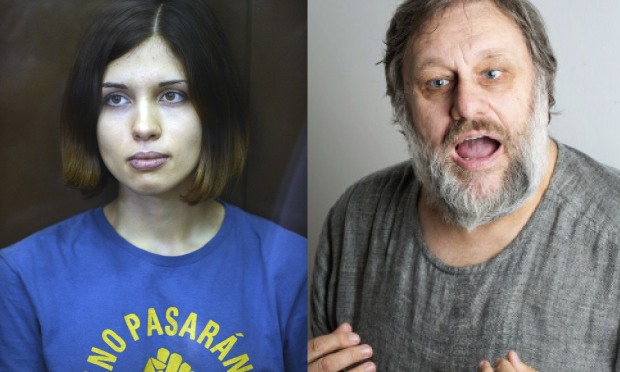
Missing for almost a month, imprisoned Pussy Riot member Nadezhda Tolokonnikova has been reported by her husband as recovering in a Siberian hospital from issues related to her hunger strike. As The Guardian reports, Tolokonnikova didn’t only resist by refusing to eat, she also kept up a lively correspondence with Slovenian theorist Slavoj Žižek while enduring reported abuse at the penal colony in Mordovia where she had been sentenced. It seems from the edited correspondence published by The Guardian that Žižek began the conversation in early January. “All hearts were beating for you” he writes, until “it became clear that you rejected global capitalism.” In a later, April 16 reply, Tolokonnikova explains exactly what Pussy Riot rejects:
As a child I wanted to go into advertising. I had a love affair with the advertising industry. And this is why I am in a position to judge its merits. The anti-hierarchical structures and rhizomes of late capitalism are its successful ad campaign. Modern capitalism has to manifest itself as flexible and even eccentric. Everything is geared towards gripping the emotion of the consumer. Modern capitalism seeks to assure us that it operates according to the principles of free creativity, endless development and diversity. It glosses over its other side in order to hide the reality that millions of people are enslaved by an all-powerful and fantastically stable norm of production. We want to reveal this lie.
Read the full published exchange at The Guardian’s site.
Related Content:
Fear of a Female Planet: Kim Gordon (Sonic Youth) on Why Russia and the US Need a Pussy Riot
Russian Punk Band, Sentenced to Two Years in Prison for Deriding Putin, Releases New Single
Slavoj Žižek Demystifies the Gangnam Style Phenomenon
Josh Jones is a writer and musician based in Durham, NC. Follow him at @jdmagness
Read More...The Big Aha, the Latest Novel by Cyberpunk Writer Rudy Rucker, is Now Out and Free Online
 A quick note: Rudy Rucker, one of the founders of the cyberpunk movement, put himself on the literary map with the Prize-Winning Ware Tetralogy. In the spirit of openness, Rucker has long made the Tetralogy freely available online. Now comes his latest work, The Big Aha, which you can read online in an illustrated format at right this very moment. Released just days ago, the novel (also available in ebook and paperback formats) was funded by 331 backers through a Kickstarter campaign launched earlier this year. For more free sci-fi, please see our rich 2012 post: Free Science Fiction Classics on the Web: Huxley, Orwell, Asimov, Gaiman & Beyond.
via BoingBoing
Related Content:
Revisit Futuria Fantasia: The Science Fiction Fanzine Ray Bradbury Published as a Teenager
Isaac Asimov Recalls the Golden Age of Science Fiction (1937–1950)
Free Philip K. Dick: Download 13 Great Science Fiction Stories
500 Free eBooks: Download to Kindle, iPad/iPhone & Nook
Read More...Hear Ezra Pound Read From His “Cantos,” Some of the Great Poetic Works of the 20th Century
No student of modernism, no lover of modern poetry, can avoid Ezra Pound, or the problem that is Ezra Pound. Although a notorious and enthusiastic booster of Mussolini’s Italian state during the Second World War, Pound’s influence over the shape and character of American literature in the early 20th century always seems to trump his regrettable, if not particularly surprising, politics. T.S. Eliot, James Joyce, H.D.—all are deeply indebted to Pound. His attempts to bridge Eastern and Western aesthetics are profound, and his own poetry, informed by his devotion to Chinese poetics and immersion in the European canon, comprises an often brilliant, generally intimidating body of work.
Over the course of five decades, during each of Pounds’ various phases—as literary impresario, language scholar, editor, and deeply controversial weirdo—he was hard at work on what became known as The Cantos, a long, loosely connected series of poetic chapters in English, Chinese, Italian that were published at various times in various forms. Pound’s travails as the author of this long and exceedingly difficult series may be the reward of a fool and his folly (as his colleagues thought) or the rocky, lonely path of genius, unappreciated in its time. I’m not sure I would recommend him as the latter, but I’ve often found not only his politics, but also his deliberate obscurity a stumbling block. And yet, there may be no substitute for hearing poetry read aloud, sometimes best by its author, who knows every nuance. At the top, hear Pound read “Canto I,” built of classical models on Anglo-Saxon scaffolding. Directly above, Pound reads from a chapter published almost ten years later. His voice is more ragged and quavering, and he rails against usury, a theme close to his often anti-Semitic economic theories. You can hear dozens more recordings of Pound, made from 1939 to the year of his death, 1972, at the Penn Sound archive. And also over at UBUweb.
You can find more readings of classic poems in the Poetry section of our Free Audio Books collection. Other works by Pound can be found in our collection of Free eBooks.
Related Content:
Ezra Pound’s Fiery 1939 Reading of His Early Poem, ‘Sestina: Altaforte’
Pier Paolo Pasolini Talks and Reads Poetry with Ezra Pound (1967)
Josh Jones is a writer and musician based in Durham, NC. Follow him at @jdmagness
Read More...Watch Houdini Escape From a Strait Jacket, Then See How He Did It (Circa 1917)
Claustrophobes, take caution, and for pity’s sake, don’t try this at home!
Should such warnings leave you undeterred, PBS has step-by-step instructions for performing Houdini’s strait jacket escape. Well, almost step-by-step. Derived from the master’s own 1909 Handcuff Secrets, the directions are both vague and horrifying in their specificity, falling somewhere between assembling an Ikea bookshelf and 127 Hours.
In need of more guidance? Have a look below at the how-to Houdini shared with Ladies Home Journal in 1918. (He also gave advice to genteel, post-WWI female readers on how to escape rope bondage.)
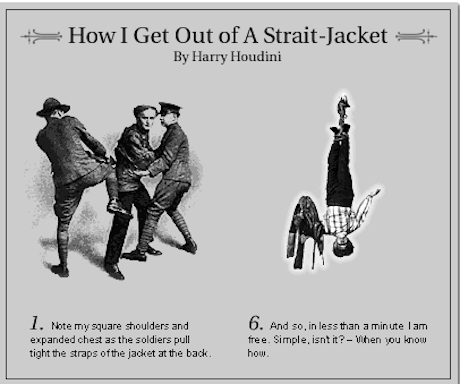
For a more manageable trick, imagine yourself a face in the crowd, gazing upward at the struggling magician, without texting, tweeting, or Instagramming. Sheer open-mouthed amazement is a trick we see precious little of these days.
Our best guess is that the video above was shot around 1917.
Related Content:
Harry Houdini’s Great Rope Escape
Arthur Conan Doyle Discusses Sherlock Holmes and Psychics in a Rare Filmed Interview (1927)
Ayun Halliday’s latest feat is directing 16 homeschooled teens in Yeast Nation, the world’s first bio-historical musical. See it in New York City this week. Follow her @AyunHalliday
Read More...Everything That’s Wrong With Back To The Future in 8 Minutes
There’s nothing really wrong with Back to the Future. Critics loved Robert Zemeckis’ sci-fi comedy when it first came out in 1985. (Roger Ebert likened it to a great Frank Capra film.) And it still delights old and new viewers almost 30 years later. But, like every film, Back to the Future has its minor flaws. The web site/YouTube channel Cinema Sins is “dedicated to pointing out all the sins [they] can find in movies, some big and some small. Some … downright microscopic.” And that’s what you get here. A breakdown of every little problem and inconsistency in Zemeckis’ film. Fortunately, the folks behind Cinema Sins don’t take themselves too seriously. Nor do they consider themselves beyond reproach. Heck, this summer they produced Everything Wrong With Cinema Sins In 3 Minutes Or Less. You can watch it here.
If you would like to support the mission of Open Culture, consider making a donation to our site. It’s hard to rely 100% on ads, and your contributions will help us continue providing the best free cultural and educational materials to learners everywhere. You can contribute through PayPal, Patreon, and Venmo (@openculture). Thanks!
Read More...David Bowie Appears in the “Director’s Cut” of a New Louis Vuitton Ad, Nods to Labyrinth
Looking like a haute couture treatment of “As the World Falls Down” from Labyrinth, by way of Peter Jackson’s Beautiful Creatures, the “Director’s Cut” of this Louis Vuitton ad above, titled “L’Invitation au Voyage,” is pretty stunning. Bowie lip syncs “I’d Rather be High,” a stand out from his latest, The Next Day, and looks nearly as magnetic as his Goblin King did almost thirty years ago. He’s definitely still got it on screen, making me pine for another Bowie-led feature-length fantasy (but not a Labyrinth remake).
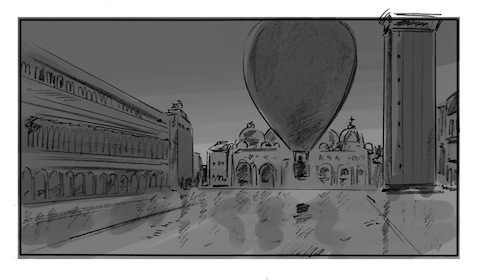
The making-of reel above might also be of interest, although at under two minutes, the techno montage doesn’t offer much insight into the elaborate design of the short. Of more interest for fans of fashion, design, and film may be this blog post (in Chinese), which features some gorgeous production stills and storyboards, like the one below. The short’s director, Romain Gavras, previously made the video for Kanye West and Jay Z’s “No Church in the Wild,” so he’s definitely got an eye for spectacle.
Related Content:
Watch David Bowie’s New Video for ‘The Stars (Are Out Tonight)’ With Tilda Swinton
David Bowie’s Fashionable Mug Shot From His 1976 Marijuana Bust
David Bowie Releases Vintage Videos of His Greatest Hits from the 1970s and 1980s
Josh Jones is a writer and musician based in Durham, NC. Follow him at @jdmagness
Read More...Take a Virtual Tour of Venice (Its Streets, Plazas & Canals) with Google Street View
There’s something inherently ridiculous about Google’s Street View cars.
Their roof-mounted 15-lens Trekker cameras constantly blunder across less-than-dignified scenes whilst trawling the roads on behalf of Google Maps (a service that is forever linked in my mind to Lazy Sunday, the preposterous rap video starring comedians Andy Samberg and Chris Parnell.)
The cars themselves are totally goofy-looking. I would imagine that spotting one in real life is something akin to a Weinermobile sighting. No wonder the producers of Arrested Development arranged for George Michael Bluth, the hapless innocent played by Michael Cera, to drive one in the series’ fourth season.

I have a hunch that the Street View Trekker’s backpack model will ultimately prove less mockable than its four-wheeled counterpart. It can go where cars can’t, conferring an extreme sports vibe despite the big, ball-shaped camera apparatus sticking up. A limited pilot program has been recruiting volunteers to wear the backpack in such locales as Bulgaria, Indonesia, and South Africa. The Philippines is another destination where volunteers are sought, and all kidding aside, it would be riveting to see how this technology might document the devastation in Tacloban.
For now, the non-automotive Street View’s greatest triumph lies in recording the canals and cobbled walkways of Venice, Italy, a feat impossible to pull off in a car. To accomplish this, a team of backpackers logged over 375 miles on foot and by boat. Their efforts provide tourists with practical information in a format to which they’ve no doubt grown accustomed, as well as presenting armchair travelers with plenty of non-disappointing eye candy.
Cyber visitors can choose to traverse the Floating City much as actual visitors can — on foot, by vaporetta or by gondola. (I’d advise making a trip to the bathroom even if you’re not actually leaving home. At the very least turn the sound down — the paddling noises accompanying the last option could cause a Pavlovian bladder response.)
In addition to the Street View and standard map, you can explore using a sepia-toned map from the David Rumsey Historical Map Collection, that dates back to 1838.
A lovely escape, all in all. Let us hope it never opens to traffic.
You can start your tour here.
Related Content:
How Venice Works: A Short Film
Google Street View Opens Up a Look at Shackleton’s Antarctic
A Virtual Tour of the Sistine Chapel
Google Street View Takes You on a Panoramic Tour of the Grand Canyon
Ayun Halliday is the author of No Touch Monkey! And Other Travel Lessons Learned Too Late, The Zinesters Guide to NYC and several other books. Follow her @AyunHalliday
Read More...Quantum Physics Made Relatively Simple: A Free Mini Course from Nobel Prize-Winning Physicist Hans Bethe
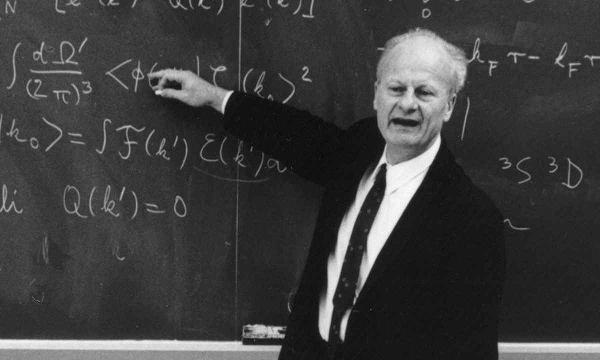
An émigré from Nazi Germany, Hans Bethe joined Cornell’s physics department back in 1935. There, he built a remarkable career for himself. A nuclear physicist, Bethe made key contributions to the Manhattan Project during World War II. After the war, he brought stellar young physicists like Richard Feynman from Los Alamos to Ithaca and turned Cornell’s physics department into a top-notch program. In 1967, he won the Nobel Prize for “his groundbreaking work on the theory of energy production in stars.”
As a tribute to Bethe, Cornell now hosts a web site called Quantum Physics Made Relatively Simple, where you can watch three lectures presented by Bethe in 1999. They’re a little different from the usual lectures you encounter online. In these videos, Bethe is 93 years old, older than your average prof. And he presents the lectures not in a Cornell classroom, but at the Kendal of Ithaca retirement community, which gives them a certain charm. You can watch them here:
Lecture 1: Here Bethe “introduces quantum theory as ‘the most important discovery of the twentieth century’ and shows that quantum theory gave us ‘understanding and technology.’ He cites computers as a dramatic realization of applied quantum physics.”
Lecture 2: “By the 1920s, physicists were driving to synthesize early quantum ideas into a consistent theory. In Lecture 2, Professor Bethe relates the exciting theoretical and experimental breakthroughs that led to modern quantum mechanics.”
Lecture 3: In the last lecture, “Professor Bethe recalls work on the interpretation of the wave function, the Heisenberg Uncertainty Principle, and the Pauli Exclusion Principle. He shows how quantum theory forced discussion of issues such as determinism, physical observables, and action-at-a-distance.”
You can watch an introduction to the lecture series here. You can also find Bethe’s lectures listed in our collection of Free Online Physics Courses, part of our collection 1,700 Free Online Courses from Top Universities
via Kottke
Related Content:
Richard Feynman Presents Quantum Electrodynamics for the NonScientist
‘The Character of Physical Law’: Richard Feynman’s Legendary Lecture Series at Cornell, 1964
Leonard Susskind Teaches You “The Theoretical Minimum” for Understanding Modern Physics
Read More...Listen to a New Album Featuring Tom Waits Songs in Hebrew (2013)
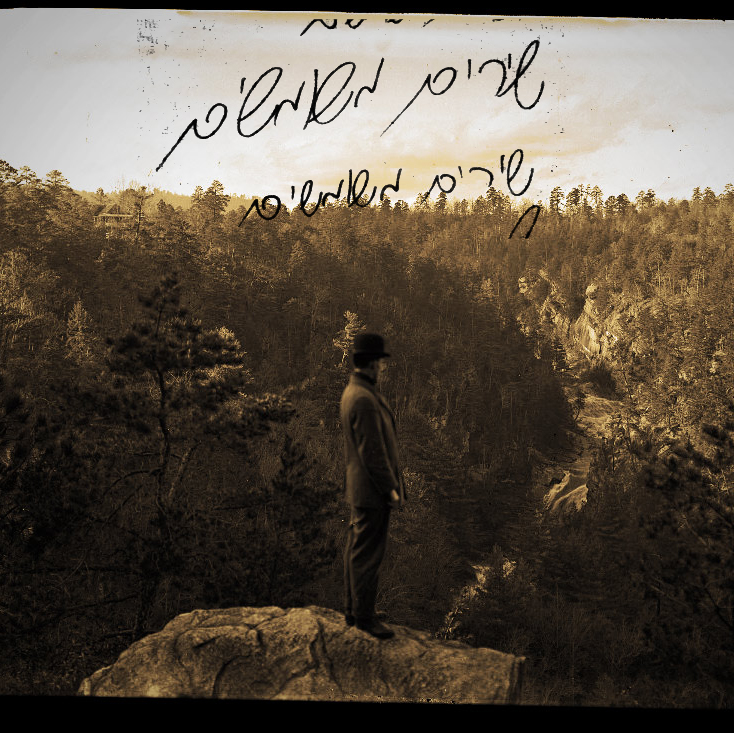 Tom Waits is a rare breed of performer, having attained vast commercial success without having had to pander to a mass audience. His gruff voice—the vocal equivalent of too many late nights, strong scotch, and a pack-an-hour habit—has become the hallmark of a sort of grimy, outsider cool favored by Jim Jarmusch and John Lurie. His career, which has spanned four decades and includes theatre, film, and the iconic interview that inspired the character of The Joker in The Dark Knight, is the envy of most musicians. It was only fitting, considering his prodigious output, that Waits would become the subject of a cover album. Unsurprisingly, it comes with a twist—it’s in Hebrew.
Heeb Magazine recently posted a link to “Shirim Meshumashim” (“Used Songs”), producer Guy Hajjaj’s four-year project where Israeli musicians recreate Tom Waits’ back catalog. The 22-song album draws widely from Waits’ career, including songs from classic albums such as Raindogs (1985) as well as the more recent Orphans: Brawlers, Bawlers & Bastards (2006) and Glitter and Doom Live (2009). While more zealous fans will undoubtedly claim that Waits’ original delivery can never be matched, those with an open mind will likely find a number of gems. Some of our favorites include “Clap Hands,” ideally suited to Hebrew’s harsh, gravelly sounds, and the lighter, yet unmistakably Waits-written, “Dirt in The Ground.”
You can stream the album above, or buy the album (downloadable on a pay-what-you-wish basis) here.
Via Heeb Magazine
Related Content:
Tom Waits’ Classic Appearance on Australian TV, 1979
Tom Waits Reads Charles Bukowski
Ilia Blinderman is a Montreal-based culture and science writer. Follow him at @iliablinderman.
Read More...Support Us
We're hoping to rely on loyal readers, rather than erratic ads. Please click the Donate button and support Open Culture. You can use Paypal, Venmo, Patreon, even Crypto! We thank you!

About Us

Open Culture scours the web for the best educational media. We find the free courses and audio books you need, the language lessons & educational videos you want, and plenty of enlightenment in between.
Advertise With Us

FREE UPDATES!
GET OUR DAILY EMAIL
Get the best cultural and educational resources on the web curated for you in a daily email. We never spam. Unsubscribe at any time.
FOLLOW ON SOCIAL MEDIA

Open Culture editor Dan Colman scours the web for the best educational media. He finds the free courses and audio books you need, the language lessons & movies you want, and plenty of enlightenment in between.
Advertise With Us

