Actress Grace Kelly Reflects on the Life & Legacy of JFK in an Artfully Animated Video
On the eve of the 50th anniversary of the John F. Kennedy Assassination, Blank on Blank has released another one of its distinctive animated videos. This one features Grace Kelly, the glamorous American actress and Princess of Monaco, contemplating her personal encounters with JFK, the heady days of Camelot, and the legacy of America’s 35th president. When asked whether the president died in vain on that day in Dallas, she offered these eloquent words:
Well, it might not seem so today, but I, for one, cannot believe that a man of Mr. Kennedy’s stature and achievements was put upon this earth for no other purpose than to stop an assassin’s bullet, or that the lesson will be wholly lost. It is only since the twentieth century that the majesty of Abraham Lincoln has been appreciated. I believe that God allows these certain tragedies to happen in order to emphasize the man and his achievements and to inspire those who follow to have the strength and the will to accomplish his unfulfilled dreams.
This interview was recorded on June 19, 1965, as part of an oral history project designed to preserve the memory of the late president. The project recorded interviews with people from all walks of life–from bus drivers to Leonard Bernstein–but, as David Gerlach, founder of Blank on Blank explains to us, few people have heard these recordings over the years. Now, however, a Boston-based radio project has turned them into an hourlong radio documentary called We Knew JFK: Unheard Stories, and it’s available online here.
You can read a transcript of the Grace Kelly interview courtesy of the John F. Kennedy Presidential Library & Museum.
Related Content:
Kurt Vonnegut to John F. Kennedy: ‘On Occasion, I Write Pretty Well’
Watch Janis Joplin’s Final Interview Reborn as an Animated Cartoon
Marshall McLuhan on the Stupidest Debate in the History of Debating (Nixon v JFK)
Read More...Read Rejection Letters Sent to Three Famous Artists: Sylvia Plath, Kurt Vonnegut & Andy Warhol
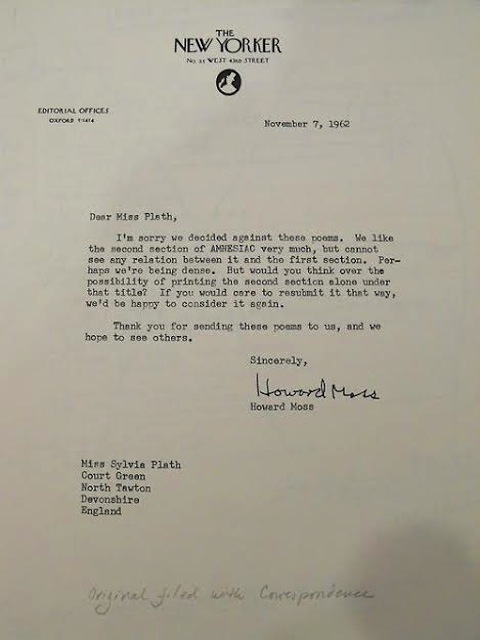
Every successful artist must master the art of accepting rejection. “Fail better,” said Beckett in his grim euphemism for perseverance. “I love my rejection slips,” wrote Sylvia Plath in every hopeful poet’s favorite quote. “They show me I try.” Plath—who also wrote “I am made, crudely, for success”—collected scores of rejection letters, receiving them even after the considerable success of 1960’s The Colossus and Other Poems. The 1962 letter above (click here to view in a larger format), from The New Yorker, doesn’t exactly reject a Plath submission, but it does recommend cutting the entire first section of “Amnesiac” and resubmitting “the second section alone under that title.” “Perhaps we’re being dense,” demurs editor Howard Moss.
The rejection must have been all the more painful since Plath was under a contract with the magazine, which entitled her to “an annual sum for the privilege of having a ‘first reading’ plus subsequent publishing rights to her new poetry,” Plath scholars tell us. And yet “much to her distress she mainly received rejections during November and December 1962.” The poem was eventually broken in two, with the first half published as “Lyonnesse,” but not by Plath herself but by publishers after her death. Hear Plath read the full poem as she intended it in her edition of Ariel, above.
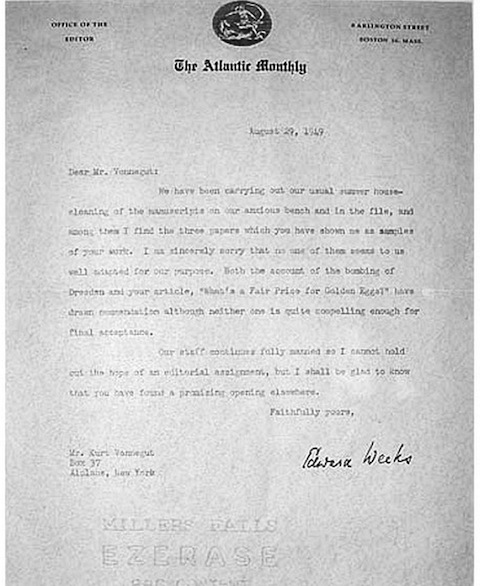
Kurt Vonnegut received an impersonal, and it would seem, long-overdue rejection letter from editor of The Atlantic Edward Weeks in 1949. Weeks writes breezily that he found Vonnegut’s “samples” during the “usual summer house-cleaning,” announcing its slush-pile status. Weeks does at least give the impression that someone, if not him, had read Vonnegut’s submissions. The aspiring writer was 27 years old, striking out “just a few years after surviving the bombing of Dresden as a POW,” Letters of Note informs us, and still twenty years away from publishing his groundbreaking novel Slaughterhouse Five. Letters of Note also provides us with the transcript below for the badly faded typescript.
The Atlantic Monthly
August 29, 1949
Dear Mr. Vonnegut:
We have been carrying out our usual summer house-cleaning of the manuscripts on our anxious bench and in the file, and among them I find the three papers which you have shown me as samples of your work. I am sincerely sorry that no one of them seems to us well adapted to for our purpose. Both the account of the bombing of Dresden and your article, “What’s a Fair Price for Golden Eggs?” have drawn commendation although neither one is quite compelling enough for final acceptance.
Our staff continues fully manned so I cannot hold out the hope of an editorial assignment, but I shall be glad to know that you have found a promising opening elsewhere.
Faithfully yours,
(Signed, ‘Edward Weeks’)
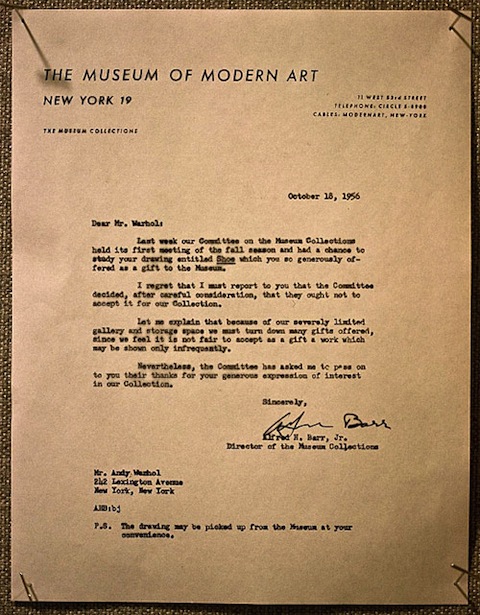
Of course visual artists are not immune. Andy Warhol received the above rejection letter from New York’s Museum of Modern Art when he attempted to donate a drawing in 1956. To its later chagrin, the museum wouldn’t let him give his work away:
Last week our Committee on the Museum Collections held its first meeting of the fall season and had a chance to study your drawing entitled Shoe which you so generously offered as a gift to the Museum.
I regret that I must report to you that the Committee decided, after careful consideration, that they ought not to accept it for our Collection.
The Warhol rejection circulated a few years ago after the MoMA tweeted Letters of Note’s post on it (read the full transcript there). Its most galling feature: a postscript that reads, with dismissive courtesy, “The drawing may be picked up from the museum at your convenience.”
Related Content:
Gertrude Stein Gets a Snarky Rejection Letter from Publisher (1912)
No Women Need Apply: A Disheartening 1938 Rejection Letter from Disney Animation
New Yorker Cartoon Editor Bob Mankoff Reveals the Secret of a Successful New Yorker Cartoon
Josh Jones is a writer and musician based in Durham, NC. Follow him at @jdmagness
Read More...A Young Björk Deconstructs (Physically & Theoretically) a Television in a Delightful Retro Video
Björk’s first international hit, “Human Behaviour” (1993) received scant radio play in North America. Rather, the Icelandic singer’s fame only grew as a result of MTV’s heavy rotation of the surrealist music video that accompanied the song, directed by Academy Award winner Michel Gondry. Despite the debt of celebrity she owed to television, Björk was not always a fan.
In the undated video above, Björk expounds on her Christmastime TV-watching habits. Immediately, the video takes an odd—or, I suppose, characteristically Björk-esque—turn when the young singer decides to take her TV apart:
But now I’m curious. I’ve switched the TV off and now I want to see how it operates. How it can make, put me into all those weird situations. So… It’s about time.
The various components prove fascinating, and Björk proceeds to describe the television’s hardware in her whimsical, otherworldly manner:
This is what it looks like. Look at this. This looks like a city. Like a little model of a city. The houses, which are here, and streets. This is maybe an elevator to go up there. And here are all the wires. These wires, they really take care of all the electrons when they come through there. They take care that they are powerful enough to get all the way through to here. I read that in a Danish book. This morning.
The most puzzling part of the video comes when Björk mentions that her cavalier approach to television is relatively new. Until recently, she had been guarded about her viewing habits:
I remember being very scared because an Icelandic poet told me that not like in cinemas, where the thing that throws the picture from it just sends light on the screen, but this is different. This is millions and millions of little screens that send light, some sort of electric light, I’m not really sure… Your head is very busy all the time to calculate and put it all together into one picture. And then because you’re so busy doing that, you don’t watch very carefully what the program you are watching is really about. So you become hypnotized.
Thanks to the wisdom contained within an unnamed Danish book, however, Björk has grown more at ease with the potential of television’s being used for mind control and hypnosis. At the end of the clip, she offers a final pearl of wisdom:
You shouldn’t let poets lie to you.
via The Atlantic
Related Content:
Björk and Sir David Attenborough Team Up in a New Documentary About Music and Technology
Ilia Blinderman is a Montreal-based culture and science writer. Follow him at @iliablinderman.
Read More...Two Viral Videos Push Against Stereotypical Messages Girls Get From the Media (Mildly NSFW)
The first of two videos circulating on the internet, “Girls Who Read” by UK poet and “Rogue Teacher” Mark Grist (above) hits back at the lad culture that objectifies women according to certain “bits” named above in some mildly NSFW language. In his video performance piece above, Grist, asked which bits he prefers by a lad in a pub, and faced with a looming cadre of both male and female peers putting on the pressure, answers haltingly, “I like a girl… who … reads.” Then, his confidence up, he elaborates:
I like a girl who reads,
Who needs the written word
And who uses the added vocabulary
She gleans from novels and poetry
To hold lively conversation
In a range of social situations
The ideal girl close to Grist’s heart “ties back her hair as she’s reading Jane Eyre” and “feeds her addiction for fiction with unusual poems and plays.” In his infectious slam cadences, Grist’s impassioned paean to female readers offers a charming alternative to the ladmag gaze, though one might argue that he still does a little bit of projecting his fantasies onto an unsuspecting lone female at the bar (who turns out to be not so alone). Maybe “Girl Who Reads” is a trope, like “Manic Pixie Dream Girl,” an idealization that says more about Grist’s desires than about any particular, actual girl, but it’s still a refreshing challenge to the leering of his pubmates, one that communicates to girls that there are men out there, even in the pubs, who value women for their minds.
The video above, for a new line of toys called GoldiBlox, designed by Stanford-educated engineer Debbie Sterling, upends another adolescent male cultural touchstone—this time a by-now classic American one—the Beastie Boys gleefully misogynistic anthem “Girls.” While the original still likely scores many a frat party, it now must compete with the rewrite performed by “Raven.” The re-appropriated “Girls” plays over video of a trio of young girls, bored to death with stereotypical pink tea sets and the like, who build a complicated Rube Goldberg machine from Goldiblox, which resemble plastic tinker toys. I foresee snippets of the updated lyrics (below) making their way onto playgrounds around the country. Hear the original Beastie Boys song, with lyrics, below.
Girls.
You think you know what we want, girls.
Pink and pretty it’s girls.
Just like the 50’s it’s girls.
You like to buy us pink toys
and everything else is for boys
and you can always get us dolls
and we’ll grow up like them… false.
It’s time to change.
We deserve to see a range.
‘Cause all our toys look just the same
and we would like to use our brains.
We are all more than princess maids.
Girls to build the spaceship,
Girls to code the new app,
Girls to grow up knowing
they can engineer that.
Girls.
That’s all we really need is Girls.
To bring us up to speed it’s Girls.
Our opportunity is Girls.
Don’t underestimate Girls.
As with all kids advertising, this is aimed as much at parents—who remember the Beastie Boys’ song—as their kids, who couldn’t possibly. And unlike Grist’s video, which only sells, perhaps, himself, the Goldiblox video aims to get kids hooked on plastic toys as much as any of the ads for products it displaces. Nonetheless, I’ll play it for my daughter in a few years, because lines like “we are all more than princess maids” constitute the perfect retort to the seemingly endless cultural slotting of girls into ridiculously subservient and fantasy roles.
Related Content:
“Science: It’s a Girl Thing!” OMG, Seriously?! The Botched Video by the EU
Christopher Hitchens Creates a Reading List for Eight-Year-Old Girl
Radiohead’s Thom Yorke Gives Teenage Girls Endearing Advice About Boys (And Much More)
Josh Jones is a writer and musician based in Durham, NC. Follow him at @jdmagness
Read More...The 10 Hidden Cuts in Rope (1948), Alfred Hitchcock’s Famous “One-Shot” Feature Film
Among his many accomplishments at the intersection of showmanship and pure cinema, Alfred Hitchcock managed, in 1948, to make a feature film without any cuts — or rather, more impressively, he made a feature film people believed had no cuts. Though cinephiles will know several fine examples of no-cut or few-cut movies from recent years (I’ve enjoyed Mike Figgis’ four-screen Time Code since it came out in the nineties, and I often recommend Il-gon Song’s more recent but rarer one-cut Magicians), they’ll also know that, due to physical limitations in the film technology of Hitchcock’s day, nobody — not even Hitchcock — could possibly have made a film longer than ten minutes out of a single, unbroken shot.
So how did Rope, one of Hitchcock’s lesser-celebrated but still thoroughly fascinating projects, convincingly fake its own form? Editor Vashi Nedomansky shows us in the three-minute video above. “On further examination,” Nedomansky writes on his blog, “Hitchcock’s gem actually contains ten edits. Five of them are hidden as the camera lens is filled by foreground objects. The other five edits are regular hard cuts that not many people either realize or acknowledge.”
Nofilmschool offers a post that goes into greater depth on Rope and editing: “Even though there is editing, it’s often described as a film that plays out in real time. Why? Probably because it’s such an immersive piece of filmmaking; the hidden edits and use of handheld cameras follow and track its characters, allowing audiences to experience and react to each situation at the same moment the actors do — right in the thick of the action.” You can find a more theoretical take from Peter J. Dellolio at Flickhead, who describes Rope as a picture exploring “some of the fundamental characteristics of the cinematic abstraction of time and space by using the mobile camera as an agent that gives plastic reality to subjective material” whose “synthesis of real time and filmic space forces the viewer to absorb narrative information on multiple, often distastefully ironic levels.” For a different framing, presentation, and analysis of Rope’s cuts, see also the short video essay “Skipping Rope.” Hitchcock may not have had the ability to really make the movie in one shot, but he certainly had the ability to keep us all taking about it these 65 years.
Related Content:
21 Free Hitchcock Movies Online
Hitchcock’s Seven-Minute Editing Master Class
Colin Marshall hosts and produces Notebook on Cities and Culture and writes essays on literature, film, cities, Asia, and aesthetics. He’s at work on a book about Los Angeles, A Los Angeles Primer. Follow him on Twitter at @colinmarshall.
Read More...Watch Leonardo da Vinci’s Musical Invention, the Viola Organista, Being Played for the Very First Time
Just yesterday, we made reference to Leonardo da Vinci’s contribution to early concepts of mechanical calculation. But if that subset of his achievements doesn’t interest you, may we suggest you look into his other work in painting, sculpture, architecture, mathematics, engineering, anatomy, geology, cartography, botany, and letters? Then again, you might find this a particularly opportune time to learn more about Leonardo da Vinci the musician. As the archetypal example of the polymathic, intellectually omnivorous “Renaissance man,” he not only attained mastery of a wide range of disciplines, but did his most impressive work in the spaces between them. Given the voluminousness of his output (not to mention the technical limitations of fifteenth-century Europe), many of his multiple domain-spanning ideas and inventions never became a reality during his lifetime. However, just this year, 494 years after Leonardo’s death, we now have the chance to see, and more importantly hear, one of them: the viola organista, an elaborate musical instrument that had previously only existed in his notebooks.
We owe this thrill not just to Leonardo himself, who left behind detailed plans for the (to him, purely theoretical) construction of such devices as this behind, but to a reported 5000 hours of physical effort by Polish concert pianist Slawomir Zubrzycki, who actually put the thing together. You can read more at the Sydney Morning Herald, whose article (on “Leonardo Da Vinci’s wacky piano”) quotes Zubrzycki: “This instrument has the characteristics of three we know: the harpsichord, the organ and the viola da gamba,” and playing it, which involves hitting keys connected to “spinning wheels wrapped in horse-tail hair,” and turning those wheels by pumping a pedal below the keyboard, produces exciting unusual waves of cello-like sounds. You can watch ten minutes of Zubrzycki debuting the instrument at Krakow’s Academy of Music above. Depending upon your inclination toward music, very old technology, or very old music technology, you may also want to glance at the related Metafilter debate about what place the viola organista could have in music today.
If you would like to support the mission of Open Culture, consider making a donation to our site. It’s hard to rely 100% on ads, and your contributions will help us continue providing the best free cultural and educational materials to learners everywhere. You can contribute through PayPal, Patreon, and Venmo (@openculture). Thanks!
Related Content:
The Anatomical Drawings of Renaissance Man, Leonardo da Vinci
An Animated History Of Aviation: From da Vinci’s Sketches to Apollo 11
What Ancient Greek Music Sounded Like: Hear a Reconstruction That is ‘100% Accurate’
Colin Marshall hosts and produces Notebook on Cities and Culture and writes essays on literature, film, cities, Asia, and aesthetics. He’s at work on a book about Los Angeles, A Los Angeles Primer. Follow him on Twitter at @colinmarshall.
Read More...Thelonious Monk Bombs in Paris in 1954, Then Makes a Triumphant Return in 1969
Thelonious Monk’s popular image as the hippest of the hip in mid-century bebop is well-deserved, but his career trajectory was not without its lame notes, including the loss of his cabaret license for several years after a 1951 drug bust in New York with Bud Powell. The incident forced him to leave the haven of the Minton’s Playhouse after-hours jam session scene and strike out for new venues and new outlets, such as recording the seminal two-volume Genius of Modern Music in 1952, which featured some of the earliest, most boisterous versions of Monk compositions like soon-to-be standard “Well, You Needn’t.” In 1954, Monk arrived in Paris where he performed at the Salle Pleyel to an audience that mostly didn’t know him. Patrick Jarenwattananon at NPR describes the night:
[H]e had almost no public profile in France apart from the most hardcore of modern jazz fans; he was nervous and probably drunk; and he followed an enormously popular Dixieland band on stage. Critics in attendance panned him, confused by his unique dissonances and agitated stage behavior. The gig was, as biographer Robin Kelley described it, a disaster.
To make matters worse, Jarenwattananon writes, Monk—used to rhythm players like Art Blakey and Al McKibbon—was apparently “assigned a local rhythm section which was probably unfamiliar with his music.” You can hear Monk above from a recording he made during that trip, without said rhythm section, playing “Round About Midnight” in his expressively percussive piano style. Monk’s style, famously described by Philip Larkin as a “faux-naif elephant dance,” was rapidly developing as he came into his own as a bandleader and composer. But although perhaps a personal milestone (Monk met lifelong friend, patron, and devotee Pannonica de Koenigswarter that night), the Paris gig of 1954 was a bust that haunted the innovative pianist.
And so it was that fifteen years later, Monk returned to the Salle Pleyel with his own quartet. This time, Jarenwattananon tells us, he arrived as an “international star.” The concert was televised, and, on November 26th, it will be released as an audio recording and DVD simply called Paris 1969 (see Monk’s quartet play “I Mean You” in an excerpt above). For a short time, you can preview and pre-order individual tracks from the recording or listen to the whole concert straight through at NPR’s site. It’s a mellower Monk than his mid-fifties incarnation, without a doubt, not the “tap-dancing, elbows-on-the-piano Monk of yore,” writes Jarenwattananon: “But it’s Monk doing Monk, swinging intensely through severe rhythmic crevasses” and generally exuding the confidence and panache of his hero Duke Ellington.
Related Content:
Advice From the Master: Thelonious Monk Scribbles a List of Tips for Playing a Gig
Thelonious Monk: Straight No Chaser
Andy Warhol Creates Album Covers for Jazz Legends Thelonious Monk, Count Basie & Kenny Burrell
Josh Jones is a writer and musician based in Durham, NC. Follow him at @jdmagness
Read More...Mark Twain’s Viciously Funny Marginalia Took Aim at Some Literary Greats
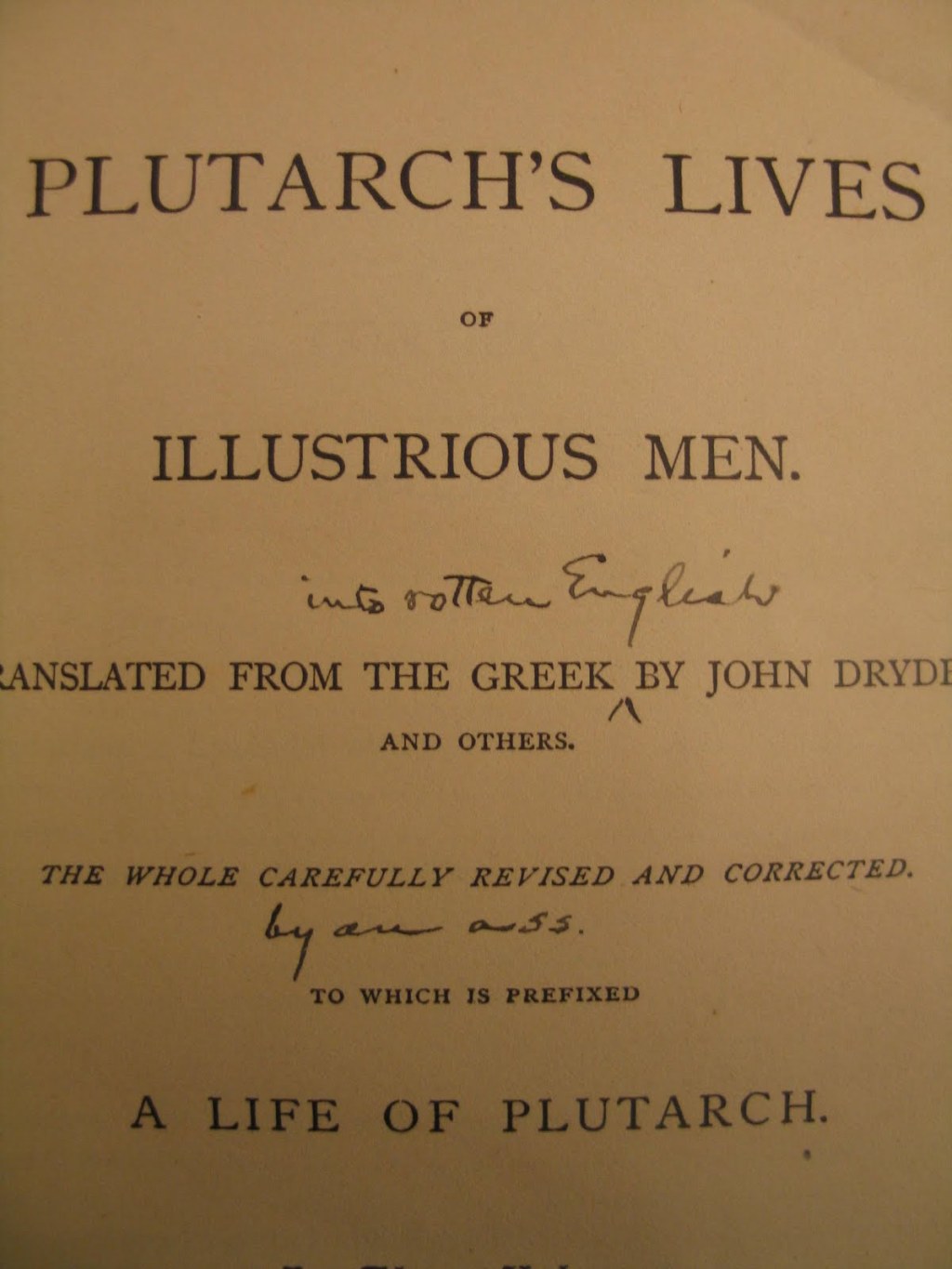
Hemingway once said that “all modern American literature comes from one book by Mark Twain called Huckleberry Finn.” Twain, however, was not only a master of subtlety and humor in fiction, but also a piercingly funny and sometimes scathing essayist whose pen ranged from politics to literary criticism. Despite publishing many biting essays, many of Twain’s best barbs never reached their targets. Instead they remained within the marginalia of his books. In a series of documents made public by the New York Times, Twain’s ire at sloppy writing makes itself known. Some comments, like this one regarding his friend, Rudyard Kipling, are fairly innocuous:
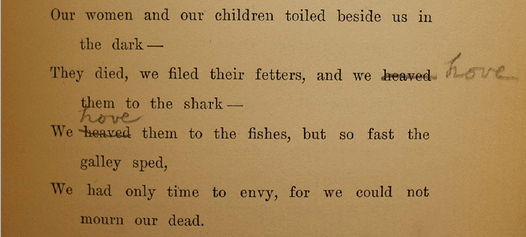
While Kipling got off lightly, John Dryden’s translation of Plutarch’s Lives seems to have hit a nerve, causing Twain to change the inscription to “translated from the Greek into rotten English by John Dryden; the whole carefully revised and corrected by an ass.” (Up top)
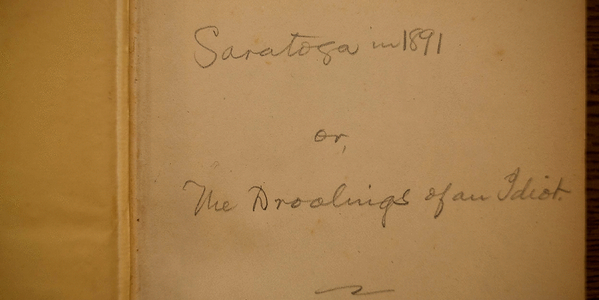
Notes in the margins of Landon D. Melville’s Saratoga in 1901 show that it fared no better. Twain, it appears, renamed the volume, dubbing it “Saratoga in 1891, or The Droolings of An Idiot.”
He also deemed some of the writings to be the “Wailings of an Idiot.”
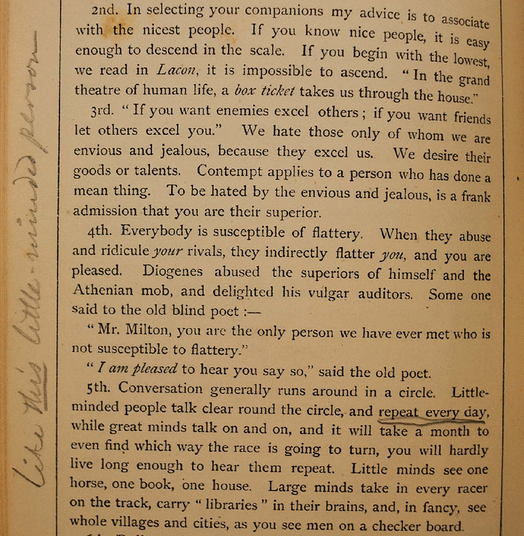
And, just so there wasn’t any ambiguity about what he thought, Twain labeled Melville a “little minded person.”
For more of Mark Twain’s jottings, head over to the New York Times’ document archive and The Mark Twain House & Museum.
Ilia Blinderman is a Montreal-based culture and science writer. Follow him at @iliablinderman.
Related Content:
Mark Twain Plays With Electricity in Nikola Tesla’s Lab (Photo, 1894)
Mark Twain Drafts the Ultimate Letter of Complaint (1905)
Mark Twain Captured on Film by Thomas Edison in 1909. It’s the Only Known Footage of the Author
Read More...Long Live Glitch! The Art & Code from the Game Now Released into the Public Domain
Back in 2009, a startup called Tiny Speck (whose co-founder Stewart Butterfield also co-founded Flickr) launched a multiplayer online video game called Glitch, which won praise for its creative visual style. Although more than 150,000 people played the game, Glitch never quite found its footing in the market. And, in 2012, it was shut down. But, now Glitch rises from the ashes and lives again.
Yesterday Tiny Speck made this announcement:
The entire library of art assets from the game, has been made freely available, dedicated to the public domain.… All of it can be downloaded and used by anyone, for any purpose. (But: use it for good.)
Tiny Speck … has relinquished its ownership of copyright over these 10,000+ assets in the hopes that they help others in their creative endeavours and build on Glitch’s legacy of simple fun, creativity and an appreciation for the preposterous. Go and make beautiful things.
According to Tiny Speck, this release “is intended primarily for developers and those with the technical ability to take advantage of the structured assets.”
Now, assuming you have some tech chops, here are some helpful links that will get you started:
- This public domain release page contains links to the GitHub repositories as well as direct download links for developers.
- The Glitch archive site offers a “comprehensive Encyclopedia of the game world, player archives and snapshots from the game, and more.”
- Above you can watch the videos 17 Fun Things To Do in Glitch in 124 Seconds. This, combined with the Glitch Beta Trailer, will give you a good overview of the game’s visual style.
Long live Glitch!
Related Content:
Ancient Greek Punishments: The Retro Video Game
Read More...Stephen Fry Explains Cloud Computing in a Short Animated Video
Just the other day, I did the unthinkable: I actually watched a pre-video advertisement. The spot, for a major bank, spent its first few minutes explaining the mechanics of credit rating. Promising useful knowledge, this bank received my attention in return — for about two thirds of the commercial, anyway. The video above, commissioned by a company called Databarracks, does much the same by offering an explanation of “cloud computing,” a concept you’ve surely heard much thrown around over the past several years. Sweetening the deal, it uses for its visuals a drawn-as-you-watch style of educational animation you may have encountered here before, and it employs as its narrator writer, comedian, and man-about-internet Stephen Fry, from whom I’ve always enjoyed a good explanation. “Today,” he begins, “we are in the middle of a revolution in business computing.”
In service of this thesis, he then goes back to 2700 BC, when the Sumerians invented the abacus, continuing on through Leonardo da Vinci’s plans for a mechanical calculator, Charles Babbage’s difference engine, Alan Turing and Tommy Flowers’ forward-looking separation of hardware from software, and Tim Berners-Lee’s realization that computers could operate on something like a neural network — something like this very World Wide Web. We then see and hear an analogy made between computing and electricity. Where once firms wanting to use electricity had to build and maintain their own burdensome power plants, now they have electricity as a utility, paying only for what they need at the time. And while firms have mainly, up to this point, purchased and operated their own stores of computing power, doing it cloud-style will free them all to pay for that, too, as a utility. A bold pitch, perhaps, but everything sounds reasonable — inevitable, even — coming from Stephen Fry.
Related Content:
Stephen Fry: What I Wish I Knew When I Was 18
Stephen Fry Introduces the Strange New World of Nanoscience
Colin Marshall hosts and produces Notebook on Cities and Culture and writes essays on literature, film, cities, Asia, and aesthetics. He’s at work on a book about Los Angeles, A Los Angeles Primer. Follow him on Twitter at @colinmarshall.
Read More...Support Us
We're hoping to rely on loyal readers, rather than erratic ads. Please click the Donate button and support Open Culture. You can use Paypal, Venmo, Patreon, even Crypto! We thank you!

About Us

Open Culture scours the web for the best educational media. We find the free courses and audio books you need, the language lessons & educational videos you want, and plenty of enlightenment in between.
Advertise With Us

FREE UPDATES!
GET OUR DAILY EMAIL
Get the best cultural and educational resources on the web curated for you in a daily email. We never spam. Unsubscribe at any time.
FOLLOW ON SOCIAL MEDIA

Open Culture editor Dan Colman scours the web for the best educational media. He finds the free courses and audio books you need, the language lessons & movies you want, and plenty of enlightenment in between.
Advertise With Us

