Lyndon Johnson Orders New Pants on the Phone and Requests More Room for His … Johnson (1964)
“Lyndon Johnson was indeed .… a being of Shakespearean dimensions—a hulking, bush-country colossus, gargantuan of ego and energy, of self-delusions and glooms and paranoias, crass cruelties and rampant vulgarities, but gargantuan also in his benevolent ambitions.” So begins Marshall Frady’s review of Robert Caro’s 2002 political biography, Master Of The Senate: The Years of Lyndon Johnson. The review then proceeds to describe Johnson’s uncouth behavior, which somehow always seemed to involve his Johnson:
He early became fabled for a Rabelaisian earthiness, urinating in the parking lot of the House Office Building as the urge took him; if a colleague came into a Capitol bathroom as he was finishing at the urinal there, he would sometimes swing around still holding his member, which he liked to call “Jumbo,” hooting once, “Have you ever seen anything as big as this?,” and shaking it in almost a brandishing manner as he began discoursing about some pending legislation. At the same time, he would oblige aides to take dictation standing in the door of his office bathroom while he went about emptying his bowels, as if in some alpha-male ritual assertion of his primacy. Even on the floors of the House and Senate, he would extravagantly rummage away at his groin, sometimes reaching his hand through a pocket and leaning with half-lifted leg for more thorough access.
Above, we have a recording of another colorful episode from the Johnson era. On August 9, 1964, the president called the Haggar clothing company to order some custom-made pants. It was seemingly an innocuous call, a call you couldn’t imagine a president making today. But it suddenly took a bizarre turn when LBJ asked for more room in the crotch, in the area “where the nuts hang.” That, before letting out a short, unapologetic belch. It’s classic Johnson.
Listen to the famous call play out above, and find a transcript of the exchange here.
Related Content:
Dizzy Gillespie Runs for US President, 1964. Promises to Make Miles Davis Head of the CIA
Actress Grace Kelly Reflects on the Life & Legacy of JFK in an Artfully Animated Video
Read More...Watch Soviet Animations of Winnie the Pooh, Created by the Innovative Animator Fyodor Khitruk
In 1962, the animator Fyodor Khitruk made his directorial debut with Story of One Crime, a film that broke with a Soviet tendency to make imitations of Disney-style animations. The film, as The Guardian explained in its 2012 obituary for the animator, came as a shock. It was stylistically simple and dealt with themes that Disney films would never touch — like, why would a polite clerk murder two housewives with a frying pan?
Khitruk made other films that were packed with social commentary, often taking aim at abuses in the Soviet system. But, he also made straightforward animations for children, none more famous than his series of films based on AA Milne’s beloved Winnie the Pooh books.
Created between 1969 and 1972, Khitruk’s three films star a bear named “Vinni-Pukh” who looks nothing like the Winnie the Pooh that Westerners grew up with. (You can see the original illustrations of Pooh by E.H. Shepard here.) But viewers will certainly recognize the storyline and spirit of the original Pooh in the Soviet adaptations. For decades, these films have enchanted East European viewers, both young and old. And they still occasionally appear on Russian TV.
Above, you can watch the three animations online. They appear in the order in which they were released: 1) Winnie-the-Pooh (Винни-Пух, 1969), 2) Winnie-the-Pooh Goes on a Visit (Винни-Пух идет в гости, 1971); and 3) Winnie-the-Pooh and the Day of Concern (Винни-Пух и день забот, 1972).
As noted up top, you might need to click the “CC” icon at the bottom of the YouTube videos in order to activate the subtitles. Unfortunately, we can’t vouch for the accuracy of the translations.
Related Content:
Hear the Classic Winnie-the-Pooh Read by Author A.A. Milne in 1929
The Complete Wizard of Oz Series, Available as Free eBooks and Free Audio Books
Read More...Legendary Japanese Author Yukio Mishima Muses About the Samurai Code (Which Inspired His Hapless 1970 Coup Attempt)
One day in November of 1970, Nobel prize-nominated author Yukio Mishima barricaded himself in the Eastern Command office of Japan’s Self-Defense Forces and tied the commandant to a chair. Accompanied by a handful of young men from the Tatenokai, a student society-cum-militia, Mishima had launched a coup against the government. He followed in the tradition of literary radicals, whose ranks held writers as diverse as Alexander Pushkin and Pablo Neruda, with one key distinction: while Russian and Chilean authors sought leftward political shifts, Mishima espoused a jackboot brand of ascetic nationalism. If Mishima’s captivation with authoritarian politics seems out of character for a writer of such emotional depth, it is worth noting that his values were rooted in the honour code of the samurai, known as bushido. A rare clip of Mishima’s English interviews, above, makes the author’s beliefs about both art and honor palpably clear:
I think that brutality might come from our feminine aspect, and elegance comes from our nervous side. Sometimes we are too sensitive about defilement, or elegance, or a sense of beauty, or the aesthetic side. Sometimes we get tired of it. Sometimes we need a sudden explosion to make us free from it. For instance, after the war, our brutal side was completely hidden… I don’t like that the Japanese culture is represented only by flower arrangement—a peace-loving culture. We still have a very strong warrior mind.
The samurai ethos was a critical component of Mishima’s most moving works, including The Sailor Who Fell From Grace With The Sea and Patriotism. In the film adaptation of Patriotism, below, Mishima shows that to him, even love is subordinate to—or perhaps greatest when it works alongside—honour. While the film’s theatrical production and graphic nature may not be for everyone’s tastes (we also note that the clip below has been re-scored, with the original film available here), the ritual suicide it depicts offers some insight into the author’s psyche—after his failed coup, Mishima plunged a blade into his stomach, and had one of the Tatenokai members behead him. He was 45 years old.
Ilia Blinderman is a Montreal-based culture and science writer. Follow him at @iliablinderman.
Related Content:
In Search of Haruki Murakami, Japan’s Great Postmodernist Novelist
Watch Kurosawa’s Rashomon Free Online, the Film That Introduced Japanese Cinema to the West
Read More...The Story of the Bass: New Video Gives Us 500 Years of Music History in 8 Minutes
Outside of modern jazz, bass players have a hard time. People either forget they exist—“John Bonham, Jimmy Page, Robert Plant, and … oh yeah, that other guy…”—or they get caricatured as the goofiest members of the band, due perhaps to the instrument’s unwieldiness and the rocking-at-the waist motions its awkward dimensions inspire. The physical postures of bassists have lent far too many perfect photographic moments to the viral Bass Dogs tumblr, which imagines bass players tickling giant, often embarrassed-looking dogs.
But meme-ing aside, the bass occupies a crucial space, covering a frequency range and rhythmic dimension without which we could not be truly moved by modern pop or classical music, either in spirit or body. And while the low end doesn’t clamor for our attention—like the upper ranges of a chanteuse’s voice, a wailing lead guitar, or crashing cymbals—and can get lost in the tinny sounds of earbuds and cheap radios, we simply cannot do without the sound of the bass. To demonstrate what a propulsive force the bass has been in the evolution of music over the centuries, collective CDZA—who have previously entertained and enlightened us about the guitar solo—feature bassist Michael Thurber in a greatest-hits-who’s‑who history lesson, “The Story of the Bass.”
We begin with that baroque precursor to the contra bass (or double bass), the viola da gamba, which Bach wrote for in his cello suites and in da gamba and harpsichord pieces. When we come to the 18th century, we are in the double bass world of brilliant virtuoso player and composer Domenico Dragonetti, beloved of Haydn and Beethoven (hear a mesmerizing Dragonetti concerto above). We then move through the 19th century with names like Serge Koussevitzky, popularizer of the 4‑string double bass we know today.
With jazz in the ‘20s , the finger plucking style comes to stand in for the tuba of proto-jazz Sousa bands. Then the 4‑note walking bassline comes to the fore, brought most famously by Duke Ellington bassman Wellman Braud. In the 40s and 50s, bass took a spotlight with, among many others, three more sometime Ellington bassists: Jimmy Blanton, Oscar Pettiford, and, especially, Charles Mingus.
The video zooms through country/bluegrass/rockabilly double bass innovations with a too-brief mention of slap bass technique before Thurber straps on a classic electric to introduce but one of Leo Fender’s contributions to modern music. The first electric bass debuted in 1951, and at the time, only one person played it, Monk (erroneously called “Mark” by CDZA) Montgomery, one of a trio of musical brothers, who played for Lionel Hampton’s band.
As we get into the post-war period, the bass evolves as rapidly as the technologies of amplification, broadcast, and recording. With the dominance of Motown in the sixties, the bass takes a lead role in R&B, with the immortal James Jamerson leading the way (above with Jackson 5). And with British rock and roll, the bass is again pushed to the forefront by, of course, Paul McCartney. New techniques abound—John Entwistle of The Who’s finger plucking style, Larry Graham’s slapping, the funk/rock/soul signatures of Nathan Watts, John Paul Jones, and Chris Squire. Pink Floyd’s Roger Waters stands alone as a singular voice on the bass.
Once Thurber reaches off-the-wall instrumentalists like Jaco Pastorious (above) and Flea (one is saddened Les Claypool doesn’t get a name check), we’re off to the races, anything goes, and other clichés. Or how about a pun? It’s a bass race to redefine the instrument until the oughties, when it settles back in for folk and sixties rock revivalism and explodes in the synth lines of the hard dance revivalism of dubstep. It’s a rollicking ride, and as any 8‑and-a-half minute history lesson is bound to be, a survey in broad strokes that surely leaves out a couple or dozen of your favorites (Bootsie Collins? Geddy Lee? Peter Hook? Kim Deal? Robbie Shakespeare?). But on the whole, it’s an instructive tour of a neglected or maligned instrument that deserves much more respect than it gets.
Related Content:
The Evolution of the Rock Guitar Solo: 28 Solos, Spanning 50 Years, Played in 6 Fun Minutes
The Fundamentals of Jazz & Rock Drumming Explained in Five Creative Minutes
An Abridged History of Western Music: “What a Wonderful World” Sung in 16 Different Styles
Josh Jones is a writer and musician based in Durham, NC. Follow him at @jdmagness
Read More...U2 Releases a Nelson Mandela-Inspired Song, “Ordinary Love”
Worth a quick mention: U2 has released “Ordinary Love,” a song written for the new film Mandela: Long Walk To Freedom. “The band saw various cuts of the film over the summer and worked diligently to write a song that truly reflects Nelson Mandela,” The Hollywood Reporter quotes film producer Harvey Weinstein as saying. And now, accompanying the song, U2 has put out a “lyric video” directed by Irish illustrator Oliver Jeffers and American artist Mac Premo. The song itself doesn’t raise my hopes that the band is breaking out of what feels like a decade-long creative rut. But it’s their first studio track in four years since 2009’s No Line on the Horizon. So, if you’re a diehard U2 fan, it will perhaps sate you until next spring, when the band is scheduled to release its next studio album,
Related Content:
Nelson Mandela’s First-Ever TV Interview (1961)
Nelson Mandela Archive Goes Online (With Help From Google)
Leonard Cohen and U2 Perform ‘Tower of Song,’ a Meditation on Aging, Loss & Survival
Read More...Noam Chomsky on Commemorating the JFK Assassination: It “Would Impress Kim Il-Sung”
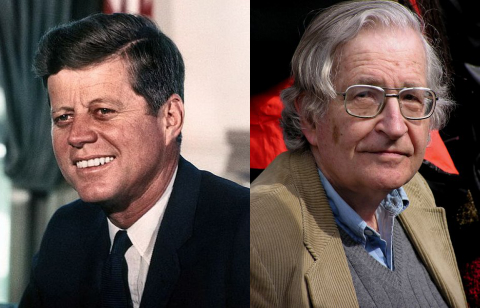 In recent decades, historians have tried to offer a balanced assessment of JFK’s life and legacy, offering clear-eyed accounts of his handling of foreign and domestic policy, and raising questions about his infidelities and health problems, all the while chipping away at the Camelot myth. On Friday, the 50th anniversary of the Kennedy assassination, the hagiography returned, and even perennial cads like Rush Limbaugh had little bad to say about America’s 35th president. He simply insisted that JFK would be a conservative, if still alive today.
Perhaps the only notable exception was Noam Chomsky. Never a fan of Kennedy (or probably any other American president for that matter), Chomsky was asked by Truthout, “Do you find it odd that the country is focusing on a 50th anniversary remembrance of the Kennedy assassination?” A leading question, no doubt, to which Chomksy replied, “Worship of leaders is a technique of indoctrination that goes back to the crazed George Washington cult of the 18th century and on to the truly lunatic Reagan cult of today, both of which would impress Kim Il-sung. The JFK cult is similar.” It’s what you get when you live in “a deeply indoctrinated society.” If you’re ready to have Chomsky throw more cold water (or is it combustible gasoline?) on the JFK legacy, head over to Truthout for more.
P.S. Don’t shoot the messenger on this…
via Leiter Reports
Related Content:
Noam Chomsky Slams Žižek and Lacan: Empty ‘Posturing’
Noam Chomsky vs. William F. Buckley, 1969
Read More...Rocks Stars Who Died Before They Got Old: What They Would Look Like Today

Live fast.
Die young.
Spare yourself the grim realities of the state fair reunion tour circuit.
On the other hand, it’s deathly hard to control one’s image from beyond the grave. Especially when you’ve got an award-winning PR Agency and a photo manipulation company teaming up to imagine how you might look had you survived!
The twelve unlucky recipients of these posthumous makeovers remain household names (see the gallery here), even though it’s nearly twenty years since the last of their number drew breath. Like Jim Morrison, Janis Joplin and Jimi Hendrix, Kurt Cobain was but 27 when he passed, though at the time of his birth, the other three were all old enough to be his mommy or daddy. Fitting, then, that he appears to be the baby of the golden group.
Music writer Elijah Wald and popular music scholar Reebee Garofalo offer insights below each portrait in the gallery about where the subjects might now find themselves in their careers. It’s all conjecture, but their experience ensures that their opinions can be taken as educated guesses, at least.
Less convincing are the sartorial choices on display. Dennis Wilson in a Hawaiian shirt, okay, but were he alive, might not Keith Moon follow suit with former-bandmates Pete Townshend and Roger Daltrey, both of whom have adopted the sleek, monochromatic wardrobe favored by aging rock gods?
And who here thinks the 78-year-old Elvis would traipse around in the sort of short-sleeved poly-blend shirt my late grandfather wore to his weekly men’s prayer breakfast?
For pity’s sake, age does not automatically imply drabness!
(Who’s that I see over there? Could it be Yoko Ono, looking great at 80, in a top hat and tap pants? Even if she were looking less-than-fit, it would still be a bold choice! I doubt she wears that get-up to the grocery store, but the progression of time has not robbed her of the ability to make a deliberate visual impression.)
What is refreshing—though not necessarily believable—is how none of the resurrected icons in these portraits seem to have gone in for plastic surgery.
Related Content:
Jimi Hendrix’s Final Interview on September 11, 1970: Listen to the Complete Audio
Watch Janis Joplin’s Final Interview Reborn as an Animated Cartoon
Animated Video: Kurt Cobain on Teenage Angst, Sexuality & Finding Salvation in Punk Music
Ayun Halliday is the author of seven books, most recently Peanut. Follow her @AyunHalliday.
Read More...The Existentialism Files: How the FBI Targeted Camus, and Then Sartre After the JFK Assassination
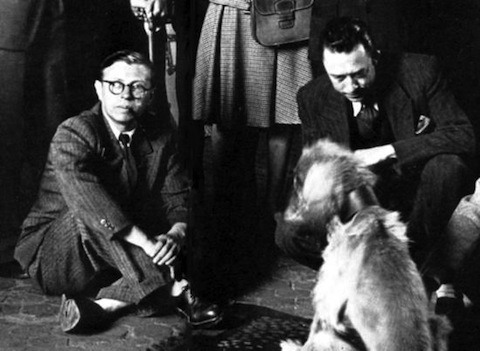
Today, as you must surely know, marks the 50th anniversary of John F. Kennedy’s assassination and also surely marks a revival of interest in the myriad conspiracy theories that abound in the absence of a satisfactory explanation for the events at Dealey Plaza on November 22nd, 1963. One theory I’ve never heard floated before comes to us via Andy Martin, lecturer in French at Cambridge University and author of The Boxer and the Goalkeeper: Sartre vs Camus. In an article for Prospect magazine, Martin writes:
To the massed ranks of the CIA, the Mafia, the KGB, Castro, Hoover, and LBJ, we can now add: Jean-Paul Sartre. FBI and State Department reports of the 1960s had drawn attention to Sartre’s membership of the Fair Play for Cuba Committee, of which Lee Harvey Oswald was also a member. And—prophetically?—Sartre had “dismissed the US as a headless nation.” […] Could he, after all, have been the Second Shooter?
It’s probably fair to say that Martin’s tongue is wedged firmly in his cheek throughout this opening of his fascinating chronicle of the FBI’s surveillance of Sartre and his onetime friend and editor Albert Camus. But Martin’s interest in the misalliance of Sartre and the Feds is very serious. What he finds during his investigation of the FBI files on existentialism is that “the G‑men, initially so anti-philosophical, find themselves reluctantly philosophizing. They become (in GK Chesterton’s phrase) philosophical policemen.”
While we have become accustomed, since the days of Joe McCarthy, to ideological witch hunts, it seems that Sartre and Camus served as test cases for the sort of thing that frequently plays out in overheated Congressional hearings and media denunciations—agents with furrowed brows and little philosophical training desperately trying to work out whether such and such abstruse academic is part of a grand conspiracy to undermine truth, justice, the American Way, etc.. Sartre appeared early on the anti-Communist radar, though, ironically, he did so as a plant of sorts, brought over in 1945 by the Office of War Information as part of a group of journalists the United States’ government hoped would put out good propaganda.
“Hoover wondered,” however, writes Martin, “what kind of good propaganda you can hope to get out of the author of Nausea and Being and Nothingness.” It turned out, not much, but a year later Hoover latched on to Sartre’s friend and editor Albert Camus, whose name he and his agents spelled, variously, as “Canus” or “Corus.” Where Sartre had breezed into the country—smitten by its literature and music—Camus was held at immigration on Hoover’s orders. He would spend a brief, depressing time and never return.
How we get from post-war surveillance of French existentialist philosophers to Sartre and the grassy knoll is a long and complicated tale, befitting the paranoid imaginings of J. Edgar Hoover. He was, after all, the conspiracy theorist par excellence and “he needed to know,” writes Martin, “if Existentialism and Absurdism were some kind of front for Communism. To him, everything was potentially a coded re-write of the Communist Manifesto.” What Hoover feared from Sartre, however, was that the latter was himself an influential believer in a conspiracy, one that cast doubt on the FBI’s strongly-held belief that Oswald was the lone gunman.
Despite gathering years of NSA-worthy surveillance on the philosophers, Hoover’s agents were never able to discern the ideological program of the French. “I can’t work out,” wrote one in a note in Sartre’s file, “if he’s pro-Communist or anti-Communist.” The black-and-white, spy-vs-spy world of the FBI left little room for philosophical nuance and literary ambiguity, after all. But they never stopped watching Sartre, convinced that “there must be some kind of conspiracy between communists, blacks, poets and French philosophers.” As it turns out, there were several—political and aesthetic conspiracies involving such terrifying figures as Frantz Fanon and Aimé Césaire. These poets and close relations of Sartre did, indeed, help foment revolution in the Caribbean and elsewhere—but theirs are stories for another day.
Read Martin’s Prospect article here.
Related Content:
How the CIA Secretly Funded Abstract Expressionism During the Cold War
Josh Jones is a writer and musician based in Durham, NC. Follow him at @jdmagness
Read More...Dutchman Masters the Art of Singing Led Zeppelin’s “Stairway to Heaven” Backwards
This has “viral video” written all over it. The only problem is that it was filmed and released back in 2003, just two years before YouTube changed our world. But who knows, maybe with your help, the video could enjoy some posthumous viralness. Or is it virality or viralosity?
The clip above features Jeroen Offerman, a Dutch visual artist who, a decade ago, spent three months learning to sing Led Zeppelin’s “Stairway to Heaven” entirely backwards. He filmed himself singing the song in reverse, while standing in front of Saint Paul’s Cathedral in London, then flipped the direction of the video (hence the pedestrians walk backwards), all in order to show how well he mastered the art of singing Zeppelin in reverse.
On his website he explains the project in greater detail, writing:
“The Stairway at St.Paul’s” is based on the hysteria that surrounded certain music-recordings of the 60’s and the 70’s. Some rock bands, like the Beatles, Judas Priest and Led Zeppelin were supposed to have put hidden messages in their records that could only be heard when played backwards. These messages though, would subconsciously be picked up by the listener who would then react in response to them.
In this way the band Judas Priest ended up in a court case because their records had ‘induced’ children to commit suicide. Also, the Beatles were supposed to suggest through their records that Paul McCartney, one of their main band members, had died in a car crash and was replaced by a look-a-like.
The most famous example though, is Led Zeppelin’s ‘Stairway to Heaven’, a song about a woman buying herself a way in to heaven. The mystic lyrics seem to urge us to follow the right path in life. But, as one line in the song already says, “sometimes words have two meanings”, and so, when played backwards, this song is supposed to urge us to worship evil.
It’s time to dive in to your record-collection and find out if it was all true. But first let us watch this video. So turn up the volume and remember the first time you smoked a cigarette…
Things get pretty great around the 6:07 mark.
I’m praying that this isn’t all a goof.
If you would like to support the mission of Open Culture, consider making a donation to our site. It’s hard to rely 100% on ads, and your contributions will help us continue providing the best free cultural and educational materials to learners everywhere. You can contribute through PayPal, Patreon, and Venmo (@openculture). Thanks!
Related Content:
Hear Led Zeppelin’s First Recorded Concert Ever (1968)
Led Zeppelin Plays One of Its Earliest Concerts (Danish TV, 1969)
Read More...
November 22, 1963: Watch Errol Morris’ Short Documentary About the Kennedy Assassination
We live in a fine time for conspiracy theorists, in at least a couple of senses. First and more broadly, given the power of the internet, they’ve never had closer at hand the semi-incriminating, half-hidden pieces of information on which they build and with which they bolster their suspicions. Nor have they ever had a more effective means of gathering and discussing their findings. Second and more specifically, the 50th anniversary of the assassination of President John F. Kennedy has come upon us. This has set all those fascinated by that grim historical event, from the soberest of skeptics to the sheerest paranoiacs, evaluating and re-evaluating it even more thoroughly than usual. Above you’ll find the short November 22, 1963 by Errol Morris, a clear-eyed documentarian and interviewer fascinated not only with those who conspire and those who theorize about such conspiracies, but also with the grander implicit questions about what we know and what we don’t, what we can know and what we can’t, and whether we even know what we can and can’t know in the first place. (The title of his new feature-length documentary about Donald Rumsfeld: The Unknown Known.)
“The more you investigate a crime, the more it becomes crystal-clear what happened,” says Josiah “Tink” Thompson, scholar of Søren Kierkegaard, private detective, and author of Six Seconds in Dallas: A Micro-Study of the Kennedy Assassination (a book with which anyone who has seen Richard Linklater’s Slacker will already feel some familiarity). “I don’t think any other crime I know of in history has been investigated with the kind of intensity that this has. And yet I don’t think we get any closer to knowing what happened now than we were 40, 45 years ago.” This opens a discussion of how all the photographic evidence of 11/22/63, up to and including the awesomely scrutinized Zapruder film, bears on the matter. “Is there a lesson to be learned?” Morris asks. “Yes, to never give up trying to uncover the truth. Despite all the difficulties, what happened in Dallas happened in one way rather than another. It may have been hopelessly obscured, but it was not obliterated.” And just as November 22, 1963 follows up The Umbrella Man, Morris’ previous piece with Thompson, Thompson has a sequel of his own in the works: a book called Last Seconds in Dallas. JFK assassination nuts — and I mean that in the nicest way — have their reading ahead of them.
November 22, 1963 will be added to the Documentary section of our collection of 600 Free Movies Online.
Related content:
Who Killed JFK? Two New Studies
Filmmaker Errol Morris Gives Us “11 Excellent Reasons Not to Vote?”
Colin Marshall hosts and produces Notebook on Cities and Culture and writes essays on literature, film, cities, Asia, and aesthetics. He’s at work on a book about Los Angeles, A Los Angeles Primer. Follow him on Twitter at @colinmarshall.
Read More...Support Us
We're hoping to rely on loyal readers, rather than erratic ads. Please click the Donate button and support Open Culture. You can use Paypal, Venmo, Patreon, even Crypto! We thank you!

About Us

Open Culture scours the web for the best educational media. We find the free courses and audio books you need, the language lessons & educational videos you want, and plenty of enlightenment in between.
Advertise With Us

FREE UPDATES!
GET OUR DAILY EMAIL
Get the best cultural and educational resources on the web curated for you in a daily email. We never spam. Unsubscribe at any time.
FOLLOW ON SOCIAL MEDIA

Open Culture editor Dan Colman scours the web for the best educational media. He finds the free courses and audio books you need, the language lessons & movies you want, and plenty of enlightenment in between.
Advertise With Us


