F. Scott Fitzgerald’s 13 Tips for What to Do with Your Leftover Thanksgiving Turkey
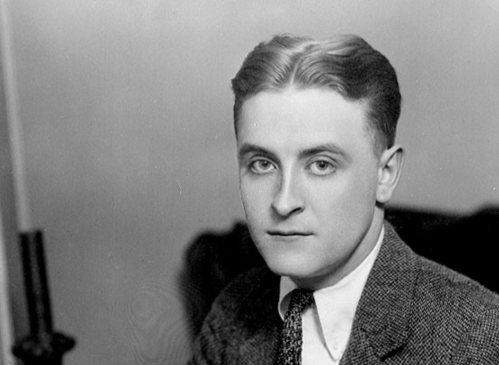
Image by “The World’s Work” via Wikimedia Commons
“At this post holiday season, the refrigerators of the nation are overstuffed with large masses of turkey, the sight of which is calculated to give an adult an attack of dizziness. It seems, therefore, an appropriate time to give the owners the benefit of my experience as an old gourmet, in using this surplus material.” There writes no less a legend of American letters than F. Scott Fitzgerald, author of The Great Gatsby and Tender is the Night (both available in our Free eBooks collection). His words quoted here, from “Turkey Remains and How to Inter Them with Numerous Scarce Recipes,” a column found in the Fitzgerald miscellany collection The Crack-Up, hold just as true this day-after-Thanksgiving as they did during those his lifetime. Lists of Note offers the full piece, which itself offers thirteen potential uses for your leftover bird, some of which, Fitzgerald writes, “have been in my family for generations”:
1. Turkey Cocktail: To one large turkey add one gallon of vermouth and a demijohn of angostura bitters. Shake.
2. Turkey à la Francais: Take a large ripe turkey, prepare as for basting and stuff with old watches and chains and monkey meat. Proceed as with cottage pudding.
3. Turkey and Water: Take one turkey and one pan of water. Heat the latter to the boiling point and then put in the refrigerator. When it has jelled, drown the turkey in it. Eat. In preparing this recipe it is best to have a few ham sandwiches around in case things go wrong.
4. Turkey Mongole: Take three butts of salami and a large turkey skeleton, from which the feathers and natural stuffing have been removed. Lay them out on the table and call up some Mongole in the neighborhood to tell you how to proceed from there.
5. Turkey Mousse: Seed a large prone turkey, being careful to remove the bones, flesh, fins, gravy, etc. Blow up with a bicycle pump. Mount in becoming style and hang in the front hall.
6. Stolen Turkey: Walk quickly from the market, and, if accosted, remark with a laugh that it had just flown into your arms and you hadn’t noticed it. Then drop the turkey with the white of one egg—well, anyhow, beat it.
7. Turkey à la Crême: Prepare the crême a day in advance. Deluge the turkey with it and cook for six days over a blast furnace. Wrap in fly paper and serve.
8. Turkey Hash: This is the delight of all connoisseurs of the holiday beast, but few understand how really to prepare it. Like a lobster, it must be plunged alive into boiling water, until it becomes bright red or purple or something, and then before the color fades, placed quickly in a washing machine and allowed to stew in its own gore as it is whirled around. Only then is it ready for hash. To hash, take a large sharp tool like a nail-file or, if none is handy, a bayonet will serve the purpose—and then get at it! Hash it well! Bind the remains with dental floss and serve.
9. Feathered Turkey: To prepare this, a turkey is necessary and a one pounder cannon to compel anyone to eat it. Broil the feathers and stuff with sage-brush, old clothes, almost anything you can dig up. Then sit down and simmer. The feathers are to be eaten like artichokes (and this is not to be confused with the old Roman custom of tickling the throat.)
10. Turkey à la Maryland: Take a plump turkey to a barber’s and have him shaved, or if a female bird, given a facial and a water wave. Then, before killing him, stuff with old newspapers and put him to roost. He can then be served hot or raw, usually with a thick gravy of mineral oil and rubbing alcohol. (Note: This recipe was given me by an old black mammy.)
11. Turkey Remnant: This is one of the most useful recipes for, though not, “chic,” it tells what to do with the turkey after the holiday, and how to extract the most value from it. Take the remants, or, if they have been consumed, take the various plates on which the turkey or its parts have rested and stew them for two hours in milk of magnesia. Stuff with moth-balls.
12. Turkey with Whiskey Sauce: This recipe is for a party of four. Obtain a gallon of whiskey, and allow it to age for several hours. Then serve, allowing one quart for each guest. The next day the turkey should be added, little by little, constantly stirring and basting.
13. For Weddings or Funerals: Obtain a gross of small white boxes such as are used for bride’s cake. Cut the turkey into small squares, roast, stuff, kill, boil, bake and allow to skewer. Now we are ready to begin. Fill each box with a quantity of soup stock and pile in a handy place. As the liquid elapses, the prepared turkey is added until the guests arrive. The boxes delicately tied with white ribbons are then placed in the handbags of the ladies, or in the men’s side pockets.
What, you expected recipes more… followable than these? And perhaps recipes with less alcohol involved? These all make much more sense if you bear in mind Fitzgerald’s formidable creativity, his even more formidable penchant for the drink, and his mordant sense of humor about it all. “I guess that’s enough turkey talk,” concludes this literary icon of my Thanksgiving-celebrating nation. “I hope I’ll never see or hear of another until—well, until next year.” If you haven’t had enough, and indeed feel like getting the jump on next year, see also the Airship’s list of twelve Thanksgiving recipes from favorite authors, including Jonathan Franzen’s pasta with kale, Alice Munro’s rosemary bread pudding, and Ralph Ellison’s sweet yams.
via Lists of Note
Related Content:
The Recipes of Iconic Authors: Jane Austen, Sylvia Plath, Roald Dahl, the Marquis de Sade & More
Prepare Marilyn Monroe’s Personal, Handwritten Turkey-and-Stuffing Recipe on Thanksgiving
Colin Marshall hosts and produces Notebook on Cities and Culture and writes essays on cities, Asia, film, literature, and aesthetics. He’s at work on a book about Los Angeles, A Los Angeles Primer. Follow him on Twitter at @colinmarshall or on his brand new Facebook page.
Read More...What Cultural Icons of the 19th & 20th Centuries Would Have Liked About Life in the 21st Century
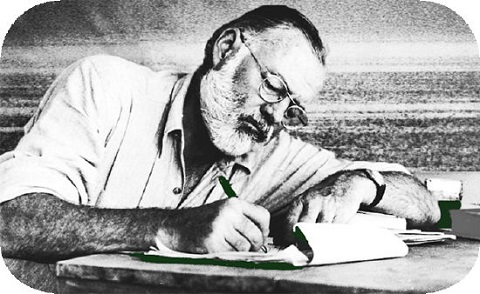
At the web site, The Fertile Fact, you can read lists and lists of things you never knew about your favorite cultural figures. Or rather, you can read lists and lists of guesses about what your favorite cultural figures of the 19th and 20th centuries would have enjoyed about life in our 21st century. From Paul Hendrickson, author of Hemingway’s Boat: Everything He Loved in Life, and Lost, 1934 – 1961, we learn that Papa would have liked e‑mail (“for a man who wrote letters to tune himself up and cool himself down against the day’s ‘real writing’, email would have been a great outlet for his emotion”). But he would have loved Twitter:
Email squared. Hemingway was the master of ‘cable-ese’, a form of slang developed by journalists in the 1920s to save space (and, as importantly, money) when sending telegraphs, which he learned in his youth as a newspaperman. He would have loved the 140-character limit to write small little novels of rage or love or something in between. If he could write an arc of a story in six words, which went: “For Sale: baby shoes, never worn,” thereby arguably inventing flash fiction, then just imagine the possibilities of the kind of War and Peace epics he might have tried via Twitter. And the possible spats he might have got into, of course.

From Tom Williams, author of A Mysterious Something In The Light: A Life of Raymond Chandler, we learn that the creator of Philip Marlowe, another potential Twitter enthusiast, would take to the works of Quentin Tarantino, since
The thing that frustrated Chandler most about Hollywood was that his vision as a writer rarely made it onto screen unmediated. For Ray, the studio always got in the way of what he was trying to do. It was a problem that particularly affected The Blue Dahlia. Though a movie beset by problems (a tight schedule meant Chandler had to write the ending in a state of extreme intoxication) one of the most constant laments in his letters is the studio’s persistent meddling with the picture. He wrote to a friend, shortly after finishing the film, “So here was I a mere writer and a tired one at that screaming at the front office to protect the producer and actually going on the set to direct scenes – I know nothing about directing – in order that the whole project be saved from going down the drain.”
Studios were more interested in getting punters into the theatre than producing good films as far as Chandler was concerned (see the bitter portrait of a studio boss in The Little Sister who talks of caring only for the number of theatres he owns, not the films shown in them, while letting his dog urinate on his trouser cuff). Though Quentin Tarantino is hardly the first director to work independently of a studio, his determination to make the films he wants (proving the value of letting a film-maker stick to his vision in the process) is something Chandler would have admired deeply. Tarantino is also willing to embrace all levels of culture, and this too is something Ray would have respected; he was never one for literary snobbery.

From Robert Zaretsky, author of A Life Worth Living: Albert Camus and the Quest for Meaning, we learn that creator of Meursault, the affectless Arab-shooting protagonist of The Stranger, would have approved of The Arab Spring:
The author of The Rebel would find little reason for hope, but none for despair. The instances of non-violent protest in Tunisia and Egypt would serve as illustrations of Camus’ insistence that true rebels never lose sight of the humanity of those who oppress them. Syria? The tragic illustration of what happens when rebels do lose sight of this imperative.
The Fertile Fact offers not only more things these three men would enjoy about our era, but similar lists for such creators as Alfred Hitchcock, Nancy Mitford, Tennessee Williams, and Agatha Christie. How long before they produce one for Virginia Woolf, the writer who, describing “the creative fact,” “the fact that engenders and suggests,” coined the phrase that gave the site its name?
Related Content:
18 (Free) Books Ernest Hemingway Wished He Could Read Again for the First Time
Raymond Chandler Denounces Strangers on a Train in Sharply-Worded Letter to Alfred Hitchcock
Quentin Tarantino’s 10 Favorite Films of 2013
Colin Marshall hosts and produces Notebook on Cities and Culture and writes essays on cities, Asia, film, literature, and aesthetics. He’s at work on a book about Los Angeles, A Los Angeles Primer. Follow him on Twitter at @colinmarshall or on his brand new Facebook page.
Read More...William Shatner Raps About How to Not Kill Yourself Deep Frying a Turkey
Like many others on Thanksgiving, William Shatner sought a “moister, tastier” turkey experience. The former Star Trek star had purchased a sizable fryer and, turned brash by pangs of hunger, threw caution to the wind; despite knowing Archimedes’ principle full well, Shatner boldly went where no cook should go and deposited the turkey into a vat brimming with oil. Oh, woeful day! The oil, displaced by the turkey, ran over the fryer’s sides and onto the open flame. Flames then shot up, burning Shatner’s arms.
In 2011, Shatner joined forces with the insurance company State Farm to create a cautionary video warning would-be Thanksgiving turkey fryers about the perils of engaging in such a gastronomic enterprise. According to State Farm, insurance claims related to Thanksgiving grease & cooking-accidents dropped by half after this public service announcement came out.
In what can only be interpreted as an attempt to tamper with perfection, in 2012, State Farm decided to have YouTube’s melodysheep remix Shatner’s original video, giving it a glistening new coat of Internet virality. We are pleased to say that the endeavor proved to be a resounding success. Please enjoy the video, above, and remember the following frying tips:
1: Avoid oil spillover–don’t overfill the pot.
2: Turn off the flame when lowering the turkey into oil.
3: Fry outside, away from the house.
4: Properly thaw the turkey before frying.
5: Keep a grease-fire-approved extinguisher nearby.
Ilia Blinderman is a Montreal-based culture and science writer. Follow him at @iliablinderman.
Read More...A Guide to Happiness: Alain de Botton’s Documentary Shows How Nietzsche, Socrates & 4 Other Philosophers Can Change Your Life
Alain de Botton is a not a philosopher’s philosopher. This means that his work is given little consideration inside academia. It also means that he speaks to many, many more people—ordinary people hungry for humanist ideas about living—than his peers. In his six-part video series, Philosophy: A Guide to Happiness, de Botton tells us that he’d always looked to philosophy as a discipline that “has wise things to say about everyday worries…. Philosophy promised something that might sound a little naïve, but was in fact rather profound: A way to learn to be happy.” I’m still not sure if this sounds more naïve or profound, but de Botton’s videos, each nearly 25 minutes long, concern thinkers who surely knew the difference. Each video also functions as a travelogue of sorts, as de Botton visits the cities that produced the thinkers, and tries to square their histories with the modern world around the relics.
Above, de Botton discusses Roman stoic philosopher and tragedian Seneca. An advisor to Nero, Seneca’s life may have been happy, at times, but it was hardly restrained. In any case, he had something to teach us about the futility of anger, and he was also, like de Botton, a great popularizer of other people’s ideas. Seneca characterized anger as a rational response that nonetheless relies on false premises, namely that we have more control over our circumstances than we actually do, and that our optimism about outcomes is unfounded and sets us up with unrealistic expectations. De Botton has before professed an affinity for the tragic view, and Seneca’s horribly bloody works, which inspired the Elizabethan genre known as “Revenge Tragedy,” are particularly grotesque explorations of anger. But perhaps it is those who most clearly see the pernicious effects of an emotion, or lack of it, who understand it best.
Take Arthur Schopenhauer, whom de Botton consults as his authority on love. Like Seneca, Schopenhauer seems very much at odds with much of his philosophical writing on love and compassion. His essay “On Women” earned him a permanent reputation as a misogynist, deserved or not. He’s rumored to have had a violent temper and wrote approvingly of keeping one’s distance from the mass of people, most of whom annoyed him disproportionately. Schopenhauer also famously wrote that it would have been preferable not to have been born at all, a position of extreme misanthropy known as antinatalism.
But there are other aspects of Schopenhauer’s romantic life to discuss, both its early successes and later failures. “Nothing in life,” says de Botton, “is more important than love for Schopenhauer.” Even with all of its pains of rejection, romantic love, Schopenhauer wrote in The World as Will and Representation, “is more important than all other aims in man’s life; and therefore it is quite worthy of the profound seriousness with which everyone pursues it.”
Another popular British philosophical thinker, John Gray, has a very different take on the great German pessimist, calling his philosophy “more subversive of humanist hopes than any other.” But de Botton’s technique seems in many ways calculated as a mild subversion of expectation, choosing as he does such contradictory, and often very solitary figures.
One solitary thinker who occupies a treasured place in the library of every humanist is Michel de Montaigne, the genial French essayist who invented the literary term essai, and who some might say also perfected the form. Montaigne has always struck me as the happiest of men, even in, or especially in his long stretches of solitude, punctuated by conscientious public service (despite his lifelong painful kidney stones). While both Schopenhauer and Montaigne engaged in lengthy self-examination, Montaigne seems to have genuinely liked himself and others. He treats himself in his writings as an old and honest friend with whom one can be perfectly candid without any fear of reprisal. This is perhaps why de Botton chose him to illustrate self-esteem.
Montaigne comes from a tradition much friendlier to philosophy as memoir (he invented the tradition). And so, in this age of the memoir, he has seen a great resurgence. In 2011, at least three popular books on Montaigne came out, one titled How to Live and another subtitled Montaigne and Being in Touch With Life. Of all the six philosophers de Botton surveys in his series, which also includes Nietzsche, Epicurus, and Socrates, Montaigne would seem the most complimentary to de Botton’s casual, personal approach to philosophy, which seeks not to dig new ground nor discover distant countries but to confront the vexing human questions that meet us always at home.
You can view all six episodes in the embedded playlist below:
Related Content:
Download 90 Free Philosophy Courses and Start Living the Examined Life
Alain de Botton Proposes a Kinder, Gentler Philosophy of Success
The Daily Habits of Highly Productive Philosophers: Nietzsche, Marx & Immanuel Kant
Alain de Botton’s Quest for The Perfect Home and Architectural Happiness
The Art of Living: A Free Stanford Online Course Explores Timeless Questions
Josh Jones is a writer and musician based in Durham, NC. Follow him at @jdmagness
Read More...Discover the “Brazen Bull,” the Ancient Greek Torture Machine That Doubled as a Musical Instrument
History is replete with brutally imaginative torture and execution techniques. The list of cruelties includes crucifixion, where victims were left to die on the cross; the rack, where torturers would place the victim on a wooden frame to be slowly pulled apart; and hanging, drawing, and quartering—the official English punishment for high treason from 1351 to 1870—where men would be drawn by horse to their place of execution, hung until near-death, and then emasculated and disemboweled before being decapitated and cut into quarters. The most intricately sadistic form of torture, however, originated with the Greek tyrant Phalaris.
Phalaris, the despot of Acragas (now Agrigento, in Sicily), was infamous for his callousness and reputedly “devoured” suckling infants. The video above describes how Phalaris, keeping to his character, asked the craftsman Perilaus to construct a bronze bull for the execution of criminals. The bull housed a hollow chamber where victims were deposited through a trapdoor. A fire was kindled beneath the bull, turning the statue into an oven.
As Phalaris supposedly admitted himself, the most savage aspect of this brazen monstrosity was its musical nature:
A countryman of my own, one Perilaus, an admirable artist, but a man of evil disposition, had so far mistaken my character as to think that he could win my regard by the invention of a new form of torture; the love of torture, he thought, was my ruling passion… He opened the back of the animal, and continued: “When you are minded to punish any one, shut him up in this receptacle, apply these pipes to the nostrils of the bull, and order a fire to be kindled beneath. The occupant will shriek and roar in unremitting agony; and his cries will come to you through the pipes as the tenderest, most pathetic, most melodious of bellowings. Your victim will be punished, and you will enjoy the music.”
It is doubtful that the tyrant so known for his barbarism would cringe at this novelty; nevertheless, Phalaris claims to have been sickened by Perilaus’ cleverness:
‘His words revolted me. I loathed the thought of such ingenious cruelty, and resolved to punish the artificer in kind. “If this is anything more than an empty boast, Perilaus,” I said to him, “if your art can really produce this effect, get inside yourself, and pretend to roar; and we will see whether the pipes will make such music as you describe.” He consented; and when he was inside I closed the aperture, and ordered a fire to be kindled. “Receive,” I cried, “the due reward of your wondrous art: let the music-master be the first to play.”
Upon hearing Perilaus’ shrieks, the content tyrant removed the craftsman from bull, and then threw him off of a cliff. “Mistaken my character,” indeed.
Ilia Blinderman is a Montreal-based culture and science writer. Follow him at @iliablinderman.
Related Content:
Ancient Greek Punishments: The Retro Video Game
What Ancient Greek Music Sounded Like: Hear a Reconstruction That is ‘100% Accurate’
Hear Homer’s Iliad Read in the Original Ancient Greek
The History of Western Architecture: From Ancient Greece to Rococo (A Free Online Course)
Read More...Marilyn Monroe’s Handwritten Turkey-and-Stuffing Recipe
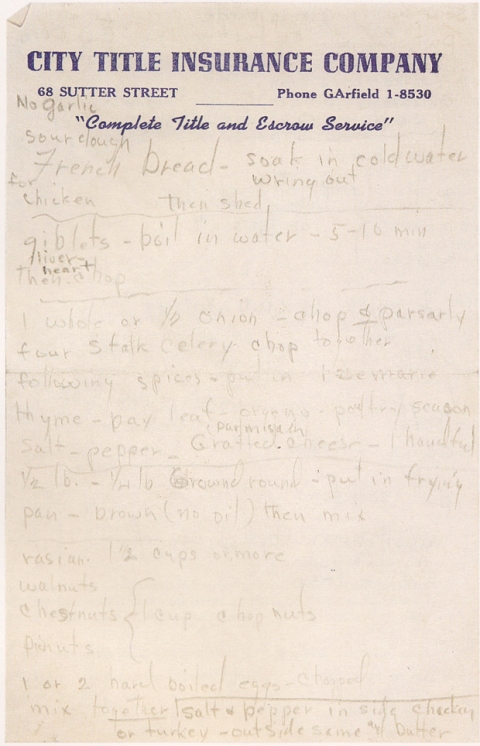
Entire industries seem to have sprung up around the mission of demonstrating that Marilyn Monroe did more in her short life than become an icon — the icon — of midcentury American starlethood. We here at Open Culture have previously featured not just her famously photographed reading of James Joyce’s Ulysses, but the contents of her personal library as well. The new book Fragments provides a great deal of rich ephemera to those scholars of Monroe’s pursuits off the screen, including, as Matt Lee and Ted Lee in the New York Times describe it, “assorted letters, poems and back-of-the-envelope scribblings that span the time from Monroe’s first marriage in 1943 to her death in 1962.” The article appears in the paper’s Dining & Wine section thanks to one Monrovian fragment of particular interest this time of year: her personal recipe for turkey and stuffing.
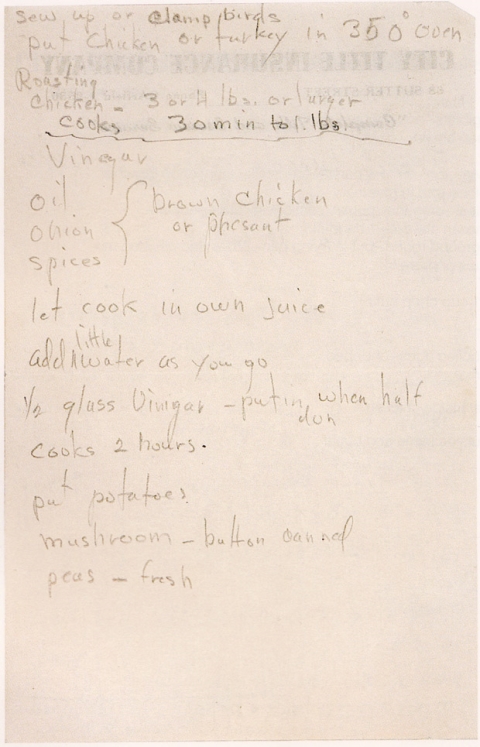
“Scrawled on stationery with a letterhead from a title insurance company,” write Lee and Lee, “the recipe describes in some detail how to prepare a stuffing for chicken or turkey. The formula is extensive in the number of ingredients (11, not including the 5 herbs and spices, or salt and pepper), and in their diversity (3 kinds of nuts and 3 animal proteins). It is unorthodox for an American stuffing in its use of a bread loaf soaked in water, wrung dry and shredded, and in its lack of added fat, broth, raw egg or any other binder.” You can find a transcript of the steps right below. And if you give a whirl on Thanksgiving, let us know how it turns out.
For the Stuffing
- No garlic
- Sourdough
- French bread — soak in cold water, wring out, then shred
- For chicken giblets — boil in water 5–10 mins
- Liver — heart then chop
- 1 whole or ½ onion, chop & parsley / four stalk celery, chop together following spices — put in rosemary
- Thyme, bay leaf, oregano, poultry seasoning, salt, pepper,
- Grated Parmesan cheese, 1 handful
- 1/2lb – 1/4lb ground round — put in frying pan — brown (no oil) then mix raisin 1 ½ cuops or more
- 1 cup chop nuts (walnuts, chestnuts, peanuts)
- 1 or 2 hard boiled eggs — chopped mix together
To Prep the Bird
- Salt & pepper inside chicken or turkey — outside same and butter
- Sew up clamp birds put chicken or turkey in 350 oven
- Roasting chicken — 3or 4lbs or larger
- Cooks 30 min to 1lbs
- Brown chicken or pheasant (vinegar, oil, onion, spices) — let cook in own juice
- Add little water as you go
- ½ glass vinegar — put in when half done
- Cooks 2 hours
- Put potatoes
- Mushroom — button canned
- Peas — fresh
via NYTimes, Brain Pickings and The Daily Mail
Related Content:
Marilyn Monroe Reads Joyce’s Ulysses at the Playground (1955)
Marilyn Monroe Explains Relativity to Albert Einstein (in a Nicolas Roeg Movie)
Colin Marshall hosts and produces Notebook on Cities and Culture and writes essays on cities, Asia, film, literature, and aesthetics. He’s at work on a book about Los Angeles, A Los Angeles Primer. Follow him on Twitter at @colinmarshall or on his brand new Facebook page.
Read More...“Soda/Pop/Coke,” A Creative Visual Remix of Harvard’s Famous 2003 Survey of American Dialects
Tomorrow, friends and relatives from far-flung corners of the country will gather as they do this time each year—stuff themselves silly, trim Christmas trees, watch football, online shop, etc. And depending on how far-flung those assembled are, there may be in certain homes some clandestine chuckling over a certain guest’s request for “pop” instead of soda, or the other way around, or some other funny way of saying things. Because in this gargantuan expanse we call the United States, we’ve got a wealth of regional variants—some differences subtle, some quite noticeable (though without necessarily the degree of socioeconomic baggage as the UK, I’m convinced).
I recall, for instance, moving to New York City over a decade ago and grappling for the next several years with New Yorkers’ insistence on saying “standing on line” instead of “in line.” As “online” acquired an entirely new meaning, this linguistic oddity took on an even more confusing dimension for outsiders. And having grown up hearing the second person plural as roughly half “you guy”s and half “y’all,”s I’ve been amused by the New York “youse.” As we learn from The Atlantic’s “Soda/Pop/Coke” above, these differences in wording correspond to regional differences in pronunciation of words like “bag,” “pecan,” and “coupon.”
Informing us that “at least 10 distinct dialects of English are spoken in the United States,” “Soda/Pop/Coke” draws on the 2003 Harvard Dialect Survey, conducted by linguist Bert Vaux. As the film’s interviewers ask callers Vaux’s survey questions, their regional affiliations appear graphically on a map of the continental United States, based on graduate student Joshua Katz’s heat mapping of Vaux’s work. You can see the more than one hundred variants Vaux’s survey measures here, and The Atlantic points us to U Penn’s dense (and specialized) National Map of the Regional Dialects of American English. It’s a complicated and rarefied science, linguistics, but we’re all at least amateur sociologists of language (sometimes bad ones) as we sort and size each other up—or completely mishear each other—based on completely unconscious choices in wording and pronunciation.
via Kottke
Related Content:
Do You Drink Soda, Pop or Soft Drinks?: 122 Heatmaps Visualize How People Talk in America
The History of the English Language in Ten Animated Minutes
Learn 46 Languages Online for Free: Spanish, Chinese, English & More
Josh Jones is a writer and musician based in Durham, NC. Follow him at @jdmagness
Read More...Newly-Released Thelonious Monk Live Recording, ‘Paris 1969,’ Now Streaming Free for a Limited Time
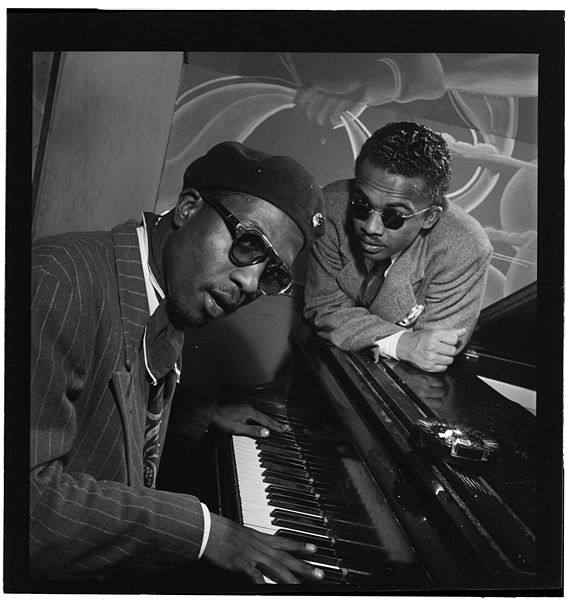 A quick heads up: Last week we told you all about how Thelonious Monk flubbed his first concert in Paris in 1954 and then made a triumphant return in 1969. The ’69 concert has just been released as a new CD, but, for a limited time, you can hear it streaming online, from start to finish, for free. It’s all thanks to NPR’s First Listen site. Enjoy.
Related Content:
Thelonious Monk Bombs in Paris in 1954, Then Makes a Triumphant Return in 1969
Advice From the Master: Thelonious Monk Scribbles a List of Tips for Playing a Gig
Thelonious Monk: Straight No Chaser
Read More...92nd Street Y Launches a New Online Archive with 1,000 Recordings of Literary Readings, Musical Performances & More
Kurt Vonnegut once commented, in an interview with Joseph Heller, that the best audience he had ever encountered was at the 92nd Street Y in New York. “Those people know everything. They are wide awake and responsive.”
Located at the corner of 92nd Street and Lexington Avenue, the 92Y has a venerable history of public performance, conversation, poetry and beyond. Vonnegut himself appeared at the 92Y seven times to read aloud from his own work. (Including this reading from Breakfast of Champions three years before the book was published.)
Cultural programming has been a focus at the 92Y since it opened in 1874. Originally, it served mostly German-Jewish men (note, it isn’t a YMCA, but a YM-YWHA—Young Men’s and Women’s Hebrew Association). But the Kaufmann Concert Hall opened in 1930, and that’s where a veritable Who’s Who of noted entertainment, politics, sports, and science figures have appeared over the years, speaking to that “wide awake and responsive” audience.
Lucky for the rest of us, the 92Y recorded the vast majority of those performances. And now 1,000 recordings appear on a new site, 92Y On Demand. It’s a fantastic archive of audio and video files, searchable by topic, year or performer name.
It’s all there: Yogi Berra looking back on his life and career. A 1961 reading by a young Nadine Gordimer. Harold Pinter reading his own short stories and weighing in on the Beatles vs. the Rolling Stones. Andrés Segovia playing a classical guitar recital. Lou Reed speaking on the eve of his live performance of Berlin (top). Billy Crystal (below) on roasting Muhammad Ali.
92Y is home to the Unterberg Poetry Center, so the new archive abounds with poetry readings. Dylan Thomas read there in 1953. Two years earlier playwright Thornton Wilder appeared and read from Emily Dickinson’s work. And closer to our own time, Paul McCartney recently read from his own poetry.
See many more celebrated figures such as Maria Bamford, Maurice Sendak, Dan Savage, Junot Díaz and Jamaica Kincaid read and discuss their work at 92Y On Demand.
Related Content:
Hear Kurt Vonnegut’s Very First Public Reading from Breakfast of Champions (1970)
Lou Reed Rewrites Edgar Allan Poe’s “The Raven.” See Readings by Reed and Willem Dafoe
Allen Ginsberg Gets Heckled by Beat Poet Gregory Corso at a 1973 Poetry Reading
Kate Rix writes about digital media and education. Follow her on Twitter.
Read More...The “Pursuit of Ignorance” Drives All Science: Watch Neuroscientist Stuart Firestein’s Engaging New TED Talk
Neuroscientist Stuart Firestein, the chair of Columbia University’s Biological Sciences department, rejects any metaphor that likens the goal of science to completing a puzzle, peeling an onion, or peeking beneath the surface to view an iceberg in its entirety.
Such comparisons suggest a future in which all of our questions will be answered. In Dr. Firestein’s view, every answer can and should create a whole new set of questions, an opinion previously voiced by playwright George Bernard Shaw and philosopher Immanuel Kant.
A more apt metaphor might be an endless cycle of chickens and eggs. Or, as Dr. Firestein posits in his highly entertaining, 18-minute TED talk above, a challenge on par with finding a black cat in a dark room that may contain no cats whatsoever.
According to Firestein, by the time we reach adulthood, 90% of us will have lost our interest in science. Young children are likely to experience the subject as something jolly, hands-on, and adventurous. As we grow older, a deluge of facts often ends up trumping the fun. Principles of Neural Science, a required text for Firestein’s undergraduate Cellular and Molecular Neuroscience course weighs twice as much as the average human brain.
The majority of the general public may feel science is best left to the experts, but Firestein is quick to point out that when he and his colleagues are relaxing with post-work beers, the conversation is fueled by the stuff that they don’t know.
Hence the “pursuit of ignorance,” the title of his talk.
Given the educational context, his choice of wording could cause a knee-jerk response. He takes it to mean neither stupidity, nor “callow indifference,” but rather the “thoroughly conscious” ignorance that James Clerk Maxwell, the father of modern physics, dubbed the prelude to all scientific advancement.
I bet the 19th-century physicist would have shared Firestein’s dismay at the test-based approach so prevalent in today’s schools.
The ignorance-embracing reboot he proposes at the end of his talk is as radical as it is funny.
For more of Stuart Firestein’s thoughts on ignorance check out the description for his Columbia course on Ignorance and his book, Ignorance: How It Drives Science.
Related Content:
Orson Welles Explains Why Ignorance Was His Major “Gift” to Citizen Kane
Noam Chomsky Explains Where Artificial Intelligence Went Wrong
Steven Pinker Explains the Neuroscience of Swearing (NSFW)
Ayun Halliday recently directed 16 homeschoolers in Yeast Nation, the world’s first bio-historical musical. Follow her @AyunHalliday.
Read More...Support Us
We're hoping to rely on loyal readers, rather than erratic ads. Please click the Donate button and support Open Culture. You can use Paypal, Venmo, Patreon, even Crypto! We thank you!

About Us

Open Culture scours the web for the best educational media. We find the free courses and audio books you need, the language lessons & educational videos you want, and plenty of enlightenment in between.
Advertise With Us

FREE UPDATES!
GET OUR DAILY EMAIL
Get the best cultural and educational resources on the web curated for you in a daily email. We never spam. Unsubscribe at any time.
FOLLOW ON SOCIAL MEDIA

Open Culture editor Dan Colman scours the web for the best educational media. He finds the free courses and audio books you need, the language lessons & movies you want, and plenty of enlightenment in between.
Advertise With Us


