Pablo Picasso’s Tender Illustrations For Aristophanes’ Lysistrata (1934)
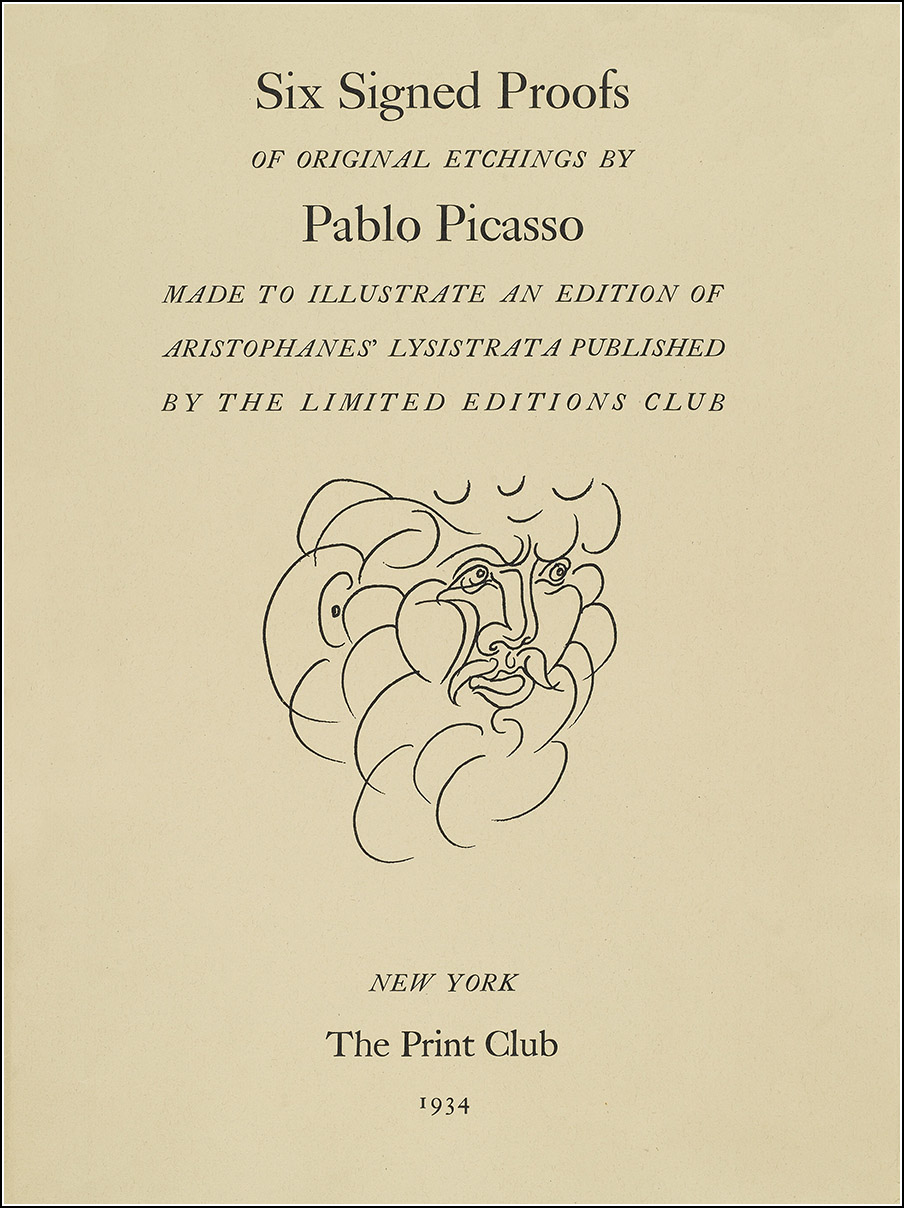
In the mid-1930s, some beautiful, high-quality books were published by a company called Limited Editions Club, which, according to Antiques Roadshow appraiser Ken Sanders, was “famous for re-issuing classics of literature and commissioning contemporary living artists to illustrate 1500-copy signed limited editions.” One of those books—the 1934 Pablo Picasso-illustrated edition of Aristophanes’ Lysistrata—is, next to Henri Matisse’s 1935 edition of Joyce’s Ulysses, one of “the most sought after and desirable limited editions on the market today.”
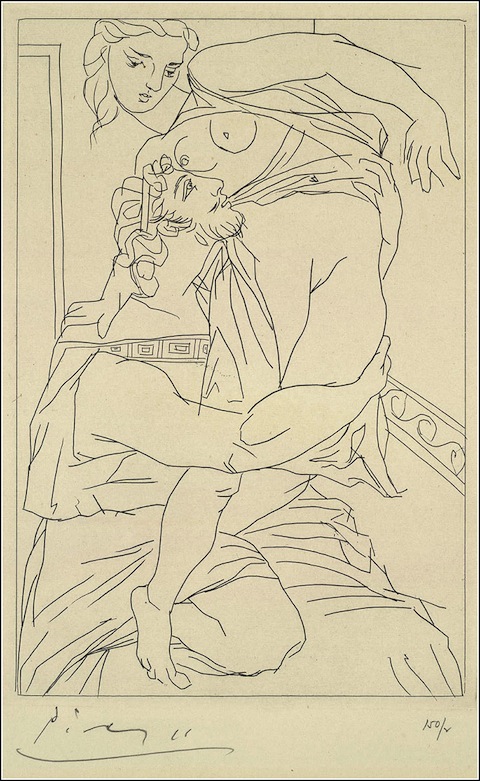
The book’s rarity, of course, renders it more valuable on the market than a mass-produced object, but whether it was worth $5,000 or $50, I think I’d hold onto my copy if I had one (here’s one for $12,000 if you’re buying). While Aubrey Beardsley’s 1896 illustrations do full and stylish justice to the satirical Greek comedy’s bawdy nature, Picasso’s drawings render several scenes as tender, softly sensual tableaux. The almost childlike simplicity of these illustrations of a play about female power and the limits of patriarchy do not seem like the work of a rumored misogynist, but then again, neither do any of Picasso’s other domestic scenes in this spare, rounded style of his.
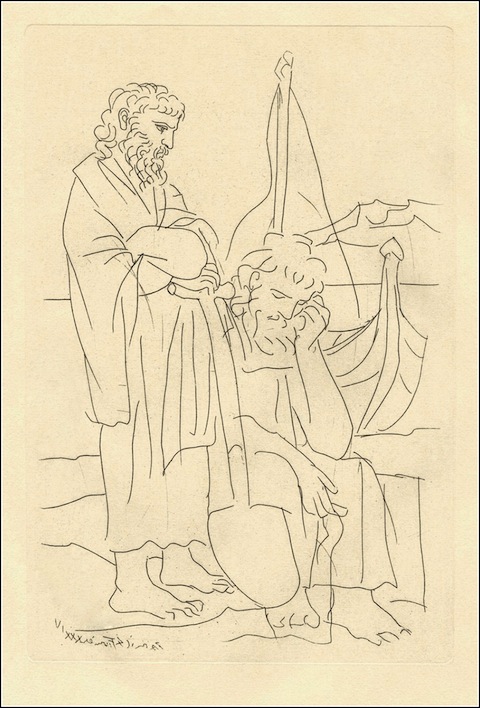
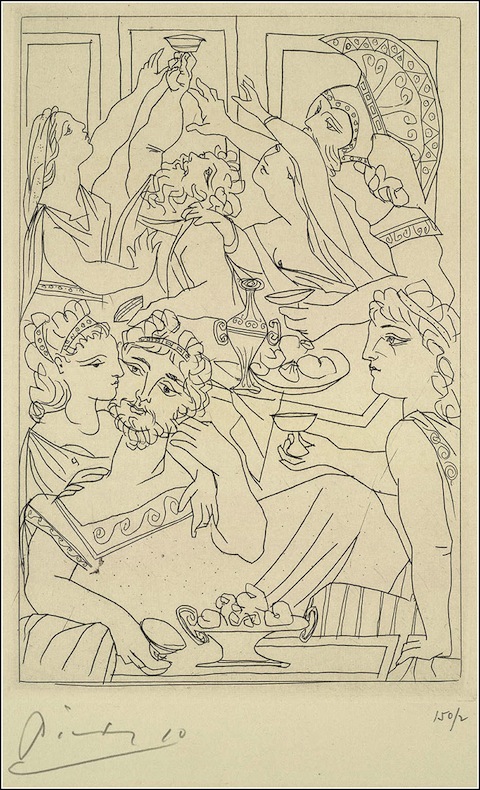
In Aristophanes’ play, the women of Greece refuse their husbands sex until the men agree to end the Peloponnesian War. The play makes much of the men’s mounting sexual frustration, with several humorous gestures toward its physical manifestations. Beardsley’s drawings offend Victorian eyes by making these scenes into exaggerated nudist farce. Picasso’s modernist sketches all but ignore the overt sexuality of the play, picturing two lovers (2nd from top) almost in the posture of mother and child, the pent up men (image above) as dejected and downcast gentle souls, and the reunion of the sexes (below) as a highly stylized, none too erotic, feast. These images are three of six signed proofs featured on the blog Book Graphics. See their site to view all six illustrations.
Related Content:
Henri Matisse Illustrates 1935 Edition of James Joyce’s Ulysses
Josh Jones is a writer and musician based in Durham, NC. Follow him at @jdmagness
Read More...Banksy Creates a Tiny Replica of The Great Sphinx Of Giza In Queens
What did Banksy’s month-long show, “Better Out than In,” bring today? Why nothing other than a miniature version of The Great Sphinx of Giza. According to the street artist’s web site, the 22nd installment in the exhibition is a “1/36 scale replica of the great Sphinx of Giza made from smashed cinderblocks.” And it comes with the warning, “You’re advised not to drink the replica Arab spring water.”

You can follow Better Out than In on Instagram through the end of October.
H/T Robin
Related Content:
How the Egyptian Pyramids Were Built: A New Theory in 3D Animation
Read More...Animated Video: Kurt Cobain on Teenage Angst, Sexuality & Finding Salvation in Punk Music
The Blank on Blank “Lost Interview” series continues to roll along. Today, they’ve released an animated video based on a July, 1993 interview with Nirvana frontman Kurt Cobain. Recorded less than a year before his death, the interviewer, Jon Savage, finds Cobain feeling relatively optimistic, upbeat, better than he’d felt in years. The interview touches on many things, but, if there’s a common theme, it’s identity — Cobain’s Irishness, his questions about his sexuality as a younger man, his views on women and sexism, his sense of being an outsider throughout his childhood, and how punk music saved him from all of that. Previous Blank on Blank videos have revived interviews from Ray Charles, Janis Joplin, David Foster Wallace, Jim Morrison & Dave Brubeck. For footage of Kurt Cobain back in the day, see some of the choice material below.
Related Content:
Nirvana Plays in a Radio Shack, the Day After Recording its First Demo Tape (1988)
Nirvana’s Home Videos: An Intimate Look at the Band’s Life Away From the Spotlight (1988)
The “Priest” They Called Him: A Dark Collaboration Between Kurt Cobain & William S. Burroughs
Kurt Cobain’s Isolated Vocal Track From ‘Smells Like Teen Spirit,’ 1991
Read More...Stephen King Writes A Letter to His 16-Year-Old Self: “Stay Away from Recreational Drugs”
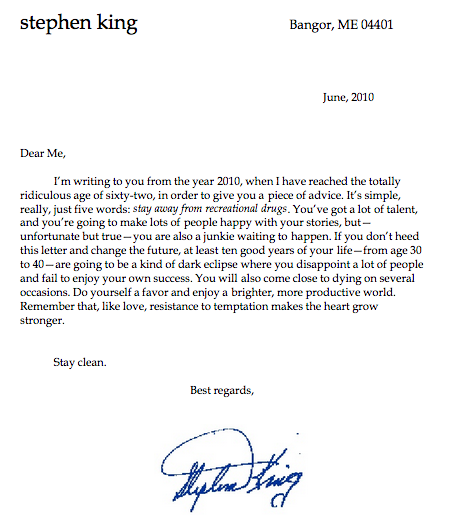
By the 1980s, it looked like Stephen King had everything. He had authored a series of bestsellers — Carrie, The Shining, Cujo – and turned them into blockbuster movies. He had a big, 24-room house. Plenty of cash in the bank. All the trappings of that American Dream. And yet … and yet … he was angry and depressed, smoking two packs of cigarettes a day, drinking lots of beer, snorting coke, and entertaining suicidal thoughts. It’s no wonder then that the author, who sobered up during the late 80s, contributed the letter above to a 2011 collection called Dear Me: A Letter to My 16-Year-Old Self. Edited by Joseph Galliano, the book asked 75 celebrities, writers, musicians, athletes, and actors this question: “If as an adult, you could send a letter to your younger self, what words of guidance, comfort, advice or other message would you put in it?” In King’s case, the advice was short, sweet, to the point. In essence, a mere five words.
To view the letter in a larger format, click here.
via Flavorwire
Related Content:
Stephen Fry: What I Wish I Had Known When I Was 18
Radiohead’s Thom Yorke Gives Teenage Girls Endearing Advice About Boys (And Much More)
Stephen King Reads from His Upcoming Sequel to The Shining
Read More...William S. Burroughs “Sings” R.E.M. and The Doors, Backed by the Original Bands
The nineties saw a lot of alternative bands not only wear their influences on their sleeves, but also bring them up on stage and into the studio. William S. Burroughs was one such luminary, appearing on Tom Waits’ 1993 The Black Rider, a collaboration with Kurt Cobain titled “Priest They Called Him,” and September Songs, a 1997 Kurt Weill tribute album featuring the likes of PJ Harvey, Nick Cave, Elvis Costello, and Lou Reed. In 1996, Burroughs got together with R.E.M. for a cover of their “Star Me Kitten” from ‘92’s Automatic for the People. In the track above, hear Burroughs recite Michael Stipe’s lyrics over the band’s instrumentation. The recording comes from an album called Songs in the Key of X: Music From and Inspired By the X‑Files, which included Frank Black, Soul Coughing, Foo Fighters, and PM Dawn. Burroughs introduces his rendition by citing a much more classical source for his cabaret approach to the song: Marlene Dietrich. “Not one of my favorite people,” he mumbles, dourly. See perhaps why.
Burroughs didn’t only work musically with contemporary alt bands in the ’90s, and he had a long, illustrious recording career several decades prior. In a mash-up that brings together a band closer to Burroughs’ prime, hear the beat writer’s rhythmic deadpan of Jim Morrison’s “Is Everybody In?,” backed by the surviving Doors. Despite the original players, it’s still a very ‘90s production (though released in 2000). From a Doors tribute album called Stoned Immaculate, the song sits, somewhat uncomfortably, next to covers and interpretations by Stone Temple Pilots, The Cult, Creed, Smash Mouth, Days of the New, and Train, and a bit cozier next to stalwarts like John Lee Hooker, Exene Cervenka, and Bo Diddley. Burroughs’ is the stand-out track among many that also feature the Doors as a backing band, although in an acid-jazz production–with samples of soul music and Morrison himself–that may sound a bit dated. But Burroughs is as dry as ever, underlining the sheer creepiness of Morrison’s poetry in a tribute that also highlights the debt Morrison owed him.
Related Content:
Patti Smith Shares William S. Burroughs’ Advice for Writers and Artists
“The Lost Paris Tapes” Preserves Jim Morrison’s Final Poetry Recordings from 1971
Josh Jones is a writer and musician based in Durham, NC. Follow him at @jdmagness
Read More...An Animation of Orson Welles’ Famous Frozen Peas Rant
If you get into a conversation with an Orson Welles enthusiast, try not to mention frozen peas. By now, even those who barely know Welles’ work — those who’ve barely seen Citizen Kane or heard War of the Worlds, let alone The Magnificent Ambersons or F for Fake — chuckle at the fact that, in the twilight of his career, the actor-auteur took on such theoretically easy-money jobs as presenting an “instructional film” on gambling for Caesars Palace and narrating a series of British television commercials for Swedish frozen-food giant Findus. But even in humble contexts like these, Welles, as his aforementioned fans would surely admit, could make headaches for his employers. The Findus people, with whose director and copywriter Welles apparently didn’t see eye-to-eye, would soon find this out — as would every listener to the uncut recordings from that unhappy day in the studio.
At the top, you can hear that very audio and watch it animated by Neil Williams. He visualizes Welles’ consternation in the face of the director’s request to emphasize the word “in” (“there’s no known way of saying an English sentence in which you begin a sentence with ‘in’ and emphasize it”) while pitching those frozen peas. And then there’s Welles’ objection to the difficult-to-enunciate “crumb crisp coating” on Findus fish sticks, and his blowup over how many times to say “beef” when describing their hamburgers as well. Veteran voice actor Maurice LaMarche, who has no doubt labored even longer in recording booths than Welles did, won an early burst of fame with his uncanny impression of Welles. When he used a version of that voice for The Brain, the Animaniacs’ dour, world-domination-minded cartoon mouse, the idea for a frozen peas parody sketch, which you can watch above, must have suggested itself.
Related Content:
Orson Welles Teaches Baccarat, Craps, Blackjack, Roulette, and Keno at Caesars Palace (1978)
Orson Welles Narrates Plato’s Cave Allegory, Kafka’s Parable, and Freedom River
The Hearts of Age: Orson Welles’ Surrealist First Film (1934)
Orson Welles’ The Stranger: Watch The Full Movie Free Online
Colin Marshall hosts and produces Notebook on Cities and Culture and writes essays on literature, film, cities, Asia, and aesthetics. He’s at work on a book about Los Angeles, A Los Angeles Primer. Follow him on Twitter at @colinmarshall.
Read More...30 Renowned Writers Speaking About God: From Isaac Asimov to Margaret Atwood
Back in 2011, Jonathan Pararajasingham, a British medical doctor specializing in Neurosurgery, created a montage of 50 renowned academics talking about their views on the existence of God. Then came Part II about a month later – Another 50 Academics Speaking About God. The videos mostly featured scientists, figures like Richard Feynman, Steven Pinker, Oliver Sacks, Stephen Hawking, and Richard Dawkins. Noticeably missing were the liberal artsy types. But then … hold the phones … came Pararajasingham’s 2012 video: 30 Renowned Writers Speaking About God. Running 25 minutes, the clip brings together comments by Nobel Laureates José Saramago and Nadine Gordimer, sci-fi legends Isaac Asimov and Arthur C. Clarke, and important contemporary novelists: Philip Roth, Margaret Atwood, Ian McEwan, Salman Rushdie, to name a few. You can find the complete list of authors below the jump.
All of these authors question the existence of God. Some are doubtful. Others roundly reject the idea. That’s the slant of this video. To theists out there, let me just say this: If you find a montage that features thinkers of similar stature and caliber making the case for God, send it our way. We’ll happily give it a look. Speaking for myself, I don’t have much of a dog in this fight.
Read More...The Challenge of Archiving Sound + Vision in the 21st Century
Where is the wisdom we have lost in knowledge?
Where is the knowledge we have lost in information?
So wonders T.S. Eliot’s chorus in a pageant play he once helped write in 1934. Never one to let modernity trample gleefully over tradition, Eliot asks us to consider—long before it seemed necessary—what the sea of information we now swim in might be worth without good maps to guide us and wise navigators to chart out the course. We live in a time in which everything can be catalogued, preserved, backed up, and made open and searchable. This is a wonderful thing. But Will Prentice, Audio Engineer and Conservation Specialist at the British Library’s Sound and Vision Division, points out a special problem with archiving in the digital age. Echoing Eliot, Prentice says in the short film above, produced by British music magazine The Wire:
The 20th century was about audiovisual material, our memory of the 20th century is heavily audiovisual, but our sense of the 21st century is going to be a different kind of audiovisual… archiving is not going to be so much about what we can bring in, but about what to exclude.
As much as we moderns hate the idea of discrimination in any form, when it comes to media, past and present, it’s often a necessary good. In thoughtful interviews above, see Prentice, Popular Music Curator Andy Linehan, and Wildlife Sounds Curator Cheryl Tipp discuss their roles as archivists of vast troves of audiovisual information in their London library.
Related Content:
How Brewster Kahle and the Internet Archive Will Preserve the Infinite Information on the Web
Josh Jones is a writer and musician based in Durham, NC. Follow him at @jdmagness
Read More...The Haircut: A Student Film Starring the Great John Cassavetes (1982)
Given the length of the average haircut, it surprises me that I don’t see more short films built around them. Tamar Simon Hoffs knew the advantages of the haircut-based short film, and she put them to use in 1982, during her time in the American Film Institute’s Directing Workshops for Women program. The Haircut’s script has a busy record executive on his way to an important lunch appointment. With only fifteen minutes to spare, he drops into Russo’s barber shop for a trim. Little does he expect that, within those fifteen minutes, he’ll not only get his hair cut, but enjoy a shave, a massage, a glass of wine, several musical numbers, romance real or imagined, and something close to a psychoanalytic session. He goes through quite a few facets of the human experience right there in the chair — minus the time-consuming “hot towel treatment” — and Russo and his colorful, efficient crew still get him out of the door on time. Hoffs knew the perfect actor for the starring role: John Cassavetes. What’s more, she knew him personally.
The connection came through her friend Elizabeth Gazzara, daughter of a certain Ben Gazzara, star of the The Killing of a Chinese Bookie, my own favorite Cassavetes-directed film. After reading the script, Cassavetes agreed to perform, “his only stipulation being that his co-stars must be entirely rehearsed and ready to go, so he could just come in and perform as if he really was the customer,” writes British Film Institute DVD producer James Blackford. “Even in a little film such as this, Cassavetes was still searching for those perfect moments that come from the spontaneity of early takes.” You’ll even laugh at a few lines, spoken by Cassavetes as his character begins to enjoy himself, that must surely have come out of his beloved improvisational methods. And we can credit the film’s surprising end to an even more personal connection of Hoffs’: to her daughter Susanna, frontwoman of The Bangles, then known as The Bangs. You can watch The Haircut on the BFI’s new DVD/Blu-Ray release of The Killing of a Chinese Bookie, or you can watch it above.
Related Content:
Wes Anderson’s First Short Film: The Black-and-White, Jazz-Scored Bottle Rocket (1992)
The Surreal Short Films of Louis C.K., 1993–1999
Portrait Werner Herzog: The Director’s Autobiographical Short Film from 1986
Colin Marshall hosts and produces Notebook on Cities and Culture and writes essays on literature, film, cities, Asia, and aesthetics. He’s at work on a book about Los Angeles, A Los Angeles Primer. Follow him on Twitter at @colinmarshall.
Read More...Charles Darwin’s Son Draws Cute Pictures on the Manuscript of On the Origin of Species
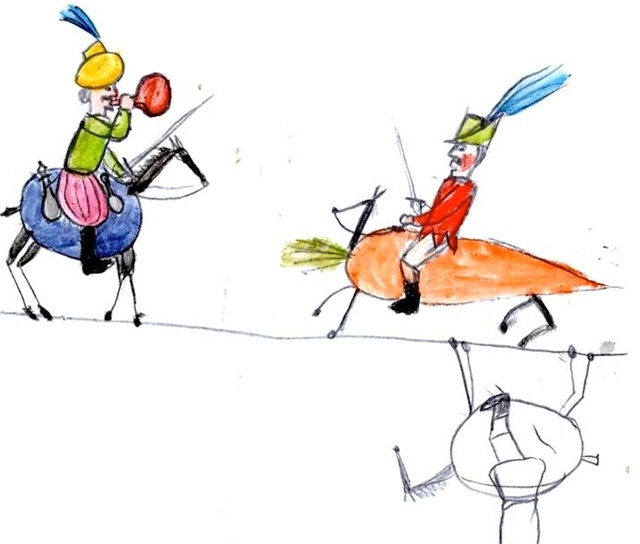
Most of us can identify Charles Darwin as the father of modern evolutionary biology, but were you aware that he also fathered ten children with his cousin, Emma Wedgwood?
As daddies go, Darwin was quite evolved himself, displaying a 21st-century level of devotion to and involvement with his young. He even went so far as to let one of his kids draw on the original manuscript for On the Origin of Species. Saving paper was as good for the environment in the mid-1800s as it is today, but his willingness to let his precious pages do double duty may explain why the seminal document survives as mere piecemeal today.
Maybe Charles and Emma read some article that suggested their household would run more smoothly if it were better organized, and lacking such modern solutions as colorful Ikea storage bins and scanners, simply pitched all but the absolute best of their children’s artwork. (Or maybe their youngest was a scruncher, destroying pages by the fistful.)
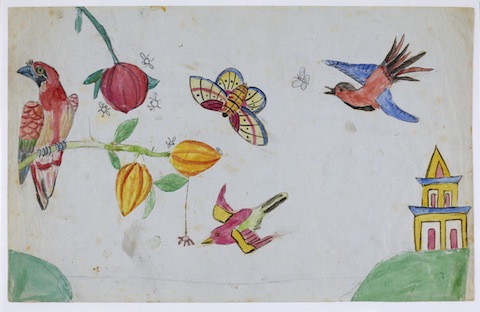
It seems a good bet young Francis Darwin’s watercolor of birds, bugs and a butterfly converging on a trio of botanically viable flowers (above) would’ve done his naturalist papa proud.
I can also state with near-scientific certainty that if the Darwins had had a refrigerator, The Battle of the Fruit and Vegetable Soldiers (top) would have been on it. Today, Francis’ masterpiece—and its flipside—reside in the Cambridge University Library.
via The Telegraph
Related Content:
Watch Darwin, a 1993 Film by Peter Greenaway
Read the Original Letters Where Charles Darwin Worked Out His Theory of Evolution
The Genius of Charles Darwin Revealed in Three-Part Series by Richard Dawkins
Darwin’s Personal Library Goes Digital: 330 Books Online
Darwin’s Legacy, a Stanford course in our collection of 750 Free Online Courses
Ayun Halliday remembers her grandmother was very impressed by her ability to draw Huckleberry Finn with his legs crossed. Follow her @AyunHalliday
Read More...Support Us
We're hoping to rely on loyal readers, rather than erratic ads. Please click the Donate button and support Open Culture. You can use Paypal, Venmo, Patreon, even Crypto! We thank you!

About Us

Open Culture scours the web for the best educational media. We find the free courses and audio books you need, the language lessons & educational videos you want, and plenty of enlightenment in between.
Advertise With Us

FREE UPDATES!
GET OUR DAILY EMAIL
Get the best cultural and educational resources on the web curated for you in a daily email. We never spam. Unsubscribe at any time.
FOLLOW ON SOCIAL MEDIA

Open Culture editor Dan Colman scours the web for the best educational media. He finds the free courses and audio books you need, the language lessons & movies you want, and plenty of enlightenment in between.
Advertise With Us

