Listen to T.S. Eliot Recite His Late Masterpiece, the Four Quartets
Here is a complete recording of T.S. Eliot reading the masterpiece of his later years, the cycle of poems called Four Quartets.
Eliot considered the Four Quartets his greatest work. “I’d like to feel that they get better as they go on,” he told Donald Hall in a 1959 interview for the Paris Review. “The second is better than the first, the third is better than the second, and the fourth is the best of all. At any rate, that’s the way I flatter myself.”
The Four Quartets are perhaps the most mystical and religious of Eliot’s poems. Each one is a meditation on time, mixing Christian and Hindu imagery with personal and historical events. “In The Waste Land the waste was place, the ‘Unreal City,’ ” writes Eliot’s biographer, Lyndall Gordon; “here, the waste is time–time unredeemed by a sense of the timeless.”
As in The Waste Land, Eliot uses the four classical elements as a structural device in the Four Quartets. The first poem, “Burnt Norton,” is associated with the element of air. It is named for an English manor house Eliot visited in the 1930s. The poem was first published in 1936. “East Coker” (which begins above at 10:46) is associated with Earth, and takes its name from the village in Somerset, England, from which the poet’s ancestor, Andrew Eliot, set out for America in 1669. The third poem, “The Dry Salvages,” (beginning at 24:17) is associated with Water and is named for a treacherous cluster of rocks off Cape Ann that was among the hazards Andrew Eliot’s ship needed to avoid in order to safely reach the coast of Massachusetts. The final poem, “Little Gidding,” (39:08) was published in 1942. Its underlying theme is one of purgatorial Fire. The poem is named for a village in Cambridgeshire, England, which was the site of a 17th century Anglican commune that based its daily life around the Book of Common Prayer.
The Four Quartets were first published as a unified whole in 1943. Despite their initial appearance as four separate poems, the themes are tightly interwoven and each poem is composed of five parallel parts. You can hear Eliot reading the Four Quartets above. To follow along as you listen, click here to open the full text in a new window. The first poem begins:
Time present and time past
Are both perhaps present in time future,
And time future contained in time past.
If all time is eternally present
All time is unredeemable.
What might have been is an abstraction
Remaining a perpetual possibility
Only in a world of speculation.
What might have been and what has been
Point to one end, which is always present.
Footfalls echo in the memory
Down the passage which we did not take
Towards the door we never opened
Into the rose-garden. My words echo
Thus, in your mind.
Related Content:
Rare 1959 Audio: Flannery O’Connor Reads ‘A Good Man is Hard to Find’
Rare Recording: Leo Tolstoy Reads From His Last Major Work in Four Languages, 1909
Nabokov Reads Lolita, Names the Great Books of the 20th Century
Read More...Zen Master Alan Watts Discovers the Secrets of Aldous Huxley and His Art of Dying
Few figures were as influential as Alan Watts and Aldous Huxley in popularizing experiments with psychedelic drugs and Eastern religion in the 20th century. Watts did more to introduce Westerners to Zen Buddhism than almost anyone before or since; Huxley’s experiments with mescaline and LSD—as well as his literary critiques of Western technocratic rationalism—are well-known. But in a countercultural movement largely dominated by men—Watts and Huxley, Ken Kesey, Timothy Leary, Allen Ginsberg, etc—Huxley’s widow Laura came to play a significant role after her husband’s death.
In fact, as we’ve discussed before, she played a significant role during his death, injecting him with LSD and reading to him from The Tibetan Book of the Dead as he passed away. In the interview above, Laura speaks with Watts about that experience, one she learned from Aldous, who performed a similar service for his first wife as she died in 1955. The occasion of the interview—conducted at Watts’ Sausalito home in 1968—is the publication of Laura Huxley’s memoir of life with her husband, This Timeless Moment. But talk of the book soon prompts discussion of Huxley’s graceful exit, which Watts calls “a highly intelligent form of dying.”
Watts relates an anecdote about Goethe’s last hours, during which a visitor was told that he was “busy dying.” “Dying is an art,” says Watts, “and it’s also an adventure,” Laura adds. Their discussion then turns to Huxley’s final novel, Island (which you can read in PDF here). Island has rarely been favorably reviewed as a literary endeavor. And yet, as Watts points out, it wasn’t intended as literature, but as a “sociological blueprint in the form of a novel.” Laura Huxley, upset at the book’s chilly reception, wishes her husband had “written it straight.” Nonetheless, she points out that Island was much more than a Utopian fantasy or philosophical thought experiment. It was a document in which “every method, every recipe… is something he experimented with himself in his own life.” As Laura wrote in This Timeless Moment:
Every single thing that is written in Island has happened and it’s possible and actual … Island is really visionary common sense. Things that Aldous and many other people said, that were seen as so audacious — they are common sense, but they were visionary because they had not yet happened.
Those things included not only radical forms of living, but also, as Huxley himself demonstrated, radical ways of dying.
Related Content:
Aldous Huxley’s Most Beautiful, LSD-Assisted Death: A Letter from His Widow
Aldous Huxley Reads Dramatized Version of Brave New World
Leonard Cohen Narrates Film on The Tibetan Book of the Dead, Featuring the Dalai Lama (1994)
Josh Jones is a writer and musician based in Washington, DC. Follow him at @jdmagness
Read More...Maurice Sendak Animated; James Gandolfini Reads from Sendak’s Story “In The Night Kitchen”
Maurice Sendak (1928–2012), the great writer and illustrator of children’s books, would have turned 85 today. To celebrate his birthday, Google has adorned its web site with a fantastic animated doodle (make sure you press the “play” button) and Blank on Blank has released a video that animates Sendak’s musings about being a kid. Based on a previously-unheard interview recorded in 2009, Sendak speaks in the clip about his difficult childhood, which was surrounded by tragedy. (He grew up in Brooklyn, the child of Polish Jewish immigrants whose remaining family perished during the Holocaust.) He also recalls how children all have problems to work through — problems that remained at the front of his mind when he started writing his classic children’s books. It’s worth pairing the video above with another animated video of Sendak’s emotional last interview with NPR’s Terry Gross. And, for a completely random bonus, we’ve added below a clip of James Gandolfini (aka Tony Soprano) reading from Sendak’s controversial story book In The Night Kitchen. The reading took place on September 15, 2008 at the 92nd St Y in New York City, at a tribute held on the occasion of Sendak’s 80th birthday.
Related Content:
The Late James Gandolfini, Star of The Sopranos, Appears on Inside the Actors Studio (2004)
The Mind & Art of Maurice Sendak: A Video Sketch
An Animated Christmas Fable by Maurice Sendak (1977)
Read More...
Making Radiolab: A Soup-to-Nuts Recipe for a Great Radio Show/Podcast
Now that virtually everyone in the Western Hemisphere has the means to make and disseminate a podcast, are there any tips to guarantee success?
Jad Abumrad, a host of the enormously popular, curiosity-based podcast, Radiolab, strives for every show to sound like “two guys talking in a surrealistic multi-dimensional space.” His degree in music composition at Oberlin College is an asset in achieving this goal, as is his easy rapport with cohost Robert Krulwich.
Radiolab’s appeal is such that director David Fine singled it out for his American Hipster project, a year long investigation into the tastes of a certain segment of the populace. The resulting video above sketches out the creation process, from the first impulse to interview an interesting person to the finished episode.
It’s not surprising that Radiolab’s brass has seized on Fine’s effort as a fundraising tool. His depiction of their behind-the-scenes labors is insistently upbeat, complete with a montage of laughing producers, writers and stars. As hard to as it is to believe this tells the whole story of what it’s like to barrel toward a collective creative deadline, it’s also hard to begrudge them their sunny depiction when Abumrad himself volunteers that the creation of a natural-sounding podcast is a far-from-natural thing.
Perhaps the biggest takeaway for aspiring podcast mavens is that quality wins out. Radiolab is rightly renowned for its excellent production values, a level of professionalism that has paved the way for a live show featuring such luminaries as comedian Demetri Martin and Pilobolus Dance Theater. If you’re not familiar Radiolab, then we suggest you catch an episode, “Memory and Forgetting,” below. More episodes can be found on SoundCloud.
Related Content:
The New Yorker’s Fiction Podcast: Where Great Writers Read Stories by Great Writers
Neil deGrasse Tyson’s StarTalk Radio Show Podcast Tackles the History of Video Games
Ayun Halliday owes Radiolab a depth of gratitude for the cheer with which her husband does the dishes.
via Coudal
Read More...David Byrne’s Graduation Speech Offers Troubling and Encouraging Advice for Students in the Arts
How could David Byrne never have given a commencement address before? As an experienced public speaker, a well-known creator who has carved out his own cultural niche, an advocate of things (such as cycling) beloved among world-changing young people, the founder of a band with a surprising multi-generational appeal, and a man with no small command of Powerpoint, he’d seem to make an appealing choice indeed. His first commencement address ever came this year at the Columbia University School of the Arts, and, viewable from 1:17:00 in the video above, it has certainly made an impact in the internet. The message some grads and fans have taken away? “If you chose a career in the arts,” as the New Yorker’s Rachel Arons puts it, “you are, basically, screwed.”
“A pie chart, based on 2011 data, showed that only three per cent of film and theatre grads, and five per cent of writing and visual-arts grads, end up working in their areas of concentration,” she writes of the visual aids delivering Byrne’s grim initial message. “A subsequent bar graph showed that, according to those stats, fourteen writing and fourteen Columbia visual-arts graduates will go on to careers in their fields, and eight theatre and eight film grads will go on to careers in theirs.” But firsthand reports from the ceremony don’t describe a too terribly shaken Columbia graduating class, and even Byrne took pains to emphasize, or at least emphatically imply, that truly worthwhile careers — such as, I would say, his own — lay outside, or in between, or at the intersection of, definable fields. And why would you want to work in the same field you studied, anyway? To paraphrase something Byrne’s friend and collaborator Brian Eno said about technology, once a whole major has built up around a pursuit, it’s probably not the most interesting thing to be doing anymore.
Related Content:
David Byrne: How Architecture Helped Music Evolve
David Byrne: From Talking Heads Frontman to Leading Urban Cyclist
David Byrne Gives Us the Lowdown on How Music Works (with Neuroscientist Daniel Levitin)
How David Byrne and Brian Eno Make Music Together: A Short Documentary
Colin Marshall hosts and produces Notebook on Cities and Culture and writes essays on literature, film, cities, Asia, and aesthetics. He’s at work on a book about Los Angeles, A Los Angeles Primer. Follow him on Twitter at @colinmarshall.
.
Read More...Louis CK Ridicules Avant-Garde Art on 1990s MTV Show
In the 1990s, somewhere on his long road to stardom, Louis CK made an appearance on a satirical “Artumentary” aired by MTV. In it, CK plays the role of David Cross, a would-be artist who specializes in photographing toilets filled with ink — a not-so-subtle metaphor for the tripe that often gets passed off as avant-garde art. In case there’s any ambiguity about the underlying message, Cross add wryly, “Basically, see, MTV will show you a lot of crap, and they’ll tell you it’s art. But I show you crap, and it’s, like, art.”
via Petapixel
Related Content:
The Surreal Short Films of Louis C.K., 1993–1999
How the Great George Carlin Showed Louis CK the Way to Success (NSFW)
David Lynch Teaches Louis C.K. How to Host The David Letterman Show
Read More...Philadelphia Orchestra Quartet Gets Stuck on a Plane in China, Plays Dvořák for Grateful Passengers
When a quartet from The Philadelphia Orchestra (my home town) recently found itself grounded on a plane at the Beijing airport, they decided after three long hours (in coach!) that enough was enough. It was time to provide musical relief to passengers sharing in their fatigue and frustration. Above you’ll find Juliette Kan and Daniel Han on violin; Che-Hung Chen on viola; and Yumi Kendall on cello, treating everyone to an impromptu version of Dvořák’s String Quartet No. 12 in F Major, Op. 96 “American” Finale.
Thanks to Burl for sending this our way!
Related Content:
Pakistani Orchestra Plays Amazing Version of Dave Brubeck’s Jazz Classic, “Take Five”
Beethoven’s “Ode to Joy” Movingly Flashmobbed in Spain
85,000 Classical Music Scores (and Free MP3s) on the Web
Read More...Samuel L. Jackson Does a Dramatic Breaking Bad Monologue for Alzheimer’s Charity
Over a career going strong since the seventies, Samuel L. Jackson has shown us time and again that he can deliver a monologue — a boon to the craft of screen acting, where brief but powerful speeches seemed to have fallen out of fashion just before Jackson’s rise to fame in the nineties. His performance as Jheri-curled hitman Jules Winnfield in Quentin Tarantino’s Pulp Fiction, of course, supplied one of the engines of that fame, and who among us doesn’t know at least part of his Biblical “I will strike down upon thee with great vengeance and furious anger” from early in that movie? In the nineties, critics looked to American independent film for exciting, innovative storytelling. At the moment, they look to television, and specifically to shows like Breaking Bad. At the top of the post, you can see these worlds collide, with Jackson’s recording of his own version of one of the series’ best known monologues.
As milquetoast high school chemistry teacher turned savagely calculating methamphetamine entrepreneur Walter White, Breaking Bad’s star Bryan Cranston has delivered more than a few striking monologues himself. Beset by a case of terminal lung cancer, White casts off the man he was to become the man who can, by the fourth season, speak the words he speaks just above to his wife, after she objects to the danger of his new line of work. “Who are you talking to right now?” he asks. “Who is it you think you see? Do you know how much I make a year? I mean, even if I told you, you wouldn’t believe it. Do you know what would happen if I suddenly decided to stop going in to work? A business big enough that it could be listed on the NASDAQ goes belly-up. Disappears. It ceases to exist without me. No, you clearly don’t know who you’re talking to, so let me clue you in. I am not in danger, Skyler. I am the danger.” Jackson performed his rendition of the monologue for an Alzheimer’s Association charity drive, but I would imagine Breaking Bad’s fans as well as Jackson’s own would hardly mind seeing him turn up on the show for a proper role.
Related Content:
Inside Breaking Bad: Watch Conan O’Brien’s Extended Interview with the Show’s Cast and Creator
Colin Marshall hosts and produces Notebook on Cities and Culture and writes essays on literature, film, cities, Asia, and aesthetics. He’s at work on a book about Los Angeles, A Los Angeles Primer. Follow him on Twitter at @colinmarshall.
Read More...Allen Ginsberg’s Personal Recipe for Cold Summer Borscht
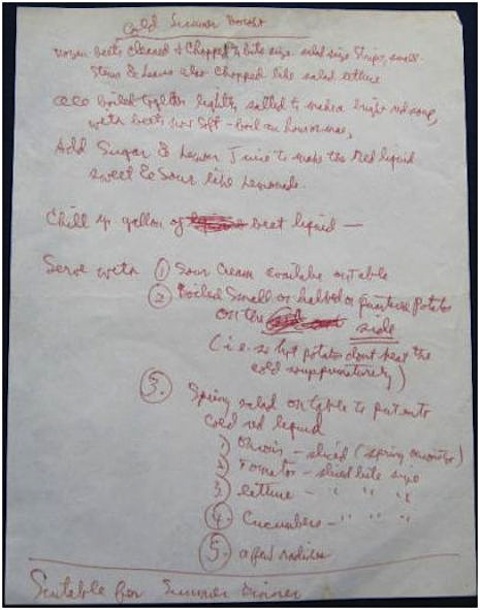
As summer approaches, let us look to Allen Ginsberg when we we feel discouraged by our lack of bikini-body. The author of “Sunflower Sutra” didn’t shy away from having his evolving physique documented shirtless or nude. Narrow minded beauty arbiters be damned. The man was well equipped for tenement living on the Lower East Side of New York in the era before air-conditioning.
Another Ginsbergian tactic for embracing the season’s heat: borscht. Unlike Rudolph Nureyev’s or Cyndi Lauper’s favorite from Veselka, the round-the-clock Ukrainian diner a few blocks from Ginsberg’s East Village home, Ginsberg’s borscht is vegetarian and cold. See the transcription of Ginsberg’s handwritten recipe below:
COLD SUMMER BORSCHT
Dozen beets cleaned & chopped to bite size salad-size Strips
Stems & leaves also chopped like salad lettuce
All boiled together lightly salted to make a bright red soup,
with beets now soft — boil an hour or more
Add Sugar & Lemon Juice to make the red liquid
sweet & sour like Lemonade
Chill 4 gallon(s) of beet liquid -
Serve with (1) Sour Cream on table
(2) Boiled small or halved potato
on the side
(i.e. so hot potatoes don’t heat the
cold soup prematurely)
(3) Spring salad on table to put into
cold red liquid
1) Onions — sliced (spring onions)
2) Tomatoes — sliced bite-sized
3) Lettuce — ditto
4) Cucumbers — ditto
5) a few radishes
__________________________________
Suitable for Summer Dinner
Cold Summer Borscht was but one of many soups to remerge from Ginsberg’s twelve-gallon stockpot. Read about his final batch here. Bon Apetit.
Related Content:
Allen Ginsberg Reads a Poem He Wrote on LSD to William F. Buckley
Allen Ginsberg Reads His Famously Censored Beat Poem, Howl
“Expansive Poetics” by Allen Ginsberg: A Free Course from 1981
Ayun Halliday is the author of seven books including Dirty Sugar Cookies: Culinary Observations, Questionable Taste. Follow her @AyunHalliday
Read More...Hear Theodor Adorno’s Avant-Garde Musical Compositions
Critical theorist and musicologist Theodor Adorno was a contrarian, almost contradictory figure—a committed Marxist thinker who was also a cultural elitist. Anyone who’s sat through a theory class will know his name (most likely through his seminal text Dialectic of Enlightenment, written with Max Horkheimer). For those who don’t, Adorno was an integral member of what was called the “Frankfurt School,” a group of early twentieth-century German scholars and social theorists who were highly critical of both Western capitalism and Soviet communism. Adorno’s work is wide-ranging, penetrating, and, at times, abstruse to the point of nigh-unintelligibility.
Despite Adorno’s hope for social transformation, his influence is (by design) primarily in the academic and cultural spheres, and his critiques of popular culture and music were scathing and sometimes just plain weird. He had a notoriously irrational dislike of jazz, for example. (Historian Eric Hobsbawm said that his writing contained “some of the stupidest pages ever written about jazz.”) Adorno also disliked “protest music,” as you can see from the interview above, in which he slams the folky, hippy stuff for its “cross-eyed transfixion with amusement” that renders it safe. Protest music, Adorno says, takes “the horrendous,” the Vietnam War in this case, and makes it “somehow consumable.” Maybe Dylan felt the same way when he gave up his Woody Guthrie act and started writing those brilliantly arcane, poetic lyrics.
But Adorno didn’t just preach the virtues of difficult art. He practiced them. In addition to championing the twelve-tone music of Arnold Schoenberg, Adorno composed his own music, for piano and strings. The three piano pieces above are his, somewhat reminiscent of the most dissonant passages in Modest Mussorgsky. Performed by pianist Steffen Schleiermacher, the pieces are titled “Langsame halbe—Immer ganz zart,” “Heftige Achtel,” and “Presto.”
A much longer, more substantial work is Adorno’s Studies for Strings in six movements. Movement one is above and movement two below (hear part 3, part 4, part 5, and part 6). It’s challenging and often quite sublime listening. The YouTuber who uploaded the music has seen fit to set it to a montage of black-and-white images. I don’t know whether this hinders or helps your appreciation, but you may wish to leave the videos running and listen to each movement while you work on other things. Or better yet, close your eyes and forget everything you know, don’t know, or think you know about Theodor Adorno.
Note: You can watch a lecture on the Frankfurt School here. It’s part of a Yale Open course on literary theory, which appears in our collection of 700 Free Online Courses.
Related Content:
The Nazis’ 10 Control-Freak Rules for Jazz Performers: A Strange List from World War II
85,000 Classical Music Scores (and Free MP3s) on the Web
Interviews with Schoenberg and Bartók
Josh Jones is a writer and musician based in Washington, DC. Follow him at @jdmagness
Read More...Support Us
We're hoping to rely on loyal readers, rather than erratic ads. Please click the Donate button and support Open Culture. You can use Paypal, Venmo, Patreon, even Crypto! We thank you!

About Us

Open Culture scours the web for the best educational media. We find the free courses and audio books you need, the language lessons & educational videos you want, and plenty of enlightenment in between.
Advertise With Us

FREE UPDATES!
GET OUR DAILY EMAIL
Get the best cultural and educational resources on the web curated for you in a daily email. We never spam. Unsubscribe at any time.
FOLLOW ON SOCIAL MEDIA

Open Culture editor Dan Colman scours the web for the best educational media. He finds the free courses and audio books you need, the language lessons & movies you want, and plenty of enlightenment in between.
Advertise With Us


