Three University Projects Use Twitter to Understand Happiness, Hate and Other Emotions in America
It turns out that the fleeting pronouncements we post on Twitter are catnip for academics and others eager to find the elusive pulse of American society. Since Twitter launched in 2006, researchers have been hard at work figuring out how to turn those 140-character musings into tea leaves with something meaningful to say about us all.
Here come three new projects that claim to provide a window into the American soul through Twitter. Whether they succeed or not, well, that’s still unclear. (And, by the way, you can start following Open Culture on Twitter here.)
Most feverishly excited about its work are the team behind the Global Twitter Heartbeat, which so far focuses mostly on the United States. With the help of a huge SGI processor to process a live feed of public social media data, a team of researchers from the University of Illinois at Urbana-Champaign has made a heat map to show how people react (through Twitter) to big events.
They looked at two things: Hurricane Sandy (top) and the 2012 Presidential Election (above). Using Twitter’s “garden hose feed”—a random sampling of 10 percent of the roughly 500 million tweets sent every day—researchers color-coded tweets red for negative tone and blue for positive and showed the shifting concentrations of Twitter activity across the country. It looks like a map of a talking weather system as occasional dialogue boxes open up to show representative tweets. Researcher Kalev Leetaru argues that tracking Twitter activity gives us the potential to track the heartbeat of society.

Two other projects look in an on-going way at tweet “tone,” or the negativity/positivity of messages. One spin on this research is the Geographic Hate Map (sample map above), a project by Dr. Monica Stephens of Humboldt State University in Northern California. To begin their work, Stephens and her team accessed a massive database of geographically tagged tweets sent between June, 2012 and April, 2013.
They used only tweets that contained any of ten “hate words.” They read each tweet to be sure the words were used in a negative way and built a map based on where the tweets came from. Then they aggregated to the county level and normalized for the amount of twitter traffic in that area so that densely populated areas don’t look more racist or homophobic by default.
Then there’s the glass half full. The Hedonometer measures happiness, or lack thereof, as expressed by tweets, calculating averages based on what the researchers call “word shifts” (watch an explanation above). This research project, put together by the University of Vermont Complex Systems Center, uses the same garden hose feed as the Global Twitter Heartbeat. This project searches for frequently used words to measure how good a day Twitter users are having. Since 2008 the Hedonometer has kept track of how often words like “happy,” “yes,” and “love” pop up in tweets, as opposed to “hate,” “no,” and “unhappy.” The saddest day on Hedonometer record so far is April 15, 2013, the day bombs exploded at the Boston Marathon finish line. Christmas Day tends to rank as the happiest day of the year.
To be sure, any tool that uses tweets for data is measuring a very young and specific subgroup of people. Tweets are not a reliable measure of anything, really, but maybe with some tweaking, these research models will come up with something interesting.
Related Content:
The Art of Data Visualization: How to Tell Complex Stories Through Smart Design
Watch a Cool and Creepy Visualization of U.S. Births & Deaths in Real-Time
An Animated Visualization of Every Observed Meteorite That Has Hit Earth Since 861 AD
Kate Rix writes about education and digital media. Follow daily ups and downs on Twitter @mskaterix.
Read More...Ricky Gervais Presents “Learn Guitar with David Brent”
To help celebrate YouTube’s first Comedy Week, Ricky Gervais has revived David Brent, the bumbling “Regional Manager” that ran the Wernham Hogg Paper Company in the UK version of The Office. Although the sitcom presented him as the ‘boss from hell,’ Brent fancied himself “a philosopher to rival Descartes, a musician to rival Texas, a dancer to rival MC Hammer.” And a “brilliant singer-songwriter” too. Perhaps you’ll remember a favorite moment from the show, when Brent led his staff in a sing-a-long to Free Love Freeway? (If not, we have it below, and you can find the chords and lyrics here.) Anyway, Brent is back, and he’s now offering guitar lessons on YouTube — lessons guaranteed to teach you absolutely nothing about playing guitar. If you want real lessons, James Taylor has you covered here.
You can find the first lesson above; the second lesson will hit Ricky Gervais’ YouTube Channel on June 3.
Related Content:
“Learn English With Ricky Gervais,” A New Podcast Debuts (NSFW)
Seinfeld, Louis C.K., Chris Rock, and Ricky Gervais Dissect the Craft of Comedy (NSFW)
Read More...Hear Kurt Vonnegut’s Very First Public Reading from Breakfast of Champions (1970)
When we think of Kurt Vonnegut, we tend to think of Slaughterhouse-Five. Maybe we also think of the short story “Harrison Bergeron,” which gets assigned in class by slightly alternative-minded English teachers. Now that I think about it, I realize that those two works of Vonnegut’s have both become movies: George Roy Hill’s Slaughterhouse-Five hit theaters in 1972, and Bruce Pittman’s Harrison Bergeron debuted on Showtime in 1995. But the belovedly cynical writer produced fourteen novels, eight story collections, and five books of essays, and even if we just explore further into those adapted for the screen, we find a perhaps under-discussed piece of Vonnegutia: Breakfast of Champions, his 1973 follow-up to Slaughterhouse-Five.
The novel examines Dwayne Hoover, a deeply troubled Pontiac salesman obsessed with the writings of pulp sci-fi author Kilgore Trout. You may remember Trout from his role in Vonnegut’s previous book, whose “unstuck-in-time” protagonist Billy Pilgrim he invites to his wedding anniversary. Breakfast of Champions sets Trout on a collision course with Hoover in the fictional American town of Midland City, bringing in a great variety of characters, themes, and elements from Vonnegut’s other work in so doing. In the clip above, you can hear the author’s very first public reading of the book, recorded on May 4, 1970 at New York’s 92nd Street Y. After it became available to readers three years later, Breakfast of Champions would become a favorite among the Vonnegut faithful. The 1999 Bruce Willis-starring film adaptation… less so.
Related Content:
Kurt Vonnegut Reads from Slaughterhouse-Five
Vonnegut’s Eight Tips on How to Write a Good Short Story
Kurt Vonnegut: “How To Get A Job Like Mine” (2002)
Colin Marshall hosts and produces Notebook on Cities and Culture and writes essays on literature, film, cities, Asia, and aesthetics. He’s at work on a book about Los Angeles, A Los Angeles Primer. Follow him on Twitter at @colinmarshall.
Read More...Dream, A Short Documentary on the Art and Culture of Burning Man
Every year, right before Labor Day, 50,000 people travel to Black Rock City, Nevada to take part in Burning Man — an experimental community dedicated to radical self reliance, radical self-expression and art. As Burning Man’s own web site will tell you, “Trying to explain what Burning Man is to someone who has never been to the event is a bit like trying to explain what a particular color looks like to someone who is blind.” Nonetheless, the Burning Man organizers offer a short, introductory essay and a First-Timer’s Guide to get you started, plus some photo galleries to help fill out the picture. And then above, we have a newly-made short film that offers a glimpse into the art and culture of the Burning Man experience. It highlights some wondrous artistic creations and the artists, designers, builders and sundry minds behind them. The documentary, Dream: Art & Culture of Burning Man, premiered at the Sonoma International Film Festival.
If you would like to support the mission of Open Culture, consider making a donation to our site. It’s hard to rely 100% on ads, and your contributions will help us continue providing the best free cultural and educational materials to learners everywhere. You can contribute through PayPal, Patreon, and Venmo (@openculture). Thanks!
Read More...Download 100 Free Online Philosophy Courses & Start Living the Examined Life
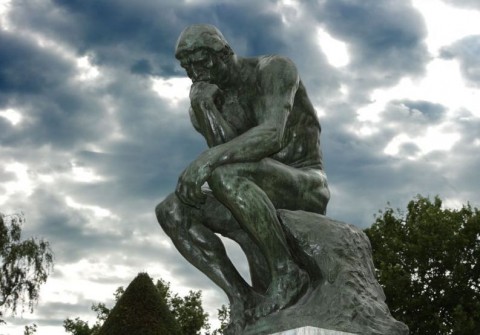
The Philosophy section of our big Free Online Courses collection just went through another update, and it now features 100 courses. Enough to give you a soup-to-nuts introduction to a timeless discipline. You can start with one of several introductory courses.
- Philosophy for Beginners – iTunes – Web Video – Marianne Talbot, Oxford
- Critical Reasoning for Beginners - iTunes Video – iTunes Audio – Web Video – Oxford
- A Romp through Ethics for Complete Beginners - iTunes Video–Web Video – Oxford
- Introduction to Political Philosophy – YouTube – iTunes – Web Video — Steven B. Smith, Yale
- The Art of Living — Web Video – Stanford
- The History of Philosophy Without Any Gaps - Multiple Formats– Peter Adamson, King’s College London
Then, once you’ve found your footing, you can head off in some amazing directions. As we mentioned many moons ago, you can access courses and lectures by modern day legends – Michel Foucault, Bertrand Russell, John Searle, Walter Kaufmann, Leo Strauss, Hubert Dreyfus and Michael Sandel. Then you can sit back and let them introduce you to the thinking of Aristotle, Socrates, Plato, Hobbes, Hegel, Heidegger, Kierkegaard, Kant, Nietzsche, Sartre and the rest of the gang. The courses listed here are generally available via YouTube, iTunes, or the web.
Explore our collection of 950 Free Courses to find topics in many other disciplines — History, Literature, Physics, Computer Science and beyond. As we like to say, it’s the most valuable single page on the web.
Find us on Facebook, Twitter and Google Plus and we’ll make it easy to share intelligent media with your friends!
Related Content:
Michel Foucault: Free Lectures on Truth, Discourse & The Self
Photography of Ludwig Wittgenstein Released by Archives at Cambridge
Take First-Class Philosophy Lectures Anywhere with Free Oxford Podcasts
Walter Kaufmann’s Lectures on Nietzsche, Kierkegaard and Sartre (1960)
Read More...Duke Ellington’s Symphony in Black, Starring a 19-Year-old Billie Holiday in Her First Filmed Performance
In September of 1935 Paramount Pictures released a nine-minute movie remarkable in several ways. Symphony in Black: A Rhapsody of Negro Life is one of the earliest cinematic explorations of African-American culture for a mass audience. It features Duke Ellington and his orchestra performing his first extended composition. And perhaps most notably, it stars Billie Holiday in her first filmed performance.
The one-reel movie, directed by Fred Waller, tells the story of Ellington’s “A Rhapsody of Negro Life,” using pictures to convey the images running through the musician’s mind as he composed and performed the piece. Ellington’s “Rhapsody” has four parts: “The Laborers,” “A Triangle,” “A Hymn of Sorrow” and “Harlem Rhythm.” Holiday appears as a jilted and abused lover in “A Triangle.”
Holiday’s only previous screen appearance was as an uncredited extra in a nightclub scene in the 1933 Paul Robeson film, The Emperor Jones. Symphony in Black was produced over a ten-month period. Holiday was only 19 when her scenes were shot. She sings Ellington’s “Saddest Tale,” a song carefully selected by the composer to fit the young singer’s style. “Saddest tale on land or sea,” begin the lyrics, “Was when my man walked out on me.” In the book Billie Holiday: A Biography, author Meg Greene calls the performance “mesmerizing”:
Symphony in Black marked an important milestone in the development of Billie Holiday, the woman and the singer. Ellington’s deft handling enabled Billie to distinguish herself from other torch singers. She did not wear her emotions on her sleeve; instead, she revealed herself gradually as the song unfolded. Hers was a carefully crafted and sophisticated performance, especially for a woman only 19 years old. This carefully woven tapestry of life and music was the origin of the persona that audiences came to identify with Billie. Other singers such as Frank Sinatra and Judy Garland may have more successfully established and cultivated an image, but Billie Holiday did it first.
Related content:
Billie Holiday Sings ‘Strange Fruit’
Billie Holiday–The Life and Artistry of Lady Day: The Complete Film
Read More...How Famous Writers — From J.K. Rowling to William Faulkner — Visually Outlined Their Novels

Click for a larger version
Every great novel—or at least every finished novel—needs a plan. I remember well a James Joyce course I took in college, taught by a belligerent Irishman who began the first class meeting by slamming his decades-old copy of Ulysses on the table, sending clouds of dust and Post-It notes around his ears and shouting, “This is my Bible!” He proceeded over the next few months to unravel the dark mysteries of Joyce’s design, with chart after chart of floral symbology, musical motifs, Dante allusions, mythic and Catholic rewritings, and Dublin city maps. Needless to say I was intimidated.
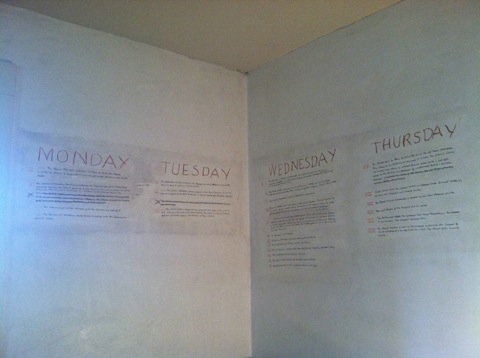
But not every author requires the god-like foresight of Joyce. Witness, for instance, J.K. Rowling’s spreadsheet for Harry Potter and the Order of the Phoenix (top), hand-drawn on lined notebook paper. Fine, Rowling’s no Joyce, but no one can say her method didn’t yield impressive results. For a more canonically literary example, see William Faulkner’s plan for A Fable (above). Faulkner famously outlined his fiction on the walls of his Rowan Oaks study, in-between bottles of bourbon.
Flavorwire has compiled a number of author outlines, from Joseph Heller’s dense, intricate grid design for Catch-22 to Jennifer Egan’s storyboards for “Black Box” and Norman Mailer’s medieval manuscript of a plan for Harlot’s Ghost. Each outline betrays a little of the author’s mind at work.
via Flavorwire
Related Content:
Six Postcards From Famous Writers: Hemingway, Kafka, Kerouac & More
Writers’ Houses Gives You a Virtual Tour of Famous Authors’ Homes
Photos of Famous Writers (and Rockers) with their Dogs
Josh Jones is a writer and musician based in Washington, DC. Follow him @jdmagness
Read More...7 Nobel Speeches by 7 Great Writers: Hemingway, Faulkner, and More
William Faulkner, 1949:
Almost every year since 1901, the Swedish Academy has apportioned one fifth of the interest from the fortune bequeathed by dynamite inventor Alfred Nobel to honor, as Nobel said in his will, “the person who shall have produced in the field of literature the most outstanding work in an ideal direction.”
Many of the greatest writers of the past 112 years have received the Nobel Prize in Literature, but there have been some glaring omissions right from the start. When Leo Tolstoy was passed over in 1901 (the prize went to the French poet Sully Prudhomme) he was so offended he refused later nominations. The list of great writers who were alive after 1901 but never received the prize is jaw-dropping. In addition to Tolstoy, it includes James Joyce, Virginia Woolf, Mark Twain, Joseph Conrad, Anton Chekhov, Marcel Proust, Henry James, Henrik Ibsen, Émile Zola, Robert Frost, W.H. Auden, F. Scott Fitzgerald, Jorge Luis Borges and Vladimir Nabokov.
But the Nobel committee has honored many worthy writers, and today we’ve gathered together seven speeches by seven laureates. Our choice was restricted by the limitations of what is available online in English. We have focused on the short speeches traditionally given on December 10 of every year at the Nobel banquet in Stockholm. With the exception of short excerpts from Bertrand Russell’s lecture, we have passed over the longer Nobel lectures (which typically run about 40 minutes) presented to the Swedish Academy on a different day than the banquet.
We begin above with one of the most often-quoted Nobel speeches: William Faulkner’s eloquent acceptance of the 1949 prize. There was actually no prize in literature given in 1949, but the committee decided to award that year’s medal 12 months later to Faulkner, citing his “powerful and artistically unique contribution to the modern American novel.” Faulkner gave his speech on December 10, 1950, in the same ceremony with Bertrand Russell. Unfortunately the audio cuts off just before the finish. To follow along and read the missing ending, click here to open the full text in a new window. Faulkner stumbles a few times during his delivery. You can listen to his smoother 1954 reading of a polished version of the speech here.
Bertrand Russell, 1950:
The British logician and philosopher Bertrand Russell was one of several prize-winners in literature who were primarily known for their work in other fields. (The short list includes statesman Winston Churchill and philosopher Henri Bergson.) In addition to his ground-breaking contributions to mathematics and analytic philosophy, Russell wrote many books for the general reader. In 1950 the Nobel committee cited his “varied and significant writings in which he champions humanitarian ideals and freedom of thought.” Above are two short audio clips from Russell’s December 11, 1950 Nobel lecture, “What Desires are Politically Important?” You can click here to open the full text in a new window.
Ernest Hemingway, 1954:
The American writer Ernest Hemingway was awarded the 1954 prize “for his mastery of the art of narrative, most recently demonstrated in The Old Man and the Sea, and for the influence that he has exerted on contemporary style.” Hemingway was not feeling well enough in December of 1954 to travel to Stockholm, so he asked John C. Cabot, United States Ambassador to Sweden, to deliver the speech for him. Fortunately we do have this recording from sometime that month of Hemingway reading his speech at a radio station in Havana, Cuba. You can click here to open the full text in a new window.
John Steinbeck, 1962:
The American writer John Steinbeck, author of The Grapes of Wrath and Of Mice and Men, was awarded the Nobel in 1962 “for his realistic and imaginative writings, combining as they do sympathetic humor and keen social perception.” To read along as you watch Steinbeck give his speech, click here to open the text in a new window.
V.S. Naipaul, 2001:
Jumping ahead from 1962 all the way to 2001, we have video of the speech given by the Trinidadian-British writer V.S. Naipaul, author of such books as In a Free State and A Bend in the River. Naipaul was cited by the Nobel committee “for having united perceptive narrative and incorruptible scrutiny in works that compel us to see the presence of suppressed histories.” You can click here to open a text of Naipaul’s banquet speech in a new window.
Orhan Pamuk, 2006:
The Turkish writer Orhan Pamuk, author of such books as The Museum of Innocence and Snow, received the prize in 2006. The Nobel committee praised the Istanbul-based writer, “who in the quest for the melancholic soul of his native city has discovered new symbols for the clash and interlacing of cultures.” To read Pamuk’s banquet speech, click here to open the text in a new window.
Mario Vargas Llosa, 2010:
The prolific Peruvian-Spanish writer Mario Vargas Llosa, author of such novels as Conversation in the Cathedral and Death in the Andes, was cited by the Nobel committee in 2010 “for his cartography of structures of power and his trenchant images of the individual’s resistance, revolt, and defeat.” To read along with Vargas Llosa as he speaks, click here to open the text in a new window.
Read More...Listen to the National’s New Album, Trouble Will Find Me, on iTunes (Free for a Limited Time)
Another quick heads up: The National’s sixth LP, Trouble Will Find Me, will be released on May 21. But, right now, you can jump over to iTunes and stream it for free on your computer or iPad (for a limited time).
To access the stream, click this link, tap the “View in iTunes” button, click the “Listen Now” button, and you’re good to go.
Above, we’re starting you off with “Sea of Love,” the first video from the album.
H/T Liz
Related Content:
Daft Punk’s New Album, Random Access Memories, Streaming for Free on iTunes for a Limited Time
Read More...Keith Richards Waxes Philosophical, Plays Live with His Idol, the Great Muddy Waters
Cadillac Records—a 2008 biopic about the rise and fall of Chicago’s Chess Records—won acclaim for bravura performances, garnered Beyonce a White House performance and threats of violence from Etta James, and took it on the chin for its deeply muddled history. But nobody goes to the movies for a history lesson, right? What stuck with me was its dramatization of that moment (okay, decade) when R&B and “race records” got rebranded by Alan Freed as “Rock n’ Roll” and crossed over the color line. Hundreds of bands hijacked Chuck Berry’s licks (as he saw it), and then Jagger crashed the party with his Muddy Waters impression while his band took their name from one of his blues songs.
The Stones may not have been the first British band to make American electric blues their own, but they were arguably the most popular. In an excerpt (below) from a longer interview from 1973, Keith Richards namechecks both Waters and Berry, as well as usual suspects Little Richard, Bo Diddley, Jimmy Reed, Slim Harpo, and the much earlier Robert Johnson and Blind Lemon Jefferson. The host pushes Keith on his roots influences and the part of black music in the Stones’ sound, asking if their lack of sentimentalism came from the blues. Keith replies,“I don’t get sentimental about things because… it doesn’t lead to clarity of thought.” And when I think clarity, I think Keith Richards. But seriously, it’s a gem of an interview.
Asked about how black musicians reacted to his blues appropriation, Richards gets philosophical: “Probably as many different reactions from them as anybody else.” We know how Chuck Berry felt—robbed—but Keith tells us Waters took it in stride, “grateful” for the introduction to the white college circuit which put more bread in his pocket. Maybe so, but Waters’ crossover before white audiences predated the Stones. Before the British invaded—two years before the Stones formed—Muddy hit England’s shores in 1958 (one year after Sister Rosetta Tharpe brought her electric blues across the pond). While the usual belief that Waters’ blues shocked the Brits may be a misconception, he won a new audience on the folk circuit, returning to England in ‘64. After laying low for a while, Waters saw a career revival late in life, performing into his final years with The Stones, Eric Clapton, Johnny Winters, and his own band. In the video above, see a full performance of Waters with the Stones from 1981, two years before Waters’ death from heart failure. He’s 66 at this gig, three years younger than Richards is now.
Related Content:
Chuck Berry Takes Keith Richards to School, Shows Him How to Rock (1987)
Revisit The Life & Music of Sister Rosetta Tharpe: ‘The Godmother of Rock and Roll’
Muddy Waters and Friends on the Blues and Gospel Train, 1964
Josh Jones is a writer and musician based in Washington, DC. Follow him @jdmagness
Read More...Support Us
We're hoping to rely on loyal readers, rather than erratic ads. Please click the Donate button and support Open Culture. You can use Paypal, Venmo, Patreon, even Crypto! We thank you!

About Us

Open Culture scours the web for the best educational media. We find the free courses and audio books you need, the language lessons & educational videos you want, and plenty of enlightenment in between.
Advertise With Us

FREE UPDATES!
GET OUR DAILY EMAIL
Get the best cultural and educational resources on the web curated for you in a daily email. We never spam. Unsubscribe at any time.
FOLLOW ON SOCIAL MEDIA

Open Culture editor Dan Colman scours the web for the best educational media. He finds the free courses and audio books you need, the language lessons & movies you want, and plenty of enlightenment in between.
Advertise With Us

