Listen to Iggy & The Stooges’ New Album Ready to Die — Online For a Limited Time
It’s probably fair to say that Iggy Pop is the Keith Richards of punk. He’d probably hate the comparison, but given his superhuman survival skills in an arena that turns lesser mortals to mush, it seems apt. And now, at 66 years old, Pop and the remaining Stooges—James Williamson, Scott Asheton, and the great Mike Watt (replacing Ron Asheton)—have released a new album, their first since 2007’s The Weirdness.
Unlike the Stones, The Stooges don’t rest on their laurels. Listen to “Burn” above and tell me this isn’t as raw power as Raw Power. Pop’s voice has deepened considerably, his youthful machismo tempered into apocalyptic doomsaying. But he’s still got the cocked-hip gravitas and full-frontal grimace that carried him through well over three decades of boom-bust-boom rock swagger. Wanna hear more? Lucky for you, NPR streams the full album, Ready to Die, this week. Listen to it below and be awed.
Related Content:
From The Stooges to Iggy Pop: 1986 Documentary Charts the Rise of Punk’s Godfather
Creative Uses of the Fax Machine: From Iggy Pop’s Bile to Stephen Hawking’s Snark
Josh Jones is a writer and musician based in Washington, DC. Follow him @jdmagness
Read More...Hear the Voice of Alexander Graham Bell for the First Time in a Century
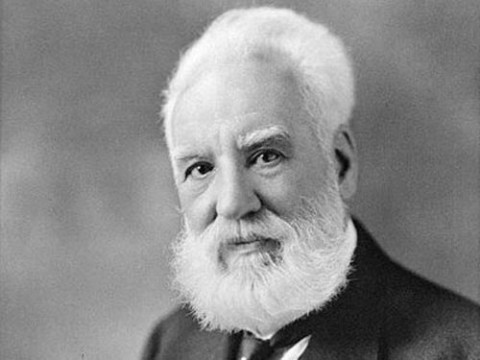
In the past, we’ve brought you sound recordings from the 19th century — recordings that recapture the long lost voices of figures likes Walt Whitman, Alfred Lord Tennyson, William Gladstone, Tchaikovsky, and Thomas Edison. Now, thanks to the “dramatic application of digital technology,” the Smithsonian brings you (quite fittingly) the lost voice of the telephone’s inventor, Alexander Graham Bell. According to biographer Charlotte Gray, Bell recorded his voice onto discs while conducting sound experiments between 1880 and 1886. Although the discs remained in the Smithsonian’s possession for decades, researchers lacked the technical ability to play them back, and Bell’s voice went “mute” until Carl Haber, a scientist at the Lawrence Berkeley National Laboratory, figured out how to take high resolutions scans of the discs and convert them into playable audio files. That’s what you can hear below. In the short recording dated April 15, 1885, the inventor declares: “Hear my voice — Alexander Graham Bell.”
H/T Malcolm; audio via The Atlantic
Related Content:
Voices from the 19th Century: Tennyson, Gladstone, Whitman & Tchaikovsky
Thomas Edison Recites “Mary Had a Little Lamb” in Early Voice Recording
Hear the Only Surviving Recording of Woolf’s Voice
Read More...The History of Coffee and How It Transformed Our World
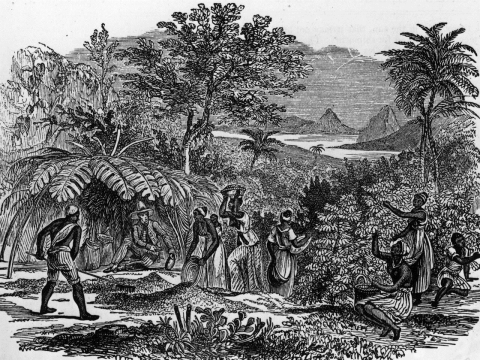
Like so many daily comestibles we completely take for granted—salt, sugar, and (far fewer of us) tobacco—coffee has a long and often brutal history. And like many of these substances, it tends to be addictive. But coffee has also inspired a longstanding social tradition that shows no signs of ever going out of fashion. It’s a drug that makes us thinky and chatty and sociable (I for one don’t speak a human language until I’ve had my first cup). It’s these contradictions of coffee history—its complicity in slave economies and the Enlightenment public square—that Mark Pendergrast takes on in his new book Uncommon Grounds: The History of Coffee and How It Transformed Our World. Pendergrast puts it this way:
One of the ironies about coffee is it makes people think. It sort of creates egalitarian places — coffeehouses where people can come together — and so the French Revolution and the American Revolution were planned in coffeehouses. On the other hand, that same coffee that was fueling the French Revolution was also being produced by African slaves who had been taken to Santo Domingo, which we now know as Haiti.
In the interview above with NPR’s “Morning Edition,” Pendergrast explains his interest in coffee history as a way to look at the “relationship between the have-nots and the haves.” His investigation is another foray into the hundreds of years of European colonial history that gave us both massive global inequality and Starbucks on every corner. Listen to the short interview, read Pendergrast’s book, and the next time you get thinky over coffee, you may just think a lot about how coffee shaped the world.
H/T Kim L.
Related Content:
The History of the World in 46 Lectures From Columbia University
“The Vertue of the COFFEE Drink”: London’s First Cafe Creates Ad for Coffee in the 1650s
Everything You Wanted to Know About Coffee in Three Minutes
Josh Jones is a writer and musician based in Washington, DC. Follow him @jdmagness
Read More...David Lynch Explains How Meditation Enhances Our Creativity
David Lynch meditates, and he meditates hard. Beginning his practice in earnest after it helped him solve a creative problem during the production of his breakout 1977 film Eraserhead, he has continued meditating assiduously ever since, going so far as to found the David Lynch Foundation for Consciousness-Based Education and Peace and publish a pro-meditation book called Catching the Big Fish.
It might seem nonsensical to hear an artist of the grotesque like Lynch speak rapturously about voyaging into his own consciousness, let alone in his fractured all-American, askew-Jimmy-Stewart manner, but he does meditate for a practical reason: it gives him ideas. Only by meditating, he says, can he dive down and catch the “big fish” he uses as ingredients in his inimitable film, music, and visual art. You can hear more of his thoughts on meditation, consciousness, and creativity in his nine-minute speech above.
If you’d like to hear more, the video just above offers a nearly two-hour presentation at UC Berkeley with Lynch as its star. You’ll also hear from outspoken quantum physicist John Hagelin and Fred Travis, director of the Center for Brain, Consciousness and Cognition Maharishi University of Management. Some of what they say might make good sense to you: after all, we could all use a method to clear our minds so we can create what we need to create. Some of what they say might strike you as total nonsense. But if you feel tempted to dismiss all as too bizarre for serious consideration, you might meditate, as it were, on other things Lynchian: backwards-talking dwarves, severed ears on suburban lawns, alien babies, women living in radiators, sitcom families in rabbit suits. He’s certainly pitched us weirder concepts than meditation.
For some secular introductions to meditation, you may wish to try UCLA’s free guided meditation sessions or check out the Meditation 101 animated beginner’s guide above. If you’re not too put off by the occasional Buddhist reference, I would also highly recommend the Insight Meditation Center’s free six-part introduction to mindfulness meditation.
Related content:
David Lynch Talks Meditation with Paul McCartney
David Lynch’s Surreal Commercials
Colin Marshall hosts and produces Notebook on Cities and Culture and writes essays on literature, film, cities, Asia, and aesthetics. He’s at work on a book about Los Angeles, A Los Angeles Primer. Follow him on Twitter at @colinmarshall.
Read More...The Physics of Mosh Pits at Heavy Metal Concerts (Explained by Cornell Grad Students)
Speaking at the American Physical Society last month, Matthew Bierbaum, a Cornell grad student, presented a talk called “Collective Motion at Heavy Metal Concerts,” where he made the case that physics is everywhere, even in a mosh pit at a heavy metal show. Along with three other Cornell researchers, Bierbaum has analyzed and modeled the collective motions of moshers in various YouTube concert videos (like the one below) and discovered that “dancers collide with each other randomly and at a distribution of speeds that resembles particles in a two-dimensional gas,” writes Lauren Wolfe in Chemical & Engineering News.
To try and understand what’s happening in mosh pits, the researchers used a flocking-based simulation that helps “model living beings as simple particles, reducing complex behavioral dynamics to a few basic rules,” says Itai Cohen, the head of the research team. From this study, the Cornell team hopes to learn more about how seemingly chaotic crowds behave, and how smarter exit routes and evacuation strategies can be designed.
You can learn more about their research by perusing the team’s published paper “Collective Motion of Moshers at Heavy Metal Concerts” or by watching Bierbaum’s aforementioned presentation in the grainy video below below.
If you would like to support the mission of Open Culture, consider making a donation to our site. It’s hard to rely 100% on ads, and your contributions will help us continue providing the best free cultural and educational materials to learners everywhere. You can contribute through PayPal, Patreon, and Venmo (@openculture). Thanks!
Related Content:
The Physics of Coffee Rings Finally Explained
Physics from Hell: How Dante’s Inferno Inspired Galileo’s Physics
Michio Kaku Explains the Physics Behind Absolutely Everything
Read More...Kurt Cobain’s Isolated Vocal Track From ‘Smells Like Teen Spirit,’ 1991
In 1991, Nirvana’s Nevermind album exploded into mainstream popular culture like–as one writer describes it– “a grenade detonating in your car radio.” The album, and the Seattle-based grunge rock movement it emerged from, was like a booster shot of 70s punk attitude into heavy metal, sweeping away the hedonism and vanity of 80s bands like Quiet Riot and Mötley Crüe. The song that epitomized the new attitude, for many, was the opening track of Nevermind, “Smells Like Teen Spirit,” with its explosive expression of youthful alienation:
With the lights out, it’s less dangerous
Here we are now, entertain us
I feel stupid and contagious
Here we are now, entertain us
The line “Here we are now, entertain us” was a joke Nirvana’s guitarist and singer Kurt Cobain liked to call out to break the ice whenever he would arrive at a party. “A lot of times,” Cobain told Rolling Stone in a 1994 interview, “when you’re standing around with people in a room, it’s really boring and uncomfortable. So it was ‘Well, here we are, entertain us.’ ”
The title of the song was taken from something his friend Kathleen Hanna, lead singer of Bikini Kill, had spray painted across his wall: “Kurt Smells Like Teen Spirit.” Hanna meant that Cobain smelled like Teen Spirit, a brand of deodorant worn by his girlfriend, but Cobain claimed not to know that until much later. Instead, he saw irony and rebellion.
You can hear Cobain’s isolated vocal track from “Smells Like Teen Spirit” above. The song was recorded at Sound City studios in Van Nuys, California in May of 1991. The band reportedly chose the second of three takes. The extreme dynamics of the performance–soft to loud, apathy to rage–were inspired by the music of the Pixies. To watch a video of Nirvana trying out an early version of “Smells Like Teen Spirit” before an audience at Seattle’s OK Hotel a month before the song was recorded, see Josh Jones’s December post, “The First Live Performance of Nirvana’s ‘Smells Like Teen Spirit’ (1991).”
via That Eric Alper
Related Content:
Patti Smith’s Cover of Nirvana’s “Smells Like Teen Spirit” Strips the Song Down to its Heart
Nirvana’s Home Videos: An Intimate Look at the Band’s Life Away From the Spotlight (1988)
Read More...Watch Them Watch Us: A History of Breaking the “Fourth Wall” in Film
Remember that scene in Nashville, when Keith Carradine sings “I’m Easy,” and every woman in the club thinks he’s speaking directly to her?
Breaking the fourth wall—also known as direct address—can have the same effect on a filmgoing audience. The compilation video above makes it clear that actors love it too. Breaking from convention can telegraph an unimpeachable cool, à la John Cusack in High Fidelity, or afford a veteran scenery chewer like Samuel L. Jackson the opportunity to turn the hog loose. It’s most often deployed in the service of comedy, but a stone-cold killer can make the audience complicit with a wink.
Screenwriter and journalist Leigh Singer pulled footage from 54 films for this mash up, and freely admits that time constraints left some favorites on the cutting room floor. What would you add, if you happened to have Marshall McLuhan right here?
Related Content:
Artist Robbie Cooper’s Video Project Immersion Stares Back at Gamers and YouTubers
The Film Before the Film: An Introduction to the History of Title Sequences in 10 Minutes
Signature Shots from the Films of Stanley Kubrick: One-Point Perspective
Ayun Halliday is that rare Generation X‑er who didn’t see Ferris Bueller’s Day Off until 2013. Follow her @AyunHalliday
Read More...The Power of Food in Quentin Tarantino’s Films
Few living filmmakers have proven as able to spin their obsessions into cinematic gold as Quentin Tarantino. The most obvious of these spring from filmgoing itself — he’s reinvented and continues to reinvent so many of his favorite techniques from genre pictures of all eras and nations — but it doesn’t take an obsession with Tarantino to find others. His sweeping, often motormouthedly expressed ideas about violence in modern society will give film scholars plenty to write about for decades to come; those of baser interests might find some satisfaction tracking the director’s penchant for shots of women’s feet. And anyone who thrilled, early in Pulp Fiction, to John Travolta and Samuel Jackson’s conversation about what the French call a Quarter Pounder with cheese knows that he also must maintain a deep personal and professional interest in food.
Furthering this very specific subfield of Quentin Tarantino Studies, Dan Goodbaum has edited together the video above, which compiles images from notable food scenes in Tarantino’s work. (Grantland’s Zach Dionne catalogued twenty of them here.) Over it, we hear a segment from Elvis Mitchell interviewing Tarantino on his radio show, The Treatment. Mitchell, ace noticer of his filmmaking guests’ themes, tricks, and tics, mentions to Tarantino “how food is used for power in your movies.” We then see and hear about the meaning of, among other comestibles, the burger in Pulp Fiction, the nachos in Death Proof, the rice in Kill Bill Volume 2 , the strudel in Inglourious Basterds, and all the sweets (taken from Leonardo DiCaprio’s real eating habits) in Django Unchained. “When you watch Jackie Brown,” Tarantino says, “you want a screwdriver.” We see a shot of the drink, albeit dominated by Patricia Arquette’s feet. But that’s another video.
via Metafilter
Related Content:
Wes Anderson from Above. Quentin Tarantino from Below
My Best Friend’s Birthday, Quentin Tarantino’s 1987 Debut Film
Colin Marshall hosts and produces Notebook on Cities and Culture and writes essays on literature, film, cities, Asia, and aesthetics. He’s at work on a book about Los Angeles, A Los Angeles Primer. Follow him on Twitter at @colinmarshall.
Read More...Richard Feynman Introduces the World to Nanotechnology with Two Seminal Lectures (1959 & 1984)
In December of 1959, Richard Feynman gave a talk called “There’s Plenty of Room at the Bottom” at an annual meeting of the American Physical Society at Caltech. In this famous lecture, Feynman laid the conceptual foundations for the field now called nanotechnology when he imagined a day when things could be miniaturized — when huge amounts of information could be encoded onto increasingly small spaces, and when machinery could be made considerably smaller and more compact. He asked his audience:
I don’t know how to do this on a small scale in a practical way, but I do know that computing machines are very large; they fill rooms. Why can’t we make them very small, make them of little wires, little elements, and by little, I mean little?
Although some have questioned the degree to which Feynman influenced the rise of nanotechnology, his lecture is still seen as a seminal event in the short history of the nano field. It’s important enough that, 25 years later, Feynman was invited to give an updated version of “There’s Plenty of Room at the Bottom” at a weeklong seminar held at the Esalen Institute in October, 1984.
This time around, he called his talk “Tiny Machines.” And while sticking close to the 1959 script, Feynman’s revised lecture shows what technological advances had been made since he first outlined his vision for a nano world. You can watch the full 79 minute talk above.
Finally, since we’re talking about things nano, let me leave you with this — Stephen Fry’s 2010 primer on nanoscience. Produced in partnership with Cambridge University, NANO YOU was named the best short film at the Scinema Science Film Festival and it does a pretty good job of explaining the nano world in 17 short minutes.
Related Content:
Free: Richard Feynman’s Physics Course from Cornell (1964)
Richard Feynman’s Ode to a Flower: A Short Animation
Read More...A Cult Classic: William Shatner Sings Elton John’s “Rocket Man” at 1978 SciFi Awards Show
Starting in the 1960s, William Shatner, riding high on his Star Trek fame, began his idiosyncratic musical career. With his 1968 concept album, The Transformed Man, the actor gave us the first taste of his musical schtick. He wouldn’t sing songs. He would speak them, often in a melodramatic, exaggerated fashion. Just listen to his versions of “Lucy in the Sky with Diamonds” and “Mr. Tambourine Man” to see what I mean.
Four decades later, the Shat hasn’t changed his style. In 2011, he released a popular version of Queen’s “Bohemian Rhapsody” (watch below) on his space-themed album, Seeking Major Tom. But really, if you want to experience the high watermark of Shatner’s musical work, you need to beam yourself back to 1978. That’s when the actor hosted The Saturn Awards (essentially the Oscars for science fiction, fantasy & horror films) and “sang” a version of “Rocket Man,” the 1972 song co-written by Elton John and Bernie Taupin. It’s Taupin who introduces Shatner, and Karen Black who introduces Taupin.
As you will see (above), the broadcast used chroma key video techniques to portray three different images of Shatner, each of which represented a different part of the Rocket Man’s character. Now a cult classic, Shatner’s performance has been parodied over the years by Beck, Family Guy, and Chris Elliot on a 1992 episode of Late Night with David Letterman, among others. You can find a new recording of “Rocket Man” on Seeking Major Tom.
Finally, if you’re wondering who brought home the hardware from the ’78 Saturn Awards, it was George Burns, Jodie Foster, Star Wars and Close Encounters of the Third Kind.
Support Us
We're hoping to rely on loyal readers, rather than erratic ads. Please click the Donate button and support Open Culture. You can use Paypal, Venmo, Patreon, even Crypto! We thank you!

About Us

Open Culture scours the web for the best educational media. We find the free courses and audio books you need, the language lessons & educational videos you want, and plenty of enlightenment in between.
Advertise With Us

FREE UPDATES!
GET OUR DAILY EMAIL
Get the best cultural and educational resources on the web curated for you in a daily email. We never spam. Unsubscribe at any time.
FOLLOW ON SOCIAL MEDIA

Open Culture editor Dan Colman scours the web for the best educational media. He finds the free courses and audio books you need, the language lessons & movies you want, and plenty of enlightenment in between.
Advertise With Us


