Mikhail Bulgakov’s The Master and Margarita, Animated in Two Minutes
You probably know Mikhail Bulgakov through one of two works: Heart of a Dog, his short novel about the forced transformation of a dog into a human being (comparisons to the grand Soviet project have, indeed, been suggested), or The Master and Margarita, his longer, later novel about a visit paid to Soviet Russia by the devil himself. Heart of a Dog, written in 1925, didn’t see official Russian publication until 1987; The Master and Margarita, written between 1928 and 1940, didn’t come out until 1967. This suggests that Bulgakov’s literary perspective may have touched a nerve with the authorities, but the artfulness with which he expressed it has since lifted him to the top of the twentieth-century Russian canon.
Other creators have paid to tribute to the enormously influential The Master and Margarita with artfulness of their own. We now have at least five films, two television series, nineteen stage productions, two ballets, four operas (though the complicated material defeated Andrew Lloyd Webber’s attempt at adaptation) and a graphic novel based in whole or in part on Bulgakov’s book. At the top of the post, you can watch Svetlana Petrova and Natalia Berezovaya’s Margarita, an animated short that, ambitious in its own way, attempts to capture The Master and Margarita in two ever-shifting minutes of imagery. (Or, as this Russian animation database puts it, “Impudent young animators dare to touch Bulgakov.” ) Though made in 1997, it comes off today as quite a tantalizing “book trailer,” though I would submit that Bulgakov’s writing needs none of our internet-age marketing innovations.
Related Content:
Colin Marshall hosts and produces Notebook on Cities and Culture and writes essays on literature, film, cities, Asia, and aesthetics. He’s at work on a book about Los Angeles, A Los Angeles Primer. Follow him on Twitter at @colinmarshall.
Read More...Watch the Finals of the Poetry Out Loud Competition, Live Tonight
“Having others’ poems in our minds and hearts means we’re never really alone.”
—Karen Kovacik, Indiana State Poet Laureate
Youssef Biaz, reciting here, was 16 years old when he was named Poetry Out Loud National Champion. Biaz won a $20,000 award and $500 worth of poetry books for his high school in Auburn, Alabama. He went on to recite poetry at the White House along with Rita Dove, Common, and Billy Collins. His favorite poet, Sharon Olds, just won the Pulitzer Prize for Poetry.
This past weekend, kids across the country packed their bags and headed to Washington, DC, to recite poetry in the eighth consecutive year of the national competition, Poetry Out Loud. The recitation competition, presented by the Poetry Foundation and the National Endowment for the Arts, brings fifty-three American high school students to the nation’s capital to compete for the title of 2013 Poetry Out Loud National Champion. It will culminate tonight in an evening of recitation competition at 7pm EDT.
If you can’t make it to DC for the free event this year, which features host Anna Deavere Smith and singer-cellist Ben Sollee, view the live webcast of Poetry Out Loud, or host a viewing party and bid a celebratory adieu to National Poetry Month.
Kristin Gecan is the media associate at the Poetry Foundation, which is the publisher of Poetry magazine and an independent literary organization committed to a vigorous presence for poetry in our culture. The site also features an archive of more than 10,000 poems. Follow the Poetry Foundation on Twitter, Tumblr, Facebook, or Pinterest.
Read More...Willie Nelson Auditions for The Hobbit Film Sequel, Turns 80 Today
Willie Nelson, America’s iconic country music singer, has logged lots of miles. And, today, he turns 80, with more than 60 studio albums, 10 live albums, and 27 collaborations to his credit. Recently, Nelson showed that he has a little more tread on his tires when, while visiting Conan O’Brien’s show, he shot a short audition reel for Peter Jackson, hoping to land the role of Gandalf in The Hobbit sequel. It’s doubtful that, wherever he is, Ian McKellan is breaking a sweat.
For more Tolkien treasures don’t miss:
Listen to J.R.R. Tolkien Read a Lengthy Excerpt from The Hobbit (1952)
Download Eight Free Lectures on The Hobbit by “The Tolkien Professor,” Corey Olsen
Discover J.R.R. Tolkien’s Personal Book Cover Designs for The Lord of the Rings Trilogy
Read More...Neil deGrasse Tyson Explains Why He’s Uncomfortable Being Labeled an ‘Atheist’
The evolutionary biologist Stephen Jay Gould famously said that science and religion are “nonoverlapping magisteria”:
The net of science covers the empirical universe: what is it made of (fact) and why does it work this way (theory). The net of religion extends over questions of moral meaning and value. These two magisteria do not overlap, nor do they encompass all inquiry (consider, for starters, the magisterium of art and the meaning of beauty). To cite the arch cliches, we get the age of rocks, and religion retains the rock of ages; we study how the heavens go, and they determine how to go to heaven.
But science and religion, as it is widely practiced, do overlap. They both make specific claims about the nature and history of the Universe. Some religionists do indeed make claims about the age of rocks.
Given the obvious overlap, it’s not surprising that scientists–particularly those who work in the most fundamental and general of fields, like physics and cosmology–are often asked for their views on religion. In this short video from Big Think, astrophysicist and popular science writer Neil deGrasse Tyson explains why he is loathe to take sides on the issue, and why he dislikes the word “atheist.”
“The moment when someone attaches you to a philosophy or a movement,” says Tyson, “then they assign all the baggage, and all the rest of the philosophy that goes with it, to you. And when you want to have a conversation, they will assert that they already know everything important that there is to know about you because of that association. And that’s not the way to have a conversation.”
Related Content:
Neil deGrasse Tyson Lists 8 (Free) Books Every Intelligent Person Should Read
Neil deGrasse Tyson Delivers the Greatest Science Sermon Ever
Alain de Botton Wants a Religion for Atheists: Introducing Atheism 2.0
Stephen Colbert Talks Science with Astrophysicist Neil deGrasse Tyson
Read More...The Odd Collection of Books in the Guantanamo Prison Library
 You don’t hear much about Guantanamo these days, unless you keep an eye on the writings of Pulitzer Prize-winning journalist Charlie Savage. Last week, Savage reported on a hunger strike involving 93 prisoners that’s now in its third month. Ostensibly the protest is in response to prison guards handling the Koran in disrespectful ways. But the real cause comes down to this: “a growing sense among many prisoners, some of whom have been held without trial for more than 11 years, that they will never go home.”
As part of Savage’s reporting on Gitmo, he has also created a photo blog that gives us insight into the prison library and its odd collection of books. The library offers prisoners access to Captain America comics (that must go over well with enemy combatants); pulp romance books by Danielle Steele (another choice pick for Islamists); the complete Harry Potter series (I imagine the Prisoner of Azkaban volume hits home); some more serious works by Gabriel Garcia Marquez, C.S. Lewis, Tolkien and Charles Dickens; an assortment of religious books; and the occasional self help book like The Anxiety & Phobia Workbook.
According to news reports, the library currently has 3,500 volumes on pre-approved topics. Prisoners have to order books in advance. (They can’t just wonder through the stacks.) And the most popular books include Agatha Christie mysteries, the self-help manual Don’t Be Sad; the The Lord of the Rings; and, of course, Harry Potter.
We know that other prisons have given their residents access to our collections of Free Audio Books and Free eBooks. But I doubt that will be happening at Gitmo any time soon.
You can follow Savage’s photoblog here.
via @themillions
Read More...Andrés Segovia: Song of the Guitar, Beautifully Filmed at the Alhambra
Not long ago we posted a beautiful scene featuring the legendary guitarist Andrés Segovia playing Johann Sebastian Bach at the Alhambra, the storied 14th century Moorish palace in Granada, Spain. Today we’re pleased to bring you the entire 50-minute film from which it came, Andrés Segovia: The Song of the Guitar.
The documentary was made in 1976 by the South African-born filmmaker Christopher Nupen. Segovia was 84 years old at the time. When he was a child living in Granada, Segovia loved to bring his guitar to the Alhambra and play for friends. “It was here,” he says in the film, “that I opened my eyes to the beauty of nature and art. To be here is to feel oneself to be near, very near, paradise.” Segovia is often described as the father of modern classical guitar. In the liner notes to the film, which is available on DVD along with another film on Segovia by Nupen, it says:
As an instrumentalist, Segovia did for the guitar what Casals did for the cello, but he did it with an instrument that had never before been taken seriously as a concert instrument. Within his own lifetime, Segovia taught himself the instrument, revolutionised the technique and elevated a folk instrument to the highest levels of the international concert platform. As a musician, he has come to be recognised as one of the most refined and profound of his time.
In the film, Segovia reminisces about his early days in Grenada and his happy discovery of the guitar. He plays ten pieces, all beautifully filmed in the courtyards of the Alhambra:
- “Capricho Catalán” by Isaac Albéniz
- “La Maja de Goya” by Enrique Granados
- “Torre Bermeja” by Isaac Albéniz
- “Sonata in E Minor” by Domenico Scarlatti
- “Minuet” by Jean-Philippe Rameau
- “Minuet” by Fernando Sor
- “Ballet and Allegretto” by Manuel Ponce
- “Gavotte I & II” by Johann Sebastian Bach
- “Leyenda” by Isaac Albéniz
- “El Noi de la Mare” a Catalan folk song
Related Content:
The Story of the Guitar: The Complete Three-Part Documentary
The Guitar Prodigy from Karachi
Read More...History Declassified: New Archive Reveals Once-Secret Documents from World Governments
In the early ’90s, the so-called “Iron Archives” of Russian political documents from the Cold War era opened up to historians, shedding light on the earliest days of Mao Zedong and Joseph Stalin’s diplomatic alliance.
But not all of the Russian documents were declassified at that time. The Woodrow Wilson International Center for Scholars has launched a new digital archive containing recently declassified materials from some 100 different international collections, including a cable Mao sent to Commander Filippov (Stalin’s alias) eagerly detailing his plans to study Russia and complaining about his poor health.
The subsequent exchange between the two world leaders is as banal as their later correspondence would be ideological. Mao suggests, once his health improves, that they use the aerodrome in Weixian for his departure and he includes the exact dimensions of the landing strip. One wonders whether Obama and Israeli President Shimon Peres worked so closely together on travel details for their meetings in March.
The details contained in the thousands of cables, telegrams and memos are part of the fun. Other documents exchanged between the KGB chairman and East German Minister in July, 1981 include blunt language about the difficulties of reading the Reagan Administration’s intentions and the importance of quashing the Polish Solidarity Movement.
Because the world’s biggest issues tend to have long roots, there is a lot of material here that echoes today’s headlines. Here, the Soviet Minister of Foreign Affairs records a 1958 memo about his assessment of North Korea’s plans for a nuclear program.
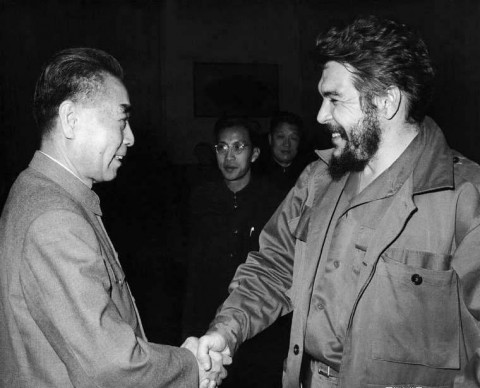
During a 1960 global communist delegation meeting, Mao Zedong spoke at length with Che Guevara about sugar sales, American influence and counter-revolutionaries.
As a side note, the Wilson Center is a one of the more intellectual memorials to an American president. Woodrow Wilson was, after all, the only President of the United States to hold a Ph.D. The Center is one of the world’s top think tanks, with research and projects focused on U.S.-Russia relations, the Middle East, North Korea and, oddly, emerging nanotechnologies. But, of course, the Wilson Center is more known for its centrist analysis of international diplomacy issues.
The new digital archive (whose tagline is “International History Declassified”) offers several ways to search: by place, year (beginning with1938) or subject. For scholars or history buffs, this is a trove worth browsing.
Kate Rix writes about education and digital media. Visit her website: .
Read More...Jane Austen, Game Theorist: UCLA Poli Sci Prof Finds Shrewd Strategy in “Cluelessness”
Professional jealousy is probably the worst reason to dismiss a new perspective, whether it comes from within one’s field, outside it, or anywhere else. Snobbery leads to inbreeding and intellectual dead-ends. So when Michael Chwe, an associate professor of political science at UCLA who specializes in game theory, has an epiphany about Jane Austen as a proto-game theorist, maybe his insights should change the way English profs—and everyone else—read the author of Pride and Prejudice.
I don’t know. I haven’t read Chwe’s book, Jane Austen: Game Theorist (read a sample chapter here), but I’ll confess, I’m skeptical of anyone who calls Austen’s literary work a “research program” that has “results” in a book of “230 diagram-heavy pages.” It seems to miss the point somehow. Austen is perhaps these days the most-adapted of British writers, and her academic cachet couldn’t be higher. But the best takes on her work—whether scholarly or popular—are fun, focused on character and language, not technocratic theory.
But maybe I’ve misjudged Chwe’s intent. He was, after all, inspired to read Austen by “watching movies and reading books with his children.” And one of the concepts Chwe ascribes to Austen is that of “cluelessness,” a term he takes from that classic nineties movie Clueless (inspired by Austen’s Emma, clip above). In Chwe’s analysis, cluelessness is not at all garden-variety stupidity; it’s the benevolent deviousness of Elizabeth Bennet or the “dumb blonde” act Alicia Silverstone’s character pulls off in convincing others that she doesn’t know what she’s doing, all the while manipulating, cajoling, and demurring to get her way.
Chwe also pursues the darker side of cluelessness, relating it to grim episodes like the 2004 killing of four private contractors in Falluja. Overall, his book identifies fifty “manipulation strategies” he finds in Austen. While his book seems to promise some entertaining observations it also might further confirm for serious Austen readers that the eighteenth-century novelist was one of the most psychologically insightful writers of the past few centuries.
Related Content:
New Stamp Collection Celebrates Six Novels by Jane Austen
As Pride and Prejudice Turns 200, Read Jane Austen’s Manuscripts Online
Josh Jones is a writer and musician based in Washington, DC. Follow him @jmagness
Read More...Woody Allen Amuses Himself by Giving Untruthful Answers in Unaired 1971 TV Interview
Celebrities tire of giving interviews. I’ve learned this by spending most of my career conducting interviews myself, and thus desperately trying to master asking the questions that wake up a weary interviewee, getting them engaged enough to cast aside the boilerplate and speak like a conversing human being. But what about the celebrities themselves? What can they do to spice up their experience? In 1971, the oft-interviewed Woody Allen sat down with Granada Television and took a bold move to keep things interesting, apparently challenging himself to reply to each question as untruthfully as possible. Though the conversation never aired, Allen did manage to keep up the routine for quite some time, and you can watch nearly forty minutes of it in the clip above.
The interviewer asks Allen for a synopsis of his new picture. “It’s a drama about human emotion in the United States,” the director flatly replies. “It deals with the tragedy of divorce as it relates to the children and those who have to suffer continually from the effects of an unhappy home.” So it contains no comedy whatsoever, then? “No, I try and keep as much comedy out of my films as possible.” The film ostensibly under discussion: Bananas. Asked question after broad, brief question, Allen lobs back ever drier and more implausible fabrications. His dedicated fans, though, will notice that he does slip in a factual statement. Asked if he watches his own films, he says no; and indeed, he famously never looks back at past work. The increasingly nervous-sounding interviewer (who may be in on the joke?) asks why. “Because I don’t have the patience to sit through them.”
h/t @lit_hum
Related content:
Woody Allen Answers 12 Unconventional Questions He Has Never Been Asked Before
Meetin’ WA: Jean-Luc Godard Meets Woody Allen in 26 Minute Film
Woody Allen Lives the “Delicious Life” in Early-80s Japanese Commercials
Woody Allen Boxes a Kangaroo, 1966
Colin Marshall hosts and produces Notebook on Cities and Culture and writes essays on literature, film, cities, Asia, and aesthetics. He’s at work on a book about Los Angeles, A Los Angeles Primer. Follow him on Twitter at @colinmarshall.
Read More...John Belushi and Dan Aykroyd Get Brian Wilson Out of Bed and Force Him to Go Surfing, 1976
There are certain legends surrounding Brian Wilson, the troubled genius behind the Beach Boys. One is that he hates going to the beach. He never went surfing, even though he wrote classic songs like “Surfer Girl,” “Surfin’ Safari,” and “Surfin’ USA.” Another is that he basically stayed in bed for two or three years in the early 1970s, weighted down by drugs and depression.
In this classic comedy sketch from the summer of 1976, John Belushi and Dan Aykroyd play a pair of California Highway Patrol officers who burst into the bedroom of Wilson’s Bel Air home and force the reclusive musician to get up and go surfing. “Brian,” says Aykroyd, “we have a citation here for you sir under Section 936A of the California Catch a Wave Statute. Brian, you’re in violation of Paragraph 12: failing to surf, neglecting to use a state beach for surfing purposes, and otherwise avoiding surfboards, surfing and surf.”
The scene is from the NBC television special It’s OK, which was produced by Saturday Night Live creator Lorne Michaels during the break between SNL’s first and second seasons. It was directed by the show’s resident flmmaker Gary Weis. The one-hour special was organized to celebrate the Beach Boys’ 15th anniversary and to promote their album, 15 Big Ones. Wilson had just rejoined the group, and the special was part of the “Brian’s Back” publicity campaign. The program, which is currently available on European-formatted DVD as The Beach Boys: Good Vibrations Tour, includes an interview of Wilson in bed, comedic scenes of band members doing offbeat things, and live footage from a July 3, 1976 Beach Boys concert at Anaheim Stadium. In the two intercut scenes above, Mike Love leads the Beach Boys onstage in a performance of “Surfin’ USA” as Wilson is forced into the ocean in his bath robe. “Okay, Mr. Wilson,” says Aykroyd. “Here’s your wave.”
Related Content:
The Making of The Beach Boys’ Pet Sounds: A Video Breakdown
Leonard Bernstein Demystifies the Rock Revolution for Curious (if Square) Grown-Ups in 1967
John Belushi’s Improvised Screen Test for Saturday Night Live (1975)
The Making of The Blues Brothers: When Belushi and Aykroyd Went on a Mission for Comedy & Music
Read More...Support Us
We're hoping to rely on loyal readers, rather than erratic ads. Please click the Donate button and support Open Culture. You can use Paypal, Venmo, Patreon, even Crypto! We thank you!

About Us

Open Culture scours the web for the best educational media. We find the free courses and audio books you need, the language lessons & educational videos you want, and plenty of enlightenment in between.
Advertise With Us

FREE UPDATES!
GET OUR DAILY EMAIL
Get the best cultural and educational resources on the web curated for you in a daily email. We never spam. Unsubscribe at any time.
FOLLOW ON SOCIAL MEDIA

Open Culture editor Dan Colman scours the web for the best educational media. He finds the free courses and audio books you need, the language lessons & movies you want, and plenty of enlightenment in between.
Advertise With Us


