Beth, I Hear You Loud and Clear: A Fictional Origin Story of KISS’ Best Selling Single
A couple of days ago, Mick Fleetwood told NPR that a band’s greatest hits belong to its fans “to be reinterpreted and create a backdrop for parts of their lives.”
With that in mind, who among us has not related … or yearned for the boyfriend or girlfriend that might allow us to relate to Peter Criss’ chart-topping “Beth”? The power ballad went gold for Criss’ band KISS in 1976, and has reigned as an ear worm on Classic Rock stations ever since:
Beth, I hear you callin’
But I can’t come home right now
Me and the boys are playin’
And we just can’t find the sound.
Close your eyes and visualize poor Beth, alone in her negligee on that giant bed, the scented candles guttering in sad recognition that art always comes first for a soulful dude like Pete.
Now open them wide for the alternate and extremely spirited take above. This version gives us Beth’s side, compliments of writer Bob Winter, director Brian Billow of Anonymous Content, and actress Lilli Birdsell, MILF-ing it up to vintage perfection as she juggles the kids and a meatloaf in the oven. Rockstar husbands’ salaries aside, Birdsell’s Beth is the embodiment of the red-blooded female multitasker popularized by the Enjoli commercial of the same period. The news that her husband “can’t” come home right now is met not with a tear, but a hilariously flat “What?” (I loved how it took several repetitions for the lyrical hook to register with her.)
I was rooting for this Beth to pull a Thelma and Louise, loading the twins into the Country Squire and dumping them at the studio for their father to deal with. Sadly, our heroine is no match for years of built-up fan interpretations. Guess Betty Draper’s not the only pretty woman doomed to sip her dinner as she stoically ignores both children and partner’s empty plate.
- Ayun Halliday hasn’t even started to think about what’s for dinner tonight, so quit asking. Follow her at @AyunHalliday
Read More...Watch D.O.A., Rudolph Maté’s “Innovative and Downright Twisted” Noir Film (1950)
Living and filmgoing here in Los Angeles, I seize every opportunity to watch Los Angeles Plays Itself, Thom Andersen’s extensive and entertaining documentary on the uses and abuses of the city throughout cinema history. In one passage, Andersen tracks the strikingly various roles of George Wyman’s 1893 Bradbury Building downtown: Deckard’s apartment in Blade Runner, Marlowe’s office in Marlowe, the place where Tom meets Autumn in (500) Days of Summer. “The movies discovered the Bradbury Building before the architectural historians did,” the narration tells us. “In China Girl, it played the Hotel Royale in Mandalay, Burma. The following year, in The White Cliffs of Dover, it played a London military hospital overflowing with wounded soldiers.” We then see the climactic scene of a film called D.O.A. which, dramatically heightened even by the standards of film noir, depicts a poisoned man chasing his own murderer up the stairs of the building’s darkened but still unmistakable atrium.
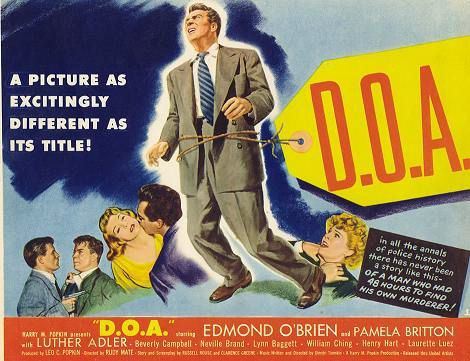
“Fatally poisoned by a luminous toxin slipped into his drink at a jazz club,” so Andersen’s narrator summarizes, “Frank Bigelow has one day before dying to track down his killer, and he finds him at the Phillips Import-Export Company… Room 427.” Few viewers of the documentary will already have seen D.O.A.; the rest surely feel intrigued enough to track it down. Fortunately, they can watch the complete 1950 film free online, since it fell into the public domain in 1977. Called “one of the most accomplished, innovative, and downright twisted entrants to the film noir genre” by the BBC’s David Wood, Hungarian expat director Rudolph Maté’s third picture has, like many of its artistic relatives, experienced a respectful re-evaluation since raising groans from critics with, among other things, the claim of being “As Excitingly Different As Its Title!” Salon’s Michael Sragow calls it an example of a “high-concept movie before its time,” one that certainly does have more to offer you on your film noir Friday than just a neat building.
Related Content:
Detour: The Cheap, Rushed Piece of 1940s Film Noir Nobody Ever Forgets
Fritz Lang’s “Licentious, Profane, Obscure” Noir Film, Scarlet Street (1945)
100 Greatest Posters of Film Noir
Colin Marshall hosts and produces Notebook on Cities and Culture and writes essays on literature, film, cities, Asia, and aesthetics. He’s at work on a book about Los Angeles, A Los Angeles Primer. Follow him on Twitter at @colinmarshall.
Read More...Leonard Susskind Teaches You “The Theoretical Minimum” for Understanding Modern Physics
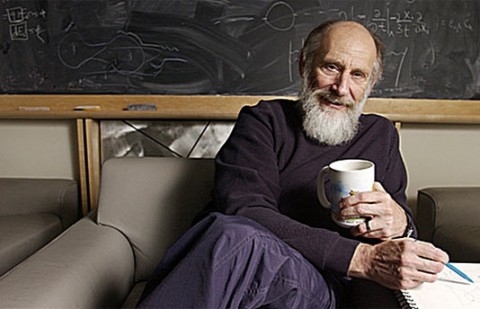 For the past decade, Leonard Susskind, one of America’s pre-eminent physicists, has taught a series of six courses in Stanford’s Continuing Studies program. The series “explores the essential theoretical foundations of modern physics,” helping lifelong learners (like you) attain the “theoretical minimum” for thinking intelligently about modern physics. Over the years, the Continuing Studies program (where, in full disclosure, I serve as the director) has taped the lectures and made them available to a global audience on YouTube and iTunes. We’ve even burned the lectures onto CDs and shipped them to remote locations in Afghanistan and Nepal where connectivity is still lacking. This week, Susskind’s popular lectures found a new home of sorts with the launch of The Theoretical Minimum, a new web site that presents the six courses in a way that’s neat, clean and easy to navigate. The site also offers a short text summary of each lecture, plus related reference materials. You can jump into the courses and get started on your own intellectual journey via this list:
- Classical Mechanics
- Quantum Mechanics
- Special Relativity and Electrodynamics
- General Relativity
- Cosmology
- Statistical Mechanics
Note: Susskind’s courses, and many others, also appear in our collection of Free Online Physics Courses, part of our collection of 875 Free Online Courses.
Related Content:
Free: Richard Feynman’s Physics Lectures from Cornell (1964)
Demystifying the Higgs Boson with Leonard Susskind, the Father of String Theory
Michio Kaku Explains the Physics Behind Absolutely Everything
Leonard Susskind, Father of String Theory, Warmly Remembers His Friend, Richard Feynman
Read More...‘Beastie Boys on Being Stupid’: An Animated Interview From 1985
Blank on Blank, the nonprofit group that uses the magic of animation to bring forgotten interviews back to life, has come out with a new episode featuring the Beastie Boys in their early days. “Beastie Boys on Being Stupid” (above) is built on excerpts from a 1985 interview with Rocci Fisch for ABC Radio. The three members of the group–Mike Diamond, Adam Horowitz and Adam Yauch–were between 19- and 21-years old at the time and had not yet released their first full-length album, Licensed to Ill. They were touring with Madonna, and just beginning to get a taste of the national spotlight. The interview is infused with the Boys’ self-deprecating wit.
Rocci Fisch: “How did you get your group name, Beastie Boys?”
Adam “MCA” Yauch: “It’s from the good old days. We were a hardcore band.”
Mike “Mike D” Diamond: “Yeah, we were like–I was like what, 14?”
Adam “MCA” Yauch: “Yeah.”
Mike “Mike D” Diamond: “I was like, 14, 15? That’s when we made our first record. We were all going to high school at the time and that’s how we met.”
Adam “MCA” Yauch: “At the time it was the stupidest name that I could possibly think of. And if you could think of a stupider name I’d probably be pretty impressed now. So lay it on me: Can you think of a stupider name name than the Beastie Boys?”
Rocci Fisch: “Not really.”
Adam “MCA” Yauch: “So then that answers your question right there.”
For a full transcript, go to the Blank on Blank Web site. And for more about Blank on Blank, including three earlier videos, see our April 19 post, “Animations Revive Lost Interviews with David Foster Wallace, Jim Morrison & Dave Brubeck.”
Related Content:
Coldplay Covers Fight For Your Right to Party at the Hollywood Bowl: A Tribute to MCA
Read More...New Jazz Archive Features Rare Audio of Louis Armstrong & Other Legends Playing in San Francisco
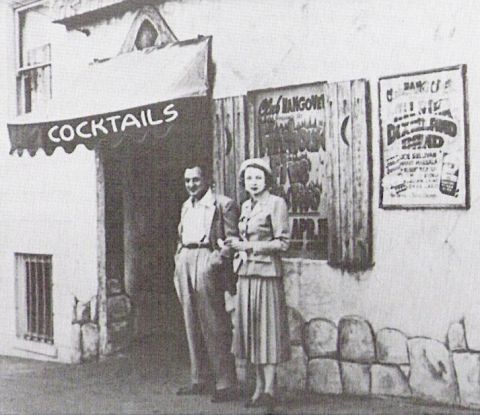
Any investigation into San Francisco’s jazz heyday of the 1950s requires a stop at the Club Hangover. Operated by bandleader Doc Dougherty on Bush Street throughout the decade, the club became a Dixieland jazz headquarters.
Now home to an adult movie theater, the club is long closed. The music lives on however in recordings made at the time, which are now available online, much of it for the first time ever, in complete, unedited recordings.
Using tapes preserved by radio station KCBS, jazz broadcaster Dave Radlauer has archived KCBS broadcasts of Hangover sessions from 1954–58. On-air host Bob Goerner interviewed musicians from the KCBS station using a dedicated phone line that delivered a signal from the club on Nob Hill. Goerner preserved the show tapes, which are now housed in the Stanford University Braun Music archive.
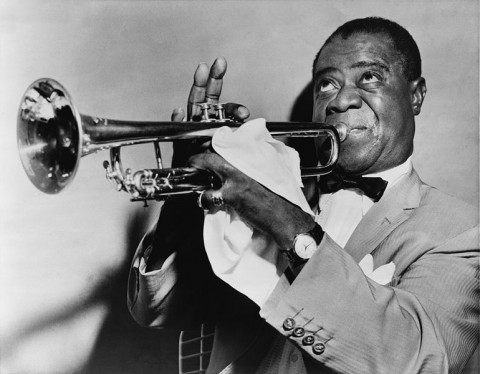
Radlauer makes the archive available as .mp3 files, including one particularly historic jam session starring Louis Armstrong. The story goes that in January, 1951 Armstrong was in San Francisco to visit his friend clarinetist Pee Wee Russell in the hospital and decided to throw Russell a fundraiser. He brought together a masterful group including pianist Earl “Fatha” Hines, credited with helping transition jazz piano from stride to swing. The place was packed and $1,500 went into the kitty for Russell’s medical bills. You can listen to Armstrong’s rehearsal and performance below.
Rehearsal:
Performance:
“Fatha” Hines was quite a performer himself. A popular headliner, his music ranged from Dixieland to bop. Another favorite at the Hangover was Muggsy Spanier, a cornetist known for his emotional solos and masterful use of the plunger mute.
These guys lived in the Bay Area: Hines was a resident of Oakland, Spanier lived in Sausalito and trombonist Kid Ory raised chickens for a time in Petaluma.
via Metafilter
Kate Rix writes about education and digital media. Visit her website: .
Related Content:
The Nazis’ 10 Control-Freak Rules for Jazz Performers: A Strange List from World War II
10 Great Performances From 10 Legendary Jazz Artists: Django, Miles, Monk, Coltrane & More
Read More...David Bowie Recalls the Strange Experience of Inventing the Character Ziggy Stardust (1977)
Oh, not another Bowie post! Oh yes, yes it is. We don’t keep our love for Bowie secret, and along with his first album in ten years comes new archival material: new to us that is, and maybe to you too.
Now, if your primary experience of Bowie was through his early 70s character Ziggy Stardust—a rock opera creation as much as Hedwig or Dr. Frank-N-Furter—it would be easy to believe Bowie was Ziggy. He inhabited the character so fully that it’s hard to imagine he was playing a very deliberate part the whole time.
But of course, he was. Ziggy and the Spiders were, as Bowie says above, a “theater piece.” Previously, we’ve featured a documentary (see again below) that chronicles the rise of Ziggy Stardust, from Bowie’s somewhat obscure beginnings to his breakout as the character. In the 1977 interview clip above from the CBC, watch Bowie, as himself, describe the experience of being Ziggy.
He talks of his influences—a mélange of kabuki theater, mime, and New York art rock (“Velvet Underground, whatever”). He calls the music from Ziggy Stardust and the Spiders From Mars “a British view of American street energy.” In retrospect, it’s easy to see the act as just that, but in the moment, Bowie’s fans believed in Ziggy as surely as they believed anything else. Watch, for example, as starstruck audience members rapturously mouth the words to “Moonage Daydream” in this clip from D.A. Pennebaker’s Ziggy Stardust film.
P
ennebaker’s film caught Bowie’s final performance as the alien rock star at London’s Hammersmith in 1973. No doubt these fans were horribly crushed when Ziggy announced his retirement before the final song. But I’m sure they kept their electric eye on the re-invented Bowie in Berlin, a period he also discusses above, when he left L.A. for Germany and began working with Brian Eno and Iggy Pop.
Related Content:
The Story of Ziggy Stardust: How David Bowie Created the Character that Made Him Famous
David Bowie Releases Vintage Videos of His Greatest Hits from the 1970s and 1980s
Josh Jones is a writer and musician based in Washington, DC. Follow him @jdmagness
Read More...Obey the Giant: Short Film Presents the True Story of Shepard Fairey’s First Act of Street Art
Street artists: you either love ’em or hate ’em. Or, to put it less bluntly, you either find ’em innovative public iconographers or find ’em puerile public nuisances. I surely don’t have to get into the controversy of appraisal and reappraisal that swirls endlessly around English stencil-wielding satirist Banksy, but even the far less secretive and aggressive Shepard Fairey has detractors as fervent as his admirers. Yes, I mean the Obama “HOPE” fellow, though he began launching images into our zeitgeist well before any of us knew the name of the future President of the United States of America. You can learn much more about his early, pre-HOPE work by watching Obey the Giant, a brand new twenty-minute documentary free to watch online. Among the truths revealed: Fairey also created “Andre the Giant has a posse” stickers, those pillars of nineties underground culture and results of an “experiment in phenomenology” that you’ve almost certainly been spotting ever since.
Directed by former Fairey intern Julian Marshall, the short examines the circumstances surrounding his creation of this prankish yet surprisingly long-lived campaign. Why appropriate the image of such a well-known professional wrestler? Why credit him with a posse? Why start spreading the word on the streets of Providence? To address these questions, Obey the Giant goes back to Fairey’s years at the Rhode Island School of Design in the late eighties and early nineties, when he hung out with a tight-knit group of hip-hop-loving skaters, known internally as “the Posse,” and needed a sample image to try making a stencil out of. The documentary, which crowdsourced its $65,000 budget through Kickstarter, features a fictionalized version of Fairey portrayed by an actor. The move seems faintly reminiscent of Banksy’s reality-ambiguous 2012 film Exit Through the Gift Shop, though the real Fairey doesn’t conceal his identity. He even occasionally turns up, so I’ve heard, at the museum here in Los Angeles where my lady works — in the gift shop, as it happens.
Related Content:
The Obama “Hope” Poster & The New Copyright Controversy
Shepard Fairey Caves In, Revises Occupy Wall Street Poster
Artist Shepard Fairey Curates His Favorite YouTube Videos
Striking Posters From Occupy Wall Street: Download Them for Free
Colin Marshall hosts and produces Notebook on Cities and Culture and writes essays on literature, film, cities, Asia, and aesthetics. He’s at work on a book about Los Angeles, A Los Angeles Primer. Follow him on Twitter at @colinmarshall.
Read More...23 Cartoonists Unite to Demand Action to Reduce Gun Violence: Watch the Result
The United States has only five percent of the world’s population, but somewhere between 35 and 50 percent of the world’s privately owned guns. Is it a surprise, then, that we have significantly higher rates of gun violence?
According to research published by the National Institutes of Health, homicide rates in the U.S. are 6.9 times higher than they are in other high-income nations. For 15- to 24-year-olds, the homicide rate is 42.7 times higher. Firearm suicide rates are 5.8 times higher in America than in other countries, even though the overall suicide rates are 30 percent lower.
A succession of high-profile massacres–Columbine, Virginia Tech, Sandy Hook–has taken place against a baseline of daily gun deaths that rarely make the national headlines: murders, suicides, accidental killings. Since the December 14 mass murder at Sandy Hook Elementary School in Newtown, Connecticut, in which 20 children and six adults were gunned down by a heavily armed man, there have been well over 3,300 gun-related deaths in America. If current trends continue, gun deaths are projected to exceed traffic deaths for the first time by the year 2015.
So what is being done? At the federal level, nothing.
Earlier this month the Senate not only struck down legislation to ban assault weapons and high-capacity gun magazines, it also struck down–at the will of a 45-member minority–a bipartison compromise to expand background checks for gun buyers, a measure supported by 90 percent of the American people.
In response to the paralysis (some would say cowardice) on Capitol Hill, a group of 23 prominent cartoonists, including Garry Trudeau, Ruben Bolling, Art Spiegelman and Tom Tomorrow, have joined forces to fight back against the gun lobby. The cartoon (above) was organized by Mayors Against Illegal Guns, and is narrated by actors Julianne Moore and Philip Seymour Hoffman.
“Enough. Demand action,” say Moore and Hoffman. “As a dad, as a mom, as a husband, as a wife, as a family, as a friend. As an American. It’s time. We can’t back down. It’s time for our leaders to act right now. Demand action”
If you would like to support the mission of Open Culture, consider making a donation to our site. It’s hard to rely 100% on ads, and your contributions will help us continue providing the best free cultural and educational materials to learners everywhere. You can contribute through PayPal, Patreon, and Venmo (@openculture). Thanks!
Read More...Joan Baez Live in 1965: Full Concert
On June 5, 1965, Joan Baez played a special concert at the BBC Television Theatre in Shepherd’s Bush, London. Although her fame at the time was newly eclipsed by that of her recently estranged lover Bob Dylan, Baez was very much in her prime.
The concert was recorded less than a month after Dylan’s 1965 tour of England, chronicled in D.A. Pennebaker’s film Don’t Look Back, in which Dylan failed to invite Baez onstage despite the fact that she had introduced him to national audiences in America.
Baez plays several Dylan songs in the BBC concert, along with other folk and pop songs from her repertoire. Included is Baez’s first hit single, her version of the Phil Ochs song “There but for Fortune,” which was released the same month in America but would not come out in the UK until the following month. The concert was originally broadcast by the BBC as two separate half-hour specials, both ending with the classic French love song “Plaisir d’amour.” Baez’s mother Joan Senior, or “Big Joan” as she was called (and who died this month at the age of 100), can be seen in the background at the 33:30 and 104:43 marks applauding and smiling proudly. The set list for the two back-to-back programs is:
- “I’m a Rambler, I’m a Gambler”
- “There but for Fortune”
- “Copper Kettle”
- “Mary Hamilton”
- “Don’t Think Twice, it’s Alright”
- “I’m Troubled and I Don’t Know Why”
- “We Shall Overcome”
- “With God on Our Side”
- “Plaisir d’amour”
- “Silver Dagger”
- “Oh Freedom”
- “She’s a Troublemaker”
- “The Unquiet Grave”
- “It Ain’t Me Babe”
- “Isn’t it Grand”
- “500 Miles”
- “Te Ador/Ate Amanha”
- “Plaisir d’amour”
Related content:
Two Legends Together: A Young Bob Dylan Talks and Plays on The Studs Terkel Program, 1963
Bob Dylan Shares a Drug-Hazed Taxi Ride with John Lennon (1966)
Read More...Rare Miles Davis Live Recordings Capture the Jazz Musician at the Height of His Powers
Very early in his career as a bandleader, Miles Davis developed a reputation for a too-cool persona on stage. Whether turning his back on the crowd or walking offstage while his sidemen soloed, his refusal to cater to audience expectations only enhanced his mystique. Whatever fans and critics made of Miles’ seeming contempt—political statement, eccentricity, or dazzling egotism—his live playing transfixed those who had the privilege to see him and consistently drew the best players in history into his orbit.
The sixties saw him at the peak of his powers as a live performer. He hit the pop charts in the early part of the decade with the 1962 two-LP set In Person, recorded over two nights at the Blackhawk in San Francisco. The very next month he recorded the Grammy-nominated Miles Davis at Carnegie Hall with an orchestra led by Gil Evans. In 2007, a never‑before released live gem from the 1963 Monterey Jazz Festival thrilled fans (listen to “So What” from that recording above). All of these recordings capture Davis during his “transition period,” between his first and second “great quintets” (which featured John Coltrane and Wayne Shorter on sax, respectively).
Directly above, hear a lesser-known, officially unreleased recording from that transitional period. Captured by French public broadcasting company ORFT, the sessions took place at the Juan-Les-Pins Festival in Antibes in July 26–28, 1963, just a few months before Monterey. Davis is backed here by the same ensemble: George Coleman on tenor sax, Herbie Hancock on piano, Ron Carter on bass, and (then seventeen-year-old) Tony Williams on drums. These recordings represent alternates and outtakes from the record originally released in ’64 as In Europe, reissued in 1989 as Miles in Antibes. The full tracklist (below) is bookended by two versions of Kind of Blue opener “So What,” and it’s interesting to compare these wildly frenetic ’63 live iterations from Monterey and Antibes to the classic of laid-back cool from the late 50s.
1. So What (July 26, 1963)
2 Stella By Starlight (July 26)
3. Seven Steps To Heaven – Walkin’ (July 26)
4. If I were a Bell (July 28, 1963)
5. So What (July 28)
Davis’ first and second “great quintets” are perhaps his most-loved groups. However, the short-lived 1963 ensemble above certainly pushed him in a new direction. For another pivotal moment of transition, watch the 1969 return to the Juan-Les-Pins Jazz Fest in the video below, which shows Davis again moving in a very different direction, presaging his ’70s swerves into acid rock and funk. This performance features another all-star ensemble, with Wayne Shorter on tenor and soprano sax, Chick Corea on electric piano, Dave Holland on bass, and Jack DeJohnette on drums.
via Past Daily
Related Content:
The Miles Davis Story, the Definitive Film Biography of a Jazz Legend
Miles Davis and His ‘Second Great Quintet,’ Filmed Live in Europe, 1967
‘The Sound of Miles Davis’: Classic 1959 Performance with John Coltrane
Josh Jones is a writer and musician based in Washington, DC. Follow him @jdmagness
Read More...Support Us
We're hoping to rely on loyal readers, rather than erratic ads. Please click the Donate button and support Open Culture. You can use Paypal, Venmo, Patreon, even Crypto! We thank you!

About Us

Open Culture scours the web for the best educational media. We find the free courses and audio books you need, the language lessons & educational videos you want, and plenty of enlightenment in between.
Advertise With Us

FREE UPDATES!
GET OUR DAILY EMAIL
Get the best cultural and educational resources on the web curated for you in a daily email. We never spam. Unsubscribe at any time.
FOLLOW ON SOCIAL MEDIA

Open Culture editor Dan Colman scours the web for the best educational media. He finds the free courses and audio books you need, the language lessons & movies you want, and plenty of enlightenment in between.
Advertise With Us

