The Confessions of Robert Crumb: A Portrait Scripted by the Underground Comics Legend Himself (1987)
Anyone who’s seen Crumb, Terry Zwigoff’s 1994 documentary about underground comics legend, R. Crumb, may consider themselves fairly conversant in both the art and the offbeat existence of the vintage-record-revering sexual adventurer and self-proclaimed wimp.
But does a traveler pass up the opportunity to visit Paris simply because he’s been there once before?
Unless you’re a virgin to the subject, The Confessions of Robert Crumb, a BBC doc whose release predated that of Zwigoff’s definitive portrait by seven years, will contain no major revelations. It’s still a lot of fun though, perhaps more so for having been scripted by its main attraction.
Crumb and his wife, fellow cartoonist, Aline Kominsky Crumb, were uneasy with Zwigoff’s portrayal, a reaction they documented in Head for the Hills!, a jointly authored, two-page comic in the New Yorker. Their objections ultimately lay with the notoriety the film would confer on them. Fame for Crumb is a monster-making drain on creativity. (“And I guarantee we won’t earn an extra dollar as a result of this wonderful exposure,” Aline adds in a word bubble, an observation the Crumb blog gives the lie to, nearly twenty years out.)
But in terms of what he was willing to own up to on camera, Crumb the screenwriter is far from a shrinking violet. The talking heads are minimized and the extended family kept to the shadows, but he’s frank about the erotic preoccupations that figure prominently in his work and have raised more than a few feminist hackles over the years. One might even say he plays it up in goofy staged bits, such as the one where he dons a lab coat to examine the powerful rear and kidney bean-shaped pelvic tilt of an impassive model clad in 80s-style Jane Fonda Workout wear. As social maladroits go, he’s not afraid to wear a lampshade on his head.
He also reveals himself as a lifelong learner, avidly researching his non-flesh-related passions. His interests are infectious. One hour with Crumb and you may find yourself spending the next two or three on esoteric topics ranging from James Gillray to Harry Roy and his Bat Club Boys.
You can find The Confessions of Robert Crumb listed in our collection of 55o Free Online Movies.
Related Content:
Record Cover Art by Underground Cartoonist Robert Crumb
The Inscrutable Imagination of the Late Comic Artist Mœbius
Ayun Halliday is a feminist and a long term Robert Crumb fan.
Read More...So You Want to Be a Writer?: Charles Bukowski Explains the Dos & Don’ts
Here’s a quick video that serves as an addendum to last week’s post, “Don’t Try”: Charles Bukowski’s Concise Philosophy of Art and Life. As you’ll recall, Bukowski’s headstone is engraved with the simple saying, “Don’t Try,” and, if you look back at his letters, the cryptic expression could be interpreted in any number of ways. (See our summary.) But, thanks to Andrew Sullivan, we can take another good whack at making sense of Bukowski’s immortal words. Released in a posthumously published collection in 2003, the Bukowski poem “So You Want to be a Writer?” (above) warns the reader:
if you have to sit for hours
staring at your computer screen
or hunched over your
typewriter
searching for words,
don’t do it.
if you’re doing it for money or
fame,
don’t do it.
if you’re doing it because you want
women in your bed,
don’t do it.
Later, the poem continues:
when it is truly time,
and if you have been chosen,
it will do it by
itself and it will keep on doing it
until you die
or it dies in you.
So here’s another way to interpret, “Don’t try.” Either you’ve got it, or you don’t. And you’ll know it if you do.
The video above comes from the Spoken Verses YouTube collection. Tom O’Bedlam always does a nice job with the readings. In this case, I’m not so sure about the visual selections in the clip. But it’s not a perfect world.
Related Content:
“Don’t Try”: Charles Bukowski’s Concise Philosophy of Art and Life
Charles Bukowski: Depression and Three Days in Bed Can Restore Your Creative Juices (NSFW)
Tom Waits Reads Charles Bukowski
The Last Faxed Poem of Charles Bukowski
Read More...“The Me Bird” by Pablo Neruda: An Animated Interpretation
From 18bis, a Brazilian design & motion graphics studio, comes this: a free interpretation of “The Me Bird,” a poem by the Nobel Prize-winning poet Pablo Neruda. Writes 18bis, “The inspiration in the strata stencil technique helps conceptualize the repetition of layers as the past of our movements and actions. The frames depicted as jail and the past as a burden serve as the background for the story of a ballerina on a journey towards freedom. A diversified artistic experimentation recreates the tempest that connects bird and dancer.” It’s all pretty wonderful.
Bonus material: You can watch The Making of The Me Bird here. And find the original text of the Neruda poem here. We have more poetry put to animation below.
Related Content:
Poems as Short Films: Langston Hughes, Pablo Neruda and More
James Franco Reads a Dreamily Animated Version of Allen Ginsberg’s Epic Poem ‘Howl’
Watch an Animated Film of Emily Dickinson’s Poem ‘I Started Early–Took My Dog’
The Animation of Billy Collins’ Poetry: Everyday Moments in Motion
Read More...Street Artist Plays Leonard Cohen’s “Hallelujah” With Crystal Glasses
When Leonard Cohen wrote “Hallelujah” back in 1984, the world didn’t take immediate notice. And the song only began its journey toward becoming a classic when it was later recorded by John Cale and Jeff Buckley. Now, it’s one of the more widely covered songs out there. Rufus Wainwright, k.d. lang, Bono, Willie Nelson, Alexandra Burke — they’ve all paid homage to the song. So have lesser-known musicians too, like this street musician, Petr Spatina, who recorded a version with crystal glass. Be sure to watch it all the way through.
If you would like to support the mission of Open Culture, consider making a donation to our site. It’s hard to rely 100% on ads, and your contributions will help us continue providing the best free cultural and educational materials to learners everywhere. You can contribute through PayPal, Patreon, and Venmo (@openculture). Thanks!
via @Pogue
Related Leonard Cohen Material:
Leonard Cohen Recounts “How I Got My Song,” or When His Love Affair with Music Began
Ladies and Gentlemen… Mr. Leonard Cohen, a 1965 Documentary
Leonard Cohen Reads “The Future” (Not Safe for Work)
Watch Lian Lunson’s 2005 documentary, Leonard Cohen: I’m Your Man
Read More...Sleight of Hand: Stanford Student Solves Rubik’s Cube While Juggling!
If you’re applying to Stanford, this is what you’re up against. Undergrads like Ravi Fernando (Class of 2014) who can solve a Rubik’s Cube … while juggling. You might want to have a safety school!
Related Content:
Robot Sets Rubik’s Cube World Record: 5.35 Seconds
This is Your Brain in Love: Scenes from the Stanford Love Competition
The Art of Living: A Free Stanford Course Explores Timeless Questions
Read More...Arthur Conan Doyle Fills Out the Questionnaire Made Famous By Marcel Proust (1899)
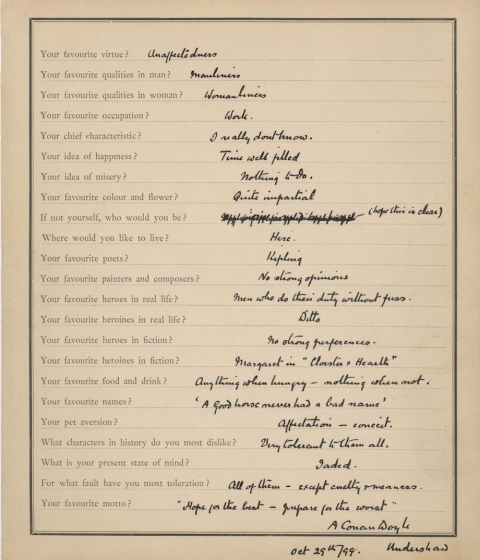
Note: click on the image for a larger version
Ah, the Proust Questionnaire: does it reveal everything about one’s personality, or nothing at all? Presumably Marcel Proust, who gave the questionnaire its name by filling it out so wholeheartedly, wouldn’t have cared either way. French interviewer Bernard Pivot must have seen some usefulness in it, since he applied its questions so regularly to guests on his literary television program Apostrophes that it gained the second name of “Pivot Questionnaire.” Open Culture readers know James Lipton also adapted a version on Inside the Actors Studio. (See our previous post here.) And now, thanks to archivists at the University of Texas at Austin’s Harry Ransom Center, we have Proust Questionnaire answers from one more luminary: Sir Arthur Conan Doyle, creator of Sherlock Holmes.
Not that Conan Doyle responds with quite so much style as does Proust. His favorite qualities in a man? Manliness. In a woman? Why, womanliness. His favorite food and drink? Anything when hungry or thirsty — nothing when not. Favorite activity? Work. This all has a certain utilitarian charm, but if you read the questionnaire itself, you also find the particular flavor of half-hidden wit that Conan Doyle’s readers would expect. But we care about his responses, as we care about Proust’s, because of all the other words they wrote. And lest we get caught up in questionnaires, let us not forget that Swann’s Way, the first volume of Proust’s In Search of Lost Time, turns one hundred this year.
via Slate
Related content:
Arthur Conan Doyle Discusses Sherlock Holmes and Psychics in a Rare Filmed Interview (1927)
Colin Marshall hosts and produces Notebook on Cities and Culture and writes essays on literature, film, cities, Asia, and aesthetics. He’s at work on a book about Los Angeles, A Los Angeles Primer. Follow him on Twitter at @colinmarshall.
Read More...The Making of John Mayer’s ‘Born & Raised’ Album Artwork, Captured in 18 Minute Short Film
This eighteen minute documentary takes you inside the work of David A. Smith, an English artist who specializes in “high-quality ornamental hand-crafted reverse glass signs and decorative silvered and gilded mirrors.” (Got that? You may want to read that last part again.) In something of a departure from earlier projects, Smith designed an ornate “turn-of-the-century, trade-card styled album cover” for John Mayer’s album Born & Raised. His work is meticulous and exacting. And this “Behind The Scenes” film, complete with commentary from Mayer and Smith, captures the artist’s process in loving detail. Now please sit back and enjoy.
Find us on Facebook, Twitter and Google Plus and we’ll make it easy to share intelligent media with your friends!
Read More...Visit the Museum of Endangered Sounds, and Experience a Blast from Technology’s Past
As gearheads go, Brendan Chilcutt’s a pretty sentimental guy, and not just because he signs his correspondence with “love.” In January, 2012, he founded the Museum of Endangered Sounds to keep outmoded technology’s most iconic noises from vanishing from the collective memory. Click on any image in the museum’s online collection to be transported in the Proustian sense.
Some of the exhibits—a manual typewriter, a rotary phone—were already amply preserved, thanks to a proliferation of cinematic appearances in their heyday.
Others might well have slipped away unnoticed, if not for Chilcutt’s curatorial efforts. Remember that number you could call to have a recorded voice inform you of the correct time? How about the static of an analog TV tuned to an empty station? The hum of a malfunctioning Discman, the chirp of a Tamagotchi…wait, what’s that I hear? The disconcerting whoosh of time speeding up?
Drown it out by activating all thirty exhibits at once. Let them sound their barbaric yawps simultaneously as the kids try to figure out what that racket is.
h/t goes to @sheerly
Related Content:
“Glitch” Artists Compose with Software Crashes and Corrupted Files
40 Great Filmmakers Go Old School, Shoot Short Films with 100 Year Old Camera
How Film Was Made: A Kodak Nostalgia Moment
Ayun Halliday is still trying to text on a cell phone from 2003
Read More...Drift: Passenger Shoots Striking Short Film Out of Airplane Window
Filmmaker Tim Sessler got a little bored on his flight from San Francisco to Salt Lake City, to Philadelphia. He says: “After reading through the in-flight magazine, the Sky Mall and the airplane security details from front to back, upside down and backwards, I felt it was the right moment to pull out my camera” and start taking aerial footage of the cross-country voyage. The camera? It’s a Canon 5d mk3 with a 24–105mm and Nikon 50mm 1.2 lens (Tim tells us). The challenge? To keep the camera stable, using his knee, the seat, the window, etc., “while avoiding any vibration that would create some nasty rolling-shutter-wobble.” A good deal more stabilization took place in post-production. When you’re done watching Drift, you can check out Sessler’s prior attempt at shooting aerial art here.
via Mefi
Read More...Watch David Bowie’s New Video for ‘The Stars (Are Out Tonight)’ With Tilda Swinton
This week David Bowie released the second single from his upcoming album, The Next Day. It’s called “The Stars (Are Out Tonight),” and the accompanying video (shown above) builds on Bowie’s lifelong exploration of androgyny.
Bowie is joined in the miniature film by actress Tilda Swinton, who plays his wife, and the models Andrej Pejic and Saskia De Brauw, who play a pair of young celebrities who mock and torment the aging couple. Swinton looks like Bowie, and Pejic and DeBrauw look like Bowie and Swinton.
The story “captures a twenty first century moment in its convergence of age, gender and the normal/celebrity divide,” according to a statement posted earlier this week on Bowie’s Facebook page. It was directed by the Italian-born filmmaker Floria Sigismondi, a prolific music video maker best known for her 2010 feature film, The Runaways.
The Next Day will be released on March 12. To learn more about it and to watch the first video from the album, see our post from last month, “David Bowie Celebrates 66th Birthday with First New Song in a Decade, Plus Vintage Videos.”
Related Content:
The Story of Ziggy Stardust: How David Bowie Created the Character that Made Him Famous
How “Space Oddity” Launched David Bowie to Stardom: Watch the Original Music Video From 1969
Backed by 157 Musicians, Beck Reimagines David Bowie’s 1977 Classic, “Sound and Vision”
Read More...Support Us
We're hoping to rely on loyal readers, rather than erratic ads. Please click the Donate button and support Open Culture. You can use Paypal, Venmo, Patreon, even Crypto! We thank you!

About Us

Open Culture scours the web for the best educational media. We find the free courses and audio books you need, the language lessons & educational videos you want, and plenty of enlightenment in between.
Advertise With Us

FREE UPDATES!
GET OUR DAILY EMAIL
Get the best cultural and educational resources on the web curated for you in a daily email. We never spam. Unsubscribe at any time.
FOLLOW ON SOCIAL MEDIA

Open Culture editor Dan Colman scours the web for the best educational media. He finds the free courses and audio books you need, the language lessons & movies you want, and plenty of enlightenment in between.
Advertise With Us

