“Joe Strummer’s London Calling”: All 8 Episodes of Strummer’s UK Radio Show Free Online
Iconic Clash frontman Joe Strummer passed away a little over ten years ago on December 22nd, 2002. He was 50 years old, and died too soon, leaving his family, friends, and fans reeling with shock and sadness. Strummer was the kind of rock star who could renounce fame and mean it, who escaped the London punk scene with integrity and health intact, and who was a larger-than-life humanitarian, yet also an approachable everyman. It’s all these qualities and, of course, the songwriting, the distinctive mumble and growl, the indelible image, and the writing and acting cred that have endeared him to a few generations of loyal admirers. In addition to all of the above, Joe Strummer was also a free-form radio DJ, playing an eclectic mix of classic punk, reggae, folk, jazz, afrobeat, and about a dozen other genres, all sequenced perfectly and introduced in his distinctive, asphalt baritone.
Strummer hosted his UK radio show, “Joe Strummer’s London Calling,” through 1998, then again in 2000–2001 (excerpt above). He played his share of Clash songs, as well as—in the later episodes—the occasional track from his last project, Joe Strummer & The Mescaleros.
But aside from the expected punk and reggae, there was no telling what he might cue up next; from the Balkan Folk of Emir Kusturica and The No Smoking Orchestra to the new wave rhumba of Zaire’s Thu-Zahina, Strummer had one hell of an eclectic collection, which should surprise no one who knows his work, but it’s still a joy to hear him spin his rollercoaster playlists.
And now, you can listen to him spin for eight hours straight if you like. All eight, one hour episodes of Strummer’s radio show are streaming free from PRX online radio. You can also download all eight episodes as podcasts, in two-parters, free on iTunes. And if it weren’t already your lucky day: a helpful gent named Zed has done the internet a favor and compiled playlists for each show, complete with links for every artist, from the most notable to most obscure. I would personally recommend taking a full day off and listening to every show straight through to the end. It may be the perfect way to honor the man who did his level best to bridge music and people from around the world with his working-class hero persona.
If you would like to support the mission of Open Culture, consider making a donation to our site. It’s hard to rely 100% on ads, and your contributions will help us continue providing the best free cultural and educational materials to learners everywhere. You can contribute through PayPal, Patreon, and Venmo (@openculture). Thanks!
Related Content:
Remembering The Clash’s Frontman Joe Strummer on His 60th Birthday
The Clash Live in Tokyo, 1982: Watch the Complete Concert
Mick Jones Plays Three Favorite Songs by The Clash at the Library
Josh Jones is a writer and musician. He recently finished a dissertation on land, literature, and labor.
Read More...Woody Allen’s Typewriter, Scissors and Stapler: The Great Filmmaker Shows Us How He Writes
Here’s a fascinating little window into the working habits of one our most brilliant and prolific artists. It’s from Robert B. Weide’s 2011 PBS film Woody Allen: A Documentary. In the scene above, Allen shows us the machine he has used for sixty years, the only typewriter he has ever owned: an early fifties manual Olympia SM‑3. “I bought this when I was sixteen,” Allen says. “It still works like a tank.”
Every comedy sketch, every screenplay, every essay ever written by Allen was composed on the one typewriter. When Weide asks Allen how he manages without the “cut-and-paste” functions of a word processor, he pulls out a pair of scissors and an old Swingline stapler. “It’s very primitive, I know,” says Allen, “but it works very well for me.”
“Allen’s persistence in using the one and only typewriter of his life, and in practicing cut-and-staple editing are certainly curious, quaint, idiosyncratic, even endearing,” writes Richard Brody in the Front Row blog at The New Yorker; “but they’re also proof on the wing of two of Allen’s lifelong qualities–untimeliness and hermeticism–as well as of the enduring struggle in his films between writing and experience.”
Related Content:
Woody Allen Answers 12 Unconventional Questions
Woody Allen Boxes a Kangaroo, 1967
Woody Allen Talks With the Reverand Billy Graham
Read More...‘Stairway to Heaven’: Watch a Moving Tribute to Led Zeppelin at The Kennedy Center
Last month the surviving members of Led Zeppelin went to Washington to receive laurels from the powerful at the 35th Annual Kennedy Center Honors. The most memorable moment, by far, came at the end of the event, when drummer Jason Bonham, son of the late Led Zeppelin drummer John Bonham, put on a bowler hat like the one his father used to wear and joined Ann and Nancy Wilson of Heart for a beautifully arranged and very moving rendition of “Stairway to Heaven.”
It was the grand finale of an evening of entertainment. Jimmy Page, Robert Plant and John Paul Jones sat watching from the balcony (alongside the other honorees and President Barack Obama and his wife Michelle) as a series of performers paid tribute to the legendary rock band. The full 20-minute segment included an introduction by comedic actor Jack Black (who called Led Zeppelin “the best band ever”) followed by tribute performances from the Foo Fighters, Kid Rock and Lenny Kravitz. But the scene that really brought down the house came at the end, when the young Bonham joined the Wilson sisters to perform Led Zeppelin’s signature song.
Ann Wilson’s singing was right on the mark. Under the most intimidating conditions, she gave a beautiful and faultless performance. “It was our honor to be asked to do it before an audience like that,” Wilson wrote afterward on the Heart Web site. “My main goal though was to please Jimmy Page, Robert Plant and John Paul Jones…especially Plant, since all these many years he has taught me so much about singing from the soul and has given me such a pleasure in his lyrics. What a high that night was. Never to be forgotten!”
Guitarist Shane Fontayne did an admirable job recreating Page’s famous solo at the climax of “Stairway to Heaven.” But the most stirring moment came when a heavenly choir–all wearing bowler hats to invoke the presence of the departed Bonham–joined Wilson in singing the final lines of the song. Looking down from the balcony, the surviving band members were visibly moved. Tears welled up in Plant’s eyes. It was a fitting tribute to a great band, and proof that rock and roll actually can–in some hands, anyway–age gracefully.
Related Content:
President Obama Pays Tribute to Led Zeppelin in Washington D.C.
Jimmy Page Tells the Story of Kashmir
Jimmy Page and Robert Plant Reunite in Exotic Marrakesh, 1994
Read More...Author Gary Shteyngart Reveals Why He Willingly Blurbs His Brains Out
If you’re an author of literary fiction, you’d do well to shoot fellow author Gary Shteyngart an advance copy of that soon-to-be-published masterpiece you’ve got in the pipeline. He won’t just love the book, he’ll blurb it, thus telegraphing your insider status to the establishment and readers in the know. It’s a far from an exclusive club. As author Levi Asher notes in the video above, Shteyngart’s the sort of mensch who willingly blurbs his friends. Also friends of friends. Ditto strangers. (Former stranger Karen Russell wonders if perhaps some agent-deployed fruit basket was responsible for garnering her some of Shteyngart’s “swami magic”.)
The insouciant quality of the typical Shteyngart endorsement is not intended to telegraph any insincerity on his part. His mission is securing readers for the sort of titles indie bookstores hold dear, and in order for that mission to succeed, he has to generate blurbs by the bushel. He may not get to the end of every volume he champions, but he makes it deep enough to get a general sense that such a thing might be pleasurable.
His highly public willingness to clamor aboard other authors’ bandwagons has been described as both promiscuity and performance art. It has inspired a tumblr, and now the tongue-in-cheek mini-documentary above. Narrated by Jonathan Ames, it features a cavalcade of grateful New York City-based lit stars, gamely striving to exude the sort of devil-may-care buoyancy at which their hero excels.
Thanks to Edward C. for sending this along.
Related Content:
The Book Trailer as Self-Parody: Stars Gary Shteyngart with James Franco Cameo
- Ayun Halliday’s best known book was blurbed by Stephen Colbert.
Read More...Previously Unreleased Jimi Hendrix Recording, “Somewhere,” with Buddy Miles and Stephen Stills
Because it’s Friday, we have a treat for you: a recently unearthed take of Jimi Hendrix ripping through a song called “Somewhere,” with Band of Gypsies drummer Buddy Miles and Stephen Stills (of CSNY) on bass. Released last November to mark the 70th anniversary of Hendrix’s birth, this track will be included on a 12-song album of previously unreleased Hendrix recordings from 1968–69 called People, Hell & Angels, coming in early March.
“Somewhere” has appeared before, on the 2000 box-set moneymaker The Jimi Hendrix Experience and a hit-and-miss 2003 double-disc of cuts called Axis Outtakes (culled from the Axis: Bold as Love Sessions). The previous release, however, was a different take, a blues-rock demo made prior to Electric Ladyland. Recorded early in 1968, with Mitch Mitchell adding drums in ’71, two years after Hendrix’s death, the other version is nothing to write home about, frankly, with a definite demo feel—exploratory, but somewhat uninspiring production, although the ideas are there (listen to it here).
The version above is another animal: it bursts out of the gate in full breakdown, then the drums recede, Hendrix rides the descending rhythm line in a long, expectant pause, and when the rhythm kicks back in, he wails and wahs his way into a tight verse, punctuated with bursts of his blues fills and Miles’s confident snare cracks. Stephen Stills’ bass playing holds up to anything Noel Redding or Billy Cox contributed to Hendrix’s ensembles. Between each verse, Hendrix explodes into the wild solo runs he’s known for. It’s a real gem, and the lyrical content perfectly captures the street-level, and Southeast Asia-ground-level, hostility, fear, and frustration of the late sixties:
Oh uh,
I see fingers, hands and shades of faces,
Reachin up and not quite touchin the promised land,
I hear pleas and prayers and a desperate whisper sayin,
Whoa Lord, please give us a helpin hand,
Yeah yeah
Way down in the background,
I can see frustrated souls of cities burnin,
And all across the water vapor,
I see weapons barkin out the stamp of death,
And up in the clouds I can imagine UFO’s jumpin themselves,
Laughin they sayin,
Those people so uptight, they sure know how to make a mess
Back in the saloon my tears mix and mildew with my drink,
I can’t really tell my feet from the stones on the floor,
But as far as I know, they may even try to wrap me up in cellophane and sell me
Brothers help me, and dont worry about lookin at the storm
Yeah yeah yeah yeah yeah
Hendrix was right. They did wrap him up and sell him.
Josh Jones is a writer and musician. He recently completed a dissertation on land, literature, and labor.
Read More...Tim Burton Shoots Two Music Videos for The Killers
Nobody could ever accuse Tim Burton of underproductivity. The past decade has seen him not only direct seven feature films but step into the music video game as well. Most directors inclined to do music videos begin there in order to transition to full-fledged movies, but Burton has, to put it mildly, never hewn to tradition. At the top of this post, you can watch his very first music video, produced in 2006 for the song “Bones” by post-punk revivalists The Killers. Featuring model Devon Aoki and 90210 star Michael Steger, the video shows off Burton’s sensibilities both by plundering the history of ickily thrilling and slyly transgressive cinema — pieces of Lolita, Creature from the Black Lagoon, and Jason and the Argonauts appear — and by making much thematic and aesthetic use of the human skeleton. Most of its action takes place in an early-sixties desert drive-in theater gone to seed, which seems to me the ideal venue in which to screen Burton’s features.
The imaginative auteur’s second and most recent music video came out just this past September. Working again in the service of The Killers, Burton dreamed up another piece of haunted whimsy for their song “Here With Me”. In it, a black-clad, serious-eyed adolescent boy — a Burtonian archetype if ever there was one — steals and makes a companion of a wax mannequin modeled after his favorite B‑movie actress. Fans can thrill to the fact that, to fill the role of this B‑movie actress, in comes Winona Ryder, star of the beloved Burton collaborations Beetlejuice and Edward Scissorhands. Ryder has led a career filled with its share of both B- and A‑movies, but to which of those levels do Burton’s rise? Neither, it would seem, or perhaps both at once, or, even more likely, to the liminal state in between — a hard-to-define psychological space, both Burton’s boosters and detractors would agree, of his very own.
Related content:
Tim Burton: A Look Inside His Visual Imagination
Tim Burton’s The World of Stainboy: Watch the Complete Animated Series
Vincent: Tim Burton’s Early Animated Film
Six Early Short Films By Tim Burton
Colin Marshall hosts and produces Notebook on Cities and Culture and writes essays on literature, film, cities, Asia, and aesthetics. Follow him on Twitter at @colinmarshall.
Read More...The Making of The Blues Brothers: When Belushi and Aykroyd Went on a Mission for Comedy & Music
Before you close out the week, you’ll want to spend some time with Ned Zeman’s piece in Vanity Fair, “Soul Men: The Making of The Blues Brothers.” It brings us back to the 1970s, when John Belushi and Dan Aykroyd labored to bring their characters, Jake and Elwood Blues, onto the national stage. Despite being the stars of Saturday Night Live, Belushi and Aykroyd had to cajole the show’s producer Lorne Michaels into letting them perform as The Blues Brothers on late night TV. First, Michaels let them warm up SNL audiences before shows. Then, in 1976, Michaels let the Blues Brothers make their first live appearance. But there was a rub. They had to dress as Killer Bees and not as “John Lee Hooker gone Hasidic.” Only in April, 1978, did Jake and Elwood make their true SNL debut as a musical act (see below).
Zeman’s piece focuses mostly on the next chapter in the history of The Blues Brothers — the making of the now legendary film. That had its own set of difficulties. Big budgets, big ambitions and big coke addictions, all threatening to derail the project. Down to the very last moment, the film looked like a guaranteed financial bust, to the tune of $27 million. But, of course, that’s not how things turned out.
Above, you can watch The Making of The Blues Brothers, a 2005 documentary that came out with the 25th anniversary re-release of the comic masterpiece. Below, watch their SNL debut.
via Kottke
Related Content:
John Belushi’s Improvised Screen Test for Saturday Night Live (1975)
William S. Burroughs on Saturday Night Live, 1981
Read More...Louis Armstrong and His All Stars Live in Belgium, 1959: The Full Show
Duke Ellington once said of Louis Armstrong, “He was born poor, died rich, and never hurt anyone on the way.”
The grandson of slaves, Armstrong grew up in the poorest neighborhood of New Orleans. As a child he was fascinated with the marching bands that played in funeral processions. At the age of seven he went to work for a junk dealer. He would ride on the junk wagon and, as he recalled later, toot an old tin horn “as a call for old rags, bones, bottles or anything that the people and the kids had to sell.” When the young boy saw an old cornet in the window of a pawn shop, he asked his boss to loan him the five dollars to buy it. He learned to play the instrument in the Home for Colored Waifs, where he was sent for delinquency. The gifted youngster soon caught the attention of the pioneering jazz cornetist Joe “King” Oliver, who became his mentor. In 1922 Armstrong joined Oliver in Chicago to play in his famous Creole Jazz Band. He was 21 years old. Before long Armstrong set out on his own, and in 1925 began recording his legendary “Hot Five” sessions that established him as a virtuoso and changed the course of jazz history. Armstrong’s horn playing and singing made an enormous impact on 20th century music. In 2006, Wynton Marsalis wrote:
Louis Armstrong’s sound transcends time and style. He’s the most modern trumpet player we’ve ever heard and the most ancient…at the same time. He has light in his sound. It’s big and open with a deep spiritual essence–a sound closest to the Angel Gabriel. You Can’t practice to get Louis Armstrong’s sound. It’s something within him that just came out. Rhythmically, he’s the most sophisticated player we’ve ever produced. He places notes unpredictably with such great timing–always swinging, always coordinated–with overwhelming transcendent power.
Marsalis’s comments are from the foreward to the Jazz Icons DVD Louis Armstrong: Live in ’59. The concert, see Part 1 above, was filmed in March of 1959 in Antwerp, Belgium. (Here are the remaining parts: Part 2, Part 3, Part 4, and Part 5.) It may be the only full Armstrong concert captured on film. By the time it was made, Armstrong was firmly established as a cultural icon. He was touring Europe with the All Stars, a group he formed in 1947. The lineup at Antwerp featured Armstrong on trumpet and vocals, Michael “Peanuts” Hucko on clarinet, Trummy Young on trombone, Billy Kyle on piano, Mort Herbert on bass, Danny Barcelona on drums and Velma Middleton on vocals for “St. Louis Blues” and “Ko Ko Mo.” Here’s the complete set list:
- When it’s Sleepy Time Down South
- (Back Home Again in) Indiana
- Basin Street Blues
- Tiger Rag
- Now You Has Jazz
- Love is Just Around the Corner
- C’est si bon
- Mack the Knife
- Stompin’ at the Savoy
- St. Louis Blues
- Ko Ko Mo (I Love You So)
- When the Saints Go Marching In
- La Vie en rose
“By the time of the All-Stars performance in Belgium,” writes Rob Bowman in the liner notes, “they were a well-oiled machine, performing similar sets night after night.” But three months later, Armstrong suffered a heart attack in Spoleto, Italy, and his pace slowed down. The Antwerp film captures Armstrong when he was still going strong. It showcases the craft of a consummate entertainer from the old school, who strove always to please people. As Bowman writes:
Coming of age as a professional musician at the dawn of jazz recording, musicians of Armstrong’s generation thought of themselves, first and foremost, as entertainers. Great art might occur in the process, but at the end of the day it was their ability to entertain that guaranteed them an audience and a living year after year. The roots of such entertainment for African American musicians of Armstrong’s generation were minstrelsy and vaudeville. To that end, Armstrong comes across as a larger-than-life character, clowning, grinning from ear to ear, rolling his eyes and mugging for the audience throughout the show. That meant shtick like Armstrong and Young’s parading at the end of “Tiger Rag,” the cornball humor of “Now You Has Jazz” and the constant guffawing and drawn out cries of “Ahh” heard at the end of tunes were an integral part of his show. While some contemporary critics accused Armstrong of being an Uncle Tom, they simply didn’t get it. This was a performance aesthetic from an earlier point in time, and Armstrong was a master.
Related content:
10 Great Performances From 10 Legendary Jazz Artists: Django, Miles, Monk, Coltrane and More
Read More...Trains and the Brits Who Love Them: Monty Python’s Michael Palin on Great Railway Journeys
What is it with Britons and trains, anyway? Hardly just the title of collection of Irvine Welsh’s stories of heroin and degradation, the term “trainspotting” actually refers to a real, and fervently pursued hobby; trainspotters exist, just as do birdwatchers and sports fans. In terms of obsession with the design and operational minutiae of their own trains, Britain falls second only to the even more densely rail-laden Japan. But we Americans, possessed of a train system few would call robust, can’t quite bring ourselves to believe it. Perhaps we just need to hear it from the mouth of Michael Palin, writer, comedian, television host, Python — and avowed trainspotter. Most of Palin’s fans know him first through his characters in the Flying Circus: the shopkeeper, Luigi Vercotti, Ken Shabby, and the most memorable Gumbys, to name but a few. But some of us know him best as the central traveler of the globe-spanning television documentaries in which he’s starred since 1989. Around the World in Eighty Days, Pole to Pole, Full Circle, Michael Palin’s Hemingway Adventure, Sahara, Himalaya, New Europe, and now Brazil with Michael Palin. Here we have a man who knows how best to get from point A to point Z, and all in between.
But before all of those shows came Palin’s first episode of the BBC’s Great Railway Journeys, a long-running series whose very existence speaks to the vitality of Britain’s train-related enthusiasm. 1980’s “Confessions of a Trainspotter”, viewable at the top of this post, follows Palin as he makes his gleeful way from London to Kyle of Lochalsh in northwestern Scotland on a series of trains fast and slow, long and short, old and new. This established him as a television traveler; fourteen years later, he returned to the program for “Derry to Kerry”, where he traced his roots along “that best-kept of all transport secrets, the Irish railway line.” “Is it just us who are like this?” Palin asks. “The British, I mean. Are there any trainspotters in Sicily? Do Belgians go misty-eyed with the thought of seeing the 12:16 to Antwerp? Do Swedes save up all year for a Hasselblad to photograph a Stockholm to Gothenburg coal train cresting a 1‑in-57 gradient?” Perhaps the most definitive answer comes from a fellow rail fan he meets mere minutes later. Palin asks the man if he has always loved trains. “Very nearly,” he replies. “There was a short period when I became interested in girls. Eventually, I got married and went back to railways.”
Related content:
America Needs More Palin … Michael Palin, That Is
An Epic Journey on the Trans-Siberian Railroad
Colin Marshall hosts and produces Notebook on Cities and Culture and writes essays on literature, film, cities, Asia, and aesthetics. Follow him on Twitter at @colinmarshall.
Read More...Jack Kerouac’s 30 Beliefs and Techniques For Writing Modern Prose
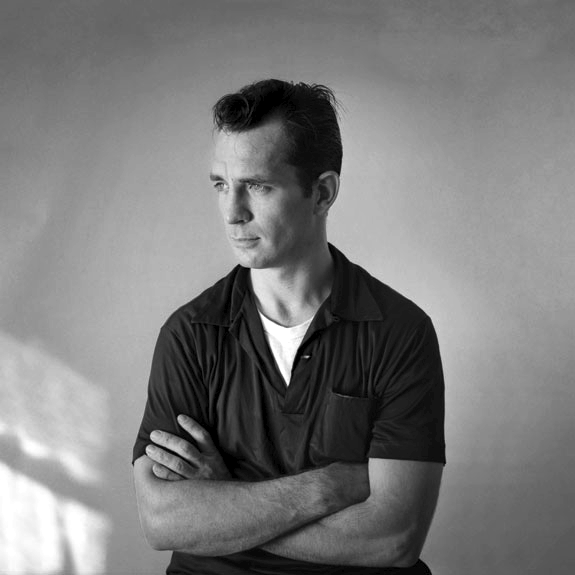
Image by Tom Palumbo, via Wikimedia Commons
Jack Kerouac is the patron saint of every starry-eyed, born-too-late, wanderlusty hipster scribe who falls in love with the poetry and visionary power of their own inner voice. I may be old and crusty now, but I once fell under Kerouac’s spell and spilled my guts unedited into long rambling prose-poems on existential bliss and tantric Buddhist bebop. Then later I realized something: Kerouac’s Kerouac was very good. My Kerouac? Not so much. You gotta do your own thing. I grew out of Kerouac’s influence and didn’t take much of him with me. Then I realized that he wasn’t always good. That he’d made the mistake of every self-proclaimed genius and stopped letting people tell him “no.” He said so himself, in a 1968 Paris Review interview with Ted Berrigan in which he admitted that all his editors since the great Malcolm Cowley, “had instructions to leave my prose exactly as I wrote it.” Now I know this was part of his method, but sometimes the later Kerouac needed a good editor.
It is a delicate dance, between the inner voice and outer editor—whether that taskmaster is oneself or someone else—and the great attraction to Kerouac is his damn-it-all attitude toward tasks and masters. His improvisational prose is the point (I’m sure someone will tell me I missed it).
Kerouac doesn’t just write about freedom, he writes freedom, and for most of us tight-assed worrywarts, his voice is healing balm for our writer’s inner excoriations. 1957’s On the Road is an incredible experiment in process as product (it’s not only a novel, it’s an art object)–a three-week burst of non-stop, uninhibited creativity, so legend has it, and unequaled in his lifetime. And yet despite his aversion to tidiness, Kerouac, like almost every writer, made lists; one in particular is thirty guidelines he called “Belief & Technique for Modern Prose.” I’ve excerpted what I think are ten highlights below, either because they seem profoundly beautiful or profoundly silly, but in a way that only Kerouac the holy fool could get away with. This is not “advice for writers.” It’s a catalog of states of being.
1. Scribbled secret notebooks, and wild typewritten pages, for yr own joy
2. Submissive to everything, open, listening
3. Try never get drunk outside yr own house
4. Be in love with yr life
5. Something that you feel will find its own form
6. Be crazy dumbsaint of the mind
7. Blow as deep as you want to blow
8. Write what you want bottomless from bottom of the mind
9. The unspeakable visions of the individual
10. No time for poetry but exactly what is
11. Visionary tics shivering in the chest
12. In tranced fixation dreaming upon object before you
13. Remove literary, grammatical and syntactical inhibition
14. Like Proust be an old teahead of time
15. Telling the true story of the world in interior monolog
16. The jewel center of interest is the eye within the eye
17. Write in recollection and amazement for yourself
18. Work from pithy middle eye out, swimming in language sea
19. Accept loss forever
20. Believe in the holy contour of life
21. Struggle to sketch the flow that already exists intact in mind
22. Dont think of words when you stop but to see picture better
23. Keep track of every day the date emblazoned in yr morning
24. No fear or shame in the dignity of yr experience, language & knowledge
25. Write for the world to read and see yr exact pictures of it
26. Bookmovie is the movie in words, the visual American form
27. In praise of Character in the Bleak inhuman Loneliness
28. Composing wild, undisciplined, pure, coming in from under, crazier the better
29. You’re a Genius all the time
30. Writer-Director of Earthly movies Sponsored & Angeled in Heaven
If you would like to support the mission of Open Culture, consider making a donation to our site. It’s hard to rely 100% on ads, and your contributions will help us continue providing the best free cultural and educational materials to learners everywhere. You can contribute through PayPal, Patreon, and Venmo (@openculture). Thanks!
Josh Jones is a writer and musician. He recently completed a dissertation on land, literature, and labor.
Related Content:
Jack Kerouac Lists 9 Essentials for Writing Spontaneous Prose
Read More...Support Us
We're hoping to rely on loyal readers, rather than erratic ads. Please click the Donate button and support Open Culture. You can use Paypal, Venmo, Patreon, even Crypto! We thank you!

About Us

Open Culture scours the web for the best educational media. We find the free courses and audio books you need, the language lessons & educational videos you want, and plenty of enlightenment in between.
Advertise With Us

FREE UPDATES!
GET OUR DAILY EMAIL
Get the best cultural and educational resources on the web curated for you in a daily email. We never spam. Unsubscribe at any time.
FOLLOW ON SOCIAL MEDIA

Open Culture editor Dan Colman scours the web for the best educational media. He finds the free courses and audio books you need, the language lessons & movies you want, and plenty of enlightenment in between.
Advertise With Us


