Watch Orson Welles’ First Ever Film, Directed at Age 19
“It’s nothing at all. Absolutely nothing. It was a joke. I wanted to make a parody of Jean Cocteau’s first film. That’s all. We shot it in two hours, for fun, one Sunday afternoon. It has no sort of meaning.”–Orson Welles
The Hearts of Age may have indeed been a lark when it was shot in 1934, but given that one of the two teenagers went on to direct Citizen Kane seven years later, no doubt it’s worth a second look.
Like all things Welles, his 19-year-old life was much more fantastic than most high school grads. Though he and school chum William Vance shot the film at their alma mater, the Todd School in Woodstock, Illinois, Welles had graduated three years earlier. According to Senses of Cinema, Welles
had spurned a scholarship to Harvard University, visited Ireland on a sketching tour only to talk his way into performing for the Dublin Gate Theatre, written detective stories for pulp magazines, and travelled through London, Paris, the Ivory Coast, Morocco and Seville, where he spent an afternoon as a professional bullfighter. After returning to America in 1933, introductions to Thornton Wilder and Alexander Wolcott led to a position in Katherine Cornell’s touring repertory company. Welles toured with the Cornell company from November 1933 to June 1934, appearing in three plays and making his New York debut as Tybalt in Romeo and Juliet.
Back in Woodstock to sponsor a theater festival at the school, Welles and Vance borrowed a camera from their old principal and shot this eight minute short.
William Vance, Welles’ friend and co-director, kept the only copy until he donated it to the Greenwich Public Library, where film historian and writer Joseph McBride discovered it in 1969. McBride then wrote about it in Film Quarterly and the secret juvenilia of Welles was out of the closet. (“Why did Joe have to discover that film?” Welles was quoted as telling his cameraman).
Never entered into copyright, it’s a public domain film and so has been available on various platforms for years. (I saw it in the ‘90s as part of a “before they were famous” short film festival with student work by Lynch, Scorsese, and Spielberg).
The short indeed looks like a parody of surrealist film, a bit like Jean Cocteau’s Blood of a Poet as Welles intended, but with a bit of René Clair’s Entr’Acte and some good ol’ Eisensteinian montage thrown in.
Welles appears in heavy stage makeup as a rich, older man in a top hat and cane, looking not too far from the elderly Charles Foster Kane. His then girlfriend and future first wife Virginia Nicholson plays an old hag who rides forlornly back and forth on a bell. There’s a clown in blackface played by Paul Edgerton, an Indian in a blanket (co-director William Vance in a cameo) and a Keystone cop, which some websites say is also Nicholson. But Charles “Blackie” O’Neal is also credited as a performer without a role and he indeed may be the actor playing the Keystone Cop. (O’Neal, by the way, would later be father to Ryan O’Neal.)
Although he dismissed the film, Welles’ preoccupations with death are here, right at the beginning of his career, with suicides, coffins, skulls, and gravestones featuring prominently. And though it’s no masterpiece and honestly a bit of a mess, it shows a director interested in experimenting with film, with humor, and the wonders of makeup.
Related Content:
Ted Mills is a freelance writer on the arts who currently hosts the artist interview-based FunkZone Podcast. You can also follow him on Twitter at @tedmills, read his other arts writing at tedmills.com and/or watch his films here.
Read More...205 Big Thinkers Answer the Question, “What Scientific Term or Concept Ought to Be More Widely Known?”

Image by Benjamin Reay, via Flickr Commons
It’s a new year, which means it’s time for the Edge.org to pose its annual question to some of the world’s finest minds. The 2017 edition asks, “What scientific term or concept ought to be more widely known?” And the question comes prefaced by this thought:
Richard Dawkins’ “meme” became a meme, known far beyond the scientific conversation in which it was coined. It’s one of a handful of scientific ideas that have entered the general culture, helping to clarify and inspire.
Of course, not everyone likes the idea of spreading scientific understanding. Remember what the Bishop of Birmingham’s wife is reputed to have said about Darwin’s claim that human beings are descended from monkeys: “My dear, let us hope it is not true, but, if it is true, let us hope it will not become generally known.”
So what established scientific idea should we try to get out there? What concept should, at all costs, see the light of day? The replies — 205 in total — feature thoughts by Richard Dawkins, of course, who’d have us learn more about the notion of “Genetic Book of the Dead.” You will also find selections by Brian Eno (“Confirmation Bias”), Jared Diamond (“Common Sense”), Janna Levin (“The Principle of Least Action”), Steven Pinker (“The Second Law of Thermodynamics”) and more. Access the complete collection of responses here.
If you would like to support the mission of Open Culture, consider making a donation to our site. It’s hard to rely 100% on ads, and your contributions will help us continue providing the best free cultural and educational materials to learners everywhere. You can contribute through PayPal, Patreon, and Venmo (@openculture). Thanks!
Read More...Carrie Fisher’s Long Career as a Writer, Screenwriter, and Hollywood Fixer: “I’m a Writer” First and Foremost
By now the news of Carrie Fisher’s death has hit hard all over the world. It’s true that for an entire generation of people, her breakout role at 19 as Princess Leia in the original Star Wars trilogy has made her a sci-fi icon and a childhood crush—both roles she longed to escape. Tribute after tribute on social media and elsewhere reminded us almost immediately after Tuesday’s announcement that her life and work have had a much wider impact, even on people who have never even seen a Star Wars film.
Fisher’s unabashedly candid public conversations about her personal struggles with substance abuse and bipolar disorder made her a powerful advocate for others who felt ashamed to talk about these too-often-taboo subjects and often too ashamed to seek help. Much like George Michael, another celebrity mourned by millions this holiday season, Fisher refused to be shamed into silence or to capitulate to bullies and bigots. Instead she practically bloomed with earthy charm and wit as she co-opted tabloid character assassination and turned it into her own form of autobiographical art and therapeutic outreach.
Her return to the rebooted Star Wars franchise last year as the wise, aging General Leia Organa elevated the conversation about older women in Hollywood, after her response to some vicious comments about her looks made her haters look small, mean, and stunted. Fisher’s talent for Oscar Wilde-worthy aphorisms that sliced right through layers of insufferable bullshit also led to one of her most successful career stints, as a writer, script doctor, and Hollywood fixer during a “long, very lucrative episode,” as she told Newsweek in a 2008 interview. (In true Carrie Fisher fashion, she brought these life experiences to an Emmy-nominated guest turn on an episode of 30 Rock as her funniest character, Rosemary Howard.)
It’s rumored that Fisher revised her lines in George Lucas’ notoriously wordy Star Wars scripts. (Although one image of Empire Strikes Back edits purported to be in her hand actually contains revisions by the film’s director Irvin Kershner.) But her formal screenwriting career began in 1990, when she adapted her bestselling 1987 autobiographical novel, Postcards from the Edge, into the screenplay for a Meryl Streep-starring film. The project led to rewriting work on high-profile comedies throughout the next decade. In addition to a credit for one of those unwieldy Lucas scripts for The Phantom Menace in 1999, Fisher helped rework films like Hook, Sister Act, Made in America, So I Married an Axe Murderer, The Wedding Singer, and several more.
Always a fiercely outspoken critic of the way Hollywood treats women, Fisher fought to make female characters more three-dimensional. In a WebMD interview, she was asked, “What does it take to heal bad dialogue?” Her pithy answer: “Make the women smarter and the love scenes better.” As a peacemaker for troubled productions, however, she often advised women actors to use diplomacy—with her own spin on the concept. When Whoopi Goldberg feuded with Disney’s Jeffrey Katzenberg, for example, Fisher advised, “Send Jeffrey a hatchet and say, ‘Please bury this on both our behalfs.’” Goldberg thought it over, and “the next day Katzenberg received his hatchet. Within a few days a token of Katzenberg’s respect arrived at her front door: two enormous brass balls.”
Stories like this one, and many more uproarious and often personally self-destructive episodes, formed the basis for Fisher’s autobiographical bestsellers, including her memoir Wishful Drinking, which also became a one-woman Broadway show, then an HBO special (see an excerpt at the top). She has always won over critics as an actress, and she made a wry kind of peace with her eternal fame as Princess Leia, imbuing the character with renewed gravitas and sensitivity in the year before her death. But she did not see herself principally as an actress. “I’m a writer,” she told WebMD. Asked whom she’d choose to share “confined quarters” with from history, she answered—with her winning combination of disarming sincerity and winking self-awareness—“Samuel Taylor Coleridge. He was manic-depressive, too.”
Related Content:
Watch a Young Carrie Fisher (RIP) Audition for Star Wars (1975)
Watch the Very First Trailers for Star Wars, The Empire Strikes Back & Return of the Jedi (1976–83)
Josh Jones is a writer and musician based in Durham, NC. Follow him at @jdmagness
Read More...When Ayn Rand Collected Social Security & Medicare, After Years of Opposing Benefit Programs
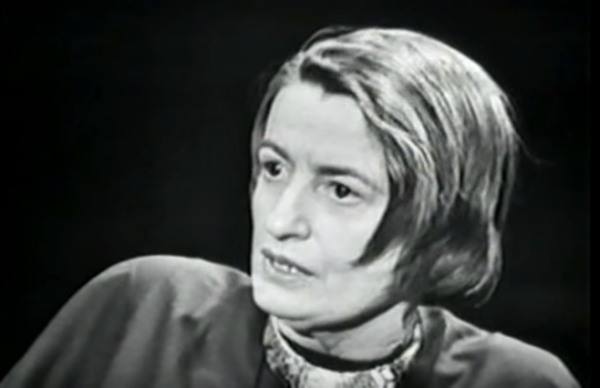
Image via YouTube, 1959 interview with Mike Wallace
A robust social safety net can benefit both the individuals in a society and the society itself. Free of the fear of total impoverishment and able to meet their basic needs, people have a better opportunity to pursue long-term goals, to invent, create, and innovate. Of course, there are many who believe otherwise. And there are some, including the acolytes of Ayn Rand, who believe as Rand did: that those who rely on social systems are—to use her ugly term—“parasites,” and those who amass large amounts of private wealth are heroic supermen.
Rand disciple Alan Greenspan, for example, initiated the era of “Reaganomics” in the early 1980s by engineering “an increase in the most regressive tax on the poor and middle class,” writes Gary Weiss, “the Social Security payroll tax—combined with a cut in benefits.” For Greenspan, “this was no contradiction. Social Security was a system of altruism at its worst. Its beneficiaries were looters. Raising their taxes and cutting their benefits was no loss to society.”
One problem with Rand’s reasoning is this: whether “parasite” or titan of industry, none of us is anything more than human, subject to the same kinds of cruel twists of fate, the same existential uncertainty, the same illness and disease. Suffering may be unequally distributed to a great degree by human agency, but nature and circumstance often have a way of evening the odds. Rand herself experienced such a leveling effect in her retirement. After undergoing surgery in 1974 for lung cancer caused by her heavy smoking, she found herself in straitened circumstances.
Two years later, she was paired with social worker Evva Pryor, who gave an interview in 1998 about their relationship. “Rarely have I respected someone as much as I did Ayn Rand,” said Pryor. When asked about their philosophical disagreements, she replied, “My background was social work. That should tell you all you need to know about our differences.” Pryor was tasked with persuading Rand to accept Social Security and Medicare to help with mounting medical expenses.
I had read enough to know that she despised government interference, and that she felt that people should and could live independently. She was coming to a point in her life where she was going to receive the very thing she didn’t like.… For me to do my job, she had to recognize that there were exceptions to her theory.… She had to see that there was such a thing as greed in this world.… She could be totally wiped out by medical bills if she didn’t watch it. Since she had worked her entire life and had paid into Social Security, she had a right to it. She didn’t feel that an individual should take help.
Finally, Rand relented. “Whether she agreed or not is not the issue,” said Pryor, “She saw the necessity for both her and [her husband] Frank.” Or as Weiss puts it, “Reality had intruded upon her ideological pipedreams.” That’s one way of interpreting the contradiction: that Rand’s philosophy, Objectivism, “has no practical purpose except to promote the economic interests of the people bankrolling it”—the sole function of her thought is to justify wealth, explain away poverty, and normalize the sort of Hobbesian war of all against all Rand saw as a societal ideal.
Rand taught “there is no such thing as the public interest,” that programs like Social Security and Medicare steal from “creators” and illegitimately redistribute their wealth. This was a “sublimely enticing argument for wealthy businessmen who had no interest whatever in the public interest.… Yet the taxpayers of America paid Rand’s and Frank O’Connor’s medical expenses.” Randians have offered many convoluted explanations for what her critics see as sheer hypocrisy. We may or may not find them persuasive.
In the simplest terms, Rand discovered at the end of her life that she was only human and in need of help. Rather than starve or drop dead—as she would have let so many others do—she took the help on offer. Rand died in 1982, as her admirer Alan Greenspan had begun putting her ideas into practice in Reagan’s administration, making sure, writes Weiss, that the system was “more favorable to the creators and entrepreneurs who were more valuable to society,” in his Randian estimation, “than people lower down the ladder of success.” After well over three decades of such policies, we can draw our own conclusions about the results.
Related Content:
Ayn Rand Helped the FBI Identify It’s A Wonderful Life as Communist Propaganda
Free Audio: Ayn Rand’s 1938 Dystopian Novella Anthem
In Her Final Speech, Ayn Rand Denounces Ronald Reagan, the Moral Majority & Anti-Choicers (1981)
Flannery O’Connor: Friends Don’t Let Friends Read Ayn Rand (1960)
Josh Jones is a writer and musician based in Durham, NC. Follow him at @jdmagness
Read More...Techie Working at Home Creates Bigger Archive of Historical Newspapers (37 Million Pages) Than the Library of Congress
“Real news, fake news, who cares, it’s all the same, am I right?”
… Not to make light of an existential crisis in journalism and the public trust—a disturbing development. Cynicism threatens to erode the very foundations of… well, ring your own alarm bell. Perhaps it’s time we (re)drew some hard lines around what we mean by the word “news.”
How to do that? I leave it to the experts—professors of journalism, reporters and archivists and historians who do the hard work of constructing genealogies and taxonomies of news, discovering its mutations and dead ends.
Journalism libraries around the country fulfill the needs of these scholars, as does the Library of Congress. But if you really want to dig into a comprehensive collection—one that bests even the august Federal government library (sort of)—you’ll need to visit the website of one Tom Tryniski, private citizen, retired “computer expert,” writes Jim Epstein at Reason, and dedicated amateur, “working alone.”
This being Reason, the preserve of “free minds and free markets,” you can expect a good bit of crowing about the entrepreneurial spirit of Tryniski’s accomplishment—an archive of 37,439,000 historic newspaper pages from the U.S. and Canada, “orders of magnitude bigger and more popular than one created by a federal bureaucracy with millions of dollars to spend.” The video above says it succinctly in a tagline: “Amateur beats gov’t at digitizing newspapers.”
Should you take an interest in what Tryniski—the sole employee of Old Fulton New York Postcards—spends, Epstein provides a full accounting of the site’s impressively meager operating budget. Should you wonder where the LoC’s money goes, and why it uses so many more resources than one retiree, you may wish to do your own comparison between Tryniski’s site and the Feds’ online news archive, Chronicling America. (And maybe pay their place a visit in the flesh.) There’s more to a library than numbers of pages and views.
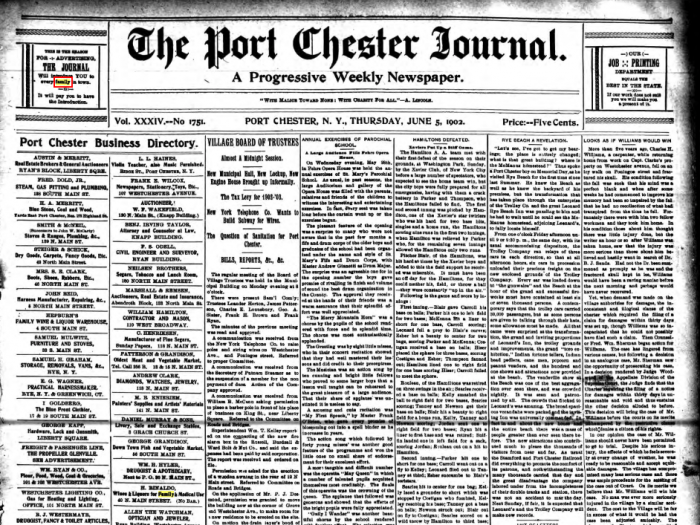
In some ways, it’s not a fair comparison. Tryniski may be a computer expert, but he’s not a web designer (or he’s an ornery, old-school purist). His site (last updated in 2014), with its frames and heavy use of Flash and GIFs, reflects the web’s anarchic 90s heyday. And where the LoC’s site chronicles all of America, Tryniski’s mostly sticks to New York, with local papers like The Port Chester Journal (above) represented heavily.
That said, the site’s search functions are much cooler than those of glossier competitors, with options for “fuzzy searching,” “phonic searching” (for those of us who can’t spell), “and “user-defined synonyms.” Tryniski also knows his way around microfilm and a microfilm scanner, despite (we’re expressly told for some reason in the video and Epstein’s article) his being “a high school graduate.”
In this triumph of the everyman story, however, Tryniski does not introduce his own collection with fulminations of the “old man shakes fist at” variety. Instead he describes his collection as a means of time travel. “It’s the day-to-day life,” he says, “that you could not imagine today. Reading the actual newspaper seems to bring it back into current context. People… sit there and it’s like, they move back into that time, and it’s like they’re living in the same time as their grandparents and great-grandparents.”
Nobody needs to fix journalism, libraries, or federal spending to have this experience, and it’s one everyone should have—whether by traveling through the pages of old newspapers or a family trove of photos and letters. History can seem like little more than a story we tell ourselves about the past, but the primary documents have tales to tell that we could never imagine.
Learn more about Tryniski’s collection at Reason, and visit the quirky, deceptively fulsome Old Fulton NY Post Cards (named as such because the site began as a scanned collection of postcards from Tryniski’s hometown of Fulton, NY). You’ll find in its charmingly clunky environs a fascinating repository of vintage news and photos. And remember, “If you did not read about it on Old Fulton NY Post Cards, IT DID NOT HAPPEN!!!”
Related Content:
From the Annals of Optimism: The Newspaper Industry in 1981 Imagines its Digital Future
Archive of Hemingway’s Newspaper Reporting Reveals Novelist in the Making
Josh Jones is a writer and musician based in Durham, NC. Follow him at @jdmagness
Read More...A Complete Reading of George Orwell’s 1984: Aired on Pacifica Radio, 1975
“It was a bright cold day in April, and the clocks were striking thirteen.” Thus, with one of the best-known opening sentences in all English literature, begins George Orwell’s 1984, the novel that even 67 years after its publication remains perhaps the most oft-referenced vision of totalitarianism’s takeover of the modern Western world. Its fable-like power has, in fact, only intensified over the decades, which have seen it adapted into various forms for film, television, the stage (David Bowie even dreamed of putting on a 1984 musical), and, most often, the radio.
In recent years we’ve featured radio productions of 1984 from 1949, 1953, and 1965. On their program From the Vault, the Pacifica Radio network has just finished bringing out of the archives their own 1975 broadcast of the novel as read by morning-show host Charles Morgan.
Neither an all-out radio drama nor a straight-ahead audiobook-style reading, Pacifica’s 1984 uses sound effects and voice acting (some contributed by June Foray, of Rocky and Bullwinkle fame) to tell the story of Winston Smith and his inner and outer struggle with the repressive, all-seeing, language-distorting government of the superstate of Oceania (and the city of Airstrip One, formerly known as England) that surrounds him.
It makes sense that Pacifica would put the whole of Orwell’s dire novelistic warning on the airwaves. Founded just after World War II by a group of former conscientious objectors, its first station, KPFA in Berkeley, California, began broadcasting in the year of 1984’s publication. As it grew over subsequent decades, the listener-funded Pacifica radio network gained a reputation for both its political engagement and its unconventional uses of the medium. (The Firesign Theater, the troupe that arguably perfected the art of the dense, multi-layered studio comedy album, got their start at Pacifica’s Los Angeles station KPFK.) Every era, it seems, produces its own 1984, and this one sounds as resonant in the 21st century — a time even Orwell dared not imagine — as it must have in the 1970s.
You can hear Part 1 of Pacifica’s 1984 at the top of the post, then follow these links to all ten parts on their Soundcloud page: Part 1, Part 2, Part 3, Part 4, Part 5, Part 6, Part 7, Part 8, Part 9, Part 10, Part 11, Part 12, Part 13.
Related Content:
Hear a Radio Drama of George Orwell’s 1984, Starring Patrick Troughton, of Doctor Who Fame (1965)
George Orwell’s 1984 Staged as an Opera: Watch Scenes from the 2005 Production in London
George Orwell Explains in a Revealing 1944 Letter Why He’d Write 1984
Based in Seoul, Colin Marshall writes and broadcasts on cities and culture. He’s at work on a book about Los Angeles, A Los Angeles Primer, the video series The City in Cinema, the crowdfunded journalism project Where Is the City of the Future?, and the Los Angeles Review of Books’ Korea Blog. Follow him on Twitter at @colinmarshall or on Facebook.
Read More...An Introduction to Jean-Luc Godard’s Innovative Filmmaking Through Five Video Essays
Even though Jean-Luc Godard turned 86 this past Saturday, cinema scholar David Bordwell would no doubt still call him “the youngest filmmaker at work today” — as he did just two years ago, in an essay on Godard’s most recent picture Goodbye to Language. Over his more than 65-year-long career, which began in film criticism and arguably never left it, the man who directed the likes of Breathless, Alphaville, and Weekend in his very first decade of filmmaking has kept his work intellectually and aesthetically innovative when most movies seem resigned, and even content, to explore the same trampled patch of cinema’s creative space over and over again.
“Godard has been the liberator of weirdness,” wrote New Yorker film critic and Godard biographer Richard Brody on the occasion of the auteur’s 82nd birthday. “He was always ahead of the game in terms of movie-madness, recognizing that the habit of thinking in terms of images and sounds didn’t detach him from emotional engagement with his subjects but added a new dimension to it.”
He secured creative freedom for himself from the beginning when he “cast amateurs alongside professionals, mixed genres and tones, called attention to the artifices of movies he loved and of genres he rejuvenated, overturned convention with an anarchic fury and an analytical passion.”
Godard, Brody concludes, “hasn’t just rethought movies; he has reconceived the cinema, as a practice and as an experience.” But what does that look like for the audience? These five video essays plunge into Godard’s work, isolating and celebrating elements that have merited our close cinephilic attention. At the top of the post, we have a brief aesthetic overview in the Criterion Collection-sponsored “Godard in Fragments,” wherein video essayist kogonada (creator of pieces previously featured here on Wes Anderson, Alfred Hitchcock, Stanley Kubrick, Andrei Tarkovsky, and neorealism) spends six and a half minutes mesmerizingly “highlighting the iconic director’s signature themes and devices,” from cameras and handguns to women’s faces and bottoms to the very concept of death.
But to understand Godard requires first understanding Breathless, his 1960 debut feature and, in the words of the Nerdwriter in his video essay on the film, “an extended investigation of a French filmic identity in the shadow of Hollywood dominance — of, indeed, whether an identity informed by another nation’s culture can exist at all.” Godard and his collaborators made the movie a little more than a decade after the end of World War II, which meant just over a decade after French restrictions on the screening of American films had vanished, plunging Godard’s impressionable generation straight and deep into the sights, sounds, style, and tropes of Hollywood filmmaking.
Breathless, in all its low-budget excitement and illustration of the notion that the severest limitations create the most favorable conditions for art, also functions as a piece of film criticism: it interprets and repurposes all that Godard and his collaborators had learned, consciously as well as unconsciously, from and about American movies, and especially America’s breathless (as it were) genre pictures. “It wants to participate in the Hollywood filmmaking it admires, but it knows that such an identification is impossible, so it deals with this by being self-conscious, by using jump cuts, awkward transitions, by robbing the classic moments of their force or making the hero’s bloody final steps way longer that it could ever possibly be, forcing you outside the film’s text — or back into it again.”
Five years later came Alphaville, another simultaneous tribute to and assault on genre from Godard and company. In it, according to Patricia Pisters’ “Despair Has No Wings: a Tribute to Godard’s Alphaville,” he “plays with film noir elements to tell a science-fiction story that unfolds many other layers,” dropping the extant pulp-fiction detective Lemmy Caution into a new, “strange” context. “Popular audiences were shocked by this worn-out and alienating version of their hero,” turned by Godard into a “cosmonautic secret agent who travels in his Ford Galaxie” into a futuristic, authoritarian Paris of ruling supercomputers, seemingly mechanical citizens, “useless vending machines,” and stark, imposing modern architecture.
But Godard’s use of architecture started before Alphaville and continued after it, argues Richard Martin in the British Film Institute video essay “Jean-Luc Godard as Architect.” He uses the term in a broad sense to mean “someone interested in building, capturing, and arranging, spaces,” an interest manifest in Breathless’ “almost joyful” Paris of “people running through the Louvre, jukeboxes, cafés, diners, and bars,” Pierrot le Fou and Weekend’s presentation of “the car crash as a kind of architectural scenario,” and Contempt’s journey from the grandly “dilapidated lots of the Cinecittà film studios on the outskirts of Rome” to its thirty-minute centerpiece in one of that city’s new modern apartments to Capri’s Casa Malaparte, “one of the most thrilling pieces of architecture not just in Godard’s career, but in the whole history of cinema.”
Maybe it makes sense that someone who first got behind the camera to make a construction documentary (watch online here) would continue to pursue an interest in the organization of space. But as Godard’s attitudes, ideas, tastes, and even politics have changed, the other qualities of his movies have changed along with them. Having worked in black-and-white, color — its use examined in the supercut “Bleu, Blanc, Rouge” below — and with Goodbye to Language even in 3D, Godard has long shown a willingness to enter new visual territories as well.
Not only will his work past, present, and future continue to give video essays a wealth of material to work with, he himself, according to Richard Brody, made the form possible, having understood since the 1970s that “home video would be the basis for a newly analytical understanding of film history, because it would allow for the easy copying of clips and their manipulation via video editing with such techniques as slow motion, freeze-frame, and superimpositions of other images and text.” Thus “every video essay that turns up online owes him a debt of gratitude,” as do many of the other innovative types of visual media to which Godard has shown the way.
Related Content:
4,000+ Free Movies Online: Great Classics, Indies, Noir, Westerns, Documentaries & More
Jean-Luc Godard Takes Cannes’ Rejection of Breathless in Stride in 1960 Interview
The Entirety of Jean-Luc Godard’s Breathless Artfully Compressed Into a 3 Minute Film
Watch Meetin’ WA: Jean-Luc Godard Films Woody Allen in 1986 Short Film
Jean-Luc Godard’s Debut, Opération béton (1955) — a Construction Documentary
Jean-Luc Godard’s After-Shave Commercial for Schick (1971)
A Young Jean-Luc Godard Picks the 10 Best American Films Ever Made (1963)
Based in Seoul, Colin Marshall writes and broadcasts on cities and culture. He’s at work on a book about Los Angeles, A Los Angeles Primer, the video series The City in Cinema, the crowdfunded journalism project Where Is the City of the Future?, and the Los Angeles Review of Books’ Korea Blog. Follow him on Twitter at @colinmarshall or on Facebook.
Read More...All of Wes Anderson’s Cinematic Commercials: Watch His Spots for Prada, American Express, H&M & More
They say a filmmaker qualifies as an auteur if you can identify their work from any given shot. That might strike even cinephiles as a difficult task unless the filmmaker in question is Wes Anderson, who for twenty years’ worth of feature films now has defined and refined a cinematic style increasingly unique to him and his host of regular collaborators. What qualities constitute the unmistakably Andersonian? Vibrant colors, especially red and yellow. Old buildings. Uniforms. The sounds of the British Invasion. Perfect symmetry. The technology of the mid-twentieth-century as well as vintage American and European design of that era. An eye for the imagined past as well as the past’s imagined future (and its use of Futura). And of course, Bill Murray.
Anderson has used different combinations of these and other aesthetic choices not just in all his full-length films from Bottle Rocket to The Grand Budapest Hotel, but also in his commercials. Given the uncompromising look and feel of his “real” filmography as well as its overall success at the box office, one might not at first imagine Anderson as the kind of auteur with the need, desire, or even ability to make advertisements.
But make them he does, an aspect of his career that actually began with a self-parodying 2004 American Express commercial starring the director himself, hard at work on his latest, albeit fictional, quiet spectacle of meticulousness and anachronism (which also has explosions).
Ever the throwback, Anderson next shot a commercial for Japan, that land where, in the days before Youtube, so many American celebrities used to go to cash in on their image unbeknownst to their Western public. Specifically, he shot it for the Japanese telecommunications giant Softbank, casting Brad Pitt as a Jacques Tati-style vacationer, good-natured if bumbling and possessed of an eye for the ladies, in the French countryside. Two years later, he and frequent writing partner Roman Coppola returned to his beloved early 1960s for Apartomatic, a spot for Stella Artois (a brand that has also employed the likes of Wim Wenders) that brings to life every young man’s fantasy of the ultimate automated bachelor pad.
In 2012, Modern Life and Talk To My Car, a pair of thirty-second commercials for a new Hyundai sedan, brought Anderson back into the present. Naturally, he delivered a present deeply rooted in the dreams of decades past, which, when the idea is to sell a product as saturated with the mythology of the postwar years as an automobile, does the job ideally. “After months of creative development on the new Hyundai Azera we were almost out of time to produce the launch spots,” writes creative director Robert Prins. “At the last minute someone suggested asking Wes Anderson to direct. We all laughed. Then he said yes.” Imagine the resulting jealousy in the conference rooms of ad agencies all over the world, where the talk constantly references Anderson’s work without ever touching the genuine article.
The following year, we featured Castello Cavalcanti, Anderson’s eight-minute short film starring Jason Schwartzman (who became an Anderson regular, and a star in his own right, in Rushmore fifteen years earlier) as a race car driver who crashes into a strangely familiar village somewhere in 1955 Italy. He shot it at Rome’s legendary Cinecittà studio at the behest of a certain Italian brand called Prada (perhaps you’ve heard of them) and in collaboration with Coppola also put together Prada: Candy, a series of three somewhat more straightforward commercials embedded as a playlist just above. Set in France this time, they tell the Jules and Jim-esque story of twin brothers vying for the attention of the same girl, a blonde bon viveuse who happens to have the same name — and if you believe the marketing, the same personality — as Prada’s fragrance.
Just yesterday we featured Come Together, Anderson’s latest commercial directorial effort with Adrien Brody playing the dedicated conductor of a badly delayed passenger train on Christmas Eve. Though it ostensibly comes as nothing more than a promotion for fast-fashion retailer H&M, thousands of fans have already thrilled to this new glimpse into Anderson’s world — a make-believe one, but “we are all make-believe, too, every one of us,” as GQ’s Chris Heath puts it, “each self-assembled from a hotchpotch of dreams and experiences and wishes and ambitions and setbacks (and, yes, what we buy and what we say and what we wear and the way we choose to wear it, and all the rest of it).” Anderson himself might well agree. But when, we all wonder, will a brand come his way worthy of a commercial starring Bill Murray?
Related Content:
Has Wes Anderson Sold Out? Can He Sell Out? Critics Take Up the Debate
A Complete Collection of Wes Anderson Video Essays
Watch the Coen Brothers’ TV Commercials: Swiss Cigarettes, Gap Jeans, Taxes & Clean Coal
Fellini’s Fantastic TV Commercials
David Lynch’s Surreal Commercials
Jean-Luc Godard’s After-Shave Commercial for Schick
Based in Seoul, Colin Marshall writes and broadcasts on cities and culture. He’s at work on a book about Los Angeles, A Los Angeles Primer, the video series The City in Cinema, the crowdfunded journalism project Where Is the City of the Future?, and the Los Angeles Review of Books’ Korea Blog. Follow him on Twitter at @colinmarshall or on Facebook.
Read More...British Advertisers Predict in 1935 What the World Will Look Like in 2500: Wireless TV, Atomic Cars & More
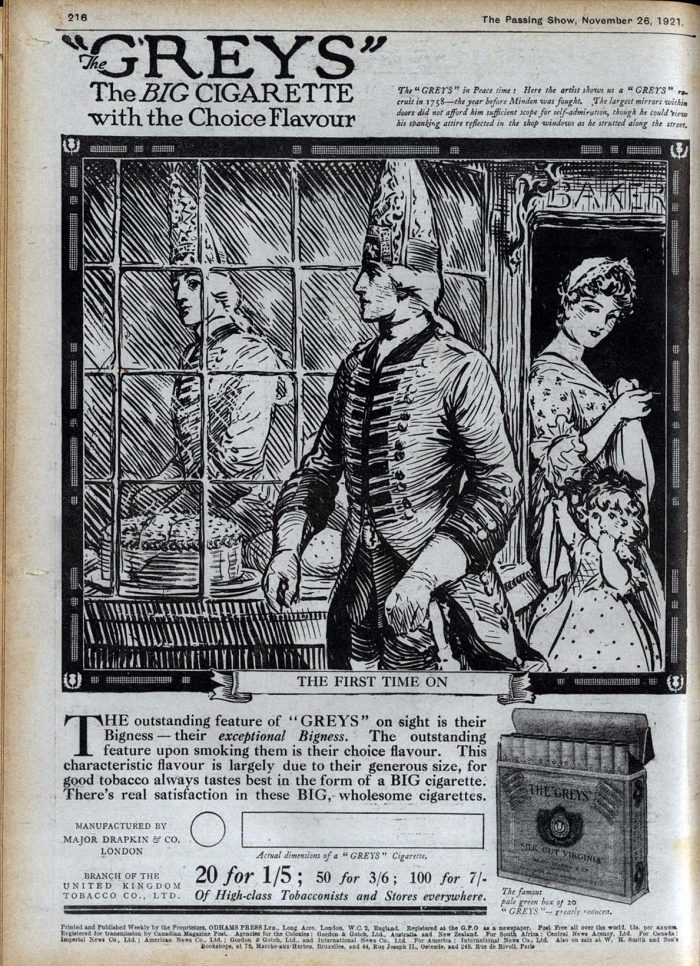
Back before the public came to terms with the grim causal relationship between cigarettes and cancer, smoking was a jolly affair, whose pleasures extended well beyond the physical act.
Smoking was sociable. Yes, there were certain situations in which three on a match could spell doom, but a far greater likelihood that lighting an attractive stranger’s coffin nail might kindle conversation, and more.
If you were at a loss for words, you might break the ice with the trading cards manufacturers slipped inside cigarette packs, such as these mid-30s beauties that came inside packs of Greys, a now-defunct British cigarette brand, and favorite of WWI vets.
The subject is unusual. Sports, cinema stars, and military scenes were common themes of the time. The “Greys Anticipations” series took creative liberties, by imagining a (cancer-free) year 2500, in which Londoners would be privy to such innovations as solar-lighting, moving sidewalks, and wireless television…
Great Scott! Were they psychic!?
Hopefully not.
Hopefully, we’ve still got 484 years to find out…
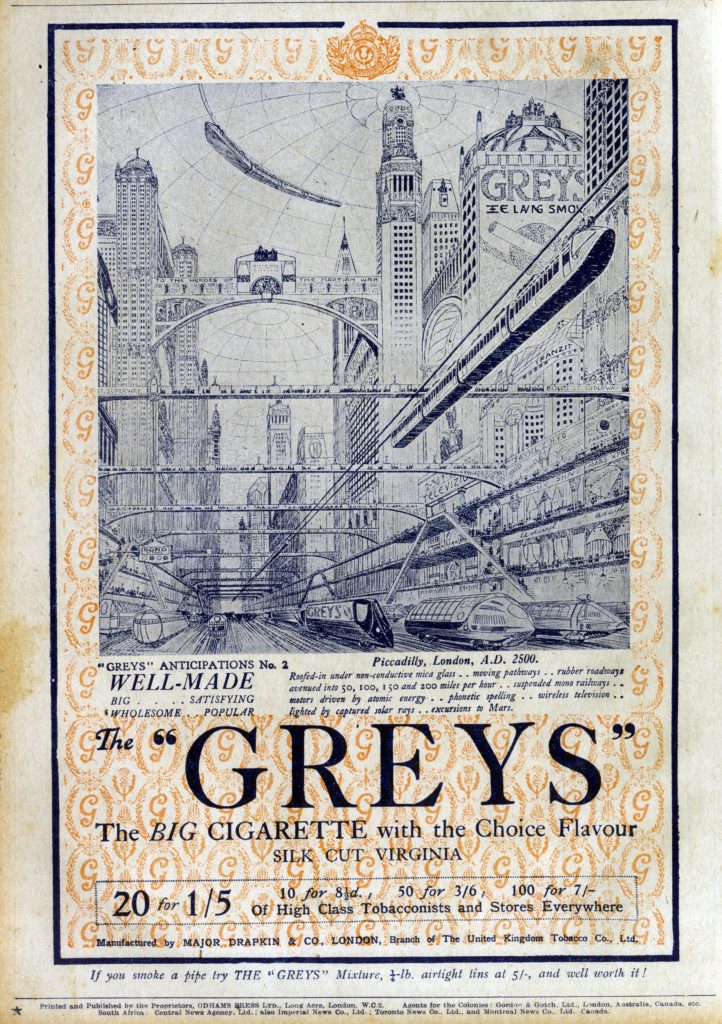
“Picadilly, London, A.D. 2500: Roofed-in under non-conductive mica glass . . moving pathways . . rubber roadways avenued into 50, 100, 150 and 200 miles per hour . . suspended mono railways . . motors driven by atomic energy . . phonetic spelling . . wireless television . . lighted by captured solar rays . . excursions to Mars.”
I’m fine with excursions to Mars and monorails but atomic energy is as problematic as the health claims once put forward by cigarette ads.
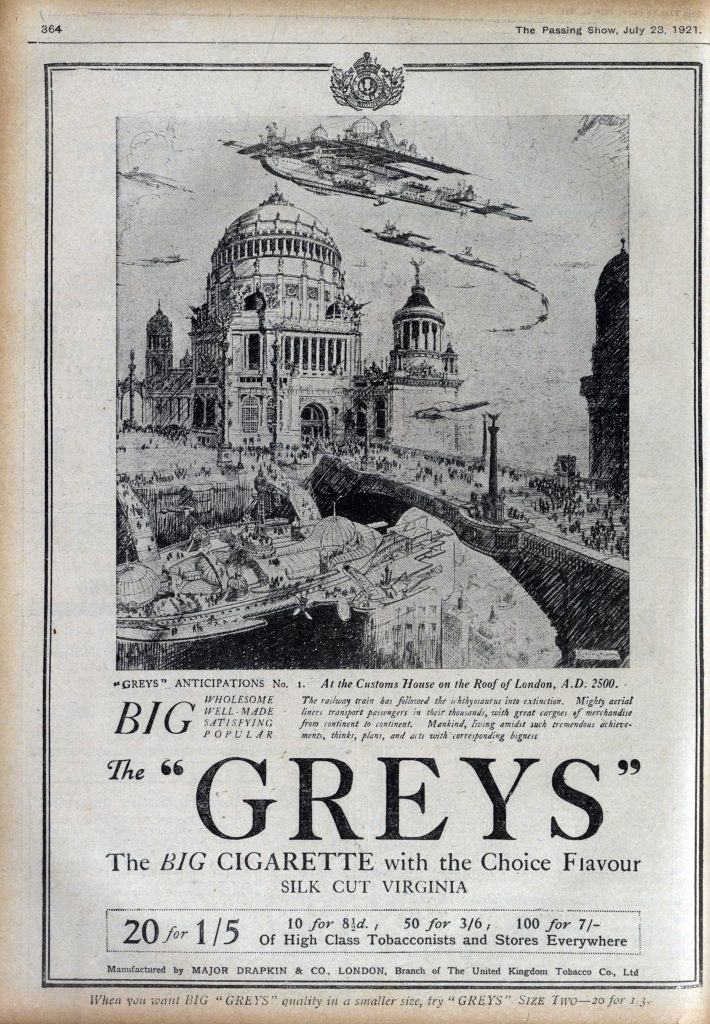
“At the Customs House on the Roof of London, A.D. 2500: The railway train has followed the ichthyosaurus into extinction. Mighty aerial liners transport passengers in their thousands, with great cargoes of merchandise from continent to continent. Mankind, living amidst such tremendous achievements, thinks, plans, and acts with corresponding bigness.”
Hmm…I was kind of rooting for train travel to make a comeback…
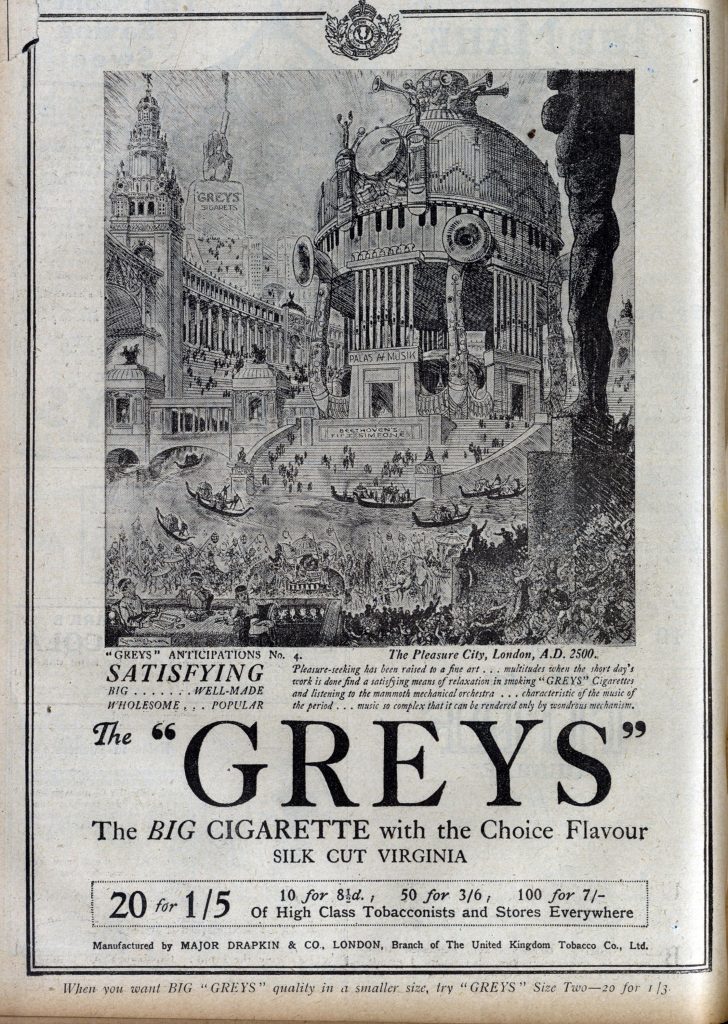
“The Pleasure City, London, A.D. 2500: Pleasure-seeking has been raised to a fine art … mutitudes when the short day’s work is done find a satisfying means of relaxation in smoking “GREYS” Cigarettes and listening to the mammoth mechanical orchestra … characteristic of the music of the period … music so complex that it can be rendered only by wonderous mechanism.”
This does sound rather fun, depending on who’s doing the programming… perhaps we should just stick with headphones and a busker on every corner.
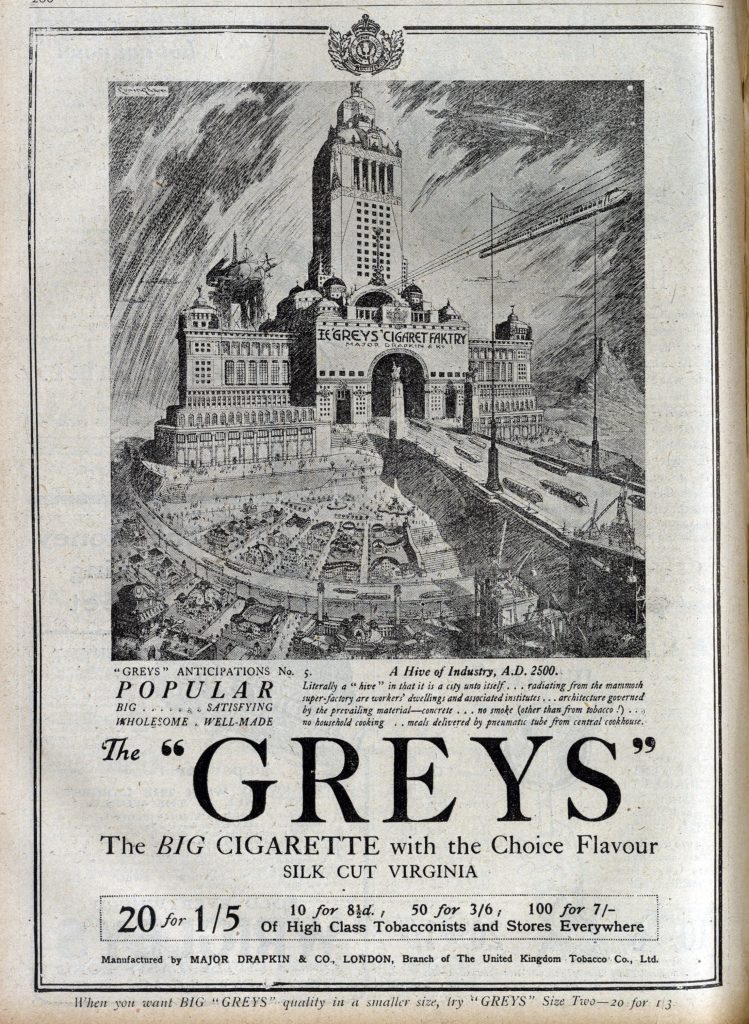
A Hive of Industry, A.D. 2500: Literally a “hive” in that it is a city unto itself … radiating from the mammoth super-factory are workers’ dwellings and associated institutes … architecture governed by the prevailing material — concrete … no smoke (other than from tobacco!) … no household cooking . . meals delivered by pneumatic tube from central cookhouse.
Um…I strongly suggest revisiting Terry Gilliam’s 1985 film, Brazil, before signing off on the whole pneumatic tube thing.
Darran Anderson, author of Imaginary Cities, took a closer look at one of the cards in the above talk about imaginary London. I share his opinion that “phonetic spelling… is the best thing that they envisaged of the future.”
He also notes that the card is about 20 years ahead of its time in promoting a mid-50s‑style vision of the future, but that it failed to predict the demise of Greys Cigarettes, by prominently advertising them on the side of a suspended monorail.
Hubris!
via Metafilter
Related Content:
In 1900, Ladies’ Home Journal Publishes 28 Predictions for the Year 2000
Cigarette Commercials from David Lynch, the Coen Brothers and Jean Luc Godard
Ayun Halliday is an author, illustrator, theater maker and Chief Primatologist of the East Village Inky zine. Her play Zamboni Godot is opening in New York City in March 2017. Follow her @AyunHalliday
Read More...Hear the Brilliant Guitar Work of Charlie Christian, Inventor of the Electric Guitar Solo (1939)
On a recent visit to Seattle’s Museum of Popular Culture (formerly EMP), I found myself transfixed for well over an hour by the Guitar Gallery, a veritable shrine for guitar players, with “55 vintage, world changing guitars from the 1770s to the present.” In addition to illustrating a few hundred years of music history, the exhibit represents the slow development of the electric guitar, and the many ungainly stages in-between. What we learn in studying the history is that guitar innovations have always been player-driven.
Guitarists have modified and built their own guitars, and many have taken models and adapted them so fully to their style that they become iconic mainstays as other models drop away. Such is the case with the ES-150, Gibson’s first “Electric Spanish” archtop guitar, and its most famous player, Charlie Christian, who has inspired some of the best-known guitarists in jazz, like Barney Kessel and Wes Montgomery, and who also may have invented the electric guitar solo. Gibson goes so far as to bestow on Christian the honorific of “the first guitar hero.”
Before Christian, guitar soloists in jazz ensembles and orchestras were rare, since the acoustic instrument couldn’t be heard loudly enough over horns, woodwinds, double bass, and drums. The first electric guitar, the “Frying Pan,” arrived in 1931, built for Hawaiian jazz lap steel players. Rapid development of the electric pickup proceeded throughout the decade, and Christian bought his ES-150 the year after it went into production in 1936.
By 1938, when he had found steady work at a club in Bismarck, North Dakota, “a local music store displayed the Gibson ES-150 with a sign reading ‘As featured by Charlie Christian.’” By this point, writes Riff Interactive, Christian was “a regional hero.”
In 1939, Christian joined the Benny Goodman orchestra, but the story of his audition tells us as much about the electric guitar’s importance as it does about Christian’s playing. It seems that “Goodman was initially unimpressed” by Christian’s strumming of an “unamplified rhythm guitar behind ‘Tea for Two.’” (hear him play the song, electrified, below.) But when jazz impresario John Hammond snuck him and his electric guitar onstage with Goodman’s Quintet later at the Victor Hugo Restaurant, “Christian matched Goodman riff for riff and improvised over 20 choruses. He was hired on the spot.” He could play some of Django Reinhardt’s most difficult songs note-for-note, and “many of the figures he worked into his solos evolved later into Benny Goodman tunes.”
“Some argue he wasn’t the first” electric soloist, writes the site Justice through Music, but “he made the electric guitar lead solo ‘popular,’ and in essence ‘invented’ it,” leading the way for “Eric Clapton, Jimmy Page, Buddy Guy, Eddie Van Halen and all the great guitar shredders.” Jazz critic Kevin Whitehead agrees, telling Terry Gross that Christian “was the single greatest influence on the signature 20th century instrument, the electric guitar, even though he died at age 25 and did all his recording in under two years.”
Beginning in his hometown of Oklahoma City as a ukulele player, Christian picked up many of his “slingshot rhythms” on the guitar from saxophonist Lester Young (hear him play with Young just above). “Amplified slide guitarists in white western swing bands showed Christian how electric guitar could project,” Whitehead notes. “He wasn’t the first electric picker who played on the frets. He dug Chicago pioneer George Barnes. But Christian had the most imposing sound.”
We have a representative sampling of the imposing sound of Christian and his ES-150 in the recordings here. At the top of the post, hear him live with Goodman (who introduces him as “our new discovery, Charles Christian”) in 1939, playing “Flying Home.” Further down listen to “Rose Room” with Goodman’s Sextet, with whom he made most of his records, Whitehead tells us, “compet[ing] for space with other good soloists.” Further down, hear Christian play “Stompin’ at the Savoy” live at Minton’s in 1941 and “Tea for Two” with Jerry Jerome in 1939.
Further up, in “Solo Flight” with Goodman’s orchestra, Christian demonstrates his “impeccable” timing and “heavy, front-loaded attack” in a two-and-a-half-minute showcase. Christian’s phenomenal playing “inspired untold jazz, blues, and rock-guitar players.” In some of his last recordings, before his death from tuberculosis in 1942, he “laid the groundwork for the new music that Christian started calling bebop.” Hear him reshape the sound of jazz with Dizzy Gillespie, Thelonious Monk, Don Byas, and Kenny Clarke above in “Groovin’ High.” “You can hear a lot of guitar’s future coming” in these recordings, Whitehead argues, “Chuck Berry included.”
Related Content:
Behold the First Electric Guitar: The 1931 “Frying Pan”
Jazz ‘Hot’: The Rare 1938 Short Film With Jazz Legend Django Reinhardt
The Story of the Guitar: The Complete Three-Part Documentary
Josh Jones is a writer and musician based in Durham, NC. Follow him at @jdmagness
Read More...Support Us
We're hoping to rely on loyal readers, rather than erratic ads. Please click the Donate button and support Open Culture. You can use Paypal, Venmo, Patreon, even Crypto! We thank you!

About Us

Open Culture scours the web for the best educational media. We find the free courses and audio books you need, the language lessons & educational videos you want, and plenty of enlightenment in between.
Advertise With Us

FREE UPDATES!
GET OUR DAILY EMAIL
Get the best cultural and educational resources on the web curated for you in a daily email. We never spam. Unsubscribe at any time.
FOLLOW ON SOCIAL MEDIA

Open Culture editor Dan Colman scours the web for the best educational media. He finds the free courses and audio books you need, the language lessons & movies you want, and plenty of enlightenment in between.
Advertise With Us

