375+ Episodes of William F. Buckley’s Firing Line Now Online: Features Talks with Chomsky, Borges, Kerouac, Ginsberg & More
On most issues, I’m clear about where I stand and why, and I used to find it enlightening to debate informed people who felt strongly about opposing positions. Sometimes we would get each other to budge a little bit, or—at the very least—sharpen the articulation of our views. These days, I often find myself in echo chambers, preaching to choirs, and other clichés about epistemic closure. It’s a situation that alarms me, and yet I find even more alarming the levels of cynicism, invective, bad faith, threats, and misinformation that pervade so much partisan debate.
I know I’m not alone in this lament. What we’ve lost—among other humanist virtues—is what philosophers and rhetoricians call the “principle of charity,” generally defined as making the clearest, most intellectually honest interpretation we can of an opponent’s views and arguing against them on those merits. The principle of charity allows us to have civil disagreements with people whose ethics we may dislike, and it thereby furthers discussion rather than stifles it.
We may all have our own story about who is to blame for the breakdown of the discourse, but before we start yelling at each other all over again, we could perhaps take some time to learn from examples of political debate done well. One long-running example involves a figure whose views I’ve usually found abhorrent (and some of which he himself later called “reprehensible”), but whose ability to defend them in charitable sparring matches with people from every possible place on the spectrum (or horseshoe), I’ve found very compelling.
I write here of William F. Buckley, the well-heeled, Ivy League-educated (many have said elitist) founder of the National Review. Whatever personal strengths or flaws we wish to ascribe to Buckley, we should agree on a few facts: During his tenure as the host of Firing Line—an often oppositional interview program in which Buckley chatted up conservative fellow travelers and sparred with leftist intellectuals, artists, and activists—we see over and over again that he made an effort to actually read his opponents’ views firsthand; to clarify his understanding of them; and to base his disagreement on the the arguments rather than the real or imagined motivations of the messenger.
Over 375 episodes of Firing Line have been made available on YouTube by the Hoover Institution at Stanford University. You can find complete episodes on Hoover’s YouTube channel here (there are probably more to come), and see their web site for an archive of full programs and transcripts available online.
Buckley didn’t always engage in reasoned debate: he issued many ugly personal and racial attacks in print. He threatened to punch both Gore Vidal and Noam Chomsky (jokingly, perhaps). But Firing Line wasn’t only about its host: its success depended also on the format, the audience, and the quality of the discussion and the guests. Take the few examples here. At the top of the post, Buckley discusses the Vietnam War with Chomsky. The latter may be incapable of raising his voice, but notice also Buckley’s cool exterior. While his genteel mannerisms rubbed many the wrong way, whether or not we like his demeanor, he consistently employs methods of clarification and argumentation rather than personal attack (stray threats of punching aside).
Nowhere in evidence is the current style of screaming over guests with whom the host disagrees. We find similar receptiveness in Buckley’s interview with Allen Ginsberg, and even with Black Panther Eldridge Cleaver, whom Buckley obvious finds distasteful, and whose violent rhetoric and violent past may warrant the reaction in many people’s estimation. Nevertheless, even in this extreme case, we see how the discussion tracks along in such a way that viewers actually learn something about the views on offer. Some may be unable to countenance either participant’s ideas, and yet may come still away from the exchange examining the basis of their own position.
Buckley didn’t only debate politics. As in his interview with Ginsberg, many of his foils were literary figures, and many of them primarily discussed writing. Firing Line brought us great television like the discussions further up with Jorge Luis Borges, with Eudora Welty and Walker Percy above, and, below, with Norman Mailer. The show ran from 1966 to 1999 and owed much of its prestige to the two public television stations—from New Jersey and South Carolina, respectively—who hosted it and allowed for its rarified audience.
Though it may not have been widely viewed, Firing Line’s influence resonated widely in its impact on other cultural figures and venues. Granted, we see Buckley’s biases on display. Make what you will of the fact that—although the period of the show’s airing saw at least two waves of feminism—Buckley rarely interviewed women unless they already agreed with him. On the whole, however, throughout the show’s 33-year run its host listened to, engaged honestly with, and attempted to understand other points of view.
h/t Emerson
Related Content:
James Baldwin Bests William F. Buckley in 1965 Debate at Cambridge University
William F. Buckley Flogged Himself to Get Through Atlas Shrugged
William F. Buckley v. Gore Vidal – 1968
Josh Jones is a writer and musician based in Durham, NC. Follow him at @jdmagness
Read More...A Short Anti-LSD Horror Film Made by the Lockheed Corporation (1969)
During the late 1960s, the defense contractor Lockheed Corporation took a strange detour into filmmaking and sponsored a series of short films, each examining the perils of a particular hardcore drug. Above, you can watch “Case Study: LSD,” a three-minute short documenting a young woman’s acid trip. Everything seems pretty groovy, until the 18-year-old protagonist goes to eat a hot dog. That’s when things go horribly wrong: the hot dog springs to life, claims it has a wife and seven kids to support, and screams bloody murder as it gets mercilessly ingested. A horror film, if I’ve ever seen one.
You can watch the three other short films in the series here: Case Study: Heroin, Case Study: Amphetamines, and Case Study: Barbiturates.
Related Content:
The Historic LSD Debate at MIT: Timothy Leary v. Professor Jerome Lettvin (1967)
Watch The Bicycle Trip: An Animation of The World’s First LSD Trip in 1943
Artist Draws Nine Portraits on LSD During 1950s Research Experiment
Ken Kesey’s First LSD Trip Animated
Read More...An Introduction to the Life & Thought of Hannah Arendt: Presented by the BBC Radio’s In Our Time
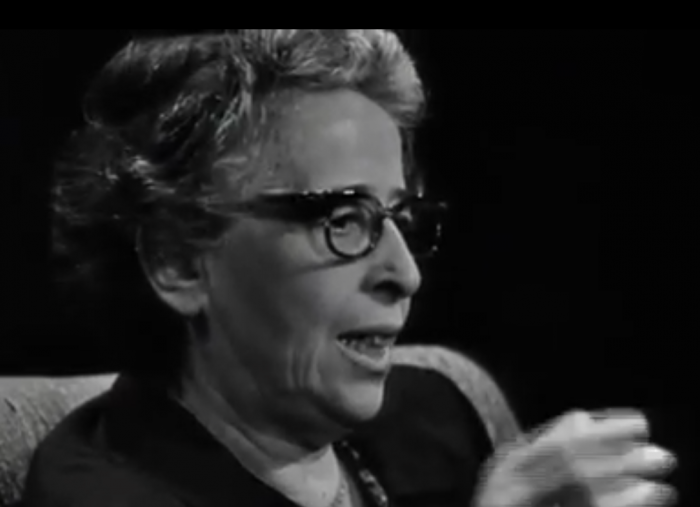
Unsettling historical parallels between the newly-developing world order and the terrors that scourged Europe in the 1930s and 40s now seem undeniable to most informed observers of contemporary geopolitics. Europeans have their own political crises to weather, but all eyes currently seem trained on the military behemoth that is my own country. “These are not normal times,” admits Jane Chong at Lawfare. Though she critiques Nazi comparisons as needlessly alarmist, she “sees no reason for optimism.” While references to history’s greatest villain abound, we’ve also seen Australian scientist Alan Finkel compare the U.S. leader to Joseph Stalin for the suppression and censorship of environmental data.
The devastation Hitler and Stalin visited upon Western and Eastern Europe can hardly be overstated—and we still find it nearly impossible to comprehend. But not soon after the end of World War II, one of the 20th century’s most probing analysts of political thought attempted to do just that.
Hannah Arendt’s 1951 The Origins of Totalitarianism remains one of “several seminal works on tyranny and oppression that have recently gained popularity among readers,” notes Alison Griswold at Quartz. And Arendt’s 1963 classic Eichmann in Jerusalem also continues to inform the moment, offering a “sobering reflection,” writes Maria Popova, on what Arendt called “the fearsome, word-and-thought-defying banality of evil.”
Arendt’s renewed relevance recently prompted Melvyn Bragg, host of the excellent BBC Radio program In Our Time, to bring three guest philosophy professors—Robert Eaglestone, Frisbee Sheffield, and Lyndsey Stonebridge—on air to discuss her ideas and influence. Bragg begins with a brief outline of Arendt’s biography, then turns to Sheffield, a lecturer at Girton College, Cambridge, for elaboration. They immediately address one of the most controversial aspects of Arendt’s young life, her affair with her mentor, Martin Heidegger, who joined the Nazi party and remained a true believer in its ideology.
But the conversation quickly moves on from there to encompass Arendt’s multi-dimensional thought. “There’s a great range to her writings,” says Sheffield. A trained classicist, Arendt wrote her dissertation on the idea of love in St. Augustine. Her most philosophical work, The Human Condition, drew on classical concepts to rank human activity into a hierarchy of labor, work, and action. She “wrote on a great range of topics,” Sheffield notes, though “there is a consistent interest in politics and political themes throughout her work.”
Yet Arendt rejected the label of political philosopher and is herself “hard to pin down” politically. Her 1963 book On Revolution, critiqued leftist and Marxist thought and praised the American Revolution for its constitutionalism. She was skeptical of the notion of universal human rights, and her essay On Violence made the argument that violence appears only in the absence of political power, not its ascendency. As we learn from listening to Bragg’s assembled panel of guests, Arendt consistently emphasized two classical concepts: the value of a civic and political order and the importance of the “life of the mind,” also the title of a two-volume work published posthumously in 1978.
In Our Time’s short, lively conversation provides an excellent introduction to Arendt’s life and work. To dive more deeply into the Arendt corpus, visit Bard College’s Hannah Arendt Center for Politics and Humanities, browse the Library of Congress’s Hannah Arendt Papers, and read Lyndsey Stonebridge’s short online essay “Hannah Arendt’s Refugee History.” You’ll also find an extensive reading list of primary and secondary sources at the In Our Time BBC page.
Related Content:
Hannah Arendt Discusses Philosophy, Politics & Eichmann in Rare 1964 TV Interview
Hannah Arendt’s Original Articles on “the Banality of Evil” in the New Yorker Archive
Josh Jones is a writer and musician based in Durham, NC. Follow him at @jdmagness
Read More...An Introduction to Hegel’s Philosophy of History: The Road to Progress Runs First Through Dark Times
The question of whether or not genuine human progress is possible, or desirable, lies at the heart of many a radical post-Enlightenment philosophical project. More pessimistic philosophers have, unsurprisingly, doubted it. Arthur Schopenhauer, cast baleful suspicion on the idea. Danish Existentialist Soren Kierkegaard thought of collective progress toward a more enlightened state an unlikely prospect. One modern critic of progress, pessimistic English philosopher John Gray, writes in his book Straw Dogs that “the pursuit of progress” is an idealist illusion ending in “mass murder.” (Gray has been unimpressed by Steven Pinker’s optimistic arguments in The Better Angels of Our Nature.)
These skeptics of progress all in some way write in response to the towering 19th century figure G.W.F. Hegel, the German logician and philosopher of history, politics, and phenomenology whose systematic thinking provided Karl Marx with the basis of his dialectical materialism. Hegel saw the mass murder brought about by massive political and economic change in his revolutionary and imperial age, but in his estimation, such man-made disasters were necessary occurrences, the “slaughter bench of history,” as he famously wrote in the Philosophy of History.
This suggests a very brutal view, and yet Hegel believed overall that “Reason is the Sovereign of the World; that the history of the world therefore, presents us with a rational process.” For Hegel, the individual personality was not important, only collective entities: peoples, states, empires. These moved against each other according to a metaphysical reasoning process working through history which Hegel called the dialectic. In his animated School of Life video above, Alain de Botton describes the dialectic in the terms we usually use—thesis, antithesis, synthesis—though Hegel himself did not exactly formulate the principle this way.
This is the common shorthand way of understanding how Hegel’s nonlinear explanation of history works: “the world makes progress,” summarizes de Botton, “by lurching from one extreme to the other, as it seeks to overcompensate for a previous mistake, and generally requires three moves before the right balance on any issue can be found.” One particularly bloody example is the terror of the French Revolution as an extreme corrective for the monarchy’s oppression. This gave way to the antithesis, the brutal autocratic empire of Napoleon in another extreme swing. Only decades later could these be reconciled in modern French civil society.
In our own time, we have encountered the progressive ideas of Hegel not only through Marx, but through the work of Martin Luther King, Jr., who studied Hegel as a graduate student at Harvard and Boston University and found much inspiration in the Philosophy of History. Though critical of Hegel’s idealism, which, “tended to swallow up the many in the one,” King discovered important first principles there as well: “His analysis of the dialectical process, in spite of its shortcomings, helped me to see that growth comes through struggle.”
We endlessly quote King’s statement, “the arc of history is long, but it bends toward justice,” but we forget his corresponding emphasis on the necessity of struggle to achieve the goal. As Hegel theorized, says de Botton above, “the dark moments aren’t the end, they are a challenging but in some ways necessary part… imminently compatible with events broadly moving forward in the right direction.” King found his own historical synthesis in the principle of nonviolent resistance, which “seeks to reconcile the truths of two opposites,” he wrote in 1954’s Stride Toward Freedom, “acquiescence and violence.” Nonviolent resistance is not passive compliance, but neither is it intentional aggression.
Hegel and his socially influential students like Martin Luther King and John Dewey have generally operated on the basis of some faith—in reason, divine justice, or secular humanism. There are much harsher, more pessimistic ways of viewing history than as a swinging pendulum moving toward some greater end. Pessimistic thinkers may be more rigorously honest about the staggering moral challenge posed by increasingly efficient means of mass killing and the perpetuation of ideologies that commit it. Yet it is partly through the influence of Hegel that modern social movements have embraced the necessity of struggle and believed progress was possible, even inevitable, when it seemed least likely to occur.
Related Content:
How Martin Luther King, Jr. Used Hegel, Kant & Nietzsche to Overturn Segregation in America
Josh Jones is a writer and musician based in Durham, NC. Follow him at @jdmagness
Read More...20 Lessons from the 20th Century About How to Defend Democracy from Authoritarianism, According to Yale Historian Timothy Snyder
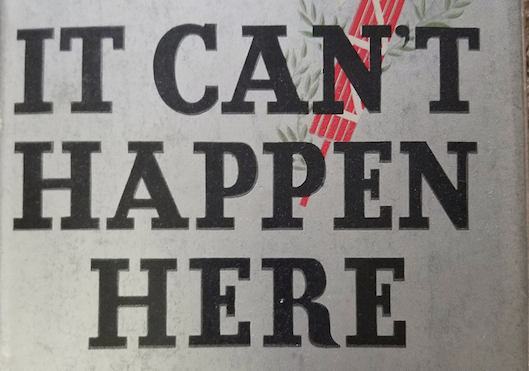
Image by Rob Kall, via Flickr Commons
Timothy Snyder, Housum Professor of History at Yale University, is one of the foremost scholars in the U.S. and Europe on the rise and fall of totalitarianism during the 1930s and 40s. Among his long list of appointments and publications, he has won multiple awards for his recent international bestsellers Bloodlands: Europe between Hitler and Stalin and last year’s Black Earth: The Holocaust as History and Warning. That book in part makes the argument that Nazism wasn’t only a German nationalist movement but had global colonialist origins—in Russia, Africa, and in the U.S., the nation that pioneered so many methods of human extermination, racist dehumanization, and ideologically-justified land grabs.
The hyper-capitalism portrayed in the U.S.—even during the Depression—Snyder writes, fueled Hitler’s imagination, such that he promised Germans “a life comparable to that of the American people,” whose “racially pure and uncorrupted” German population he described as “world class.” Snyder describes Hitler’s ideology as a myth of racialist struggle in which “there are really no values in the world except for the stark reality that we are born in order to take things from other people.” Or as we often hear these days, that acting in accordance with this principle is the “smart” thing to do. Like many far right figures before and after, Hitler aimed to restore a state of nature that for him was a perpetual state of race war for imperial dominance.
After the November election, Snyder wrote a profile of Hitler, a short piece that made no direct comparisons to any contemporary figure. But reading the facts of the historical case alarmed most readers. A few days later, the historian appeared on a Slate podcast to discuss the article, saying that after he submitted it, “I realized there was more.… there are an awful lot of echoes.” Snyder admits that history doesn’t actually repeat itself. But we’re far too quick, he says, to dismiss that idea as a cliché “and not think about history at all. History shows a range of possibilities.” Similar events occur across time under similar kinds of conditions. And it is, of course, possible to learn from the past.
If you’ve heard other informed analysis but haven’t read Snyder’s New York Review of Books columns on fascism in Putin’s Russia or the former Yanukovich’s Ukraine, or his long article “Hitler’s World May Not Be So Far Away,” you may have seen his widely-shared Facebook post making the rounds. As he argued in The Guardian last September, today we may be “too certain we are ethically superior to the Europeans of the 1940s.” On November, 15, Snyder wrote on Facebook that “Americans are no wiser than the Europeans who saw democracy yield to fascism, Nazism, or communism.” Snyder has been criticized for conflating these regimes, and rising “into the top rungs of punditdom,” but when it comes to body counts and levels of suppressive malignancy, it’s hard to argue that Stalinist Russia, any more than Tsarist Russia, was anyone’s idea of a democracy.
Rather than making a historical case for viewing the U.S. as exactly like one of the totalitarian regimes of WWII Europe, Snyder presents 20 lessons we might learn from those times and use creatively in our own where they apply. In my view, following his suggestions would make us wiser, more self-aware, proactive, responsible citizens, whatever lies ahead. Read Snyder’s lessons from his Facebook post below and consider ordering his latest book On Tyranny: Twenty Lessons from the Twentieth Century:
1. Do not obey in advance. Much of the power of authoritarianism is freely given. In times like these, individuals think ahead about what a more repressive government will want, and then start to do it without being asked. You’ve already done this, haven’t you? Stop. Anticipatory obedience teaches authorities what is possible and accelerates unfreedom.
2. Defend an institution. Follow the courts or the media, or a court or a newspaper. Do not speak of “our institutions” unless you are making them yours by acting on their behalf. Institutions don’t protect themselves. They go down like dominoes unless each is defended from the beginning.
3. Recall professional ethics. When the leaders of state set a negative example, professional commitments to just practice become much more important. It is hard to break a rule-of-law state without lawyers, and it is hard to have show trials without judges.
4. When listening to politicians, distinguish certain words. Look out for the expansive use of “terrorism” and “extremism.” Be alive to the fatal notions of “exception” and “emergency.” Be angry about the treacherous use of patriotic vocabulary.
5. Be calm when the unthinkable arrives. When the terrorist attack comes, remember that all authoritarians at all times either await or plan such events in order to consolidate power. Think of the Reichstag fire. The sudden disaster that requires the end of the balance of power, the end of opposition parties, and so on, is the oldest trick in the Hitlerian book. Don’t fall for it.
6. Be kind to our language. Avoid pronouncing the phrases everyone else does. Think up your own way of speaking, even if only to convey that thing you think everyone is saying. (Don’t use the internet before bed. Charge your gadgets away from your bedroom, and read.) What to read? Perhaps “The Power of the Powerless” by Václav Havel, 1984 by George Orwell, The Captive Mind by Czesław Milosz, The Rebel by Albert Camus, The Origins of Totalitarianism by Hannah Arendt, or Nothing is True and Everything is Possible by Peter Pomerantsev.
7. Stand out. Someone has to. It is easy, in words and deeds, to follow along. It can feel strange to do or say something different. But without that unease, there is no freedom. And the moment you set an example, the spell of the status quo is broken, and others will follow.
8. Believe in truth. To abandon facts is to abandon freedom. If nothing is true, then no one can criticize power, because there is no basis upon which to do so. If nothing is true, then all is spectacle. The biggest wallet pays for the most blinding lights.
9. Investigate. Figure things out for yourself. Spend more time with long articles. Subsidize investigative journalism by subscribing to print media. Realize that some of what is on your screen is there to harm you. Learn about sites that investigate foreign propaganda pushes.
10. Practice corporeal politics. Power wants your body softening in your chair and your emotions dissipating on the screen. Get outside. Put your body in unfamiliar places with unfamiliar people. Make new friends and march with them.
11. Make eye contact and small talk. This is not just polite. It is a way to stay in touch with your surroundings, break down unnecessary social barriers, and come to understand whom you should and should not trust. If we enter a culture of denunciation, you will want to know the psychological landscape of your daily life.
12. Take responsibility for the face of the world. Notice the swastikas and the other signs of hate. Do not look away and do not get used to them. Remove them yourself and set an example for others to do so.
13. Hinder the one-party state. The parties that took over states were once something else. They exploited a historical moment to make political life impossible for their rivals. Vote in local and state elections while you can.
14. Give regularly to good causes, if you can. Pick a charity and set up autopay. Then you will know that you have made a free choice that is supporting civil society helping others doing something good.
15. Establish a private life. Nastier rulers will use what they know about you to push you around. Scrub your computer of malware. Remember that email is skywriting. Consider using alternative forms of the internet, or simply using it less. Have personal exchanges in person. For the same reason, resolve any legal trouble. Authoritarianism works as a blackmail state, looking for the hook on which to hang you. Try not to have too many hooks.
16. Learn from others in other countries. Keep up your friendships abroad, or make new friends abroad. The present difficulties here are an element of a general trend. And no country is going to find a solution by itself. Make sure you and your family have passports.
17. Watch out for the paramilitaries. When the men with guns who have always claimed to be against the system start wearing uniforms and marching around with torches and pictures of a Leader, the end is nigh. When the pro-Leader paramilitary and the official police and military intermingle, the game is over.
18. Be reflective if you must be armed. If you carry a weapon in public service, God bless you and keep you. But know that evils of the past involved policemen and soldiers finding themselves, one day, doing irregular things. Be ready to say no. (If you do not know what this means, contact the United States Holocaust Memorial Museum and ask about training in professional ethics.)
19. Be as courageous as you can. If none of us is prepared to die for freedom, then all of us will die in unfreedom.
20. Be a patriot. The incoming president is not. Set a good example of what America means for the generations to come. They will need it.
Related Content:
Umberto Eco Makes a List of the 14 Common Features of Fascism
George Orwell’s Final Warning: Don’t Let This Nightmare Situation Happen. It Depends on You!
Josh Jones is a writer and musician based in Durham, NC. Follow him at @jdmagness
Read More...Deconstructing How Louis CK Writes a Joke
Those who subscribe to the notion that deconstructing a joke ruins it may consider making an exception for the Nerdwriter (aka Evan Puschak).
His careful parsing of Louis CK’s Monopoly joke, above, takes rhythm, word choice, and the importance of a clearly stated premise into account.
Delivering the 207-word joke at the Beacon Theater, CK is characteristically nonchalant, but Puschak argues that there’s nothing unrehearsed about his performance.
Take the way he ramps up a scenario that will be familiar to any parent—the six-year-old who is emotionally unequipped to handle losing at games. CK gets at an even deeper truth about the howling injustice of being six, by saying that his younger daughter is “not emotionally developed enough to handle her inevitable loss in every game of Monopoly.”
Oh, the humanity.
Puschak also singles out CK’s acting ability. The way he speaks to his daughter, placing her in the first row of the audience, sharpens the comedy by helping the audience to fully visualize the scenario he’s set up:
I play Monopoly with my kids, that’s really fun. My nine year old, she can totally do Monopoly. The six year old totally gets how the game works but she’s not emotionally developed enough to handle her inevitable loss in every game of Monopoly because a monopoly loss is dark. It’s heavy. It’s not like when you lose at Candyland ‘Oh you got stuck in the fudgy-thing, baby! Oh well you’re in the gummy twirly‑o’s! You didn’t get to win!’ But when she loses at Monopoly, I gotta look at her little face and go ‘Ok, so here’s what’s gonna happen now, ok? All your property, everything you have, all your railroads and houses, and all your money…that’s mine now. Gotta give it all to me. Give it to me, that’s right. And no no, you can’t play anymore because, you see, even though you’re giving me all of that, it doesn’t even touch how you owe me. Doesn’t even touch it, baby. You’re going down hard, it’s really bad. All you’ve been working for all day, I’m gonna take it now and I’m gonna use it to destroy your sister. I mean I’m gonna ruin her! It is just mayhem on this board for her now.
You can view the Nerdwriter’s other videos essays on his website or subscribe to his YouTube channel where a new video is published every Wednesday.
Related Content:
How the Great George Carlin Showed Louis CK the Way to Success (NSFW)
20-Year-Old Louis CK Performs Stand Up (1987)
Louis CK Ridicules Avant-Garde Art on 1990s MTV Show
Ayun Halliday is an author, illustrator, theater maker and Chief Primatologist of the East Village Inky zine. Her play Zamboni Godot is opening in New York City in March 2017. Follow her @AyunHalliday.
Read More...Watch 100 Randomly Ticking Metronomes Miraculously Achieve Synchronicity
It’s always satisfying to impose order on chaos, especially if it doesn’t involve bellowing at a roomful of jacked up teenagers.
Witness the experiment above.
Members of Ikeguchi Laboratory, a Japanese organization dedicated to the analysis and prediction of nonlinear phenomena, placed 100 randomly ticking metronomes on a hanging platform, curious as to how long it would take them to synchronize.
(SPOILER ALERT! They start synching up around the 1 minute, 20 second mark.)
How? Why? Is this some mystical, musical variant of menstrual synchrony?
Nope. Physics is doing the heavy lifting here.
The key is that the platform holding the metronomes is not fixed. It affects their movement by moving in response to theirs.
To put it another way, KE = 0.5 • m • v2. Which is to say Kinetic Energy = 0.5 • mass of object • (speed of object)2.
If you’re looking for another scientific explanation, here’s how Gizmodo puts it: “the metronomes are transferring energy to the platform they’re on, which then transfers that energy back to the metronomes—until they all sync up and start hitting the beat in one glorious wavelength.”
By the two and a half minute mark, some viewers will be raring to delve into further study of energy transference.
Others, their brains imploding, may elect to downshift into a purely auditory experience.
Close your eyes and listen as the last hold outs fall into rhythmic step with the rest of the herd. A pleasantly harmonious sound, not unlike that moment when a roomful of jacked up teens simmers down, achieving the sort of blissful hive mind that’s a balm to teacher’s frazzled soul.
Craving more? Ikeguchi Laboratory also filmed their metronomes in triangular, circular and X‑shaped formations, available for your viewing pleasure on the lab’s YouTube channel.
Related Content:
The Remarkable Physics of Ants: Watch Them Turn into Fluids and Solids at Will
The Mysterious Physics Behind How Bikes Ride by Themselves
Ayun Halliday is an author, illustrator, theater maker and Chief Primatologist of the East Village Inky zine. Her play Zamboni Godot is opening in New York City in March 2017. Follow her @AyunHalliday
Read More...How The Beatles’ Sgt. Pepper’s Lonely Hearts Club Band Changed Album Cover Design Forever
I am older than Evan Puschak, The Nerdwriter, one of a handful who have mastered the online video essay. But I still find myself agreeing with his take on the music video as mostly unnecessary and distracting. At least at first. Then I get nostalgic and remember some of the videos of my youth, like, say The Cure’s “Pictures of You” or Boyz II Men’s “It’s So Hard to Say Goodbye to Yesterday”—both bittersweet tracks about nostalgia—and I feel differently. The video can have a powerful emotional pull on us. But its power to sell music has perhaps never matched that of the album cover, even after the death of the record store. Puschak makes the case that The Beatles forever changed the form, making it into the “almost limitless” art we know today.
Another critic besides Puschak—one who remembers buying a first pressing of Sgt. Pepper’s Lonely Hearts Club Band—might be alleged to have fallen victim to a reverie. But there is nostalgia and there are qualitative historical arguments, and Puschak, a consummately careful, if exceedingly concise, essayist, makes the latter. In times past, he informs us, during the first few decades of the industry, record covers were more or less utilitarian brown paper bags, with some exceptions. Then came Columbia Records designer Alexander Steinweiss in 1938 to revolutionize album art, initiating a “huge boom in sales.” The market followed suit and record shops bloomed with color as album covers became little billboards for their contents.
“Since music has no spatial dimension,” and we can’t hold it in our hands, “the album cover emerged as the stand-in for the commodity to be purchased. This explains the so-called “personality cover” featuring prominent band photos that look like portraits of actors’ troupes. It’s a convention The Beatles dutifully observed on their first few sleeves in the early sixties. As their stature increased, however, the band “seemed to become darkly aware of their status as commodities.” (Thus the glum looks on the cover of their unsubtly titled 1964 Beatles for Sale.)
Their evolution from the teenpop “personality cover” to the broody and surreal is self-evident, from Rubber Soul’s groovy band shot and psychedelic lettering to Revolver’s take on Aubrey Beardsley, courtesy of Klaus Vormann, “The Beatles were leaders in expanding an album cover’s function from a marketing tool to a work of art in its own right.” Then we come to Sgt. Pepper’s, and the shift is cemented. The album cover’s designer, Peter Blake, explicitly thought of the cover as “a piece of art rather than an album cover. It was almost a piece of theater design.” And the band themselves had a direct hand in its creation. “We all chose our own colours and our own materials,” noted McCartney.
They also chose most of the people on the cover (out of many who turned them down or didn’t make the final cut). By “juxtaposing highbrow artists and thinkers with pop icons,” says Puschak, “The Beatles signal the breakdown and mixing of high and low culture that they themselves exemplified.” What’s brilliant about the cover is that it taps into the band and the record buyer’s nostalgia with an open acknowledgement of the music as commerce. “We liked the idea of reaching out to the record-buyer,” McCartney recalled, “because our memories of spending our own hard-earned cash and really loving anyone who gave us value for money.”
But, as Puschak points out, the Sgt. Pepper’s cover also serves as its own critique. “By staging the scene as a performance and an audience,” he says, “the band challenges us to deal with the function of both.” That this message coincides with their decision to stop touring suggests that the band was using the album cover as they were using their music to draw the audience closer and give them the private emotional and aesthetic experiences so many inviting album covers now routinely promise. Designer Blake and the band encouraged listeners to have an intellectual relationship with the record from the very start, with the cryptic who’s‑who puzzle photomontage of famous people and the lyrics printed directly on the back. In so doing, they announced that although recorded music was inescapably a commodity, it was also, inseparably, a modern art.
Related Content:
Andy Warhol Creates Album Covers for Jazz Legends Thelonious Monk, Count Basie & Kenny Burrell
Classic Jazz Album Covers Animated, or the Re-Birth of Cool
Josh Jones is a writer and musician based in Durham, NC. Follow him at @jdmagness
Read More...Inside the Creepy, “Abandoned” Wizard of Oz Theme Park: Scenes of Beautiful Decay
The romantic allure of the ghostly, abandoned theme park is difficult to resist. Case in point: The Land of Oz, above, a not-entirely-defunct attraction nestled atop North Carolina’s Beech Mountain.
Debbie Reynolds, accompanied by her 13-year-old daughter, Carrie Fisher, cut the ribbon on the park’s opening day in 1970.
Its road was far from smooth, even before urban explorers began filching its 44,000 custom-glazed yellow bricks, eventually forcing management to repave with painted stand issue models.
One of its two founders died of cancer six months before opening, and later a fire destroyed the Emerald City and a collection of memorabilia from the 1939 MGM film.
Crippled by the gas crisis and insurmountable competition from Disney World and its ilk, the Land of Oz closed in 1980, thus sparing it the indignities of Yelp reviews and discerning child visitors whose expectations have been formed by CGI.
Its shuttering attracted another kind of tourist: the camera-toting, fence hopping connoisseurs of what is now known as “ruin porn.”
An isolated, abandoned theme park based on the Wizard of Oz? Could there be a holier grail?
Only trouble is…the Land of Oz didn’t stay shuttered. Local real estate developers cleaned it up a bit, luring overnight visitors with rentals of Dorothy’s house. They started a tradition of reopening the whole park for one weekend every October, and demand was such that June is now Land of Oz Family Fun Month. The International Wizard of Oz Club held its annual convention there in 2011. How abandoned can it be?
And yet, unofficial visitors, sneaking onto the grounds off-season, insist that it is. I get it. The quest of adventure, the desire for beautiful decay, the bragging rights… After photographing the invariably leaf strewn Yellow Brick Road, they turn their lenses to the lumpy-faced trees of the Enchanted Forest.
Yes, they’re creepy, but it’s less from “abandonment” than a low-budget approximation by the hands of artists less expert than those of the original.
It’s safe to presume that any leaves and weeds littering the premises are merely evidence of changing seasons, rather than total neglect.
What I want to know is, where’s the sex, drugs & rock’n’roll evidence of local teens’ off-season blowouts—no spray painted f‑bombs? No dead soldiers? Security must be pretty tight.
If creepy’s what the perpetuators of the abandonment myth crave, they could content themselves with the amateur footage above, shot by a visiting dad in 1970.
Those costumes! The scarecrow and the tin man in particular… Buzzfeed would love ’em, but it’s hard to imagine a millennial tot going for that mess. Their Halloween costumes were 1000 times more accurate.
(In interviews, the one generation who can remember the Land of Oz in its prime is a loyal bunch, recalling only their long ago sense of wonder and excitement. Ah, life before Betamax…)
The documentary video below should settle the abandonment myth once and for all. It opens not in Kansas, but New York City, as a carload of young performers heads off for their annual gig at the Land of Oz. They’re conversant in jazz hands and certain Friends of Dorothy tropes, surely more so than the local players who originally staffed the park. Clearly, these ringers were hired to turn in credible impersonations of the characters immortalized by Ray Bolger, Burt Lahr, and Judy Garland. Presumably, their updated costumes also passed muster with Autumn at Oz’s savvy child attendees.
Still craving that ruin porn? Business Insider published Seph Lawless’ photos of “the crumbling park” here.
If you’d prefer to rubberneck at a truly abandoned theme park, check out the Carpetbagger’s video tour of Cave City, Kentucky’s Funtown Mountain. (Though be forewarned. It was sold at auction in April 2016 and plans are afoot to reengineer it as as “an epic playground of wonder, imagination, and dreams.”)
Related Content:
Disneyland 1957: A Little Stroll Down Memory Lane
Jurassic Park Tells You Everything You Need to Know About the Dangers of Global Capitalism
Ayun Halliday is an author, illustrator, theater maker and Chief Primatologist of the East Village Inky zine. Her play Zamboni Godot is opening in New York City in March 2017. Follow her @AyunHalliday.
Read More...Trainwreck: The Teach to One Math Experiment in Mountain View, CA Is a Cautionary Tale About the Perils of Digital Math Education

Image via Wikimedia Commons
I live in Silicon Valley, which operates on the assumption that there’s no problem that technology can’t solve. It suffuses our culture here, and sometimes we pay the price for this technocratic utopianism. Case in point: Right now, I’m sending my kid to a public school in Mountain View, CA–the home of Google–where the administrators have upended the entire sixth grade math program. Last August, they abolished the traditional math program–you know, where students get to sit in a classroom and learn from a trained and qualified math teacher. And instead the administrators asked students to learn math mainly from a computer program called Teach to One. Run by a venture called New Classrooms, Teach to One promises to let each student engage in “personalized learning,” where a computer program gauges each student’s knowledge of math, then continually customizes the math education that students receive. It all sounds like a great concept. Bill Gates has supposedly called it the “Future of Math Education.” But the rub is this: Teach to One doesn’t seem ready for the present. And our kids are paying the price.
A new article featured in our local paper, The Mountain View Voice, outlines well the problems that students and parents have experienced with the Teach to One program. I would encourage any parent or educator interested in the pitfalls of these “innovative” math programs to give the article a good look. (Update: The Mountain View Voice has done a series of excellent articles on the Teach to One experiment in Mountain View and all that went wrong. They’re all listed below.)
If you read the article, here’s what you will learn. The Mountain View school district apparently budgeted $521,000 to implement and operate this new-fangled math program in two local schools (Graham and Crittenden Middle Schools). Had they adequately beta tested the program beforehand, the school district might have discovered that Teach to One teaches math–we have observed–in a disjointed, non-linear and often erratic fashion that leaves many students baffled and disenchanted with math. The program contains errors in the math it teaches. Parents end up having to teach kids math at home and make up for the program’s deficiencies. And all the while, the math teachers get essentially relegated to “managing the [Teach to One] program rather than to providing direct instruction” themselves.
By October, many parents started to register individual complaints with the school district. By December, 180 parents signed a letter meticulously outlining the many problems they found with the Teach to One program. (You can read that letter here.) When the school later conducted a survey on Teach to One (review it here), 61% of the parents “said they do not believe the program matches the needs of their children,” and test scores show that this crop of sixth graders has mastered math concepts less well than last year’s. (Note: there was a big decrease in the number of kids who say they love math, and conversely a 413% increase in the number of kids who say they hate math.) Given the mediocre evaluation, the parents have asked for one simple thing–the option to let their kids learn math in a traditional setting for the remainder of the year, until it can be demonstrated that Teach to One can deliver better results. (Teach to One would ideally continue as a smaller pilot, where the kinks would get worked out.) So far the school district, headed by Ayindé Rudolph, has continued to champion the Teach to One program in finely-spun bureaucratic letters that effectively disregard parental concerns and actual data points. But the schools have now agreed to let students spend 5o% of their time learning math with Teach to One, and the other 50% learning math from a qualified teacher. Why the impractical half measure? I can only speculate.
I posted this so that interested parents and educators, wherever you live, can be prudent and thoughtful when it comes to adopting computer-driven math programs. Perhaps you can learn something from our cautionary tale. Do your research, run a controlled pilot, and make sure the product is actually a good fit for your school. Again, I would encourage you to read the fine article in The Mountain View Voice, the parents’ letter outlining the observed deficiencies in the Teach to One program, and the eye-opening survey results on Teach to One.
Update: It was announced on January 12 that the Mountain View will discontinue the Teach to One math pilot effective immediately. Patronizingly, New Classrooms has attributed the scrapping of the pilot to a communication problem. “There was a subset of parents of higher-achieving students who didn’t fully understand how Teach to One operated and how much it benefited their children,” Joel Rose is quoted as saying in The Wall Street Journal. Once again, I’d refer you back to the actual data collected by our schools. It speaks for itself.
Great Articles by The Mountain View Voice: Mountain View’s local paper has done some excellent reporting on this fiasco. I would encourage you to read them all.
- Parents up in arms over digital math program
- District abruptly drops digital math program
- Stuck with a half-million-dollar bill
- Math program’s flaws hidden from school board, public
This story has also received coverage from The Wall Street Journal and Edsurge.
Update 2019: It sounds like another Teach-to-One pilot in Elizabeth, NJ has its own issues. Read here and here.
Read More...Support Us
We're hoping to rely on loyal readers, rather than erratic ads. Please click the Donate button and support Open Culture. You can use Paypal, Venmo, Patreon, even Crypto! We thank you!

About Us

Open Culture scours the web for the best educational media. We find the free courses and audio books you need, the language lessons & educational videos you want, and plenty of enlightenment in between.
Advertise With Us

FREE UPDATES!
GET OUR DAILY EMAIL
Get the best cultural and educational resources on the web curated for you in a daily email. We never spam. Unsubscribe at any time.
FOLLOW ON SOCIAL MEDIA

Open Culture editor Dan Colman scours the web for the best educational media. He finds the free courses and audio books you need, the language lessons & movies you want, and plenty of enlightenment in between.
Advertise With Us


