An Animated Introduction to McCarthyism: What Is It? And How Did It Happen?
During the 1970s, a young Donald Trump was mentored by Roy Cohn, a brash, take-no-prisoners lawyer, who first came to prominence during the 1950s, when he served as the consigliere to Joseph McCarthy and his campaign to expose suspected communists in the United States. In what’s known as the Second Red Scare, McCarthy led increasingly broad and paranoid investigations, trying to find Communists, sympathizers and spies, both inside and outside the federal government. Mostly on the basis of rumor, not fact, “thousands of individuals were aggressively investigated and questioned before government panels.” Blacklists were created. Some were jailed. Careers and livelihoods were destroyed.
Year later, playwright Arthur Miller recalled, “Suffice it to say, it was a time of great–no doubt unprecedented–fear.” “The air of terror was heavy.” “I was sure the whole thing would soon go away.” Eventually a sense of futility gave way to anger, and Miller responded by writing The Crucible, a commentary on McCarthyism wrapped in a drama about the Salem witch trials of 1692/93.
Above, you can watch above a six minute primer on McCarthyism, prepared by Ellen Schrecker, professor emerita of American history at Yeshiva University. An expert on the history of McCarthyism, she has been called “the dean of the anti-anti-Communist historians.” Her books on the subject include: Many Are the Crimes: McCarthyism in America and Age of McCarthyism: A Brief History with Documents.
If you would like to support the mission of Open Culture, consider making a donation to our site. It’s hard to rely 100% on ads, and your contributions will help us continue providing the best free cultural and educational materials to learners everywhere. You can contribute through PayPal, Patreon, and Venmo (@openculture). Thanks!
Related Content:
Free Online History Courses
Bertolt Brecht Testifies Before the House Un-American Activities Committee (1947)
Ayn Rand Helped the FBI Identify It’s A Wonderful Life as Communist Propaganda
How to Spot a Communist Using Literary Criticism: A 1955 Manual from the U.S. Military
Read More...
An Introduction to the Philosophy of Science: A Free Online Course
From John Sanders, Professor of Philosophy at the Rochester Institute of Technology, comes An Introduction to the Philosophy of Science. In 11 lectures, Sanders probes the nature of the scientific enterprise, the logic of science, its claims to reliability, and its relationships to society and to problems of human values. You can stream all the lectures above, or find them all on this YouTube playlist.
An Introduction to the Philosophy of Science will be added to our list of Free Philosophy Courses, a subset of our collection, 1,700 Free Online Courses from Top Universities
Matt Damon Reads Howard Zinn’s “The Problem is Civil Obedience,” a Call for Americans to Take Action
Say, for example, that a gang of obscenely rich mercenaries with questionable ties and histories had taken power with the intent to destroy institutions so they could loot the country, further impoverish and disempower the citizenry, and prosecute, imprison, and demonize dissidents and ethnic and religious minorities. Such a scenario would cry out, one might think, for civil action on a never-before-seen scale. Millions, one might imagine, would either storm the castle or refuse to obey the commands of their new rulers. We might describe this situation as a topsy-turvy turn of events, should, say, such an awful thing come to pass.
Topsy-turvy is exactly the phrase Howard Zinn used in his characterization of the U.S. during the Vietnam War, when he saw a situation like the one above, one that had also obtained, he said, in Hitler’s Germany and Stalin’s Russia.
“I start,” he said, opening a debate, in 1970, at Johns Hopkins University with philosopher Charles Frankel on the question of civil disobedience,
from the supposition that the world is topsy-turvy, that things are all wrong, that the wrong people are in jail and the wrong people are out of jail, that the wrong people are in power and the wrong people are out of power, that the wealth is distributed in this country and the world in such a way as not simply to require small reform but to require a drastic reallocation of wealth.
And with this preamble, which you can hear read by Matt Damon in the video above, the historian and activist began to make his case that civil disobedience “is not our problem…. Our problem is civil obedience.”
We recognize this for Nazi Germany. We know that the problem there was obedience, that the people obeyed Hitler. People obeyed; that was wrong. They should have challenged, and they should have resisted; and if we were only there, we would have showed them. Even in Stalin’s Russia we can understand that; people are obedient, all these herdlike people.
But “America is different” than other world empires, says Zinn, anticipating the usual claims of exceptionalism. No, he says, it isn’t. “It is not that special. It really isn’t.” Later in his speech, Zinn calls the “voting process” a “sham.”
Totalitarian states love voting. You get people to the polls and they register their approval. I know there is a difference—they have one party and we have two parties. We have one more party than they have, you see.
What is called for, he argued, is not a return to the past nor a rejiggering of the political machinery, but a political consciousness that recognizes common struggles across borders:
People in all countries need the spirit of disobedience to the state, which is not a metaphysical thing but a thing of force and wealth. And we need a kind of declaration of interdependence among people in all countries of the world who are striving for the same thing.
Damon’s reading took place during the 2012 performance in Voices of a People’s History, a now-yearly event that since 2003 has dramatized “the extraordinary history of ordinary people who built the movements that made the United States what it is today, ending slavery and Jim Crow, protesting war and the genocide of Native Americans, creating unions and the eight hour work day, advancing women’s rights and gay liberation, and struggling to right wrongs of the day.”
The words of Howard Zinn feature prominently in all these events, and “The Problem is Civil Obedience”—which was published as an essay two years after the 1970 debate—has proven a popular choice. In 2004 at the second Voices of a People’s History, Wallace Shawn (above) read the text, and Zinn himself was in attendance. Shawn is best known for his comic turns in Woody Allen’s Manhattan, Louis Malle’s My Dinner With Andre, and Rob Reiner’s The Princess Bride, and he can’t help but bring his wry humor to the reading simply by sounding like himself.
In another reading of Zinn’s speech, Grey’s Anatomy actor and outspoken activist Jesse Williams takes on the text, introduced by a recording of the 2004 introduction to Shawn’s reading. These three different readings from three very different actors and personalities all have one thing in common: their audiences all seem to recognize the situation Zinn described in 1970 as entirely relevant to their own in 2004, 2012, 2014, and… perhaps, also in 2017.
Read Zinn’s full remarks here and see new performances from this year’s Voices of a People’s History at their website.
You can find Zinn’s essay published in the collection: The Zinn Reader: Writings on Disobedience and Democracy.
Related Content:
Henry David Thoreau on When Civil Disobedience and Resistance Are Justified (1849)
Josh Jones is a writer and musician based in Durham, NC. Follow him at @jdmagness
Read More...How 1940s Film Star Hedy Lamarr Helped Invent the Technology Behind Wi-Fi & Bluetooth During WWII

A certain ideal of America holds that an immigrant who arrives in that land of opportunity can, with hard work and luck, completely remake themselves, even into an A‑list movie star or an inventor of heretofore unimagined new things. Hedy Lamarr, by this reckoning, ranks among the ideal Americans: born Hedwig Eva Maria Kiesler in Vienna, she arrived in Hollywood in 1938 and reigned, under her new name granted by movie mogul Louis B. Mayer, as perhaps the most beautiful face on the silver screen for the next dozen years.
A reluctant star since her early role in the scandalous Czech film Ekstase and in America never quite able to escape typecasting as the mysterious, exotic beauty opposite a “real” actor, the bored Lamarr occupied her mind by turning to invention.
Working away at her drafting table instead of making the nightly Hollywood party rounds, Lamarr came up with everything from dissolving soda tablets to improved traffic signals and tissue boxes to a “skin-tautening technique based on the principles of the accordion.”
But her place in the canon of American inventors rests on an idea that came out of a conversation with composer George Antheil. Married back in Austria to arms dealer Friedrich Mandl, she’d overheard conversations, according to her New York Times obituary, between her then-husband and many Nazi-higher ups “who seemed to place great value on creating some sort of device that would permit the radio control of airborne torpedoes and reduce the danger of jamming. She and Antheil got to discussing all this. The idea, they decided, was to defeat jamming efforts by sending synchronized radio signals on various wavelengths to missiles, which could then be directed to hit their mark.”
Lamarr filed this ingenious patent for a “frequency-hopping” communication system in 1942, but it raised no military interest until the Cuban Missile Crisis twenty years later, when the Navy started using the technology on their ships. It evolved in the decades thereafter, ultimately becoming an indispensable element of such technologies in widespread use today as wi-fi and Bluetooth. Having signed her invention over to the military, Lamarr never made a dime from it herself, but in 1996, four years before she died, she did receive the Electronic Future Foundation’s Pioneer Award. “It’s about time,” she said when she heard the news.

More recently, historian Richard Rhodes told the story of Lamarr’s inventing life in full with the book Hedy’s Folly: The Life and Breakthrough Inventions of Hedy Lamarr, the Most Beautiful Woman in the World. “Hedy realized that what she came up with was important but I don’t think she knew how important it was going to be,” said her son Anthony Loder. “The definition of importance is the more people that it affects over the longer period of time. The longer this goes on and the more people it affects the more important she will be.” Lamarr herself, in response to praise for her contribution to communication technology received in her lifetime, explained it as merely the result of following her instincts: “Improving things comes naturally to me.”
Related Content:
Watch The Strange Woman, the 1946 Noir Film Starring Hedy Lamarr
Mark Twain’s Patented Inventions for Bra Straps and Other Everyday Items
Percussionist Marlon Brando Patented His Invention for Tuning Conga Drums
Based in Seoul, Colin Marshall writes and broadcasts on cities and culture. He’s at work on a book about Los Angeles, A Los Angeles Primer, the video series The City in Cinema, the crowdfunded journalism project Where Is the City of the Future?, and the Los Angeles Review of Books’ Korea Blog. Follow him on Twitter at @colinmarshall or on Facebook.
Read More...Watch a 5‑Part Animated Primer on Afrofuturism, the Black Sci-Fi Phenomenon Inspired by Sun Ra
We recognize its hallmarks in music especially. It is the province of Sun Ra, George Clinton and Parliament/Funkadelic, Afrika Bambaataa, and, in recent years, Janelle Monae, Andre 3000, Beyoncé, and many other black artists who have updated for the 21st century the styles and sounds of Afrofuturism. Reaching back into an Afrocentric past—with heavy emphasis on Egyptology—and forward to an interstellar future, the genre of Afrofuturism reclaims the terrain of science fiction for people of African descent, serving as an “umbrella term,” as one contemporary Afrofuturist community puts it, “for the Black presence in sci-fi, technology, magic, and fantasy.”
One might be surprised to learn that the term itself did not originate with the visionary founder of its aesthetic. Sun Ra (formerly Herman Poole Blount)—bandleader of the Arkestra and space alien from Saturn—called his space-themed big band music “cosmic jazz” or, sometimes, “phre music—music of the sun.” Instead, “Afrofuturism” was coined by cultural critic Mark Dery in his seminal 1994 essay “Black to the Future,” which included interviews with sci-fi author Samuel R. Delany, critic and musician Greg Tate, and scholar Tricia Rose. Afrofuturism has taken on a variety of meanings, not only in music, but also in art, dance, film, and science fiction writing like that of Delany and Octavia Butler.
But as you’ll learn in the video above, the first in a 5‑part animated series on the genre from Dust, “its roots go back to the late 1930s in Huntsville, Alabama,” the actual birthplace of Sun Ra, where he maintained he was abducted, taken to Saturn (not Jupiter, as the narrator mistakenly says), and told by aliens to “transport black people away from the violence and racism of planet Earth.” The series traces the growth of Sun Ra’s original mission through the cultural touchstones of Lieutenant Uhura, George Clinton, Jimi Hendrix, and Missy Elliott.
Sun Ra died in 1993, the year before Dery invented the name for his generous legacy. “What does it say,” the narrator asks, “about how far we have or have not come if this message still resonates with each new generation?” Dery recently took on the question in a 2016 essay, in which he quotes Tate—now at work on a book on Afrofuturism: “Having ceded the racial ground war to Enlightenment-era imperialism somewhere back in the 17th century, black futurism determined that the fiery realms of the symbolic and the mythic and the rhetorical and the spiritual and the wickedly stylish, sonic, and polyrhythmic would become our culture’s bailiwick, raison d’être, and cultural triumphalist battleground.”
Afrofuturism transforms trauma, the erasure of the black past, and bleak prospects for the future into powerful displays of creative agency. The struggle to claim that agency in the face of imperial violence and plunder continues, Dery argues, but now takes place in the midst of technological developments even a space alien like Sun Ra could not have foreseen. While many of the questions once asked about the humanity of enslaved people have shifted to debates over androids, cyborgs, and other posthuman creations, the conditions for many colonized and marginalized people all over the world have not considerably improved.
As “Afrofuturism is all too aware,” Dery writes, “objects can have inner lives…. Consequently, it is less concerned with knocking the human off its ontological perch than it is in forging alliances with Others of any species, human or posthuman.”
Afrofuturism speaks to our moment because it alone – not the ahistorical, apolitical corporate precogs at TED talks; not the fatuous Hollywood franchises that have nothing to say about our times – offers a mythology of the future present, an explanatory narrative that recovers the lost data of historical memory, confronts the dystopian reality of black life in America, demands a place for people of color among the monorails and the Hugh Ferris monoliths of our tomorrows, insists that our Visions of Things to Come live up to our pieties about racial equality and social justice.
You can see three short episodes of Dust’s Afrofuturism series above, with parts four and five to come. (You will be able to find them all here.) Until then, watch the short Vox video explainer on Afrofuturism below.
Related Content:
Josh Jones is a writer and musician based in Durham, NC. Follow him at @jdmagness
Read More...Free Download: The Book Lover’s Guide to Coffee

FYI: Courtesy of Penguin Random House, you can download The Book Lover’s Guide to Coffee. This free guide–a “celebration of ideas that make coffee and literature inseparable”–features:
- 6 authors on coffee’s cultural significance ;
- The rituals of 7 famous coffee-obsessed authors;
- Infographics rich with caffeinated, bookish data;
- Tips on taking the perfect coffee;
- Brewing guides from Birch Coffee.
You can download the coffee guide here. (They do require an email address.) Meanwhile, find more good coffee items in the Relateds below.
Related Content:
A Rollicking French Animation on the Perils of Drinking a Little Too Much Coffee
Philosophers Drinking Coffee: The Excessive Habits of Kant, Voltaire & Kierkegaard
David Lynch Directs a Mini-Season of Twin Peaks in the Form of Japanese Coffee Commercials
“The Virtues of Coffee” Explained in 1690 Ad: The Cure for Lethargy, Scurvy, Dropsy, Gout & More
10 Essential Tips for Making Great Coffee at Home
800 Free eBooks for iPad, Kindle & Other Devices
1,000 Free Audio Books: Download Great Books for Free Read More...Stream 8,000 Vintage Afropop Recordings Digitized & Made Available by The British Library
Stability or cultural vitality: many nations seem as if they can only have one or the other. The Republic of Guinea, for instance, has endured quite a turbulent history, yet its musicians have also enjoyed roles as “pioneers in the creation of African popular music styles and as the voice of a new Africa.” That’s the view of the University of Melbourne’s Graeme Counsel, who over the past decade has made a series of trips to the Guinean capital of Conakry on a mission to preserve the great variety of music, part of the tradition now broadly labeled “Afropop,” recorded during the decades of state-sponsored cultural abundance after the country gained independence from France in 1958.
“Under the leadership of music lover President Ahmed Sékou Touré,” writes Hyperallergic’s Allison Meier, “the government was soon sending out guitars, saxophones, and brass instruments to 35 state-funded prefecture orchestras as part of a new authenticité policy.
This directive encouraged a cultural revival that mixed traditional sounds with contemporary music, particularly Cuban and Latin rhythms.” The effort had its own record label called Syliphone, which recorded and distributed this new Guinean music until the mid-1980s, and the powerful radio signal of Radiodiffusion Télévision Guinée (RTG) turned listeners on to it well beyond the new country’s borders.
Counsel, already a collector of Syliphone records, discovered during his PhD research in 2001 that the Guinean government still held a collection of that era’s music (though “a large part of the archive had been destroyed in 1985 when the RTG was bombed by Guinean artillery during an unsuccessful coup”). Applying for and receiving, ultimately, three rounds of funding from the British Library’s Endangered Archives Programme, he set about digitizing and cataloging the unexpectedly numerous and perhaps expectedly disorganized and poorly maintained reels of magnetic tape he found, working through bureaucratic hassles, coups d’état, and even a massacre.
“Nothing would deter me,” writes Counsel in a series of essays (part one, part two, part three) on the project, “not the authorities’ indifference towards the sound archive, not the recalcitrance of their attitudes, nor the tragedies of everyday life in Guinea. Nothing.” The fruits of his labors have now become available at the British Library’s online Syliphone archive, which boasts over 8,000 Guinean Afropop tracks recorded over 26 years. Meier names among the “legendary” music it makes available “the loose rhythms of the Bembeya Jazz National, the horn-heavy melodies of the Super Boiro Band, the Latin-influenced beats of Orchestre de la Paillote, and the all-women Cuban-infused les Amazones de Guinée.” Those musicians’ names may not ring a bell for you now, but a little time with the archive will guarantee a long-term inability to get their songs out of your head.
Find the 8,000 recordings here.
via Hyperallergic/Electronic Beats
Related Content:
New Documentary Brings You Inside Africa’s Little-Known Punk Rock Scene
The Alan Lomax Sound Archive Now Online: Features 17,000 Blues & Folk Recordings
Based in Seoul, Colin Marshall writes and broadcasts on cities and culture. He’s at work on a book about Los Angeles, A Los Angeles Primer, the video series The City in Cinema, the crowdfunded journalism project Where Is the City of the Future?, and the Los Angeles Review of Books’ Korea Blog. Follow him on Twitter at @colinmarshall or on Facebook.
Read More...Watch Umberto Eco Walk Through His Immense Private Library: It Goes On, and On, and On!
When Umberto Eco died last year at the age of 84, he left behind a sizable body of work and a vast collection of books. He wrote such hefty and much-read novels as The Name of the Rose and Foucault’s Pendulum as well as stories for children, pieces of literary criticism, academic texts on semiotics, studies of everything from medieval aesthetics to modern media, and much else besides, but as we recently noted, he also advised against becoming too prolific. Not for him the life of “those novelists who publish a book every year,” thus missing out on the “pleasure of spending six, seven, eight years to tell a story.”
Still, the man wrote a lot. He also read a lot, as a glance at a chapter or two from any one of his own novels will attest. An avowed fan of James Joyce and Jorge Luis Borges, Eco wove into his work countless threads pulled from the literary and intellectual history of a host of different places, cultures, and languages — evidence of a well-stocked mind indeed, but a well-stocked mind requires a well-stocked library, or libraries.
We can only imagine how many such citadels of knowledge Eco visited in his travels all over the world, but we don’t have to imagine the one he built himself, since we can see it in the video above. Though not infinite like the library of all possible books imagined by Borges, Eco’s private home library looks, from certain angles, nearly as big. The camera follows Eco as he passes shelf after packed shelf, some lining the walls and others standing free, eventually finding his way to one volume in particular — despite the fact that he apparently shelved very few of his books with their spines facing outward.
According to Nassim Nicholas Taleb, quoted by Maria Popova at Brain Pickings, Eco’s library contained 30,000 books and tended to separate visitors into two categories: ‘those who react with ‘Wow! Signore professore dottore Eco, what a library you have! How many of these books have you read?’ and the others — a very small minority — who get the point that a private library is not an ego-boosting appendage but a research tool. Read books are far less valuable than unread ones.” By that measure, Eco might have amassed an even more valuable library than his fans would assume.
Related Content:
Umberto Eco Dies at 84; Leaves Behind Advice to Aspiring Writers
Umberto Eco Makes a List of the 14 Common Features of Fascism
Umberto Eco Explains the Poetic Power of Charles Schulz’s Peanuts
Based in Seoul, Colin Marshall writes and broadcasts on cities and culture. He’s at work on a book about Los Angeles, A Los Angeles Primer, the video series The City in Cinema, the crowdfunded journalism project Where Is the City of the Future?, and the Los Angeles Review of Books’ Korea Blog. Follow him on Twitter at @colinmarshall or on Facebook.
Read More...How Cormac McCarthy Became a Copy-Editor for Scientific Books and One of the Most Influential Articles in Economics
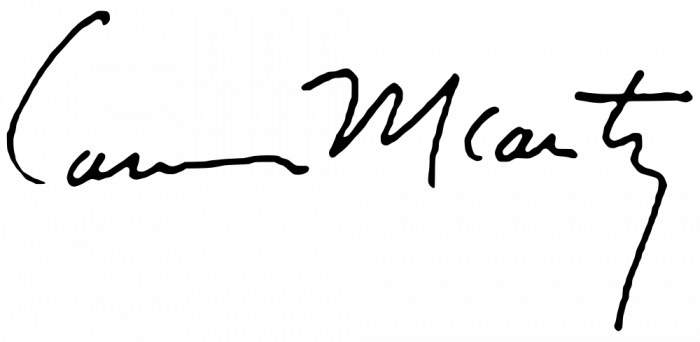
Creative Commons image via Wikimedia Commons
I first came to know the work of Cormac McCarthy through the 1973 novel Child of God, a portrait of a terrifyingly alienated loner who becomes a serial killer. The book so immerses readers in the dank, claustrophobic world of its protagonist, Lester Ballard, that one can almost smell the dirt and rotting flesh. Next, I read Blood Meridian, McCarthy’s psychedelically brutal epic about a mercenary band of scalp hunters who massacred Native Americans in the mid-nineteenth century Southwest. In McCarthy’s avalanche of prose—which lacks commas, apostrophes, quotation marks, and most every other mark of punctuation—long passages of grim death and carnage become hallucinatory trance-inducing incantations.
It’s never a good idea to identify an author too closely with their fiction; the most disturbingly effective works of horror and madness have very often been designed by writers of the highest emotional sensitivity and critical intelligence. This is certainly the case with McCarthy, whose work plumbs the deepest existential abysses. Nevertheless, I harbored certain anxious expectations of him, unsure if he was a writer I’d ever actually want to meet. So like many others, I was more than a little puzzled by McCarthy’s decision to give his first and only TV interview in 2007 on Oprah Winfrey’s wildly popular platform.
But among the many things we learned from their pleasant conversation is that McCarthy doesn’t care much for literary society. He doesn’t like writers so much as he loves writing and thinking, of all kinds. He spends most of his time with scientists, keeping—as we noted in a post last week—an office at a think tank called the Santa Fe Institute and doing most of his writing there on a noisy old typewriter. While developing relationships with physicists, McCarthy took an interest in their writing, and volunteered to copy-edit several scientific books. He overhauled the prose in physicist Lawrence Krauss’s Quantum Man, a biography of Richard Feynman, promising, says Krauss, that he “could excise all the exclamation points and semicolons, both of which he said have no place in literature.”
In 2005, McCarthy read the manuscript of the Harvard physicist Lisa Randall’s first book, Warped Passages: Unraveling the Mysteries of the Universe’s Hidden Dimensions. He “gave it a good copy-edit,” Randall said, and “really smoothed the prose.” Later he did the same for her second book, Knocking on Heaven’s Door. During that experience, she notes, “we had some nice conversations about the material. In fact, I saw a quote where he used a physics example I had given in response to a question about truth and beauty.”
Perhaps McCarthy sees this avocation as a challenge and an opportunity to learn. Perhaps he’s also doing research for his own work. His latest project, The Passenger, includes a character who is a Los Alamos physicist. But what about another, surprisingly out-of-the-blue editorial job he took on in 1996? Before he applied his austerities to Krauss and Randall’s work, he received an article from theoretical economist and friend W. Brian Arthur. The piece, scheduled to be published in the Harvard Business Review, was titled “Increasing Returns and the New World of Business.”
After mailing McCarthy the article, Arthur called and asked him how he liked it. “There was a silence on the line,” he tells Rick Tetzeli in an interview for Fast Company, “and then he said, ‘Would you be interested in some editorial help on that?’” The two spent four hours going over the writing. “Let’s say the piece was better for all the hours Cormac and I spent poring over every sentence,” Arthur says, noting that his editor called in a “slight panic” after hearing about the collaboration. You can read the full article here. It’s “a lot punchier and more sharply worded than you might expect, given its subject matter,” writes The Onion’s A.V. Club. It also contains a lot more punctuation than we might expect, given its copy-editor’s philosophy.
“Increasing Returns and the New World of Business” became one of Harvard Business Review’s “most influential articles” Tetzeli writes. “Even now, the theory of increasing returns is as important as ever: it’s at the heart of the success of companies such as Google, Facebook, Uber, Amazon, and Airbnb.” Did McCarthy’s encounter with Arthur’s theory appear in his later fiction? Who knows. Perhaps where Arthur’s vision of economic growth predicted the massive tech giants to come, McCarthy’s keen mind saw the ever-increasing profits of business savvy drug cartels like those in No Country for Old Men and his Ridley Scott collaboration The Counselor.
via The A.V. Club
Related Content:
Cormac McCarthy’s Three Punctuation Rules, and How They All Go Back to James Joyce
Werner Herzog and Cormac McCarthy Talk Science and Culture
Josh Jones is a writer and musician based in Durham, NC. Follow him at @jdmagness
Read More...Alexis De Tocqueville’s Democracy in America: An Animated Introduction to the Most Insightful Study of American Democracy
We cannot rightly see ourselves without honest feedback. Those who surround themselves with sycophants and people just like them only hear what they want to hear, and never get an accurate sense of their capabilities and shortcomings. And so the best feedback often comes from people outside our in-groups. This can be as true of nations as it can be of individuals, provided our critics are charitable, even when unsparingly honest, and that they take a genuine interest in our well-being.
These qualities well describe one of the sharpest critics of the United States in the past two centuries. Alexis de Tocqueville, aristocratic French lawyer, historian, and political philosopher, who traveled to the fledgling country in 1831 to observe a nation then in the grip of a populist fever under Andrew Jackson, a president who became notorious for his expropriation of indigenous land, ruthless relocation policies, and embrace of Southern slavery. But the groups who flourished under Jackson’s rule did so with a tremendous enthusiasm that the French thinker admired but also viewed with a very skeptical eye.
De Tocqueville published his observations and analyses of the United States in a now-famous book, Democracy in America. Though we’ve come to take the idea of democracy for granted, for the young Frenchman, a child of Napoleonic Europe, it was “a highly exotic and new political option,” as Alain de Botton tells us in his animated video introduction above. De Tocqueville “presciently believed that democracy was going to be the future all over the world, and so he wanted to know, ‘what would that be like?’”
With a grant from the French government, De Tocqueville traveled the country (then less than half its current size) for nine months, getting to know its people and customs as best he could, and making a series of general observations that would form the vignettes and arguments in his book. He was “particularly alive to the problematic and darker sides of democracy.” De Botton discusses five critical insights from Democracy in America. See three of them below, with quotes from De Tocqueville himself.
1. Democracy Breeds Materialism.
For De Tocqueville one kind of materialism—the excessive pursuit of wealth—disposed the country to another, “a dangerous sickness of the human mind”—the denial of a spiritual or intellectual life. “While man takes pleasure in this honest and legitimate pursuit of well-being,” he wrote, “it is to be feared that in the end he may lose the use of his most sublime faculties, and that by wanting to improve everything around him, he may in the end degrade himself.”
De Tocqueville, says De Botton, observed that “money seemed to be quite simply the only achievement that Americans respected” and that “the only test of goodness for any item was how much money it happens to make.”
2. Democracy Breeds Envy & Shame
“When all the prerogatives of birth and fortune have been abolished,” wrote De Tocqueville, “when every profession is open to everyone, an ambitious man may think it is easy to launch himself on a great career and feel that he has been called to no common destiny. But this is a delusion which experience quickly corrects.” Unable to rise above his circumstances, and yet believing that he should be equal to his neighbors in achievements, such a person may blame himself and feel ashamed, or succumb to envy and ill will.
De Tocqueville was far too optimistic about the abolishment of “prerogatives of birth and fortune,” but many Americans might recognize themselves still in his general picture, in which “the sense of unlimited opportunity could initially encourage a surface cheerfulness.” And yet, De Botton notes, “as time passed and the majority failed to raise themselves, Tocqueville noted that their mood darkened, that bitterness took hold and choked their spirits, and that their hatred of themselves and their masters grew fierce.”
3. Tyranny of the Majority
De Tocqueville, De Botton says, thought that “democratic culture… often ends up demonizing any assertion of difference, and especially cultural superiority, even though such attitudes might be connected with real merit.” In such a state, “society has an aggressive leveling instinct.”
It wasn’t only attacks on high culture that De Tocqueville feared, but what he called the “Omnipotence of the Majority,” a phrase he used to denote the power of public opinion as an almost totalitarian means of social control. In volume two of his study, published in 1840, De Tocqueville devoted particular attention to “the power which that majority naturally exercises over the mind…. By whatever political laws men are governed in the ages of equality, it may be foreseen that faith in public opinion will become for them a species of religion, and the majority its ministering prophet.”
From this prediction, De Tocqueville foresaw “two tendencies; one leading the mind of every man to untried thoughts, the other prohibiting him from thinking at all.”
De Botton goes on to discuss two closely related critiques: democracy’s suspicion of all authority and its undermining of free thought. Rather than encountering the kind of marketplace of ideas the country prides itself on fostering, he found in few places “less independence of mind, and true freedom of discussion, than in America.” The criticism is harsh, and De Tocqueville did not flatter his hosts often, and yet for all of its “inherent drawbacks,” De Botton writes at the School of Life, the Frenchman “isn’t anti-democratic.”
His aim is “to get us to be realistic” about democratic society and its tendencies to inhibit rather than enlarge many freedoms. As Arthur Goldhammer observes at The Nation, De Tocqueville believed that “True freedom lay not in the pursuit of individualistic aims, but “in ‘slow and tranquil’ action in concert with others sharing some collective purpose.”
Related Content:
Bertrand Russell’s Ten Commandments for Living in a Healthy Democracy
Josh Jones is a writer and musician based in Durham, NC. Follow him at @jdmagness
Read More...Support Us
We're hoping to rely on loyal readers, rather than erratic ads. Please click the Donate button and support Open Culture. You can use Paypal, Venmo, Patreon, even Crypto! We thank you!

About Us

Open Culture scours the web for the best educational media. We find the free courses and audio books you need, the language lessons & educational videos you want, and plenty of enlightenment in between.
Advertise With Us

FREE UPDATES!
GET OUR DAILY EMAIL
Get the best cultural and educational resources on the web curated for you in a daily email. We never spam. Unsubscribe at any time.
FOLLOW ON SOCIAL MEDIA

Open Culture editor Dan Colman scours the web for the best educational media. He finds the free courses and audio books you need, the language lessons & movies you want, and plenty of enlightenment in between.
Advertise With Us


