Watch Coda, a Prize-Winning, Thought-Provoking Animation About a Lost Soul’s Encounter with Death
Alan Holly’s short animated film, Coda, was shortlisted for the 2015 Academy Awards and nominated for an Annie Award, on its way to winning 18 awards at film festivals across the world (including Best Animated Short Film at South by Southwest). As you probably know, a coda is typically the passage that brings a song/musical piece to a close. In the case of Holly’s film, it refers to the end of life, a soul’s attempt to bargain with Death before eventually accepting his fate.
According to Filmbase, the nine-minute, hand-animated film is “the culmination of two years of painstaking work by a small team of dedicated animation artists” in Ireland. And it’s voiced “by Brian Gleeson (Standby, The Stag, Love/Hate) and Orla Fitzgerald (The Wind that Shakes the Barley).”
Aesthetically, writes Short of the Week, the “film combines many elements in a unique way—the flat shapes and refined color palettes (seen also in work by Matthias Hoegg) with the painterly, organic movement of greats like Miyazaki. In fact, one could almost view the film as a modern day Miyazaki film with it’s piano score, surreal elements, and powerful characters.”
Coda will be added to our list of Free Animations, a subset of our collection, 4,000+ Free Movies Online: Great Classics, Indies, Noir, Westerns, Documentaries & More. You can watch it above.
If you would like to support the mission of Open Culture, consider making a donation to our site. It’s hard to rely 100% on ads, and your contributions will help us continue providing the best free cultural and educational materials to learners everywhere. You can contribute through PayPal, Patreon, and Venmo (@openculture). Thanks!
Related Content:
Death: A Free Philosophy Course from Yale
Rik Mayall Voices the Animation “Don’t Fear Death” Just Months Before His Untimely Passing
Read More...
How to Make the World’s Smallest Cup of Coffee, from Just One Coffee Bean
The Finnish coffee company, Paulig, has been around for a good long while–since 1876, to precise. But only in 2017 did they get around to doing this–enlisting Helsinki designer Lucas Zanotto “to make the smallest cup of coffee, out of 1 bean.” Zanotto doesn’t need much more than a nail file, candle, and thimble-sized cup to produce that tiny cup of joe. Conceptually, it’s a neat exercise in efficiency and conservation. But, practically speaking, will it get you through the day?
If you would like to support the mission of Open Culture, consider making a donation to our site. It’s hard to rely 100% on ads, and your contributions will help us continue providing the best free cultural and educational materials to learners everywhere. You can contribute through PayPal, Patreon, and Venmo (@openculture). Thanks!
Related Content:
A Rollicking French Animation on the Perils of Drinking a Little Too Much Coffee
Philosophers Drinking Coffee: The Excessive Habits of Kant, Voltaire & Kierkegaard
David Lynch Directs a Mini-Season of Twin Peaks in the Form of Japanese Coffee Commercials
“The Virtues of Coffee” Explained in 1690 Ad: The Cure for Lethargy, Scurvy, Dropsy, Gout & More
Read More...Philosophical, Sci-Fi Claymation Film Answers the Timeless Question: Which Came First, the Chicken or the Egg?
It’s a question that’s occupied our greatest thinkers, from Aristotle and Plato to Neil deGrasse Tyson and Bill Nye:
Which came first—the chicken or the egg?
The debate will likely rage as long as there’s a faith-based camp to square off against the evidence-based camp.
With that in mind, and the weekend looming, we’re inclined to go with the Claymation camp, in the form of Time Chicken, Nick Black’s 6‑minute stop-motion meditation, above.
Described by its creator as a “philosophical-action-fantasy into the world of science, religion, knowledge and creation,” Time Chicken benefits from an appropriately bombastic original score performed by the Prague Symphony Orchestra and the seeming-eyewitness testimony of its admittedly clay-based, all-poultry cast.
Black’s copious cinematic references and science fiction tropes are every bit as delectable as a Mughal style egg-stuffed whole chicken slow cooked in a rich almond-poppy seeds-yogurt-&-saffron gravy.
Kudos to the filmmaker, too, for eschewing the uncredited dubbing that made fellow claymator Nick (Park)’s Chicken Run a crossover hit, trusting instead in the (unsubtitled) original language of his subjects.
Readers, watch this hilarious little film and weigh in. Which came first? The chicken? Or the egg?
Related Content:
Ayun Halliday is an author, illustrator, theater maker and Chief Primatologist of the East Village Inky zine. Follow her @AyunHalliday.
Read More...Hear What the Language Spoken by Our Ancestors 6,000 Years Ago Might Have Sounded Like: A Reconstruction of the Proto-Indo-European Language
As scholars of ancient texts well know, the reconstruction of lost sources can be a matter of some controversy. In the ancient Hebrew and less ancient Christian Biblical texts, for example, critics find the remnants of many previous texts, seemingly stitched together by occasionally careless editors. Those source texts exist nowhere in any physical form, complete or otherwise. They must be inferred from the traces they have left behind—signatures of diction and syntax, stylistic and thematic preoccupations….
So it is with the study of ancient languages, but since oral cultures far predate written ones, the search for linguistic ancestors can take us back to the very origins of human culture, to times unremembered and unrecorded by anyone, and only dimly glimpsed through scant archaeological evidence and observable aural similarities between vastly different languages. So it was with the theoretical development of Indo-European as a language family, a slow process that took several centuries to coalesce into the modern linguistic tree we now know.
The observation that Sanskrit and ancient European languages like Greek and Latin have significant similarities was first recorded by a Jesuit missionary to Goa, Thomas Stephens, in the sixteenth century, but little was made of it until around 100 years later. A great leap forward came in the mid-nineteenth century when German linguist August Schleicher, under the influence of Hegel, published his Compendium of the Comparative Grammar of the Indo-European Languages. There, Schleicher made an extensive attempt at reconstructing the common ancestor of all Indo-European languages, “Proto-Indo-European,” or PIE, for short, thought to have originated somewhere in Eastern Europe, though this supposition is speculative.
To provide an example of what the language might have been like Schleicher made up a fable called “The Sheep and the Horses” as a “sonic experiment.” The story has been used ever since, “periodically updated,” writes Eric Powell at Archaeology, “to reflect the most current understanding of how this extinct language would have sounded when it was spoken some 6,000 years ago.” Having no access to any texts written in Proto-Indo-European (which may or may not have existed) nor, of course, to any speakers of the language, linguists disagree a good deal on what it should sound like; “no single version can be considered definitive.”
And yet, since Schleicher’s time, the theory has been considerably refined. At the top of the post, you can hear one such refinement based on work by UCLA professor H. Craig Melchert and read by linguist Andrew Byrd. See a translation of Schleicher’s story, “The Sheep and the Horses” below:
A sheep that had no wool saw horses, one of them pulling a heavy wagon, one carrying a big load, and one carrying a man quickly. The sheep said to the horses: “My heart pains me, seeing a man driving horses.” The horses said: “Listen, sheep, our hearts pain us when we see this: a man, the master, makes the wool of the sheep into a warm garment for himself. And the sheep has no wool.” Having heard this, the sheep fled into the plain.
Byrd also reads another story in hypothetical Proto-Indo-European, “The King and the God,” using “pronunciation informed by the latest insights into PIE.”
See Powell’s article at Archaeology for the written transcriptions of both Schleicher’s and Melchert/Byrd’s versions of PIE, and see his article here to learn about the archeological evidence for the Bronze Age speakers of this theoretical linguistic common ancestor.
Note: The wonderful image that accompanies this post on Facebook and Twitter comes from this post in our archive: The Tree of Languages Illustrated in a Big, Beautiful Infographic. It was created by Minna Sundberg and can be purchased as a poster here.
via io9
Related Content:
Was There a First Human Language?: Theories from the Enlightenment Through Noam Chomsky
Hear The Epic of Gilgamesh Read in its Original Ancient Language, Akkadian
Learn Latin, Old English, Sanskrit, Classical Greek & Other Ancient Languages in 10 Lessons
Josh Jones is a writer and musician based in Durham, NC. Follow him at @jdmagness
Read More...The Coffee Revolt of 1674: When Women Campaigned to Prohibit “That Newfangled, Abominable, Heathenish Liquor Called COFFEE”
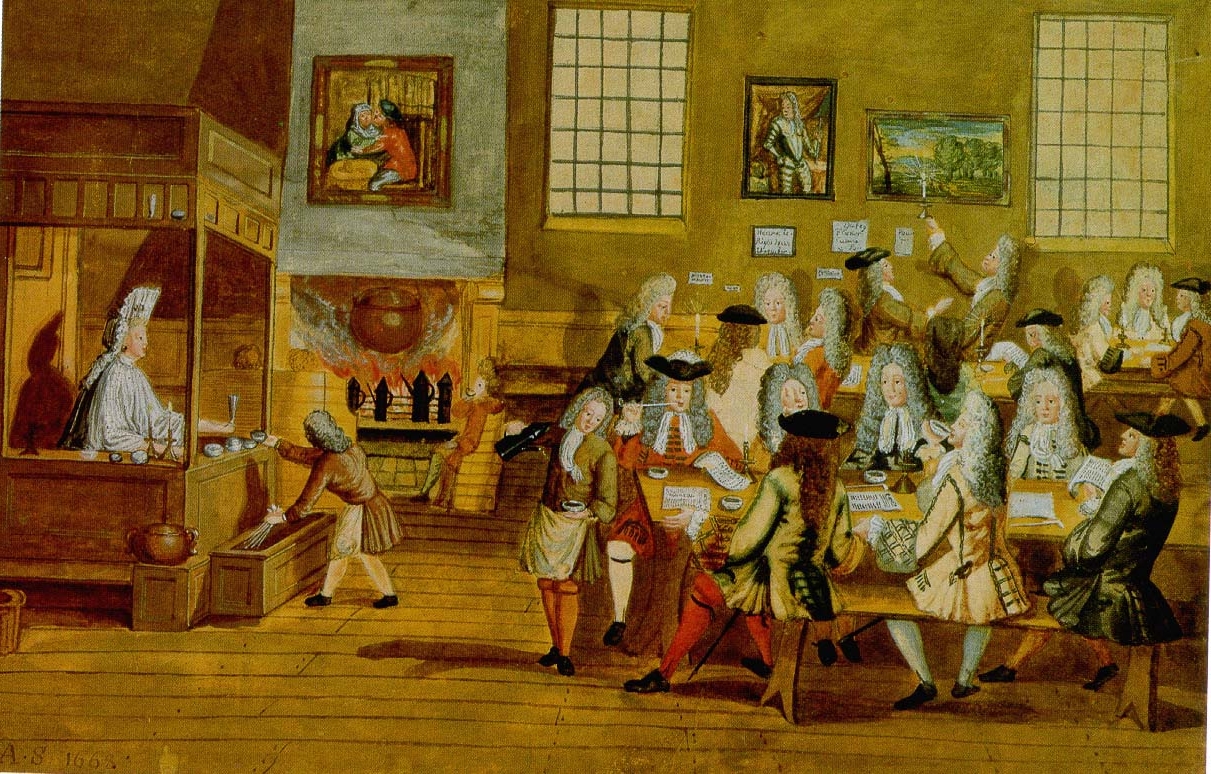
We denizens of the craft-roasting, wi-fi-connected 21st century know well how to drink voluminous quantities of coffee and argue our opinions. In 17th-century London, however, such pursuits could look shocking and dangerous, especially since they happened in coffee houses, the new urban spaces where, according to Res Obscura’s Benjamin Breen, you could “bet on bear fights, warm your legs by the fire, witness public dissections (human and animal), solicit prostitutes (male and female), buy and sell stocks, purchase tulips or pornographic pamphlets, observe the activities of spies, dissidents, merchants, and swindlers, and then read your mail, delivered directly to your table.”
The patrons, while engaging in all that, partook of “a new drug from the Muslim world—black, odiferous, frightening, bewitching — called ‘coffee.’ ” Quickly finding itself subject to a great deal of scientific research and everyday argument as to its merits and demerits, the drink set off the satirical “Coffee Revolt of 1674,” which began that year with a pamphlet called “The Womens Petition Against Coffee,” purporting to offer “The Humble Petitions and Address of Several Thousands of Buxome Good-Women, Languishing in Extremity of Want.”
It seems that England, once “a Paradise for Women” thanks to “the brisk Activity of our men, who in former Ages were justly esteemed the Ablest Performers in Christendome,” had, for the non-coffee-drinking sex, become a deeply unsatisfying place:
The dull Lubbers want a Spur now, rather than a Bridle: being so far from dowing any works of Supererregation that we find them not capable of performing those Devoirs which their Duty, and our Expectations Exact. The Occasion of which Insufferable Disaster, after a furious Enquiry, and Discussion of the Point by the Learned of the Faculty, we can Attribute to nothing more than the Excessive use of that Newfangled, Abominable, Heathenish Liquor called COFFEE, which Riffling Nature of her Choicest Treasures, and Drying up the Radical Moisture, has so Eunucht our Husbands, and Cripple our more kind Gallants, that they are become as Impotent as Age, and as unfruitful as those Desarts whence that unhappy Berry is said to be brought.
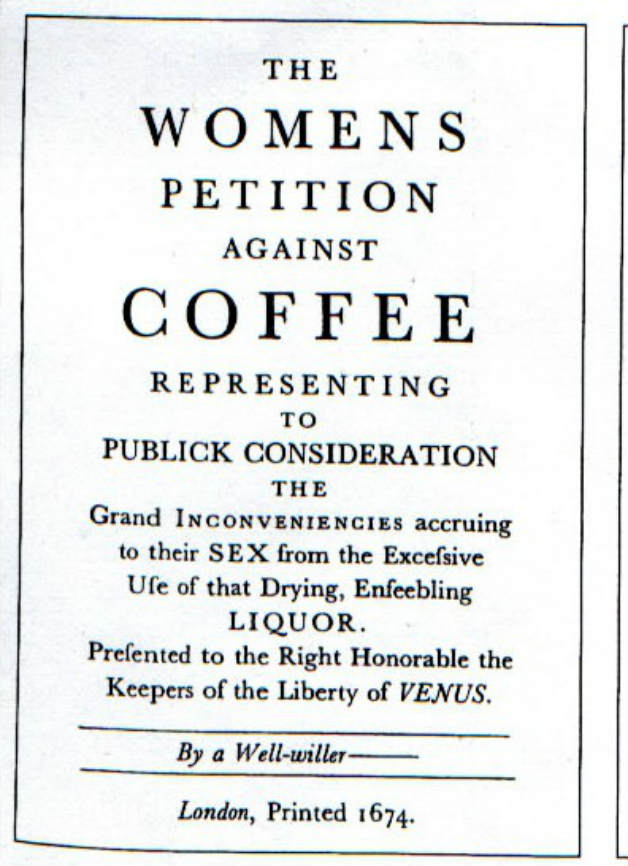
Coffee, so insist the Buxome Good-Women, renders the men of England “as Lean as Famine, as Rivvel’d as Envy, or an old meager Hagg over-ridden by an Incubus. They come from it with nothing moist but their snotty Noses, nothing stiffe but their Joints, nor standing but their Ears.” These charges drew a response in the form of the “Mens Answer to the Womens Petition Against Coffee, Vindicating Their own Performances, and the Vertues of that Liquor, from the Undeserved Aspersions lately cast upon them by their SCANDALOUS PAMPHLET.” In it, the “men” ask the “women,” among other questions,
Why must innocent COFFEE be the object of your Spleen? That harmless and healing Liquor, which Indulgent Providence first sent amongst us, at a time when Brimmers of Rebellion, and Fanatick Zeal had intoxicated the Nation, and we wanted a Drink at once to make us Sober and Merry: ‘Tis not this incomparable settle Brain that shortens Natures Standard, or makes us less Active in the Sports of Venus, and we wonder you should take these Exceptions, since so many of the little Houses, with the Turkish Woman stradling on their Signs, are but Emblems of what is to be done within for your Conveniencies, meer Nurseries to promote the petulant Trade, and breed up a stock of hopeful Plants for the future service of the Republique, in the most thriving Mysteries of Debauchery; There being scarce a Coffee-Hut but affords a Tawdry Woman, a wonton Daughter, or a Buxome Maide, to accommodate Customers; and can you think that any which frequent such Discipline, can be wanting in their Pastures, or defective in their Arms?
“The extravagant claims for coffee made by men’s-health handbills exposed the commodity to satire,” writes Markman Ellis, author of The Coffee-House: A Cultural History, but “that coffee might have a deleterious effect on male virility was a theory accorded considerable scientific respect.” Still, pamphlets like the “Womens Petition” took as their target less the biological effects of coffee than “the new urban manners of masculine sociability that coffee represents. The satirist accuses coffee-house habitués of being ‘effeminate’ because they spend their time talking, reading, and pursuing their business rather than carousing, drinking, and whoring.” If any women of the 21st century would really prefer that men go back to those old ways — well, it would at least make for an interesting argument.
You can read online “The Womens Petition Against Coffee,” and “Mens Answer to the Womens Petition Against Coffee.”
For more background on the early days of coffee, see The Public Domain Review’s article, “The Lost World of the London Coffee House.”
Related Content:
“The Virtues of Coffee” Explained in 1690 Ad: The Cure for Lethargy, Scurvy, Dropsy, Gout & More
If Coffee Commercials Told the Unvarnished Truth
How Coffee Affects Your Brain: A Very Quick Primer
A Rollicking French Animation on the Perils of Drinking a Little Too Much Coffee
Based in Seoul, Colin Marshall writes and broadcasts on cities and culture. He’s at work on a book about Los Angeles, A Los Angeles Primer, the video series The City in Cinema, the crowdfunded journalism project Where Is the City of the Future?, and the Los Angeles Review of Books’ Korea Blog. Follow him on Twitter at @colinmarshall or on Facebook.
Read More...Patti Smith, Umberto Eco & Richard Ford Give Advice to Young Artists in a Rollicking Short Animation
Note: There are a couple brief not-safe-for-work moments in this film.
Patronizing, ponderous, well-meaning, self-aggrandizing, incoherent… young artists are subjected to a lot of unsolicited advice, and not just from their parents.
But what happens when a young artist actively seeks it out?
Daniella Shuhman turned to the Louisiana Channel’s series, “Advice to the Young,” feasting on the collected wisdom of such heavy hitters as performance artist Marina Abramovic, author Umberto Eco, artist Olafur Eliasson, and the multitalented Godmother of Punk, Patti Smith in preparation for her final project at Jerusalem’s Bezalel Academy of Arts and Design.
Her resultant short film, above, appears to be the work of a deliriously aggro inner child, one with a keen bullshit meter and an anarchic sense of humor.
“The most important advice I have is to have fun,” counsels novelist Jonathan Franzen—a man who allegedly wrote The Corrections while wearing earplugs, earmuffs, and a blindfold, then busted on Oprah Winfrey when she chose it for for her Book Club.
Cue great spurts of animated arterial blood.
At least Franzen bothers to sound encouraging… much more so than Abramovic, or fellow novelist Richard “Talk Yourself Out of It If You Possibly Can Because You’re Probably Not Going to Be Very Good At It” Ford.
(Parents struggling to come up with tuition may be relieved to learn that Ford’s on leave from Columbia University this term.)
Meanwhile, Shuhman breaks for NSFW territory to visualize artist Eliasson’s advice, a move that would surely please another Louisiana Channel personality, cartoonist David Shrigley. Perhaps it can be his consolation prize for not making the cut.
The pulsating reproductive organs aren’t entirely inappropriate. Listen to Eliasson’s full interview to hear him equate making art with making the world. Now that’s the sort of advice that will put a young artist to work!
Some of the more generous advice:
Build a good name, keep your name clean, don’t make compromises, don’t worry about making a bunch of money or being successful.
Don’t be embarrassed about what excites you.
If you are doing something weird that everybody hates, that might be something worth looking into and worth investigating.
Make your own way in the world. Wrap up warm. Eat properly, sensibly. Don’t smoke and phone your mom.
We love imagining the sort of unfettered advice Shuhman will one day be in a position to dispense.
You can see some of her post graduation illustration work on her Flickr page.
Related Content:
Ayun Halliday is an author, illustrator, theater maker and Chief Primatologist of the East Village Inky zine. Follow her @AyunHalliday.
Read More...John Coltrane Draws a Picture Illustrating the Mathematics of Music
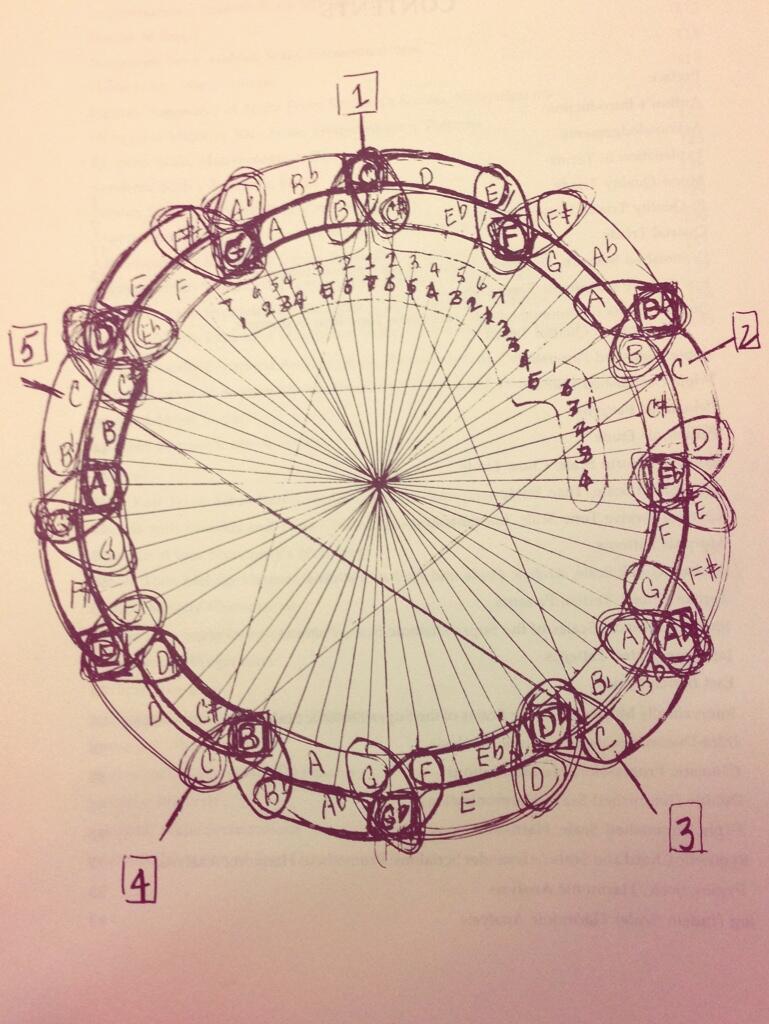
Physicist and saxophonist Stephon Alexander has argued in his many public lectures and his book The Jazz of Physics that Albert Einstein and John Coltrane had quite a lot in common. Alexander in particular draws our attention to the so-called “Coltrane circle,” which resembles what any musician will recognize as the “Circle of Fifths,” but incorporates Coltrane’s own innovations. Coltrane gave the drawing to saxophonist and professor Yusef Lateef in 1967, who included it in his seminal text, Repository of Scales and Melodic Patterns. Where Lateef, as he writes in his autobiography, sees Coltrane’s music as a “spiritual journey” that “embraced the concerns of a rich tradition of autophysiopsychic music,” Alexander sees “the same geometric principle that motivated Einstein’s” quantum theory.
Neither description seems out of place. Musician and blogger Roel Hollander notes, “Thelonious Monk once said ‘All musicans are subconsciously mathematicians.’ Musicians like John Coltrane though have been very much aware of the mathematics of music and consciously applied it to his works.”
Coltrane was also very much aware of Einstein’s work and liked to talk about it frequently. Musican David Amram remembers the Giant Steps genius telling him he “was trying to do something like that in music.”
Hollander carefully dissects Coltrane’s mathematics in two theory-heavy essays, one generally on Coltrane’s “Music & Geometry” and one specifically on his “Tone Circle.” Coltrane himself had little to say publically about the intensive theoretical work behind his most famous compositions, probably because he’d rather they speak for themselves. He preferred to express himself philosophically and mystically, drawing equally on his fascination with science and with spiritual traditions of all kinds. Coltrane’s poetic way of speaking has left his musical interpreters with a wide variety of ways to look at his Circle, as jazz musician Corey Mwamba discovered when he informally polled several other players on Facebook. Clarinetist Arun Ghosh, for example, saw in Coltrane’s “mathematical principles” a “musical system that connected with The Divine.” It’s a system, he opined, that “feels quite Islamic to me.”

Lateef agreed, and there may be few who understood Coltrane’s method better than he did. He studied closely with Coltrane for years, and has been remembered since his death in 2013 as a peer and even a mentor, especially in his ecumenical embrace of theory and music from around the world. Lateef even argued that Coltrane’s late-in-life masterpiece A Love Supreme might have been titled “Allah Supreme” were it not for fear of “political backlash.” Some may find the claim tendentious, but what we see in the wide range of responses to Coltrane’s musical theory, so well encapsulated in the drawing above, is that his recognition, as Lateef writes, of the “structures of music” was as much for him about scientific discovery as it was religious experience. Both for him were intuitive processes that “came into existence,” writes Lateef, “in the mind of the musican through abstraction from experience.”
If you would like to support the mission of Open Culture, consider making a donation to our site. It’s hard to rely 100% on ads, and your contributions will help us continue providing the best free cultural and educational materials to learners everywhere. You can contribute through PayPal, Patreon, and Venmo (@openculture). Thanks!
Related Content:
John Coltrane’s Handwritten Outline for His Masterpiece A Love Supreme
John Coltrane’s ‘Giant Steps’ Animated
Josh Jones is a writer and musician based in Durham, NC. Follow him at @jdmagness
Read More...Pink Floyd Adapts George Orwell’s Animal Farm into Their 1977 Concept Album, Animals (a Critique of Late Capitalism, Not Stalin)
Pink Floyd will always be known for their massively successful concept albums, and David Gilmour and Roger Waters’ tense, and personally explosive, dynamic on albums like Dark Side of the Moon seems reminiscent of another masterful songwriting duo known for rock high concepts. Indeed, “there would have been no Dark Side of the Moon, and no dragons-and-warlocks-themed prog-rock epics,” writes Jody Rosen at Slate, “had the Beatles not decided to don epaulets for their lark of an album cover and impersonate a vaudeville band.”
But where The Beatles’ loose conceptual masterpieces had their stormy and sad moments, they generally kept things chipper on albums like Sgt. Pepper’s. Pink Floyd seemed determined to do precisely the opposite, setting a template for entire genres of metal to follow. 1977’s Animals especially reminds me of nothing so much as an album by Megadeth or Mastodon. Musical and thematic similarities abound: epic, booming, doomy songs with lyrics completely uninterested in charming their listeners. “Sheep,” for example, contains a modified version of the 23rd Psalm: “The Lord is my shepherd. He maketh me to hang on hooks in high places and coverteth me to lamb cutlets.”
As the brutish title alerts us, Animals is an adaptation of George’s Orwell’s Animal Farm (and the origin of Pink Floyd’s giant inflatable pig). The schematic allegory of Orwell’s book lends a high degree of coherence to Waters’ extended songs—only five in total. But he supplies his own characteristic bile (he famously spit on a fan during one tour, an incident that inspired The Wall). It couldn’t be more appropriate. Where Orwell’s novel is a transparent attack on Stalinism, Waters adapts his critique to “the economic and ideological systems within late-twentieth century liberal democracies.” So argues Phil Rose in an in-depth study of Waters’ lyrical ideas. The album’s “primary concern… is to reveal the effects that technocratic capitalist relations have on the nature of human beings and the evident divisions that undemocratic structures of power create among us as individuals.”
Orwell showed the effects of “undemocratic structures” by reducing individuals to animal types, and so does Waters, simplifying the classes further into three (and leaving out humans altogether): the ruling pigs, praetorian and aspiring capitalist dogs, and the sheep, the mindless masses. The opener, “Pigs on the Wing (Part One)” (top), an urgent acoustic strummer that gets picked up at the end of the album in a strangely upbeat reprise, sets a dystopian tone with images that may now seem old hat (bear in mind Animals debuted five years before Blade Runner).
If you didn’t care what happened to me,
And I didn’t care for you,
We would zig zag our way through the boredom and pain
Occasionally glancing up through the rain.
Wondering which of the buggers to blame
And watching for pigs on the wing.
Most of the songs began their lives as a rough collection that came together after Dark Side of the Moon and Wish You Were Here. Waters insisted on the literary conceit, against Gilmour’s objections, but the themes had already been very much on his mind. “Dogs,” above, was once a sardonic rant called “You’ve Gotta Be Crazy,” and one of its bleakest stanzas survives from that earlier track:
You gotta keep one eye looking over your shoulder.
You know it’s going to get harder, and harder, and harder as you
get older.
And in the end you’ll pack up and fly down south,
Hide your head in the sand,
Just another sad old man,
All alone and dying of cancer.
There may be no sharper an antithesis to “When I’m 64.” The image is made all the more devastating by the homicidal paranoia surrounding it. Not all of the Orwell overlay works so well, but when it does, it does so with devastating force. Consider these lines from “Sheep,” as terrifying as any late Medieval judgement scene, and more effective for an age that may not believe in hell but has seen the slaughterhouses:
What do you get for pretending the danger’s not real.
Meek and obedient you follow the leader
Down well trodden corridors into the valley of steel.
What a surprise!
A look of terminal shock in your eyes.
Now things are really what they seem.
The band’s “bleakest studio album,” argues Brice Ezell at Consequence of Sound, “feels eerily relevant in these grave times.” I can’t help but agree. Pink Floyd greatly inspired much of the heavy music to follow, doing as much as Black Sabbath or Led Zeppelin, I’d argue, to engage the imaginations of metalheads and prog-rock storytellers. Much of the music that followed them sounds very dated, but forty years after its release, their gloomiest record—which is saying a lot—seems more relevant than ever. Animals ends on an ambivalent note, hopeful but wary. The pigs are still on the wing, and the only remedy at hand, Waters suggests in the last few lines, may be to “know that I care what happens to you / And I know that you care for me.”
Related Content:
Pink Floyd’s “Echoes” Provides a Soundtrack for the Final Scene of Kubrick’s 2001: A Space Odyssey
Josh Jones is a writer and musician based in Durham, NC. Follow him at @jdmagness
Read More...Rock Scene: Browse a Complete Online Archive of the Irreverent Magazine That Chronicled the 1970s Rock & Punk Scene

The website RockScenester, assembled by Ryan Richardson, has created a complete online archive of Rock Scene magazine, which ran from 1973 through 1982.
In the book There Goes Gravity: A Life in Rock and Roll, Rock Scene’s co-founder Lisa Robinson writes, the magazine “was printed on cheap paper and the ink came off on your hands.” “It was an irreverent, cult music magazine that documented and glamorized the rise of glamrock and punk rock.” “Part fanzine, part tabloid, Rock Scene was where you could see what happened before or after the show, particularly at parties and backstage.” “Years after Rock Scene was out out print,” Robinson continues, “musicians–Michael Stipe, Duran Duran’s Nick Rhodes, Pearl Jam’s Jeff Ament, Thurston Moore, Chrissie Hynde and many others–would tell me that they grew up trying to find it in their small towns.” They wouldn’t have that problem today.
Every single issue of Rock Scene, from 1973 through 1982, has been scanned cover to cover. (Richardson personally dropped $1500 on the project.) You can flip through editions featuring David Bowie (1973), The New York Dolls (1974), Lou Reed (1974), The Rolling Stones (1974), Peter Gabriel (1975), Patti Smith (1976) Robert Plant (1977), The Ramones (1977), Iggy Pop (1977) and Debbie Harry (1982). Or just explore the full archive here. There’s 54 in total.
More zines can be found in the Relateds below.
If you would like to support the mission of Open Culture, consider making a donation to our site. It’s hard to rely 100% on ads, and your contributions will help us continue providing the best free cultural and educational materials to learners everywhere. You can contribute through PayPal, Patreon, and Venmo (@openculture). Thanks!
Related Content:
Read More...Watch 70 Movies in HD from Famed Russian Studio Mosfilm: Classic Films, Beloved Comedies, Tarkovsky, Kurosawa & More
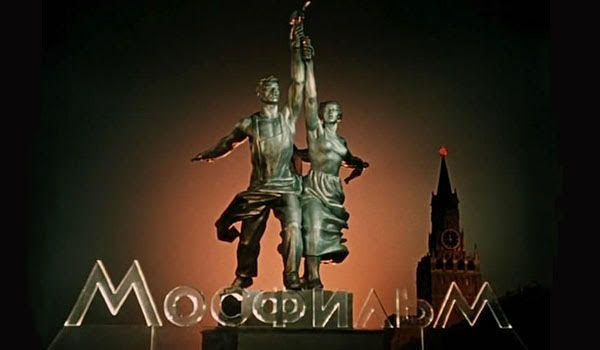
To most international cinephiles, the word Mosfilm immediately brings to mind two towering names in Russian motion pictures: Sergei Eisenstein and Andrei Tarkovsky. Both directors made not just important movies but took major steps to develop the visual language of film itself, and both worked for Mosfilm, one of Russia’s largest and oldest film studios. First established in 1923, it went on to produce more than 3,000 films during the Soviet era, some of which now define the cinema of that period. Now viewers around the world can enjoy their aesthetic lushness, historical interest, and pure entertainment value more easily than ever on Mosfilm’s Youtube channel, which offers among its many freely viewable pictures a selection of 70 films in high definition.
You’ll want to start, of course, with Eisenstein and Tarkovsky. Mosfilm has made available in HD the former’s Alexander Nevsky (1938) and much of the latter’s filmography: Ivan’s Childhood (1962), Andrei Rublev (1966), Solaris (1972), The Mirror (1975), and Stalker (1979).
For all their high artistic achievement, however, they may admittedly reinforce the West’s Cold War-era image of Russians as terribly serious people who seldom even crack a smile, let alone laugh. So why not follow those up with a dive into Mosfilm’s considerable HD selection of beloved, light-hearted Soviet comedies?
Of all Soviet comedy directors, Leonid Gaidai stands as by far the most successful. You can watch a fair few of his works, long and short, on Mosfilm’s HD playlist, including Operation Y and Shurik’s Other Adventures (1965); the intriguingly titled Kidnapping, Caucasian Style (1967); The Diamond Arm (1969), the most popular society comedy ever; The Twelve Chairs (1971); Ivan Vasilievich Changes Profession (1973), based on a play by Mikhail Bulgakov; and It Can’t Be! (1975). It also offers several films from Gaidai’s contemporary Eldar Ryazanov, who worked in a more satirical vein (and showed a surprising willingness to poke fun at the absurdities of Soviet life): Carnival Night (1956), the beloved musical Hussar Ballad (1962), Beware of the Car (1966), Office Romance (1977), Station for Two (1982), and A Cruel Romance (1984).
You may also notice the conspicuous presence of a certain highly notable non-Russian filmmaker: Akira Kurosawa, who in 1975 worked with Mosfilm to make Dersu Uzala, an adaptation of the memoirs of a trapper in Russia’s far eastern wilderness. It came as just one of Mosfilm’s many literary adaptations, the most famous perhaps being Sergei Bondarchuk’s 1969 vision of Leo Tolstoy’s War and Peace. On Mosfilm’s HD playlist you’ll also find two features drawing on the work of Anton Chekhov: Andrei Konchalovsky’s Uncle Vanya (1971), and Emil Loteanu’s My Tender and Affectionate Beast, or a Hunting Accident (1978), a feature-length adaptation of A Hunting Party.
Mosfilm’s Youtube channel features not just Soviet-era movies, but those from more recent years as well: the mighty film studio survived the dissolution of the Soviet Union itself, continuing to contribute to cinema as a quasi-private federation of independent studios. Its current Director General, Karen Shakhnazarov, boasts an impressive filmography of his own. You can get an HD taste of his work by watching Jazzmen (1983), Winter Evening in Gagra (1985), Courier (1986), Zerograd (1989), The Assassin of the Tsar (1991), Dreams (1993), Poisons, or the World History of Poisoning (2001), and The Vanished Empire (2008), all of which weave together the threads — the visionary, the historical, the everyday, the absurd — running through Mosfilm’s long history.
NOTE: Though many of the titles on Mosfilm’s HD playlist appear only in Russian, most of the films themselves come with English subtitles. Make sure to click the “CC” icon on the lower right of the Youtube player to turn them on.
Some of the films mentioned above will be added to our meta collection, 4,000+ Free Movies Online: Great Classics, Indies, Noir, Westerns, Documentaries & More.
Related Content:
Watch War and Peace: The Splendid, Epic Film Adaptation of Leo Tolstoy’s Grand Novel (1969)
Free Films by Andrei Tarkovsky, Sergei Eisenstein & Other Russian Greats
Watch Battleship Potemkin and Other Free Sergei Eisenstein Films
A Visual Introduction to Soviet Montage Theory: A Revolution in Filmmaking
Based in Seoul, Colin Marshall writes and broadcasts on cities and culture. He’s at work on a book about Los Angeles, A Los Angeles Primer, the video series The City in Cinema, the crowdfunded journalism project Where Is the City of the Future?, and the Los Angeles Review of Books’ Korea Blog. Follow him on Twitter at @colinmarshall or on Facebook.
Read More...Support Us
We're hoping to rely on loyal readers, rather than erratic ads. Please click the Donate button and support Open Culture. You can use Paypal, Venmo, Patreon, even Crypto! We thank you!

About Us

Open Culture scours the web for the best educational media. We find the free courses and audio books you need, the language lessons & educational videos you want, and plenty of enlightenment in between.
Advertise With Us

FREE UPDATES!
GET OUR DAILY EMAIL
Get the best cultural and educational resources on the web curated for you in a daily email. We never spam. Unsubscribe at any time.
FOLLOW ON SOCIAL MEDIA

Open Culture editor Dan Colman scours the web for the best educational media. He finds the free courses and audio books you need, the language lessons & movies you want, and plenty of enlightenment in between.
Advertise With Us

