An Animated History of Tea
Self proclaimed tea geek, Shunan Teng’s knowledge of her chosen subject extends well beyond the proper way to serve and prepare her best-loved beverage.
Her recent TED-Ed lesson on the History of Tea, above, hints at centuries of bloodshed and mercenary trade practices, discreetly masked by Steff Lee’s benign animation.
Addiction, war, and child labor—the last, a grim ongoing reality…. Meditate on that the next time you’re enjoying a nice cup of Darjeeling, or better yet, matcha, a preparation whose Western buzz is starting to approximate that of the Tang dynasty.
Even die-hard coffee loyalists with little patience for the ritualistic niceties of tea culture can indulge in some fascinating trivia, from the invention of the clipper ship to the possible health benefits of eating rather than drinking those green leaves.
Test your TQ post-lesson with TED-Ed’s quiz, or this one from Tea Drunk, Teng’s authentic Manhattan tea house.
Related Content:
George Orwell Explains How to Make a Proper Cup of Tea
10 Golden Rules for Making the Perfect Cup of Tea (1941)
“The Virtues of Coffee” Explained in 1690 Ad: The Cure for Lethargy, Scurvy, Dropsy, Gout & More
Ayun Halliday is an author, illustrator, theater maker and Chief Primatologist of the East Village Inky zine. She’ll be appearing onstage in New York City this June as one of the clowns in Paul David Young’s Faust 3. Follow her @AyunHalliday.
Read More...A Big List of Free Art Lessons on YouTube
It may seem like a dubious honor to belong to a select group that includes some of my favorite creative people: art school dropouts. But while a failed endeavor can be painful, many a dropout learns that the experience is valuable not only because failures can fuel future success, but also because the skills, techniques, and ways of thinking one picks up in the first, “boot camp,” year of art school are widely applicable to every creative endeavor.
My favorite art school class was simply called “Foundations.” As the name implies, it dealt exclusively with basic materials and techniques—for joining, painting, sculpting, building, etc. One learns to think of large, complicated, potentially overwhelming projects of as reducible in some sense to materials and techniques. What am I working with? What is the nature of this material and what are the best ways to shape it? What does it want to become?
These are practical, fundamental questions artists ask themselves, no matter how big or high concept their ideas. These days, the materials are likely to be more virtual than physical, or some creative mixture of the two. Still, similar considerations apply, as well as the basic skills of using color, perspective, shadow, and line effectively. In the free video tutorials here, you can learn many of those skills without attending, or dropping out, of art school. They may not provide a complete arts education, but they offer high quality lessons for artists needing to supplement or refresh their skill sets.
At the top, Ahmed Aldoori explains the color wheel and color palettes in Photoshop. In other videos on his YouTube channel, he gives tips on drawing hands (a particular challenge for every artist), artist anatomy, digital painting, and more. Another channel, Draw with Chris, offers free and premium content for both digital and traditional artists, such as the long video on shading technique above. He also has a popular two part series on life drawing (part 1 — part 2).
For artists and animators interested in “semi realistic, manga, and anime style characters, environments, and concept art,” the Lapuka channel features many free short videos on the basics, such as their short intro to “1,2, and 3 point perspective” above. Other videos teach “Multiplying and scaling in 1 point perspective,” “Cutting in 1 point perspective,” “Drawing with a mouse,” and rendering certain popular anime characters.
All of these tutorials come from a list compiled by Deviantart user DamaiMikaz, who has helpfully divided several dozen YouTube instructional series into categories like “Art Fundamentals,” “Tutorial & How to,” “Digital art software,” “Traditional Art,” and others. Whether you’re an aspiring artist, dabbling amateur, working professional, or an art school dropout picking the craft back up, you’ll find what you need here. Know of any other free video resources not listed in this archive? Let us and our readers know in the comments and we’ll add the primo picks to the list.
Below find the list created by DamaiMikaz:
Art fundamentals
People that teach you the fundamentals of art. Anatomy, color, perspective, etc
Ahmed Aldoori
CG Cookie ConceptTutorial & How to
How to’s and tutorials on various subjects
Ahmed Aldoori
Art of Wei
Art ProfBrushboost
CG Cookie Concept
DRAW with Chris
Draw with Jazza
Drawing Tutorials Online
FZDSCHOOL
Happy D. Artist
Imagine FX
Istebrak
Javi can draw!
Jesus Conde
Kienan Lafferty
LevelUp
My Drawing Tutorials
Proko
Sinix Design
Sycra
The Art of Aaron Blaise
The Drawfee Channel
Tyler Edlin
Will Terrell
Xia TaptaraDigital art software
Channels geared towards creating effects in digital art software
digitalfxcube
PHLEARN
Photoshop Training ChannelTraditional art
Channels doing traditional art
agnescecile
Baylee Jae
Happy D. Artist
James Gurney
Lachri Fine Art
Michael James Smith
Robin Clonts
Sara Tepes
Stanley Artgerm Lau
Super Ani
Zimou TanManga / Anime
Channels geared towards drawing manga/anime style
markcrilley
Nuei Neko
Sycra
Whyt MangaTimelapse paintings
Just stare in awe
agnescecile
Alice X. Zhang
Apterus Graphics
Asuka111 Art
Atey Ghailan
axel torvenius
BrotherBaston
Brushboost
Chris Cold
Concept Art Sessions
Daniel Wachter
Draw With Rydi
FZDSCHOOL
Ilya Kuvshinov
Ilya Tyljakov
James Gurney
Jesus Conde
Jordan Grimmer
Kienan Lafferty
Kim-Seang Hong
Kiwa
LevelUp
Lina Sidorova
Nuei Neko
Peixel
saejinoh
Sara Tepes
Scott Robertson
SpoonfishLee
Stanley Artgerm Lau
Super Ani
Xia Taptara
zephyo
Zimou TanCritique’s & Overpaints
People painting over other people’s painting. Great to get insight
Ahmed Aldoori
Art Prof
BORODANTE
CG Cookie Concept
FZDSCHOOL
Istebrak
Related Content:
Brian Eno on Why Do We Make Art & What’s It Good For?: Download His 2015 John Peel Lecture
Free Course: An Introduction to the Art of the Italian Renaissance
Josh Jones is a writer and musician based in Durham, NC. Follow him at @jdmagness
Read More...Soundgarden’s Chris Cornell Sings Haunting Acoustic Covers of Prince’s “Nothing Compares 2 U,” Michael Jackson’s “Billie Jean” & Bob Marley’s “Redemption Song”
I entered high school to the huge sounds of Soundgarden’s second album, Louder than Love, playing at home, in friends’ cars, on MTV’s 120 Minutes late at night.… The band’s debut, and two previous EPs released on Seattle’s Sub Pop records, had not attracted much notice outside of a fairly small scene. But Louder than Love—especially “Hands All Over”—was as hooky and alarming as breakthrough singles by other emerging bands on the other side of the country, while losing none of the propulsive grit, groove, and raw, metal/hardcore power of their earlier work. Thousands of new listeners started paying attention.
But there’s another reason the songs on Louder than Love resonated so strongly (and scored them a major label deal). The album announced singer Chris Cornell as a vocalist to be reckoned with—a singer with incredible power, melodic instinct, and a four-octave range.
On songs like “Hands All Over” and “Loud Love,” he broke away from a fairly narrow Ozzy Osbourne/Robert Plant style he’d cultivated and introduced a sound that took both influences in a direction neither had gone before, one full of anguish, urgency, and even menace.
Millions more got to know Cornell’s voice after Superunknown’s “Black Hole Sun,” but even then no one would have predicted the direction he would go in after leaving Soundgarden. He injected soul and sensitivity into songs like Audioslave’s “Original Fire” and “Be Yourself”—love ‘em or don’t—qualities we can hear in abundance in his covers of sensitive and soulful songs like Prince’s “Nothing Compares 2 U” and Michael Jackson’s “Billie Jean.” In his unplugged version of Jackson’s pop masterpiece the song acquires the heaviness and grievous beauty of a murder ballad. And I mean that entirely as a compliment. He brings “Nothing Compares 2 U” into “soulful new life,” as Slate writes, which is saying quite a lot, given that Sinead O’Connor’s version is more or less perfect.
Cornell took his own life at age 52 on Wednesday night after playing with a reunited Soundgarden in Detroit, and after struggling with depression for many years. It’s true he was never lauded as a songwriter of a Prince/Michael Jackson caliber. His lyrics were often tossed-off free associations rather than carefully crafted narratives. One’s appreciation for them is a matter of taste. But like the artists he covers here, both of whom also died tragically in their 50s, his music reflected a deep concern for the state of the world. This comes through clearly in songs like “Hands All Over,” “Hunger Strike,” and in some pointed comments he made during his final performance.
Rolling Stone has a few more acoustic Cornell covers of Metallica, the Beatles, Elvis Costello, and more, and they’re all great. He did a profoundly affecting, gospel-like take on Whitney Houston’s belter, “I Will Always Love You.” But for a true, and truly heartbreaking, example of how he could imbue a song with his “unforgettable vulnerability,” watch him play Bob Marley’s “Redemption Song” at New York’s Beacon Theater in 2015 above, in an absolutely riveting duet with his daughter, Toni. Cornell will be dearly missed by everyone who knew him, and by the millions of people who were deeply moved by his voice.
Related Content:
Prince Plays Unplugged and Wraps the Crowd Around His Little Finger (2004)
Johnny Cash & Joe Strummer Sing Bob Marley’s “Redemption Song” (2002)
Patti Smith’s Cover of Nirvana’s “Smells Like Teen Spirit” Strips the Song Down to its Heart
Josh Jones is a writer and musician based in Durham, NC. Follow him at @jdmagness
Read More...Guillermo del Toro Creates a List of His 20 Favorite Art House/Criterion Films
When it comes to films released by the Criterion Collection, we’d all struggle to narrow our favorites down to only ten, but we probably wouldn’t have quite as hard a time as Guillermo del Toro. The director of Mimic, Hellboy, and Pan’s Labyrinth characteristically takes it to another level, bemoaning the “unfair, arbitrary, and sadistic top ten practice,” crafting instead a series of “thematic/authorial pairings” (and in first place, a trifecta) for his Criterion “top-ten” feature. The list, whether he meant us to take it linearly or not, runs as follows:
- Akira Kurosawa’s Throne of Blood, High and Low, and Ran, the Emperor of Cinema’s “most operatic, pessimistic, and visually spectacular films.”
- Ingmar Bergman’s The Seventh Seal and Fanny and Alexander (theatrical version), which “have the primal pulse of a children’s fable told by an impossibly old and wise narrator, both “ripe with fantastical imagery and a sharp sense of the uncanny.”
- Jean Cocteau’s Beauty and the Beast and Georges Franju’s Eyes Without a Face, both of which “depend on sublime, almost ethereal, imagery to convey a sense of doom and loss: mad, fragile love clinging for dear life in a maelstrom of darkness.”
- David Lean’s Great Expectations and Oliver Twist, two “epics of the spirit [ … ] plagued by grand, utterly magical moments and settings” and laced with passages that “skate the fine line between poetry and horror.”
- Terry Gilliam’s Time Bandits and Brazil, the work of a “living treasure” who “understands that ‘bad taste’ is the ultimate declaration of independence from the discreet charm of the bourgeoisie” and tells stories in elaborate worlds “made coherent only by his undying faith in the tale he is telling.”
- Kaneto Shindo’s Onibaba and Kuroneko, a “perverse, sweaty double bill” fusing “horrors and desire, death and lust” that, when del Toro first saw them at age ten, “did some serious damage to my psyche.”
- Stanley Kubrick’s Spartacus and Paths of Glory, which “speak eloquently about the scale of a man against the tide of history, and both raise the bar for every ‘historical’ film to follow.”
- Preston Sturges’ Sullivan’s Travels and Unfaithfully Yours, “masterful films full of mad energy and fireworks, but Sullivan’s Travels also manages to encapsulate one of the most intimate reflections about the role of the filmmaker as entertainer.”
- Carl Theodor Dreyer’s Vampyr and Benjamin Christensen’s Häxan, the former “a memento mori, a stern reminder of death as the threshold of spiritual liberation” and the latter “the filmic equivalent of a hellish engraving by Bruegel or a painting by Bosch.”
- Victor Erice’s The Spirit of the Beehive and Charles Laughton’s The Night of the Hunter, “the two supreme works of childhood/horror [ … ] lamentations of worlds lost and the innocents trapped in them.”
Having already featured a tour of del Toro’s man cave and a tour of his imagination by way of his sketches here on Open Culture, it makes for a natural follow-up to offer this tour of his distinctive cinematic consciousness. A director since his childhood back in Mexico (then equipped with his dad’s Super 8, his own action figures, and a potato he once cast as a serial killer), he went on to study not filmmaking, strictly speaking, but makeup and special effects design. The resultant mastery of visual richness, especially in service of the grotesque, shows up even in his earliest available works, such as the 1987 short Geometria we posted a few years ago.
Del Toro’s next feature, a fantasy adventure set in Cold War America called The Shape of Water and involving a fish-man locked away in a secret government facility, will no doubt make even more use of all the tastes the director’s favorite Criterion films have instilled in him: for grand spectacle, for freakishness, for the uncanny, for “mad, fragile love,” and for sheer disturbance. May he continue to do “serious damage” to the psyches of his own audiences for decades to come.
Related Content:
Geometria: Watch Guillermo del Toro’s Very Early, Ghoulish Short Film (1987)
Sketches by Guillermo del Toro Take You Inside the Director’s Wildly Creative Imagination
A Guided Tour of Guillermo del Toro’s Creativity-Inducing Man Cave, “Bleak House”
Martin Scorsese Names His Top 10 Films in the Criterion Collection
120 Artists Pick Their Top 10 Films in the Criterion Collection
Based in Seoul, Colin Marshall writes and broadcasts on cities and culture. He’s at work on a book about Los Angeles, A Los Angeles Primer, the video series The City in Cinema, the crowdfunded journalism project Where Is the City of the Future?, and the Los Angeles Review of Books’ Korea Blog. Follow him on Twitter at @colinmarshall or on Facebook.
Read More...Noel Coward’s “Alice (Is At It Again)” Gets Reimagined as a Very Modern Fairy Tale: A Short Film Starring Sarah Snook
English playwright, lyricist, actor and raconteur Noel Coward (1899 –1973) is still remembered for his plays such as the wife-after-death comedy Blithe Spirit and Private Lives; his playlet Still Life, which became the classic David Lean film Brief Encounter, and his scripting and co-direction of the WW2 morale-booster In Which We Serve, also directed by Lean, for which Coward won an Honorary Academy Award. However, he’s perhaps better known now more as an image of archetypal mid-20th century Englishness, replete with dressing-gown and cigarette-holder, and the hundreds of witty songs and poems he wrote, such as Mad Dogs and Englishman and Mrs Worthington, which he performed in cabaret in his distinctively clipped English manner to much acclaim in London and, latterly, in Las Vegas.
His 1946 song Alice (Is At It Again), written and then cut from his flop musical Pacific 1860, became a standard of his cabaret act and, with its suggestive lyrics, risqué subject matter and sly wit, is typical of his oeuvre. It’s thus a surprising choice perhaps by rising Australian actress Sarah Snook for the subject of her new short film Alice, co-devised with director Laura Scrivano, and the second film of The Passion, a new online series of performed poetry films coming out of Australia. The first film in the series, A Lovesong, starring Daniel Henshall (from AMC’s Turn: Washington Spies), featured T.S. Eliot’s modernist masterpiece The Love Song of J. Alfred Prufrock (watch it below), so Alice is a change both in style and tone for the series, but continues the project’s experimentation in rendering poetry on film for a digital audience.
Sarah, who won critical acclaim for her genderswitching role in the 2015 science-fiction thriller Predestination, found the Coward text in a bookshop in San Francisco, while sourcing a text for her film for the series.
Says Sarah:
(Director) Laura and I were interested in the ideas of femininity and how that is expressed, particularly in sexual or sensual terms. When I read the poem, I was charmed by it and excited by the potential and challenge of contemporizing it for The Passion. Coward’s themes are very much of the time and place of the original lyrics’ writing, as is his take on them, while our adaptation is an updating, an exploration of female sexuality and empowerment that Coward plays with, and the wildness and freedom of discovering that. Our Alice, who I think nods to Coward’s, is breaking out of the strictures of her background, and being free and true to herself.
Originally Alice, as read by Coward, would have been performed with a patter, a rhythm of its own, with a sense of irony and a lot of wit, and certainly in his very particular RP accent. It’s hard to escape that as it’s written so well and embedded so deeply into the lines, with a particular scansion, but I wanted to go against that somewhat, while retaining and respecting Coward’s sparkle and playfulness.
Alice is the second film of The Passion series, in which actors select a text which has a personal significance for them or strikes a particular chord, and then work closely in collaboration with director Laura Scrivano to develop it as a new performance piece for film. A third film is currently in development. More information about the series can be found at this website.
Dan Prichard is an online film and webseries producer, based in Sydney, whose work explores identity, place, and the space between film and performance in the digital arena. Visit his website and follow him on twitter @georgekaplan81
Read More...Edward Gorey Illustrates H.G. Wells’ The War of the Worlds in His Inimitable Gothic Style (1960)
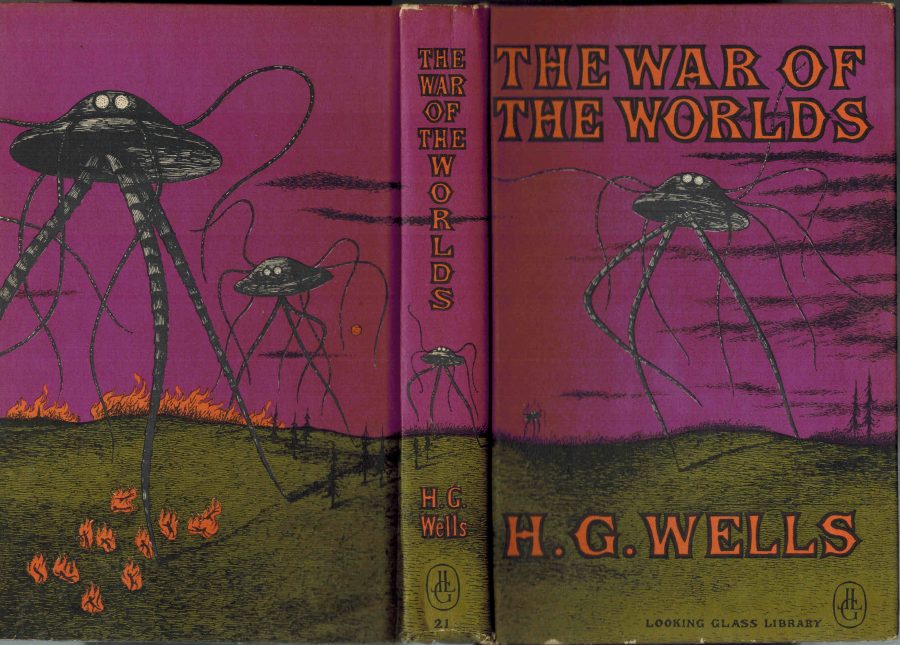
The story of malicious space aliens invading Earth has a resonance that knows no national boundaries. In fact, many modern versions make explicit the moral that only fighting off an existential threat from another planet could unify the inherently fractious human species. H.G. Wells’ 1898 novel The War of the Worlds, in many ways the archetypal telling of the space-invaders tale, certainly proved compelling on both sides of the pond: though set in Wells’ homeland of England, it made a lasting impact on American culture when Orson Welles produced a thoroughly localized version for radio, his infamous War of the Worlds Halloween 1938 broadcast. (Listen to it here.)
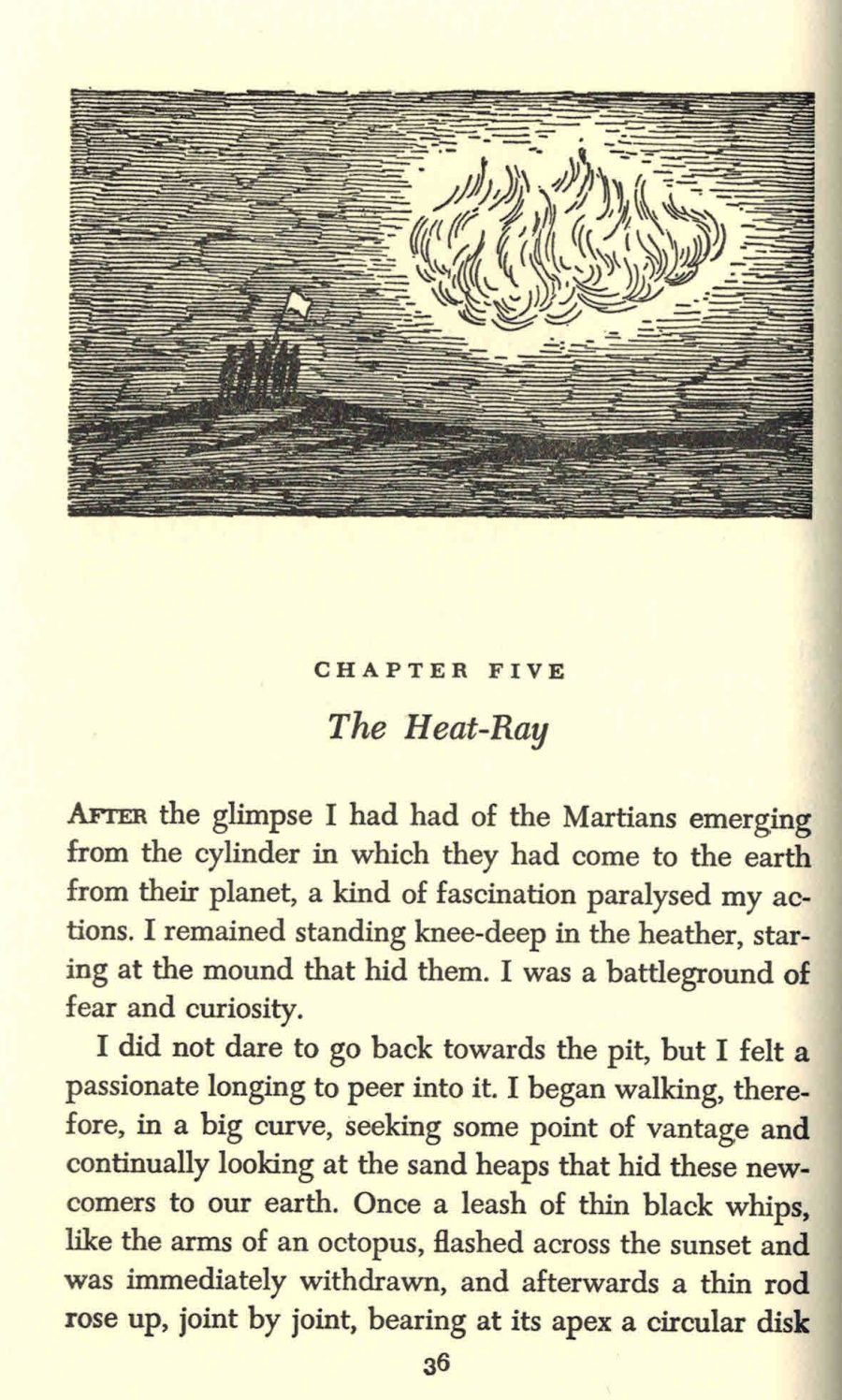
And so who better to illustrate a mid-2oth-century edition of the novel than Edward Gorey? He was born in and spent nearly all his life in America, but developed an artistic sensibility that struck its many appreciators as uncannily mid-Atlantic. His work continues to draw descriptions like “Victorian” and “gothic,” surely underscored by his association with the British literature-adapting television show Mystery!, for whose title sequences he drew characters and settings, and the young-adult gothic mystery novels of Anglophile author John Bellairs. The Gorey-illustrated War of the Worlds came out in 1960 from Looking Glass Library, featuring his drawings not just at the top of each chapter but on its wraparound cover as well. Though out of print, you can find old copies for sale online.
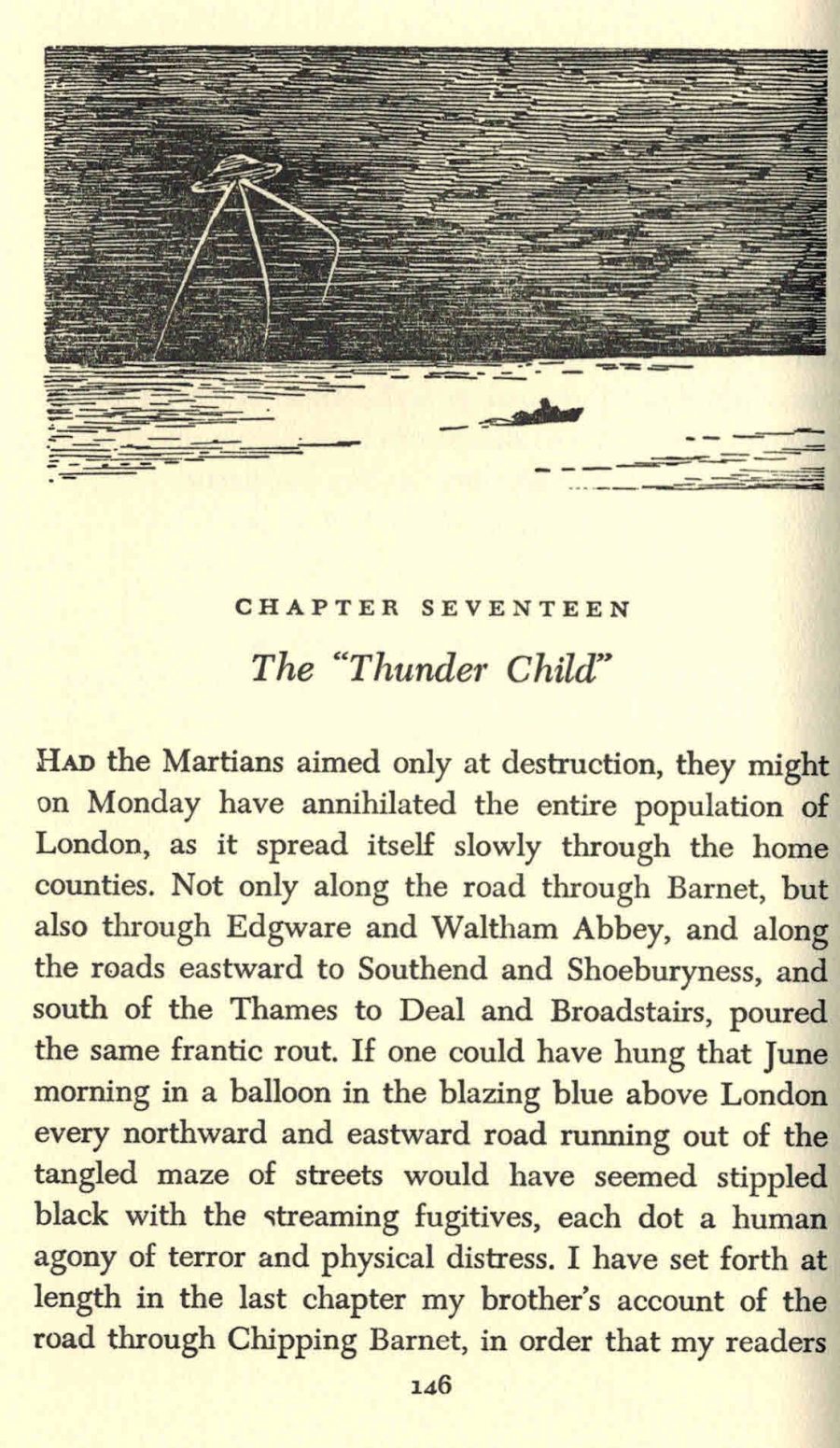
Gorey had begun his career in the early 1950s at the art department of publisher Doubleday Anchor, creating book covers and occasionally interior illustrations. In addition to Bellairs’ novels, he would also go on to put his artistic stamp on such literary classics as Bram Stoker’s Dracula and T.S. Eliot’s Old Possum’s Book of Practical Cats, bringing to each his signature combination of whimsy and dread in just the right proportions. Given the inherent ominousness and threat of The War of the Worlds, Gorey’s dark side comes to the fore as the story’s long-legged terrors arrive and wreak havoc on Earth, only to fall victim to common disease.
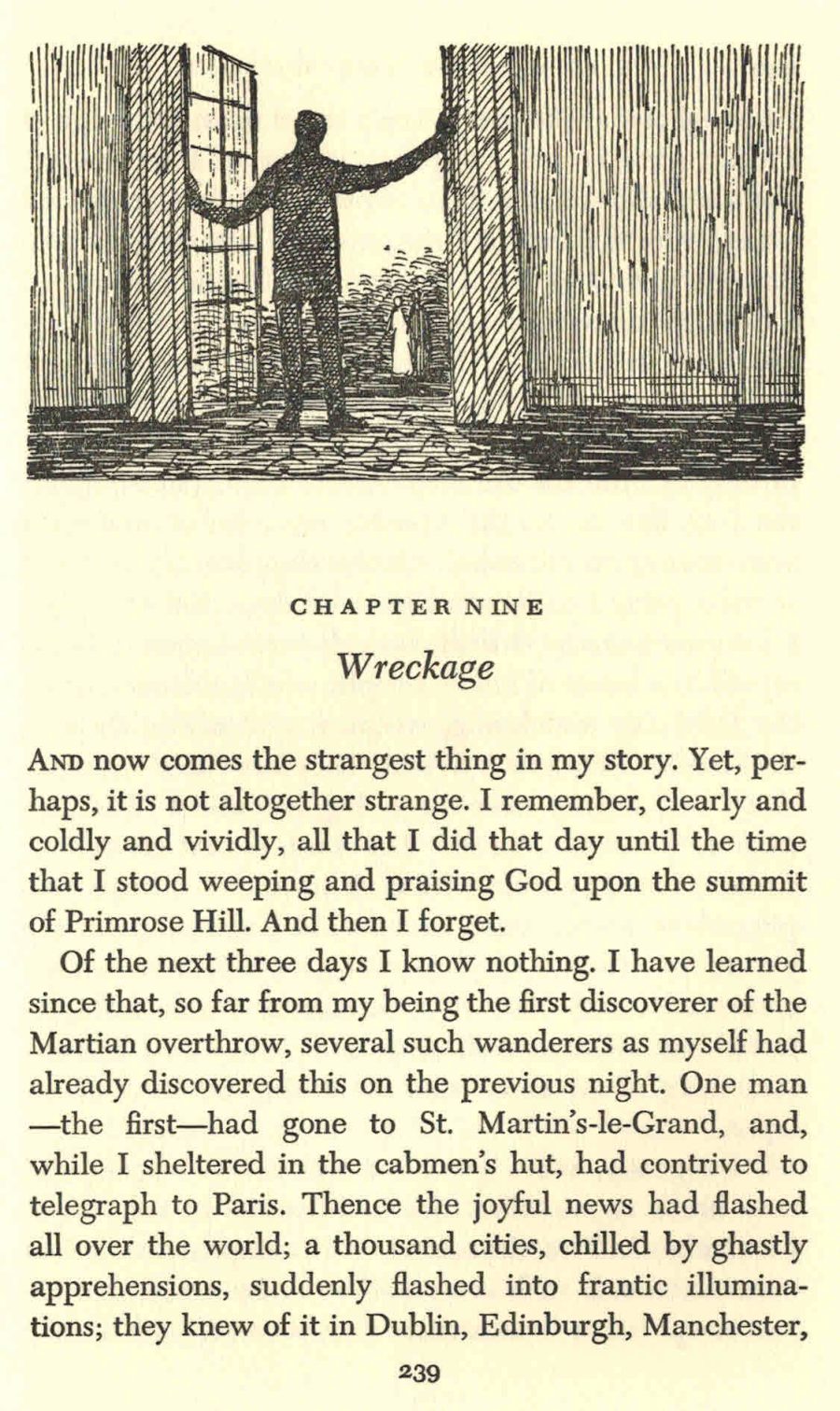
Gorey’s War of the Worlds illustrations also seem to draw some inspiration from the very first ones that accompanied the novel upon its initial publication as a Pearson’s Magazine serial in 1897. You can compare and contrast them by browsing the high-resolution scans of the out-of-print 1960 Looking Glass Library War of the Worlds at this online exhibition at Loyola University Chicago Digital Special Collections, in partnership with the Edward Gorey Charitable Trust.
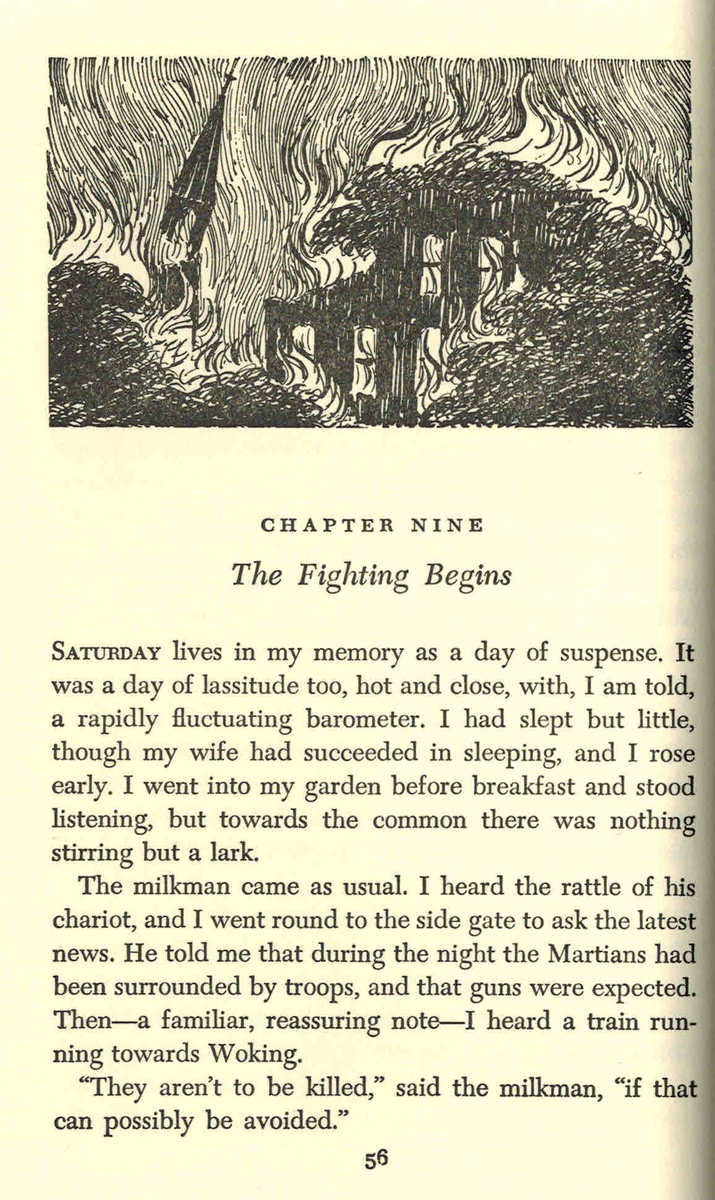
Though conceptually similar to the illustrations in Pearson’s, drawn by an artist (usually of children’s books) named Warwick Goble, they don’t get into quite as much detail — but then, they don’t have to. To evoke a complex mixture of fascinated anticipation and creeping fear, Gorey never needed more than an old house, a huddle of silhouettes, or a pair of eyes glowing in the darkness.
via Heavy Metal
Related Content:
The Very First Illustrations of H.G. Wells’ The War of the Worlds (1897)
Hear Orson Welles’ Iconic War of the Worlds Broadcast (1938)
The Great Leonard Nimoy Reads H.G. Wells’ Seminal Sci-Fi Novel The War of the Worlds
Based in Seoul, Colin Marshall writes and broadcasts on cities and culture. He’s at work on a book about Los Angeles, A Los Angeles Primer, the video series The City in Cinema, the crowdfunded journalism project Where Is the City of the Future?, and the Los Angeles Review of Books’ Korea Blog. Follow him on Twitter at @colinmarshall or on Facebook.
Read More...The Frida Kahlo Action Figure
Earlier this week, an organization called “Today Is Art Day” launched a Kickstarter campaign to produce the latest in a line of action figures. First came the Vincent van Gogh action figure. Now, joining him in the ‘Art History Heroes Collection,’ there will be a Frida Kahlo figure. (Yes, they’ve already raised $19,490, surpassing their $14,585 goal.) Standing 5 inches tall, made of high quality plastic, Frida will come with a monkey attached to her back, and a detachable surrealist heart. Expect delivery in September.
If you would like to support the mission of Open Culture, consider making a donation to our site. It’s hard to rely 100% on ads, and your contributions will help us continue providing the best free cultural and educational materials to learners everywhere. You can contribute through PayPal, Patreon, and Venmo (@openculture). Thanks!
Related Content:
Frida Kahlo’s Colorful Clothes Revealed for the First Time & Photographed by Ishiuchi Miyako
Frida Kahlo and Diego Rivera Visit Leon Trotsky in Mexico, 1938
Read More...Timelapse Film Shows How the British Library Digitized the World’s Largest Atlas, the 6‑Foot Tall “Klencke Atlas” from 1660
As a way of currying favor with a monarch, Johannes Klencke’s gift to Charles II (1630–1685) was one of the most audacious and beautiful objects ever offered. Klencke was a Dutch sugar merchant and knew that the king loved maps, and hoped that his gift would land him a favorable trading deal. (It did. He got knighted.)
The gift, the 1660 Klencke Atlas, is one of the world’s biggest books at nearly six feet tall and nearly seven and a half feet wide when open, and it contains 41 wall maps of various accuracy. We first posted about the Klencke Atlas back in 2015, where you can see a short BBC doc on the British Library’s care of the book. But only recently has the library been able to scan the maps so the public can now access them for free in high resolution.
The above video, which the British Library posted by way of Daniel Crouch Rare Books, shows a time-lapse of the multiple day shoot, which took several people, a very large room, several lights, and a specially designed stand to hold the heavy volume.
The public domain images are now part of the Library’s Picturing Places website, which holds many examples of rare maps, landscapes, and large scale technical drawings.
The book itself, as huge as it might be, is actually very fragile, so now the public and scholars can fully explore these maps at leisure while the original goes back into storage.
via Hyperallergic
Related Content:
Behold the Largest Atlas in the World: The Six-Foot Tall Klencke Atlas from 1660
Browse & Download 1,198 Free High Resolution Maps of U.S. National Parks
Ted Mills is a freelance writer on the arts who currently hosts the artist interview-based FunkZone Podcast and is the producer of KCRW’s Curious Coast. You can also follow him on Twitter at @tedmills, read his other arts writing at tedmills.com and/or watch his films here.
Read More...Watch the 1917 Ballet “Parade”: Created by Erik Satie, Pablo Picasso & Jean Cocteau, It Provoked a Riot and Inspired the Word “Surrealism”
In 1917, a handful of Europe’s leading avant-garde artists collaborated on a project that it’s hard to believe actually exists. Conceived “in the fertile, creative mind of Jean Cocteau,” writes Museworthy, the ballet Parade combined the talents of Cocteau, Erik Satie, Pablo Picasso, and Sergei Diaghilev’s dance company the Ballets Russes in a cubist slice of dreamlike life. Its brings popular entertainments into the high art of ballet, something simply not done at the time, and features a very early use of sound effects in the score, added by Cocteau, to Satie’s annoyance. Parade was Satie’s first ballet and the first (but not the only) time he would work with Picasso.
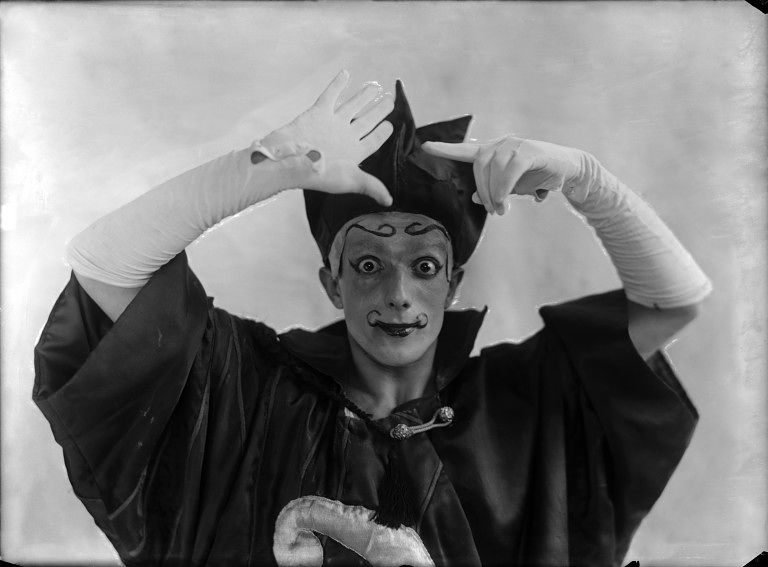
Cocteau’s short, one-act scenario presents us with a troupe of carnival performers trying to entice passersby into their shows. They are unsuccessful, this troupe, consisting of a Chinese magician, young American girl, a pair of acrobats, a horse, and several dancers in huge cardboard cubist costumes so heavy and awkward they can hardly move.
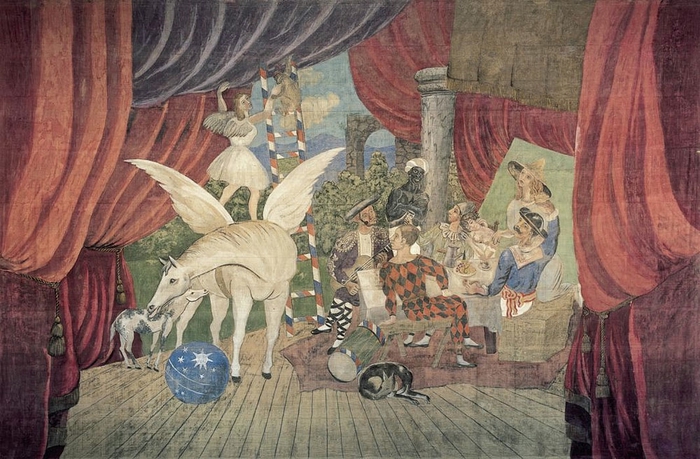
But “if anyone found Picasso’s costume designs a bit wacky, they’d sure be pleased with his gorgeous set designs,” Museworthy notes, pointing out the backdrop above. Indeed it was hardly unusual for an avant-garde modernist painter to design for the ballet; “Salvador Dali, Marc Chagall, Andre Derain, Joan Miro, and Léon Bakst all worked on costumes and scenery, much of it for the Ballets Russes.”
But there was something especially infuriating about this piece for audiences. (You can see an excerpt from a recent production at the top, and a low quality video of a longer performance above.) The premiere provoked an even bigger riot than Stravinsky’s The Rite of Spring had four years earlier. It’s said that Erik Satie was slapped in the face by an angry attendee. “Critics weren’t much kinder than the masses,” Museworthy adds. After one scathing review, Satie sent the critic angry postcards calling him a “blockhead,” “cretin,” and an “arse.” He was convicted of libel but managed to evade a prison sentence.
Picasso, on the other hand, “came out of the Parade debacle quite well” and would marry one of the dancers, Olga Khokhlova the following year. His highly-regarded design and costuming partly inspired the poet Guillaume Apollinaire to coin in his program notes the word “surrealism” before Surrealism became an artistic phenomenon in Paris. As such, Parade should maybe be required viewing for every student of Surrealist art, dance, film, etc. from Dali to David Lynch.
Related Content:
Hear Igor Stravinsky’s Symphonies & Ballets in a Complete, 32-Hour, Chronological Playlist
Josh Jones is a writer and musician based in Durham, NC. Follow him at @jdmagness
Read More...30 Hours of Doctor Who Audio Dramas Now Free to Stream Online
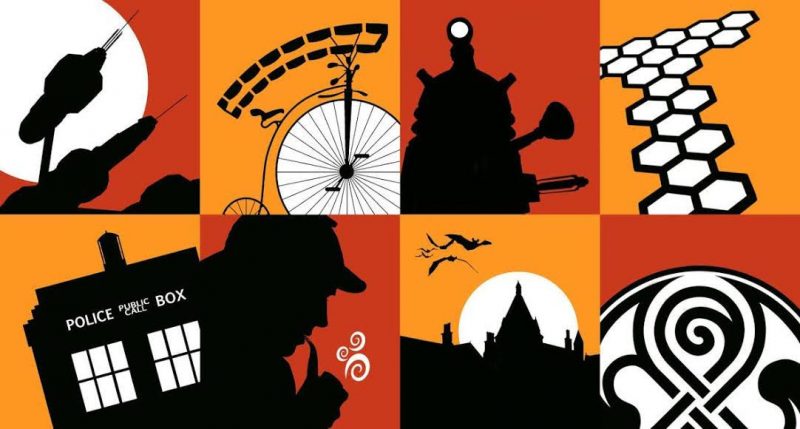
“Yes, this should provide adequate sustenance for the Doctor Who marathon,” once said The Simpsons’ Comic Book Guy while pushing a wheelbarrow full of fast-food tacos down the street. As the embodiment of fandom for all things fantasy and sci-fi, he would certainly know that Doctor Who, no longer an obscure BBC television show but an ever-expanding fictional universe with a global fan base, constitutes the ideal material for binge-watching, which he could now do at his convenience on a service like Britbox. But it isn’t just watching: now, on Spotify (whose free software you can download here if you don’t have it already), you can binge-listen to thirty straight hours of Doctor Who audio dramas as well.
“An icon of modern British culture and the longest-running science-fiction TV show in history, Doctor Who has never been more popular than it is today,” wrote Christopher Bahn in the AV Club’s 2010 primer on the series, which had relaunched five years earlier after initially running from 1963 to 1989. “No matter who’s playing the lead, the basic premise has been essentially the same since the show’s debut: A mysterious, eccentric alien known only as The Doctor (not ‘Doctor Who,’ in spite of the title) travels through time and space having adventures and fighting evil. He’s usually accompanied by one or two humans picked up along the way. They journey with him in a time machine called a TARDIS, which looks like a blue phone booth.”
This format “allowed the show to literally go anywhere in the universe and sometimes outside it, with virtually limitless storytelling possibilities.” At its best, “Doctor Who relied on solid, imaginative scripts to create smart science-fiction thrillers with a humanistic, anti-authoritarian heart. Consistently popular through the 1960s and 1970s, the show began to falter in the following decade as tight budgets and questionable artistic choices took their toll.” After its cancellation in 1989, Doctor Who “lived on through the ’90s, as science-fiction shows often do, in the wilderness genres of semi-official novels and radio plays.”
The best known of these Doctor Who radio plays, which you can hear on this playlist, come produced by a company called Big Finish. Having acquired a license from the BBC in 1999 (and recently renewed it into 2025), they’ve put out a range of audio dramas, both one-offs and series of various lengths, using not just the characters but many of the actual actors from the television show, including six of those who have taken on the iconic Doctor role onscreen. Owing to the fact that Doctor Who officially has no canon and thus no need for continuity, rigorous or otherwise, they can get even more imaginative than their source material, going so far as to explore counterfactual storylines such as one where the Doctor never leaves his home planet in the first place.
Below you’ll find a complete list, assembled by a fan on Reddit, of the series and episodes of Big Finish’s Doctor Who audio dramas now available on Spotify and are now housed to our collection of Free Audio Books. The material comes to thirty hours in total, but the question of when to listen to it falls second to a more important consideration: what sort of sustenance will best ensure that you can keep up with all of the Doctor’s audio adventures?
Main Range:
- The Sirens of Time
- Phantasmagoria
- Whispers of Terror
- The Land of the Dead
- The Fearmonger
- The Marian Conspiracy
- The Genocide Machine
- Red Dawn
- The Spectre of Lanyon Moor
- Winter for the Adept
- The Apocalypse Element
- The Fires of Vulcan
- The Shadow of the Scourge
- The Holy Terror
- The Mutant Phase
- Storm Warning
- Sword of Orion
- The Stones of Venice
- Minuet in Hell
- Loups-Garoux
- Dust Breeding
- Bloodtide
- Project: Twilight
- The Eye of the Scorpion
- Colditz
- Primeval
- The One Doctor
- Invaders from Mars
- The Chimes of Midnight
- Seasons of Fear
- Embrace the Darkness
- The Time of the Daleks
- Neverland
- Spare Parts
- …ish
- The Rapture
- The Sandman
- The Church and the Crown
- Bang-Bang-a-Boom!
- Jubilee
- Nekromanteia
- The Dark Flame
- Doctor Who and the Pirates
- Creatures of Beauty
- Project: Lazarus
- Flip-Flop
- Omega
- Davros
- Master
- Zagreus
Special Releases:
Fourth Doctor Adventures:
1.02 The Renaissance Man
Eighth Doctor Adventures:
1.1 Blood of the Daleks, Part 1
1.2 Blood of the Daleks, Part 2
1.5 Phobos
1.6 No More Lies
The Lost Stories:
1.01 The Nightmare Fair
1.02 Mission to Magnus
1.03 Leviathan
1.04 The Hollows of Time
1.05 Paradise 5
1.06 Point of Entry
1.08 The Macros
Box 1. The Fourth Doctor Box Set
The Companion Chronicles:
2.1 Mother Russia
2.2 Helicon Prime
2.3 Old Soldiers
2.4 The Catalyst
Destiny of the Doctor:
- Hunters of Earth
- Shadow of Death
- Vengeance of the Stones
- Babblesphere
- Smoke and Mirrors
- Trouble in Paradise
- Shockwave
- Enemy Aliens
- Night of the Whisper
- Death’s Deal
- The Time Machine
Short Trips:
The Stageplays:
Bernice Summerfield:
Box 2. Road Trip
Box 3. Legion
Box 4. New Frontiers
Box 5. Missing Persons
Graceless:
Dalek Empire:
- Invasion of the Daleks
- The Human Factor
- “Death to the Daleks!”
- Project Infinity
- Dalek War: Chapter One
- Dalek War: Chapter Two
- Dalek War: Chapter Three
- Dalek War: Chapter Four
Jago & Litefoot:
Counter-Measures:
Iris Wildthyme:
2.3 The Two Irises
UNIT:
I, Davros:
Cyberman:
1.1 Scorpius
1.2 Fear
1.3 Conversion
1.4 Telos
2.0 Cyberman 2
Charlotte Pollard:
Related Content:
BritBox Now Streaming Now Streaming 550 Episodes of Doctor Who and Many Other British TV Shows
The Fascinating Story of How Delia Derbyshire Created the Original Doctor Who Theme
Based in Seoul, Colin Marshall writes and broadcasts on cities and culture. He’s at work on a book about Los Angeles, A Los Angeles Primer, the video series The City in Cinema, the crowdfunded journalism project Where Is the City of the Future?, and the Los Angeles Review of Books’ Korea Blog. Follow him on Twitter at @colinmarshall or on Facebook.
Read More...Support Us
We're hoping to rely on loyal readers, rather than erratic ads. Please click the Donate button and support Open Culture. You can use Paypal, Venmo, Patreon, even Crypto! We thank you!

About Us

Open Culture scours the web for the best educational media. We find the free courses and audio books you need, the language lessons & educational videos you want, and plenty of enlightenment in between.
Advertise With Us

FREE UPDATES!
GET OUR DAILY EMAIL
Get the best cultural and educational resources on the web curated for you in a daily email. We never spam. Unsubscribe at any time.
FOLLOW ON SOCIAL MEDIA

Open Culture editor Dan Colman scours the web for the best educational media. He finds the free courses and audio books you need, the language lessons & movies you want, and plenty of enlightenment in between.
Advertise With Us


