Going to Concerts and Experiencing Live Music Can Make Us Healthier & Happier, a New Psychology Study Confirms

Image by Niels Epting, via Flickr Commons
It can sometimes seem like so much qualitative science confirms what we already know through experience and folk wisdom. But that does not make such research redundant. Instead, it sets the stage for more detailed investigations into specific causes and effects, and can lead to more refined understanding of general phenomena. For example, “a new study out of Australia,” reports CNN, “confirms what we probably already knew,” by concluding that if you want to be happier, you should get out more.
Specifically, you should get out to concerts and music festivals and dance your you-know-what off. The Australian researchers found that “people who actively engaged with music through dancing and attending events like concerts and musicals reported a higher level of subjective wellbeing.” The March, 2017 study, cheekily titled “If You’re Happy and You Know It: Music Engagement and Subjective Wellbeing,” defines the latter phrase as “the scientific psychological term for general mood ‘happiness,’ which is positive, stable, and consistent over time.”
Subjective wellbeing (SWB), although a self-reported measure, helps psychologists identify effective therapies for depression and mood disorders. Engaging meaningfully with music is one of them, and one needn’t be a musician to reap the benefits. While “producing music and performing encourage self-exploration, emotional expression, self-esteem and confidence,” the study’s authors write, interacting with music as a fan is also “associated with higher mood when considered in terms of activation and valence.”
Simply consuming recorded music, however, will not have the same benefits. While “recent technological advances” and streaming services have “increased the availability of and accessibility to music… engaging with music extends beyond just passive listening.” In large part, the active participation in a music scene—as part of a fan community or festival audience, for example—shows positive outcomes because of the “social component of music engagement.” Listening by oneself “may improve physical health and emotional wellbeing.” Listening “in the company of others is associated with stronger positive experiences.”
As the site Live for Live Music puts it, “live music universally lowers stress levels, increases social bonds while decreasing levels of pain, and can even physiologically cause people to get “skin-gasms.” And if that’s not reason enough to get tickets to see your favs, I don’t know what is. One would also hope the study makes a convincing case for funding live music as a mental health initiative. Unless you live in a city with lots of free concerts, the expense of such events can be prohibitive. At least in Australia, the researchers note, “attending musical events is costly, and may be a privilege afforded to those who earn a higher income.”
Susan Perry at Minnpost sums up a few other limitations of the study, such as its lack of data on frequency of attendance, and that it does not “differentiate between people who are musically talented and those who aren’t.” Nonetheless, one particular finding should have you shedding inhibitions to increase your SWB. “Dancers,” Perry summarizes, were “more likely than non-dancers to be happy,” as were those who sing along.
Related Content:
Playing an Instrument Is a Great Workout For Your Brain: New Animation Explains Why
Josh Jones is a writer and musician based in Durham, NC. Follow him at @jdmagness
Read More...Sci-Fi Radio: Hear Radio Dramas of Sci-Fi Stories by Ray Bradbury, Philip K. Dick, Ursula K. LeGuin & More (1989)

Image by Mr.Hasgaha, via Flickr Commons
If you dig through our archives, you can find no shortage of finely-produced radio dramatizations of your favorite science fiction stories. During the 1950s, NBC’s Dimension X adapted stories by the likes of Isaac Asimov, Ray Bradbury, Robert Heinlein, and even Kurt Vonnegut. Later in the ’50s, X Minus One continued that tradition, dramatizing stories by Robert A. Heinlein, Philip K. Dick, Poul Anderson and others. By the 1970s, Mind Webs got into the act and produced 188 adaptations–classics by Ursula K. LeGuin, Isaac Asimov, Arthur C. Clarke. And the BBC did up Isaac Asimov’s Foundation Trilogy.
Those productions will keep you busy for a good while. But if you’re wondering what the 1980s delivered, then tune into Sci-Fi Radio, a series of 26 half-hour shows which aired on NPR Playhouse, starting in 1989. Some of the adapted stories include: “Sales Pitch” and “Imposter” by Philip K. Dick, “Diary of the Rose” and “Field of Vision” by Ursula K. LeGuin, “Wall of Darkness” by Arthur C. Clarke, and “Frost and Fire” by Ray Bradbury.
You can stream all episodes below, or over at Archive.org. Sci-Fi Radio will be added to our collection, 1,000 Free Audio Books: Download Great Books for Free. Hope you enjoy.
If you would like to support the mission of Open Culture, consider making a donation to our site. It’s hard to rely 100% on ads, and your contributions will help us continue providing the best free cultural and educational materials to learners everywhere. You can contribute through PayPal, Patreon, and Venmo (@openculture). Thanks!
Related Content:
Isaac Asimov’s Foundation Trilogy: Hear the 1973 Radio Dramatization
X Minus One: Hear Classic Sci-Fi Radio Stories from Asimov, Heinlein, Bradbury & Dick
Hear 6 Classic Philip K. Dick Stories Adapted as Vintage Radio Plays
Read More...Hear the 20 Favorite Punk Albums of Black Flag Frontman Henry Rollins
The punk movement gave birth to hundreds of bands in a small amount of time, like a petri dish that just explodes under the right conditions. Forty years later, we are still living in the aftermath of that explosion and sorting things out. Lists need to be made. And if you consider garage rock to be proto-punk, the list can be very long.
Four years ago, L.A. Weekly created a list of the Top 20 punk albums of all time, but purists might despair to see Green Day on there or just anything after the ‘90s.
But they also turned to their columnist, Black Flag vocalist, intense spoken word performer, and radio deejay Henry Rollins, and asked him to create his own list. See them below, and hear them above (via this playlist).
- The Clash — The Clash (1977)
- Generation X — Generation X (1977)
- The Adverts — Crossing the Red Sea (1978)
- X Ray Spex — Germ Free Adolescents (1978)
- The Sex Pistols — Never Mind the Bollocks (1977)
- The Ramones — The Ramones (1976)
- Eater — The Album (1977)
- The Damned — Damned Damned Damned (1977)
- The Fall — Hex Enduction Hour (1982)
- The Buzzcocks — Another Music In A Different Kitchen (1978)
- The Saints — (I’m) Stranded (1977)
- UK Subs — Another Kind of Blues (1979)
- Wire — Pink Flag (1977)
- The Lurkers — Fulham Fallout (1978)
- Alternative TV — The Image Has Cracked (1978)
- The Ruts — The Crack (1979)
- The Germs — GI (1979
- X — Los Angeles (1980)
- The Minutemen — The Punchline (1981)
- Stiff Little Fingers — Inflammable Material (1979)
In his brief intro, Rollins mulls over the eternal genre question–where does punk stop and post-punk begin?
Could Wire, also be considered Post Punk? Where do you put bands like PIL, Joy Division, Television, Patti Smith, Suicide, and Killing Joke? What about Gang of Four, 999 and the Banshees? For me, as a lean definition, I go by the classic UK 1977 graduating class, Pistols, Clash, etc., and go from there.
The list, he says, is in no particular order, but it’s not a surprise to see the first Clash album at the top, followed by the debut albums of the Ramones, the Sex Pistols, The Damned, X, Wire, The Buzzcocks, The Saints, The Germs, X‑Ray Spex, The Adverts, and Stiff Little Fingers. Very few on that list went on to top their debut, or even–such as the Pistols and The Germs–record a follow-up.
Rollins talked about this in an essay (also for the L.A. Weekly) on why he loves another band on his list, the U.K. Subs.
How some of those bands were able to follow up with another album is a fascinating bit of musical history, as well as a study of talent, vision and integrity. It is where the rubber truly meets the road. After the explosive excitement of the initial batch of songs has settled, the band often is left with a success-derived self-awareness that hangs like a cloud over the practice room. The awfulness of expectation enters the equation, and the results are not always good.
Rollins is a fan of the first four U.K. Subs LPs–“they are like desert island LPs. Records you can’t do without,” he once said.
Other interesting choices on Rollins’ list: the shameless Ramones-copyists The Lurkers, The Minutemen’s first album (instead of the undisputed classic Double Nickels on the Dime), the lesser-known Eater, the Ruts, and the Fall’s Hex Enduction Hour, which is punk in aesthetic, but certainly not in production.
For a man who usually has something to say, it would have been cool to have some commentary from Rollins on his choices. On the other hand, maybe he’d just tell us to shut up. The music speaks for itself.
Related Content:
The History of Punk Rock in 200 Tracks: An 11-Hour Playlist Takes You From 1965 to 2016
Four Female Punk Bands That Changed Women’s Role in Rock
Ted Mills is a freelance writer on the arts who currently hosts the artist interview-based FunkZone Podcast and is the producer of KCRW’s Curious Coast. You can also follow him on Twitter at @tedmills, read his other arts writing at tedmills.com and/or watch his films here.
Read More...Meet Alexander Graham Bell, Inventor of the Telephone and Popular TV Pitchman
Mr. Watson, come here! I want you to tell me why I keep showing up in television commercials. Is it because they think I invented the television?
- The ghost of Alexander Graham Bell
Not at all, my dear Mr. Bell. A second’s worth of research reveals that a 21-year-old upstart named Philo Taylor Farnsworth invented television. By 1927, when he unveiled it to the public, you’d already been dead for five years.
You invented the telephone, a fact of which we’re all very aware.
Though you might want to look into intellectual property law.… Historic figures make popular pitchmen, especially if — like Lincoln, Copernicus, and a red hot Alexander Hamilton, they’ve been in the grave for over 100 years. (Hint — you’ve got five years to go.)
Or you could take it as a compliment! You’ve made an impression so lasting, the briefest of establishing shots is all we television audiences need to understand the advertiser’s premise.
Thusly can you be co-opted into selling the American public on the apparently revolutionary concept of chicken for breakfast, above.
And that’s just the tip of the iceberg!
Mr. Watson gets a cameo in your 1975 ad for Carefree Gum. You definitely come off the better of the two.
You’re an obvious choice for a recent AT&T spot tracing a line from your revelatory moment to 20-something hipsters wielding smartphones and sparklers on a Brooklyn rooftop. Their devices aren’t the only thing connecting you. It’s also the beards…
Apologies for the beardlessness of this 10 year old, low-budget spot for Able Computing in Papua New Guinea. Possibly the costumer thought Einstein invented the phone? Or maybe the creative director was counting on the local viewing audience not to sweat the small stuff. Your invention matters more than your facial hair.
Lego took a cue from the 80s Muppet Babies craze by sending you back to childhood. They also saddled you and your mom with American accents, a regrettably common practice. I bet you would’ve liked Legos, though. They’re like blocks.
As for this one, your guess is as good as mine.
Readers, please share your favorite ads featuring historic figures in the comments below.
Related Content:
Hear the Voice of Alexander Graham Bell for the First Time in a Century
Thomas Edison’s Silent Film of the “Fartiste” Who Delighted Crowds at Le Moulin Rouge (1900)
Ayun Halliday is an author, illustrator, theater maker and Chief Primatologist of the East Village Inky zine. See her onstage in New York City in Paul David Young’s Faust 3, an indictment of the Trump administration that adapts and mangles Goethe’s Faust (Parts 1 and 2) and the Gospels in the King James translation, as well as bits of Yeats, Shakespeare, Christmas carols, Stephen Foster, John Donne, Heiner Müller, Julia Ward Howe, and Abel Meeropol. Follow her @AyunHalliday.
Read More...The Art of the Marbler: An Enchanting Film on the Centuries-Old Craft of Making Handmade Marbled Paper
The current mode of scandal in business and politics involves email and tweets rather than memoranda. But we do not yet live a paperless world, even if you haven’t dusted your printer in months. Book production and sales continue to rise, for example, defying predictions of a few years back that eBooks would overtake print. Even if we have to someday make paper in laboratories rather than forests and mills, it’s hard to imagine readers ever letting go of the pleasures of its textures and smells, or of simple, yet satisfying acts like placing a favorite paper bookmark in the creases.
We do, however, seem to live in a largely stationary-less world, and we have for some time. As the fine art of making artisanal papers recedes into history, so too does the printing of books with marbled covers and pages.
Yet, if you have on your shelf hardback books anywhere from 30 to 130 years old, you no doubt have a few with marbled patterns on them or in them. And if you’ve ever wondered about this strange art form, wonder no more. The 1970 British educational film, “The Art of the Marbler,” above, offers a broad overview of this fascinating “material which has covered books for many centuries.”
Produced by Bedfordshire Record Office of Cockerell Marbling and directed by K.V. Whitbread, the short film is a marvel of quaintness. It effortlessly achieves the kind of quirk Wes Anderson’s films strive for simply by being itself. We learn that every marbled paper, unlike Christmas wrapping paper, is a “separate and unique original.” And that the process is precious and specialized, and nearly all done by hand. Lest we become too enamored of the idea that marbling is strictly a historical curiosity these days, the mesmerizing video above from 2011 by Seyit Uygur shows us up close how his parents perform the art of Ebru, Turkish for paper marbling.
Marbling, the “printmaking technique that basically looks like capturing a galaxy on a page,” as Emma Dajska writes at Rookie, became quite popular in the Islamic world, where intricate patterns stood in lieu of portraits. But the process originated neither in England nor Turkey, but in China and, later, Japan, where it is known as Suminagashi, or “floating ink.” The Japanese technique, as you can see in the video tutorial above from Chrystal Shaulis, is very different from British Marbling or Turkish Ebru, seeming to combine the methods of Jackson Pollack with those of the Zen gardener. However it’s done, the results, as “The Art of the Marbler” tells and shows us, are each one a “unique original.”
“The Art of the Marbler” will be added to our list of Free Documentaries, a subset of our collection, 4,000+ Free Movies Online: Great Classics, Indies, Noir, Westerns, Documentaries & More.
Related Content:
The Making of Japanese Handmade Paper: A Short Film Documents an 800-Year-Old Tradition
How Ink is Made: The Process Revealed in a Mouth-Watering Video
Josh Jones is a writer and musician based in Durham, NC. Follow him at @jdmagness
Read More...Google Creates a Digital Archive of World Fashion: Features 30,000 Images, Covering 3,000 Years of Fashion History
Both the fashion and art worlds foster the creation of rarified artifacts inaccessible to the majority of people, often one-of-a-kind pieces that exist in specially-designed spaces and flourish in cosmopolitan cities. Does this mean that fashion is an art form like, say, painting or photography? Doesn’t fashion’s ephemeral nature mark it as a very different activity? We might consider that we can ask many of the same questions of haute couture as we can of fine art. What are the social consequences of taking folk art forms, for example, out of their cultural context and placing them in gallery spaces? What is the effect of tapping street fashion as inspiration for the runway, turning it into objects of consumption for the wealthy?
Such questions should remind us that fashion and the arts are embedded in human cultural and economic history in some very similar ways. But they are also very different social practices. Much like trends in food (both fine dining and cheap consumables) fashion has long been implicated in the spread of markets and industries, labor exploitation, environmental degradation, and even microbes. As Jason Daley points out at Smithsonian, “The craze for silk in ancient Rome helped spawn the Silk Road, a fashion for feathered hats contributed to the first National Wildlife Refuges. Fashion has even been wrapped up in pandemics and infectious diseases.”
So how to tell the story of a human activity so deeply embedded in every facet of world history? Expansively. Google Arts & Culture has attempted to do so with its “We wear culture” project. Promising to tell “the stories behind what we wear,” the project, as you can see in the teaser video at the top, “travelled to over 40 countries, collaborating with more than 180 cultural institutions and their world-renowned historians and curators to bring their textile and fashion collections to life.” Covering 3,000 years of history, “We wear culture” uses video, historical images, short quotes and blurbs, and fashion photography to create a series of online gallery exhibits of, for example, “The Icons,” profiles of designers like Oscar de la Renta, Coco Chanel, and Issey Miyake.
Another exhibit “Fashion as Art” includes a feature on Florence’s Museo Salvatore Ferragamo, a gallery dedicated to the famous designer and containing 10,000 models of shoes he created or owned. Asking the question “is fashion art?”, the exhibit “analyses the forms of dialogue between these two worlds: reciprocal inspirations, overlaps and collaborations, from the experiences of the Pre-Raphaelites to those of Futurism, and from Surrealism to Radical Fashion.” It’s a wonder they don’t mention the Bauhaus school, many of whose resident artists radicalized fashion design, though their geometric oddities seem to have had little effect on Ferragamo.
As you might expect, the emphasis here is on high fashion, primarily. When it comes to telling the stories of how most people in the world have experienced fashion, Google adopts a very European, supply side, perspective, one in which “The impact of fashion,” as one exhibit is called, spans categories “from the economy and job creation, to helping empower communities.” Non-European clothing makers generally appear as anonymous folk artisans and craftspeople who serve the larger goal of providing materials and inspiration for the big names.
Cultural historians may lament the lack of critical or scholarly perspectives on popular culture, the distinct lack of other cultural points of view, and the intense focus on trends and personalities. But perhaps to do so is to miss the point of a project like this one—or of the fashion world as a whole. As with fine art, the stories of fashion are often all about trends and personalities, and about materials and market forces.
To capitalize on that fact, “We wear culture” has a number of interactive, 360 degree videos on its YouTube page, as well as short, advertising-like videos, like that above on ripped jeans, part of a series called “Trends Decoded.” Kate Lauterbach, the program manager at Google Arts & Culture, highlights the videos below on the Google blog (be aware, the interactive feature will not work in Safari).
- Find out how Chanel’s black dress made it acceptable for women to wear black on any occasion (Musée des Arts Décoratifs, Paris, France — 1925)
- Step on up—way up—to learn how Marilyn Monroe’s sparkling red high heels became an expression of empowerment, success and sexiness for women (Museo Salvatore Ferragamo from Florence, Italy — 1959)
- See designer Vivienne Westwood’s unique take on the corset, one of the most controversial garments in history (Victoria and Albert Museum, London, UK — 1990)
- Discover the Comme des Garçons sweater and skirt with which Rei Kawakubo brought the aesthetics and craftsmanship of Japanese design onto the global fashion stage (Kyoto Costume Institute, Kyoto, Japan — 1983)
Does the project yet deliver on its promise, to “tell the stories behind what we wear”? That all depends, I suppose, on who “we” are. It is a very valuable resource for students of high fashion, as well as “a pleasant way to lose an afternoon,” writes Marc Bain at Quartz, one that “may give you a new understanding of what’s hanging in your own closet.”
“We wear culture” features 30,000 fashion pieces and more than 450 exhibits. Start browsing here.
Related Content:
1930s Fashion Designers Predict How People Would Dress in the Year 2000
Punk Meets High Fashion in Metropolitan Museum of Art Exhibition PUNK: Chaos to Couture
Josh Jones is a writer and musician based in Durham, NC. Follow him at @jdmagness
Read More...Experts Predict When Artificial Intelligence Will Take Our Jobs: From Writing Essays, Books & Songs, to Performing Surgery and Driving Trucks

We know they’re coming. The robots. To take our jobs. While humans turn on each other, find scapegoats, try to bring back the past, and ignore the future, machine intelligences replace us as quickly as their designers get them out of beta testing. We can’t exactly blame the robots. They don’t have any say in the matter. Not yet, anyway. But it’s a fait accompli say the experts. “The promise,” writes MIT Technology Review, “is that intelligent machines will be able to do every task better and more cheaply than humans. Rightly or wrongly, one industry after another is falling under its spell, even though few have benefited significantly so far.”
The question, then, is not if, but “when will artificial intelligence exceed human performance?” And some answers come from a paper called, appropriately, “When Will AI Exceed Human Performance? Evidence from AI Experts.” In this study, Katja Grace of the Future of Humanity Institute at the University of Oxford and several of her colleagues “surveyed the world’s leading researchers in artificial intelligence by asking them when they think intelligent machines will better humans in a wide range of tasks.”
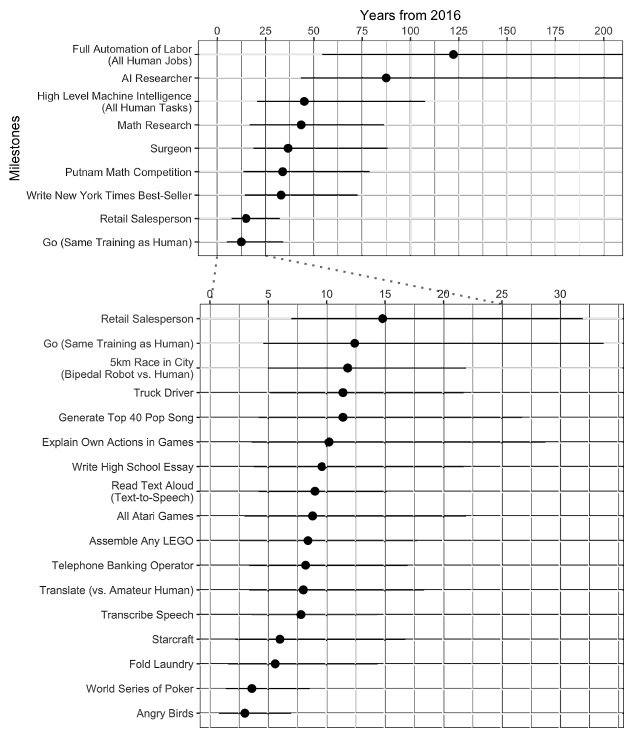
You can see many of the answers plotted on the chart above. Grace and her co-authors asked 1,634 experts, and found that they “believe there is a 50% chance of AI outperforming humans in all tasks in 45 years and of automating all human jobs in 120 years.” That means all jobs: not only driving trucks, delivering by drone, running cash registers, gas stations, phone support, weather forecasts, investment banking, etc, but also performing surgery, which may happen in less than 40 years, and writing New York Times bestsellers, which may happen by 2049.
That’s right, AI may perform our cultural and intellectual labor, making art and films, writing books and essays, and creating music. Or so the experts say. Already a Japanese AI program has written a short novel, and almost won a literary prize for it. And the first milestone on the chart has already been reached; last year, Google’s AI AlphaGo beat Lee Sedol, the South Korean grandmaster of Go, the ancient Chinese game “that’s exponentially more complex than chess,” as Cade Metz writes at Wired. (Humane video game design, on the other hand, may have a ways to go yet.)
Perhaps these feats partly explain why, as Grace and the other researchers found, Asian respondents expected the rise of the machines “much sooner than North America.” Other cultural reasons surely abound—likely those same quirks that make Americans embrace creationism, climate-denial, and fearful conspiracy theories and nostalgia by the tens of millions. The future may be frightening, but we should have seen this coming. Sci-fi visionaries have warned us for decades to prepare for our technology to overtake us.
In the 1960s Alan Watts foresaw the future of automation and the almost pathological fixation we would develop for “job creation” as more and more necessary tasks fell to the robots and human labor became increasingly superfluous. (Hear him make his prediction above.) Like many a technologist and futurist today, Watts advocated for Universal Basic Income, a way of ensuring that all of us have the means to survive while we use our newly acquired free time to consciously shape the world the machines have learned to maintain for us.
What may have seemed like a Utopian idea then (though it almost became policy under Nixon), may become a necessity as AI changes the world, writes MIT, “at breakneck speed.”
via Big Think/MIT Technology Review
Related Content:
Hear Alan Watts’s 1960s Prediction That Automation Will Necessitate a Universal Basic Income
Bertrand Russell & Buckminster Fuller on Why We Should Work Less, and Live & Learn More
Artificial Intelligence Program Tries to Write a Beatles Song: Listen to “Daddy’s Car”
Artificial Intelligence: A Free Online Course from MIT
Josh Jones is a writer and musician based in Durham, NC. Follow him at @jdmagness
Read More...Lou Reed Curates an Eclectic Playlist of His Favorite Songs During His Final Days: Stream 27 Tracks Lou Was Listening To
Lou Reed was a voracious listener. Rather than consume music, he imbibed it, drank it down in draughts, then sweated it out through his pores. His inexhaustible thirst for songs resulted in a body of work that has always sounded intimately familiar, even when it takes us to places no songwriters had before: the bitter, tender, violent underside of glamour, art, and romance.
But where, exactly, did Reed’s wry, bleak, yet tender sensibility come from? How did he manage so much complex emotional resonance in such seemingly simple songs as “Sunday Morning” and “Perfect Day”? Part of the answer comes from his veneration of Beat poets and writers like Allen Ginsberg and William Burroughs, as well as his one-time mentor Delmore Schwartz. “I thought if you could do what those writers did,” he said, “and put it to drums and guitar, you’d have the greatest thing on earth.”
This was no easy accomplishment. It took someone like Reed, steeped in pop, folk, rock, and jazz songcraft, to pull it off in such a way that Rolling Stone could call the Velvet Underground “the most influential American rock band of all time”—largely, writes the Daily Dot, “because of Reed’s sonic and lyrical contributions.” For most of Reed’s career, however, discovering the sources of his magic could be difficult.
Reed’s interview moods ranged from irascibly confrontational to disdainfully taciturn to facetiously garrulous. “Everything is jokes to this bibulous bozo,” remarked Lester Bangs in a 1973 interview. “He really makes a point of havin’ some fun!” But age, it seems, and the internet, mellowed him out and made him more likely to share. He opened up about his love for Kanye West’s Yeezus and other things. He appeared on Saturday Night Live to dispute internet rumors that he had died in 2001.
And when he did die, in 2013, he left behind the Spotify account “he was curating… himself,” keeping “playlists of songs he liked from the radio,” and showing both serious and casual students of Lou Reed that “the best online source on Lou Reed is… Lou Reed.” In the two volume playlist above called “What I’m Listening To,” Reed shows us just how serious he was about soaking up all of the sounds around him.
Nicki Minaj, Prince, Waylon Jennings, indie funk/soul Canadians King Khan & BBQ, psychedelic indie chamber pop band Of Montreal, Tom Waits, Miles Davis, Deerhoof, post-hardcore band Fucked Up, brilliant neo-soul singer/rapper/songwriter Georgia Anne Muldrow, Captain Beefheart… and that’s just volume one. Name a genre—Reed has found what he clearly considers its perfect exemplar. You can almost see him taking notes, scowling with envy, smirking with appreciation for how his own influence has permeated the past few the decades.
Famous musicians aren’t always the most interesting people, though Reed’s private life was sensational enough to warrant retelling. But many fans will find it much more interesting to get into the mind of Reed the artist. And for that, you’ll need to try and hear what he heard. Or, at least, listen to what he listened to.
If you need Spotify’s free software, download it here. Here are the direct links to the two Spotify playlists: Playlist 1 — Playlist 2.
Related Content:
Lou Reed Creates a List of the 10 Best Records of All Time
Teenage Lou Reed Sings Doo-Wop Music (1958–1962)
An Animation of The Velvet Underground’s “Sunday Morning” … for Your Sunday Morning
Josh Jones is a writer and musician based in Durham, NC. Follow him at @jdmagness
Read More...Ennio Morricone’s Iconic Song, “The Ecstasy of Gold,” Spellbindingly Arranged for Theremin & Voice
You know Ennio Morricone’s “The Ecstasy Of Gold,” a musical composition first made famous in Sergio Leone’s 1966 spaghetti western The Good, the Bad and the Ugly. It has since been covered by everyone from Metallica, to Yo-Yo Ma. And now you can add German electronic musician Carolina Eyck to the list.
Above, watch Eyck take “The Ecstasy Of Gold” in new, intriguing directions, using a theremin and a voice looper. It’s pretty mesmerizing.
Below, watch Carolina’s introduction to the theremin. And down in the Relateds, find much more on the theremin, including vintage footage of Russian inventor Leon Theremin giving a demo of the newfangled electronic instrument.
If you would like to support the mission of Open Culture, consider making a donation to our site. It’s hard to rely 100% on ads, and your contributions will help us continue providing the best free cultural and educational materials to learners everywhere. You can contribute through PayPal, Patreon, and Venmo (@openculture). Thanks!
Related Content:
Beethoven’s Ode to Joy Played With 167 Theremins Placed Inside Matryoshka Dolls in Japan
“Somewhere Over the Rainbow” Played on a 1929 Theremin
Read More...The History of Punk Rock in 300 Tracks: A 13-Hour Playlist Takes You From 1965 to Present
It may be that familiarity breeds contempt, and if that’s so, we should all be very glad of the wealth of excellent documentaries correcting the monolithic commercial story of punk, which goes something like this: The Sex Pistols and The Clash explode into the world in 1977 purveying anarchy and revolution and designer BDSM gear, and the status quo freaks out, then discovers many savvy marketing opportunities and here we are at our local punk boutique before the punk arena show at Corporation Stadium.
That’s a boring story, mostly because all the most interesting parts, and weirdest, most violent, gross-out, angry, experimental, queer, black, radical, feminist, etc. parts get left out, along with nearly all the best bands. Even if we date punk from the early seventies in New York with Patti Smith and the Ramones, we’re missing key progenitors from the 60s, from Detroit, Germany, Tacoma, Washington… The brackets we snap around decades as though each one popped into existence independently may blind us to how much history folds back in on itself, as do musical eras and genres.
Even before Crass arrived in ‘77 as “the missing link between counterculture hippies and punk’s angry rhetoric,” the MC5 ruled Detroit stages and bloody political conventions in 1968 Chicago. Though they’re credited—along with fellow motor city natives Iggy and The Stooges—with the invention of punk, they played hippy music: loose, bluesy, soulful, filled with long jams and solos. But they played it harder and with more speed, raw metal edge, and intensity than anyone, while adopting the politics of the Black Panthers. It’s refreshing to see both the MC5 and The Stooges represented in the Spotify playlist below, “The Evolution of Punk in Chronological Order.” (If you need Spotify’s software, download it here.)
What may sound didactic is in fact pleasantly surprising, and maybe essential as far as these things go. No, of course, “not EVERY punk band will be listed here,” the playlist’s creator concedes on Reddit. Not only is this impossible, but, as he or she goes on, “I am constructing this list by my own personal beliefs of what makes a band punk.” (Sorry, Blink 182 fans.) I’d be intrigued to know what those beliefs are. They are discriminating, yet ecumenical. Not only does the MC5 get much-deserved inclusion, but so do seminal 60s garage rock bands like The Monks, an American band from Germany, and The Sonics from Tacoma.
We begin with a little-known, quaintly-named act called Ronnie Cook & The Gaylads, who in 1965 recorded “Goo Goo Muck,” a novelty track that delivered for The Cramps sixteen years later. Early 60s rockabilly, surf-rock, and bubblegum (all products of the previous decade), are of course essential to so much punk, but the novelty act is also a punk staple. I’m pleased to see here serious experimentalists like Suicide and NEU!, two bands without whom so much of the 2000s could not have happened. I’m also pleased to see eighties pranksters The Dead Milkman, who wrote deeply offensive novelty songs like “Takin’ Retards to the Zoo” and sounded like a comic book.
Do we not hear of the Dead Milkmen, and bands like Choking Victim, Cock Sparrer, or the Crucifucks, because of political correctness run amok? That seems like an anachronistic way to look at things. I can assure you they pissed people off just as much at the time, and everyone argued endlessly about free speech. It’s true, the most offensive punk figure on the list, G.G Allin, became a minor celebrity on the daytime circuit after his extreme indulgences in masochism and coprophilia onstage. But most punk bands played for limited audiences, released on tiny labels, and attached themselves to particular regions. Playing punk rock was not always a very popular thing to do.
There are too many fragments, too many offshoots, tribes, divisions and affiliations for a monoculture summary. But if you were to write an account of punk using only the tracks on this playlist, it would be a comprehensive overview most people do not know, and a fascinating one at that. Maybe punk died–in ’77 when it signed to CBS, or in 1979 at the dawn of the eighties, or last year, who knows. But this list insists on covering over fifty years–from “Goo Goo Muck” to SKAAL’s 2016 “Not a Fan,” an almost classical slab of hardcore, with a chorus that provides the ideal coda: “Your rules / I’m not a fan.” Is punk dead? You tell me.
Related Content:
Josh Jones is a writer and musician based in Durham, NC. Follow him at @jdmagness
Read More...
Support Us
We're hoping to rely on loyal readers, rather than erratic ads. Please click the Donate button and support Open Culture. You can use Paypal, Venmo, Patreon, even Crypto! We thank you!

About Us

Open Culture scours the web for the best educational media. We find the free courses and audio books you need, the language lessons & educational videos you want, and plenty of enlightenment in between.
Advertise With Us

FREE UPDATES!
GET OUR DAILY EMAIL
Get the best cultural and educational resources on the web curated for you in a daily email. We never spam. Unsubscribe at any time.
FOLLOW ON SOCIAL MEDIA

Open Culture editor Dan Colman scours the web for the best educational media. He finds the free courses and audio books you need, the language lessons & movies you want, and plenty of enlightenment in between.
Advertise With Us

