James Franco Hosts Philosophy Time, a New Videos Series Created to Help Philosophy Reach a Wider Audience
How do you get ordinary people interested in philosophy? If we are to believe the accounts of Plato, this wasn’t so difficult in ancient Athens. One simply lounged around the Acropolis harassing passersby, a tactic sure to fail in most city centers, town squares, and strip malls today. Podcasts and YouTube videos grab their share of eyes and ears, though many in their audiences also sing in the choir. Former Python John Cleese has done his part to popularize philosophical thinking. As someone who has moved between the worlds of academia and popular culture, Cleese has both credibility and visibility on his side. Some younger audiences (I write with apologies to Cleese) may be inclined to tune him out.
How about another actor with both fame and higher ed cred? Someone “very appealing to a younger demographic”? Someone like… James Franco—currently a doctoral student at Yale, and formerly a lecturer and/or student/graduate of UCLA, Columbia, NYU, Brooklyn College, Warren Wilson College, and the Rhode Island School of Design? This might seem like the resume either of an academic dilettante, or of a lifelong student and lover of knowledge.
Given Franco’s commitment to teaching, writing, and developing and starring in literary films like As I Lay Dying, The Sound and the Fury, The Broken Tower, and Howl, we might give him the benefit of the doubt. Not everyone’s a fan, but he does bring a good deal of academic enthusiasm to the role of philosophy popularizer.
Franco also brings along an actual philosopher, Eliot Michaelson, of King’s College, a former teacher of his. He proposed the idea of their project, “Philosophy Time,” while the two were at UCLA together, Michaelson as a grad student and Franco as an undergrad finishing his English degree after taking a hiatus from college to become a star. “We had somehow ended up becoming friends,” writes Michaelson, “In part, probably because I had no idea who he was.” Their long-gestating idea—an attempt to widen philosophy’s audience—has finally come to fruition. In the short episodes here, you can see the two in conversation with Rutgers University’s Andy Egan, at the top (on beauty), Princeton’s Liz Harmon, further up (on the fraught topic of abortion), and Rutgers’ Liz Camp, above and below (on imagination and metaphor).
Michaelson is a moderating influence. Franco’s laid back presentation will remind you of his performances in stoner comedy Pineapple Express, the 83rd Academy Awards ceremony, and the 2008 High Times Stoner of the Year event (though he swears he doesn’t touch the stuff anymore). Squiggly, animated word and thought bubbles add another comic touch. But whether or not viewers are charmed by his persona, they’ll find that he lets his guests do most of the talking, and they each make it plain that philosophy can be fascinating and imminently relevant to our ordinary modern lives. The kinds of questions Socrates needled hapless Athenians with—about beauty, ethics, and language—are just as pressing now as they were 2400 years ago.
You can find the emerging trove of “Philosophy Time” videos on YouTube here.
via Leiter Reports
Related Content:
James Franco Reads a Dreamily Animated Version of Allen Ginsberg’s Epic Poem ‘Howl’
James Franco Reads 6 Short Poems from His New Collection
140+ Free Online Philosophy Courses
The Partially Examined Life: A Philosophy Podcast
Josh Jones is a writer and musician based in Durham, NC. Follow him at @jdmagness
Read More...How Insomnia Shaped Franz Kafka’s Creative Process and the Writing of The Metamorphosis: A New Study Published in The Lancet
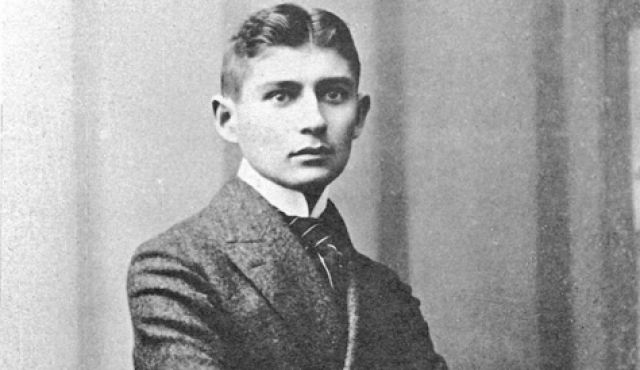
Whatever else we take from it, Franz Kafka’s nightmarish fable The Metamorphosis offers readers an especially anguished allegory on troubled sleep. Filled with references to sleep, dreams, and beds, the story begins when Gregor Samsa awakens to find himself (in David Wylie’s translation) “transformed in his bed into a horrible vermin.” After several desperate attempts to roll off his back, Gregor begins to agonize, of all things, over his stressful working hours: “’Getting up early all the time,’ he thought, ‘it makes you stupid. You’ve got to get enough sleep.” Realizing that he has overslept and missed his five o’clock train, he agonizes anew over the frantic workday ahead, and we can hear in his thoughts the complaints of their author. “Sleep and lack thereof,” writes The Independent’s Christopher Hooten, “is of course a central theme in Kafka’s best known work…. It seems there was a strong dose of autobiography at play.”
Chronically insomniac, Kafka wrote at night, then rose early each morning for his hated job at an insurance office. Though he made good use of restlessness, Kafka characterized his insomnia as much more than an inconvenient physical ailment. He thought of it in metaphysical terms, as a kind of soul-sickness. “Sleep,” he wrote in his diaries, “is the most innocent creature there is and sleepless man the most guilty.”
Insomnia transformed Kafka into an unclean thing, quivering in fear of death. “Perhaps I am afraid that the soul, which in sleep leaves me, will not be able to return,” he confessed in a letter to German writer Milena Jesenská. Anxious expressions like this, writes Theresa Fisher, have led researchers to “speculate that Kafka’s pathological traits… indicate borderline personality disorder.” This posthumous diagnosis may be a leap too far. “Unearthing his insomnia, however,” and its effects on his life and work, “requires less speculation.”
Kafka’s descriptions of his anxious insomniac writing habits have led Italian doctor Antonio Perciaccante and his wife and co-author Alessia Coralli to argue in a recent paper published in The Lancet that the writer composed much of his fiction in a state of something like lucid dreaming. In one diary entry, Kafka writes, “it was the power of my dreams, shining forth into wakefulness even before I fall asleep, which did not let me sleep.” Perciaccante and Coralli note that “this seems to be a clear description of a hypnagogic hallucination, a vivid visual hallucination experienced just before the sleep onset.” It’s something we’ve all experienced. Kafka, fearing sleep, stayed there as long as he could. Lest we think of his writing as therapeutic in some way, he gives no indication that it was so. Indeed, it seems that writing introduced more pain: “When I don’t write,” he told Jesenská, “I am merely tired, sad, heavy; when I do write, I am torn by fear and anxiety.”
Kafka made many similar statements about sleep deprivation bringing him to “a depth almost inaccessible at normal conditions.” The visions he encountered, he wrote, “shape themselves into literature.” Through surveying the literature, biographies, interpretations, and the author’s diaries and letters to Jesenská and Felice Bauer, Perciaccante and Coralli pieced together a “psychophysiological” account of Kafka’s dream logic. As Perciaccante told ResearchGate in an interview, his study concerned itself less with the causes of Kafka’s sleeplessness. He admits “it’s difficult to classify Kafka’s insomnia.” Instead the authors concerned themselves with the effects of remaining in a hypnagogic state (a word, notes Drake Baer, that etymologically means “being abducted into sleep”), as well as Kafka’s awareness of his insomnia’s magical and debilitating power.
Metamorphosis, says Perciaccante, in addition to a work about social and familial alienation, “may also represent a metaphor for the negative effects that poor quality sleep, short sleep duration, and insomnia may have on mental and physical health.” Had Kafka overcome his malady, he may never have written his best-known work. Indeed, he may not have written at all. “Perhaps there are other forms of writing,” he told Max Brod in 1922, “but I know only this kind, when fear keeps me from sleeping, I know only this kind.” Perciaccante and Coralli see Kafka’s insomniac torment as a primary theme in his work, but two dissenting voices, writer Saudamini Deo and forensic doctor and anthropologist Philippe Charlier, disagree. Writing into The Lancet to express their view, they assert that despite Kafka’s persistent laments and the squirmy fate of the autobiographical Gregor Samsa, the writer’s “insomnia was not at all dehumanizing… but the exact opposite—ie, humanizing the self by bringing to surface elements of unconscious that guide most actions of our waking life.”
Related Content:
Franz Kafka’s Kafkaesque Love Letters
How a Good Night’s Sleep — and a Bad Night’s Sleep — Can Enhance Your Creativity
Josh Jones is a writer and musician based in Durham, NC. Follow him at @jdmagness
Read More...Historical Plaque Memorializes the Time Jack Kerouac & William S. Burroughs Came to Blows Over the Oxford Comma (Or Not)
Maybe it doesn’t take much to get a grammar nerd in a state of agitation, or even, perhaps, violent rage. While I generally avoid the term “grammar nazi,” it does bluntly convey the severe intolerance of certain grammarians. One of the most popular recent books on grammar, Lynn Truss’s Eats, Shoots & Leaves, announces itself in its subtitle as a “Zero Tolerance Approach to Punctuation.” And sure enough, the main title of the entertaining guide comes from a violent joke, in which a panda enters a bar, eats a sandwich, then shoots up the joint. Asked why, he tells the bartender to look up “panda” in the dictionary: “Panda. Large black-and-white bear-like mammal, native to China. Eats, shoots and leaves.”
Truss’s example illustrates not a grammatical point of contention, but a mistake, a misplaced comma that completely changes the meaning of a sentence. But we might refer to many technically correct examples involving the absence of the Oxford comma, the final comma in a series that sets off the last item.
Many people have argued, with particular vehemence, that the “and” at the end of a series satisfies the comma’s function. No, say other strict grammarians, who point to the confusing ambiguity between, say, “I went to dinner with my sister, my wife, and my friend” and “I went to dinner with my sister, my wife and my friend.” We could adduce many more potentially embarrassing examples.
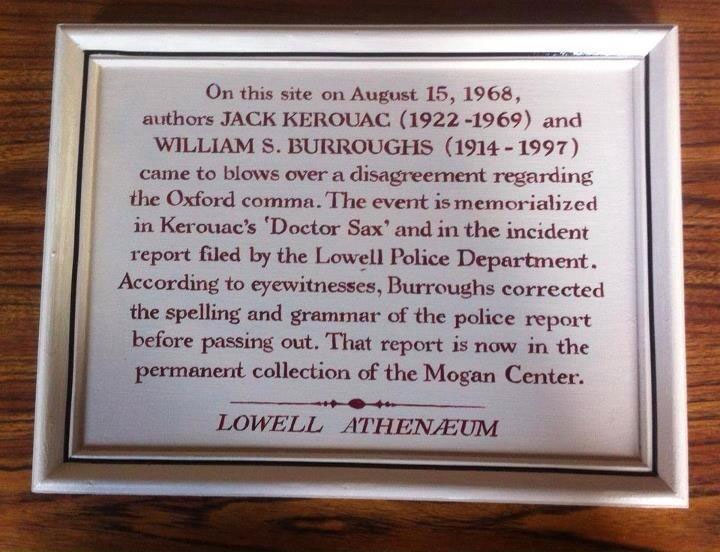
The Oxford comma is so contentious a grammatical issue that it supposedly provoked a drunken fistfight between Beat writers Jack Kerouac and William S. Burroughs. At least, that is, according to a plaque at Mill No. 5 in Lowell, Massachusetts, a historic textile mill built in 1873 and since revitalized into a performance space with shops and a farmer’s market. “On this site on August 15, 1968,” the plaque reads, Kerouac and Burroughs “came to blows over a disagreement regarding the Oxford comma. The event is memorialized in Kerouac’s ‘Doctor Sax’ and in the incident report filed by the Lowell Police Department.” The next line should give us a clue as to how seriously we should take this historical tidbit: “According to eyewitnesses, Burroughs corrected the spelling and grammar of the police report.”
The plaque is a hoax, the fight never happened. (And it is one of many such joke historical markers at the mill.) Doctor Sax was written nine years earlier, in 1959, and Kerouac and Burroughs hadn’t even met at the time of that novel’s events. But it’s a great story. “We imagine Burroughs grabbing the policemen’s pen,” writes Alexis Madrigal at The Atlantic, “lucid as a shaman, and then plopping onto the grass, out cold.” (The Anarchist’s Guide to Historic House Museums calls the spurious plaque “an act of historic vandalism.”) We like the story not only because it’s a juicy bit of lore involving two legendary writers, but also because the Oxford comma, for whatever reason, is such a weirdly inflammatory issue. The TED-Ed video above calls it “Grammar’s great divide.” (The comma acquired its name, points out Mental Floss, “because the Oxford University Press style guidelines require it.”)
If it isn’t already evident, I seriously favor the Oxford comma, perhaps enough to defend it in pitched battle. But if you need convincing by gentler means, you might heed the wisdom of The New Yorker’s resident “comma queen,” who, in the video above, serves up another humorous instance of a serial comma faux pas involving strippers, JFK, and Stalin (or “the strippers, JFK and Stalin”). For a much more serious Oxford comma kerfuffle, we might refer to a class action lawsuit involving overtime pay for truckers, a case that “hinged entirely” on the serial comma, “a debate that has bitterly divided friends, families and foes,” writes Daniel Victor at The New York Times, in a sentence that puckishly, or contrarily, leaves out the last comma, and sets the grammar intolerant among us grinding our teeth. But the Oxford comma is no joke. Its lack may cost Maine company Oakhurst millions of dollars, or their employees millions in pay. “The debate over commas is often a pretty inconsequential one,” writes Victor. Until it isn’t, and someone gets sued, shot, or punched in the face. So snub the Oxford comma, I say, at your peril.
Related Content:
Jack Kerouac Lists 9 Essentials for Writing Spontaneous Prose
Josh Jones is a writer and musician based in Durham, NC. Follow him at @jdmagness
Read More...Attempting to Set the World Record for Most Frida Kahlo Lookalikes in One Place: It Happened in Dallas

Fun fact: The Dallas Museum of Art and the Latino Center for Leadership Development celebrated Frida Kahlo’s 110th birthday last week. And the festivities were capped off with an attempt to set the Guinness World Record for the largest gathering of people dressed as Frida Kahlo in one space.
According to the rules of Frida Fest, to participate in the record attempt, individuals had to provide their own costume, and make sure their costumes included the following elements:
- A unibrow drawn onto the face joining the eyebrows. This can be done with make-up or by sticking hair.
- Artificial flowers worn in the hair, a minimum of three artificial flowers must be worn.
- A red or pink shawl.
- A flower-printed dress that extends to below the knees on all sides; the dress must not have any slits up the side.
Notes NPR, there’s “no official word yet on whether a record was set, but prior to Thursday, there didn’t appear to be another record-holder listed in the Guinness World Records.”
You can see a gallery of 44 photos on the museum’s Facebook page. Enjoy.

Photo Courtesy of Ashley Gongora and Kathy Tran — at Dallas Museum of Art.

Photo Courtesy of Ashley Gongora and Kathy Tran — at Dallas Museum of Art.
If you would like to support the mission of Open Culture, consider making a donation to our site. It’s hard to rely 100% on ads, and your contributions will help us continue providing the best free cultural and educational materials to learners everywhere. You can contribute through PayPal, Patreon, and Venmo (@openculture). Thanks!
Related Content:
The Frida Kahlo Action Figure
Frida Kahlo’s Colorful Clothes Revealed for the First Time & Photographed by Ishiuchi Miyako
Frida Kahlo and Diego Rivera Visit Leon Trotsky in Mexico, 1938
Read More...Syd Barrett’s “Effervescing Elephant” Comes to Life in a New Retro-Style Animation
The story is well known. Syd Barrett, spiralling into depression, “hallucinations, disorganized speech, memory lapses, intense mood swings, and periods of catatonia,” left Pink Floyd in April, 1968, before recording two solo albums (The Madcap Laughs and Barrett) and then fading into obscurity. Above you can watch a delightful, new animation of “Effervescing Elephant,” a song Barrett first wrote during his teenage years and recorded in 1970. The new “retro-style” animation comes from Yoann Hervo. Below, find another animated take on “Effervescing Elephant,” this one from Steve Bobinksi.
If you would like to support the mission of Open Culture, consider making a donation to our site. It’s hard to rely 100% on ads, and your contributions will help us continue providing the best free cultural and educational materials to learners everywhere. You can contribute through PayPal, Patreon, and Venmo (@openculture). Thanks!
Related Content:
Psychedelic Scenes of Pink Floyd’s Early Days with Syd Barrett, 1967
Pink Floyd Performs on US Television for the First Time: American Bandstand, 1967
Read More...Take an Online Course on Design & Architecture with Frank Gehry
FYI: If you sign up for a MasterClass course by clicking on the affiliate links in this post, Open Culture will receive a small fee that helps support our operation.
“Most of our cities are built with just faceless glass, only for economies and not for humanities.” We’ve all heard many variations on that complaint from many different people, but seldom with the authority carried by the man making it this time: Frank Gehry, author of some of the most talked-about buildings of the past thirty years. You may love or hate his work, the body of which includes such striking, formally and materially unconventional buildings as Bilbao’s Guggenheim Museum, Los Angeles’ Walt Disney Concert Hall, and Seattle’s Museum of Pop Culture, but you can’t remain indifferent to it, and that alone tells us how deeply Gehry understands the power of his craft.
And so when Gehry talks architecture, we should listen. Masterclass, the online education startup that has produced courses in various disciplines with such high-profile practitioner-teachers as David Mamet, Herbie Hancock, Jane Goodall, Steve Martin, and Werner Herzog, has readied a rich opportunity to do so in the fall: “Frank Gehry Teaches Design and Architecture,” whose trailer you can view above. The $90 course promises a look into the creative process, as well as into the “never-before-seen model archive,” of this biggest of all “starchitects” whose “vision for what architecture could accomplish” has reshaped not just our skylines but “the imaginations of artists and designers around the world.”
As with any educational experience, the more thoroughly you prepare in advance, the more you’ll get out of it, and so, to that end, we suggest watching Sydney Pollack’s documentary Sketches of Frank Gehry, recently made available online by the Louis Vuitton Foundation. “Pollack is not usually a documentarian, and Gehry has never been documented; they were friends, and Gehry suggested Pollack might want to ‘do something,’ ” wrote Roger Ebert in his review. “Because Pollack has his own clout and is not merely a supplicant at Gehry’s altar, he asks professional questions as his equal, sympathizes about big projects that seem to go wrong and offers insights.”
Pollack also “has access to the architect’s famous clients, like Michael Eisner,” commissioner of the Disney Concert hall, “and Dennis Hopper, who lives in a Gehry home in Santa Monica” — just as Gehry himself does, in the house whose radical, quasi-industrial modification did much to make his name. Though he also brings in a few of the architect’s many critics to provide balance, “Pollack’s opinion is clear: Gehry is a genius.” You may think so too, which would be a good a reason as any to take his Masterclass. Even if you think the opposite, the physical and cultural impact of Gehry’s work, as well as his enduring relevance and industriousness — he continues to design today, in his late eighties, especially for his long-ago adopted hometown of Los Angeles — has something to teach us all.
Related Content:
Gehry’s Vision for Architecture
Based in Seoul, Colin Marshall writes and broadcasts on cities and culture. He’s at work on the book The Stateless City: a Walk through 21st-Century Los Angeles, the video series The City in Cinema, the crowdfunded journalism project Where Is the City of the Future?, and the Los Angeles Review of Books’ Korea Blog. Follow him on Twitter at @colinmarshall or on Facebook.
Read More...Christopher Lee Reads Four Classic Horror Stories by Edgar Allan Poe (1979)
Christopher Lee, whose nearly 70-year acting career spanned most of the 20th century and nearly all of the 21st century so far, saw numerous technological, cinematic, and cultural trends come and go but remained an institution all the while. He first grew famous, as his many fans know, in the vivid, campy Hammer Horror films of the 1950s, 60s, and 70s like The Curse of Frankenstein, Corridor of Blood, and Dracula. His starring role in that last gave him his signature onscreen persona — he would go on to play the blood-sucking Count a total of ten times — but though he specialized in dark, villainous roles, his understanding of their essence meant his hundreds of performances transcended their eras, and often their material as well.
Lee knew, in other words, what it meant to be frightening, ominous, or simply unsettling in a rich and intriguing way, and that knowledge can hardly have come without an appreciation for the enduring work of Edgar Allan Poe.
We’ve previously featured several of Lee’s readings of the 19th-century American master of the macabre, including Poe’s most famous works like “The Raven” and “The Fall of the House of Usher,” but only dedicated collectors will have run across the long out-of-print release we submit for your enjoyment today: Christopher Lee Reads Edgar Allan Poe Tales of Horror, originally released in 1979, on cassette only, by the discount label Music for Pleasure, Ltd.
Spanning two tapes, this recording includes not only “The Fall of the House of Usher” but “The Black Cat,” “The Pit and the Pendulum,” and “The Cask of Amontillado,” all of which demonstrate not just Lee’s ability to conjure up a spooky atmosphere with his voice alone, but his perfect suitability to the kind of language Poe used to tell his stories, always highly mannered even while hinting at the unspeakable depths below. The question of what makes Poe’s writing so of its time yet so timeless may never be fully answered, but then, nor, probably, will the question of what makes Lee’s elegant performances stand out from even the most schlocky or dated productions. Whatever the reasons, the union of the two always guarantees captivating listening, even from a simple 1970s bargain-bin package like this one. You can find old cassettes of Christopher Lee Reads Edgar Allan Poe Tales of Horror floating around on Amazon.
Related Content:
1,000 Free Audio Books: Download Great Books for FreeChristopher Lee Reads Edgar Allan Poe’s “The Raven,” and From “The Fall of the House of Usher”
Horror Legend Christopher Lee Reads Bram Stoker’s Dracula
Horror Legend Christopher Lee Presents a Heavy Metal Version of The Little Drummer Boy
Based in Seoul, Colin Marshall writes and broadcasts on cities and culture. He’s at work on the book The Stateless City: a Walk through 21st-Century Los Angeles, the video series The City in Cinema, the crowdfunded journalism project Where Is the City of the Future?, and the Los Angeles Review of Books’ Korea Blog. Follow him on Twitter at @colinmarshall or on Facebook.
Read More...How Ada Lovelace, Daughter of Lord Byron, Wrote the First Computer Program in 1842–a Century Before the First Computer
I’ve never quite understood why the phrase “revisionist history” became purely pejorative. Of course, it has its Orwellian dark side, but all knowledge has to be revised periodically, as we acquire new information and, ideally, discard old prejudices and narrow frames of reference. A failure to do so seems fundamentally regressive, not only in political terms, but also in terms of how we value accurate, interesting, and engaged scholarship. Such research has recently brought us fascinating stories about previously marginalized people who made significant contributions to scientific discovery, such as NASA’s “human computers,” portrayed in the book Hidden Figures, then dramatized in the film of the same name.
Likewise, the many women who worked at Bletchley Park during World War II—helping to decipher encryptions like the Nazi Enigma Code (out of nearly 10,000 codebreakers, about 75% were women)—have recently been getting their historical due, thanks to “revisionist” researchers. And, as we noted in a prior post, we might not know much, if anything, about film star Hedy Lamarr’s significant contributions to wireless, GPS, and Bluetooth technology were it not for the work of historians like Richard Rhodes. These few examples, among many, show us a fuller, more accurate, and more interesting view of the history of science and technology, and they inspire women and girls who want to enter the field, yet have grown up with few role models to encourage them.
We can add to the pantheon of great women in science the name Ada Byron, Countess of Lovelace, the daughter of Romantic poet Lord Byron. Lovelace has been renowned, as Hank Green tells us in the video at the top of the post, for writing the first computer program, “despite living a century before the invention of the modern computer.” This picture of Lovelace has been a controversial one. “Historians disagree,” writes prodigious mathematician Stephen Wolfram. “To some she is a great hero in the history of computing; to others an overestimated minor figure.”
Wolfram spent some time with “many original documents” to untangle the mystery. “I feel like I’ve finally gotten to know Ada Lovelace,” he writes, “and gotten a grasp on her story. In some ways it’s an ennobling and inspiring story; in some ways it’s frustrating and tragic.” Educated in math and music by her mother, Anne Isabelle Milbanke, Lovelace became acquainted with mathematics professor Charles Babbage, the inventor of a calculating machine called the Difference Engine, “a 2‑foot-high hand-cranked contraption with 2000 brass parts.” Babbage encouraged her to pursue her interests in mathematics, and she did so throughout her life.
Widely acknowledged as one of the forefathers of computing, Babbage eventually corresponded with Lovelace on the creation of another machine, the Analytical Engine, which “supported a whole list of possible kinds of operations, that could in effect be done in arbitrarily programmed sequence.” When, in 1842, Italian mathematician Louis Menabrea published a paper in French on the Analytical Engine, “Babbage enlisted Ada as translator,” notes the San Diego Supercomputer Center’s Women in Science project. “During a nine-month period in 1842–43, she worked feverishly on the article and a set of Notes she appended to it. These are the source of her enduring fame.” (You can read her translation and notes here.)
In the course of his research, Wolfram pored over Babbage and Lovelace’s correspondence about the translation, which reads “a lot like emails about a project might today, apart from being in Victorian English.” Although she built on Babbage and Menebrea’s work, “She was clearly in charge” of successfully extrapolating the possibilities of the Analytical Engine, but she felt “she was first and foremost explaining Babbage’s work, so wanted to check things with him.” Her additions to the work were very well-received—Michael Faraday called her “the rising star of Science”—and when her notes were published, Babbage wrote, “you should have written an original paper.”
Unfortunately, as a woman, “she couldn’t get access to the Royal Society’s library in London,” and her ambitions were derailed by a severe health crisis. Lovelace died of cancer at the age of 37, and for some time, her work sank into semi-obscurity. Though some historians have seen her as simply an expositor of Babbage’s work, Wolfram concludes that it was Ada who had the idea of “what the Analytical Engine should be capable of.” Her notes suggested possibilities Babbage had never dreamed. As the Women in Science project puts it, “She rightly saw [the Analytical Engine] as what we would call a general-purpose computer. It was suited for ‘developping [sic] and tabulating any function whatever… the engine [is] the material expression of any indefinite function of any degree of generality and complexity.’ Her Notes anticipate future developments, including computer-generated music.”
In a recent episode of the BBC’s In Our Time, above, you can hear host Melvyn Bragg discuss Lovelace’s importance with historians and scholars Patricia Fara, Doron Swade, and John Fuegi. And be sure to read Wolfram’s biographical and historical account of Lovelace here.
Related Content:
The Contributions of Women Philosophers Recovered by the New Project Vox Website
Real Women Talk About Their Careers in Science
Josh Jones is a writer and musician based in Durham, NC. Follow him at @jdmagness
Read More...
Garry Kasparov Now Teaching an Online Course on Chess
FYI: If you sign up for a MasterClass course by clicking on the affiliate links in this post, Open Culture will receive a small fee that helps support our operation.
Quick FYI: Garry Kasparov is now teaching an online course on chess, apparently his first online course ever. A grandmaster and six-time World Chess Champion, Kasparov held the highest chess rating (until being surpassed by Magnus Carlsen in 2013) and also the record for consecutive tournament victories (15 in a row). In his course, featuring 29 video lessons, Kasparov gives students “detailed lessons,” covering “his favorite openings and advanced tactics,” all of which will help students “develop the instincts and philosophy to become a stronger player.”
The course is being offered by MasterClass, the same venture developing classes with these other luminaries–Herbie Hancock on Jazz, Jane Goodall on the Environment, David Mamet on Dramatic Writing, Steve Martin on Comedy, Aaron Sorkin on Screenwriting, Gordon Ramsay on Cooking, Judy Blume on Writing, and Werner Herzog on Filmmaking.
You can take this class by signing up for a MasterClass’ All Access Pass. The All Access Pass will give you instant access to this course and 85 others for a 12-month period.
Related Content:
A Free 700-Page Chess Manual Explains 1,000 Chess Tactics in Plain English
Claymation Film Recreates Historic Chess Match Immortalized in Kubrick’s 2001: A Space Odyssey
A Human Chess Match Gets Played in Leningrad, 1924
Play Chess Against the Ghost of Marcel Duchamp: A Free Online Chess Game
Watch Bill Gates Lose a Chess Match in 79 Seconds to the New World Chess Champion Magnus Carlsen
Read More...Franz Kafka Agonized, Too, Over Writer’s Block: “Tried to Write, Virtually Useless;” “Complete Standstill. Unending Torments” (1915)
No one sings as purely as those who inhabit the deepest hell—what we take to be the song of angels is their song.
Poor Kafka, born too early to blame his writer’s block on 21st-century digital excuses: social media addiction, cell phone addiction, streaming video…
Would The Metamorphosis have turned out differently had its author had access to a machine that would have allowed him to self-publish, communicate facelessly, and dispense entirely with typists, pens and paper?
Had Kafka had his way, his friend and fellow writer, Max Brod, would have carried out instructions to burn his unpublished work—including letters and journal entries—upon his death.
Instead Brod published them.
How horrified would their author be to read The New Yorker’s opinion that his journals should be regarded as one of his major literary achievements? A Kafka-esque response might be the mildest reaction warranted by the situation:
His life and personality were perfectly suited to the diary form, and in these pages he reveals what he customarily hid from the world.
These once-private pages (available in book format here) reveal a not-unfamiliar writerly tendency to agonize over a perceived lack of output:
JANUARY 20, 1915: The end of writing. When will it take me up again?
JANUARY 29, 1915: Again tried to write, virtually useless.
JANUARY 30, 1915: The old incapacity. Interrupted my writing for barely ten days and already cast out. Once again prodigious efforts stand before me. You have to dive down, as it were, and sink more rapidly than that which sinks in advance of you.
FEBRUARY 7, 1915: Complete standstill. Unending torments.
MARCH 11, 1915: How time flies; another ten days and I have achieved nothing. It doesn’t come off. A page now and then is successful, but I can’t keep it up, the next day I am powerless.
MARCH 13, 1915: Lack of appetite, fear of getting back late in the evening; but above all the thought that I wrote nothing yesterday, that I keep getting farther and farther from it, and am in danger of losing everything I have laboriously achieved these past six months. Provided proof of this by writing one and a half wretched pages of a new story that I have already decided to discard…. Occasionally I feel an unhappiness that almost dismembers me, and at the same time am convinced of its necessity and of the existence of a goal to which one makes one’s way by undergoing every kind of unhappiness.
Psychology Today identifies five possible underlying causes for such inactivity, and tips for surmounting them. It seems likely the fastidious, self-absorbed Kafka would have rejected them on their breezy tone alone, but perhaps other less persnickety individuals will find something of use:
1. You’ve Lost Your Way
If you’re stalled because you lost your way, try the opposite of what you usually do—if you’re a plotter, give your imagination free rein for a day; if you’re a freewriter or a pantser, spend a day creating a list of the next 10 scenes that need to happen. This gives your brain a challenge, and for this reason you can take heart, because your billions of neurons love a challenge and are in search of synapses they can form.
2. Your Passion Has Waned
Remember, your writing brain looks for and responds to patterns, so be careful that you don’t make succumbing to boredom or surrendering projects without a fight into a habit. Do your best to work through the reasons you got stalled and to finish what you started. This will lay down a neuronal pathway that your writing brain will merrily travel along in future work.
3. Your Expectations Are Too High
Instead of setting your sights too high, give yourself permission to write anything, on topic or off topic, meaningful or trite, useful or folly. The point is that by attaching so much importance to the work you’re about to do, you make it harder to get into the flow. Also, if your inner critic sticks her nose in (which often happens), tell her that her role is very important to you (and it is!) and that you will summon her when you have something worthy of her attention.
4. You Are Burned Out
You aren’t blocked; you’re exhausted. Give yourself a few days to really rest. Lie on a sofa and watch movies, take long walks in the hour just before dusk, go out to dinner with friends, or take a mini-vacation somewhere restful. Do so with the intention to give yourself—and your brain—a rest. No thinking about your novel for a week! In fact, no heavy thinking for a week. Lie back, have a margarita, and chill.
5. You’re Too Distracted
Take note that, unless you’re just one of those rare birds who always write no matter what, you will experience times in your life when it’s impossible to keep to a writing schedule. People get sick, people have to take a second job, children need extra attention, parents need extra attention, and so on. If you’re in one of those emergency situations (raising small children counts), by all means, don’t berate yourself. Sometimes it’s simply necessary to put the actual writing on hold. It is good, however, to keep your hands in the water. For instance, in lieu of writing your novel:
Read works similar to what you hope to write.
Read books related to the subject you’re writing about.
Keep a designated journal where you jot down ideas for the book (and other works).
Write small vignettes or sketches related to the book
Whenever you find time to meditate, envision yourself writing the book, bringing it to full completion.
Make writing the book a priority.
Additionally, you may find some merit in enlisting a friend to publish, I mean, burn the above-mentioned journals posthumously. Just don’t write anything you wouldn’t want the public to see.
Read author Susan Reynolds’ complete Psychology Today advice for blocked writers here.
Have a peek at Kafka’s Diaries: 1910–1923 here.
via Austin Kleon
Related Content:
Franz Kafka’s Kafkaesque Love Letters
Franz Kafka: An Animated Introduction to His Literary Genius
Ayun Halliday is an author, illustrator, theater maker and Chief Primatologist of the East Village Inky zine, currently appearing onstage in New York City in Paul David Young’s Faust 3. Follow her @AyunHalliday.
Read More...Support Us
We're hoping to rely on loyal readers, rather than erratic ads. Please click the Donate button and support Open Culture. You can use Paypal, Venmo, Patreon, even Crypto! We thank you!

About Us

Open Culture scours the web for the best educational media. We find the free courses and audio books you need, the language lessons & educational videos you want, and plenty of enlightenment in between.
Advertise With Us

FREE UPDATES!
GET OUR DAILY EMAIL
Get the best cultural and educational resources on the web curated for you in a daily email. We never spam. Unsubscribe at any time.
FOLLOW ON SOCIAL MEDIA

Open Culture editor Dan Colman scours the web for the best educational media. He finds the free courses and audio books you need, the language lessons & movies you want, and plenty of enlightenment in between.
Advertise With Us


