Brooklyn Academy of Music Puts Online 70,000 Objects Documenting the History of the Performing Arts: Download Playbills, Posters & More
Yesterday the sad news broke that The Village Voice will discontinue its print edition. Co-founded by Norman Mailer in 1955 and providing New Yorkers with savvy music writing, raunchy advice columns, juicy exposés, reviews, entertainment listings, apartments, jobs, band members, terrible roommates, and pretty much anything else one might desire every week for over half a century, the paper will be missed. Though it won’t disappear online, the loss of the street-level copy in its comfortingly familiar red plastic box marks the abrupt end of an era. Those of us inclined to mourn its passing can take some solace in the fact that so many of the city’s key cultural institutions still persist.
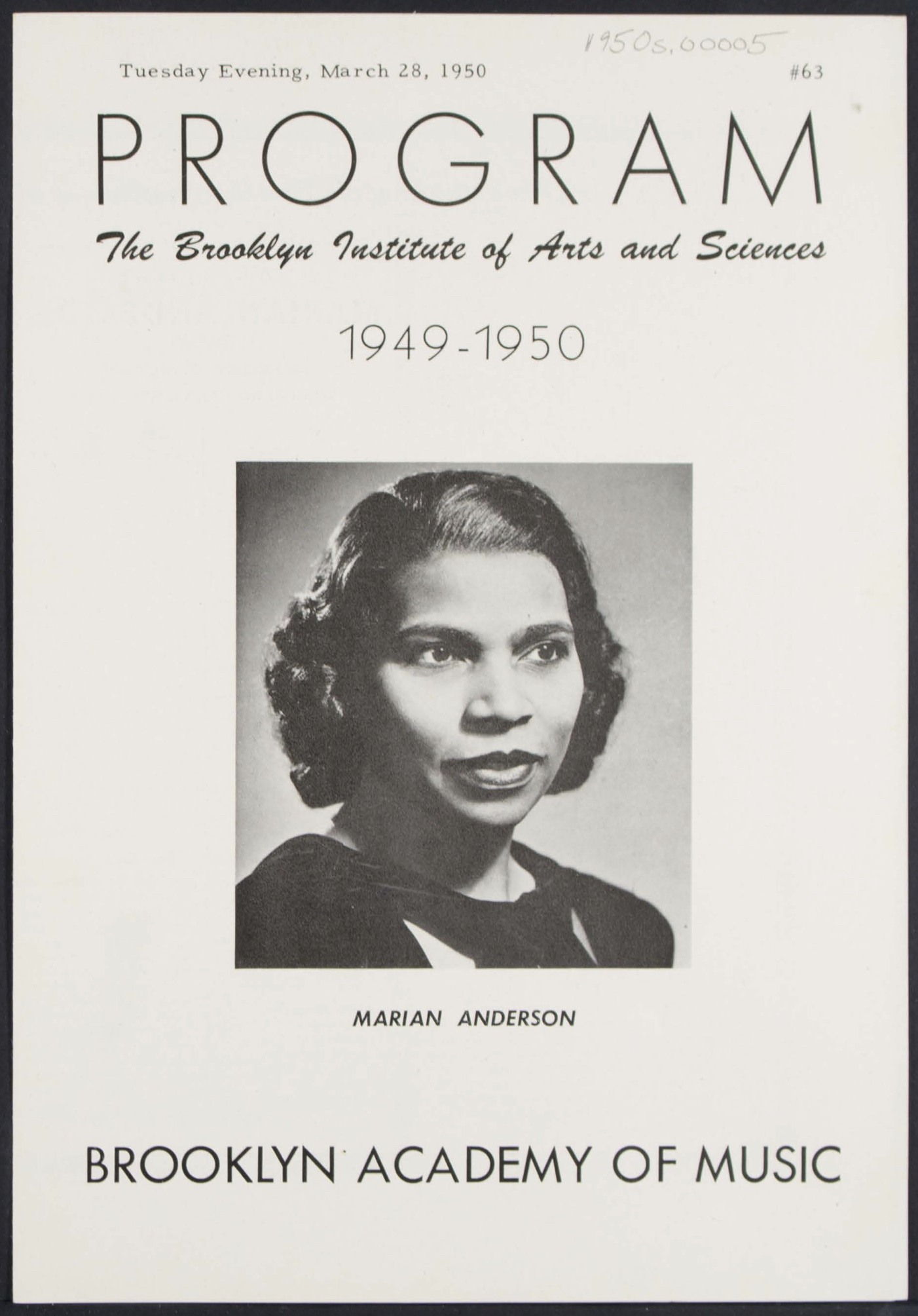
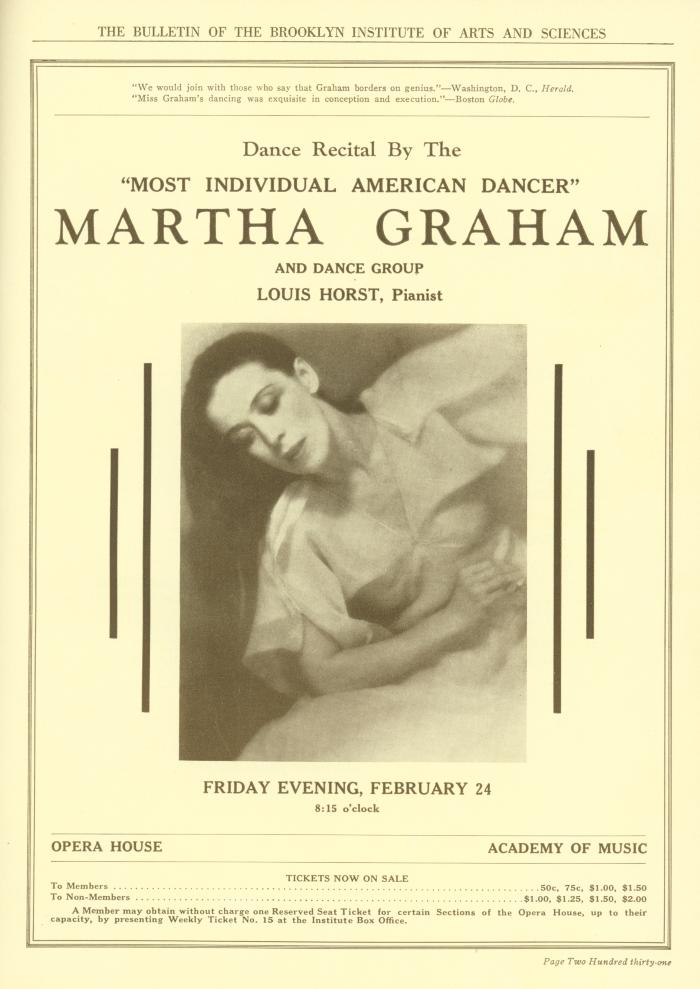
Prominent among them, Brooklyn’s Academy of Music, or BAM, has been at it since 1861, when it began as the home of the Philharmonic Society of Brooklyn. It has inhabited its present Beaux Arts building in Fort Greene since 1908. In its 150 years as a performance space for opera, classical, avant-garde theater, dance, and music, and film, BAM has amassed quite a collection of memorabilia. This year, on its century-and-a-half anniversary, it has made 70,000 of those artifacts available to the public in its Leon Levy Digital Archive. Like future issues of the Voice, you cannot hold these in your hand, unless you happen to be one of the museum’s curators. But “researchers—or anyone else interested,” writes The New York Times, “can create personalized collections based on specific artists, companies or eras.”

The history represented here is vast and deep, by a young country’s standards. “Every presidential candidate made campaign stops there before there was television,” says former BAM president Karen Brooks Hopkins. “Mary Todd Lincoln was in the audience during the opening week of festivities. Then you have [Rudolph] Nuryev making his first performance in the West just after he defects, [Martha] Graham performing her last performance on stage….” These landmark moments notwithstanding, BAM has earned a reputation as a home for avant-garde performance art, and the collection certainly reflects that dimension among the 40,000 artists represented.
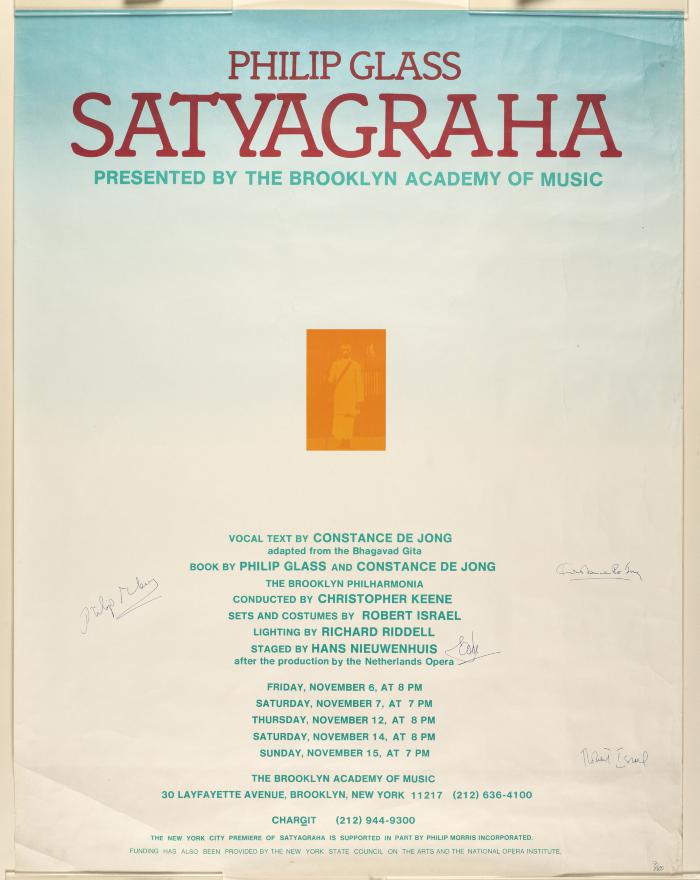
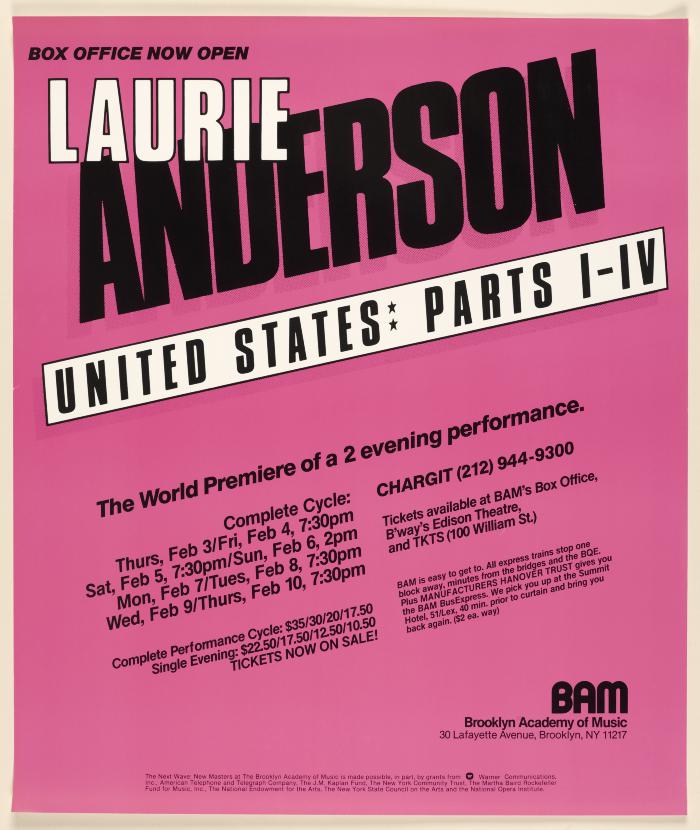
We have further up the postcard Keith Haring designed for a 1984 Bill T. Jones and Arnie Zane piece called Secret Pastures (Haring also designed the sets). We have the poster above for a 1981 performance of Philip Glass’ Satyagraha, his opera based on the life of Gandhi. And below, a poster for the 1983 world premier of Laurie Anderson’s United States: Parts I‑IV. These objects come from BAM’s Next Wave Festival collection, which contains many thousands of photographs, playbills, and posters from the space’s more experimental side, many, though not all of them, downloadable.
Between the Civil War memorabilia and modernist documents, you’ll find all sorts of fascinating ephemera: photos of a very young Meryl Streep and Christopher Lloyd in a 1977 production of Happy End at the Chelsea Theater during a BAM Spring Series, or of an older Patrick Stewart in a 2008 Macbeth. Just below, we have a charming playing card featuring the Brooklyn Academy of Music’s Peter Jay Sharp building in 1909, the year after it was built. It’s an imposing structure that seems like it might last forever, though much of the vibrant creative work featured year after year at BAM may someday also move entirely into digital spaces. Enter the complete BAM digital archive here.
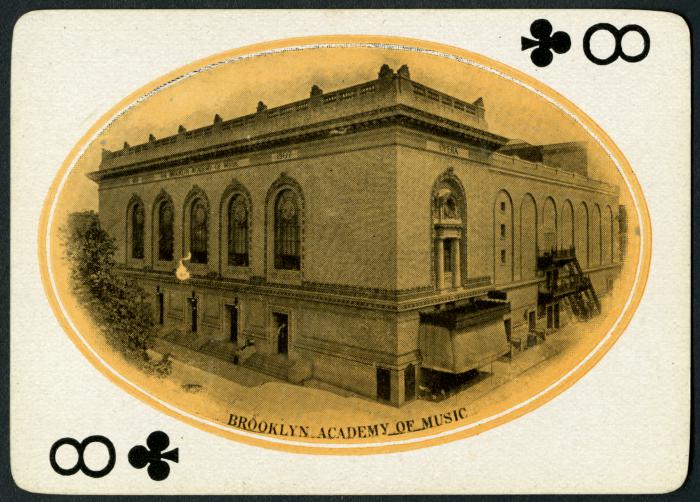
via The New York Times/Hyperallergic
Related Content:
The Theater Dictionary: A Free Video Guide to Theatre Lingo
A Minimal Glimpse of Philip Glass
Josh Jones is a writer and musician based in Durham, NC. Follow him at @jdmagness
Read More...What’s a Scientifically-Proven Way to Improve Your Ability to Learn? Get Out and Exercise

Wikimedia Commons Image by the U.S. Navy
The benefit, nay necessity, of physical exercise is undeniable. The medical community has identified sedentary lifestyles as an epidemic, sometimes called “sitting disease” (or as people like to say, “sitting is the new smoking”). Prolonged sitting has been established as a cause of all sorts of chronic illnesses including heart disease, diabetes, and even certain cancers. Combine this problem with the steady stream of processed foods in more and more diets and we have a full-blown public health crisis on our hands that requires some serious intervention on the part of doctors, dieticians, physical therapists, and scientists.
And as more and more researchers are finding out, a poor diet and lack of exercise can also have seriously harmful effects on the brain. Conversely, as a recent University of California study shows, exercise boosts brain function; it “enhances learning and memory, improves executive function” and “counteracts… mental decline.” To put the theory of enhanced learning to the test, researchers have conducted several experiments and found that physical activity can improve the ability to learn new things at nearly any age.
Studies have “found correlations between children’s aerobic fitness and their brain structure,” reports The New York Times, and kids who exercise before math and reading tests show consistently higher scores than their sedentary peers. Likewise, a study conducted with college students in Ireland found that participants performed significantly better on memory tests after 30 minutes of cycling. One likely explanation is that exercise increases the production of BDNF (Brain-Derived Neurotropic Factor), a protein that promotes nerve health. And in a new paper published by researchers from Italy, China, and Thailand, we find that that exercise can specifically improve the ability to learn new languages.
The study tested 40 college-age Chinese students who are learning English. One group remained sedentary, while another rode exercise bikes at a moderate pace both before and during study sessions. The students who biked performed better on 8 separate vocabulary tests and were better able to recognize correct English sentences. These results are similar to those of a recent German study which found that a group of young women riding exercise bikes, at slow and moderate paces, performed much better on vocabulary tests than another group who didn’t exercise.
Though The New York Times points to a different study with contrasting results, the evidence seems largely on the side of exercise-enhances-learning proponents. “In recent years,” the Times notes, “a wealth of studies in both animals and people have shown that we learn differently if we also exercise.” You’ll find many of those studies summarized at the BBC, The Guardian, and elsewhere, along with several possible explanations for the phenomenon. Psychologist Justin Rhodes notes that “aerobic exercise can actually reverse hippocampal shrinkage,” increasing gray matter in an area of the brain associated with memory and emotion. His contention is backed by recent research on mice and humans.
In any case, although it appears that more vigorous exercises like cycling and running create the most improvement, taking a brisk walk before a class or study session can also help with retention and alertness. Whatever kind of exercise one does, a simple “take-home message,” says one researcher, “may be that instruction should be flanked by physical activity. Sitting for hours and hours without moving is not the best way to learn.” Having trouble getting motivated to run or bike before you study for that math test or start a new language course? Take some advice from Harvard Medical School on how to start slowly, find something you like doing, and turn everyday activities into exercise.
Related Content:
Why Sitting Is The New Smoking: An Animated Explanation
Josh Jones is a writer and musician based in Durham, NC. Follow him at @jdmagness
Read More...The Comedic Legacies of Dick Gregory and Jerry Lewis (RIP): A Study in Contrasts
Two titans of comedy passed away this weekend, but the deaths of Dick Gregory and Jerry Lewis have seemed like cultural footnotes amidst some of the most anxious, angry few days in recent U.S. history. Gregory and Lewis are stars of a bygone era, maybe two full generations behind contemporary popular relevance. And yet, in many ways, the mid-20th century world where both men got their start feels closer than ever.
Both Gregory and Lewis once wielded considerable power in the entertainment industry and in their other chosen spheres of influence—the civil rights movement and charitable giving, respectively. In nearly every other respect, the two could not have been more different.
Gregory broke into mainstream success with a new wave of black comics like Bill Cosby and Richard Pryor, and like Pryor, he did so by telling painful truths about racism that many white Americans laughed about but were unwilling to honestly confront or change. You can hear an early example in the routine above, from his 1962 album Dick Gregory Talks Turkey.
Gregory got his big break in 1961 when he seized the moment in a tryout at Hugh Hefner’s Chicago Playboy Club. As he later told CBS Sunday Morning, “I pushed that white boy out of the way and ran up there…. Two hours later, they called Hefner. And Hefner came by and they went out of their mind.” That same year, he made his first national TV appearance. See it at 15:16 in the documentary Walk in My Shoes just above, which also features Malcolm X and Congress for Racial Equality (CORE) founder James Farmer.
In the playlist below, you can hear three full Gregory comedy recordings, Living Black & White (1961), East & West (1961), and an interview album, Dick Gregory on Comedy. Throughout his career, Gregory was an uncompromising civil rights activist who was beaten and arrested in the sixties at marches and protests. He was at the 1963 March on Washington, faced down the Klan to help integrate restaurants, and fasted to protest the Vietnam War. In a review of his provocatively-titled autobiography, The New York Times described him as “a man who deeply wants a world without malice and hate and is doing something about it.”
He also did something about it in comedy. When Jack Paar’s producer called him to appear on the show, Gregory hung up on him. Then Paar himself called, and Gregory told him he wouldn’t come on unless he could sit on the couch, a privilege afforded white comics and denied their black counterparts. Paar agreed. “It was sitting on the couch,” he said, “that made my salary grow in three weeks from $250 working seven days a week to $5,000 a night.” For the next several decades, he leveraged his wealth and fame for humanitarian and civil rights causes, and even a run for mayor of Chicago in 1967 and a popular write-in presidential campaign in the 1968 election. He died at 84 a venerated elder statesman of stand-up comedy and of the Civil Rights Movement.
Jerry Lewis’s legacy is much more complicated, and serves in many ways as a “cautionary tale,” as Nick Gillespie puts it, for the hubris of celebrity. Lewis broke through in the 50s as the animated, rubbery comic foil to Dean Martin’s suave straight man in the hugely famous comedy duo of Martin & Lewis. See them above do a standup routine in 1952 on their Colgate Comedy Hour, with an introduction (and intervention) from Bob Hope. The act was a phenomenon. “Coming from literally nowhere,” writes Shawn Levy at The Guardian, “the pair rode a skyrocketing 10-year career that made them staples of American showbiz for the rest of their lives…. They met when they were just two guys scuffling for a break in Times Square, and they helped forge a new brand of popular entertainment suited to the postwar mood.”
In the same year as the broadcast further up, Lewis made his first appearance, with Martin and Jackie Gleason, on the Muscular Dystrophy Associations of America (MDAA) telethon. Just above, see them do a bit while the familiar banks of operators stand by behind them. Lewis began hosting his own MDAA telethon in 1966 and did so until 2010, raising billions for the organization, which remembers him as a “Comic genius. Cultural icon. Humanitarian.” Many disability activists feel otherwise, including many former “Jerry’s Kids,” his “pet name,” writes Gillespie, for the poster children he recruited to represent the MD community on the telethon and related advocacy materials. “The telethon was widely parodied,” and Lewis’s efforts have been seen by many activists and protestors as self-serving, perpetuating harmful, demeaning attitudes and encouraging pity for MD sufferers rather than acceptance and social equality.
As a movie star, Lewis often played an all-American doofus whose physical antics and stammering, boyish persona endeared him to audiences (see above, for example, from 1952’s Sailor Beware). As a director, he made tightly choreographed madcap comedies. He also traded in offensive stereotypes, participating in an ugly Hollywood tradition that emerged from anti-Chinese bigotry of the 19th century and anti-Japanese World War II propaganda. (Lewis was unflatteringly remembered in The Japan Times as the “king of low-brow comedy… forever squealing, grimacing and flailing his way” through various roles.) He introduced Asian caricatures into his act in the Martin & Lewis days (see below) and reprised the shtick in his critically-loathed 1980 film Hardly Working, in which, writes Paul Macovaz at Senses of Cinema, he “realizes an offensive, profoundly racist yellow-face sashimi chef.”
“I imagine that most viewers will be troubled by it,” Macovaz comments, “wrenched viscerally from their enjoyment of the Lewisian idiot and pressed squirming into the overdetermined conceptual narrative zone of American Orientalism.” Those viewers who know another of Lewis’s later-career disasters will recognize another awkward character in Hardly Working, the sad-faced clown of 1972’s disastrous The Day the Clown Died, a film so ill-advised and badly executed that Lewis never allowed it to be released. (Just below, see a short documentary on the abortive effort.) In the movie, as comedy writer Bruce Handy noted in a 1992 Spy magazine article, the comedian plays “an unhappy German circus clown… sent to a concentration camp and forced to become a sort of genocidal Pied Piper, entertaining Jewish children as he leads them to the gas chambers.” Meant to be his first “serious,” dramatic role, the largely unseen film now stands as an archetypal epitome of poor taste—an artistic failure that Mel Brooks might have dreamed up as a sick joke.
As Gillespie points out, Lewis’s last years saw him threatening to punch Lindsay Lohan and telling refugees to “stay where the hell they are.” Long past the time most people wanted to hear them, he persisted in making “racist and misogynistic jokes” and gave “the most painfully awkward interview of 2016” to the Hollywood Reporter. He became well-known for verbally abusing his audiences. The running joke that Lewis was beloved by the French, which “only made him less respectable in his home country,” may have been run into the ground. But in the latter half of his career, it sums up how much American comedians—even those like Steve Martin, Robin Williams, Jim Carrey, and Eddie Murphy, who were clearly influenced by his manic humor—were often unwilling to make too much of the debt. But looking back at his 1950s dada zaniness and at films like The Nutty Professor, it’s impossible to deny his contributions to 20th century comedy and even a certain brand of absurdist 21st century humor.
Related Content:
Hear 30 of the Greatest Standup Comedy Albums: A Playlist Chosen by Open Culture Readers
Chris Rock Creates a List of His 13 Favorite Standup Comedy Specials
Bill Hicks’ 12 Principles of Comedy
Josh Jones is a writer and musician based in Durham, NC. Follow him at @jdmagness
Read More...Final Show of Metallica’s North American Tour Now Streaming Free Online
A quick fyi: Metallica wrapped up their North American tour on Friday night in Edmonton–their first North American tour in eight years. The show was live-streamed on YouTube, and it’s now fully viewable online, thanks to MetallicaTV. Enjoy all 2 hours and 41 minutes of it. You can see a setlist for the show here.
If you would like to support the mission of Open Culture, consider making a donation to our site. It’s hard to rely 100% on ads, and your contributions will help us continue providing the best free cultural and educational materials to learners everywhere. You can contribute through PayPal, Patreon, and Venmo (@openculture). Thanks!
Related Content:
A Bluegrass Version of Metallica’s Heavy Metal Hit, “Enter Sandman”
Metallica Playing “Enter Sandman” on Classroom Toy Instruments
Read More...Ansel Adams, Dorothea Lange, Clem Albers & Francis Stewart’s Censored Photographs of a WWII Japanese Internment Camp

Image by Ansel Adams
In places where atrocities or widespread human rights violations occur, we sometimes hear ordinary citizens later claim they didn’t know what was going on. In the case of the internment of Japanese Americans during World War II, this would be almost impossible to believe. “120,000 people,” notes Newsweek, “lost their property and their freedom,” rounded up in full view of their neighbors. Every major publication of the time reported on Franklin Roosevelt’s 1941 Executive Order. Newsweek wrote “that people in coastal areas ‘were more anxious than ever to get rid of their aliens after rumors that signal lights were seen before submarine attacks’ ” off the coast of Southern California. There were many such rumors, the kind that spread xenophobic fear and paranoia, and which people used to vocally support, or tacitly approve of, sending their neighbors to internment camps because of their ancestry.

Image by Francis Stewart
Other reactions were less than subtle. The West Seattle Herald confronted readers with the blunt headline “GET ‘EM OUT!” Nonetheless, Newsweek’s Rob Verger writes, “the policy was by no means greeted with unanimous support,” and a vigorous public debate played out, with opponents pointing to the blatant racism and violations of civil rights. Two-thirds of the internees were American citizens. Yet all Japanese Americans were repeatedly called “aliens,” language consistent with the virulently anti-Japanese propaganda campaigns emerging at the same time.
Once the camps were built and the internees imprisoned, however, a massive propaganda effort began, not only the sell the camps as a necessary national security measure, but to portray them as idyllic villages where the patriotic internees patiently waited out the war by farming, playing baseball, making arts and crafts, running general stores, attending school, waving flags, and running newspapers.

Image by Clem Albers
Much of that information was conveyed to the public visually by photographers hired by the War Relocation Authority to document the camps. Among them were Clem Albers, Francis Stewart, and Dorothea Lange—well known for her photographs of the Great Depression. All three visited the camp called Manzanar in the foothills of the Sierra mountains. Another famous photographer, Ansel Adams, gained access to Manzanar by virtue of his friendship with its director, Ralph Merritt.

Image by Dorothea Lange
Their photographs, for the most part, show busily working men and women, smiling schoolchildren, and lots of patriotic leisure activities, like Stewart’s photo of sixth grade boys playing softball, further up. The photographers were strictly prohibited from photographing guards, watchtowers, searchlights, or barbed wire, and the heavy military presence at the camp is nearly always out of frame, with some very rare exceptions, like Albers’ photograph above of military police.

Image by Ansel Adams
Adams worked under these prohibitions as well, but his photos captured camp life as honestly as he could. The stunning landscapes sometimes compete, even in the background, with the real subject of some of his images (as in the photo at the top). But he also conveyed the harsh barrenness of the region. He tried to intimate the oppressive police apparatus by capturing its shadow. “The purpose of my work,” he wrote to the Library of Congress in 1965 upon donating his collection, “was to show how these people, suffering under a great injustice, and loss of property, business and professions, had overcome a sense of defeat and despair [sic].” His images often show internees “in heroic poses,” writes Dinitia Smith, as above, in order to ennoble their conditions. Lange’s photographs, on the other hand, like that of a young girl below, “seemingly unstaged and unlighted… bear the hallmarks” of her “distinctively documentary style.” Her pictures “compress intense human emotion into carefully composed frames.” Some of her photos show smiling, relaxed subjects. Many others, like the photograph of a barracks interior further down, show the faces of weary, uncertain, and despondent civilian prisoners of war.

Image by Dorothea Lange
Perhaps because of her refusal to sentimentalize the camps, or because of her left-wing politics and opposition to internment (both known before she was hired), Lange’s work was censored, not only through restricted access, but through the impoundment of over 800 photographs she took at 21 locations. Those photos were recently published in a book called Impounded: Dorothea Lange and the Censored Images of Japanese American Internment and hundreds of them are free to view online at the Densho Digital Repository’s Dorothea Lange Collection. The National Park Service’s collection features 16 pictures from Lange’s visit to Manzanar. At the NPS site, you’ll also find collections of photographs from that camp by Adams, Albers, and Stewart. Each, to one degree or another, faced a form of censorship in what they could photograph or whether their work would be shown at all. What most ordinary people saw at the time did not tell the whole story. For all practical purposes, writes Oberlin Library, “life at a Japanese internment camp was comparable to the life of a prisoner behind bars.”

Image by Dorothea Lange
Related Content:
478 Dorothea Lange Photographs Poignantly Document the Internment of the Japanese During WWII
200 Ansel Adams Photographs Expose the Rigors of Life in Japanese Internment Camps During WW II
Dr. Seuss Draws Anti-Japanese Cartoons During WWII, Then Atones with Horton Hears a Who!
Josh Jones is a writer and musician based in Durham, NC. Follow him at @jdmagness
Read More...A Century of Global Warming Visualized in a 35 Second Video
Antti Lipponen, a researcher at the Finnish Meteorological Institute, gathered historical data from NASA and produced a short video effectively showing that, from 1900 through 2016, the temperature has steadily gotten warmer worldwide. Each spoke of the wheel represents one of 191 different countries. And the hotter the color (e.g. oranges and reds), the warmer the temperature. You can get a closer look at the historical progression here. The materials have been released under a Creative Commons license on Flickr.
Note: If you want to better understand the science of Global Warming, we’d recommend watching the lectures from this free Global Warming course from the University of Chicago:
If you would like to support the mission of Open Culture, consider making a donation to our site. It’s hard to rely 100% on ads, and your contributions will help us continue providing the best free cultural and educational materials to learners everywhere. You can contribute through PayPal, Patreon, and Venmo (@openculture). Thanks!
Related Content:
Global Warming: A Free Course from UChicago Explains Climate Change
132 Years of Global Warming Visualized in 26 Dramatically Animated Seconds
A Song of Our Warming Planet: Cellist Turns 130 Years of Climate Change Data into Music
Frank Capra’s Science Film The Unchained Goddess Warns of Climate Change in 1958
Read More...Marshall McLuhan Explains Why We’re Blind to How Technology Changes Us, Raising the Question: What Have the Internet & Social Media Done to Us?
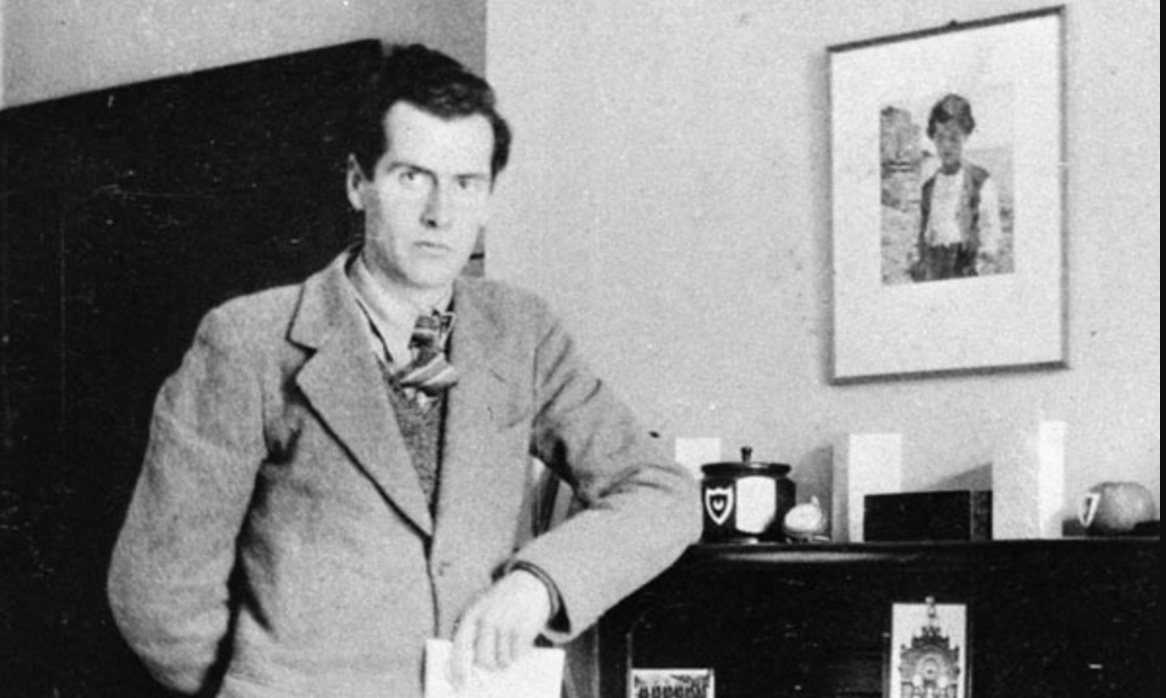
Image of Marshall McLuhan at Canada, by Wikimedia Commons
So many of us use Facebook every day, but how many of us know that its enormous presence in our lives owes, in part, to modern philosophy? “In the course of his studies at Stanford,” writes John Lanchester in a recent London Review of Books piece of Facebook, Silicon Valley billionaire Peter Thiel, an early investor in the company, “became interested in the ideas of the US-based French philosopher René Girard, as advocated in his most influential book, Things Hidden since the Foundation of the World,” especially a concept he called “mimetic desire.”
“Human beings are born with a need for food and shelter,” writes Lanchester. “Once these fundamental necessities of life have been acquired, we look around us at what other people are doing, and wanting, and we copy them.” Or as Thiel explained it, “Imitation is at the root of all behavior.” Lanchester reports that “the reason Thiel latched onto Facebook with such alacrity was that he saw in it for the first time a business that was Girardian to its core: built on people’s deep need to copy,” yet few of us, its users, have clearly perceived that essential aspect of Facebook and other social media platforms.
Marshall McLuhan, despite having died decades before their development, would have caught on right away — and he understood why even we savvy denizens of the 21st century haven’t. “For the past 3500 years of the Western world, the effects of media — whether it’s speech, writing, printing, photography, radio or television — have been systematically overlooked by social observers,” said the author of Understanding Media and The Medium is the Message. “Even in today’s revolutionary electronic age, scholars evidence few signs of modifying this traditional stance of ostrichlike disregard.”
Those words come from an in-depth 1969 interview with Playboy magazine that broke the celebrity literature professor McLuhan’s ideas to an even wider audience than they’d had before. In it he diagnosed a “peculiar form of self-hypnosis” he called “Narcissus narcosis, a syndrome whereby man remains as unaware of the psychic and social effects of his new technology as a fish of the water it swims in. As a result, precisely at the point where a new media-induced environment becomes all pervasive and transmogrifies our sensory balance, it also becomes invisible.”
As McLuhan saw it, “most people, from truck drivers to the literary Brahmins, are still blissfully ignorant of what the media do to them; unaware that because of their pervasive effects on man, it is the medium itself that is the message, not the content, and unaware that the medium is also the massage — that, all puns aside, it literally works over and saturates and molds and transforms every sense ratio. The content or message of any particular medium has about as much importance as the stenciling on the casing of an atomic bomb.”
Just last month, no less omnipresent an internet titan than Google celebrated McLuhan’s 106th birthday, and a social observer called PR Professor saw in it a certain irony: though “it seems like technology that extends man’s ability to experience and interpret the world is positive and desirable,” McLuhan pointed out “that the inherent tendency to focus on the messages within the media make us blind to the limits and structures imposed by the mediums themselves.” This blindness has consequences indeed, since, according to McLuhan, each time a society develops a new media technology, “all other functions of that society tend to be transmuted to accommodate that new form” as that technology “saturates every institution of that society.”
This went for speech, writing, print, and the telegraph as well as it goes for “social media platforms like Twitter, which reduce expressive possibilities to 140 characters of text or expressing one’s self through the ‘re-tweeting’ of posts by others.” McLuhan believed that at one time only the interpretive work of the artist, “who has had the power — and courage — of the seer to read the language of the outer world and relate it to the inner world,” could allow the rest of us to recognize the thoroughgoing effects of technology on society, but that “the new environment of electric information” had made possible “a new degree of perception and critical awareness by nonartists.” At least more of us, if we step back, can now understand our affliction by mimetic desire, Narcissus narcosis, or any number of other troubling conditions. What to do about them remains an open question.
Related Content:
McLuhan Said “The Medium Is The Message”; Two Pieces Of Media Decode the Famous Phrase
New Animation Explains Sherry Turkle’s Theories on Why Social Media Makes Us Lonely
Based in Seoul, Colin Marshall writes and broadcasts on cities and culture. He’s at work on the book The Stateless City: a Walk through 21st-Century Los Angeles, the video series The City in Cinema, the crowdfunded journalism project Where Is the City of the Future?, and the Los Angeles Review of Books’ Korea Blog. Follow him on Twitter at @colinmarshall or on Facebook.
Read More...Bertrand Russell Reveals the 4 Human Desires That Make Our World: Acquisitiveness, Rivalry, Vanity & Love of Power
Contrary to Aristotle, the eminent logician, philosopher, and activist Bertrand Russell believed that virtue and morality play little part in political life. Rather, what most drives us to action, he argued, is selfish desire. Russell’s political philosophy could seem almost Machiavellian, most notably in his Nobel Prize speech 1950, in which he proclaims that “all human activity is prompted by desire.” (Hear Russell read an excerpt above.)
There is a wholly fallacious theory advanced by some earnest moralists to the effect that it is possible to resist desire in the interests of duty and moral principle. I say this is fallacious, not because no man ever acts from a sense of duty, but because duty has no hold on him unless he desires to be dutiful. If you wish to know what men will do, you must know not only, or principally, their material circumstances, but rather the whole system of their desires with their relative strengths.
Russell’s argument about desire admits “there is no limit to the efforts that men will make, or to the violence that they will display” in the face of perceived scarcity, and his observations recall not only the realpolitik of Machiavelli, but the insights of that most prominent theorist of desire, Sigmund Freud.
Man differs from other animals in one very important respect, and that is that he has some desires which are, so to speak, infinite, which can never be fully gratified, and which would keep him restless even in Paradise. The boa constrictor, when he has had an adequate meal, goes to sleep, and does not wake until he needs another meal. Human beings, for the most part, are not like this.
Rather than libidinous instincts, however, Russell names four main political desires that cannot be satisfied: Acquisitiveness (“the wish to possess as much as possible), Rivalry (“a much stronger motive”), Vanity (“a motive of immense potency”), and Love of Power (“which outweighs them all”). We may note the tremendous degree to which all four desires seem actively at work in shaping our current world. All four of these qualities greet us every morning on our smartphones and never let up, day after day. But it has always been so to one degree or another, Russell argues. The important thing is to be clearsighted on the matter. Although selfish political desires can and largely are destructive, they need not always be so.
Political desires like the love of power may “have other sides which are more desirable.” Scholarly and scientific endeavors may be “mainly actuated by a love of power.…. In politics, also, a reformer may have just as strong a love of power as a despot. It would be a complete mistake to decry love of power altogether as a motive.” “Russell,” writes Maria Popova, is “a thinker of exceptional sensitivity to nuance and to the dualities of which life is woven.” He cautions that we cannot simply dismiss our most powerful motive as “a wholesale negative driver.”
The real problem, as Russell sees it, lies in “circumstances in which populations will fall below selfishness, if selfishness is interpreted as enlightened self-interest.” The phenomenon we observe of people “voting against their interests” is for Russell an occasion “on which they are convinced that they are acting from idealistic motives.”
Much that passes as idealism is disguised hatred or disguised love of power. When you see large masses of men swayed by what appear to be noble motives, it is as well to look below the surface and ask yourself what it is that makes these motives effective. It is partly because it is so easy to be taken in by a facade of nobility that a psychological inquiry, such as I have been attempting, is worth making.
Rather than virtue or morality, politics most requires “intelligence,” Russell concludes, “a thing that can be fostered by known methods of education.” These are not the forms of education we generally receive: “Schools are out to teach patriotism,” he says, “newspapers are out to stir up excitement; and politicians are out to get re-elected. None of the three, therefore, can do anything towards saving the human race from reciprocal suicide.”
The Cold War threat of nuclear annihilation hangs heavy over Russell’s speech. As long as humans are gripped by hatred and fear of others and held in thrall to political delusions, he suggests, the possibility of mutually assured destruction remains. On the other hand, if we were honest about our desires, and “if men were actuated by self-interest,” Russell writes, “which they are not.… if men desired their own happiness as ardently as they desired the misery of their neighbors.… the whole human race would cooperate.” Read the full text of Russell’s Nobel speech here.
Related Content:
Free Online Political Science Courses
7 Nobel Speeches by 7 Great Writers: Hemingway, Faulkner, and More
Bertrand Russell & Buckminster Fuller on Why We Should Work Less, and Live & Learn More
Josh Jones is a writer and musician based in Durham, NC. Follow him at @jdmagness
Read More...How Leonard Cohen & David Bowie Faced Death Through Their Art: A Look at Their Final Albums
When Leonard Cohen released You Want it Darker in late 2016, some suspected that it would be his last album. When the 82-year-old singer-songwriter died nineteen days later, it felt like a reprise of David Bowie’s passage from this mortal coil at the beginning of that year in which we lost so many important musicians: just two days after the release of his album Blackstar, Bowie shocked the world by dying of an illness he’d chosen not to make public. Both Cohen and Bowie’s fans immediately doubled down their scrutiny of what turned out to be their final works, finding in both of them artistic interpretations of the confrontation with death.
The title track of You Want It Darker, says the narrator of the Polyphonic video essay above, “is not just any song, but the culmination of many meditations on Cohen’s own mortality. The result is a hauntingly accusatory song towards his own god.”
This analysis focuses on lines, delivered by Cohen’s gravelier-than-ever singing voice, like “If you are the dealer, I’m out of the game / If you are the healer, that means I’m broken and lame” and “If thine is the glory, then mine must be the shame / You want it darker, we kill the flame.” Cohen also uses phrases taken from a Jewish mourner’s prayer as a way of “facing up to his god and submitting.”
The non-religious Bowie took a different tack. “Just take a look at Bowie’s costume,” says the essay’s narrator. “He’s bandaged, frail, and maniacal in the ‘Blackstar’ video. While the bandage serves to represent wounds, it can also be taken as a blindfold,” historically “worn by those condemned to execution.” Using Christian imagery, Bowie frames his song “in the post-paradise world of mortal life,” in a sense referencing what Cohen once described as “our blood myth,” the crucifixion. And so Bowie’s song “is using our cultural vocabulary to explore our relationship with death.” And yet, “in the midst of this dark song, Bowie offers optimism” in the form of the titular Blackstar, a “newly inspired being” that emerges from death.
“While mankind can’t cheat death, we can still find immortality in the way people remember us, the legacy that they carry on.” And despite recognizing their basic humanity, many of us carriers of the legacy still struggle to process the deaths of high-profile, sui generis performing artists. Maybe it has to do with their status as icons, and icons, strictly speaking, can’t die — but nor can they live. Leonard Cohen and David Bowie, the men, may have finished their days, and what days they were, but Leonard Cohen and David Bowie, the cultural phenomena, will surely outlast us all.
You can listen to Cohen and Bowie’s final albums above. If you need Spotify’s free software, get it here.
Related Content:
Leonard Cohen Has Passed at Age 82: His New and Now Final Album Is Streaming Free Online
Hear Leonard Cohen’s Final Interview: Recorded by David Remnick of The New Yorker
David Bowie Sings “Changes” in His Last Live Performance, 2006
Dave: The Best Tribute to David Bowie That You’re Going to See
Death: A Free Philosophy Course from Yale
Based in Seoul, Colin Marshall writes and broadcasts on cities and culture. He’s at work on the book The Stateless City: a Walk through 21st-Century Los Angeles, the video series The City in Cinema, the crowdfunded journalism project Where Is the City of the Future?, and the Los Angeles Review of Books’ Korea Blog. Follow him on Twitter at @colinmarshall or on Facebook.
Read More...Métal hurlant: The Hugely Influential French Comic Magazine That Put Moebius on the Map & Changed Sci-Fi Forever
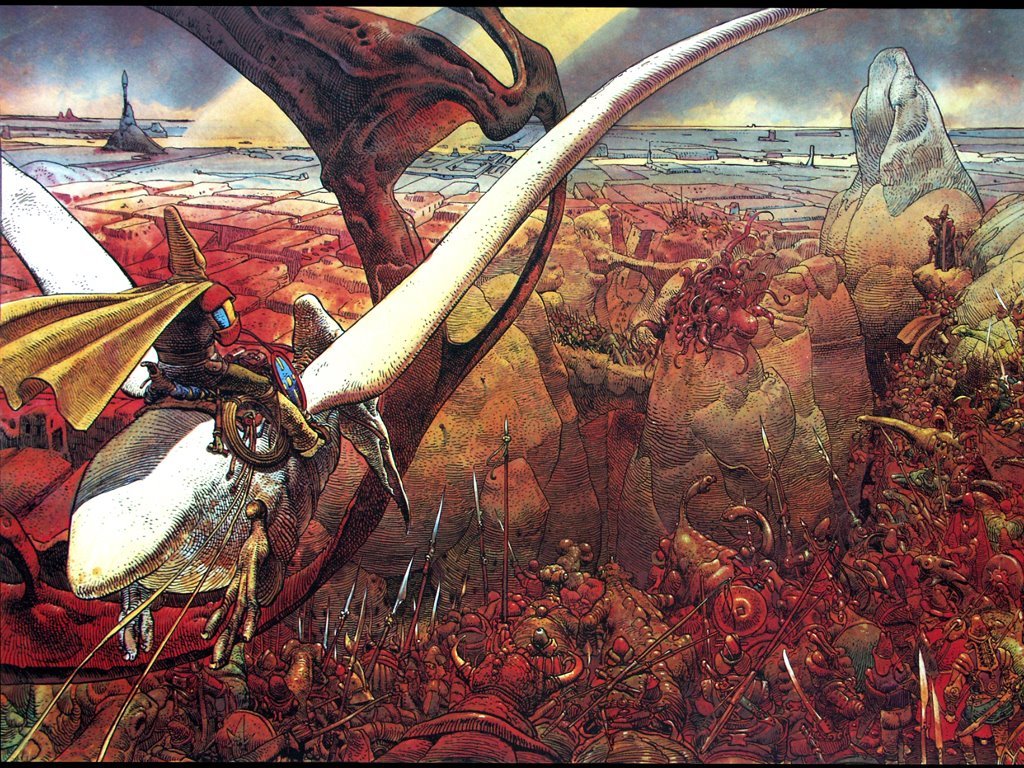
Would you believe that one particular publication inspired a range of visionary creators including Ridley Scott, George Lucas, Luc Besson, William Gibson, and Hayao Miyazaki? Moreover, would you believe that it was French, from the 1970s, and a comic book? Not that that term “comic book” does justice to Métal hurlant, which during its initial run from 1974 to 1987 not only redefined the possibilities of the medium and greatly widened the imaginative possibilities of science fiction storytelling, but brought to prominence a number of wholly unconventional and highly influential artists, chief among them Jean Giraud, best known as Moebius.
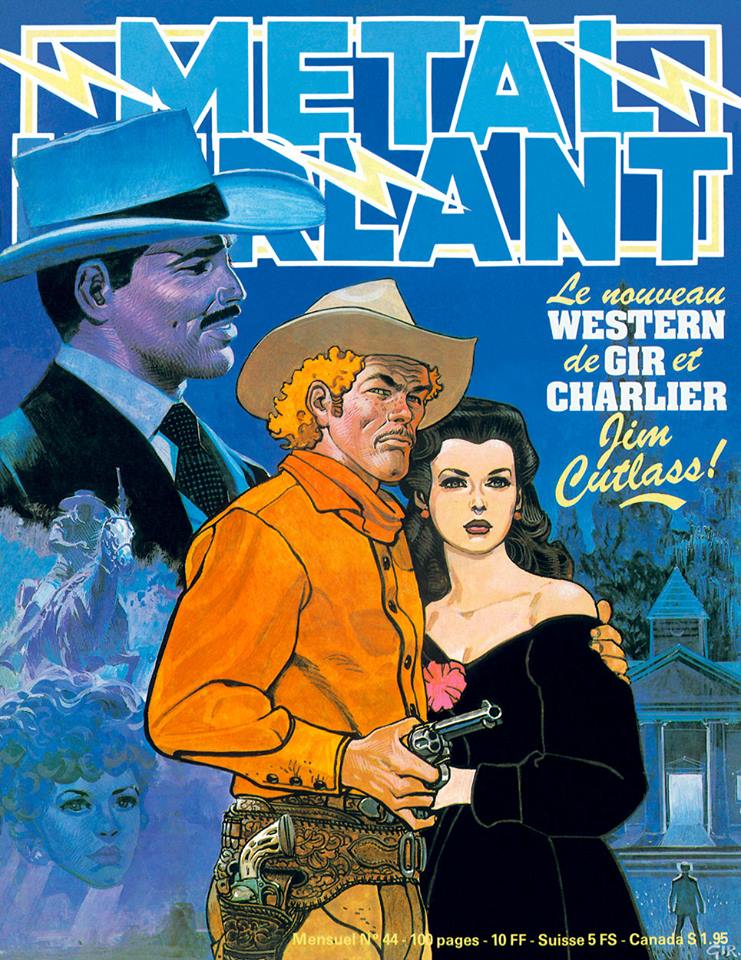
Métal hurlant, according to Tom Lennon in his history of the magazine, launched “as the flagship title of Les Humanoïdes Associés, a French publishing venture set up by Euro comic veterans Moebius, Druillet and Jean-Pierre Dionnet, together with their finance director Bernard Farkas. Influenced by both the American underground comix scene of the 1960s and the political and cultural upheavals of that decade, their goal was bold and grandiose: they were going to kick ass, take names, and make people take comics seriously.”
This demanded “artistic innovation at every level,” from high-quality, large-format paper stock to risk-taking storytelling “shot through with a rich vein of humour and delivered with a narrative sophistication previously unseen in the medium.”

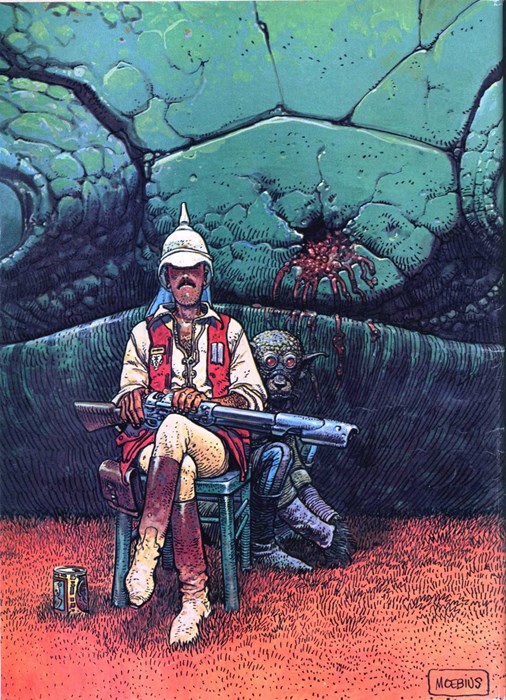
Giraud took to the possibilities of the new publication with a special avidness. Under the pen name “Gir,” writes Lennon, he “was best known as the co-creator of the popular Western series, Blueberry. By the mid-1970s, Giraud was feeling increasingly constrained by the conventions of the western genre, so decided to revive a long-dormant pseudonym to embark on more experimental work. As ‘Moebius’, Giraud not only worked in a different genre to ‘Gir’ – a deeply personal, highly idiosyncratic form of science fiction and fantasy – but his art looked like it was drawn by a completely different person,” and “unlike anything that had been seen in comics — or, for that matter, in any other medium.”
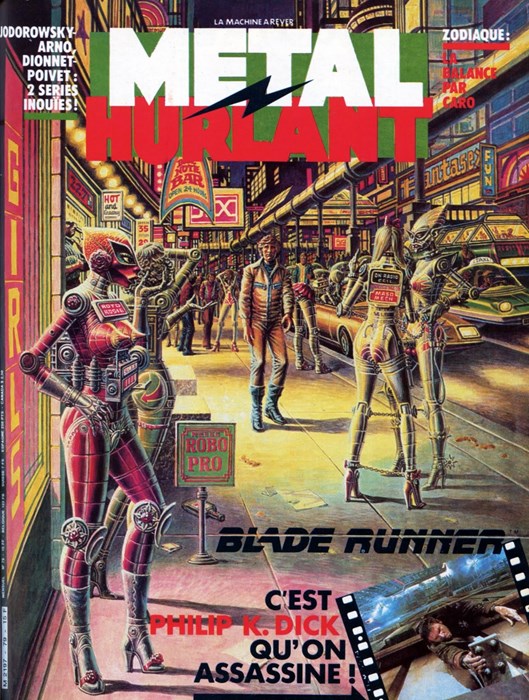
Métal hurlant saw the debuts of two of Moebius’ best-known characters: the pith-helmeted and mustachioed protector of miniature universes Major Grubert and the silent, pterodactyl-riding explorer Arzach, who bears a certain resemblance to the protagonist of Miyazaki’s 1984 film Nausicaä of the Valley of the Wind. Read through the back issues of the magazine — or its 40-years-running American version, Heavy Metal — and you’ll also glimpse, in the work of Moebius and others, elements that would later find their way into the worlds of Neuromancer, Mad Max, Alien, Blade Runner, Star Wars, and much more besides.
“A while ago, SF was filled with monstrous rocket ships and planets,” said Moebius in 1980. “It was a naive and materialistic vision, which confused external space with internal space, which saw the future as an extrapolation of the present. It was a victim of an illusion of a technological sort, of a progression without stopping towards a consummation of energy.” He and Métal hurlant did more than their part to transform and enrich that vision, but plenty of old perceptions still remain for their countless artistic descendants to warp beyond recognition.
via Tom Lennon/Dazed Digital
Related Content:
Moebius’ Storyboards & Concept Art for Jodorowsky’s Dune
The Inscrutable Imagination of the Late Comic Artist Mœbius
Watch Moebius and Miyazaki, Two of the Most Imaginative Artists, in Conversation (2004)
Based in Seoul, Colin Marshall writes and broadcasts on cities and culture. He’s at work on the book The Stateless City: a Walk through 21st-Century Los Angeles, the video series The City in Cinema, the crowdfunded journalism project Where Is the City of the Future?, and the Los Angeles Review of Books’ Korea Blog. Follow him on Twitter at @colinmarshall or on Facebook.
Read More...Support Us
We're hoping to rely on loyal readers, rather than erratic ads. Please click the Donate button and support Open Culture. You can use Paypal, Venmo, Patreon, even Crypto! We thank you!

About Us

Open Culture scours the web for the best educational media. We find the free courses and audio books you need, the language lessons & educational videos you want, and plenty of enlightenment in between.
Advertise With Us

FREE UPDATES!
GET OUR DAILY EMAIL
Get the best cultural and educational resources on the web curated for you in a daily email. We never spam. Unsubscribe at any time.
FOLLOW ON SOCIAL MEDIA

Open Culture editor Dan Colman scours the web for the best educational media. He finds the free courses and audio books you need, the language lessons & movies you want, and plenty of enlightenment in between.
Advertise With Us


