How the CIA Funded & Supported Literary Magazines Worldwide While Waging Cultural War Against Communism
Over the course of this tumultuous year, new CIA director Mike Pompeo has repeatedly indicated that he would move the Agency in a “more aggressive direction.” In response, at least one person took on the guise of former Chilean president Salvador Allende and joked, incredulously, “more aggressive”? In 1973, the reactionary forces of General Augusto Pinochet overthrew Allende, the first elected Marxist leader in Latin America. Pinochet then proceeded to institute a brutal 17-year dictatorship characterized by mass torture, imprisonment, and execution. The Agency may not have orchestrated the coup directly but it did at least support it materially and ideologically under the orders of President Richard Nixon, on a day known to many, post-2001, as “the other 9/11.”
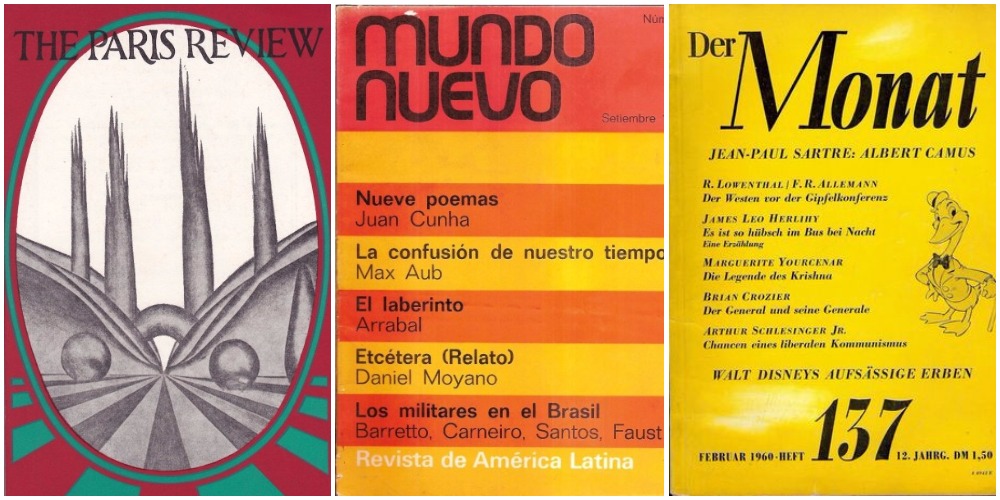
The Chilean coup is one of many CIA interventions into the affairs of Latin America and the former European colonies in Africa and Asia after World War II. It is by now well known that the Agency “occasionally undermined democracies for the sake of fighting communism,” as Mary von Aue writes at Vice, throughout the Cold War years. But years before some of its most aggressive initiatives, the CIA “developed several guises to throw money at young, burgeoning writers, creating a cultural propaganda strategy with literary outposts around the world, from Lebanon to Uganda, India to Latin America.” The Agency didn’t invent the post-war literary movements that first spread through the pages of magazines like The Partisan Review and The Paris Review in the 1950s. But it funded, organized, and curated them, with the full knowledge of editors like Paris Review co-founder Peter Matthiessen, himself a CIA agent.
The Agency waged a cold culture war against international Communism using many of the people who might seem most sympathetic to it. Revealed in 1967 by former agent Tom Braden in the pages of the Saturday Evening Post, the strategy involved secretly diverting funds to what the Agency called “civil society” groups. The focal point of the strategy was the CCF, or “Congress for Cultural Freedom,” which recruited liberal and leftist writers and editors, oftentimes unwittingly, to “guarantee that anti-Communist ideas were not voiced only by reactionary speakers,” writes Patrick Iber at The Awl. As Braden contended in his exposé, in “much of Europe in the 1950s, socialists, people who called themselves ‘left’—the very people whom many Americans thought no better than Communists—were about the only people who gave a damn about fighting Communism.”
No doubt some literary scholars would find this claim tendentious, but it became agency doctrine not only because the CIA saw funding and promoting writers like James Baldwin, Gabriel Garcia Márquez, Richard Wright, and Ernest Hemingway as a convenient means to an end, but also because many of the program’s founders were themselves literary scholars. The CIA began as a World War II spy agency called the Office of Strategic Services (OSS). After the war, says Guernica magazine editor Joel Whitney in an interview with Bomb, “some of the OSS guys became professors at Ivy League Universities,” where they recruited people like Matthiessen.
The more liberal guys who were part of the brain trust that formed the CIA saw that the Soviets in Berlin were getting masses of people from other sectors to come over for their symphonies and films. They saw that culture itself was becoming a weapon, and they wanted a kind of Ministry of Culture too. They felt the only way they could get this paid for was through the CIA’s black budget.
McCarthy-ism reigned at the time, and “the less sophisticated reactionaries,” says Whitney, “who represented small states, small towns, and so on, were very suspicious of culture, of the avant-garde, the little intellectual magazines, and of intellectuals themselves.” But Ivy League agents who fancied themselves tastemakers saw things very differently.
Whitney’s book, Finks: How the CIA Tricked the World’s Best Writers, documents the Agency’s whirlwind of activity behind literary magazines like the London-based Encounter, French Preuves, Italian Tempo Presente, Austrian Forum, Australian Quadrant, Japanese Jiyu, and Latin American Cuadernos and Mundo Nuevo. Many of the CCF’s founders and participants conceived of the enterprise as “an altruistic funding of culture,” Whitney tells von Aue. “But it was actually a control of journalism, a control of the fourth estate. It was a control of how intellectuals thought about the US.”
While we often look at post-war literature as a bastion of anti-colonial, anti-establishment sentiment, the pose, we learn from researchers like Iber and Whitney, was often carefully cultivated by a number of intermediaries. Does this mean we can no longer enjoy this literature as the artistic creation of singular geniuses? “You want to know the truth about the writers and publications you love,” says Whitney, “but that shouldn’t mean they’re ruined.” Indeed, the Agency’s cultural operations went far beyond the little magazines. The Congress of Cultural Freedoms used jazz musicians like Louie Armstrong, Dave Brubeck, and Dizzy Gillespie as “goodwill ambassadors” in concerts all over the world, and funded exhibitions of Abstract Expressionists like Mark Rothko, Jackson Pollack, and Willem de Kooning.
The motives behind funding and promoting modern art might mystify us unless we include the context in which such cultural warfare developed. After the Cuban Revolution and subsequent Communist fervor in former European colonies, the Agency found that “soft liners,” as Whitney puts it, had more anti-Communist reach than “hard liners.” Additionally, Communist propagandists could easily point to the U.S.‘s socio-political backwardness and lack of freedom under Jim Crow. So the CIA co-opted anti-racist writers at home, and could silence artists abroad, as it did in the mid-60s when Louis Armstrong went behind the Iron Curtain and refused to criticize the South, despite his previous strong civil rights statements. The post-war world saw thriving free presses and arts and literary cultures filled with bold experimentalism and philosophical and political debate. Knowing who really controlled these conversations offers us an entirely new way to view the directions they inevitably seemed to take.
Related Content:
How the CIA Secretly Funded Abstract Expressionism During the Cold War
Louis Armstrong Plays Historic Cold War Concerts in East Berlin & Budapest (1965)
Josh Jones is a writer and musician based in Durham, NC. Follow him at @jdmagness
Read More...Eerie 19th Century Photographs of Ghosts: See Images from the Long, Strange Tradition of “Spirit Photography”
We might draw any number of conclusions from the fact that rats’ brains are enough like ours that they stand in for humans in laboratories. A misanthropic existentialist may see the unflattering similarity as evidence that there’s nothing special about human beings, despite our grandiose sense of ourselves. A medieval European thinker would draw a moral lesson, pointing to the rat’s gluttony as nature’s allegory for human greed. And a skeptical observer in the 19th and early 20th centuries might take note of how easily both rats and humans can be manipulated; the latter, for example, by pseudo-phenomena like Spiritualism, which encompassed a wide range of claims about ghosts and the afterlife, from seances to spirit photography.
One such skeptical observer in 1920, Millaias Culpin, even wrote in his Spiritualism and the New Psychology of the “’scientific’ supporters of spiritualism,” most of them “eminent in physical science.” They are easily convinced, Culpin thought, because “they have been trained in a world where honesty is assumed to be a quality of all workers. A laboratory assistant who played a trick upon one of them would find his career at an end, and ordinary cunning is foreign to them. When they enter upon the world of Dissociates, where deceit masquerades under the disguise of transparent honesty, these eminent men are but as babes—country cousins in the hands of confidence-trick men.”
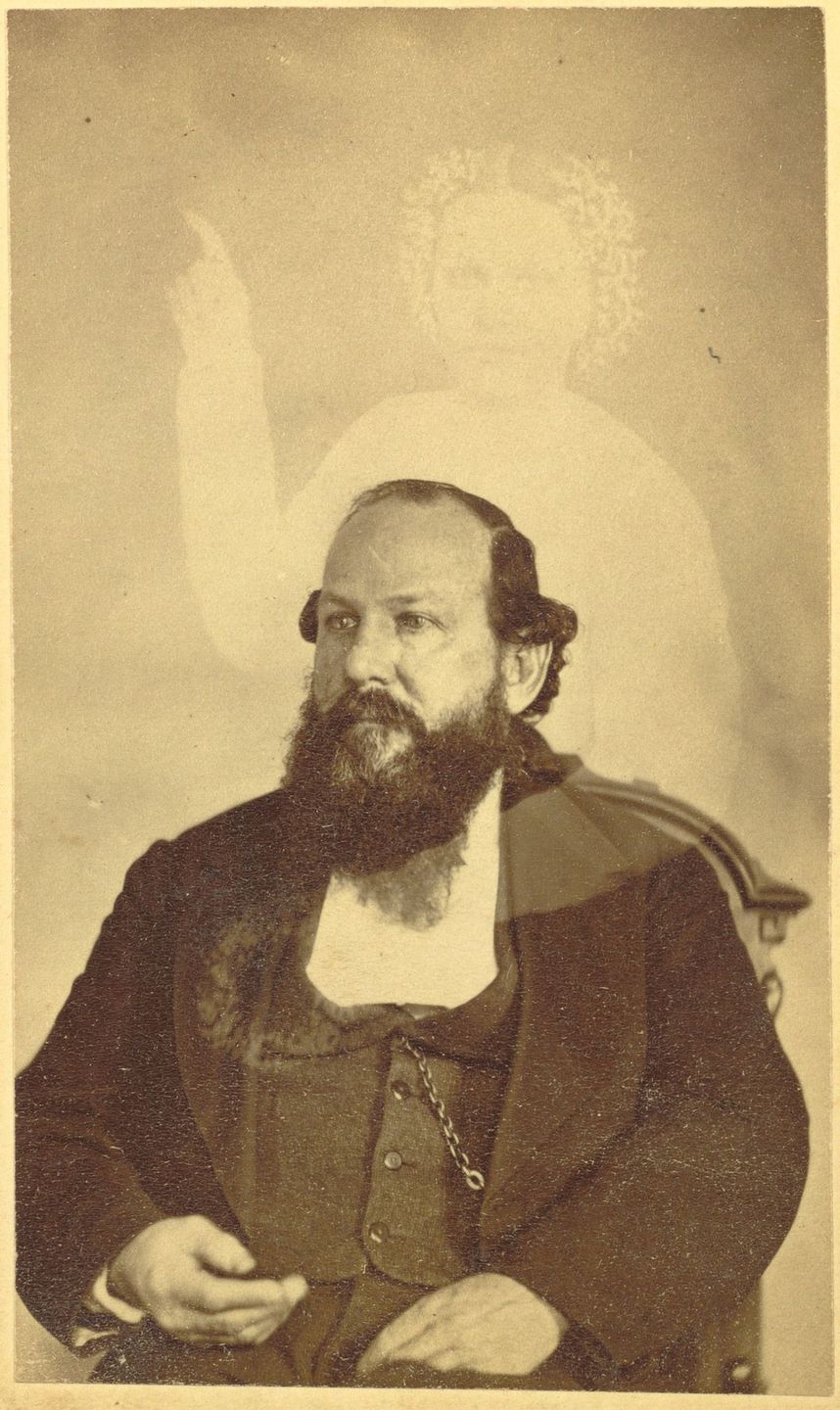
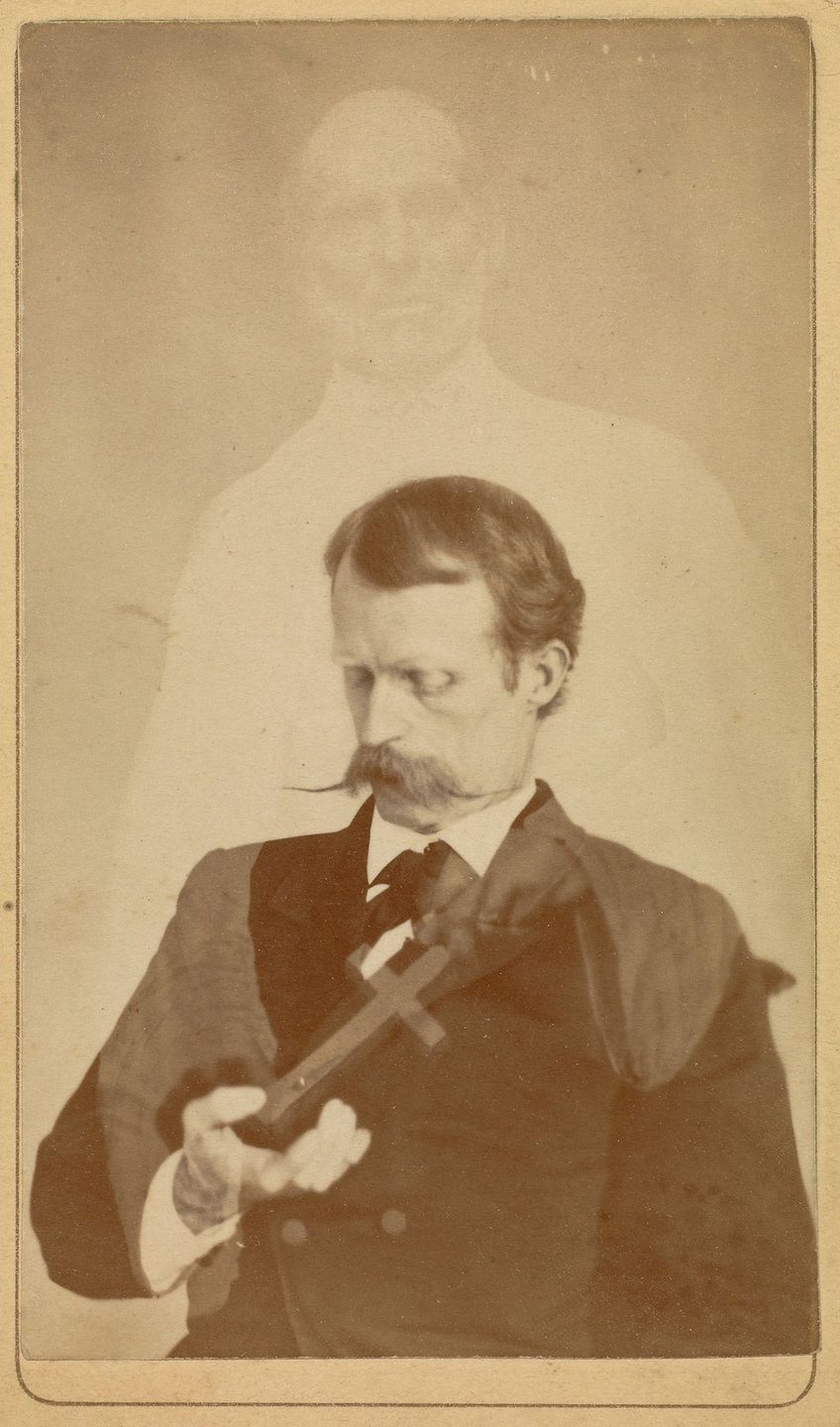
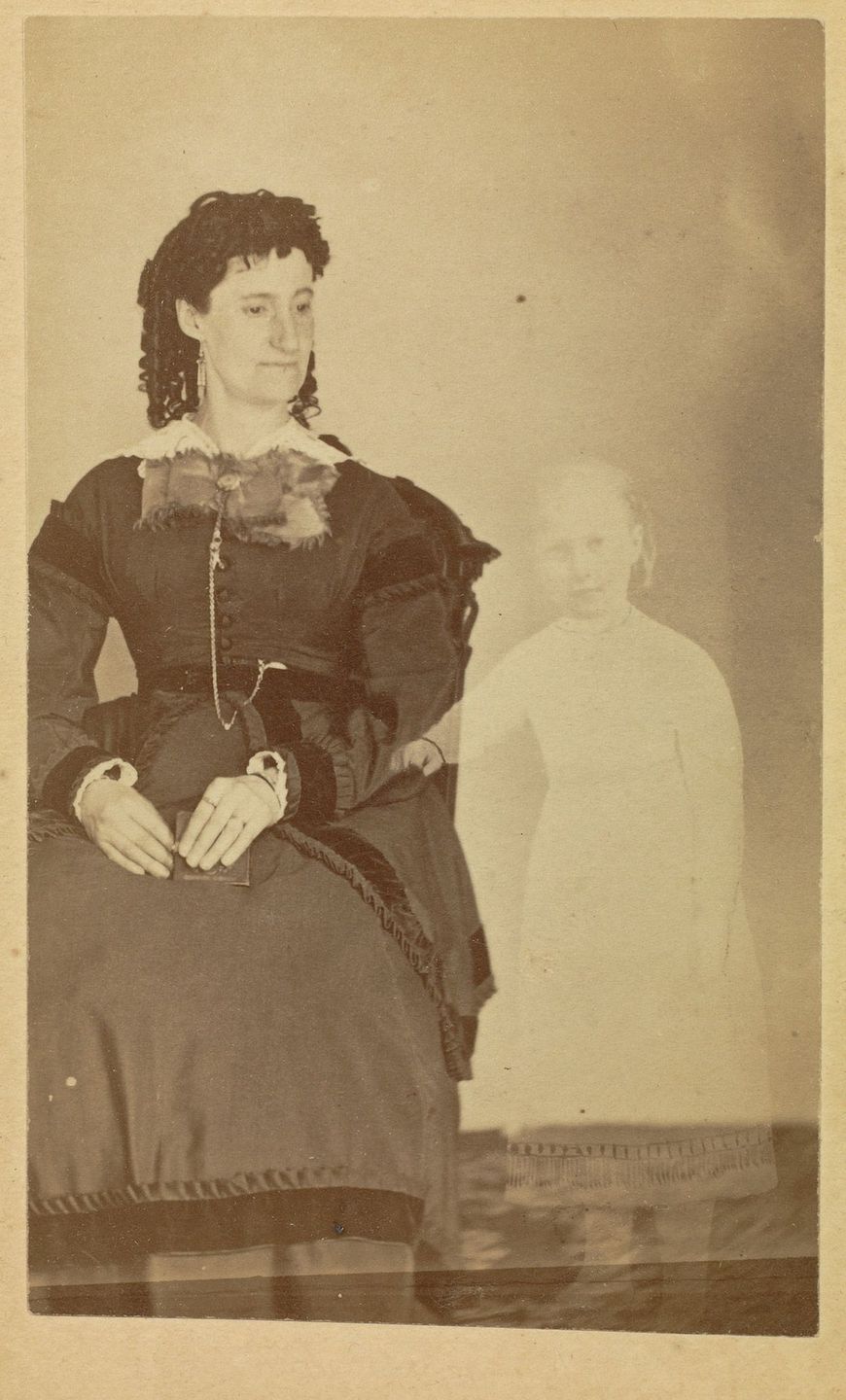
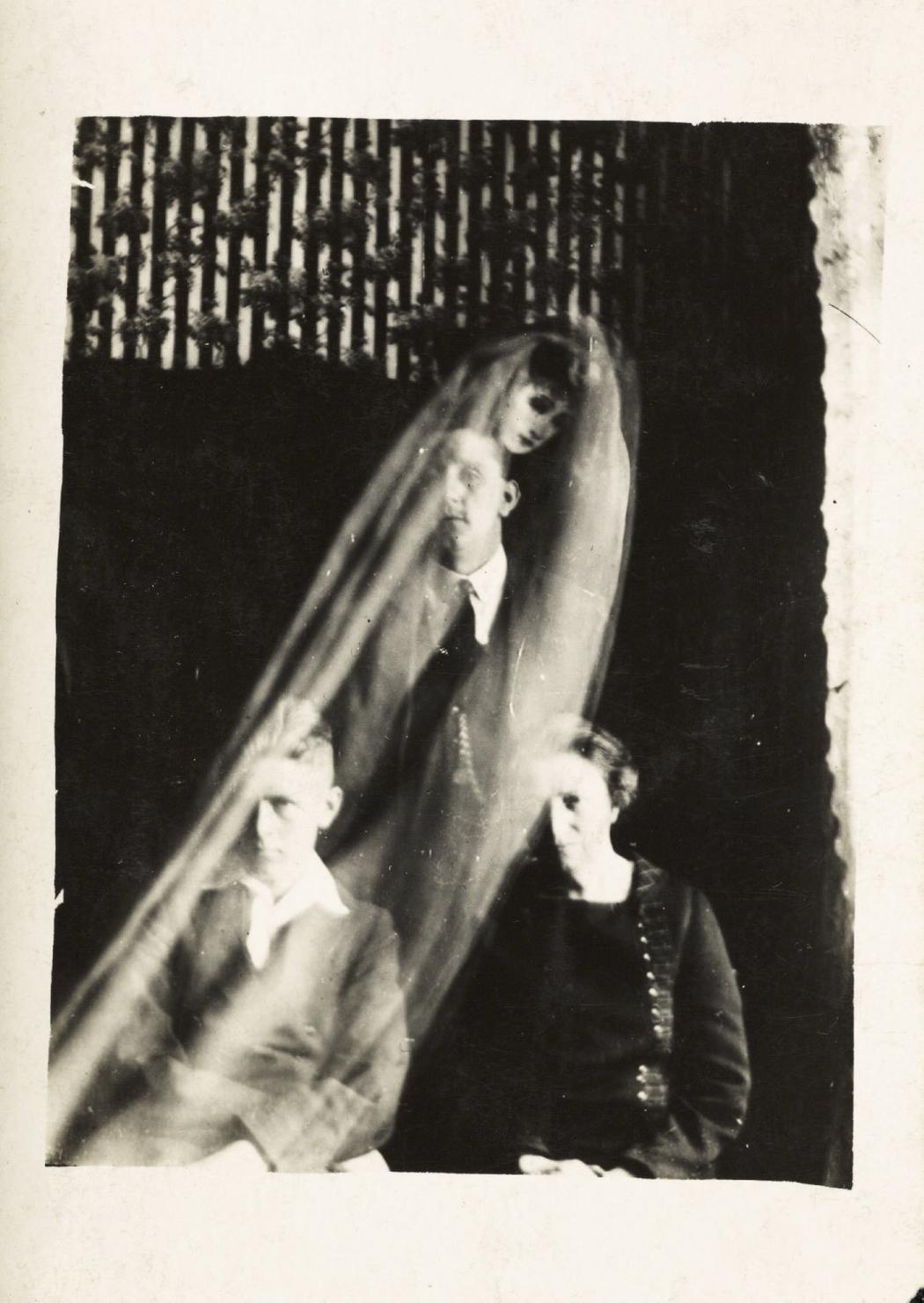
Such adherents of Spiritualist beliefs were taken in not because they were naturally credulous or stupid, but because they had been “trained” to trust the evidence of their senses. So-called spirit photographs, like those you see here, allowed people to “show material evidence for their beliefs.” Photographers who created the images, Mashable explains, could “easily make two exposures on a single negative, manipulate the negative to create ghostly blurs, or overlap two negatives in the darkroom to produce an extra face within the resultant frame.”
The audience for this work was “vast,” and many fit Culpin’s generalizations. In 1921, for example, paranormal investigator Hereward Carrington wrote of “a number of ‘spirit’ and ‘thought’ photographs, the evidence for which seemed to me to be exceptionally good.” In describing other pictures as “obviously fraudulent” or “extremely puzzling,” Carrington made critical distinctions and appeared to use the methods and the language of science in the evaluation of objects purporting to prove the existence of ghosts.
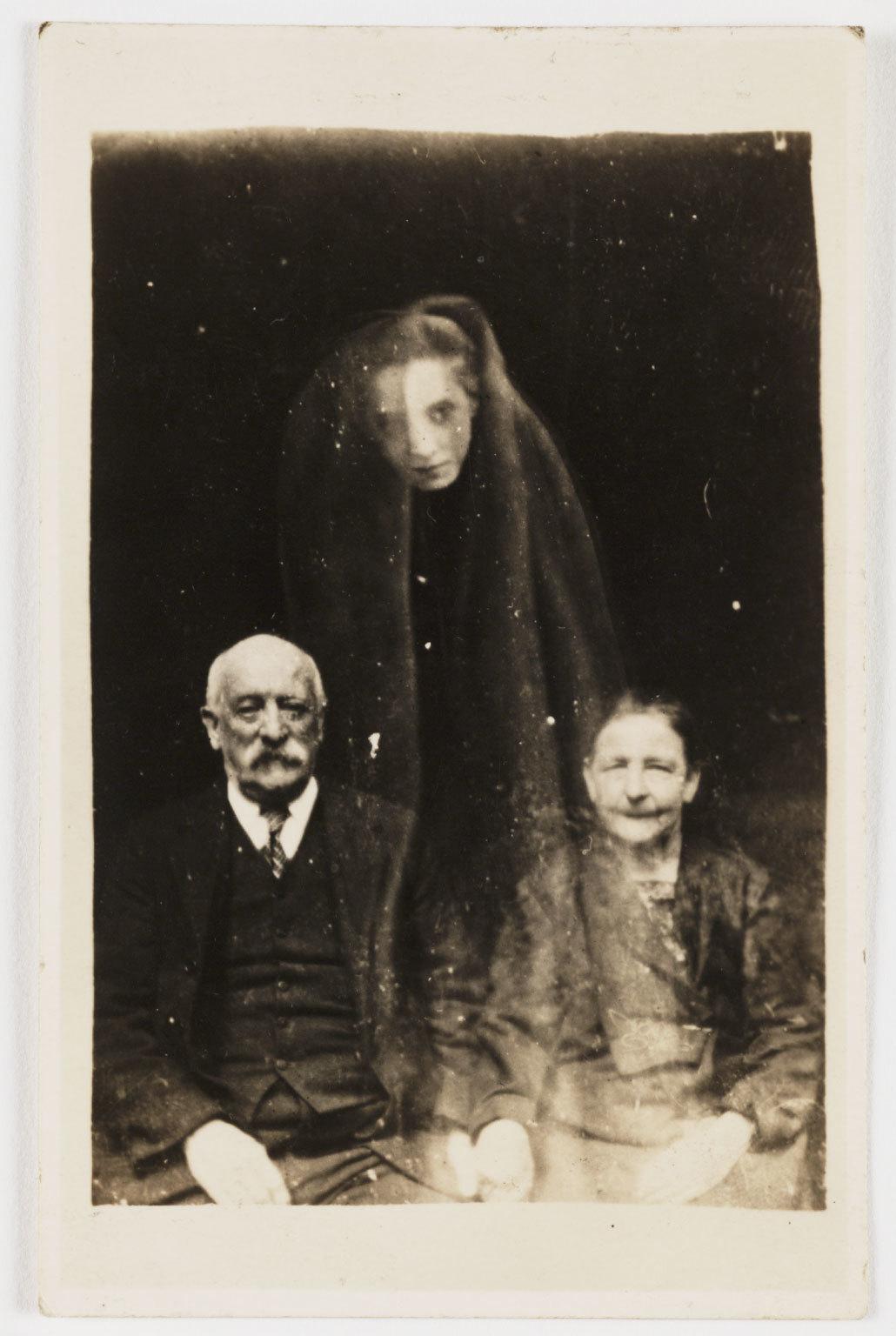
It may seem incredible that spirit photography had widespread appeal for as long as it did. The photographs first began appearing in the 1860s, emerging “from a small Boston portrait studio” and first made by William H. Mumler, the genre’s inventor and “most prominent early proponent,” writes Mashable.
Mumler was neither a photographer nor a medium. He originally worked as a silver engraver, while dabbling in photography in the local studio of a woman named Mrs. Stuart. One day in 1861, in the midst of developing a self-portrait, Mumler reported that the dim figure of a young cousin who had died twelve years earlier emerged in the final print.
These ghostly images continued to appear—on their own, the story goes—and the studio’s receptionist, a part-time medium, helped popularize them. Soon Mumler “received visitors from across America, including the recently widowed Mary Todd Lincoln.” Most of these visitors did not work as scientists or professional paranormal investigators. They were ordinary people bereaved by the mass death of the Civil War and deeply motivated to accept physical confirmation of an afterlife. Moreover, before the rise of Fundamentalist Evangelicalism in the 1920s, Spiritualism was on the front lines of an earlier culture war: spirit photography was “a tangible symbol of the overarching argument of mysticism versus science and rationalism.”
The three images at the top of the post date from the earliest period of spirit photography, between 1862 and 1875, and they were all produced by Mumler in Boston and New York, where he moved in 1869, and where he was charged with fraud, then “acquitted of all charges because they could not be sufficiently proven.” (See many more of his photos at Mashable and the Getty Museum online archive.) Though his business suffered, spirit photography only grew more popular, particularly in Spiritualist circles in Britain, where Arthur Conan Doyle, creator of the hyper-rational Sherlock Holmes, was one of the most ardent of Spiritualist believers.
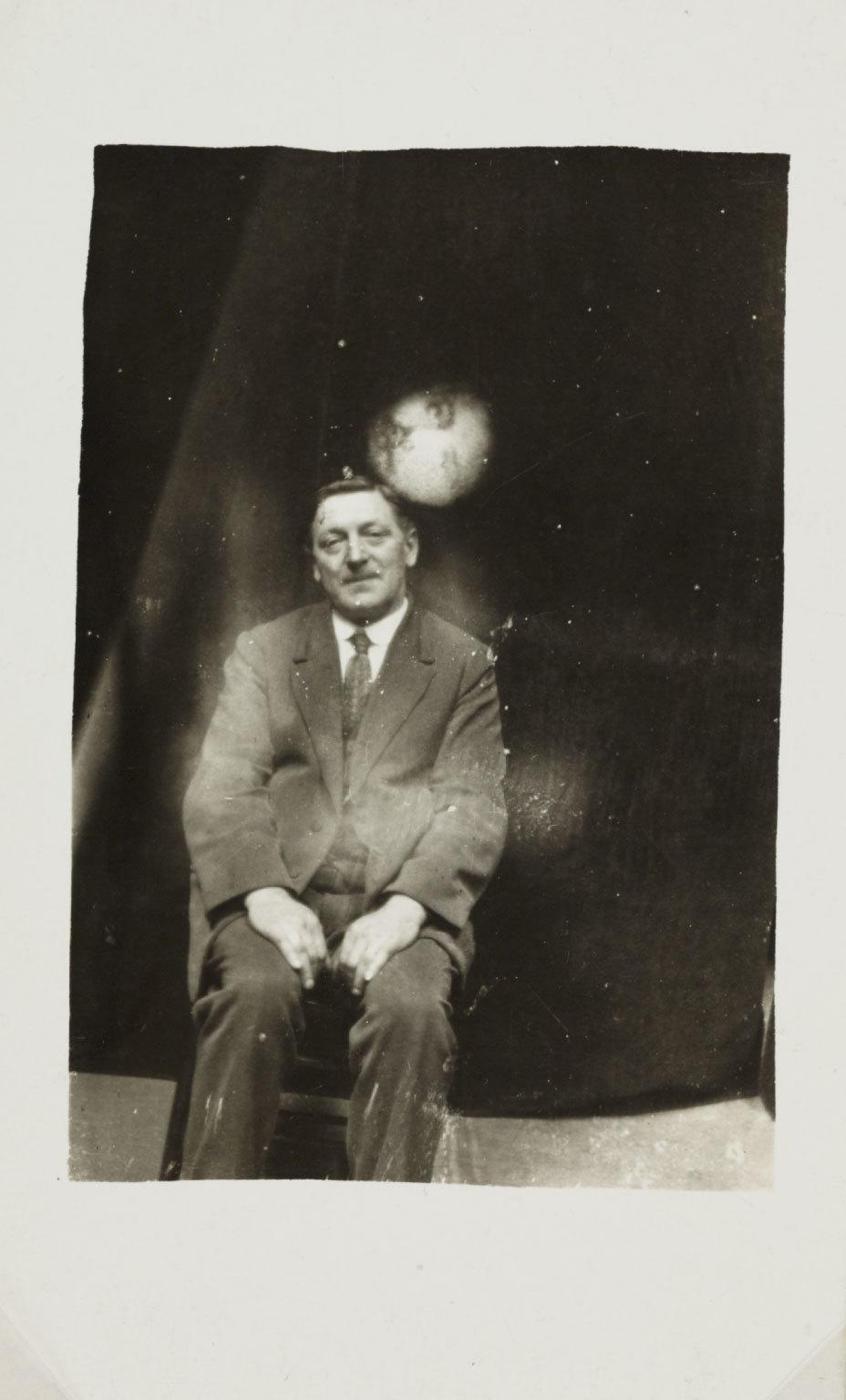
Doyle supported a British photographer named William Hope, who began taking spirit photographs in 1905, founded a group called the Crewe Circle and later “went on to prey on grieving families,” writes River Donaghey at Vice, “who lost loved ones in WWI and desperately wanted photographic proof that their relatives were still hovering around in spectral form.” Even after Hope and his crew were exposed, Doyle continued to support him, going so far as to write a book called The Case for Spirit Photography. The four photographs above and below are Hope’s work (see many more at Vice and the Public Domain Review). They are seriously creepy—in the way movies like The Ring are creepy—but they are also, quite obviously, photographic fictions.
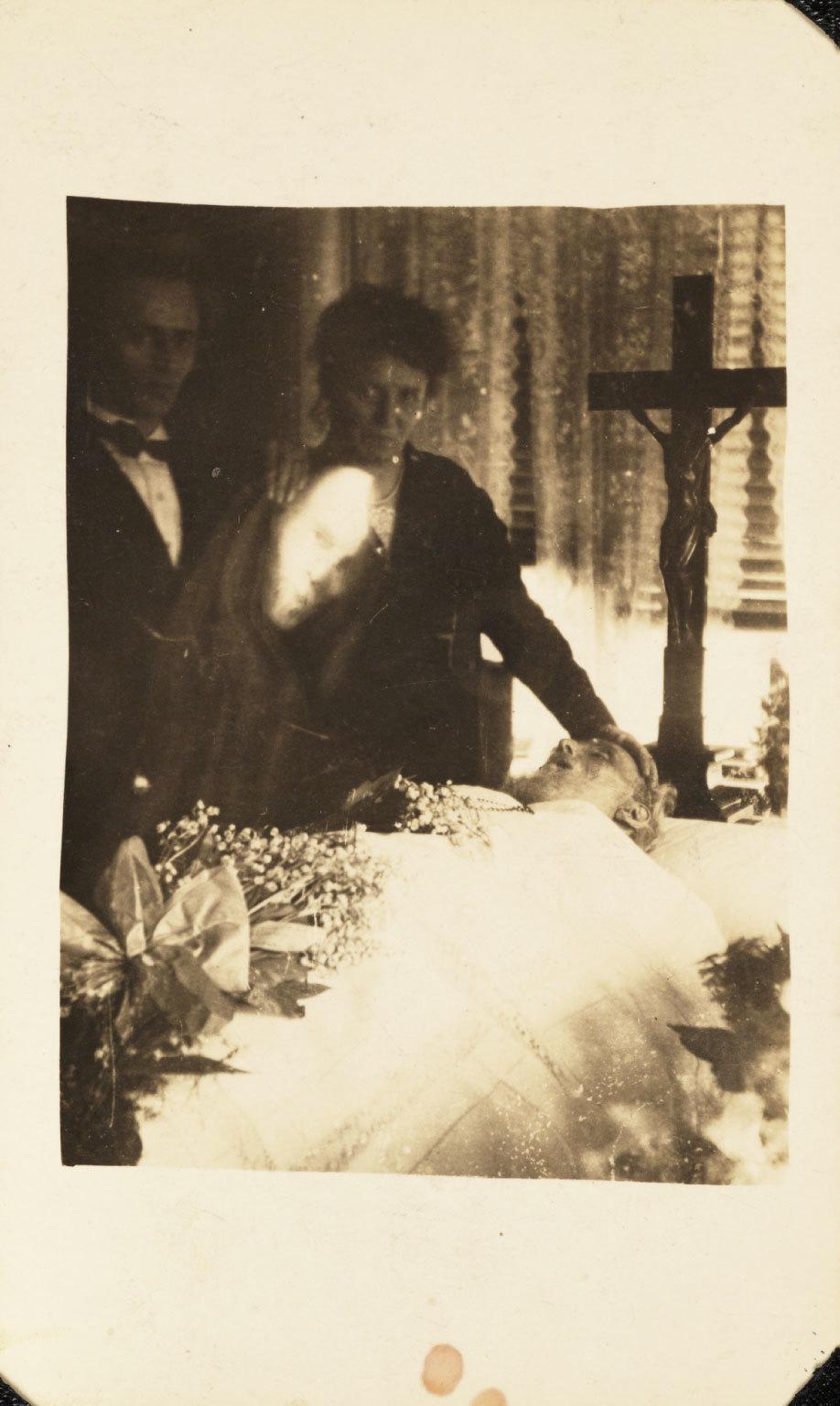
Even as viewers of photography became savvier as the century wore on, many people thrilled to Hope’s work until his death in 1933, maybe for the same reason we watch The Ring; it’s a fun scare, nothing more, if we suspend our disbelief. As for the true believers in spirit photography—they are not so different either from us 21st century sophisticates. We’re still taken in all the time by hoaxes and frauds, maybe because it’s still as easy to push the buttons in our brains, and because, well, we just want to believe.
Related Content:
Browse The Magical Worlds of Harry Houdini’s Scrapbooks
Josh Jones is a writer and musician based in Durham, NC. Follow him at @jdmagness
Read More...John Coltrane Draws a Mysterious Diagram Illustrating the Mathematical & Mystical Qualities of Music
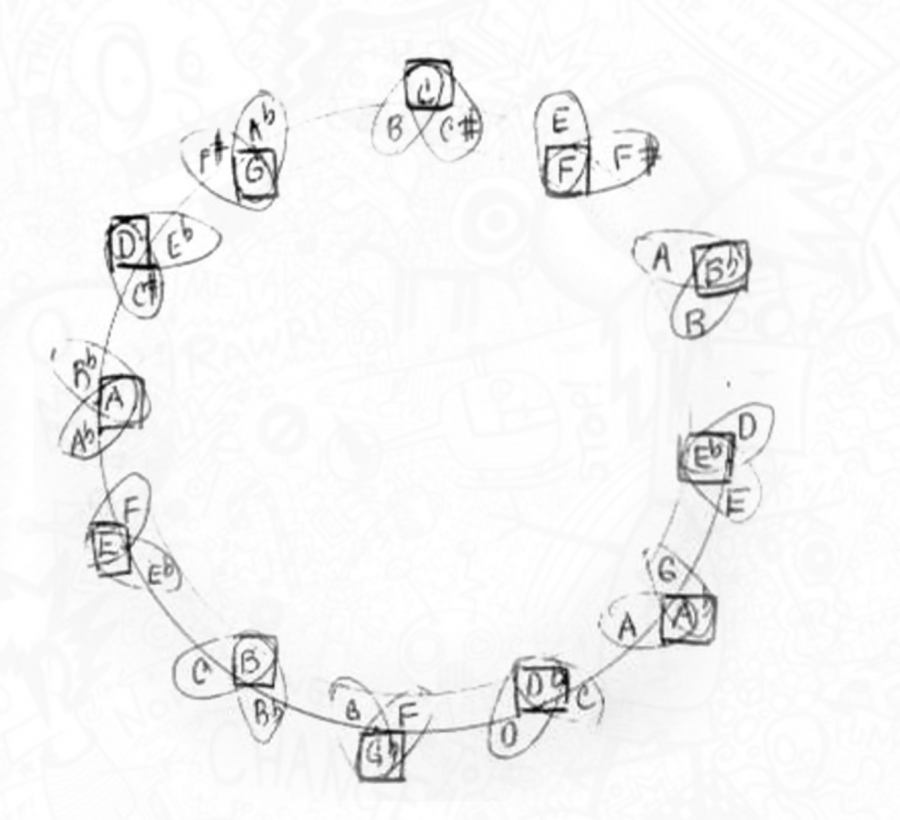
In a post earlier this year, we wrote about a drawing John Coltrane gave his friend and mentor Yusef Lateef, who reproduced it in his book Repository of Scales and Melodic Patterns. The strange diagram contains the easily recognizable circle of fifths (or circle of fourths), but it illustrates a much more sophisticated scheme than basic major scale theory. Just exactly what that is, however, remains a mystery. Like every mystical explorer, the work Coltrane left behind asks us to expand our consciousness beyond its narrow boundaries. The diagram may well show a series of “multiplicities,” as saxophonist Ed Jones writes. From the way Coltrane has “grouped certain pitches,” writes vibes player Corey Mwamba, “it’s easy to infer that Coltrane is displaying a form of chromatic modulation.” These observations, however, fail to explain why he would need such a chart. “The diagram,” writes Mwamba, “may have a theoretical basis beyond that.” But does anyone know what that is?
Perhaps Coltrane cleared certain things up with his “corrected” version of the tone circle, above, which Lateef also reprinted. From this—as pianist Matt Ratcliffe found—one can derive Giant Steps, as well as “the Star of David or the Seal of Solomon, very powerful symbolism especially to ancient knowledge and the Afrocentric and eventually cosmic consciousness direction in which Coltrane would ultimately lead on to with A Love Supreme.”
Sound too far out? On the other side of the epistemological spectrum, we have physicist and sax player Stephon Alexander, who writes in his book The Jazz of Physics that “the same geometric principle that motivated Einstein’s theory was reflected in Coltrane’s diagram.” Likewise, saxophonist Roel Hollander sees in the tone circle a number of mathematical principles. But, remaining true to Coltrane’s synthesis of spirituality and science, he also reads its geometry according to sacred symbolism.
In a detailed exploration of the math in Coltrane’s music, Hollander writes, “all tonics of the chords used in ‘Giant Steps’ can be found back at the Circle of Fifths/Fourths within 2 of the 4 augmented triads within the octave.” Examining these interlocking shapes shows us a hexagram, or Star of David, with the third triad suggesting a three-dimensional figure, a “star tetrahedron,” adds Hollander, “also known as ‘Merkaba,” which means “light-spirit-body” and represents “the innermost law of the physical world.” Do we actually find such heavy mystical architecture in the Coltrane Circle?—a “’divine light vehicle’ allegedly used by ascended masters to connect with and reach those in tune with the higher realms, the spirit/body surrounded by counter-rotating fields of light (wheels within wheels)”?
As the occult/magical/Kabbalist associations within the circle increase—the numerology, divine geometry, etc.—we can begin to feel like Tarot readers, joining a collection of random symbolic systems together to produce the results we like best. “That the diagram has to do with something,” writes Mwamba, “is not in doubt: what it has to do with a particular song is unclear.” After four posts in which he dissects both versions of the circle and ponders over the pieces, Mwanda still cannot definitively decide. “To ‘have an answer,’” he writes, “is to directly interpret the diagram from your own viewpoint: there’s a chance that what you think is what John Coltrane thought, but there’s every chance that it is not what he thought.” There’s also the possibility no one can think what Coltrane thought.
The circle contains Coltrane’s musical experiments, yet cannot be explained by them; it hints at theoretical physics and the geometry of musical composition, while also making heavy allusion to mystical and religious symbolism. The musical relationships it constructs seem evident to those with a firm grasp of theory; yet its strange intricacies may be puzzled over forever. “Coltrane’s circle,” writes Faena Aleph, is a “mandala,” expressing “precisely what is, at once, both paradoxical and obvious.” Ultimately, Mwamba concludes in his series on the diagram, “it isn’t possible to say that Coltrane used the diagram at all; but exploring it in relation to what he was saying at the time has led to more understanding and appreciation of his music and life.”
The circle, that is, works like a key with which we might unlock some of the mysteries of Coltrane’s later compositions. But we may never fully grasp its true nature and purpose. Whatever they were, Coltrane never said. But he did believe, as he tells Frank Kofsky in the 1966 interview above, in music’s ability to contain all things, spiritual, physical, and otherwise. “Music,” he says, “being an expression of the human heart, or of the human being itself, does express just what is happening. The whole of human experience at that particular time is being expressed.”
Related Content:
Coltrane’s “Giant Steps” Animated (Part II)
A New Mural Pays Tribute to John Coltrane in Philadelphia
Josh Jones is a writer and musician based in Durham, NC. Follow him at @jdmagness
Read More...Behold the “Book Wheel”: The Renaissance Invention Created to Make Books Portable & Help Scholars Study Several Books at Once (1588)
Devotees of print may object, but we readers of the 21st century enjoy a great privilege in our ability to store a practically infinite number of digitized books on our computers. What’s more, those computers have themselves shrunk down to such compactness that we can carry them around day and night without discomfort. This would hardly have worked just forty years ago, when books came only in print and a serious computer could still fill a room. The paper book may remain reasonably competitive even today with the convenience refined over hundreds and hundreds of years, but its first handmade generations tended toward lavish, weighty decoration and formats that now look comically oversized.

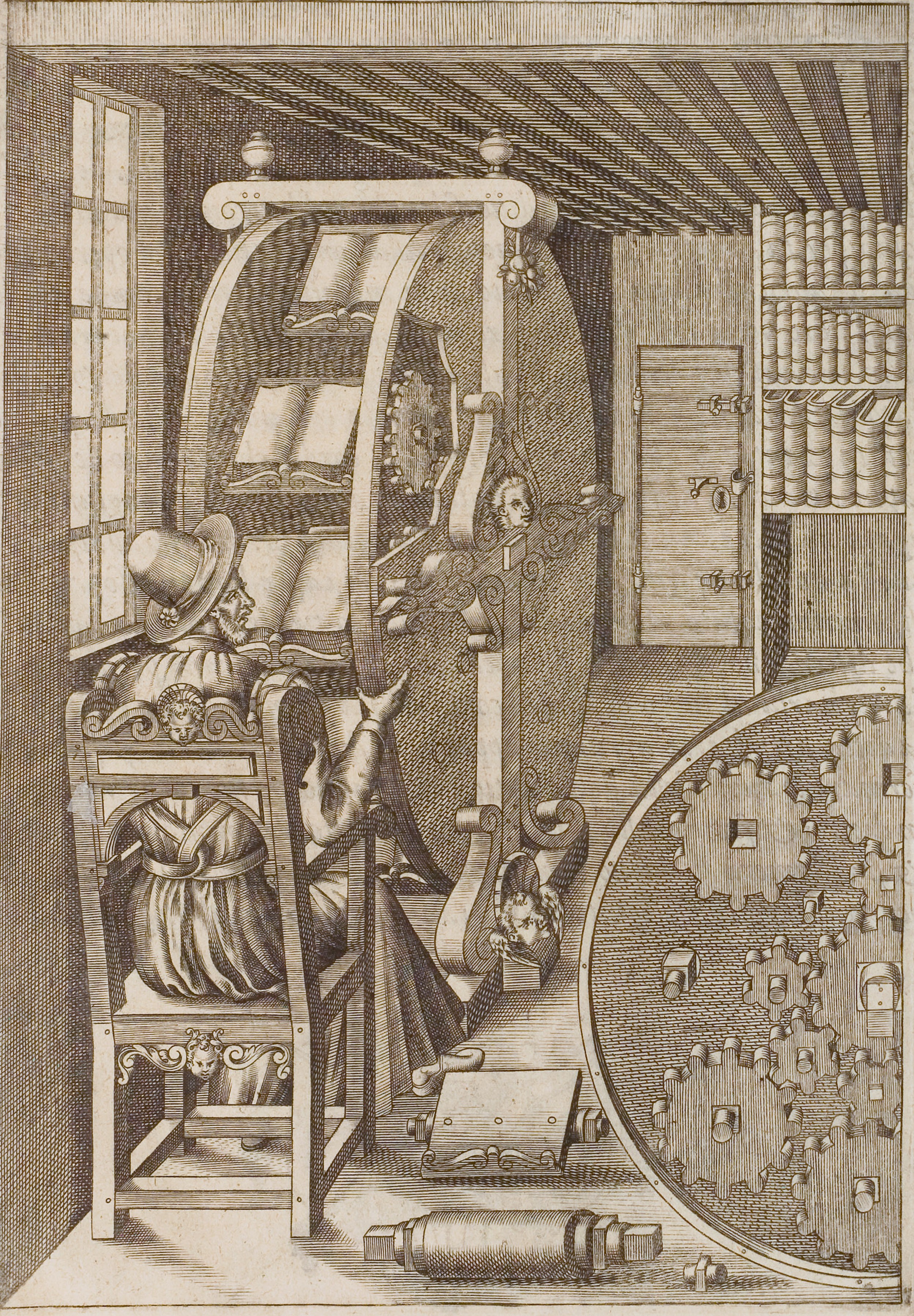
These posed real problems of unwieldiness, one solution to which took the unlikely form of the bookwheel. In 1588’s The Various and Ingenious Machines of Captain Agostino Ramelli, the Italian engineer of that name “outlined his vision for a wheel-o-books that would employ the logic of other types of wheel (water, Ferris, ‘Price is Right’, etc.) to rotate books clockwork-style before a stationary user,” writes the Atlantic’s Megan Garber.
The design used “epicyclic gearing — a system that had at that point been used only in astronomical clocks — to ensure that the shelves bearing the wheel’s books (more than a dozen of them) would remain at the same angle no matter the wheel’s position. The seated reader could then employ either hand or foot controls to move the desired book pretty much into her (or, much more likely, his) lap.” This rotating bookcase gave 16th century readers the ability to read heavy books in place, with far greater ease.
In his 1588 book, Ramelli added:
This is a beautiful and ingenious machine, very useful and convenient for anyone who takes pleasure in study, especially those who are indisposed and tormented by gout. For with this machine a man can see and turn through a large number of books without moving from one spot. Moveover, it has another fine convenience in that it occupies very little space in the place where it is set, as anyone of intelligence can clearly see from the drawing.
Inventors all over Europe created their own versions of the bookwheel during the 17th and 18th centuries, fourteen examples of which still exist. (The one pictured in the middle of the post, built around 1650, now resides in Leiden.) Even architect Daniel Libeskind has built one, based on Ramelli’s design and exhibited in his homeland at the 1986 Venice Biennale. Alas, after it went to Geneva for an exhibition at the Palais Wilson, it fell victim to a terrorist fire bombing. Innovation, it seems, will always have its enemies.
Related Content:
Discover the Jacobean Traveling Library: The 17th Century Precursor to the Kindle
The Art of Making Old-Fashioned, Hand-Printed Books
Wonderfully Weird & Ingenious Medieval Books
Wearable Books: In Medieval Times, They Took Old Manuscripts & Turned Them into Clothes
800 Free eBooks for iPad, Kindle & Other Devices
Based in Seoul, Colin Marshall writes and broadcasts on cities and culture. He’s at work on the book The Stateless City: a Walk through 21st-Century Los Angeles, the video series The City in Cinema, the crowdfunded journalism project Where Is the City of the Future?, and the Los Angeles Review of Books’ Korea Blog. Follow him on Twitter at @colinmarshall or on Facebook.
Read More...How a Recording Studio Mishap Created the Famous Drum Sound That Defined 80s Music & Beyond
It’s not a subtle effect, by any means, which is precisely what makes it so effective. Gated reverb, the sound of an airbag deploying or weather balloon suddenly blowing out, an airy thud that pervades eighties pop, and the work of every musician thereafter who has referenced eighties pop, including CHVRCHES, Tegan and Sara, M83, Beyoncé, and Lorde, to name but a very few.
Before them came the pummeling gated drums of Kate Bush, Bruce Springsteen, Prince, Depeche Mode, New Order, Cocteau Twins, David Bowie, and Grace Jones, who turned Roxy Music’s “Love is the Drug” into a strict machine with the gated reverb of her 1980 cover.
Roxy Music caught up quickly with songs like the lovely “More Than This” on 1982’s Avalon, but Jones was an early adopter of the effect, which—like many a legendary piece of studio wizardry—came about entirely by accident, during a 1979 recording session for Peter Gabriel’s eerie solo track “Intruder.”
On the drums—Vox’s Estelle Caswell tells us in the explainer video at the top—was Gabriel’s former Genesis bandmate Phil Collins, and in the control room, recording engineer Hugh Padgham, who had inadvertently left a talkback mic on in the studio.
The mic happened to be running through a heavy compressor, which squashed the sound, and a noise gate that clamped down on the reverberating drums, cutting off the natural decay and creating a short, sharp echo that cut right through any mix. After hearing the sound, Gabriel arranged “Intruder” around it, and the following year, Collins and Padgham created the most iconic use of gated reverb in pop music history on “In the Air Tonight.” “Thanks to a happy accident,” says Caswell, “the sound of the 80s was born.” Also the sound of the oughties and beyond, as you’ll hear in the 38-s0ng playlist above, featuring many of the pioneers of gated reverb and the many earnest revivalists who made it hip, and ubiquitous, again.
Related Content:
All Hail the Beat: How the 1980 Roland TR-808 Drum Machine Changed Pop Music
The “Amen Break”: The Most Famous 6‑Second Drum Loop & How It Spawned a Sampling Revolution
Two Guitar Effects That Revolutionized Rock: The Invention of the Wah-Wah & Fuzz Pedals
Josh Jones is a writer and musician based in Durham, NC. Follow him at @jdmagness
Read More...Wassily Kandinsky Syncs His Abstract Art to Mussorgsky’s Music in a Historic Bauhaus Theatre Production (1928)
European modernity may never had taken the direction it did without the significant influence of two Russian artists, Wassily Kandinsky and Modest Mussorgsky. Kandinsky may not have been the very first abstract painter, but in an important sense he deserves the title, given the impact that his series of early 20th century abstract paintings had on modern art as a whole. Inspired by Goethe’s Theory of Colors, he also published what might have been the first treatise specifically devoted to a theory of abstraction.
The composer Mussorgsky’s most famous work, Pictures at an Exhibition (listen here), had a tremendous influence on some of the most famous composers of the day when it debuted, which happened to be after its author’s death. Written in 1874 as a solo piano piece, it didn’t see publication until 1886, when it quickly became a virtuoso challenge for pianists and a popular choice for arrangements most notably by Maurice Ravel and Nikolai Rimsky-Korsakov, who, along with Igor Stravinsky and others, interpreted and expanded on many of Mussorgsky’s ideas into the early 20th century.
Mussorgsky’s early death in 1881 prevented any living collaboration between the painter and composer, but it’s only natural that his minimalist musical piece should have inspired Kandinsky’s only successful stage production. In Kandinsky’s theory, musical ideas operate like primary colors. His paintings explicitly illustrate sound. In his stage adaptation of Pictures at an Exhibition, he had the opportunity to paint sound in motion.
Kandinsky was first inspired to paint, at the age of 30, after hearing a performance of Wagner’s Lohengrin. “I saw all my colors in spirit,” he remarked afterward, “Wild, almost crazy lines were sketched in front of me.” The Denver Art Museum’s Renée Miller writes of Kandinsky’s experience as an example of synesthesia. He drew from the work of Arnold Schoenberg in his abstract expressionist canvases, and “gave many of his paintings musical titles, such as Composition and Improvisation.”
For his part, Mussorgsky found inspiration for his nonrepresentational work in the strangely uncanny representational visual art of Russian architect and painter Viktor Hartmann, his closest friend and member of a circle of artists attempting a nationalist Russian cultural revival. Mussorgsky’s Pictures at an Exhibition sets music to a collection of Hartmann’s paintings and drawings exhibited after the artist’s death, including sketches of opera costumes and a monumental architectural design.
The creation of several highly distinctive musical motifs is of a piece with Mussorgsky’s opera compositions. Both he and Kandinsky were drawn to opera for its dramatic conjunction of visual art, performance, and music, or what Wagner called Gesamtkunstwerk, the “total work of art.” And yet, despite their mutual admiration for classical forms and traditional Russian folklore, both artists illustrated the title of Wagner’s essay on the subject, “The Artwork of the Future,” more fully than Wagner himself.
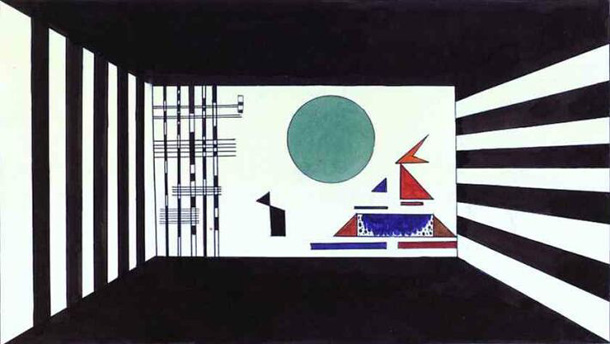
Mussorgsky’s piece, as composed solo on the piano, is willfully odd, ugly and piercingly beautiful by turns, and always unsettling, like the Hartmann paintings that inspired it. So visually descriptive is its musical language that it might be said to induce a virtual form of synesthesia. In illustrating Pictures at an Exhibition, Kandinsky “took another step towards translating the idea of ‘monumental art’ into life,” notes the site Modern Art Consulting, “with his own sets and light, color and geometrical shapes for characters.”
On April 4, 1928, the première at the Friedrich Theater, Dessau, was a tremendous success. The music was played on the piano. The production was rather cumbersome as the sets were supposed to move and the hall lighting was to change constantly in keeping with Kandinsky’s scrupulous instructions. According to one of them, “bottomless depths of black” against a black backdrop were to transform into violet, while dimmers (rheostats) were yet to be invented.
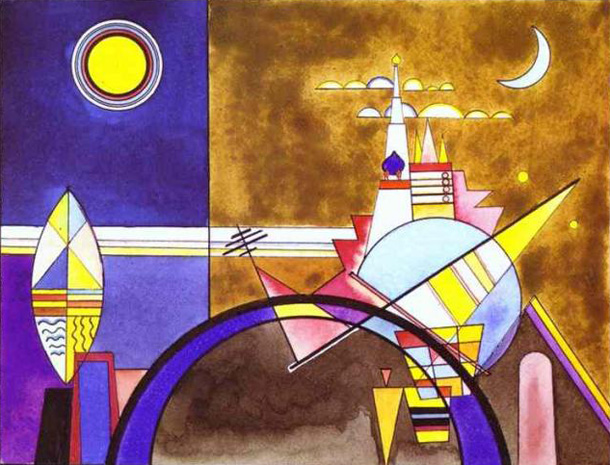
Rather than translating Mussorgsky’s piece back into Hartmann’s representational idiom, Kandinsky creates an operatic movement of geometrical figures from the lexicon of the Bauhaus school. (Only “The Great Gate of Kiev,” at the top, resembles the original painting.) Rather than create narrative, “Kandinsky’s task was to turn the music into paintings,” says Harald Wetzel, curator of a recent exhibit in Dessau featuring many of the set designs. Those static elements “give just a limited impression of the stage production,” which was “constantly in motion.”
We may not have film of that original production, but we do have a very good sense of what it might have looked like through its many re-stagings over the past few years, including the production further up with pianist Mikhaïl Rudy at the théâtre de Brive in 2011 and the animated video remake above, which brings it even further into the future. See a selection of photos from the Kandinsky exhibit at Deutsche Welle and compare these paintings with the original pictures by Viktor Hartmann that inspired Mussorgsky’s piece.
Related Content:
Time Travel Back to 1926 and Watch Wassily Kandinsky Make Art in Some Rare Vintage Video
Josh Jones is a writer and musician based in Durham, NC. Follow him at @jdmagness
Read More...Hear What Happens When Avant-Garde Composer Pierre Boulez Conducts Three Frank Zappa Songs
Was Frank Zappa a musical genius? A modernist, avant-garde composer who just happened to work in an idiomatic pastiche of jazz, classical, progressive rock and juvenile shock tactics? The question can be a deeply divisive one. Zappa tends to inspire either intense devotion or intense dislike. But whatever one’s opinion of the man or his music, it’s safe to say that when he wasn’t working alone, Zappa worked in the company of some incredibly talented musicians. And he attracted, as John Rockwell wrote in 1984 at The New York Times, “a tiny following among classical avant-gardists.”
That year, one of his more genteel fans, Pierre Boulez—former music director of the New York Philharmonic and “widely regarded,” notes Rockwell, “as one of the great composers of the [20th] century”—decided to conduct a suite of Zappa songs. Zappa hoped the resulting album, The Perfect Stranger, would help him realize his ambition of having his music taken seriously in classical circles. (“A brief collaboration in 1970 with Zubin Mehta,” writes April Peavey at PRI, “went nowhere.”)
Boulez conducts his own ensemble for three tracks on the album, “The Perfect Stranger,” “Naval Aviation in Art?” and “Dupree’s Paradise.” The remaining four songs are performed by “The Barking Pumpkin Digital Gratification Consort,” a Zappaism for the Synclavier, Zappa’s favorite electronic instrument. For all the high seriousness the collaboration implies, Zappa couldn’t help inserting his surreally sardonic sense of humor; always “a compulsive musical comedian,” wrote Rockwell, he wears here “the defensive mask of irony, again.”
Each of the songs has an accompanying scenario. “The Perfect Stranger” imagines that “a door-to-door salesman, accompanied by his faithful gypsy-mutant industrial vacuum cleaner, cavorts licentiously with a slovenly housewife.” In “Love Story,” Zappa wants us to picture “an elderly Republican couple attempting sex while breakdancing.” Many people have had trouble getting past the sophomoric posturing and seeing Zappa’s music as serious art. He often seemed intent on alienating exactly such people.
But perhaps Zappa did not need the pedigree Boulez lent to his work. When listening, for example, to the Mothers of Invention play Zappa’s original arrangement of “Dupree’s Paradise” (top), one has to admit, he created brilliantly complex, rhythmically exciting music and, in the final analysis, represented “a particularly appealing type of quintessentially American composer—genuinely defiant of established categories and divisions that others routinely accept.” Listen to the Boulez/Zappa collaboration The Perfect Stranger in the Spotify playlist above, or access it directly on Spotify here.
Related Content:
Hear the Musical Evolution of Frank Zappa in 401 Songs
Frank Zappa’s Amazing Final Concerts: Prague and Budapest, 1991
Josh Jones is a writer and musician based in Durham, NC. Follow him at @jdmagness
Read More...When Roald Dahl Hosted His Own Creepy TV Show Way Out, a Companion to Rod Serling’s Twilight Zone (1961)
In an odd twist of history, two of the wisest and weirdest children’s writers of their generation also happened to have both been fighter pilots during World War II. Antoine de Saint-Exupéry, author of The Little Prince, flew reconnaissance missions for the French Air Force before the 1940 armistice with Nazi Germany. Roald Dahl, author of—among many others—Charlie and the Chocolate Factory, James and the Giant Peach, and The BFG, flew with the Royal Air Force. Both wrote about their flying exploits and both writers, it so happened, were once shot down over Libya, which also happens to be the title of Dahl’s first published story, written for grown-ups and published in the Saturday Evening Post in 1946.
There are maybe other uncanny similarities, but one thing Saint-Exupéry never turned his hand to is television. Dahl, on the other hand, had the opportunity to host two TV shows during his lifetime: Way Out in 1961 and Tales of the Unexpected, which aired from 1979 to 1988 and featured several episodes based on Dahl’s own stories. Although he has become renowned for his high-concept kid’s books, at the time of Dahl’s entrée onto the tube, he had mainly achieved fame as a writer of macabre tales published in the New Yorker as well as a script written for Alfred Hitchcock Presents called “Lamb to the Slaughter.”
Dahl seems a natural fit for the medium, not only as a writer but as a presenter, with his dry wit and suave personality. But his first show, Way Out—eight episodes of which you can now watch on YouTube—came about entirely by accident, or rather, as the serendipitous result of another program’s spectacular failure. This is no exaggeration. Jackie Gleason, perhaps the most famous comedian of his day, had decided in 1961 to attempt a celebrity game show on CBS called You’re in the Picture. The show was such a bomb that it only aired once, and the following week, Gleason appeared on a bare stage for half an hour, the authors of a Filmfax Magazine article write, and “apologized to the American public for the insult to their intelligence that had been perpetrated the week before.”
This went on for several more weeks, then Gleason invited celebrity friends on for impromptu interviews and “when things started getting desperate,” had a chimp on as a guest star. One CBS network head at the time remembered the show later as the greatest disaster of his decades-long career in television. Enter producer David Susskind, “a man who could deliver a program quickly and under pressure,” and a great fan of Roald Dahl. Cooking up the idea of “an eerie, chilling creepy drama,” Susskind says, with “a nether world sense to it,” he approached Dahl with an offer to replace Gleason’s travesty with adaptations of his stories and the opportunity to host.
Only one of Dahl’s stories made it into the show, the first episode “William & Mary” (above), about a man planning to become a brain in a jar. But the show was an instant hit with critics, especially Dahl’s brief, darkly humorous opening and closing monologues. One critic described him as “a thin Alfred Hitchcock, an East Coast Rod Serling.” And like Serling’s show, Way Out—which was spelled in a title card after the first episode with an inexplicable single apostrophe as ’Way Out—trafficked in sci-fi and psychological horror. But the two shows were not in competition. Twilight Zone and Way Out both aired on the same network, CBS, and the time slot of Gleason’s failed show happened to directly precede The Twilight Zone, just then ending its second season. Dahl’s show was billed as a “companion program” to Serling’s.
Sadly for all the praise showered upon ’Way Out, it did not attract a large enough audience to get renewed for a second season, and it would be another 18 years before Dahl returned to television. But even had he never returned, or never even made his first program, Dahl’s significant contribution to TV history would be secure. His first children’s book, The Gremlins, originally written in 1943 for a failed Disney project, inspired what is perhaps the most well-known Twilight Zone episode of them all, the William Shatner-starring “Nightmare at 20,000 Feet,” which involves a certain terrifying shock on an airplane and was so effective, it was remade for Twilight Zone, the film. The episode adapted a story by Richard Matheson, but it was Dahl who first came up with the idea.
Related Content:
Alfred Hitchcock Presents Ghost Stories for Kids (1962)
Josh Jones is a writer and musician based in Durham, NC. Follow him at @jdmagness
Read More...The Map of Computer Science: New Animation Presents a Survey of Computer Science, from Alan Turing to “Augmented Reality”
I’ve never wanted to start a sentence with “I’m old enough to remember…” because, well, who does? But here we are. I remember the enormously successful Apple IIe and Commodore 64, and a world before Microsoft. Smart phones were science fiction. To do much more than word process or play games one had to learn a programming language. These ancient days seemed at the time—and in hindsight as well—to be the very dawn of computing. Before the personal computer, such devices were the size of kitchen appliances and were hidden away in military installations, universities, and NASA labs.
But of course we all know that the history of computing goes far beyond the early 80s: at least back to World War II, and perhaps even much farther. Do we begin with the abacus, the 2,200-Year-Old Antikythera Mechanism, the astrolabe, Ada Lovelace and Charles Babbage? The question is maybe one of definitions. In the short, animated video above, physicist, science writer, and YouTube educator Dominic Walliman defines the computer according to its basic binary function of “just flipping zeros and ones,” and he begins his condensed history of computer science with tragic genius Alan Turing of Turing Test and Bletchley Park codebreaking fame.
Turing’s most significant contribution to computing came from his 1936 concept of the “Turing Machine,” a theoretical mechanism that could, writes the Cambridge Computer Laboratory “simulate ANY computer algorithm, no matter how complicated it is!” All other designs, says Walliman—apart from a quantum computer—are equivalent to the Turing Machine, “which makes it the foundation of computer science.” But since Turing’s time, the simple design has come to seem endlessly capable of adaptation and innovation.
Walliman illustrates the computer’s exponential growth by pointing out that a smart phone has more computing power than the entire world possessed in 1963, and that the computing capability that first landed astronauts on the moon is equal to “a couple of Nintendos” (first generation classic consoles, judging by the image). But despite the hubris of the computer age, Walliman points out that “there are some problems which, due to their very nature, can never be solved by a computer” either because of the degree of uncertainty involved or the degree of inherent complexity. This fascinating, yet abstract discussion is where Walliman’s “Map of Computer Science” begins, and for most of us this will probably be unfamiliar territory.
We’ll feel more at home once the map moves from the region of Computer Theory to that of Computer Engineering, but while Walliman covers familiar ground here, he does not dumb it down. Once we get to applications, we’re in the realm of big data, natural language processing, the internet of things, and “augmented reality.” From here on out, computer technology will only get faster, and weirder, despite the fact that the “underlying hardware is hitting some hard limits.” Certainly this very quick course in Computer Science only makes for an introductory survey of the discipline, but like Wallman’s other maps—of mathematics, physics, and chemistry—this one provides us with an impressive visual overview of the field that is both broad and specific, and that we likely wouldn’t encounter anywhere else.
As with his other maps, Walliman has made this the Map of Computer Science available as a poster, perfect for dorm rooms, living rooms, or wherever else you might need a reminder.
Related Content:
Free Online Computer Science Courses
Watch Breaking the Code, About the Life & Times of Alan Turing (1996)
The Map of Mathematics: Animation Shows How All the Different Fields in Math Fit Together
The Map of Physics: Animation Shows How All the Different Fields in Physics Fit Together
The Map of Chemistry: New Animation Summarizes the Entire Field of Chemistry in 12 Minutes
Josh Jones is a writer and musician based in Durham, NC. Follow him at @jdmagness
Read More...The “Lost” Pink Floyd Soundtrack for Michelangelo Antonioni’s Only American Film, Zabriskie Point (1970)
There’s a good argument to be made that some of the most insightful writing about the United States comes from artists observing the country from afar or through the eyes of a bemused newcomer. For European artists and thinkers, writing about the behemoth across the sea seems to have proven an irresistible challenge from the start, even if, like Franz Kafka, some never set foot on the continent. Alexis de Tocqueville, Werner Herzog, Martin Amis, Wim Wenders, the list could go on and on, and would include many very enlightening perspectives.
But not every such effort has been a success, in either critical or commercial terms. Michelangelo Antonioni’s Zabriskie Point (1970), for example, the Italian director’s “only American movie,” writes Richard Metzger at Dangerous Minds, “completely missed its mark and failed to capture the zeitgeist of the hippie New Left counterculture of the era.”
When the film was released in 1970, “audiences and critics alike hated it, just hated it.” The film’s young, unknown male lead Mark Frechette “distanced himself from the director,” writes Dennis Lim at Slate, saying, “he wasn’t making a film about any America I knew.” Guitarist John Fahey, in Rome to record a song for the film, almost came to blows with Antonioni “when the maestro launched into an anti-American rant.”
If Antonioni came off to his critics as a “clueless tourist” cinematically, he also passed up an excellent opportunity musically. In the studio when the Doors recorded “L’America” for L.A. Woman, he “inexplicably turned down the track, which could have worked spectacularly well in his film.” Instead, thanks in large part to his co-writer and current girlfriend Clare Peploe, Antonioni chose Pink Floyd to score the film, after hearing Peploe’s copy of Ummagumma. He loved the album, and listened to it obsessively, especially the dramatic, psychedelic “Careful with that Axe, Eugene.”
In the end, however, only three songs from the band made the final cut. Antonioni instead filled out the soundtrack with music by Fahey, The Youngbloods, Roy Orbison, The Grateful Dead, and others. The complete recording of the original Floyd soundtrack was never commercially released and has only officially existed in fragments. One fan in a music forum notes that the 2 CD Zabriskie Point soundtrack includes the three songs from the film and four unused bonus tracks. The huge, and hugely expensive, Floyd box set The Early Years contains 16 outtakes, none of them on the soundtrack CD.
The only way fans have been able to hear the complete, original soundtrack has been through a series of bootlegs, some featuring only the eight intended final songs, others including some or all of the known outtakes. One such compilation, above, collects several songs and outtakes, but doesn’t include the full completed soundtrack. Despite this discographic disarray, the discarded original soundtrack, in its many forms, has proven “an extremely satisfying listen,” Metzger writes. If it sounds “like a ‘lost’ Pink Floyd album recorded at the end of 1969,” it’s “because that’s exactly what it is.” Reminding us at times of Atom Heart Mother, or Meddle, or Ummagumma, it both looks back at previous work and ahead toward what’s to come.
The band turned out some uncharacteristically straight-ahead electric barroom blues (above). “Heart Beat, Pig Meant,” which appears over the film’s opening credits (top) “was Pink Floyd’s first time using a human heartbeat as a musical instrument (but it would not be the last).” Richard Wright’s “The Violent Sequence,” further up, may have been scrapped by Antonioni, but it would later “be retooled as ‘Us and Them’ on Dark Side of the Moon.” Aside from that album’s unintended life as uncanny sonic accompaniment to The Wizard of Oz, the band did some of its most experimental, and transitional, work through film soundtracks, such as those for Barbet Schroeder’s 1969 More and 1972 film The Valley. Their work with Antonioni is no exception, but Zabriskie Point, likely because of its many confusing states of existence, has not received as much attention.
Perhaps it’s time to revisit Zabriskie Point, the film, as well as its original soundtrack. As fans of Pink Floyd, we can see what inspired the band to create music that would help determine the direction of their epic albums to come. As fans of Antonioni, perhaps, we may come to a greater appreciation of his much-maligned flop, which Lim contends “is of a piece with Antonioni’s best work: a luxuriant portrait of spiritual alienation with a sense of place far more expressive than its blankly beautiful characters.” Given that description, it’s no wonder Antonioni found Pink Floyd such an intriguing choice, even if neither the Italian director nor English band had said much of anything in their work about the cauldron of political unrest, sexual experimentation, and cultural disaffection of the U.S. in the late 60s.
Related Content:
Pink Floyd’s “Echoes” Provides a Soundtrack for the Final Scene of Kubrick’s 2001: A Space Odyssey
Syd Barrett’s “Effervescing Elephant” Comes to Life in a New Retro-Style Animation
Josh Jones is a writer and musician based in Durham, NC. Follow him at @jdmagness
Read More...Support Us
We're hoping to rely on loyal readers, rather than erratic ads. Please click the Donate button and support Open Culture. You can use Paypal, Venmo, Patreon, even Crypto! We thank you!

About Us

Open Culture scours the web for the best educational media. We find the free courses and audio books you need, the language lessons & educational videos you want, and plenty of enlightenment in between.
Advertise With Us

FREE UPDATES!
GET OUR DAILY EMAIL
Get the best cultural and educational resources on the web curated for you in a daily email. We never spam. Unsubscribe at any time.
FOLLOW ON SOCIAL MEDIA

Open Culture editor Dan Colman scours the web for the best educational media. He finds the free courses and audio books you need, the language lessons & movies you want, and plenty of enlightenment in between.
Advertise With Us


