Hear the Hagia Sophia’s Awe-Inspiring Acoustics Get Recreated with Computer Simulations, and Let Yourself Get Transported Back to the Middle Ages
The technology used to produce, record, and process music has become ever more sophisticated and awe-inspiring, especially in the capability of software to emulate real instruments and acoustic environments. Digital emulation, or “modeling,” as it’s called, doesn’t simply mimic the sounds of guitar amplifiers, pianos, or synthesizers. At its best, it reproduces the feel of an aural experience, its textures and sonic dimensions, while also adding a seemingly infinite degree of flexibility.
When it comes to a technology called “convolution reverb,” we can virtually feel the air pressure of sound in a physical space, such that “listening in may be viewed as much as a spatial experience as it is a temporal one.” So notes Stanford’s Icons of Sound, a collaboration between the University’s Center for Computer Research in Music and Acoustics (CCRMA) and the Department of Art & Art History. The researchers in this joint project have combined resources to create a performance of Byzantine chant from the 6th century CE, simulated to sound like it takes place inside a prime acoustic environment designed for this very music, the Hagia Sophia in Istanbul.
Built by the emperor Justinian between 532 and 537, when the city was Constantinople, the massive church (later mosque and now state-run museum) “has an extraordinarily large nave spreading over 70 meters in length; it is surrounded by colonnaded aisles and galleries. Marble covers the floor and walls.” Its center is “crowned by a dome glittering in gold mosaics and rising 56 meters above the ground.” The effect of the building’s heavy, reflective surfaces and its architectural enormity “challenges our contemporary expectation of the intelligibility of language.”
We are accustomed to hear the spoken or sung word clearly in dry, non-reverberant spaces in order to decode the encoded message. By contrast, the wet acoustics of Hagia Sophia blur the intelligibility of the message, making words sound like emanation, emerging from the depth of the sea.
The Icons of Sound team has reconstructed the underwater acoustics of the Hagia Sophia using convolution reverb techniques and what are called “impulse responses”—recordings of the reverberations in particular spaces, which are then loaded into software to digitally simulate the same psychoacoustics, a process known as “auralization.” CCRMA describes an impulse response as an “imprint of the space,” which is then applied to sounds recorded in other environments. Typically, the process is used in studio music production, but Icons of Sound brought it to live performance at Stanford’s Bing Concert Hall last year, and made the group Cappella Romana sound like their voices had transported from the Holy Roman Empire.
“To recreate the unique sound,” writes Kat Eschner at Smithsonian, “performers sang while listening to the simulated acoustics of Hagia Sophia through earphones. Their singing was then put through the same acoustic simulator and played during the live performance through speakers in the concert hall.” As you can hear in these clips, the result is immersive and profound. One can only imagine what it must have been like live. To complete the effect, the production used “atmospheric reinforcement,” notes Stanford Live, “via projected images and lighting.” The audience was “immersed in an environment where the unique interplay of music, light, art, and sacred text has the potential to induce a quasi-mystical state of revelation and wonder.”
The only sounds the researchers were able to record in the actual space of the ancient church were four popping balloons. By layering the reverberations captured in these recordings, and compensating for the different decay times inside the Bing, they were able to approximate the acoustic properties of the building. You can hear several more audio samples recorded in different places at this site. In the video above, associate professor of medieval art Bissera Pentcheva explains how and why the Hagia Sophia shapes sound and light the way it does. While purists might prefer to see a performance in the actual space, one must admit, the ability to virtually deliver a version of it to potentially any concert hall in the world is pretty cool.
Related Content:
David Byrne: How Architecture Helped Music Evolve
What Did Ancient Greek Music Sound Like?: Listen to a Reconstruction That’s ‘100% Accurate’
Josh Jones is a writer and musician based in Durham, NC. Follow him at @jdmagness.
Read More...The David Bowie Book Club Gets Launched by His Son: Read One of Bowie’s 100 Favorite Books Every Month
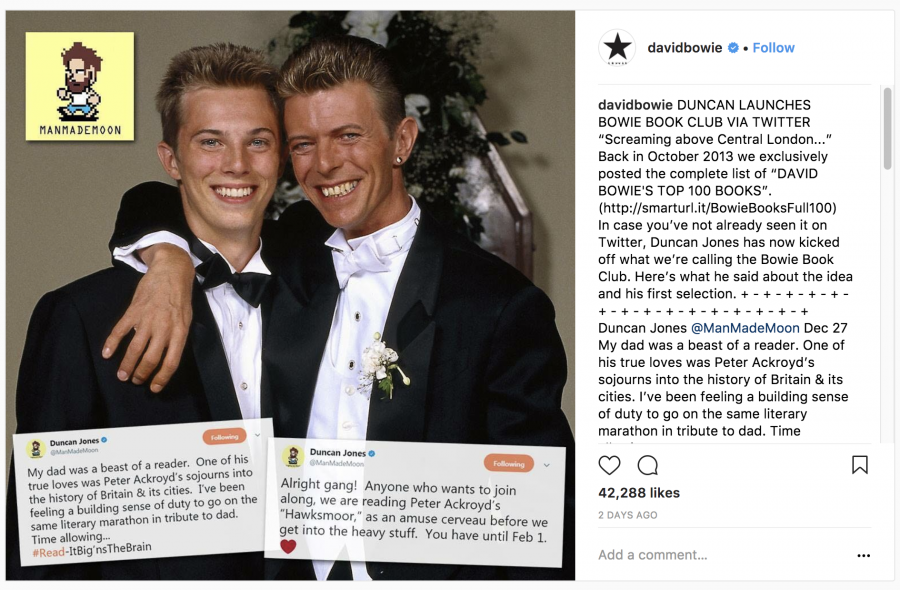
Cast as the star of 1976’s The Man Who Fell to Earth, David Bowie traveled to New Mexico for the shoot, meeting with director Nicolas Roeg soon upon arrival. “I took with me hundreds and hundreds of books,” Bowie said to The Face magazine a few years later. “And I had these cabinets” — a modernized Jacobean traveling library — “and they were rather like the boxes that amplifiers get packed up in, and I was going through all these books and they were pouring out all over the floor — there were just mountains of books. And Nick was sitting there watching me and he said, ‘Your great problem, David, is that you don’t read enough.’ ”
Due to Bowie’s hyper-serious state of mind in those days, he went on to recall, “it didn’t occur to me at the time that it was a joke.” Though he changed his ways of thinking and even dropped the traveling library, Bowie seems to have maintained his formidable reading habits for the rest of his life. (In 1987, he even posed for one of the American Library Association’s “READ” posters.) A few years ago we featured his Top 100 Book List, whose variety encompasses everything from The Outsider to Sexual Personae to A Confederacy of Dunces.
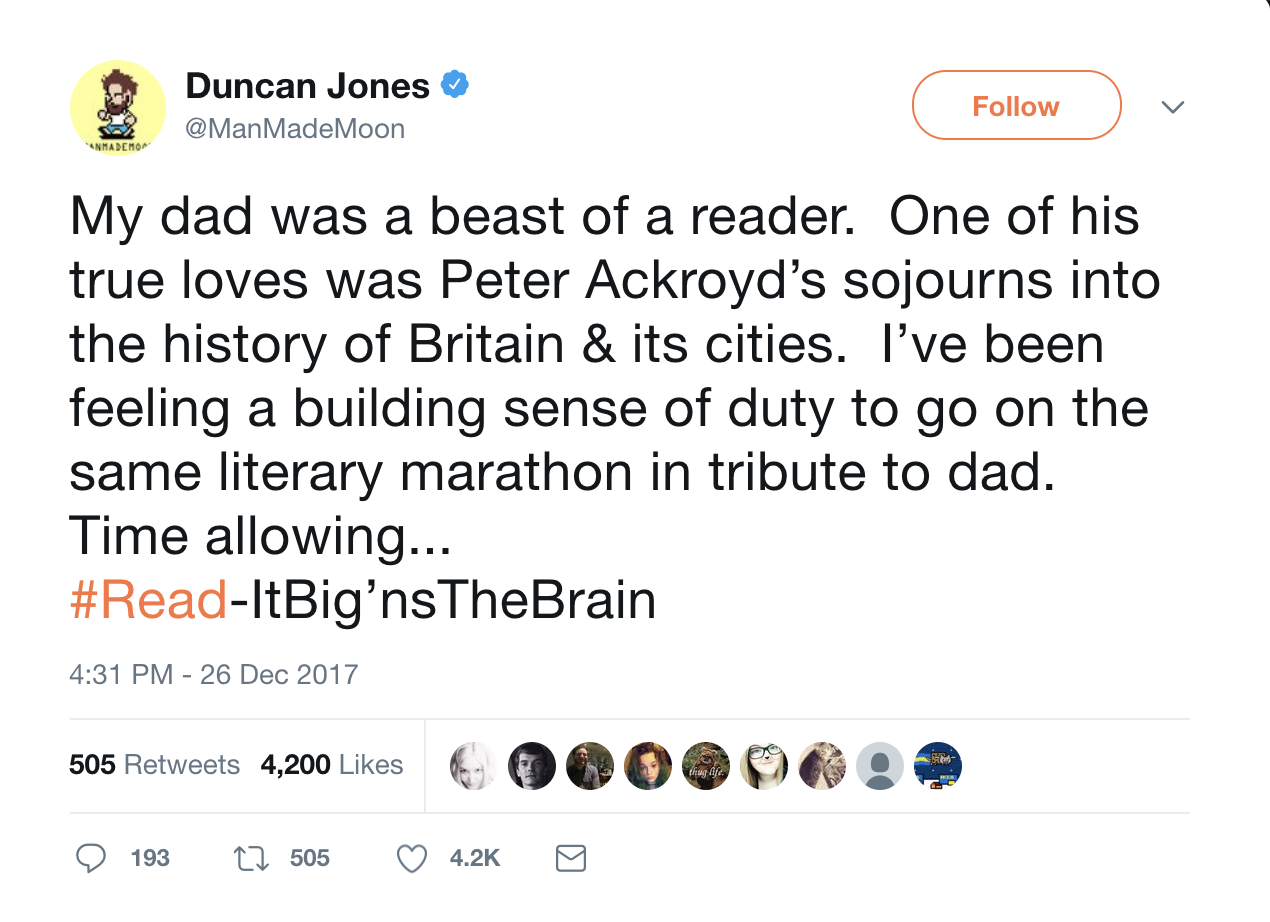
“My dad was a beast of a reader,” Bowie’s son Duncan Jones, an avid Twitter user, tweeted last week. “One of his true loves was Peter Ackroyd’s sojourns into the history of Britain & its cities. I’ve been feeling a building sense of duty to go on the same literary marathon in tribute to dad.” And so Jones’ informal David Bowie book club begins with Ackroyd’s 1985 postmodern novel Hawksmoor, which tells the parallel stories of an early 18th-century London architect and a late 20th-century London detective and which Joyce Carol Oates called “a witty and macabre work of the imagination, intricately plotted, obsessive in its much-reiterated concerns with mankind’s fallen nature.”
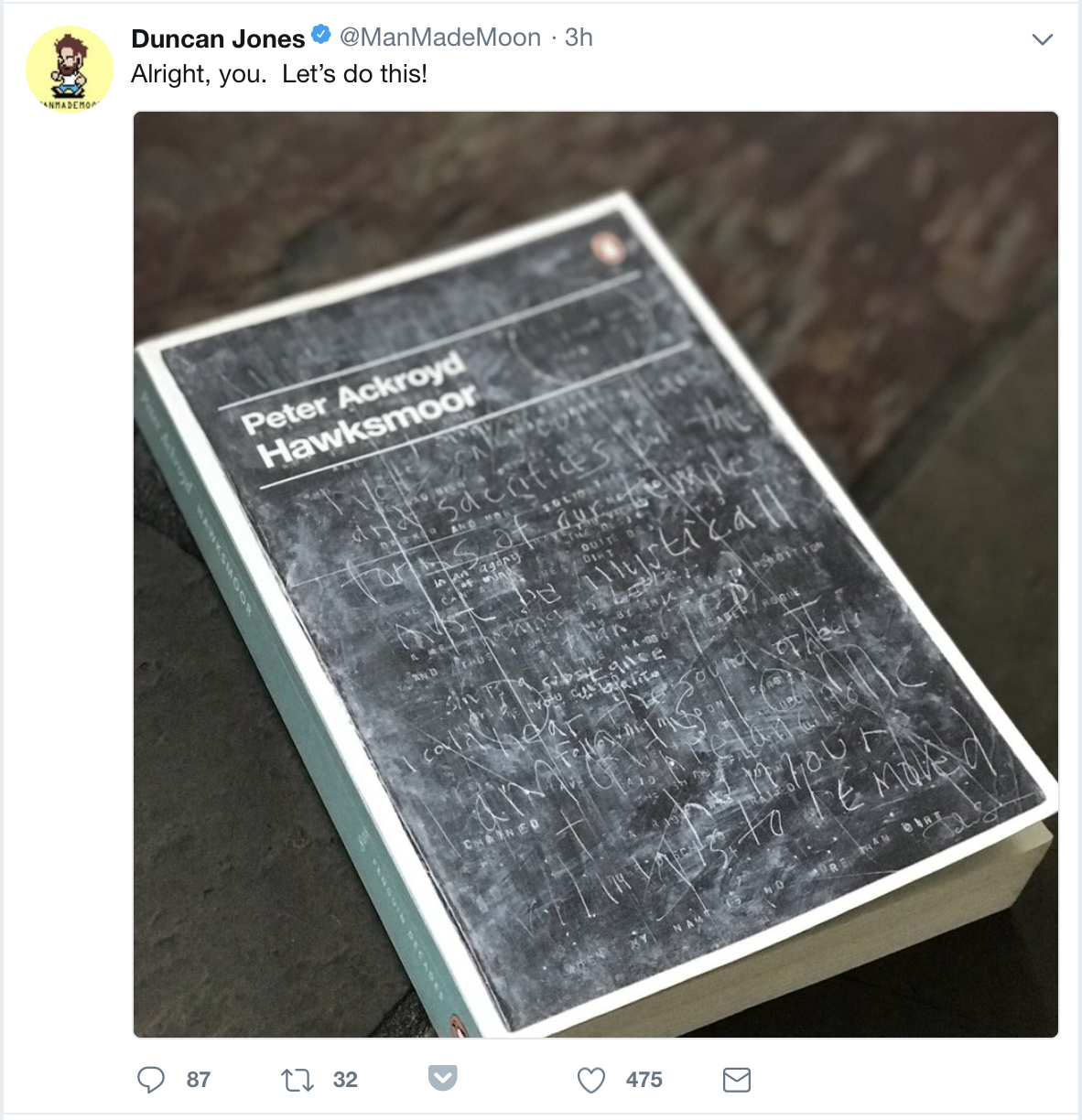
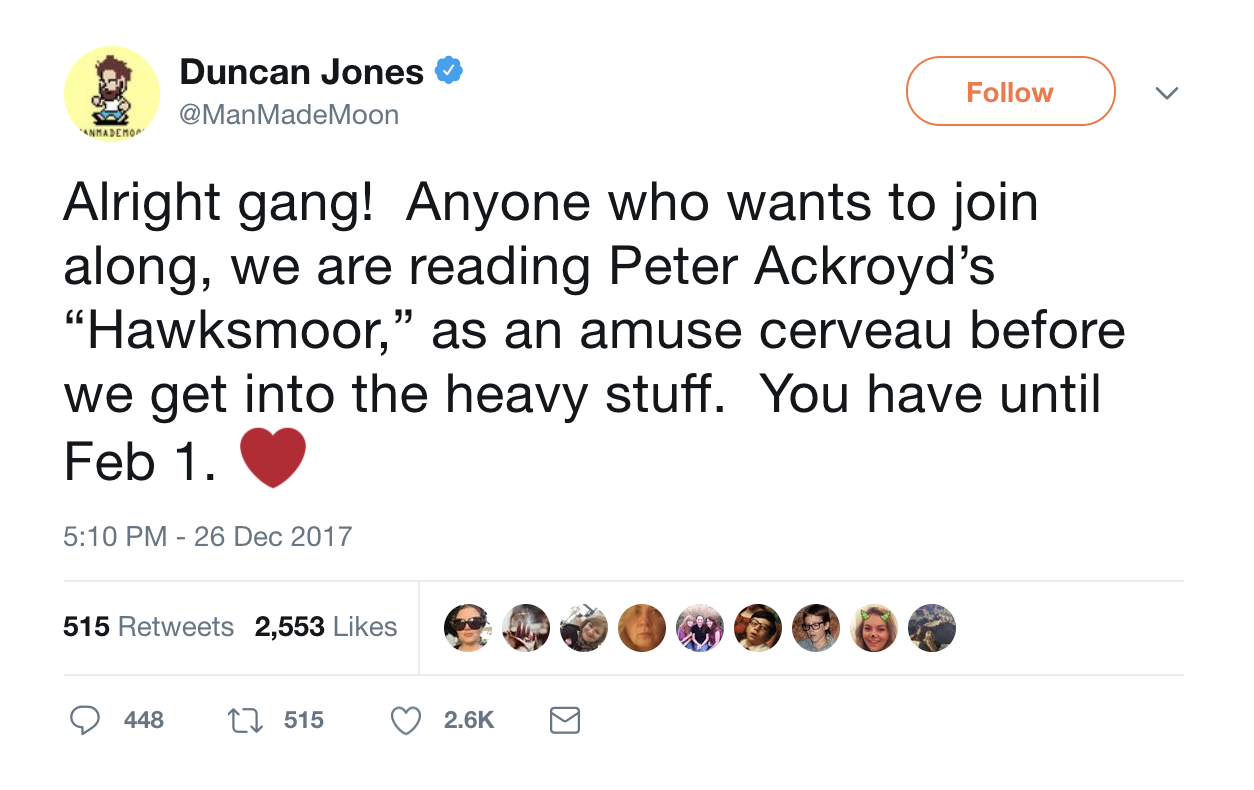
Jones calls the book “an amuse cerveau before we get into the heavy stuff,” the “heavy stuff” presumably including other such Bowie picks as White Noise, A Clockwork Orange and Last Exit to Brooklyn. If you’d like to participate in the Jones-led discussion of Hawksmoor on his Twitter page, you’ve got until the first of February to get it read. If you feel like you don’t read enough, consider this the Bowiest possible way to fulfill a new year’s resolution to do more of it.
Note: Separately you can also check out The Bowie Book Club Podcast where two friends spend a month reading a book on Bowie’s list. Find those episodes here.
Related Content:
David Bowie Urges Kids to READ in a 1987 Poster Sponsored by the American Library Association
Discover the Jacobean Traveling Library: The 17th Century Precursor to the Kindle
Based in Seoul, Colin Marshall writes and broadcasts on cities and culture. His projects include the book The Stateless City: a Walk through 21st-Century Los Angeles and the video series The City in Cinema. Follow him on Twitter at @colinmarshall or on Facebook.
Read More...Eudora Welty’s Handwritten Eggnog Recipe, and Charles Dickens’ Recipe for Holiday Punch
’Tis the season to break out the family recipes of beloved relatives, though often their provenance is not quite what we think.
(Imagine the cognitive dissonance upon discovering that Mother swiped “her” Italian Zucchini Crescent Pie from Pillsbury Bake-Off winner, Millicent Nathan of Boca Raton, Florida…)
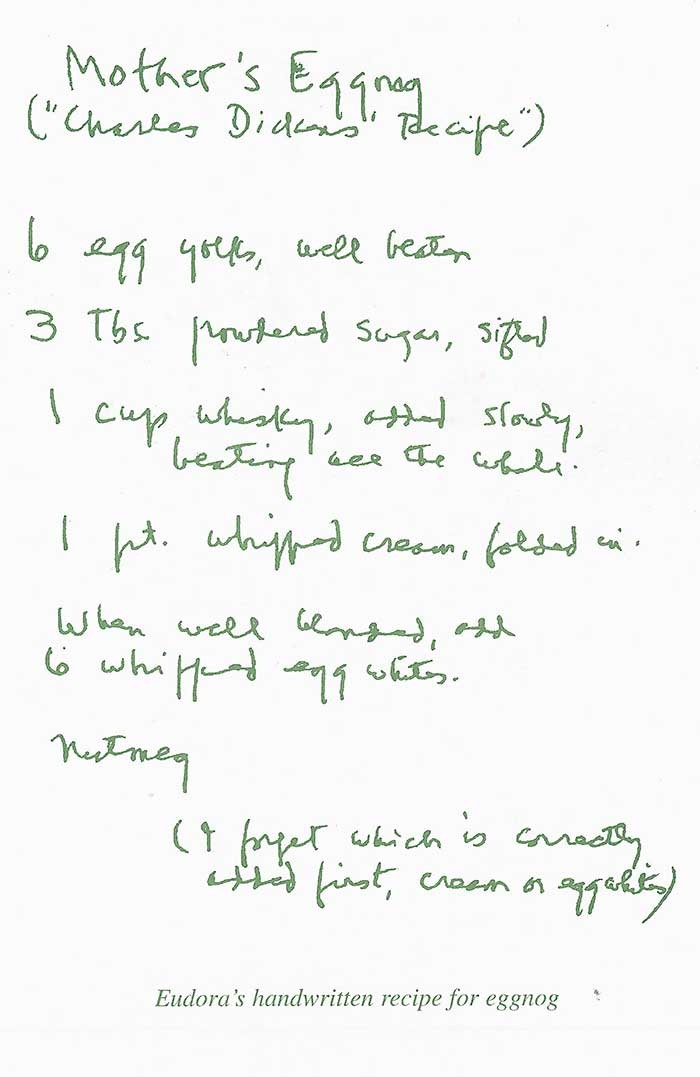
When it came to crediting the eggnog she dubbed “the taste of Christmas Day,” above, Pulitzer Prize-winning author Eudora Welty shared it out equally between her mother and author Charles Dickens:
In our house while I was growing up, I don’t remember that hard liquor was served at all except on one day in the year. Early on Christmas morning, we woke up to the sound of the eggbeater: Mother in the kitchen was whipping up eggnog. All in our bathrobes, we began our Christmas before breakfast. Throughout the day Mother made batches afresh. All our callers expected her eggnog.
It was ladled from the punch bowl into punch cups and silver goblets, and had to be eaten with a spoon. It stood up in peaks. It was rich, creamy and strong. Mother gave full credit for the recipe to Charles Dickens.
Nice, but perhaps Dickens is undeserving of this honor? The contents of his punchbowl bore little resemblance to Mother Welty’s, as evidenced by an 1847 letter to his childhood friend, Amelia Filloneau, in which he shared a recipe he promised would make her “a beautiful Punchmaker in more senses than one”:
Peel into a very strong common basin (which may be broken, in case of accident, without damage to the owner’s peace or pocket) the rinds of three lemons, cut very thin, and with as little as possible of the white coating between the peel and the fruit, attached. Add a double-handfull of lump sugar (good measure), a pint of good old rum, and a large wine-glass full of brandy — if it not be a large claret-glass, say two. Set this on fire, by filling a warm silver spoon with the spirit, lighting the contents at a wax taper, and pouring them gently in. Let it burn for three or four minutes at least, stirring it from time to Time. Then extinguish it by covering the basin with a tray, which will immediately put out the flame. Then squeeze in the juice of the three lemons, and add a quart of boiling water. Stir the whole well, cover it up for five minutes, and stir again.
This sounds very like the “seething bowls of punch” the jolly Ghost of Christmas Present shows Ebenezer Scrooge in A Christmas Carol, dimming the chamber with their delicious steam.
It’s also vegan, in contrast to what you might have been served in the Welty ladies’ home.
Why not serve both? In the words of Tiny Tim, “Here’s to us all!”
Eudora Welty’s Mother’s Eggnog (Attributed, Perhaps Erroneously, to Charles Dickens)
6 egg yolks, well beaten
Add 3 tbsp. powdered sugar
Add 1 cup whiskey, added slowly, beating all the while
Fold in 1 pint whipped cream
Whip 6 whipped egg whites and add to the mixture above.
Charles Dickens’ Holiday Punch (adapted from Punch by David Wondrich)
3/4 cup sugar
3 lemons
2 cups rum
1 1/4 cups cognac
5 cups black tea (or hot water)
Garnish: lemon and orange wheels, freshly grated nutmeg
In the basin of an enameled cast-iron pot or heatproof bowl, add sugar and the peels of three lemons.
Rub lemons and sugar together to release citrus oils. For more greater infusion, let sit for 30 minutes.
Add rum and cognac to the sugar and citrus.
Light a match, and, using a heatproof spoon (stainless steel is best), pick up a spoonful of the spirit mix.
Carefully bring the match to the spoon to light.
Carefully bring the lit spoon to the spirits in the bowl.
Let the spirits burn for about three minutes. The fire will melt the sugar and extract the oil from the lemon peels.
Extinguish the bowl by covering it with a heatproof pan or tray.
Skim off the lemon peels (leaving them too long in may impart a bitter flavor).
Squeeze in the juice of the three peeled lemons, and add hot tea or water.
If serving the punch hot, skip to the next step. If serving cold, cool punch in the refrigerator and, when cooled, add ice.
Garnish with citrus wheels and grated nutmeg.
Ladle into individual glasses.
Learn more about these and other festive holiday drinks in Master of Wine Elizabeth Gabay’s essay “Celebrating Christmas and New Year With Punch.”
Image above via Garden and Gun
Related Content:
Charles Mingus’ “Top Secret” Eggnog Recipe Contains “Enough Alcohol to Put Down an Elephant”
Blue Christmas: Feed Your Seasonal Depression with Holiday Masterpieces
Ayun Halliday is an author, illustrator, theater maker and Chief Primatologist of the East Village Inky zine. Follow her @AyunHalliday.
Read More...A 17-Hour Chronological Playlist of Beatles Songs: 338 Tracks Let You Hear the Musical Evolution of the Iconic Band
The Beatles have seemingly never been just a band; they’ve been a brand, a history, an institution, a genre, a generational soundtrack, a merchandising empire, and so much more—possessed of the kind of cultural importance that makes it impossible to think of them as only musicians. Their “narrative arc,” Tom Ewing writes at Pitchfork, from Beatlemania to their current enshrinement and everything in-between, “is irresistible.” But the story of the Beatles as we typically understand it, Ewing writes, does their music a disservice, setting it apart from “the rest of the pop world” and “making newcomers as resentful as curious.”
For all the deification (which John Lennon scandalously summed up in his “bigger than Jesus” quip), the band began as nothing particularly out of the ordinary. “Britain in the early 1960s swarmed with rock’n’roll bands,” and though the Beatles excelled early on, they mostly followed trends, they didn’t invent them.
Their sound was so of the time that Decca’s A&R executive Dick Rowe passed on them in 1962, telling Brian Epstein, “guitar groups are on their way out.” Little could he have known, however: “guitar groups” came roaring back because of the band’s first album, Please, Please Me, and the especially savvy marketing skills of Epstein, who helped land them that fateful Ed Sullivan Show appearance.
Millions of people saw them play their single “I Want to Hold Your Hand” and the world changed forever, so the story goes. In so many ways that’s so. The Ed Sullivan gig launched a thousand bands, and remains at top of the list of nearly every baby boomer musician’s most influential moments. But as the sixties wore on, and Beatlemania assumed the various forms of lunchboxes, fan clubs, and a wacky cartoon series with badly impersonated voices, their act seemed like it might run its course as a passing pop-culture fad. They were, in effect, a very talented boy band, subject to the fate of boy bands everywhere. Their ascent into Olympus wasn’t inevitable, and “every record they made was born out of a new set of challenges.”
Rubber Soul, the band’s 1965 farewell to the carefree, boyish pop band they had been, perfectly met the challenge they faced—how to grow up. It was “the most out-there music they’d ever made, but also their warmest, friendliest and most emotionally direct,” Rob Sheffield writes at Rolling Stone. They were “smoking loads of weed, so all through these songs, wild humor and deep emotion go hand in hand.” These threads of playful, drug-fueled experimentation, screwball comedy, and earnest sentiment changed not only the band’s career trajectory, but “cut the story of pop music in half,” Sheffield opines.
Such proclamations can and have been made of the groundbreaking Sgt. Pepper’s Lonely Hearts Club Band. Each Beatles milestone cements our impression of them as a messianic force, destined to steer the course of pop music history—a story that glosses over their novelty records, lesser works, many outtakes and half thoughts, cover songs, and flops, like their 1967 Magical Mystery Tour film. Some of these lesser works deserve the label. The mellotron-heavy “Only a Northern Song” on Yellow Submarine, for example, sounds far too much like an inferior “Strawberry Fields Forever.”
Others, like the Magical Mystery Tour soundtrack album, give us gems like McCartney’s “Penny Lane” (a song originally recorded during the Sgt. Pepper’s sessions), as well as “I Am the Walrus,” “Hello Goodbye,” “Baby, You’re a Rich Man,” “All You Need is Love” … the film may have disappointed, but the record, I’d say, is essential.
In the chronological Spotify playlist further up of 338 songs, you can follow the quirky, upbeat, downbeat, sometimes uneven, sometimes breathtakingly brilliant musical journey of the band everyone thinks they know and see why they are so much more interesting than a museum exhibit or rock and roll mythology. They were, after all, only human, but their willingness to indulge in weird experiments and to master genre exercises gave them the discipline and experience they needed to make their masterpieces.
Related Content:
How The Beatles’ Sgt. Pepper’s Lonely Hearts Club Band Changed Album Cover Design Forever
Josh Jones is a writer and musician based in Durham, NC. Follow him at @jdmagness
Read More...10 Reasons Why Hannibal’s Military Genius Still Captures Our Imagination Today
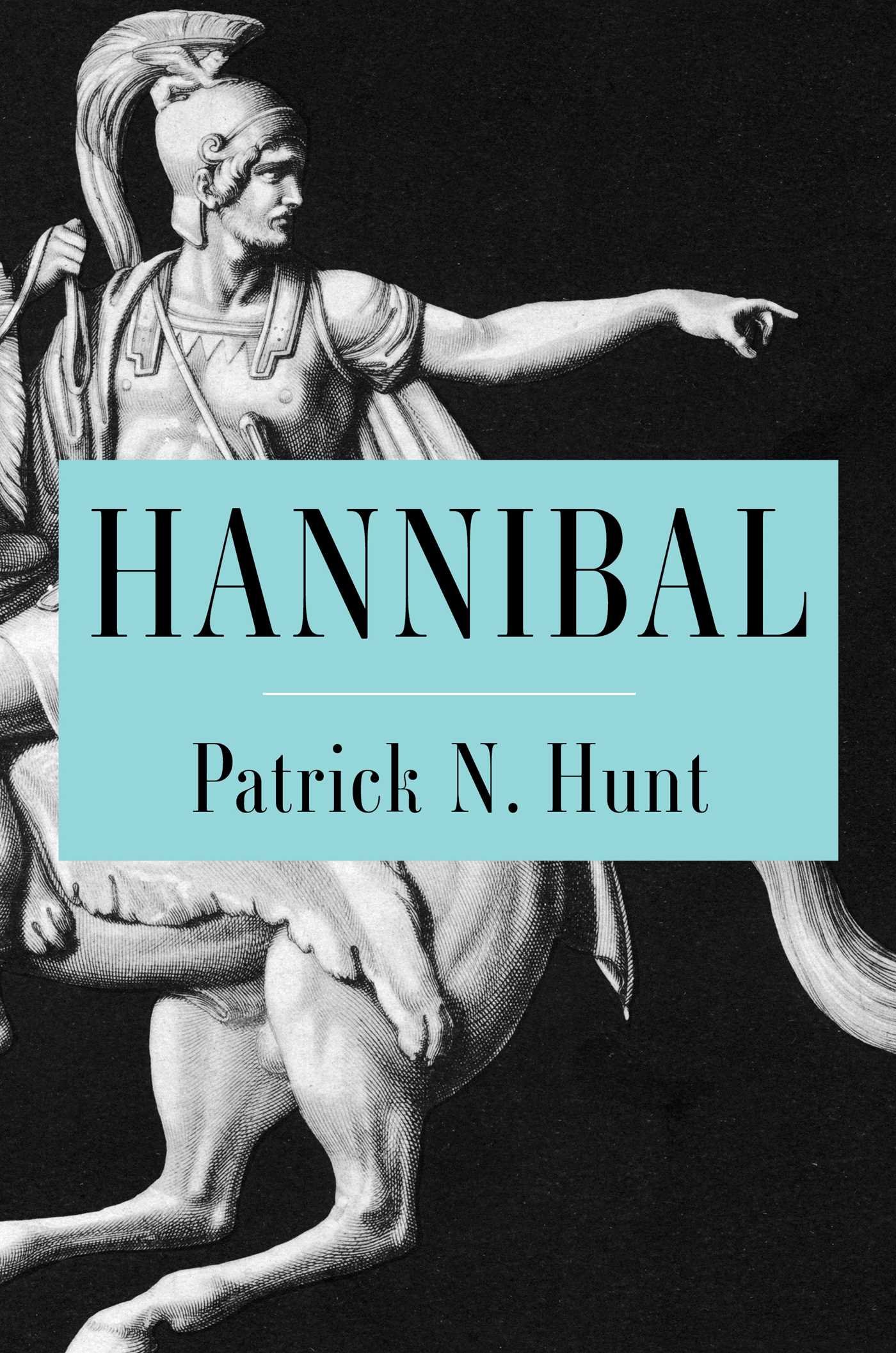
Note: This is a guest post from Patrick Hunt, author of the new book, Hannibal.
Hannibal Barca, otherwise simply known as Hannibal, lived and waged war over two thousand years ago – but is he still relevant in a world where the Romans are long gone? His famous crossing of the Alps in winter with an intrepid army and elephants is unforgettable, but are his brilliant maneuvers and intelligence gathering still worth examining? Despite the enigma of this great Carthaginian general being unable to preserve Carthage after him, Hannibal’s tactics and methods offer great lessons not only for military history but also for civilization at large. History reveals the Romans had a destiny of world conquest, but what is less well known is how much Hannibal changed the ways in which the Romans conducted the wars that eventually brought them Pax Romana, a peace often forged out of violence after a brutal expansion that killed and enslaved millions, including Carthage a century after Hannibal.
Before Hannibal, Rome was hemmed in by seas on almost all sides and could hardly expand except northward into Etruscan and Celtic territory; acquiring Sicily was Rome’s first step outside its mainland. But Hannibal forced Rome to fight a very different kind of war; his victories taught them how exploitable their military organization was, and he pressured Rome to change for survival. More relevant, while Hannibal didn’t invent spycraft, he seemingly used it more effectively than any other ancient general by his careful contingency planning. Hannibal set precedents for spy agencies and intelligence gathering and how to stage battles in any kind of terrain and weather–templates that current nations still study and follow. Every military academy today offers detailed classes and seminars on Hannibal’s tactics. I am frequently invited to lecture on Hannibal’s intelligence gathering in venues like the U.S. Naval War College, where classes are filled with Navy, Army, Marines, and Air Force officers along with representatives of the intelligence agencies. That is also why the National Geographic Society sponsored my Hannibal field research – sending me to every Hannibal battle site and to Carthage in Tunisia, along with Spain, France, Italy and even Turkey where Hannibal concluded his dramatic life — and also why Simon and Schuster published my biography Hannibal this summer. Here are some nuggets from 20 years of Hannibal fieldwork found in this new book.
- Hannibal studied his opponents very carefully, employing every means of gathering intelligence in enemy camps, including spies from allied populations who provisioned the Romans.
- When necessary, Hannibal paid for credible intelligence with silver supplied from mines in Carthaginian Spain; as long as that silver lasted to pay for good intel, he was unbeatable. Once Rome conquered Spain’s silver mines, Hannibal’s ability to gather and exploit such military intelligence was cut off. There is a direct correlation to Hannibal’s access to silver for intel or mercenary use and his brilliant victories.
- Hannibal usually went for the unpredictable surprise maneuver that had never been seen before, including crossing the Alps in winter and forcing the Romans to fight in the dead of winter and at night.
- Hannibal got into the minds of his enemies with psy-ops, exposing their weaknesses, triggering their anger and vanity, and making them fall into his traps; undermining the confidence of the Roman foot soldiers in big battles and paralyzing them with fear. Romans taught their children to fear Hannibal as the bogeyman – always warning in crises for centuries that “Hannibal is at the Gates”.
- Hannibal proved it’s not the size of your army but how well prepared it is. He epitomizes the old adage, “Better 10 men wisely led than 100 with a fool at the head.” Even if austere, Hannibal’s leadership was legendarily charismatic – he even slept with his men on the ground wrapped in a blanket. He taught his men the brutality of war with likely less PTSD than his enemies because he always prepared them with ideas like “fight or die.” Much later, Machiavelli even alluded to Hannibal in The Prince with the concept that it’s “better to be feared than loved.”
- Hannibal effectively used the most mobile units possible with his Numidian cavalry, often outflanking the Roman infantry on multiple campaigns, especially in his famous “double envelopment” or where he finished battles with ambushes from the rear where there was no escape.
- Because his armies were almost always smaller – especially after his difficult Alps crossing when he lost many soldiers – Hannibal augmented his arsenal with weapons of nature: forcing the Romans to cross the frozen Trebbia River, hiding his armies in the fog above Lake Trasimene, driving captured cattle with torches tied to their horns to fool the Romans into thinking he was on the move at night at Volturnus, making the Romans face the blinding dust and sand blowing from Africa at Cannae. He even confused the Romans at Cannae with some of his troops outfitted with captured Roman gear.
- Similarly, after studying terrain and topography, Hannibal always chose his battle sites when possible for the best possible advantage, especially constricting the larger Roman armies where they would be unable to outflank him and instead they would be hemmed in by rivers or hills, etc., also choosing terrain where he could hide ambushes in nearby forests.
- Hannibal sagely exploited the 2‑consul Roman alternating command rotated one day between an experienced military veteran and the next day with a political appointee populist leading. On at least three occasions, Hannibal annihilated the Romans on the days when fools were the supposed commanders. The following Roman generations learned the hard lesson from this and the Senate created a professional army commanded by veteran leadership. Eventually Rome also amped up its cavalry and became less dependent on infantry thanks to Hannibal.
- Hannibal taught his one formidable Roman opponent Scipio how to implement brilliant tactics, how to mine data from military intelligence and how to benefit from Spain’s mercenary silver to bribe the Numidians to abandon Carthage. Scipio – the only one to beat Hannibal — respected Hannibal more than any other Roman because he learned so much from him. It’s one of the great ironies in history that Hannibal is apparently more famous than Scipio, and it’s not only because of crossing the Alps with elephants: ultimately the Romans didn’t appreciate a victorious Scipio any more than the Carthaginians appreciated a victorious Hannibal. Hannibal will remain a profound enigma in that he could not ultimately win the war with Rome, yet he could win so many brilliant battles with incredibly memorable tactics still taught today.
The Roman book Stratagemata by Frontinus — a compilation of military stratagems — has more clever ruses of Hannibal than any other commander up to that time. Historic great commanders or officers who studied or emulated Hannibal include but are not limited to Julius Caesar, Belisarius, Charlemagne, Napoleon, Suvorov, Kutuzov, von Clausewitz, Montgomery, Liddell Hart, Rommel, Patton and Schwarzkopf, among many others. Even the term blitzkrieg alluded to Hannibal’s clan (Barca = “lightning”) and his rapid advance in his invasion of Italy.” So, of course, Hannibal is at least as relevant as any other memorable person in history, especially in a time of world chaos and rethinking strategic allegiances.
Postscript: Hannibal (Simon and Schuster 2017) has been acclaimed in reviews from The New York Times, Christian Science Monitor, Philadelphia Inquirer, Ancient History Encyclopedia, a starred Kirkus Review and many others, and also nominated in the Kirkus List of Best Nonfiction Books of 2017.
Read More...George Orwell Predicted Cameras Would Watch Us in Our Homes; He Never Imagined We’d Gladly Buy and Install Them Ourselves
Normalization—the mainstreaming of people and ideas previously banished from public life for good reason—has become the operative description of a massive societal shift toward something awful. Whether it’s puff pieces on neo-Nazis in major national newspapers or elected leaders who are also documented sexual predators, a good deal of work goes into making the previously unthinkable seem mundane or appealing.
I try not to imagine too often where these things might lead, but one previously unthinkable scenario, the openly public mass surveillance apparatus of George Orwell’s 1984 has pretty much arrived, and has been thoroughly normalized and become both mundane and appealing. Networked cameras and microphones are installed throughout millions of homes, and millions of us carry them with us wherever we go. The twist is that we are the ones who installed them.
As comic Keith Lowell Jensen remarked on Twitter a few years ago, “What Orwell failed to predict is that we’d buy the cameras ourselves, and that our biggest fear would be that nobody was watching.” By appealing to our basic human need for connection, to vanity, the desire for recognition, and the seemingly instinctual drive for convenience, technology companies have persuaded millions of people to actively surveille themselves and each other. They incessantly gather our data, as Tim Wu shows in The Attention Merchants, and as a byproduct have provided access to our private spaces to government agents and who-knows-who-else.
Computers, smartphones, and “smart” devices can nearly all be hacked or commandeered. Former director of national intelligence James Clapper reported as much last year, telling the U.S. Senate that intelligence agencies might make extended use of consumer devices for government surveillance. Webcams and “other internet-connected cameras,” writes Eric Limer at Popular Mechanics, “such as security cams and high-tech baby monitors, are… notoriously insecure.” James Comey and Mark Zuckerberg both cover the cameras on their computers with tape.
The problem is far from limited to cameras. “Any device that can respond to voice commands is, by its very nature, listening to you all the time.” Although we are assured that those devices only hear certain trigger words “the microphone is definitely on regardless” and “the extent to which this sort of audio is saved or shared is unclear.” (Recordings on an Amazon Echo are pending use as evidence in a murder trial in Arkansas.) Devices like headphones have even been turned into microphones, Limer notes, which means that speakers could be as well, and “Lipreading software is only getting more and more impressive.”
I type these words on a Siri-enabled Mac, an iPad lies nearby and an iPhone in my pocket… I won’t deny the appeal—or, for many, the necessity of connectivity. The always-on variety, with multiple devices responsible for controlling greater aspects of our lives may not be justifiable. Nonetheless, 2017 could “finally be the year of the smart home.” Sales of the iPhone X may not meet Apple’s expectations. But that could have more to do with price or poor reviews than with the creepy new facial recognition technology—a feature likely to remain part of later designs, and one that makes users much less likely to cover or otherwise disable their cameras.
The thing is, we mostly know this, at least abstractly. Bland bulleted how-to guides make the problem seem so ordinary that it begins not to seem like a serious problem at all. As an indication of how mundane insecure networked technology has become in the consumer market, major publications routinely run articles offering helpful tips on how “stop your smart gadgets from ‘spying’ on you” and “how to keep your smart TV from spying on you.” Your TV may be watching you. Your smartphone may be watching you. Your refrigerator may be watching you. Your thermostat is most definitely watching you.
Yes, the situation isn’t strictly Orwellian: Oceana’s constantly surveilled citizens did not comparison shop, purchase, and customize their own devices voluntarily. (It’s not strictly Foucauldian either, but has its close resemblances.) Yet in proper Orwellian doublespeak, “spying” might have a very flexible definition depending on who is on the other end. We might stop “spying” by enabling or disabling certain features, but we might not stop “spying,” if you know what I mean.
So who is watching? CIA documents released by a certain unsavory organization show that the Agency might be, as the BBC segment at the top reports. As might any number of other interested parties from data-hoarding corporate bots to tech-savvy voyeurs looking to get off on your candid moments. We might assume that someone could have access at any time, even if we use the privacy controls. That so many people have become dependent on their devices, and will increasingly become so in the future, makes the question of what to do about it a trickier proposition.
Related Content:
Josh Jones is a writer and musician based in Durham, NC. Follow him at @jdmagness
Read More...What Happens When a Jazz Musician Accidentally Texts His Wife with Voice Recognition…While Playing the Trombone
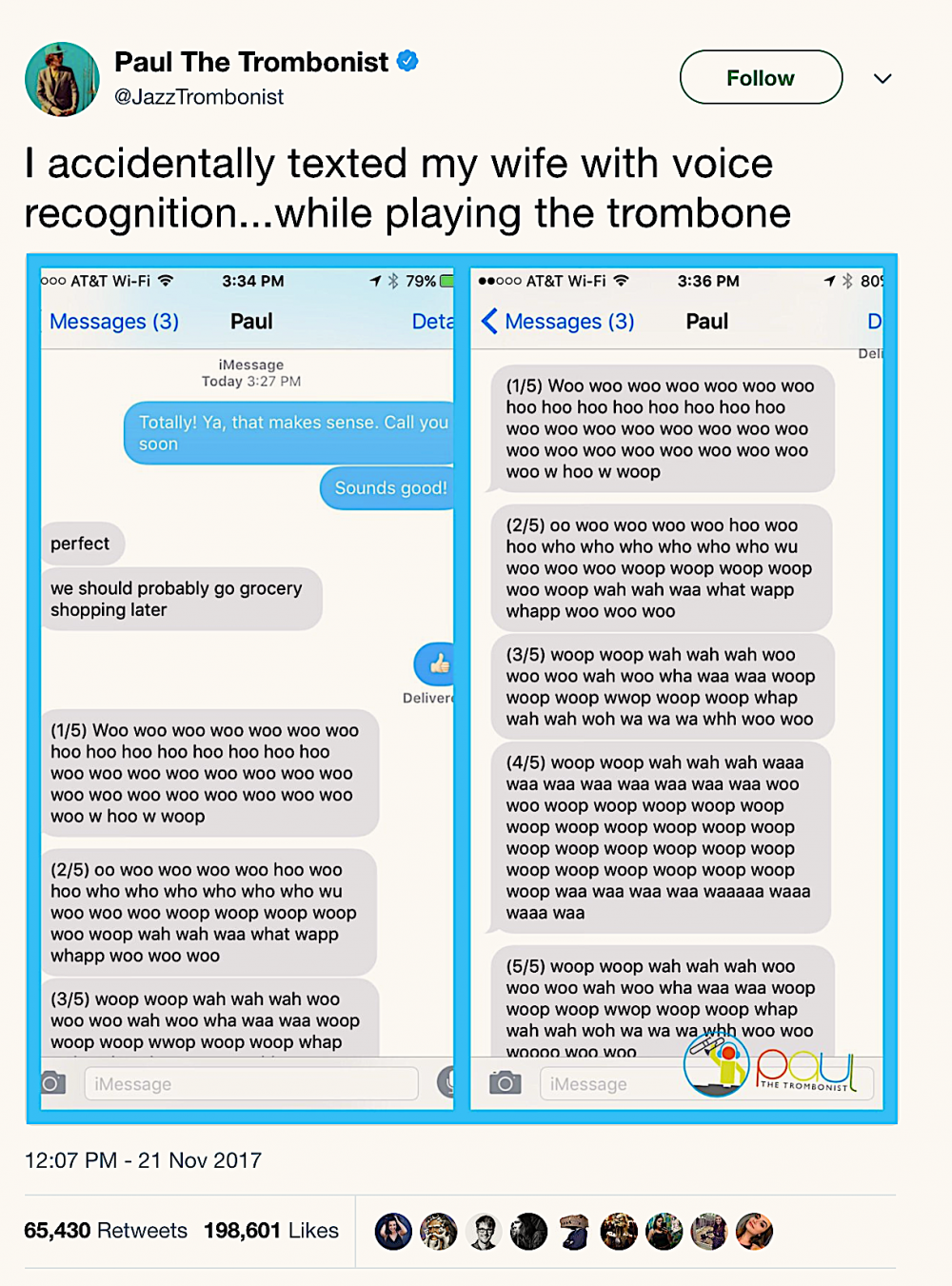
A couple of days ago, Paul Nowell (aka Paul the Trombonist) sent out this simple tweet, showing what happened when his iPhone’s voice recognition system happened to capture his trombone session and turned it into words. The tweet went viral. And now, 65,000 “Retweets” and 198,000 “Likes” later, you can see how the original recording session went down. Enjoy the demo below:
If you would like to support the mission of Open Culture, consider making a donation to our site. It’s hard to rely 100% on ads, and your contributions will help us continue providing the best free cultural and educational materials to learners everywhere. You can contribute through PayPal, Patreon, and Venmo (@openculture). Thanks!
Related Content:
Farmer Serenades Cows by Playing Lorde’s “Royals” on the Trombone
Read More...Research Finds That Intellectual Humility Can Make Us Better Thinkers & People; Good Thing There’s a Free Course on Intellectual Humility
We may have grown used to hearing about the importance of critical thinking, and stowed away knowledge of logical fallacies and cognitive biases in our argumentative toolkit. But were we to return to the philosophical sources of informal logic, we would find that we only grasped at some of the principles of reason. The others involve questions of what we might call virtue or character—what for the Greeks fell into the categories of ethos and pathos. The principle of charity, for example, in which we give our opponents a fair hearing and respond to the best version of their arguments as we understand them. And the principle, exemplified by Plato’s Socrates, of intellectual humility. Or as one punk band put it in their Socratic tribute. “All I know is that I don’t know. All I know is that I don’t know nothing.”
Intellectual humility is not, contrary to most popular appearances, reflexively according equal weight to “both sides” of every argument or assuming that everyone’s opinion is equally valid. These are forms of mental laziness and ethical abdication. It is, however, believing in our own fallibility and opening ourselves up to hearing arguments without immediately forming a judgment about them or the people who make them. We do not abandon our reason and values, we strengthen them, argues Mark Leary, by “not being afraid of being wrong.” Leary, professor of psychology and neuroscience at Duke University, is the lead author of a new study on intellectual humility that found “essentially no difference between liberals and conservatives or between religious and nonreligious people” when it comes to intellectual humility.
The study challenges many ideas that can prevent dialogue. “There are stereotypes about conservatives and religiously conservative people being less intellectually humble about their beliefs,” says Leary. But he and his colleagues “didn’t find a shred of evidence to support that.” This doesn’t necessarily mean that such people have high degrees of intellectual humility, only that all of us, perhaps equally, possess fairly low levels of the trait. I’ll be the first to admit that it is not an easy one to develop, especially when we’re on the defensive for some seemingly good reasons—and when we live in a culture that encourages us to make decisions and take actions on the strength of an image, some minimal text, and a few buttons that lead us right to our bank accounts. (To quote Operation Ivy again, “We get told to decide. Just like as if I’m not gonna change my mind.”)
But in the Duke study, reports Alison Jones at Duke Today, “those who displayed intellectual humility did a better job of evaluating the quality of evidence.” They took their time to make careful considerations. And they were generally more charitable and “less likely to judge a writer’s character based on his or her views.” By contrast, “intellectually arrogant” people gave writers with whom they disagreed “low scores in morality, honesty, competence, and warmth.” As a former teacher of rhetoric, I wonder whether the researchers accounted for the quality and persuasiveness of the writing itself. Nonetheless, this observation underscores the problem of conflating an author’s work with his or her character. Moral judgment can inhibit intellectual curiosity and open-mindedness. Intellectually arrogant people often resort to insults and personal attacks over thoughtful analysis.
The enormous number of assumptions we bring to almost every conversation with people who differ from us can blind us to our own faults and to other people’s strengths. But intellectual humility is not genetically determined—it is a skill that can be learned, Leary believes. Big Think recommends a free MOOC from the University of Edinburgh on intellectual humility (see an introduction to the concept at the top and a series of lectures here). “Faced with difficult questions,” explains course lecturer Dr. Ian Church, “people often tend to dismiss and marginalize dissent…. The world needs more people who are sensitive to reasons both for and against their beliefs, and are willing to consider the possibility that their political, religious and moral beliefs might be mistaken.” The course offers three different levels of engagement, from casual to quite involved, and three separate class sections at Coursera: Theory, Practice, and Science.
It’s likely that many of us need some serious preparation before we’re willing to listen to those who hold certain views. And perhaps certain views don’t actually deserve a hearing. But in most cases, if we can let our guard down, set aside feelings of hostility, and become willing to learn something even from those with whom we disagree, we might be able to do what so many psychologists continue to recommend. As Cindy Lamothe writes at New York Magazine’s Science of Us blog, “we have to be willing to expose ourselves to opposing perspectives in the first place—which means that, as daunting as it may seem, listening to friends and family with radically different views can be beneficial to our long-term intellectual progress.” The holidays are soon upon us. Let the healing—or at least the charitable tolerance if you can manage it—begin.
Related Content:
Stephen Fry Identifies the Cognitive Biases That Make Trump Tick
32 Animated Videos by Wireless Philosophy Teach You the Essentials of Critical Thinking
Why We Need to Teach Kids Philosophy & Safeguard Society from Authoritarian Control
Josh Jones is a writer and musician based in Durham, NC. Follow him at @jdmagness
Read More...What the Future Sounded Like: Documentary Tells the Forgotten 1960s History of Britain’s Avant-Garde Electronic Musicians
It really is impossible to overstate the fact that most of the music around us sounds the way it does today because of an electronic revolution that happened primarily in the 1960s and 70s (with roots stretching back to the turn of the century). While folk and rock and roll solidified the sound of the present on home hi-fis and coffee shop and festival stages, the sound of the future was crafted behind studio doors and in scientific laboratories. What the Future Sounded Like, the short documentary above, transports us back to that time, specifically in Britain, where some of the finest recording technology developed to meet the increasing demands of bands like the Beatles and Pink Floyd.
Much less well-known are entities like the BBC’s Radiophonic Workshop, whose crew of engineers and audio scientists made what sounded like magic to the ears of radio and television audiences. “Think of a sound, now make it,” says Peter Zinovieff “any sound is now possible, any combination of sounds is now possible.” Zinovieff, London-born son of an émigré Russian princess and inventor of the hugely influential VCS3 synthesizer in 1969, opens the documentary—fittingly, since his technology helped power the futuristic sound of progressive rock, and since, together with the Radiophonic Workshop’s Delia Derbyshire and Brian Hodgson, he ran Unit Delta Plus, a studio group that created and promoted electronic music.
Also appearing in the documentary is Tristram Cary, who, with Zinovieff, founded Electronic Music Studios, one of four makers of commercial synthesizers in the late sixties, along with ARP, Buchla, and Moog. Zinovieff and Carey are not household names in part because they didn’t particularly strive to be, preferring to work behind the scenes on experimental forms and eschewing popular music even as their technology gave birth to so much of it. The aristocratic Zinovieff and pipe-smoking, professorial Carey hardly fit in with the crowd of rock and pop stars they inspired.
In hindsight, however, Zinovieff desires more recognition for their work. “One thing which is odd, is that there’s a missing chapter, which is EMS, in all the books about electronic music. People do not know what incredible mechanical adventures we were up to.” Those adventures included not only creating new technology, but composing never-before-heard music. Both Zinovieff and Carey continue to create electronic scores, and Carey happens to be one of the first adopters in Britain of musique concrète, the proto-electronic music pioneered in the 1940s using tape machines, microphones, filters, and other recording devices, along with found sounds, field recordings, and ad hoc instruments made from non-instrument objects. (See examples of these techniques in the clip above from the 1979 BBC documentary The New Sound of Music.)
Many of the sounds that emerged from Britain’s electronic music founders came out of the detritus of World War II. Carey’s first serious studio design, he says, “coincided with the post-war appearance of an enormous amount of junk from the army, navy, and air force. For someone who knew what to do, and could handle a soldering iron, and could design audio equipment, even if you only had 30 shillings in your pocket, you could get something.” With their knowledge of electronics and hodge-podge of technology, Carey and his compatriots were designing an avant-garde electronic “high modernity,” author Trevor Pinch declares. “I think you can think of people like Tristan Carey as dreaming of a future soundscape of London.” Nowadays, those sounds are as familiar to us as the music piped over the speakers in restaurants and shops. One wonders what the future after the future these pioneers designed will sound like?
What the Future Sounded Like will be added to our collection of Documentaries, a subset of our collection, 4,000+ Free Movies Online: Great Classics, Indies, Noir, Westerns, Documentaries & More.
Related Content:
Two Documentaries Introduce Delia Derbyshire, the Pioneer in Electronic Music
Josh Jones is a writer and musician based in Durham, NC. Follow him at @jdmagness.
Read More...Jimmy Page Unplugged: Led Zeppelin’s Guitarist Reveals His Acoustic Talents in Four Videos (1970–2008)
There are those who say Jimmy Page’s guitar playing went into decline near the end of the 70s for reasons that are in dispute, whether drugs, tendonitis, or a broken ring finger during a 1975 tour. (Thirty-two years later, he broke his pinky and had to delay a Led Zeppelin reunion.) Every musician goes through slumps. Page talked in a 1977 interview about an earlier such episode, during his session work in the sixties when horns and orchestras began to eclipse guitars, and he found himself “taking a back seat with just the occasional riff.” The experience made him reevaluate his career. “I didn’t realize how rusty I was going to get until a rock and roll session turned up from France, and I could hardly play.”
One thing that sustained Page in those low times was his acoustic playing. As a session player, he tells the ‘77 interviewer, “I had to do it on studio work, and you come to grips with it very quickly too, very quickly, because it is what is expected. There was a lot of busking in the early days, but as I say, I had to come to grips with it, and it was a good schooling.”
Though Page first started out playing in acoustic skiffle bands, he says his first guitar was a Grazzioso, “which was like a copy of a Stratocaster,” his next instrument a real Fender Strat, and his third, the “Black Beauty” Gibson Les Paul that he played on Zeppelin’s early studio sessions before it was stolen. It was his earlier session work that trained him as a disciplined, and underrated, acoustic player—and at times a profoundly inspired one.
When, after almost ten years, Page reunited with Robert Plant in 1994 for a series of MTV Unplugged sessions (top), his acoustic playing was top notch. In other acoustic sessions from just a few years earlier (the 1989 video further up) a slightly out-of-it Page plays with quite much less subtlety and restraint, though he’s certainly still got the skill. But careless performances like these are not characteristic of Page’s true talents as an acoustic player. Ignore the poor video quality and listen to his incredible picking above on a 1970 broadcast of The Julie Felix Show in England.
Page could showcase his lead playing, adapted to a folk idiom, on the acoustic guitar, but he has always excelled as a rhythm player as well. Just above, in an outtake from the 2008 documentary It Might Get Loud—while still recovering from that broken pinky finger—Page plays what Guitar World identifies only as “an uncredited instrumental” on a guitar that “appears to be in an open tuning, possibly C.” Whatever this composition, we can hear in these broad strums a whole rhythmic arrangement, with drum and bass parts and negative space drawn around the hints of melody. Page has always had one of the most thoroughly imaginative guitar styles in rock and roll, and when he steps back from his blues-based electric playing and embraces the acoustic guitar, he showcases how much the influence of various acoustic world and folk musics “gave Led Zeppelin a richness,” writes Stephen Erlewine at Allmusic, “unheard in their heavy rock peers.”
Related Content:
Jimmy Page Tells the Story of “Kashmir”
Jimmy Page Tells the Story of “Stairway to Heaven”: How the Most Played Rock Song Came To Be
13-Year-Old Jimmy Page Plays Guitar on TV in 1957, an Early Moment in His Spectacular Career
Josh Jones is a writer and musician based in Durham, NC. Follow him at @jdmagness
Read More...Support Us
We're hoping to rely on loyal readers, rather than erratic ads. Please click the Donate button and support Open Culture. You can use Paypal, Venmo, Patreon, even Crypto! We thank you!

About Us

Open Culture scours the web for the best educational media. We find the free courses and audio books you need, the language lessons & educational videos you want, and plenty of enlightenment in between.
Advertise With Us

FREE UPDATES!
GET OUR DAILY EMAIL
Get the best cultural and educational resources on the web curated for you in a daily email. We never spam. Unsubscribe at any time.
FOLLOW ON SOCIAL MEDIA

Open Culture editor Dan Colman scours the web for the best educational media. He finds the free courses and audio books you need, the language lessons & movies you want, and plenty of enlightenment in between.
Advertise With Us


