Stream the “Complete” John Coltrane Playlist: A 94-Hour Journey Through 700+ Transformative Tracks
In a contrarian take on the legacy of John Coltrane on the 50th anniversary of his death last year, Zack Graham at GQ did not recommend Giant Steps nor A Love Supreme nor Blue Train nor My Favorite Things as the most important album in the artist’s career, but a record most casual jazz fans may never encounter, and which even the hardest-core Coltrane fans never heard in his lifetime. Recorded in the year of his death, Interstellar Space—a frenetic suite of free jazz duets with drummer Rashied Ali—didn’t appear until 1974. The album has since received widespread critical acclaim, and stands, Graham argues, as “Coltrane’s most influential record, its echoes still heard today in everything from electronic music to some of the world’s biggest hip hop acts.”
Graham makes a compelling case. It’s hardly an accessible album, but discerning listeners will nonetheless hear the sound of now in Ali’s stuttering, rapid fire beats and Coltrane’s modal bleats. Looking back, it can almost seem like he knew he was running out of time, and rushed to leave behind a blueprint for the music of the future.
“In his last months,” writes Stephen Davis at Rolling Stone, “Coltrane had changed everything about his music,” and, perhaps, everything about music in general, jazz and otherwise. His evolution as a musician and explorer of the mystical potentialities of artistic expression was so radical that from a certain point of view we are forced to work backward when approaching his catalog, as we might do with biographies of saints.
Should we pursue this line of thinking, however, we might have to grant that the posthumous Interstellar Space and its follow-up Stellar Regions—compiled from tapes Alice Coltrane discovered in 1994—are the result of Coltrane’s final musical apotheosis and thus can sound nigh-incomprehensible to most mere mortals. Interstellar Space “is a musicians’ album, for sure,” Graham admits, and an album for those fully open to the unknown: “the dissonance and enharmonic experimentation… is otherworldly.”
Working backward, we see Coltrane’s transfiguration into an avant-garde pioneer in 1966’s Ascension, an album that “still manages to confound as many listeners as it convinces,” Derek Taylor writes at All About Jazz. A Love Supreme is Coltrane’s gospel, a spiritual classic that draws everyone in with its message of transcendence and oneness. Earlier milestones My Favorite Things, Giant Steps, and Blue Train are each miraculous feats of musicianship that drew huge crowds of admirers and imitators, and then there are the years of apprenticeship, when the young Coltrane studied under masters like Miles Davis and Dizzy Gillespie, and practiced the dharma of Charlie Parker.
A narrative of Coltrane as a kind of musical messiah explains the literal veneration of his work by the Church of Saint John Coltrane, but it is only one convenient means of Coltrane appreciation. In truth, his oeuvre is too vast and varied in scope to neatly sum up in any fully satisfying way. We might just as well start at the beginning, when Coltrane was a mostly unknown, but very hip, sideman, playing with the greats throughout the fifties. “From his Bird-emulating beginnings to his flights into the unknown in his last years,” writes Fernando Ortiz, compiler of the “Complete” John Coltrane playlist above, “the standard of his music and his passion are always at the top or very close to it.”
Comprising over 700 tracks, “or four straight days of listening,” this playlist list is still “far from perfect,” Ortiz admits, “since it is subject to availability and to the non-systematic approach to data on Spotify, but it’s not that far this time.”
…no studio recording he made between 1955 and 1965 is missing (his previous years are well represented, starting with his 1946 recordings while in the Navy), which includes all his studio work as a leader during those years, as well as all his recordings as a sideman with Miles and Monk.
The weighting toward live recordings, “both from official and bootleg sources,” provides a very multifaceted view of the artist’s onstage development, and the inclusion of box sets like Heavyweight Champion: The Complete Atlantic Recordings offer panoramic surveys of his studio work. While we don’t get everything here, and some of the omissions are key, you will, if you spend quality time delving into this treasure house, understand why the name Coltrane conjures such intensity of awe, praise, and devotion.
Related Content:
Organized Religion Got You Down? Discover The Church Of Saint John Coltrane
John Coltrane’s Handwritten Outline for His Masterpiece A Love Supreme (1964)
Josh Jones is a writer and musician based in Durham, NC. Follow him at @jdmagness
Read More...When the Sex Pistols Played at the Chelmsford Top Security Prison: Hear Vintage Tracks from the 1976 Gig
Serious fans of live recordings well know that such productions are usually doctored before they reach the masses, with effects added to sweeten the mix, recording errors corrected, instruments and crowd noise overdubbed, tracks rearranged, and performances from different nights combined. It’s a common practice and shouldn’t alarm anyone expecting absolute documentary fidelity. If you couldn’t make the show to experience the band firsthand, they’d at least like you to hear them at their best. (Who could resist the opportunity to revise, say, a public speaking gig after the fact?)
When record companies are involved, every effort can go into making a saleable product, but heavy editing usually doesn’t happen to taped bootlegs. One notable exception happens to come from an exceptional gig, when the Sex Pistols followed Johnny Cash’s example and played the Chelmsford Top Security Prison during their first major tour of England in 1976 for an audience of 500 prisoners. Partly due to a serious recording issue—the near total failure to capture original bassist Glen Matlock—and partly to a “confused idea of what would make for a worthy release,” writes Ned Raggett at Allmusic, the band’s soundman Dave Goodman decided to make several alterations to the recording.
These changes, in turn, gave rise to a mythology surrounding the show, raising its reputation to the levels of chaos for which the Pistols are renowned. That reputation itself largely revolves around Sid Vicious’ later onstage antics, and is at times inflated. The Pistols could be a great live band—Steve Jones, Paul Cook, and Matlock were all more than capable musicians, and Johnny Rotten was a perfect punk spectacle all his own. But the elements didn’t always come together amidst the band’s unrehearsed disorder.
The audience at Chelmsford were, please excuse the pun, a captive one, and therefore, unable to display the same unbridled enthusiasm as the band’s usual crowds of rubberneckers and scenesters. To play up the gig, then, Goodman dubbed in the sounds of “random crowd and violence noise” and sirens. He didn’t only see fit to overdub Matlock’s missing bass, but also added in “an incredibly poor Rotten imitator goading the ‘prisoners’ on between songs,” Ragett notes, “as well as often singing on top of the real Rotten himself!” That first 1990 release of Live at Chelmsford does not so much gild the band’s musical strengths as it “plays on the revolutionary/anarchy side of the punk image to no avail.”
Luckily, the original recordings remained, and were released later on the Sex Pistols Alive compilation, in their original order, and, rearranged, on a second Live at Chelmsford Prison CD. It is the originals, with minimal treatment, that you can hear here. At the top is “Anarchy in the UK,” below it “Submission,” and a sneering cover of The Who’s “Substitute” further down. The giant hole in the middle of the mix where Matlock’s bass should be is hard to ignore, but overall, these are some occasionally great performances, particularly from Cook and Jones, whose pounding drums and blistering guitar come through loud and clear, often burying Rotten’s voice, which is muddied throughout.
But a good recording of half the band hardly sells the legend of the Sex Pistols, especially the Sex Pistols in prison. “By all accounts,” writes Raggett, “it was a bit of a harrowing experience.” But you’d have to have been there to know it, and you probably wouldn’t want to be. So it’s no wonder Goodman saw the need to spruce things up with what Discogs’ notes describe as “a canned audio track of a riot (complete with shouting, scuffles, breaking glass, etc.)” A lot of people hated it, but if you’re really curious, you can grab a copy of the overdubbed version and hear for yourself. Or listen to the full, undoctored, recording on YouTube.
Related Content:
Watch the Sex Pistols’ Very Last Concert (San Francisco, 1978)
Josh Jones is a writer and musician based in Durham, NC. Follow him at @jdmagness
Read More...The 25 Principles for Adult Behavior: John Perry Barlow (R.I.P.) Creates a List of Wise Rules to Live By
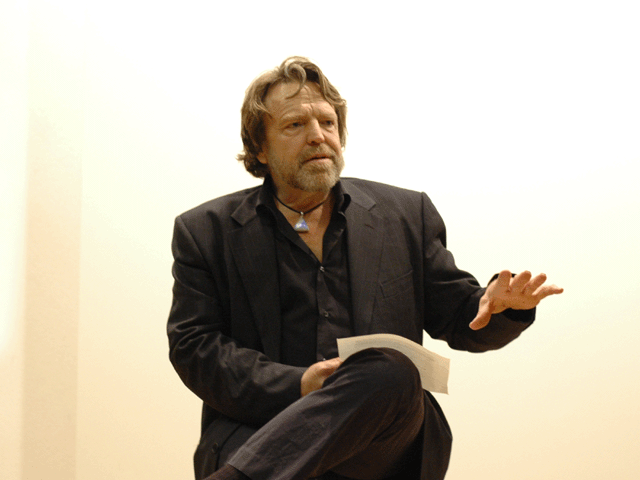
Image by the European Graduate School, via Wikimedia Commons
The most successful outlaws live by a code, and in many ways John Perry Barlow, founder of the Electronic Freedom Foundation, Wyoming rancher, and erstwhile songwriter for the Grateful Dead—who died on Wednesday at the age of 70—was an archetypal American outlaw all of his life. He might have worn a white hat, so to speak, but he had no use for the government telling him what to do. And his charismatic defense of unfettered internet liberty inspired a new generation of hackers and activists, including a 12-year-old Aaron Swartz, who saw Barlow speak at his middle school and left the classroom changed.
Few people get to leave as lasting a legacy as Barlow, even had he not pioneered early cyberculture, penning the “Declaration of Independence of the Internet,” a techo-utopian document that continues to influence proponents of open access and free information. He introduced the Grateful Dead to Dr. Timothy Leary, under whose guidance Barlow began experimenting with LSD in college. His creative and personal relationship with the Dead’s Bob Weir stretches back to their high school days in Colorado, and he became an unofficial member of the band and its “junior lyricist,” as he put it (after Robert Hunter).
“John had a way of taking life’s most difficult things and framing them as challenges, therefore adventures,” wrote Weir in a succinctly poignant Twitter eulogy for his friend. We might think of Barlow’s code, which he laid out in a list he called the “25 Principles of Adult Behavior,” as a series of instructions for turning life’s difficulties into challenges, an adventurous reframing of what it means to grow up. For Barlow, that meant defying authority when it imposed arbitrary barriers and proprietary rules on the once-wild-open spaces of the internet.
But being a grown-up also meant accepting full responsibility for one’s behavior, life’s purpose, and the ethical treatment of oneself and others. See his list below, notable not so much for its originality but for its plainspoken reminder of the simple, shared wisdom that gets drowned in the assaultive noise of modern life. Such uncomplicated idealism was at the center of Perry’s life and work.
1. Be patient. No matter what.
2. Don’t badmouth: Assign responsibility, not blame. Say nothing of another you wouldn’t say to him.
3. Never assume the motives of others are, to them, less noble than yours are to you.
4. Expand your sense of the possible.
5. Don’t trouble yourself with matters you truly cannot change.
6. Expect no more of anyone than you can deliver yourself.
7. Tolerate ambiguity.
8. Laugh at yourself frequently.
9. Concern yourself with what is right rather than who is right.
10. Never forget that, no matter how certain, you might be wrong.
11. Give up blood sports.
12. Remember that your life belongs to others as well. Don’t risk it frivolously.
13. Never lie to anyone for any reason. (Lies of omission are sometimes exempt.)
14. Learn the needs of those around you and respect them.
15. Avoid the pursuit of happiness. Seek to define your mission and pursue that.
16. Reduce your use of the first personal pronoun.
17. Praise at least as often as you disparage.
18. Admit your errors freely and soon.
19. Become less suspicious of joy.
20. Understand humility.
21. Remember that love forgives everything.
22. Foster dignity.
23. Live memorably.
24. Love yourself.
25. Endure.
Barlow the “cowboy, poet, romantic, family man, philosopher, and ultimately, the bard of the digital revolution”—as Stephen Levy describes him at Wired—“became a great explainer” of the possibilities inherent in new media. He watched the internet become a far darker place than it had ever been in the 90s, a place where governments conduct cyberwars and impose censorship and barriers to access; where bad actors of all kinds manipulate, threaten, and intimidate.
But Barlow stood by his vision, of “a world that all may enter without privilege or prejudice accorded by race, economic power, military force, or station of birth… a world where anyone, anywhere may express his or her beliefs, no matter how singular, without fear of being coerced into silence or conformity.”
This may sound naïve, yet as Cindy Cohn writes in EFF’s obituary for its founder, Barlow “knew that new technology could create and empower evil as much as it could create and empower good. He made a conscious decision to move toward the latter.” His 25-point code urges us to do the same.
via Kottke/Hacker News
Related Content:
Alejandro Jodorowsky’s 82 Commandments For Living
Josh Jones is a writer and musician based in Durham, NC. Follow him at @jdmagness
Read More...Understanding Pink Floyd’s Wish You Were Here, Their Tribute to Departed Bandmate Syd Barrett
Since Dark Side of the Moon, the members of Pink Floyd dealt in various ways with the fate of their original singer Syd Barrett. As Roger Waters said about the band in 1975, “It couldn’t have happened without him, but on the other hand, it couldn’t have gone on with him.” On Dark Side of the Moon, Barrett is not directly addressed, but the themes of madness swirl through the various big statement songs and in the various quotes from friends and roadies peppered throughout the mix. Later on, The Wall would bring listeners a main character who goes mad and shuts himself up in isolation externally and internally. Echoes of Syd are everywhere.
And right in the middle of that stretch is Wish You Were Here, both a direct tribute to Syd Barrett and a caustic musing on the music business. The latter both negatively affected the band at the time and, in some way, accelerated Syd’s decline into (most probably) schizophrenia.
YouTube channel Polyphonic’s eight-minute overview of the album will introduce casual listeners to the story behind the making of the album, and the lyrics that specifically applied to Syd. “You were caught in the crossfire of childhood and stardom” is one of many eulogies to their friend, the “crazy diamond” of the suite of songs that bookend the album.
The video, which includes clips from the BBC documentary on the making of the album currently streaming in various venues (don’t blame us for the particular poor quality of this clip, especially the subtitles), also mentions a visit that Barrett made to the Abbey Road Studio. Bald, eyebrows shaved, and overweight, the man was unrecognizable compared to the svelte, darkly handsome lead singer they had known only a few years’ earlier. It’s an emotional moment that only adds to the impact of this ghostly and melancholic album.
Related Content:
Neil deGrasse Tyson: “Because of Pink Floyd, I’ve Spent Decades Undoing the Idea That There’s a Dark Side of the Moon”
Hear Lost Recording of Pink Floyd Playing with Jazz Violinist Stéphane Grappelli on “Wish You Were Here”
Ted Mills is a freelance writer on the arts who currently hosts the artist interview-based FunkZone Podcast and is the producer of KCRW’s Curious Coast. You can also follow him on Twitter at @tedmills, read his other arts writing at tedmills.com and/or watch his films here.
Read More...Virginia Woolf’s Personal Photo Album Digitized & Put Online by Harvard: See Candid Snapshots of Woolf, Her Family, and Friends from the Bloomsbury Group

Some writers are restless by nature, roaming like Ernest Hemingway or Henry Miller, settling nowhere and everywhere. Others are homebodies, like William Faulkner and Virginia Woolf. Their fiction reflects their desire to nest in place. Strolling the grounds of Faulkner’s Rowan Oak one sweltering summer, I swear I saw the author round a corner of the house, lost in thought and wearing riding clothes. Visitors to Virginia Woolf’s home in the village of Rodmell in East Sussex have surely had similar visions.
Woolf’s home contains her writing life within the lush garden grounds and cottage walls of the 17th century Monk’s House—Virginia and Leonard’s retreat, then permanent home, from 1919 until her suicide by drowning in the nearby River Ouse in 1941.
Even in death she belonged to the house; Leonard buried her ashes beneath an elm in the Monk’s House garden. Although Leonard was the gardener, “there are very few entries” in Virginia’s diary “which do not mention the garden.”
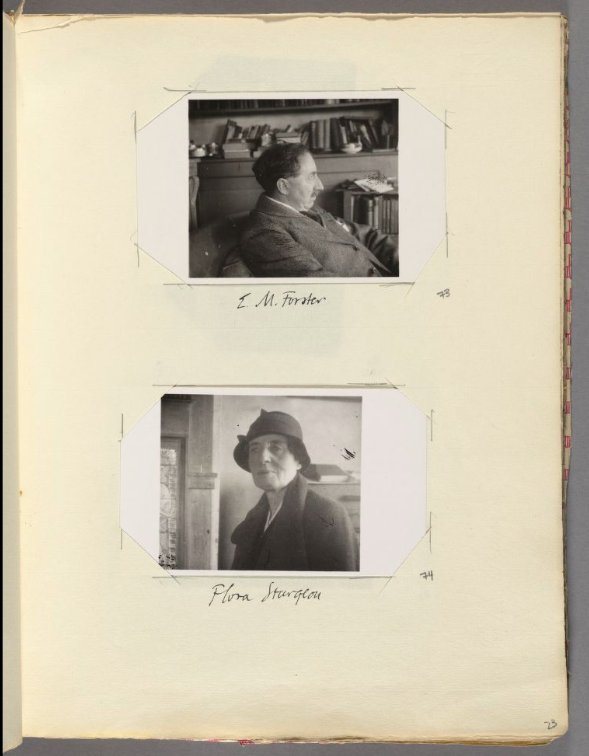
But there are many other ways to meet the author of Mrs. Dalloway and Jacob’s Room than traveling to her writer’s lodge, a tidy, tiny house on the Monk’s House grounds that served as her office. Like an avid Instragrammer—or like my mother and probably yours—Woolf kept careful record of her life in photo albums, which now reside at Harvard’s Houghton Library. The Monk’s House albums, numbered 1–6, contain images of Woolf, her family, and her many friends, including such famous members of the Bloomsbury group as E.M. Forster (above, top), John Maynard Keynes, and Lytton Strachey (below, with Woolf and W.B. Yeats, and playing chess with sister Marjorie). Harvard has digitized one album, Monk’s House 4, dated 1939 on the cover. You can view its scanned pages at their library site.
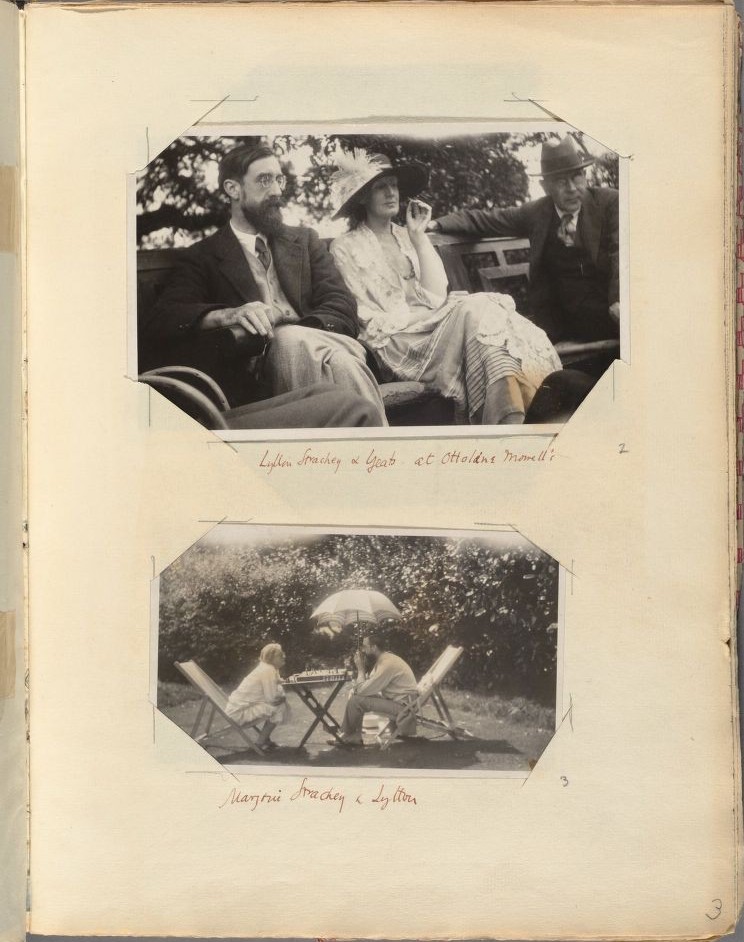
There are vacation photos and family photos; landscapes and photos of pets; clippings from newspapers and magazines; and, of course, the garden. The albums span the period 1890 to 1947 (including additions by Leonard after Virginia’s death). Many of the photos are labeled, many are not. Many of the albums’ pages are left blank. The photographs are arranged in no particular order. The net effect is that of a life recollected in pregnant images laced with lacunae, a psychological theme of so much of Woolf’s writing. Woolf, writes Maggie Humm, “believed that photographs could help her to survive those identity-destroying moments of her own life—her incoherent illnesses.”
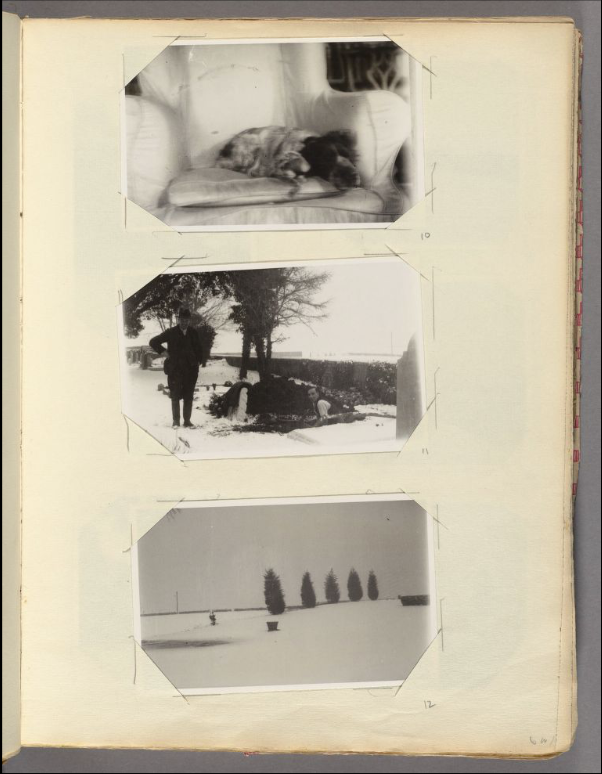
But photography was also a means for cultivating relationships. Woolf “skillfully transformed friends and moments into artful tableaux, and she was surrounded by female friends and family who were also energetic photographers,” including her sister, Lady Ottoline Morrell, her friend and lover Vita Sackville-West, and her great aunt Julia Margaret Cameron. She “frequently invited friends to share her reflections. The letters and diaries describe a constant exchange of photographs, in which the photographs become a meeting-place, a conversation, aide-mémoires, and sometimes mechanisms of survival and enticement.”
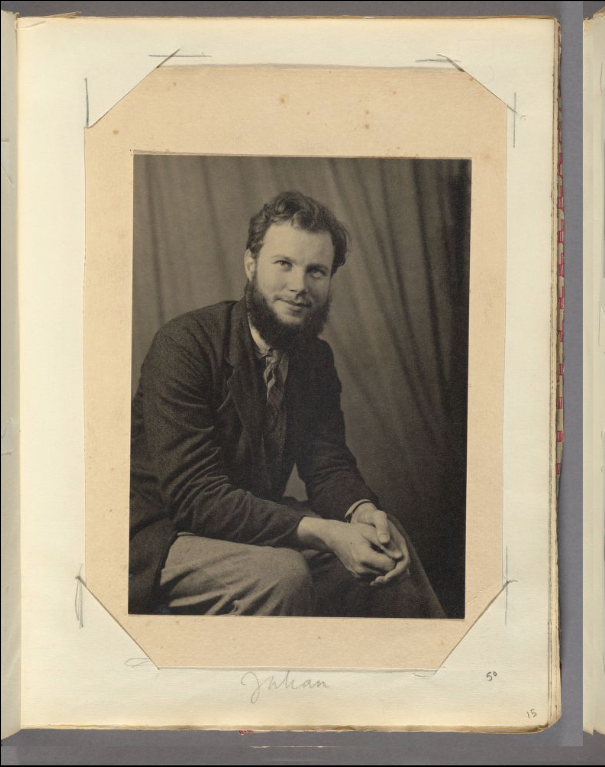
Unlike Monk’s House, a world built and shared with her husband, Woolf’s albums represent her own personal network of relationships. They serve as memorials and meditations after the deaths of those close to her. “Photographs of friends were important memento mori,” such as the portrait of poet Julian Bell, above, her nephew, who was killed in the Spanish Civil War. The photos document gatherings and important life events among her social circle. They perform all the tasks of ordinary photo albums, and more—showing us the “chain of perceptions” of which personal identity is made in Woolf’s modernist vision, with repetitions and sequences centered around familiar objects like her favorite chair.
For fans, avid readers, critics, and literary historians, the photographs provide a visual record of a life we come to know so well through the letters, diaries, and romans à clef. Writing to her sister, Woolf once described painting a portrait “using dozens of snapshots in the paint.” Visit her photo album here at the Harvard Library site, and flip through the pages of her life in snapshots.
Related Content:
An Animated Introduction to Virginia Woolf
The Steamy Love Letters of Virginia Woolf and Vita Sackville-West (1925–1929)
Why Should We Read Virginia Woolf? A TED-Ed Animation Makes the Case
Josh Jones is a writer and musician based in Durham, NC. Follow him at @jdmagness
Read More...H.P. Lovecraft’s Poem “Nemesis” Gets Unexpectedly Sung to the Tune of Billy Joel’s “Piano Man”
“The internet made me do it,” says musician Julian Velard. For whatever reason, it made him take H.P Lovecraft’s 1917 poem “Nemesis” and mash it up with Billy Joel’s “Piano Man.” Find the original poem below. But know Velard “had to cut a couple lines to get it to fit.” Enjoy.
Thro’ the ghoul-guarded gateways of slumber,
Past the wan-moon’d abysses of night,
I have liv’d o’er my lives without number,
I have sounded all things with my sight;
And I struggle and shriek ere the daybreak, being driven to madness with fright.
I have whirl’d with the earth at the dawning,
When the sky was a vaporous flame;
I have seen the dark universe yawning,
Where the black planets roll without aim;
Where they roll in their horror unheeded, without knowledge or lustre or name.
I had drifted o’er seas without ending,
Under sinister grey-clouded skies
That the many-fork’d lightning is rending,
That resound with hysterical cries;
With the moans of invisible daemons that out of the green waters rise.
I have plung’d like a deer thro’ the arches
Of the hoary primordial grove,
Where the oaks feel the presence that marches
And stalks on where no spirit dares rove;
And I flee from a thing that surrounds me, and leers thro’ dead branches above.
I have stumbled by cave-ridden mountains
That rise barren and bleak from the plain,
I have drunk of the fog-foetid fountains
That ooze down to the marsh and the main;
And in hot cursed tarns I have seen things I care not to gaze on again.
I have scann’d the vast ivy-clad palace,
I have trod its untenanted hall,
Where the moon writhing up from the valleys
Shews the tapestried things on the wall;
Strange figures discordantly woven, which I cannot endure to recall.
I have peer’d from the casement in wonder
At the mouldering meadows around,
At the many-roof’d village laid under
The curse of a grave-girdled ground;
And from rows of white urn-carven marble I listen intently for sound.
I have haunted the tombs of the ages,
I have flown on the pinions of fear
Where the smoke-belching Erebus rages,
Where the jokulls loom snow-clad and drear:
And in realms where the sun of the desert consumes what it never can cheer.
I was old when the Pharaohs first mounted
The jewel-deck’d throne by the Nile;
I was old in those epochs uncounted
When I, and I only, was vile;
And Man, yet untainted and happy, dwelt in bliss on the far Arctic isle.
Oh, great was the sin of my spirit,
And great is the reach of its doom;
Not the pity of Heaven can cheer it,
Nor can respite be found in the tomb:
Down the infinite aeons come beating the wings of unmerciful gloom.
Thro’ the ghoul-guarded gateways of slumber,
Past the wan-moon’d abysses of night,
I have liv’d o’er my lives without number,
I have sounded all things with my sight;
And I struggle and shriek ere the daybreak, being driven to madness with fright.
Related Content:
H.P. Lovecraft Gives Five Tips for Writing a Horror Story, or Any Piece of “Weird Fiction”
Lovecraft: Fear of the Unknown (Free Documentary)
Read More...When Japan’s Top Animators Made a Thrilling Cyberpunk Commercial for Irish Beer: Watch Last Orders (1997)
When it came out in 1995, Mamoru Oshii’s Ghost in the Shell showed the world what the art of Japanese animation could do with the kind of gritty, tech-saturated, globalized cyberpunk visions popularized in the previous decade by William Gibson and other writers. The film’s particularly successful release in the United Kingdom got some culturally savvy marketers in Ireland thinking: why not use this sort of thing to sell beer?
But rather than ripping it off and watering it down — all too par for the course in advertising — they hired animators straight from Production I.G., Ghost in the Shell’s studio, to create a whole new animated cyberpunk reality, the one in which Last Orders, the minute-long spot above, takes place. The 1997 commercial tells the story of six samurai rushing through a cityscape that has everything we’ve now come to expect from this genre: forests of high-rises, bustling streets, mysterious women, artificial humanoids, the technological everywhere merged with the organic, and neon signs aplenty.
The samurai converge on their destination, a tavern, just in time to silently but firmly signal their demand for their drink of choice: Murphy’s Irish Stout, a Heineken-distributed brew offered as a lighter, less bitter alternative to the market-dominating Guinness. But no matter of the steely determination of the samurai in Last Orders, the first anime-style commercial ever to air in the UK and Ireland, it seems that one challenges such an iconic brand at one’s peril: Murphy’s currently has only a five-percent share of the Irish stout market, and that mostly thanks to a 28-percent share in its native Cork.
The Japanese animators who worked on the commercial have fared rather better, going on to, among many other respected projects, Blood: The Last Vampire and Jin-Roh: The Wolf Brigade. Though I’ve never encountered Murphy’s on any tap, I’d gladly watch a movie or even an entire series set in its world. The stout market, the mighty Guinness included, may have been on the decline in recent years, but cyberpunk, in our own ever more globalized and tech-saturated reality, seems about due for a comeback.
via Kotaku
Related Content:
Watch a New Star Wars Animation, Drawn in a Classic 80s Japanese Anime Style
The Art of Hand-Drawn Japanese Anime: A Deep Study of How Katsuhiro Otomo’s Akira Uses Light
Based in Seoul, Colin Marshall writes and broadcasts on cities and culture. His projects include the book The Stateless City: a Walk through 21st-Century Los Angeles and the video series The City in Cinema. Follow him on Twitter at @colinmarshall or on Facebook.
Read More...The Largest Early Map of the World Gets Assembled for the First Time: See the Huge, Detailed & Fantastical World Map from 1587
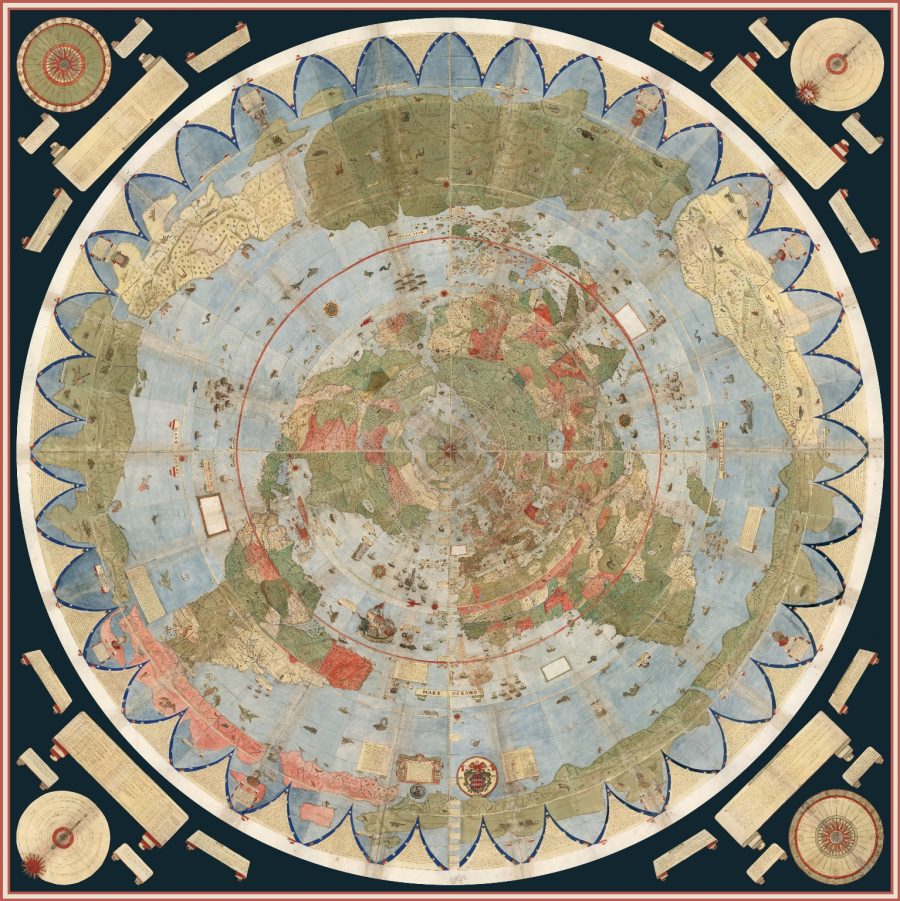
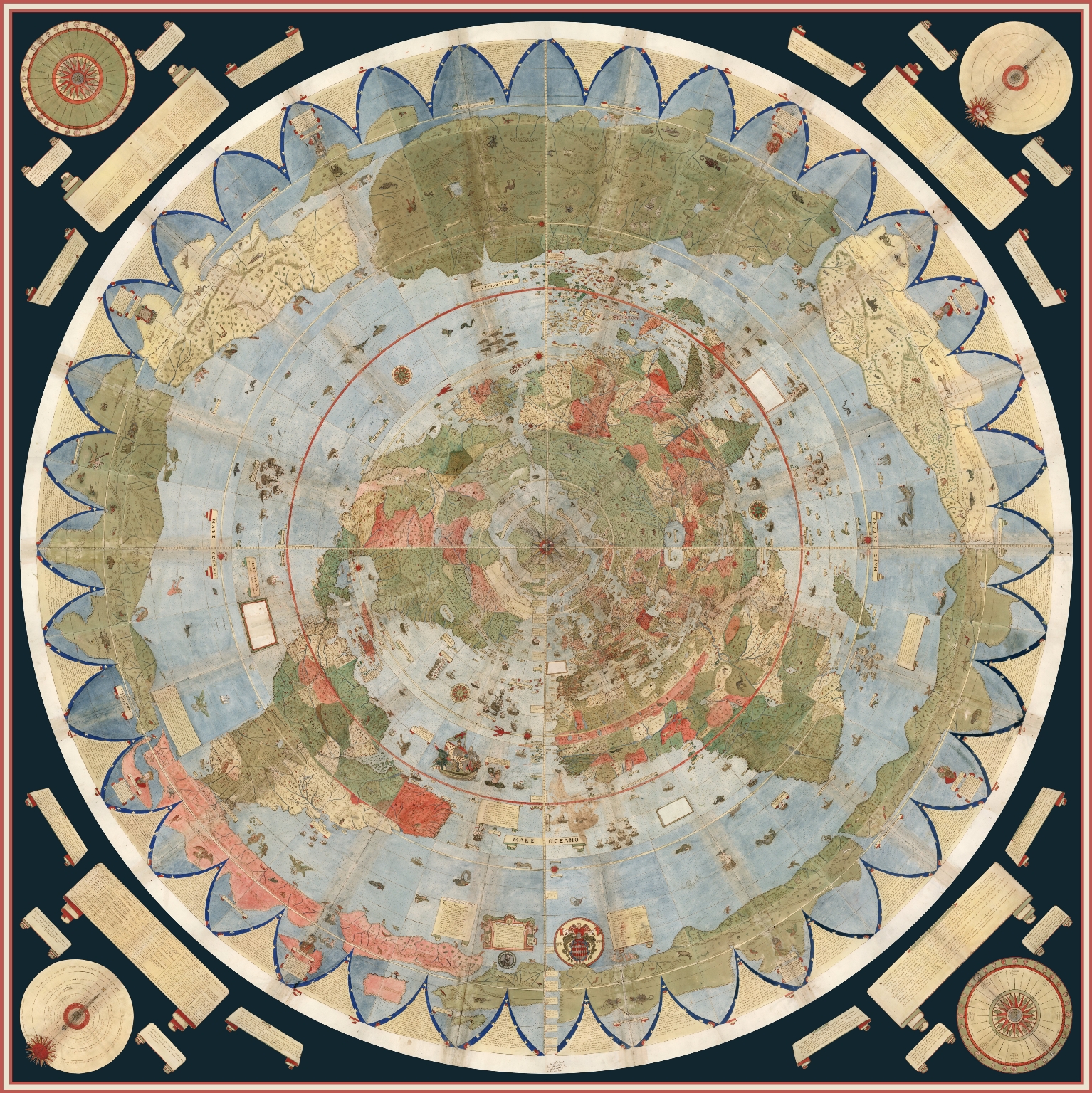
We in the early 21st century can call up detailed maps of almost any place on Earth with little more effort than typing its name. Most of us can dimly recall a time when it wasn’t quite so easy, but imagine trying to satisfy your geographical curiosity in not just decades but centuries past. For the 16th-century Milanese gentleman scholar Urbano Monte, figuring out what the whole world looked like turned into an enormous project, in terms of both effort and sheer size. In 1587, he created his “planisphere” map as a 60-page manuscript, and only now have researchers assembled it into a single piece, ten feet square, the largest known early map of the world. View it above, or in a larger format here.
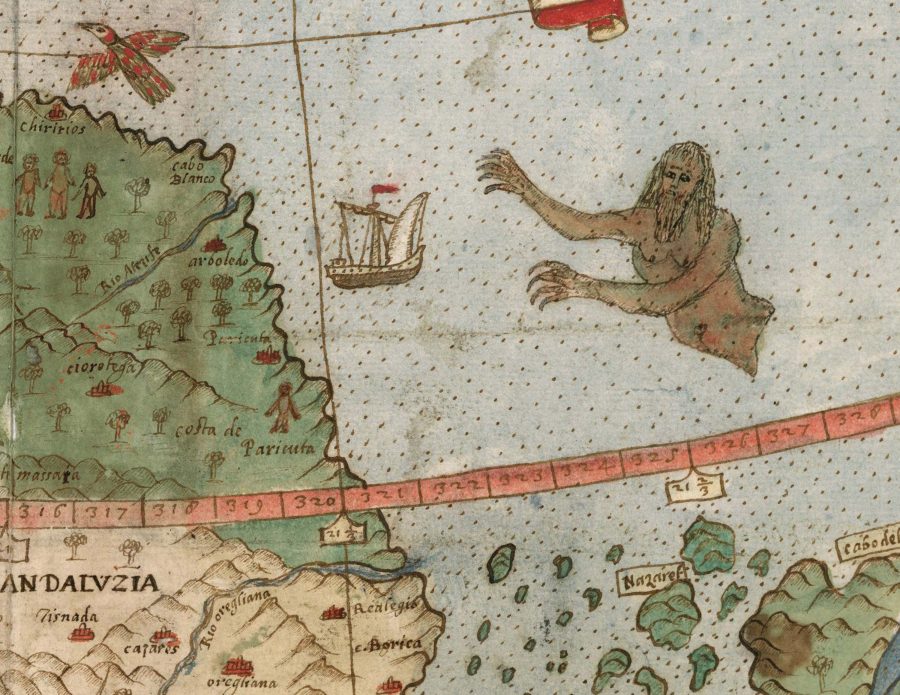
“Monte appears to have been quite geo-savvy for his day,” writes National Geographic’s Greg Miller, noting that “he included recent discoveries of his time, such as the islands of Tierra del Fuego at the tip of South America, first sighted by the Portuguese explorer Ferdinand Magellan in 1520,” as well as an uncommonly detailed Japan based on information gathered from a visit with the first official Japanese delegation to Europe in 1585.
And in accordance with the mapmaking style of the time, he got more fanciful in the less-understood spaces: “Animals roam the land, and his oceans teem with ships and monsters. King Philip II of Spain rides what looks like a floating throne off the coast of South America, a nod to Spanish prominence on the high seas.”
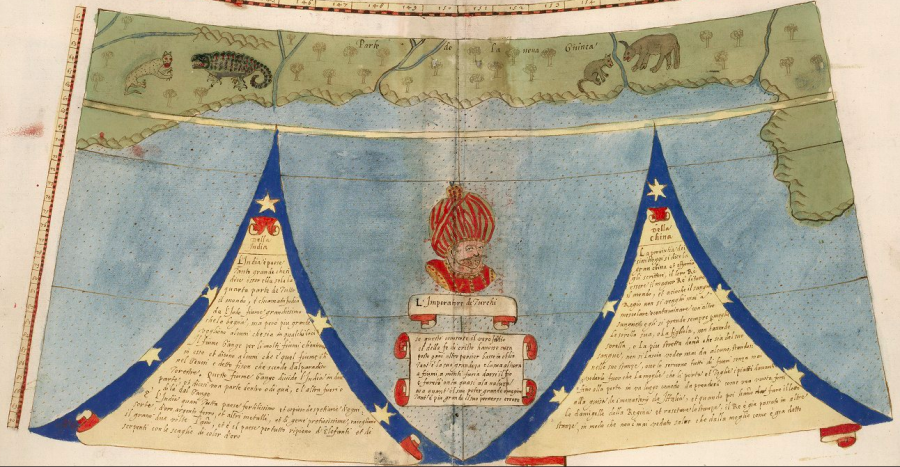
“Monte’s map reminds us of why historical maps are so important as primary resources,” says Stanford University’s David Rumsey Map Collection, which holds one of only three extant versions of the map and which conducted the digital project of scanning each of its pages and assembling them into a whole. Not only does its then-unusual (but now long standard in aviation) north polar azimuthal projection show Monte’s use of “the advanced scientific ideas of his time,” but the “the artistry in drawing and decorating the map embodies design at the highest level; and the view of the world then gives us a deep historical resource with the listing of places, the shape of spaces, and the commentary interwoven into the map.”
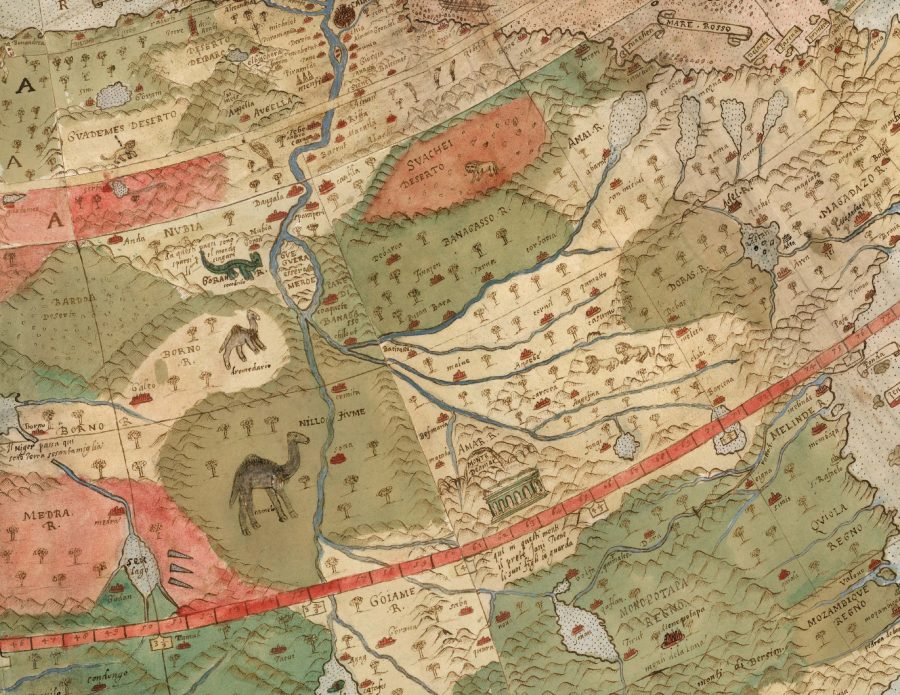
You can see/download Monte’s planisphere in detail at the David Rumsey Map Collection, both as a collection of individual pages and as a fully assembled world map. There you can also read, in PDF form, cartographic historian Dr. Katherine Parker’s “A Mind at Work: Urbano Monte’s 60-Sheet Manuscript World Map.” And to bring this marvel of 16th-century cartography around to a connection with a marvel of 21st-century cartography, they’ve also taken Monte’s planisphere and made it into a three-dimensional model in Google Earth, a mapping tool that Monte could scarcely have imagined — even though, as a close look at his work reveals, he certainly didn’t lack imagination.
via Hyperallergic
Related Content:
The History of Cartography, the “Most Ambitious Overview of Map Making Ever,” Now Free Online
Japanese Designers May Have Created the Most Accurate Map of Our World: See the AuthaGraph
Watch the History of the World Unfold on an Animated Map: From 200,000 BCE to Today
Based in Seoul, Colin Marshall writes and broadcasts on cities and culture. His projects include the book The Stateless City: a Walk through 21st-Century Los Angeles and the video series The City in Cinema. Follow him on Twitter at @colinmarshall or on Facebook.
Read More...Coursera and Google Launch an Online Certificate Program to Help Students Become IT Professionals & Get Attractive Jobs
If you’ve so much as set foot in the realm of massive online open courses (MOOCs) — a list of which we offer right here on Open Culture — you’ve no doubt heard of Coursera, which, since it started up in 2012, has become one of the biggest MOOC providers around. Like most growing Silicon Valley companies, Coursera has branched out in several different directions, bringing in courses from universities from all over the world as well as offering certificate and Master’s programs. Now, in partnership with Google, it has launched a program to train information-technology professionals for jobs in the industry.
Techcrunch’s Ingrid Lunden describes Coursera’s Google IT Support Professional Certificate program as “a course written by Googlers for the Coursera platform to teach and then test across six fundamental areas of customer support: troubleshooting and customer service, networking, operating systems, system administration, automation, and security. No prior IT experience is necessary.” The global, English-language program “has 64 hours of coursework in all, and students are expected to complete it in eight to 12 months, at a cost of $49/month.” This means “the typical cost of the course for full-paying students will be between $392 and $588 depending on how long it takes,” which Lunden calls “a pretty good deal” compared to other IT training programs.
Amid talk of vanishing jobs across so many sectors of the economy, Coursera and Google are marketing the IT Support Professional Certificate as a promising path to gainful employment: “There’s no better example of a dynamic, fast-growing field than IT support,” writes Google Product Lead Natalie Van Kleef Conley, citing statistics showing 150,000 IT support jobs currently open in the United states and an average starting salary of $52,000. Coursera notes that “upon completion of the certificate, you can share your information with top employers, like Bank of America, Walmart, Sprint, GE Digital, PNC Bank, Infosys, TEKSystems, UPMC, and, of course, Google.”
If you suspect that you might share professional aspirations with young Edgar Barragan of Queens, whose testimonial video shows how he became a Google IT support specialist after participating in the program that evolved into the IT Support Professional Certificate, visit the official page on Coursera. There you can read up on the details of the six courses that make up the program and read answers to the questions frequently asked about it. Do you think you’d excel in a career amid the nuts and bolts of computers? With Google and Coursera’s program officially opening next Wednesday, January 24th, now’s a good time indeed to figure out whether it could get you where you want to be. Get more information and/or enroll here.
Note: Open Culture has a partnership with Coursera. If readers enroll in certain Coursera courses, it helps support Open Culture.
Related Content:
Based in Seoul, Colin Marshall writes and broadcasts on cities and culture. His projects include the book The Stateless City: a Walk through 21st-Century Los Angeles and the video series The City in Cinema. Follow him on Twitter at @colinmarshall or on Facebook.
Read More...An Animated Introduction to Friedrich Nietzsche’s Philosophical Recipe for Getting Over the Sources of Regret, Disappointment and Suffering in Our Lives
The idea of acceptance has found much, well… acceptance in our therapeutic culture, by way of Elisabeth Kübler-Ross’ five stages of grief, 12-step programs, the wave of secular mindfulness practices, the body-acceptance movement, etc. All of these interventions into depressed, bereaved, guilt-ridden, and/or anxious states of mind have their own aims and methods, which sometimes overlap, sometimes do not. But what they all share, perhaps, for all the struggle involved, is a general sense of optimism about acceptance.
One cannot say this definitively about the Stoic idea of amor fati—the instruction to “love one’s fate”—though you might be persuaded to think otherwise if you google the term and come up with a couple dozen popularizations. Yes, there’s love in the name, but the fate we’re asked to embrace may just as well be painful and debilitating as pleasurable and uplifting. We cannot change what has happened to us, or much control what’s going to happen, so we might as well just get used to it, so to speak.
If this isn’t exactly optimism in the sense of “it gets better,” it isn’t entirely pessimism either. But it can become a grim and joyless fatalistic exercise. Yet, as Friedrich Nietzsche used the term—and he used it with much relish—amor fati means not only accepting loss, suffering, mistakes, addictions, appearances, or mental and emotional turbulence; it means accepting all of it—everything and everyone that causes both pain and pleasure, as Alain de Botton says above, “with strength and an all-embracing attitude that borders on a kind of enthusiastic affection.”
“I do not want to wage war against what is ugly,” he wrote in The Gay Science, “I do not want to accuse; I do not even want to accuse those who accuse.” Readers of Nietzsche may find themselves picking up any one of his books, including The Gay Science, to see him doing all of the above, constantly, on any random page. But his is never a systematic philosophy, but an expression of passion and attitude, inconsistent in its parts but, as a whole, surprisingly holistic. “My formula for greatness in a human being,” he writes in Ecce Homo, “is amor fati”
That one wants nothing to be different, not forward, not backward, not in all eternity. Not merely bear what is necessary, still less conceal it… but love it.
Although the concept may remind us of Stoic philosophy, and is very often discussed in those terms, Nietzsche saw such thought—as he understood it—as gloomy, ascetic, and life-denying. His use of amor fati goes beyond mere resignation to something more radical, and very difficult for the human mind to stomach, to use a somewhat Nietzschean figure of speech. “It encompasses the whole of world history (including the most horrific episodes),” notes a Leiden University summary, “and Nietzsche’s own role in this history.” Above all, he desired, he wrote, to be a “Yes-sayer.”
Is amor fati a remedy for regret, dissatisfaction, the endlessly restless desire for social and self-improvement? Can it banish our agony over history’s nightmares and our personal records of failure? De Botton thinks so, but one never really knows with Nietzsche—his often satirical exaggerations can turn themselves inside out, becoming exactly the opposite of what we expect. Yet above all, what he always turns away from are absolute ideals; we should never take his amor fati as some kind of divine commandment. It works in dialectical relation to his more vigorous critical spirit, and should be applied with a situational and pragmatic eye. In this sense, amor fati can be seen as instrumental—a tool to bring us out of the paralysis of despair and condemnation and into an active realm, guided by a radically loving embrace of it all.
Related Content:
The Philosophy of “Optimistic Nihilism,” Or How to Find Purpose in a Meaningless Universe
The Digital Nietzsche: Download Nietzsche’s Major Works as Free eBooks
Josh Jones is a writer and musician based in Durham, NC. Follow him at @jdmagness
Read More...Support Us
We're hoping to rely on loyal readers, rather than erratic ads. Please click the Donate button and support Open Culture. You can use Paypal, Venmo, Patreon, even Crypto! We thank you!

About Us

Open Culture scours the web for the best educational media. We find the free courses and audio books you need, the language lessons & educational videos you want, and plenty of enlightenment in between.
Advertise With Us

FREE UPDATES!
GET OUR DAILY EMAIL
Get the best cultural and educational resources on the web curated for you in a daily email. We never spam. Unsubscribe at any time.
FOLLOW ON SOCIAL MEDIA

Open Culture editor Dan Colman scours the web for the best educational media. He finds the free courses and audio books you need, the language lessons & movies you want, and plenty of enlightenment in between.
Advertise With Us