Mark Linsenmayer, Erica Spyres, and Brian Hirt examine the conventions, techniques, and staying power of the beloved ’90s sitcom. Are we supposed to identify with, or idolize, or merely like these people? What makes the formula work, did it sustain itself over its 10-year run, was it successfully replicated (like by How I Met Your Mother or by Chuck Lorre?), and what parts haven’t aged well?
We reviewed a ton of articles to prep for this that you may want to read:
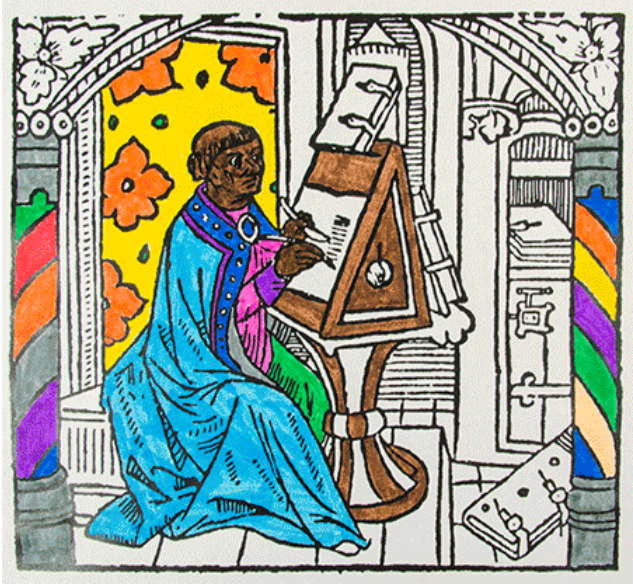
It may never lend a catchy title to a steamy TV hospital drama, but Avicenna’s 11th-century Canon of Medicine has the distinction of being “the most famous medical textbook ever written.” It has remained, as William Osler wrote in a 1918 Yale lecture, “a medical bible for a longer time than any other work.” Completed in 1025, the compendium drew Greek, Roman, Arabic, Indian, and Chinese medical science together in five dense volumes of material informed by the theories of Galen and structured by the systematic philosophy of Aristotle, whom Avicenna (Abū-ʿAlī al-Ḥusayn ibn-ʿAbdallāh Ibn-Sīnā) called “The First Teacher.”
Translated into Latin in the 12th century and “often revised,” the Canon, notes the Stanford Encyclopedia of Philosophy, “formed the basis of medical instruction in European Universities until the 17th century.” A copy of excerpts from the text has even been found translated into 15th-century Irish, demonstrating a link between medieval Ireland and the Islamic world. Avicenna’s influence generally on the intellectual culture of medieval and early modern Europe and the Arab-speaking world can hardly be overstated.
Born in 980 A.D., the Persian philosopher and physician was instrumental in the recovery of Hellenic thought, first in the Islamic world, then later in Europe. He took to the study of medicine very early in his extraordinary career. “I became proficient in it in the shortest time,” he says, “until the excellent scholars of medicine began to study under me.” He also became a practicing physician, inspired by a desire to put his learning to the test. “Through my experiences I acquired an amazing practical knowledge and ability in methods of treatment.”
The practical knowledge in The Canon of Medicine was largely the basis for its continued use for centuries. It lays out rules for drug testing, which include an insistence on human trials and the importance of conducting multiple experiments and showing consistent results across cases. Like most classical scientific texts, it weaves empirical observation with metaphysics, theology, scholastic speculation, and cultural biases particular to its time and place. But the practical outlines of its medical knowledge transcend its archaisms.
The work presents “an integrated view of surgery and medicine,” notes the Journal of the Royal Society of Medicine. In addition to his imminently useful guide for assessing the effects of drugs, Ibn Sina tells his readers “how to judge the margin of healthy tissue to remove with an amputation,” an intervention that has saved countless numbers of lives. “The enduring respect in the 21st century for a book written a millennium earlier is testimony to Ibn Sina’s achievement.”
One of the defining features of the text is its insistence on the practice of medicine as a systematic scientific pursuit of equal merit to the theorizing of it:
Someone might say to us that medicine is divided into theoretical and practical parts and that, by calling it a science, we have considered it as being all theoretical. To this we respond by saying that some arts and philosophy have theoretical and practical parts, and medicine, too, has its theoretical and practical parts. The division into theoretical and practical parts differs from case to case, but we need not discuss these divisions in disciplines other than medicine. If it is said that some parts of medicine are theoretical and other parts are practical, this does not mean that one part teaches medicine and the other puts it into practice – as many researchers in this subject believe. One should be aware that the intention is something else: it is that both parts of medicine are science, but one part is the science dealing with the principles of medicine, and the other with how to put those principles into practice.
Of course, much of the medical theory in the Canon has been disproven, but it remains of keen interest to students of the history of medicine and of European and Islamic intellectual cultural history more generally. Avicenna towers above his contemporaries, yet his work also bears witness to the larger “intellectual climate of his time,” as the site Medical History Tour points out. He emerged from a milieu “shaped by centuries of translation and cross-cultural scholarship” of Greek, Roman, Indian, Chinese, Persian, and Arabic literature. “A rich Persian medical tradition began 200 years before Avicenna.”
Nonetheless, “however the world came by the genius of Avicenna, his influence was lasting,” with The Canon of Medicine remaining a definitive “best practices” guide to medicine for centuries after its composition. See full scans of several Arabic copies of the text at the Library of Congress’s World Digital Library and read a full English translation of the massive 5‑volume work, with its extensive chapters on definitions, anatomy, etiology, and treatments, at the Internet Archive.
“With its newspapers in every language and scores of radio stations, Shanghai was a media city before its time, celebrated as the Paris of the Orient and ‘the wickedest city in the world.’ ” So British writer J.G. Ballard remembers the Chinese metropolis in which he grew up in his autobiography Miracles of Life. “Shanghai struck me as a magical place, a self-generating fantasy that left my own little mind far behind.” Born in 1930, Ballard caught Shanghai at a particularly stimulating time: “Developed on the basis of ‘unequal treaties’ successively instituted after the First Opium War in 1842,” writes MIT’s John A. Crespi, Chinese port cities like Shanghai “experienced a welter of technological and demographic changes,” including automobiles, skyscrapers, rolled cigarettes, movie theaters coffeehouses, and much else besides.
Such heady days also gave rise to media that reflected and critiqued them, and 1930s Shanghai produced no more compelling an example of such a publication than Modern Sketch (时代漫画, Shídài Mànhuà).
Among its points of interest, writes Crespi, “one can point to Modern Sketch’s longevity, the quality of its printing, the remarkable eclecticism of its content, and its inclusion of work by young artists who went on to become leaders in China’s 20th-century cultural establishment. But from today’s perspective, most intriguing is the sheer imagistic force with which this magazine captures the crises and contradictions that have defined China’s 20th century as a quintessentially modern era.”
Published monthly from January 1934 through June 1937, the magazine first appeared on newsstands just over two decades after the collapse of China’s dynastic system. The modernization-minded May Fourth Movement, nationalist Northern Expedition, and purge of communists by “Generalissimo” Chiang Kai-shek were even more recent memories.
But the relative stability of the “Nanjing Decade” had begun in 1927, and its zeitgeist turned out to be rich soil for a wild cultural flowering in China’s coastal cities, none wilder than in Shanghai. To the reading public of this time Modern Sketch offered treatments of material like “eroticized women, foreign aggression — particularly the rise of fascism in Europe and militarized Japan — domestic politics and exploitation, and modernity-at-large,” writes Crespi.
The magazine’s attitude “could be incisive, bitter, shocking, and cynical. At the very same time it could be elegant, salacious, and preposterous. Its messages might be as simple as child’s play, or cryptically encoded for cultural sophisticates.”
Sometimes it didn’t encode its messages cryptically enough: as a result of one unflattering depiction of Xu Shiying, China’s ambassador to Japan, the authorities suspended publication and detained editor Lu Shaofei. Not that Lu didn’t know what he was getting into with Modern Sketch: “On all sides a tense era surrounds us,” he wrote in the magazine’s inaugural issue. “As it is for the individual, so it is for our country and the world.”
As for an answer to the question of whether the strange and tense but enormously fruitful cultural and political moment in which Lu and his collaborators found themselves wold last, “the more one fails to find it, the more that desire grows. Our stance, our single responsibility, then, is to strive!”
You can read more about what project entailed, and see in greater detail its textual and visual results, in Crespi’s history of this magazine that strove to capture the everyday reality of life on display in 1930s Shanghai — “though I sometimes wonder,” Ballard writes, “if everyday reality was the one element missing from the city.”
Based in Seoul, Colin Marshall writes and broadcasts on cities, language, and culture. His projects include the book The Stateless City: a Walk through 21st-Century Los Angeles and the video series The City in Cinema. Follow him on Twitter at @colinmarshall or on Facebook.
There are few filmmakers alive today who have the mystique of Werner Herzog. His feature films and his documentaries are brilliant and messy, depicting both the ecstasies and the agonies of life in a chaotic and fundamentally hostile universe. And his movies seem very much to reflect his personality – uncompromising, enigmatic and quite possibly crazy. How else can you explain his willingness to risk life and limb to shoot in such forbidding places as the Amazonian rain forest or Antarctica?
In perhaps his greatest film, Fitzcarraldo — which is about a dreamer who hatches a scheme to drag a riverboat over a mountain — Herzog decides, for the purposes of realism, to actually drag a boat over a mountain. No special effects. No studios. In the middle of the Peruvian jungle.
The production, perhaps the most miserable in the history of film, is the subject of the documentary The Burden of Dreams. After six punishing months, a weary-looking Herzog described his surroundings:
I see it more full of obscenity. It’s just — Nature here is vile and base. I wouldn’t see anything erotical here. I would see fornication and asphyxiation and choking and fighting for survival and… growing and… just rotting away. Of course, there’s a lot of misery. But it is the same misery that is all around us. The trees here are in misery, and the birds are in misery. I don’t think they — they sing. They just screech in pain. […] But when I say this, I say this all full of admiration for the jungle. It is not that I hate it, I love it. I love it very much. But I love it against my better judgment.
His worldview brims with a heroic pessimism that is pulled straight out of the German Romantic poets. Nature is not some harmonious anthropomorphized playground. It is instead nothing but “chaos, hostility and murder.” For those sick of the cynical dishonesty of Hollywood’s current crop of Award-ready fare (hello, The Imitation Game), Herzog comes as a bracing tonic. An icon of what independent cinema should be rather than what it has largely become.
Below is Herzog’s list of advice for filmmakers, found on the back of his latest book Werner Herzog – A Guide for the Perplexed. (Hat tip goes to Jason Kottke for bringing it to our attention.) Some maxims are pretty specific to the world of moviemaking – “That roll of unexposed celluloid you have in your hand might be the last in existence, so do something impressive with it.” Other points are just plain good lessons for life — “Always take the initiative,” “Learn to live with your mistakes.” Read along and you can almost hear Herzog’s malevolent Teutonic lilt.
1. Always take the initiative.
2. There is nothing wrong with spending a night in jail if it means getting the shot you need.
3. Send out all your dogs and one might return with prey.
4. Never wallow in your troubles; despair must be kept private and brief.
5. Learn to live with your mistakes.
6. Expand your knowledge and understanding of music and literature, old and modern.
7. That roll of unexposed celluloid you have in your hand might be the last in existence, so do something impressive with it.
8. There is never an excuse not to finish a film.
9. Carry bolt cutters everywhere.
10. Thwart institutional cowardice.
11. Ask for forgiveness, not permission.
12. Take your fate into your own hands.
13. Learn to read the inner essence of a landscape.
14. Ignite the fire within and explore unknown territory.
15. Walk straight ahead, never detour.
16. Manoeuvre and mislead, but always deliver.
17. Don’t be fearful of rejection.
18. Develop your own voice.
19. Day one is the point of no return.
20. A badge of honor is to fail a film theory class.
21. Chance is the lifeblood of cinema.
22. Guerrilla tactics are best.
23. Take revenge if need be.
24. Get used to the bear behind you.
Note: An earlier version of this post appeared on our site in January 2015.
Jonathan Crow is a Los Angeles-based writer and filmmaker whose work has appeared in Yahoo!, The Hollywood Reporter, and other publications. You can follow him at @jonccrow. And check out his blog Veeptopus, featuring lots of pictures of badgers and even more pictures of vice presidents with octopuses on their heads. The Veeptopus store is here.
In 1936 — perhaps the darkest year of his life — F. Scott Fitzgerald was convalescing in a hotel in Asheville, North Carolina, when he offered his nurse a list of 22 books he thought were essential reading. The list, above, is written in the nurse’s hand.
Fitzgerald had moved into Asheville’s Grove Park Inn that April after transferring his wife Zelda, a psychiatric patient, to nearby Highland Hospital. It was the same month that Esquire published his essay “The Crack Up”, in which he confessed to a growing awareness that “my life had been a drawing on resources that I did not possess, that I had been mortgaging myself physically and spiritually up to the hilt.”
Fitzgerald’s financial and drinking problems had reached a critical stage. That summer he fractured his shoulder while diving into the hotel swimming pool, and sometime later, according to Michael Cody at the University of South Carolina’s Fitzgerald Web site, “he fired a revolver in a suicide threat, after which the hotel refused to let him stay without a nurse. He was attended thereafter by Dorothy Richardson, whose chief duties were to provide him company and try to keep him from drinking too much. In typical Fitzgerald fashion, he developed a friendship with Miss Richardson and attempted to educate her by providing her with a reading list.”
It’s a curious list. Shakespeare is omitted. So is James Joyce. But Norman Douglas and Arnold Bennett make the cut. Fitzgerald appears to have restricted his selections to books that were available at that time in Modern Library editions. At the top of the page, Richardson writes “These are books that Scott thought should be required reading.”
It may sound odd, but one of the things I miss most about living in New York City is the ability to hop on a bus or train, or walk a few blocks from home, and end up lounging in a forest, the cacophony of traffic reduced to a dim hum, squirrels bounding around, birds twittering away above. Such urban respites are plentiful in NYC thanks to its 10,542 acres of forested land, “about half as much as the Congaree Swamp in South Carolina,” notes James Barron at The New York Times, in one of the most densely populated urban areas in the country.
“Most of the city’s forest is deep in parks”—in Central Park, of course, and also Prospect Park and Riverside, and dozens of smaller oases, and the lush Botanical Gardens in the Bronx. The city’s forests are subject to the usual pressures other wooded areas face: climate change, invasive species, etc.
They are also dependent on a well-funded Parks Department and nonprofits like the Natural Areas Conservancy for the preservation and upkeep not only of the large parks but of the trees that shade city streets in all five boroughs.
Luckily, the city and nonprofit groups have been working together to plan for what the conservancy’s senior ecologist, Helen Forgione, calls “future forests,” using big data to map out the best paths for urban woodland. The NYC Parks department has been busy compiling figures, and you can find all of their tree stats at the New York City Street Tree Map, which “brings New York City’s urban forest to your fingertips. For the first time,” the Parks department writes, “you have access to information about every street tree in New York City.”
Large forested parks on the interactive map appear as flat green fields—the department has not counted each individual tree in Central Park. But the map gives us fine, granular detail when it comes to street trees, allowing users to zoom in to every intersection and click on colored dots that represent each tree, for example lining Avenue D in the East Village or Flatbush Avenue in Brooklyn. You can search specific locations or comb through citywide statistics for the big picture. At the time of this writing, the project has mapped 694,249 trees, much of that work undertaken by volunteers in the TreesCount! 2015 initiative.
There are many more trees yet to map, and the department’s forestry team updates the site daily. Out of 234 species identified, the most common is the London Planetree, representing 12% of the trees on the map. Other popular species include the Littleleaf Linden, Norway Maple, Pin Oak, and Ginko. Some other stats show the ecological benefits of urban trees, including the amount of energy conserved (667,590,884 kWh, or $84,279,933.06) and amount of carbon dioxide reduced (612,100 tons).
Visit the New York City Street Tree Map for the full, virtual tour of the city’s trees, and marvel—if you haven’t experienced the city’s vibrant tree life firsthand—at just how green the empire city’s streets really are.
David Crosby is not only one of rock’s great songwriters; he is also one of rock’s great raconteurs—always ready with a story, told as only he can tell it, about life in not just one, but two of the most influential bands of the 1960s, the Byrds and Crosby, Stills & Nash and sometimes Young. Few people have lived a life as colorful as his and lived to tell about it. Even fewer possess Crosby’s wit and eye for detail.
He came by his wealth of anecdotes at a significant cost, however, to himself and the people around him, as he readily admits in the newly released (on Blu-ray) Cameron Crowe-produced documentary Remember My Name. Now a wizened 78-years-old and still prolific and raising hell (on Twitter, at least) Crosby reached far back in the memory vault to tell the tale of his life, from childhood to his 60s heyday to his stints in jail and rehab and through every sordid stage of full blown addiction.
Drugs will seriously mess up your life, says Crosby, in no uncertain terms, but it’s also clear his life would have been much less eventful, and less interesting, without them. Take the story he tells of running into John Coltrane in the men’s room of the South Side Chicago club called McKie’s in 1963. Incredibly high, Crosby finds himself blown out of his seat and against the wall by Elvin Jones’ drum solo. He retreats to the bathroom and promptly hits the floor. “I’ve got my head against this puke green tile,” he says in the clip above from Remember My Name (see the trailer below).
While Crosby tried to pull himself together, who should walk in but Coltrane, still playing:
He never stopped soloing. He’s still soloing. And he’s like burning in this bathroom. He doesn’t even know I’m there. He never even saw me. I’m thinking I’m gonna slide right down this tile. I’m thinking my nose is gonna open and my brain is gonna rush out onto the floor. It was so intense. I never heard anyone be more intense with music than that in my life.
Crosby gets into more detail in an interview with JazzTimes. Coltrane, he says, “played in the [restroom] for a couple of minutes because the sound was good—it was echoey—and he was… as good as you think he was.” He also talks at length about his long relationship with jazz, from his discovery of late-50s records by Dave Brubeck, Chet Baker, and Bill Evans, to Miles Davis recording a version of his song “Guinnevere.” (Davis was apparently instrumental in getting the Byrds signed to Columbia Records.)
The influence of Davis and Coltrane on Crosby’s songwriting is perhaps less evident than in, say, the work of Joni Mitchell, but Crosby admits that his “phrasing and melody choice” derived from “really good horn players.” It’s interesting to note just how much impact late-50s/early 60s jazz had on not only Crosby and Mitchell, but also 60s icons like Grace Slick. Listening to these classic rock survivors describe how Miles and Coltrane helped shape their sound shows just how much the mid-century jazz revolution fueled the rock revolution that followed.
Now that he’s sober, Crosby’s stories don’t involve nearly as much floor tile and brains sliding out of noses, but they’re still full of jazz encounters, including his recent collaborations with Wynton Marsalis and jazz collective Snarky Puppy. Read more about his recent projects and history with jazz over at JazzTimes.
Opera used to be a central part of European pop culture, Pavarotti was as big a pop star as they come. But still, it’s now the quintessential art-form of the wealthy and snobbish. What gives?
Guest Sean Spyres from Springfield Regional Opera joins his sister Erica along with Mark and Brian to discuss opera’s place in culture (including its film appearances), how it’s different from music theater, the challenges it faces and how it might become more relevant.
Henry James’ disparagement of Victorian novels has always struck me as odd. “What do such large loose baggy monsters,” as he called them, “with their queer elements of the accidental and the arbitrary, artistically mean?” The question might be asked of what has often been considered the first modern novel, Miguel de Cervantes’ Don Quixote, a tragic-comic adventure whose first volume ranges over 52 loose, episodic chapters and whose second appeared ten years later to comment explicitly on the first’s success.
And then, six-hundred years earlier, there appeared what many consider to be the first novel ever written, The Tale of Genji, which “covers almost three quarters of a century,” notes translator Edward Seidensticker in an introduction to his 1976 edition. “The first forty-one chapters have to do with the life and loves of the nobleman known as ‘the shining Genji,’” the son of an emperor. We follow Genji from birth to his 52nd year, then the final ten chapters relate the tale of Kaoru, “who passes in the world as Genji’s son but is really the grandson of his best friend.” (See a 12th-century illustration from the tale above.)
Written by a noblewoman and lady of the court in 11th century Heian Japan, the book’s author is called Murasaki Shikibu, but her real name is unknown. Shikibu “designates an office held by her father”; Murasaki probably derives from the name of a main character in the novel. There is no “conclusive evidence that the Genji was either finished or unfinished at the time, nor is there conclusive evidence that it is finished or unfinished today.” Some chapters have been thought spurious, some deemed missing. No original manuscript exists, and only four of the novel’s 54 chapters have been authenticated as transcriptions from the original text.
That is, until this month, when a “lost”—or previously unknown—chapter surfaced, and “is now the fifth confirmed transcription of the historical novel,” as Hakim Bishara writes at Hyperallergic. “The newly discovered chapter, titled ‘Wakamurasaki,’ depicts Genji’s encounter with Murasaki-no-ue, the young woman who later becomes his wife.” It was discovered by Motofuyu Okochi, The Japan Times reports, “a descendent of the former feudal lord of the Mikawa-Yoshida Domain in Aichi Prefecture.”
The new Genji material appears “in one chapter of a five-chapter work called ‘Aobyoshibon’ (blue cover book), compiled by poet Fujiwara Teika,” who is believed to have transcribed the oldest documented versions of the novel during the Kamakura Period (1185–1333). There is as yet no critical discussion of how this find might change the way scholars read the book, but as a loose baggy monster, it can expand and contract, change its shape and composition, without losing its essential character.
As Seidensticker writes, “Murasaki Shikibu was no Aristotelian, planning her beginning, middle, and end before she set brush to paper. The Genji is full of hesitations and wrong turns and retreats.” Full, in other words, of the meanderings of the mind. (You can read Seidensticker’s translation of the Genji online here.) Another Western admirer of the novel, Jorge Luis Borges, writing of an earlier translation, put it another way: “What interests us is not the exoticism—the horrible word—but rather the human passions… Murasaki’s work is what one would quite precisely call a psychological novel.”
The photograph was invented in the early 19th century, but who invented it? Histories of photography point to several different independent inventors, most of them French: Nicéphore Niépce, for example, who in 1826 made the first work recognizable as a photograph, or more famously Louis Daguerre, honored for his invention of the daguerreotype photographic process by the French Academy of Sciences and the Académie des Beaux Arts in 1839. But what about Daguerre’s contemporary Hippolyte Bayard, who had also been developing and refining his own form of photography? After going unacknowledged by the Academy, he had only one option left: suicide.
The Vox Darkroom video above tells the story of Bayard’s 1840 Self Portrait as a Drowned Man, which depicts exactly what its title suggests: Bayard’s corpse, retrieved from the water and propped up unclaimed at the morgue. “The Government which has been only too generous to Monsieur Daguerre, has said it can do nothing for Monsieur Bayard, and the poor wretch has drowned himself,” reads the note on the back of the photograph. “Oh the vagaries of human life.…!”
A sorry tale, to be sure, and of a kind not unknown in the history of invention. But wait: how could a dead man shoot a “self-portrait”? And if indeed “no-one has recognized or claimed him,” as the note adds, who would have bothered to write the note itself?
Bayard, still very much alive, made Self Portrait as a Drowned Man as a kind of artistic stunt, the latest in a series of self-portraits testing his photographic process. The “morgue” shot contains some of the artifacts in its predecessors, including a garden statue, a floral vase, and Bayard’s signature broad straw hat. (Even the expression of death was of a piece with his previous self-portraits: the long exposure time meant he’d had to hold absolutely still with his eyes closed in all of them as well.) Until his death in 1887 — long after Daguerre had passed — Bayard continued experimenting with photography, creating reality-departing images including “double self portraits.” If he couldn’t go down as the inventor of the photograph, at least he could go down as the inventor of the fake photograph — a still-relevant invention, to say the least, given our increasingly complicated relationship with the truth in the 21st century.
Based in Seoul, Colin Marshall writes and broadcasts on cities, language, and culture. His projects include the book The Stateless City: a Walk through 21st-Century Los Angeles and the video series The City in Cinema. Follow him on Twitter at @colinmarshall or on Facebook.

Film has always been a medium that seeks to entertain as well as edify, framing thrills and chills for profit, and framing compositions deserving of the label of “art.” Very often it has done both at the same time. Every casual student of the medium will, at least, admit this much. But never have the differences between movie art and entertainment seemed as magnified and polarized as they are now, in the midst of debates about comic book franchises and the fine art we call cinema.
Whatever the reasons, film has not reached the détente between art and entertainment achieved by popular music—another medium dependent on late-19th/20th century recording technologies and born of a thoroughly modern commercial matrix. Of course, not all pop aspires to art. But the idea that music can be hugely entertaining—drawing on the “low” genres of fantasy, science fiction, and comic books—and also worthy of cultural immortality has become uncontroversial in large part because of the career of one musician.
David Bowie, rock and roll’s original space alien superhero, used his bankable personae through the decades to give credence to the idea of “art rock,” to realize its glam possibilities, to turn the rock auteur into an actor. He learned from a host of experimenters, both his direct influences and his spiritual predecessors. And he inspired a legion of successors who weren’t afraid to play characters in their work, to mix interests in philosophy, literature, and the occult with the flamboyant, campy styles of the comics. (A mix comics themselves played with in both popular and underground manifestations.)
Bowie embodied the future when he appeared on the scene as Ziggy in 1972, after years of laboring in obscurity and a few fleeting brushes with fame. “The incarnations of David Bowie were, in themselves, science fictional, “writes Neil Gaiman in the forward to a new graphic novel, BOWIE: Stardust, Rayguns, & Moonage Daydreams, which tells the story of Bowie’s rise as Ziggy. “All I was missing was a Bowie comic,” says Gaiman of his own fandom. “And, missing it, I would draw bad Bowie comics myself.” Ziggy Stardust especially called for such treatment.
Bowie wore the glam rock Martian mask with such commitment no one doubted that he meant it—only what, exactly, he meant by it. “He defied classification,” notes Simon & Schuster, “with his psychedelic aesthetics, his larger-than-life image, and his way of hovering on the border of the surreal.” Fittingly, the comic is drawn by an artist who realized a psychedelic, surrealist creative vision of Neil Gaiman’s: Michael Allred, who worked on the Sandman series.
We're hoping to rely on loyal readers, rather than erratic ads. Please click the Donate button and support Open Culture. You can use Paypal, Venmo, Patreon, even Crypto! We thank you!
Open Culture scours the web for the best educational media. We find the free courses and audio books you need, the language lessons & educational videos you want, and plenty of enlightenment in between.