As ISIS carries out its reign of terror in Syria and Iraq, many diplomats probably wouldn’t mind rolling the calendar back to 2003 — to what now look like simpler times. If you’re feeling strangely nostalgic for the Saddam era, you’ll want to check out videos from “Three Love Songs,” an art installation staged in Doha (2010) and London (2013) by the Iraqi visual artist Adel Abidin. Here is how he describes the exhibition:
This piece examines terror and love, and how façades are played through song, specifically Iraqi songs that were commissioned by Saddam Hussein, used to glorify the regime during the decades of his rule. The installation syncs three stylized music videos (lounge, jazz and pop) that each features an archetypal western chanteuse: young, blonde, and seductive. Each video’s dramatic “look” creates a different atmosphere but the songs dedicated to Saddam Hussein tie them together. The lyrics are sung by the performers in Arabic (Iraqi dialect) and are subtitled in English and Arabic. The singers do not know what they are singing about, but they are directed to perform (though voice and gesture) as though the songs were traditional, passionate love songs. It is this uncomfortable juxtaposition — between the lush visual romanticism and the harsh meaning of the lyrics, between the seduction of the performer and comprehension of the viewer — that forms the main conceptual element of this work.
Above and below, you can see outtakes from the video installations in “Three Love Songs.” You’ve got your lounge tune up top. Jazz and Pop below.
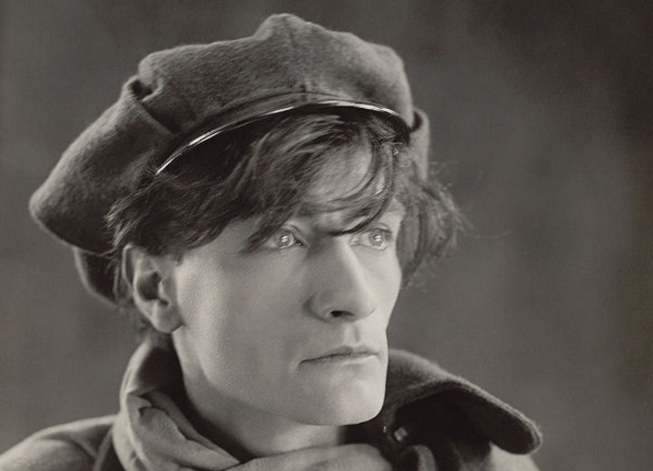
Antonin Artaud had his first mental breakdown at the age of 16 and, from there on out, spent much of his life in and out of asylums. Diagnosed with “incurable paranoid delirium,” Artaud suffered from hallucinations, glossolalia, and bouts of violent rage. And his treatment probably did about as much harm as it did good. He was prescribed laudanum, which gave him a lifelong addiction to opiates. He endured some truly horrific procedures like electric shock treatment along with the highly dubious insulin therapy, which put him in a coma for a while.
In spite of this, Artaud proved to be a hugely influential theorist and playwright, famous for coining the term, “Theater of Cruelty.” His performances were designed to assault the senses and sensibilities of the audience and awaken them to the base realities of life — sex, torture, murder and bodily fluids. Artaud wanted to break down the boundary between actor and audience and create an event that was ecstatic, uncontained and even dangerous. His ideas revolutionized the stage. As the late great Susan Sontag once wrote, “no one who works in the theater now is untouched by the impact of Artaud’s specific ideas.”
But generally speaking, his ideas about theater were more popular than his actual productions. One of his most famous plays, first staged in 1935, was Les Cenci, about a father who rapes his daughter and then gets brutally killed by his daughter’s hired thugs. The play was a flop when it debuted, running for a mere 17 performances. Even Sontag conceded that Les Cenci was “not a very good play.”
Artaud’s last work was an audio piece called To Have Done With The Judgment Of God (Pour en Finir avec le Jugement de dieu), and it proved to be equally unpopular, at least with some very important people. Commissioned by Ferdinand Pouey, head of the dramatic and literary broadcasts for French Radio in 1947, the work was written by Artaud after he spent the better part of WWII interned in an asylum where he endured the worst of his treatment. The piece is as raw and emotionally naked as you might expect –an anguished rant against society. A raving screed filled with scatological imagery, screams, nonsense words, anti-American invectives and anti-Catholic pronouncements.
The piece (above) was slated to air on January 2, 1948 but station director Vladimir Porché yanked it at the last moment. Apparently, he wasn’t terribly fond of the copious references to poop and semen nor the anti-American vitriol. Porché’s rejection caused a cause célèbre among Parisian intellectuals. René Clair, Jean Cocteau and Paul Éluard among others loudly protested the decision, and Pouey even resigned from his job in protest, but to no avail. It never aired. Artaud, who reportedly took the rejection very personally, died a month later. You can listen to the broadcast above. And, in case your French isn’t up to snuff, you can still appreciate its theatrical elements, maybe while reading an English translation of the radio play script here.
If you can’t get enough of Artaud’s final work, you can watch this staged version of To Have Done With the Judgment of Godbelow starring Billy Barnum and John Voigt (no, not Angelina Jolie’s father, the avant-garde musician).
Jonathan Crow is a Los Angeles-based writer and filmmaker whose work has appeared in Yahoo!, The Hollywood Reporter, and other publications. You can follow him at @jonccrow. And check out his blog Veeptopus, featuring one new drawing of a vice president with an octopus on his head daily.
Here in Los Angeles, we learn to live with helicopters. Whether police, news, or unidentifiable, these great mechanical hummingbirds buzz over the city in a kind of omnipresence that can drive new arrivals nuts. The movies have turned helicopters into a visual icon of Los Angeles, but in real life they’ve become more like the city’s sonic signature, to the point where the distinctively rapid, repetitive thump of their rotor blades sometimes bleeds into our dreams. Whether or not innovative German composer Karlheinz Stockhausen spent much time here I don’t know, but he, too, dreamt of helicopters, and the inspiration this vision granted him led to his 1993 Helikopter-Streichquartett, also known as the Helicopter String Quartet. You can see a 2012 Birmingham performance by the Elysian String Quartet above. And no, the piece doesn’t mean “Helicopter” as any kind of metaphor; you’ve got to have not just one but four of the things to properly play it.
I heard and saw the four string players in four helicopters flying in the air and playing. At the same time I saw people on the ground seated in an audio-visual hall, others were standing outdoors on a large public plaza. In front of them, four towers of television screens and loudspeakers had been set up: at the left, half-left, half-right, right. At each of the four positions one of the four string players could be heard and seen in close-up.
Most of the time, the string players played tremoli which blended so well with the timbres and the rhythms of the rotor blades that the helicopters sounded like musical instruments.
When I woke up, I strongly felt that something had been communicated to me which I never would have thought of on my own. I did not tell anyone anything about it.
An actual performance, which gets even more complicated than you’d imagine, involves not just separate helicopters for each string player but separate video cameras to capture and send (“possibly via satellite relay”) their images and those of the Earth behind them. It also requires precision-timed and music-synchronized ascents and descents, “blending” of the sounds of the strings with the sounds of the rotors (via three distinct microphones per chopper), an active mixer to keep the signals in balance, and a moderator to explain it all. At Ubuweb, Frank Scheffer’s 1995 German documentary has more to show and tell about what it took to bring the literal dream of the Helikopter-Streichquartett into reality, a painstaking effort which must surely count as one of the 20th century’s largest-scale sublimations of annoyance into art.
Derek Jarman was too old and too accomplished to be a punk. By 1977, the openly gay filmmaker and artist was already 36 and had an impressive CV that included doing set design for Ken Russell’s The Devils and directing Sebastiane, a landmark in gay cinema, notable for not only its frank depiction of the male body but also for its dialogue which was entirely in Latin. Nonetheless, Jarman gathered together notables from London’s burgeoning punk scene, including a young, lithe Adam Ant, to create Jubilee –the first and, arguably best, punk movie ever.
The plot, as such, centers on Queen Elizabeth I who, with the help of court occultist John Dee (played by Rocky Horror Picture Show’s Richard O’Brien), sees her land 400 years into the future. It’s a Britain filled with garbage and plagued with crime. Queen Elizabeth II, for instance, was killed in a mugging. As Queen Elizabeth I wanders around the wreckage of the British Empire, she encounters a bunch of leather-clad toughs including Amyl Nitrite (played by Malcolm McLaren protégé Jordan), Crabs (Little Nell, also from Rocky Horror) and Mad (Toyah Willcox, who would later go on to delight a generation of toddlers by voicing The Teletubbies). The highpoint of the movie is, without a doubt, is when Jordan performs a risqué dance to a glammed up version of Rule Britannia.
Jarman tapped into the same feelings of anger, disillusionment, and nihilism that the Sex Pistols articulated. As Jarman told The Guardian in 1978, “We have now seen all established authority, all political systems, fail to provide any solution — they no longer ring true.” Jubilee feels like a John Waters movie without the gross-out gags. A Paul Morrissey movie but with a clear sense of political purpose. It’s giddy, uninhibited, violent and occasionally quite disturbing.
Reactions to the movie were, not surprisingly, mixed. Yet the people who really despised the flick weren’t cultural conservatives as you might expect. They would fret over the film when it finally aired on late night TV in 1986. But in 1978, when the film came out, the very people the film was about hated it. Souxsie Sioux, of Souxsie and the Banshees fame, had a bit part in the film but nonetheless thought that it was “hippy trash.” Punk fashionista Vivienne Westwood hated the movie so much she made an insulting T‑shirt about it. And Adam Ant, who went to the premiere with his mother, initially thought the film was terrible. Jarman didn’t give a toss. “I don’t particularly want people to like the film or what it depicts,” he once told a reporter. “I simply hope that it makes them feel that something is going on.”
Yet over the years, the film’s reputation has steadily improved. Ant, for instance, has changed his opinion of Jubilee. “Today I think it’s an amazing achievement and testament to Derek Jarman’s persistence and ingenuity.” And historian Jon Savage, who literally wrote the book on punk, declared that “it’s the best film about punk, for all its failings.” British critic Julian Upton went one step further:
Jubilee is the most important British film of the late ’70s. Okay, it faced little competition at the time — just a weak trickle of ill-conceived co-productions, third-rate softcore, and the usual heritage and nostalgia. Next to those, Jubilee, then as now, stands out like a sore thumb.
Jonathan Crow is a Los Angeles-based writer and filmmaker whose work has appeared in Yahoo!, The Hollywood Reporter, and other publications. You can follow him at @jonccrow. And check out his blog Veeptopus, featuring one new drawing of a vice president with an octopus on his head daily.
To make an exciting movie, do you really need much more than an art thief and his capers? With Dripped, animator Léo Verrier sees that can’t-miss premise and raises it in an exploration of art history. In its 1940s New York City setting, painting-swiping protagonist Jack lives not just to make world-renowned canvasses his own, but a part of him. When he gets these works of art back to his apartment, he doesn’t even consider selling them; instead, he chews and swallows them, thus enabling him to assume in body the forms and colors famously expressed in paint on their surfaces. We are what we eat, and Jack eats art, but even becoming the art of others ultimately leaves him unsatisfied. Determined to paint and eat a canvas of his own, he finds his stomach can’t handle his work in progress. Thrown into a bout of frustration, an angered Jack tosses one of his paintings to the ground, randomly splattering it with every color at hand. And thus he discovers, in this animated fantasy, the technique that Jackson Pollock would pioneer in reality.
To see the real artist — one not known for his eating, though his drinking did gain a reputation of its own — in action have a look at Hans Namuth’s 1951 footage of Pollock painting with his signature “drip” method above. To learn more about the how and the why of it, see also the 1987 documentary Portrait of an Artist: Jackson Pollock, which we featured in 2012; and below, see the Museum of Modern Art’s short examination and re-creation of Pollock’s “action painting” technique. Chance may have led him to discover this practice, but it hardly means he gave up control. Filmmaker Stan Brakhage liked to tell the following illustrative story, which came out of hanging out with various artists and composers in Pollock’s studio in the late 40s:
They were, like, commenting, and they used the words “chance operations” — which was no bother to me because I was hearing it regularly from John Cage — and the power and the wonder of it and so forth. This really angered Pollock very deeply and he said, “Don’t give me any of your ‘chance operations.’ ” He said, “You see that doorknob?” and there was a doorknob about fifty feet from where he was sitting that was, in fact, the door that everyone was going to have to exit. Drunk as he was, he just with one swirl of his brush picked up a glob of paint, hurled it, and hit that doorknob smack-on with very little paint over the edges. And then he said, “And that’s the way out.”
It’s one of those questions I’ve always wondered about. And maybe you have too. Just how do they extract caffeine from coffee beans? In the first episode of a new Mental Floss series, “Big Questions,” a guy named Craig, rocking a tight t shirt, gives us some answers. If I’m guessing right, the video relies fairly heavily on this Scientific American article from 1999. It helps demystify the process a little more.
Charles Baudelaire’s decadent visions pushed the Victorian cult of beauty toward modernism, Henry Miller’s lurid epics pushed a then staid modernism toward anarchic beat writing, and Georges Bataille and the surrealists of his arts journal Documents gave us much of the culture we have today, call it what you will if postmodern is too passé. Obsessed with torture, pornography, horror, and bodily fluids, Bataille “wanted to bring art down to the base level of other physical phenomena,” says surrealist scholar Dawn Ades. Where other transgressive figures of the past have mostly been tamed, Bataille, I submit, is still quite dangerous. The Bataille quote that opens the film above, A perte de vue (“As far as the eye can see”), won’t go down easily with almost anyone: “The world,” reads narrator Jean-Claude Dauphin, “is only inhabitable on the condition that nothing in it is respected.” This, the documentary suggests, is Bataille’s philosophy, one he defines as “a need for sensibility to call up disturbance.”
Bataille, a failed priest and sometime librarian, founded surrealist flagship Documents in 1929, published 15 issues, then went on to write novels, poems, and essays for the next thirty years. But his most famous work has remained his first, The Story of the Eye, originally published under the pseudonym Lord Auch in 1928. It’s a book that even today can seem like “social anthrax,” as novelist John Wray put it, in a way that other once taboo-breaking works like Joyce’s Ulysses, for example, certainly do not. It’s an apt comparison, not on literary grounds, but given that both writers were haunted by once fervent Catholicism turned to fervent rejection. Writes Mark Hudson in The Guardian, “he did believe in his own transgressive philosophies in a quasi-religious sense.” Like Joyce, “there’s a powerful dualism in his thought, a profound religious impulse.” Unlike Joyce—or Bataille’s fellow surrealists for that matter, who “excommunicated” him from the movement—“there is still much in his work that is difficult to redeem and far from being accommodated by the mainstream—if indeed it ever can be.”
You can read four of Bataille’s challenging pieces at Supervert’s elibrary: The Story of the Eye and three essays, “The Use Value of D.A.F. de Sade,” “The Big Toe,” and “The Cruel Practice of Art.” Bataille’s philosophy, writes Supervert, “apparently lay in personal experience—in particular his childhood with a suicidal mother and a blind, syphilitic father.” This kind of psychologizing may seem superfluous, yet Bataille introduces himself to us, in his own words—through audio interviews in the first few minutes of A pert de vue—as the product of “a sad place to be.” Personal origins aside, Bataille’s philosophy has resonated widely and “helped pave the way to contemporary critical theory.” By embracing everything rejected, feared, or held in contempt, Bataille reclaimed everyday parts of human existence—those we euphemize or seek to contain—for literature, philosophy… and well, the internet. If some of Bataille’s preoccupations are irredeemable for mainstream tastes, you may find as you watch the film above and read Bataille’s writing that this is for good reason.
We’ve become so accustomed to thinking of the Beatles as Serious Artists™ that it’s easy to forget—at least for those of us who weren’t there—how highly commercial a franchise they were in the mid-sixties. It’s no wonder Joe Strummer’s line about “phony Beatlemania” in the Clash’s “London Calling” resonated so strongly for those disaffected with the reign of the Fab Four. The real thing was overwhelming enough, but the slew of official, unofficial, and bootleg merchandising that followed it, much of it aimed at children, makes the band’s dominance seem, well, kinda juvenile. Before they escaped pop stardom and retreated to the studio to record their psychedelic masterpieces, the Beatles received every possible commercial treatment, from lunchboxes and cereal bowls to jigsaw puzzles, lampshades, and a Ringo Starr bubble bath. Perusing an online auction of Beatles merch is a bit like touring Graceland.
There’s one artifact from the height of Beatlemania that you won’t find, however. Instead, you can watch it for free on Youtube. I refer to The Beatles, a half-hour Saturday morning cartoon show that ran on ABC from September, 1965 to September 1969 and produced a total of 39 episodes. The band themselves had almost nothing to do with the show, other than appearing in an odd promotion. Trading entirely in broad slapstick comedy of the Scooby-Doo variety, the show saw the four mates tumble into one goofy situation after another, some supernatural, some musical, some theatrical. Although all natural performers themselves, no Beatle ever voiced his character on the show. Instead, American actor Paul Frees, as John and George, and British actor Lance Percival, as Paul and Ringo, imitated them, very badly. The Beatles cartoon show aired at a time when the kids TV landscape was just beginning to resemble the one we have today, with ABC competitor CBS running superhero shows like Space Ghost, Superman, and Mighty Mouse, but the surreal plots and musical numbers on The Beatles were an attempt to reach adults as well. Watch clips from Season 1 above.
Apple had lots of big announcements today — a new watch, a new iPhone, and payment system. But wait, there’s more! On its big day, Apple also announced that anyone with an iTunes account can download for freeSongs of Innocence, U2’s first album in 5 years. The album will remain free on iTunes until October 13, 2014, after which time it will be released on CD and maybe vinyl. You can access the album in several ways.
1.) On your iOS device, go to the Music app and select the Albums tab. Select Songs of Innocence. Tap a track to listen or tap the iCloud icon to download.
2.) On your Mac or PC, open iTunes, then select the Albums tab. Select Songs of Innocence. Select a track to listen or click the iCloud icon to download.
3.) On any of your devices, go to Featured Stations and select Songs of Innocence to listen. Starting September 10.
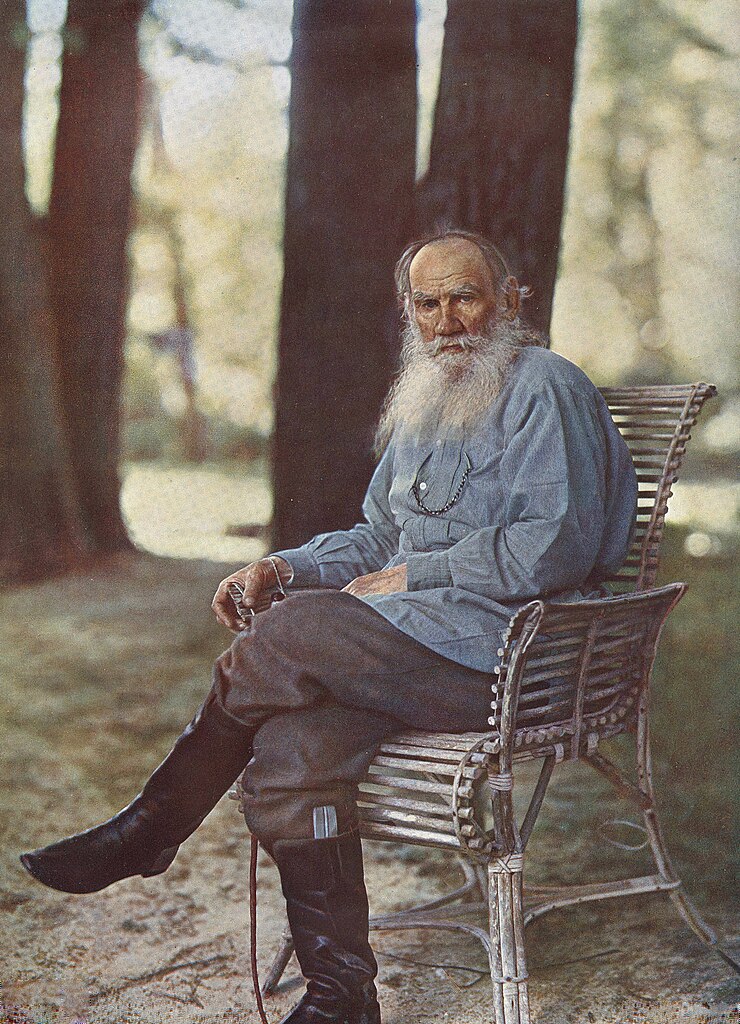
A good few people objected to a recent project that colorized old photos of Walt Whitman, Charlie Chaplin, Helen Keller, Mark Twain, and other historical characters. Leave them alone! they grumped. The past, they wanted left in black and white. But this is not so easily done when some photos—whether of august personages like Leo Tolstoy above, or of ordinary anonymous peasants below—were always processed in color. The Tolstoy image dates from 1908, two years before his death, but the process is much older, and successful color photographs, not simply hand-painted colorizations, go back at least to the Lumiere Brothers’ Autochromes from the late 19th century.
The method that gave us Tolstoy in color involved taking three photographs—with a red, a green, and a blue filter—then projecting the resulting prints through filters of the same color. It’s a procedure that dates to Scottish scientist James Clerk Maxwell’s 1861 experiments, which put to the test several earlier theories. The photographs you see here are the work of scientist and inventor Sergei Prokudin-Gorsky, who had perfected the projection method to such a degree that—as he wrote in a letter to Tolstoy asking him to pose—he only needed “from 1 to 3 seconds to take the photograph.” Thus it would not be “overly tiresome” for the soon-to-be eighty-year-old novelist.
Tolstoy, of course, was a national institution, and had warranted an earlier attempt at a color portrait by an anonymous amateur to whom Prokudin-Gorsky refers in his letter of request. The first attempt, the inventor implies, was a botched job. Billing himself as a specialist in “photography ‘in natural colors,’” the self-confident entrepreneur assured the writer he could produce “excellent results” with “accurate colors.” “My colored projections,” he wrote, “are known in both Europe and in Russia.” Prokudin-Gorsky was received and given two days to take several color photographs, though whether the others have survived, I do not know. We do know that the portrait appeared in the August, 1908 issue of The Proceedings of the Russian Technical Society as “the first Russian color photoportrait.” The journal offered the image in tribute to Tolstoy’s upcoming 80th birthday celebration, writing:
Our periodical, as a purely technical one, cannot honor this venerable representative of Russian thought and word with special articles. Desiring, however, to take part in the general festivities, the editorial staff […] decided to publish in this, its August issue, the newest portrait of Tolstoy, which is the dernier mot in photographic technology. The portrait was taken on location and in natural colors, achieved through technical methods alone, without any use of the artist’s brush or tool.
Prokudin-Gorsky expressed his gratitude to the novelist by mailing him a photographic periodical containing “many pictures produced in my workshops from my photographs.” Perhaps the other photos we see here were contained in that journal. Prokudin-Gorsky had every reason to be proud of his work, and the Russian Technical Society every reason to endorse it. The pictures are stunning.
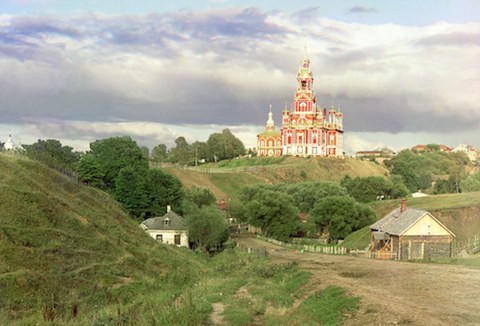
Some of the photographs, like the Tolstoy portrait, have a painterly, almost impressionistic quality. Others, like the 1911 village scene with the Nikolaevskii Cathedral in the distance, have almost the depth of field and fine-grained clarity of 35mm film. And some, like that of the already cartoonish structure below, have an almost hallucinatory CGI quality. The method wasn’t perfect—even with such short exposures, subjects had to remain absolutely still. If they moved, the result was an eerie double exposure effect you see in the middle distance of the field workers photographed above. But overall, these photographs simply astonish in their crispness and fidelity.
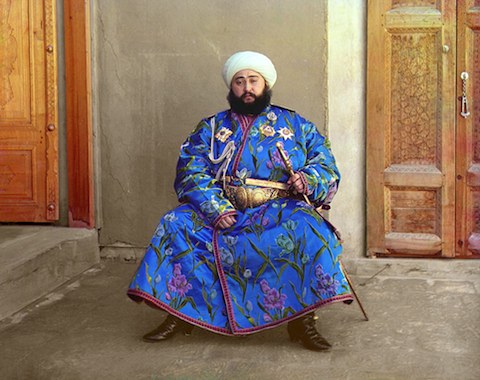
You can see many more of Prokudin-Gorsky’s images at this online gallery, which includes over a dozen early-twentieth century photos of Russian laborers, landscapes, and self portraits. Prokudin-Gorsky’s work also preserves images of various Eastern European peoples in traditional dress—like the final Emir of Bukhara, now Uzbekistan, below in 1910. Many of these groups were on the verge of cultural extinction in the coming years of Soviet imperialism. Unwittingly, Prokudin-Gorsky managed to beautifully capture the very end of tsarist Russia, most poignantly symbolized for so many Russians by their aged literary hero, whose birthday we celebrate again today. Google decided to do so in full color as well, with fancy doodles of his major works. You may accuse them of tampering with the past, but those who find these color photographs too modern may need to expand their definition of modernity.
August and Louis Lumière might have made the first film – a simple, static shot of workers leaving their factory for the day – but George Méliès invented the art form of cinema. Through his experiments, Méliès discovered that magic happened when he turned the camera off and on. People suddenly disappeared into thin air. Objects appeared out of nowhere. A famed magician, Méliès knew he was on to something. His discovery planted the seeds for just about every cinematic technique in the book — including animation. You can watch six of Méliès’ films here, including his landmark 1902 short A Trip to the Moon.
The person credited with making the first film-based animation, however, is James Stuart Blackton with his film Humorous Phases of Funny Faces (1906). You can watch it above. The short starts with the artist’s hand drawing on a chalkboard. Soon, however, the drawing starts to move on its own. The film is as primitive as it is fun. A man in a top hat blows cigar smoke into a woman’s face. A clown dances. Imagine the shock and awe of an audience not weaned on Pixar and Mickey Mouse watching a picture come to life for the first time.
Blackton started his career as a journalist and a vaudeville cartoonist. In 1896, he was assigned to cover Thomas Edison’s brand new invention – the Vitascope, an early film projector. Edison proved to be such a good salesman that Blackton ended up buying one. Soon he, along with his vaudeville partner Albert Smith, founded one of the first ever movie studios — the American Vitagraph Company. The company eventually became known for creating some of the first movie adaptations of Shakespeare and Charles Dickens, but before that, they made short “trick” movies — flashy shorts to be shown during vaudeville shows. One of those movies, The Enchanted Drawing(1900) is essentially a filmic version of Blackton’s act with some cinematic sleight-of-hand thrown in. And as you can see below, it points the way to Blackton’s breakthrough with Humorous Phases.
In 1911, Blackton, along with his co-director, the spectacularly talented Winsor McCay, made Little Nemo, a movie that hints at the true potential of animation. Sure, their movie has way too much half-hearted live action slap stick, which pads out the running time to an over-stuffed 10 minutes, but the actual animation, which starts around 8:30, is utterly gorgeous. Watch it below.
Jonathan Crow is a Los Angeles-based writer and filmmaker whose work has appeared in Yahoo!, The Hollywood Reporter, and other publications. You can follow him at @jonccrow. And check out his blog Veeptopus, featuring one new drawing of a vice president with an octopus on his head daily.
We're hoping to rely on loyal readers, rather than erratic ads. Please click the Donate button and support Open Culture. You can use Paypal, Venmo, Patreon, even Crypto! We thank you!
Open Culture scours the web for the best educational media. We find the free courses and audio books you need, the language lessons & educational videos you want, and plenty of enlightenment in between.