As an arty, unathletic only child in the 70s, I refused to buy into the idea that science could be fun. This despite a wealth of zippy educational programming, and the efforts of at least two cute young teachers whose hands-on approach included throwing eggs off of a railroad trestle, demolishing toothpick bridges and dipping things into liquid nitrogen for the sheer pleasure of seeing them explode when they hit the wall. Nice try. As far as I was concerned, those dullsville black-and-white films from the ’50s embodied the subject’s general vibe far more honestly than any attempt to force it down our throats with a fashionable Honeycomb Kids-style spin.
Having by now met dozens of scientists and science enthusiasts who are left cold by the arts, I’m not ashamed to be plainspoken here. I certainly don’t begrudge them their passion, and appreciate it when they don’t belittle mine. Different strokes, you know?
Stegerfor’s method for capturing big brained innovators in a light frame of mind resembles a well run experiment. His unsuspecting specimens were apprehended at Germany’s annual Lindau Nobel Laureate Meeting. Thus secured, they were led one at a time into a temporary studio where each was invited to draw whatever it was that had earned him or her the Nobel prize. The results weren’t much as art, but they’re unmistakably playful, bristling with arrows, exclamation points, smiley faces, and word bubbles. The photographer let his subjects pick the pose, at which points things did become art.
I’m going to award 1996 Chemistry laureate Sir Harold Kroto Best in Show for his well warranted action pose. Apparently, his discovery’s molecular structure looks like a soccer ball.
It’s not exactly Breaking Bad, but it does bring Chemistry alive for me as a subject others might find enjoyable in the empirical sense.
View a gallery of Volker Stegerfor’s Sketches of Science. If you’re really into it, the Nobel Museum is heralding a traveling exhibition of Stegerfor’s work with audio recordings of the scientists on the subject of their discoveries.
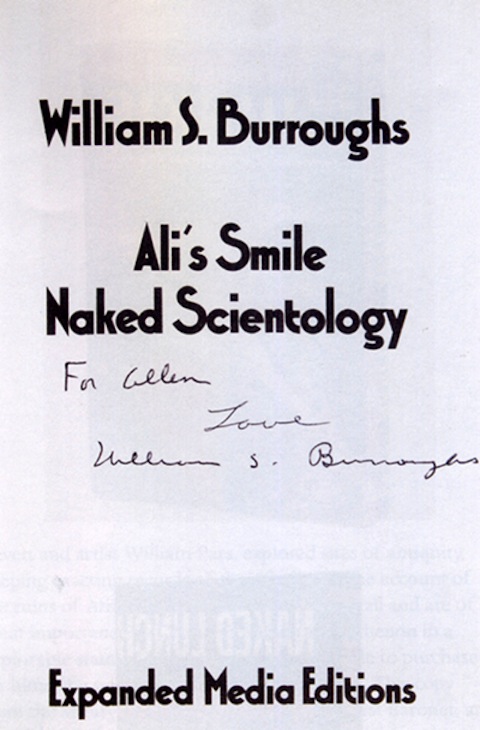
Crash director Paul Haggis impressed us all when his defection from the Church of Scientology became the subject of “The Apostate,” a 2011 New Yorker profile by Lawrence Wright. But Haggis’ high-profile departure from the lavish if shadowy house that L. Ron Hubbard built had a notable precedent in William S. Burroughs’ Naked Scientology. The Naked Lunch author and Beat Luminary published it after his own disillusionment with the organization of Scientology, though he retained his esteem for what he considered their mind-improving techniques. Booktryst offers a brief summary of Burroughs’ intense flirtation with the Church and its teachings: his initial attraction “because of its promise to liberate the mind by clearing it of traumatic memories that impeded personal growth, and, by extension, social progress and freedom from social control,” and his ultimate disappointment that, as biographer Ted Morgan puts it, he “had hoped to find a method of personal emancipation and found instead another control system.”
For a more in-depth look at what brought Burroughs into Scientology and what put him off of it, read Lee Konstantinou’s i09 post on the subject. “Burroughs took Scientology quite seriously indeed for the better part of a decade — during what was arguably his most artistically fertile period,” Konstantinou writes. “Today, where so much attention focuses on the science fictional origins of Scientology, it is easy to forget how seemingly in harmony the Church was with a whole range of countercultural, ‘New Age,’ and anti-psychiatric practices in the Sixties.” He files Scientology with Burroughs’ other “mind-expanding and mind-freeing practice,” including hallucinogens, “Mayan calendrical mind control systems,” apomorphine, and his signature “cut-up” texts. To hear all about it straight from Burroughs, read his 1970 Los Angeles Free Press j’accuse against Hubbard and his “fascist” tendencies, and the whole of Naked Scientology in PDF form.
Actually, LSD ABC, defies neat categorization. Beyond the fact that they’re both spelled out using letters, what could Dim Sum possibly have in common with VHS? Not much prior serving as inspirational prompts for graphic designers Laurent & Françoise (otherwise known as Laura Sicouri and Kadavre Exquis). Now they’re 1/13th of a delightfully twisted animated whole, one of those deadline-free pet projects that goes on to spawn a limited edition vinyl album.
The duo is prone to fetishizing the anachronistic technologies of the recent past, in a manner slightly more elegant than comedians Tim Heidecker and Eric Wareheim. They toss in a foot similar to the one Terry Gilliam used to such effect on Monty Python. H and S are subjected to the sort of indignities Wile E. Coyote used to suffer at the hands of the Road Runner. It’s all tied together with AT&T Lab’s decidedly unnatural-sounding Natural Voice text-to-speech narration.
While it’s difficult to pick a favorite from such a mind bending array, I’m going to have to go with P…for Pet Piano, natch. You?
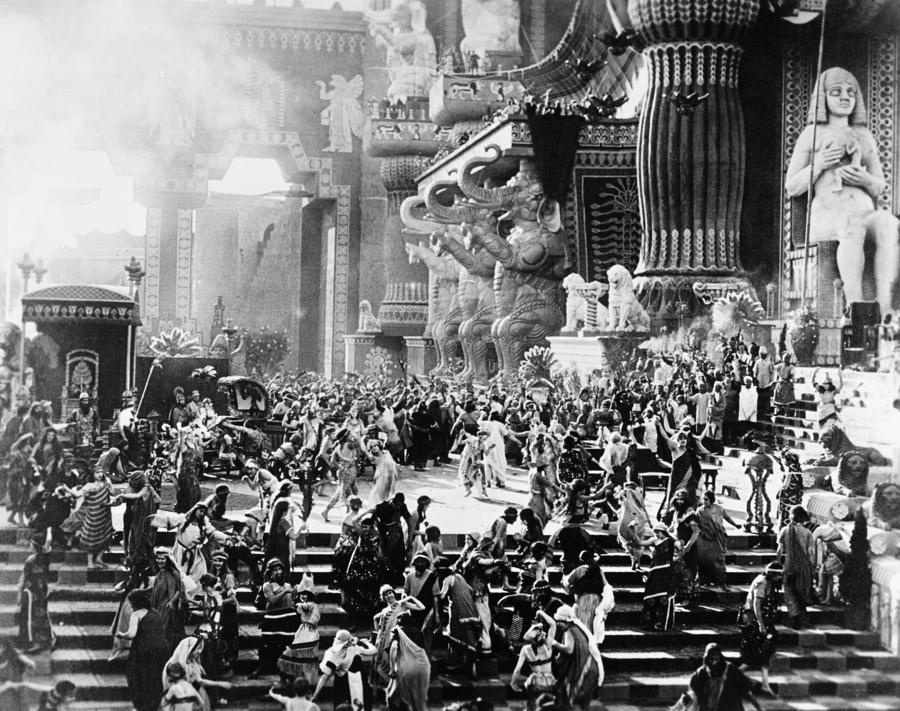
In 1915, D.W. Griffith shot one of the most controversial films in the history of cinema. Birth of a Nation “was a decisively original work of art—in effect, the founding work of cinematic realism,” writes Richard Brody in The New Yorker. But, despite being “titanically original,” the film was outrageously racist in the way that it depicted African-Americans during the Reconstruction Era. Even in 1915, audiences knew that the film had crossed a line. The NAACP protested against the film’s fabrications and inaccuracies. Riots broke out in Boston, Philadelphia and other major cities. And Griffith’s legacy never recovered, even if he tried to atone (some say) in 1916 with the release of Intolerance, anothermasterpiece of the Silent Era.
Billed as a “colossal spectacle,” Intolerance featured massive sets, extravagant period costumes, and more than 3,000 extras, and, in grand fashion, it wove together “four distinct but parallel stories that demonstrated mankind’s intolerance during four different ages in world history.” A century later, Birth of a Nation might not get many public viewings. But this past weekend a restored version of Intolerancebegan a weeklong run at the Film Forum in New York City. If the restored version doesn’t make it to a city near you, you can view the original film, all three epic hours of it, online for free. Intolerance is cataloguedin our collection of 525 Free Movies Online.
J.J. Cale died on Friday. Cale was one of the greatest and most influential guitar players of the rock and roll era. “Of all the players I ever heard,” said Neil Young, “it’s gotta be Hendrix and J.J. Cale who are the best electric guitar players.”
It’s hard to imagine a musician more diametrically opposed to Jimi Hendrix than Cale, who was the master of nuance and understatement. Perhaps the best word to describe his country swing-inflected guitar playing would be “cool.” The restrained dynamics, the delicate touch — Cale’s playing demanded close attention and sensitivity in a listener. His vocals, too, were kept way down in the mix, a reflection of his introverted personality. “The effortlessness, that restraint and underplaying, under-singing — it was just very powerful,” said pop musician Beck to the Los Angeles Times in 2009. “The power of doing less and holding back in a song, I’ve taken a lot of influence from that.”
Perhaps the greatest exemplar of Cale’s wide influence was Eric Clapton, who made hits out of two previously obscure songs written by Cale — “After Midnight” and “Cocaine” — and patterned much of his ’70s music after the Tulsa Sound Cale helped create. When asked by Vanity Fair to name the living person he most admired, Clapton was unequivocal: J.J. Cale. “In my humble opinion,” Clapton wrote in his 2007 autobiography, “he is one of the most important artists in the history of rock, quietly representing the greatest asset his country has ever had.”
To remember Cale and his artistry, we bring you a 1979 video (above) of Cale and his band playing live at Rainbow Studios in Los Angeles with his old friend and fellow Oklahoman Leon Russell. Here’s the set list:
Science fans this week got their first tantalizing peek at the long-awaited sequel to Carl Sagan’s classic PBS series Cosmos. Astrophysicist Neil deGrasse Tyson, who takes Sagan’s place in the new series, traveled to Comic-Con in San Diego last week for the unveiling of this new trailer.
Cosmos: A Spacetime Odyssey will begin airing on the Fox television network in the spring of 2014. As with the first Cosmos, there will be 13 episodes. According to the Fox Web site, “Cosmos: A Spacetime Odyssey will invent new modes of scientific storytelling to reveal the grandeur of the universe and re-invent celebrated elements of the legendary original series, including the Cosmic Calendar and the Ship of the Imagination. The most profound scientific concepts will be presented with stunning clarity, uniting skepticism and wonder, and weaving rigorous science with the emotional and spiritual into a transcendent experience.”
The new Cosmos is produced by Sagan’s widow Ann Druyan, who co-wrote and produced the original series with her husband and Steven Soter. “This series is still about that same thing,” Druyan told reporters, “but we’re telling a completely different set of stories, establishing the coordinates, but then jumping off from there.”
As the new trailer would suggest, the updated series will be rich in special effects. According to a story this week in Wired, the original series’ use of historical reenactments by actors will mostly be replaced with animation in what director Brannon Braga called “a sophisticated graphic novel-type style.” But the visual effects will be there only to serve the narrative. “As humans, we like hearing stories,” Tyson said in San Diego. “We have what I think is the greatest story ever told: the story of the universe, and our place within it, and how we came to discover our place within it. And finally, we have the methods and tools to bring that to the screen.”
NOTE: All 13 episodes of the 1980 series Cosmos: A Personal Voyage can be seen for free by following this link to Hulu. Alas, free viewing may not be available in all countries.
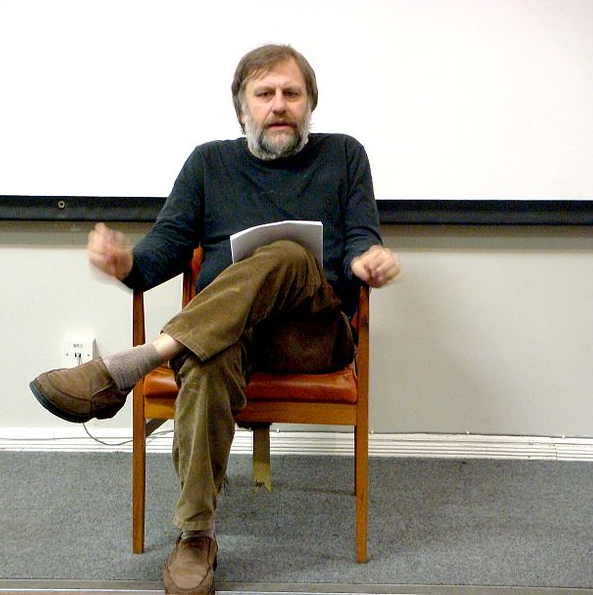
Fur has flown, claws and teeth were bared, and folding chairs were thrown! But of course I refer to the bristly exchange between those two stars of the academic left, Slavoj Žižek and Noam Chomsky. And yes, I’m poking fun at the way we—and the blogosphere du jour—have turned their shots at one another into some kind of celebrity slapfight or epic rap battle grudge match. We aim to entertain as well as inform, it’s true, and it’s hard to take any of this too seriously, since partisans of either thinker will tend to walk away with their previous assumptions confirmed once everyone goes back to their corners.
But despite the seeming cattiness of Chomsky and Žižek’s highly mediated exchanges (perhaps we’re drumming it up because a simple face-to-face debate has yet to occur, and probably won’t), there is a great deal of substance to their volleys and ripostes, as they butt up against critical questions about what philosophy is and what role it can and should play in political struggle. As to the former, must all philosophy emulate the sciences? Must it be empirical and consistently make transparent truth claims? Might not “theory,” for example (a word Chomsky dismisses in this context), use the forms of literature—elaborate metaphor, playful systems of reference, symbolism and analogy? Or make use of psychoanalytic and Marxian terminology in evocative and novel ways in serious attempts to engage with ideological formations that do not reveal themselves in simple terms?
Another issue raised by Chomsky’s critiques: should the work of philosophers who identify with the political left endeavor for a clarity of expression and a direct utility for those who labor under systems of oppression, lest obscurantist and jargon-laden writing become itself an oppressive tool and self-referential game played for elitist intellectuals? These are all important questions that neither Žižek nor Chomsky has yet taken on directly, but that both have obliquely addressed in testy off-the-cuff verbal interviews, and that might be pursued by more disinterested parties who could use their exchange as an exemplar of a current methodological rift that needs to be more fully explored, if never, perhaps, fully resolved. As Žižek makes quite clear in his most recent—and very clearly-written—essay-length reply to Chomsky’s latest comment on his work (published in full on the Verso Books blog), this is a very old conflict.
Žižek spends the bulk of his reply exonerating himself of the charges Chomsky levies against him, and finding much common ground with Chomsky along the way, while ultimately defending his so-called continental approach. He provides ample citations of his own work and others to support his claims, and he is detailed and specific in his historical analysis. Žižek is skeptical of Chomsky’s claims to stand up for “victims of Third World suffering,” and he makes it plain where the two disagree, noting, however, that their antagonism is mostly a territorial dispute over questions of style (with Chomsky as a slightly morose guardian of serious, scientific thought and Žižek as a sometimes buffoonish practitioner of a much more literary tradition). He ends with a dig that is sure to keep fanning the flames:
To avoid a misunderstanding, I am not advocating here the “postmodern” idea that our theories are just stories we are telling each other, stories which cannot be grounded in facts; I am also not advocating a purely neutral unbiased view. My point is that the plurality of stories and biases is itself grounded in our real struggles. With regard to Chomsky, I claim that his bias sometimes leads him to selections of facts and conclusions which obfuscate the complex reality he is trying to analyze.
………………….
Consequently, what today, in the predominant Western public speech, the “Human Rights of the Third World suffering victims” effectively mean is the right of the Western powers themselves to intervene—politically, economically, culturally, militarily—in the Third World countries of their choice on behalf of the defense of Human Rights. My disagreement with Chomsky’s political analyses lies elsewhere: his neglect of how ideology works, as well as the problematic nature of his biased dealing with facts which often leads him to do what he accuses his opponents of doing.
But I think that the differences in our political positions are so minimal that they cannot really account for the thoroughly dismissive tone of Chomsky’s attack on me. Our conflict is really about something else—it is simply a new chapter in the endless gigantomachy between so-called continental philosophy and the Anglo-Saxon empiricist tradition. There is nothing specific in Chomsky’s critique—the same accusations of irrationality, of empty posturing, of playing with fancy words, were heard hundreds of times against Hegel, against Heidegger, against Derrida, etc. What stands out is only the blind brutality of his dismissal
I think one can convincingly show that the continental tradition in philosophy, although often difficult to decode, and sometimes—I am the first to admit this—defiled by fancy jargon, remains in its core a mode of thinking which has its own rationality, inclusive of respect for empirical data. And I furthermore think that, in order to grasp the difficult predicament we are in today, to get an adequate cognitive mapping of our situation, one should not shirk the resorts of the continental tradition in all its guises, from the Hegelian dialectics to the French “deconstruction.” Chomsky obviously doesn’t agree with me here. So what if—just another fancy idea of mine—what if Chomsky cannot find anything in my work that goes “beyond the level of something you can explain in five minutes to a twelve-year-old” because, when he deals with continental thought, it is his mind which functions as the mind of a twelve-year-old, the mind which is unable to distinguish serious philosophical reflection from empty posturing and playing with empty words?
There’s a long and companionable history between music and mathematics. While it is often said that every culture has its own form of music, it’s also nearly just as true that most ancient cultures explored the mathematical principles of sound. Leave it to the Pythagoreans of Ancient Greece to notice the relationship between musical scales and mathematical ratios.
How music and science intersect is a more modern inquiry. Fields like neuroscience and modern medicine and technology make both the roots of music and cognition, as well as how science can inspire music, a crackling frontier.
Channel 4 in England aired a new documentary When Björk Met Attenboroughon July 27th with—who better?—naturalist David Attenborough as host. Attenborough, who was famously granted privileged access to film Dian Fossey’s research on mountain gorillas, teams up with a less elusive but fascinating figure this time around. Attenborough actually co-hosts the program with Björk.
Björk’s album Biophilia is the launching-off point for the documentary. It’s an apt choice. Björk has called live performances of music on the album a “meditation on the relationship between music, nature, and technology.”
New instruments were specially designed for the album and the songs are conceptually wedded to natural phenomena. “Moon” features musical repeating musical cycles; “Thunderbolt” includes arpeggios inspired by the time between the moment when lightening is seen and thunder is heard.
In the documentary, Attenborough explores how music exists in the natural world, taking viewers through the filming of the Reed Warbler and Blue Whales. For her part, Björk argues that cutting-edge technology keeps music intuitive and accessible. Featured are the instruments Björk developed for Biophilia: the “pendulum harp,” the “sharpsichord” and the “gameleste,” a combination gamelan and celesta programmed to be played remotely on an iPad.
Mick Jagger turns 70 today, and I think we can safely say at this point that he’s going to stick with this rock star thing. But if at some point in his youth he had decided on a different career, he might have gone with “post-drug bust interview subject” (or civil libertarian activist). It’s a skill he practiced often. Take the clip above, filmed after the legendary 1967 Stones’ drug bust after a News of the World article exposed the band’s recreational use, along with that of the Moody Blues and The Who. The bust, it turns out, was an L.A. Confidential-style frame-up between the tabloid and the police, and included the collaboration of a dealer known appropriately as “Acid King,” real name David Schneiderman. According to Simon Wells’ exhaustive Butterfly on a Wheel: The Great Rolling Stones Drug Bust, Schneiderman “remains probably the most enigmatic figure in rock and roll folklore” and claimed to work for the CIA, MI5, and other secret agencies (turns out this may have been true).
So the Stones were set up, which doesn’t mean they weren’t also really high (hear Wells tell the story in detail in an author interview above). But they took it in stride, using the publicity to substantiate their image as rock and roll’s bad boys and sending the suave, voluble Jagger out on press jags, like the very strange panel interview with the show World in Action, from which the above excerpt comes, where Mick sits down with a couple chaplains and a couple suits and defends the rights of the individual. Jagger proves himself a very able spokesman for his generation—intelligent, poised, and yes, ridiculously handsome. He not only stood up to defend himself in interviews throughout the Stones’ turbulent drug-fueled heydays, but he stood by his man Keith as well. Check him out below fielding press questions with aplomb for a slightly addled Richards after one of Keith’s drug trials.
What motion picture did no less an auteur than Orson Welles call “the greatest comedy ever made, the greatest Civil War film ever made, and perhaps the greatest film ever made”? Why, Joseph Frank “Buster” Keaton’s 1926 The General, unsung in its day but heaped with critical acclaim ever since. The General, as Roger Ebert describes it, “is an epic of silent comedy, one of the most expensive films of its time, including an accurate historical recreation of a Civil War episode, hundreds of extras, dangerous stunt sequences, and an actual locomotive falling from a burning bridge into a gorge far below.” This and all of Keaton’s movies, Ebert adds, showcase “a graceful perfection, such a meshing of story, character and episode, that they unfold like music.”
You can watch The General online right above. If you then find yourself moved to take in more of Keaton’s filmography, have a look at this list of his freely viewable pictures helpfully compiled by MUBI. Its still-active links include all of the following movies:
These 21 films will give you a thorough primer on the joy of silent comedy as perfected by Buster Keaton, in Ebert’s words “not the Great Stone Face so much as a man who kept his composure in the center of chaos. Other silent actors might mug to get a point across, but Keaton remained observant and collected. That’s one reason his best movies have aged better than those of his rival, Charlie Chaplin. He seems like a modern visitor to the world of the silent clowns.”
We will add a number of these films to our collection of 500+ Free Movies Online.
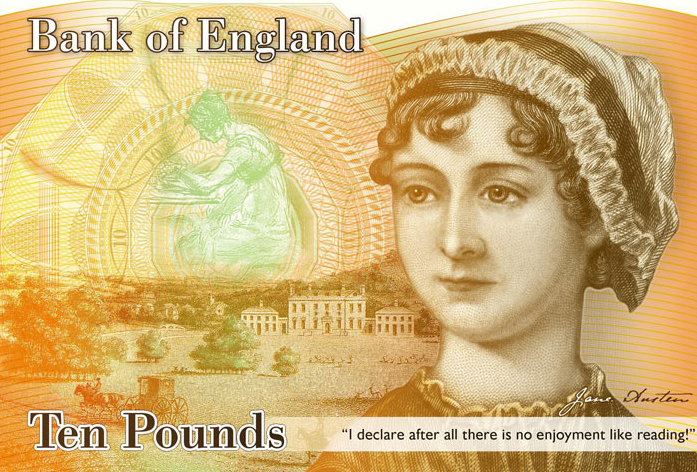
Earlier this year, the Royal Mail released a stamp collection commemorating Jane Austen’s six novels. Now, word has leaked out that, probably starting in 2017, the author of Pride and Prejudice will appear on the £10 note. Said Mark Carney, the new governor of the Bank of England, “Jane Austen certainly merits a place in the select group of historical figures to appear on our banknotes. Her novels have an enduring and universal appeal and she is recognised as one of the greatest writers in English literature.” Only three women have appeared on English banknotes since they started portraying historical figures in 1970. Austen will be the fourth. The Guardian has more on this good story here.
We're hoping to rely on loyal readers, rather than erratic ads. Please click the Donate button and support Open Culture. You can use Paypal, Venmo, Patreon, even Crypto! We thank you!
Open Culture scours the web for the best educational media. We find the free courses and audio books you need, the language lessons & educational videos you want, and plenty of enlightenment in between.