Andy Stewart builds boats with his own hands for life-affirming reasons. It’s a way to make inanimate objects come alive, to breathe new life into our world. But Stewart also enjoys the challenge of it all. The sea, he tells us, is the “final arbitrator” of your work. Quite decisively, it tells you whether a boat has been crafted with precision, whether every piece of wood contributes to the larger hull/whole. If your boat can stand the rigorous tests of nature and time, you know you’ve mastered your craft. The short documentary above, Shaped on all Six Sides, was directed by Kat Gardiner.
If you would like to support the mission of Open Culture, consider making a donation to our site. It’s hard to rely 100% on ads, and your contributions will help us continue providing the best free cultural and educational materials to learners everywhere. You can contribute through PayPal, Patreon, and Venmo (@openculture). Thanks!
Great talents seem to embody their craft. It’s as if they invented the form and then broke the mold when they were finished with it.
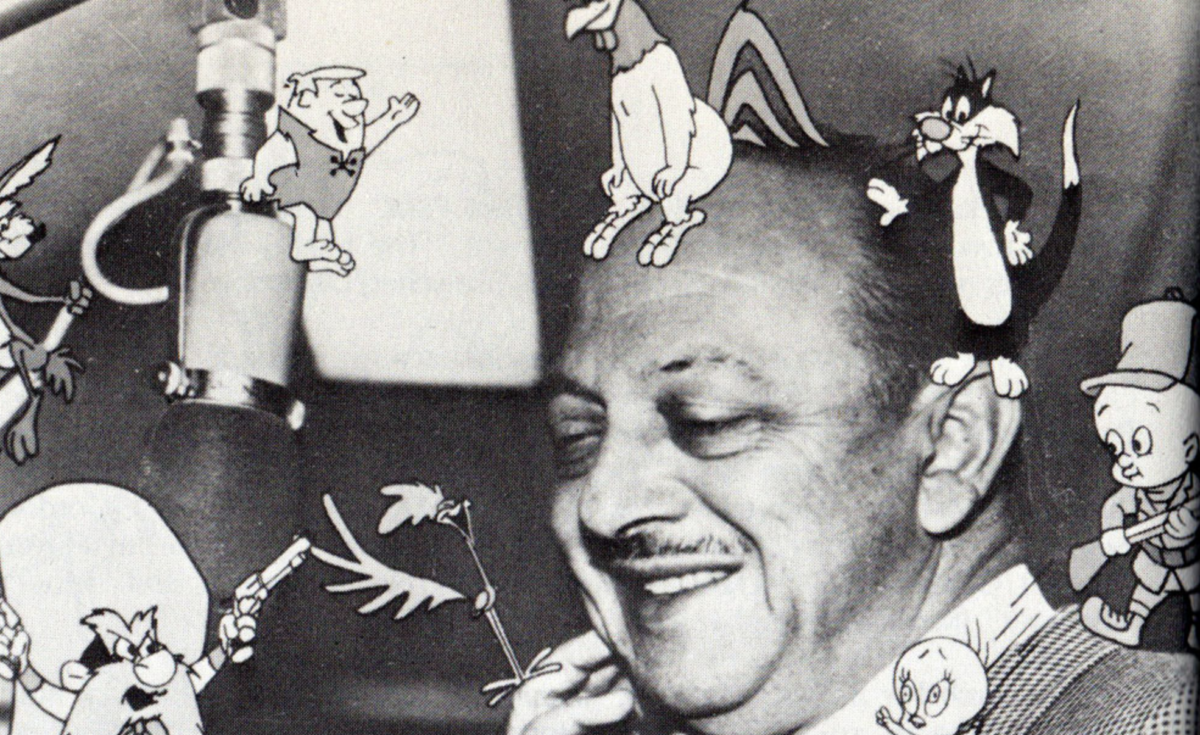
One of the best modern examples of this virtuosity is Mel Blanc, voice of Bugs Bunny and nearly all of the Looney Tunes cartoon gang. Blanc, who voiced more than 1,000 characters, was famously hard-working. At one point in his career, he scrambled from studio to studio around Los Angeles to work on 18 radio shows in one week.
As Malcolm Gladwell likes to say, that kind of practice leads to mastery. And, in Mel Blanc’s case, it may have saved his life.
Radio Lab, broadcast over WNYC, recently aired a piece about Blanc (listen below) featuring an interview with his son Noel Blanc, who is also a voice actor. Noel Blanc tells the story of a terrible car accident that badly injured his father in 1961 as he was driving home along Sunset Boulevard from a job in San Francisco. Mel Blanc, driving an Aston Martin, collided with another car on Dead Man’s Curve. Blanc was almost killed and slipped into a coma. Blanc’s son and wife spent two weeks at his bedside trying to revive him, but got no response.
One day, about 14 days after the accident, one of Blanc’s neurologists walked into the room and tried something completely new. He went to Mel’s bed and asked, “Bugs Bunny, how are you doing today?”
There was a pause while people in the room just shook their heads. Then, in a weak voice, came the response anyone would recognize.
“Myeeeeh. What’s up doc?”
The doctor then asked Tweety if he was there too.
“I tot I taw a puddy tat,” was the reply.
It took seven more months in a body cast for Blanc to recover. He even voiced Barney Rubble in the first episodes of The Flintstones whilelying in bed with a microphone dangling from above.
The Radio Lab piece includes excerpts from an episode of This is Your Life when Blanc’s doctor tried to explain how he revived his patient. “It seemed like Bugs Bunny was trying to save his life,” was all he could say.
Radio Lab features another neurologist’s opinion: Blanc was such a hard-working professional that his characters lived, protected from the brain injury, deep in his unconscious mind. The doctor’s question must have sounded like a director’s cue.
Essentially, “Mr. Blanc, you’re on.”
And he was, until 1989. Listen through to the end of the podcast. The end of Blanc’s life is as remarkable as his long career.
Below, we have added a related documentary, Mel Blanc: The Man of a Thousand Voices.
Kate Rix writes about education and digital media. Visit her website to see more of her work. Follow her on Twitter: @mskaterix.
It used to be that accepting an advance on an unwritten novel was as good as admitting failure before the work is even finished. Can you imagine blue-blood novelists Edith Wharton or Henry James taking a check before finishing their books?
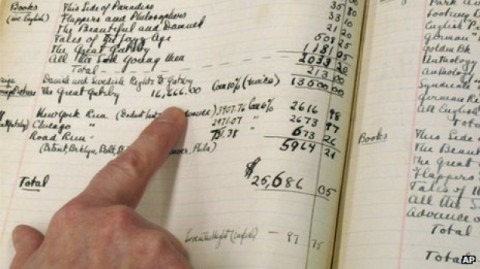
F. Scott Fitzgerald may have been a long-suffering wannabe when it came to high society, but he never pretended to be anything but a businessman when it came to writing. For nearly his entire professional life he kept a detailed ledger of his income from writing, in which he noted the $3,939 advance he received for his in-progress novel, The Great Gatsby. The new Gatsby film out this summer is the fifth adaptation. The first earned Fitzgerald $16,666. (See the surviving footage here.)
Recently digitized by the University of South Carolina, the lined notebook, which the writer probably packed with him on all of his travels, paints a picture of a pragmatic businessman repeatedly on and off the wagon. Sound like Gatsby? Maybe a little.
A true Jazz Age storyteller, Fitzgerald sets up the droll social scene of his own early days: Not long after his birth on September 24, 1896, the infant “was baptized and went out for the first time—to Lambert’s corner store on Laurel Avenue.”
It’s worth a stroll through Fitzgerald’s clipped account of his childhood, for the humor and the poignant references to birthday parties and childhood mischief. By 1920 the writer is married and has some professional momentum. In the margins of that year’s page, he writes “Work at the beginning but dangerous toward the end. A slow year, dominated by Zelda & on the whole happy.”
By the last entry, the state of Fitzgerald’s life is grim—“work and worry, sickness and debt.” The book reads like a whirlwind of drinking, writing, travel and jet-setting. Fitzgerald holds his gaze steady on social dynamics, noting gatherings and arguments with friends alongside the notes about his creative bursts and dry spells.
Kate Rix writes about education and digital media. Visit her website at and follow her on Twitter @mskaterix.
The work of James Joyce has inspired many a musician—from John Cage to Kate Bush, and Lou Reed to Irish band Therapy?. The famed Irish writer was himself a great lover of song (his only collection of poetry is titled Chamber Music); most readers of Joyce know that he packed his stories and novels with thousands of allusions and quotes from popular and classical songs. Fewer know that if the encyclopedic modernist had not become James Joyce the heavyweight author, we might know him as James Joyce, singer and composer. Joyce once shared the stage with opera singer John McCormack and studied and performed music throughout his life.
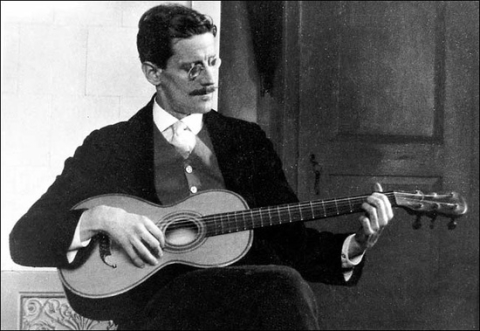
Joyce the singer is typically pictured “drooping over the keys” of a piano (as Shakespeare and Company founder Sylvia Beach put it). But he also played the guitar, as you can see from the 1915 photo above (taken in Trieste by Joyce’s friend Ottacaro Weiss). Joyce’s small-bodied guitar has been housed at the Joyce Tower Museum in Dublin since 1966, in an unplayable state.
Now, English luthier Gary Southwell has undertaken a restoration of the instrument at the behest of Tower Museum curator Robert Nicholson and Fran O’Rourke, professor of philosophy at Joyce’s alma mater, University College Dublin. A musician himself, O’Rourke will perform Joycean Irish songs during Bloomsweek to offset the cost of the project, accompanied on the restored Joyce guitar by Irish classical guitarist John Feeley
Luthier Southwell describes the guitar as “a fairly standard instrument of the period… not from any great maker of the past or anything like that.” In the video above from The Irish Times, see Southwell, Professor O’Rourke, and Joyce scholar Terence Killeen describe the state of the guitar and its history. And below, listen to Joyce’s only known composition, the melancholy “Bid Adieu to Girlish Days,” sung by tenor Kevin McDermott.
The venue isn’t as large. The head of hair isn’t as full. The beat doesn’t drive as hard. But the song remains the same. Above, Mick Jones revisits a Clash classic, “Train in Vain,” at the opening of The Rock and Roll Public Library in 2009. If you want to see vintage Clash, then check out some of the classic Clash concerts we’ve highlighted below. Other charming songs played that day at the library include:
Should I Stay or Should I Go?
Stay Free
Note: We originally posted Mick’s library gig in March of 2012. I’m reposting it today to see if we’ve got some tech bugs worked out and because I love these endearing clips so much. Hope you enjoy.
Even if you don’t know classical music, you know Ludwig van Beethoven’s Symphony No. 9. Finished in 1824, Beethoven’s final complete symphony, and the first from any major composer to use voices, has risen to and remained at the top of the Western orchestral canon as one of the most frequently performed symphonies in existence. The Japanese have even gone so far as to make it a New Year’s tradition. I remember, when first learning the Japanese language, watching an educational video about an amateur neighborhood chorus converting the original German into more readable Japanese phonetic script, so as to better sing it for their celebration. A charming story, to be sure, but at the top of the post, you’ll find Beethoven’s 9th rendered with the exact opposite of amateurism by the Wiener Philharmoniker, with Leonard Bernstein conducting. (Part one, Part Two, Part Three, Part Four.) Then again, at the root of “amateur” lies the term “to love,” and who would dare accuse Bernstein, however consummately professional a man of music, of not loving this symphony?
“I’ve just finished filming and recording the great 9th Symphony,” Bernstein says in the clip just above, describing how the experience got him thinking about historical dates. “My associations led me back to the year of my own birth, 1918, the year of the great armistice which brought the First World War to an end. Now, I had the key. The password was peace, armistice, brotherhood — ‘ain’t gonna study war no more.’ Peace, brotherhood, we are all children of one father, let us embrace one another, all the millions of us, friendship, love, joy: these, of course, are the key words and phrases from [Friedrich] Schiller’s [“Ode to Joy”] to which Beethoven attached that glorious music, ranging from the mysterious to the radiant to the devout to the ecstatic.” You can also watch the performance that put Bernstein’s mind on this track as one of the many included in Beethoven 9, Deutsche Grammophon’s first iPad/iPhone/iPod app. For free, you get two minutes of the symphony with all features enabled. “The full experience,” their site adds, ” is then unlocked through In-App Purchase.”
In 1941, England found itself in an all-out-war with Nazi Germany. It had sustained severe damage when the Nazis unleashed the Blitz on 16 English cities between September 1940 and May 1941. Despite the heavy toll, there was only one thing for most Brits to do — to keep calm and carry on and preserve small moments of normalcy when possible. Of course, that meant drinking tea and not just any tea, but good tea. Above we present Tea Making Tips, a short 1941 film created by the Empire Tea Bureau, that outlines the golden rules for making tea worthy of its name. The narrator reminds the viewers, “Tea is not a manufactured article which can be made, bottled up and served at will. It must be prepared every time it is acquired, and it’s success or failure depends entirely upon the attention you pay to the six golden rules.” If you watch the 10-minute film, you’ll actually count 10 rules (if not more), many of which are still presumably relevant to a tea drinker today. They are as follows:
1) In general, store tea leaves in an airtight container, preferably away from cheese, soap, spices and other items with strong aromas.
2) Also keep the tea off of the ground and away from walls.
3) Always use a good quality tea. You’ll spend a little more money, but you’ll actually get more bang for your pound.
4) Use fresh water. Stale water makes stale tea, which no one needs, especially in wartime.
5) Make sure you warm your teapot before adding hot water and tea leaves.
6) Use the right ratio of tea leaves to water.
7) Steep the tea in water that’s neither under-boiled nor over-boiled.
8) Let the tea infuse for the right amount of time. 3–5 minutes should cover most kinds of tea. Other kinds will need more time.
9) Use tea pots made of china, earthenware, and stainless steel. Avoid ones made of enamel or tin.
10) Don’t add milk to the tea too soon. Wait for the last possible minute.
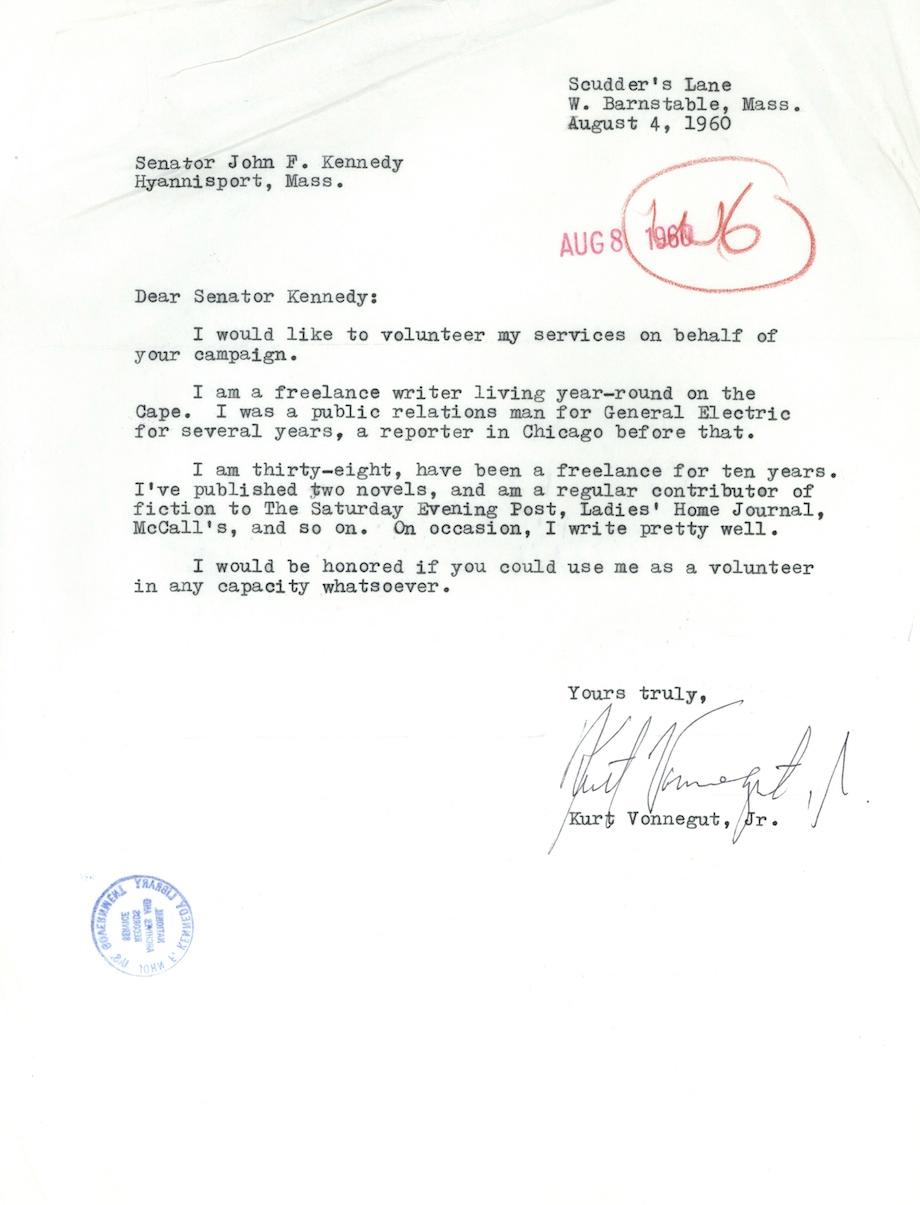
When archivist Stacey Chandler was combing through one of the “Massachusetts” files recently at the John F. Kennedy Presidential Library and Museum in Boston, she stumbled on something unexpected: a letter to Kennedy from an obscure writer named Kurt Vonnegut, volunteering his services on Kennedy’s presidential campaign.
The letter (click the image above to see it larger) was written on August 4, 1960, when Vonnegut was a struggling fiction writer and a failed Saab dealer living on Cape Cod, in the town of West Barnstable, Massachusetts. He had written two novels: Player Piano (1952) and The Sirens of Titan (1959). In a few declarative sentences, Vonnegut outlines his writing experience and offers his help. There is no record at the JFK Library of a reply from Kennedy and, according to Rebecca Onion at Slate, no mention of the subject in two Vonnegut biographies.
“I am thirty-eight,” writes Vonnegut, “have been a freelance for ten years. I’ve published two novels, and am a regular contributor of fiction to The Saturday Evening Post, Ladies’ Home Journal, McCall’s, and so on. On occasion, I write pretty well.”
A couple of days ago, Mick Fleetwood told NPR that a band’s greatest hits belong to its fans “to be reinterpreted and create a backdrop for parts of their lives.”
With that in mind, who among us has not related … or yearned for the boyfriend or girlfriend that might allow us to relate to Peter Criss’ chart-topping “Beth”? The power ballad went gold for Criss’ band KISS in 1976, and has reigned as an ear worm on Classic Rock stations ever since:
Beth, I hear you callin’
But I can’t come home right now
Me and the boys are playin’
And we just can’t find the sound.
Close your eyes and visualize poor Beth, alone in her negligee on that giant bed, the scented candles guttering in sad recognition that art always comes first for a soulful dude like Pete.
Now open them wide for the alternate and extremely spirited take above. This version gives us Beth’s side, compliments of writer Bob Winter, director Brian Billow of Anonymous Content, and actress Lilli Birdsell, MILF-ing it up to vintage perfection as she juggles the kids and a meatloaf in the oven. Rockstar husbands’ salaries aside, Birdsell’s Beth is the embodiment of the red-blooded female multitasker popularized by the Enjoli commercial of the same period. The news that her husband “can’t” come home right now is met not with a tear, but a hilariously flat “What?” (I loved how it took several repetitions for the lyrical hook to register with her.)
I was rooting for this Beth to pull a Thelma and Louise, loading the twins into the Country Squire and dumping them at the studio for their father to deal with. Sadly, our heroine is no match for years of built-up fan interpretations. Guess Betty Draper’s not the only pretty woman doomed to sip her dinner as she stoically ignores both children and partner’s empty plate.
- Ayun Halliday hasn’t even started to think about what’s for dinner tonight, so quit asking. Follow her at @AyunHalliday
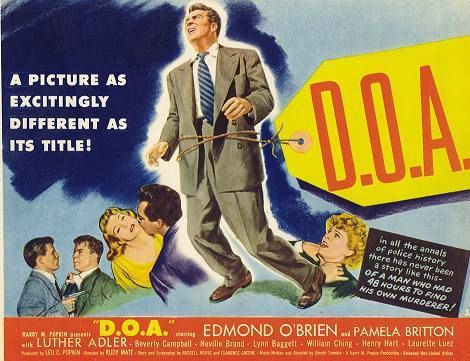
Living and filmgoing here in Los Angeles, I seize every opportunity to watch Los Angeles Plays Itself, Thom Andersen’s extensive and entertaining documentary on the uses and abuses of the city throughout cinema history. In one passage, Andersen tracks the strikingly various roles of George Wyman’s 1893 Bradbury Building downtown: Deckard’s apartment in Blade Runner, Marlowe’s office in Marlowe, the place where Tom meets Autumn in (500) Days of Summer. “The movies discovered the Bradbury Building before the architectural historians did,” the narration tells us. “In China Girl, it played the Hotel Royale in Mandalay, Burma. The following year, in The White Cliffs of Dover, it played a London military hospital overflowing with wounded soldiers.” We then see the climactic scene of a film called D.O.A. which, dramatically heightened even by the standards of film noir, depicts a poisoned man chasing his own murderer up the stairs of the building’s darkened but still unmistakable atrium.
“Fatally poisoned by a luminous toxin slipped into his drink at a jazz club,” so Andersen’s narrator summarizes, “Frank Bigelow has one day before dying to track down his killer, and he finds him at the Phillips Import-Export Company… Room 427.” Few viewers of the documentary will already have seen D.O.A.; the rest surely feel intrigued enough to track it down. Fortunately, they can watch the complete 1950 film free online, since it fell into the public domain in 1977. Called “one of the most accomplished, innovative, and downright twisted entrants to the film noir genre” by the BBC’s David Wood, Hungarian expat director Rudolph Maté’s third picture has, like many of its artistic relatives, experienced a respectful re-evaluation since raising groans from critics with, among other things, the claim of being “As Excitingly Different As Its Title!” Salon’s Michael Sragow calls it an example of a “high-concept movie before its time,” one that certainly does have more to offer you on your film noir Friday than just a neat building.
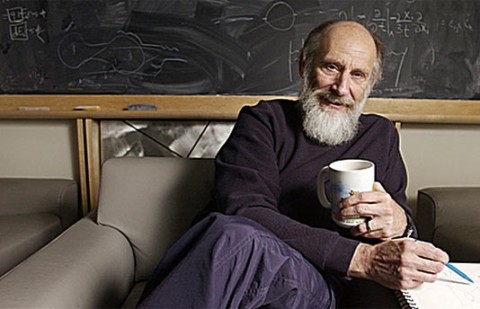
For the past decade, Leonard Susskind, one of America’s pre-eminent physicists, has taught a series of six courses in Stanford’s Continuing Studies program. The series “explores the essential theoretical foundations of modern physics,” helping lifelong learners (like you) attain the “theoretical minimum” for thinking intelligently about modern physics. Over the years, the Continuing Studies program (where, in full disclosure, I serve as the director) has taped the lectures and made them available to a global audience on YouTube and iTunes. We’ve even burned the lectures onto CDs and shipped them to remote locations in Afghanistan and Nepal where connectivity is still lacking. This week, Susskind’s popular lectures found a new home of sorts with the launch of The Theoretical Minimum, a new web site that presents the six courses in a way that’s neat, clean and easy to navigate. The site also offers a short text summary of each lecture, plus related reference materials. You can jump into the courses and get started on your own intellectual journey via this list:
We're hoping to rely on loyal readers, rather than erratic ads. Please click the Donate button and support Open Culture. You can use Paypal, Venmo, Patreon, even Crypto! We thank you!
Open Culture scours the web for the best educational media. We find the free courses and audio books you need, the language lessons & educational videos you want, and plenty of enlightenment in between.