Apple Computer Inc. will introduce an unusual database and management information program Tuesday that the company hopes will help it maintain its lead in technology for making computers easy to use.
The new software, known as Hypercard, will enable users of Apple’s Macintosh computers to organize information on computerized file cards that can be linked to other file cards in intricate ways. The program will be included for no charge with each Macintosh sold, starting this month.
Hypercard made its appearance precisely when Apple also released “a communications device, known as a modem, that will enable the Macintosh to send documents to and from facsimile machines.” Some of us still use modems today. Hypercard, not so much. At least not directly.
If you would like to support the mission of Open Culture, consider making a donation to our site. It’s hard to rely 100% on ads, and your contributions will help us continue providing the best free cultural and educational materials to learners everywhere. You can contribute through PayPal, Patreon, and Venmo (@openculture). Thanks!
Jack White, best known as the frontman of The White Stripes, launched Third Man Records in 2001, which has since positioned itself as “an innovator in the world of vinyl records and a boundary pusher in the world of recorded music, aiming to bring tangibility and spontaneity back into the record business.”
After establishing a physical location in Nashville in 2009, Third Man Records opened a second site in Detroit, and now a new vinyl pressing plant in the Motor City, providing a home to eight German-made record pressing machines. Jack White told CBS, “One day, I want this place to be like what I had heard about Henry Ford wanted for Ford Motor company. Which was you pour in raw materials on this side and out the other side of the factory pop out cars.”
Above you can get a half hour tour of the new record plant from Mythbuster’s Adam Savage. Enjoy.
If you would like to support the mission of Open Culture, consider making a donation to our site. It’s hard to rely 100% on ads, and your contributions will help us continue providing the best free cultural and educational materials to learners everywhere. You can contribute through PayPal, Patreon, and Venmo (@openculture). Thanks!
In places where atrocities or widespread human rights violations occur, we sometimes hear ordinary citizens later claim they didn’t know what was going on. In the case of the internment of Japanese Americans during World War II, this would be almost impossible to believe. “120,000 people,” notes Newsweek, “lost their property and their freedom,” rounded up in full view of their neighbors. Every major publication of the time reported on Franklin Roosevelt’s 1941 Executive Order. Newsweek wrote “that people in coastal areas ‘were more anxious than ever to get rid of their aliens after rumors that signal lights were seen before submarine attacks’ ” off the coast of Southern California. There were many such rumors, the kind that spread xenophobic fear and paranoia, and which people used to vocally support, or tacitly approve of, sending their neighbors to internment camps because of their ancestry.
Image by Francis Stewart
Other reactions were less than subtle. The West Seattle Herald confronted readers with the blunt headline “GET ‘EM OUT!” Nonetheless, Newsweek’s Rob Verger writes, “the policy was by no means greeted with unanimous support,” and a vigorous public debate played out, with opponents pointing to the blatant racism and violations of civil rights. Two-thirds of the internees were American citizens. Yet all Japanese Americans were repeatedly called “aliens,” language consistent with the virulently anti-Japanese propaganda campaigns emerging at the same time.
Once the camps were built and the internees imprisoned, however, a massive propaganda effort began, not only the sell the camps as a necessary national security measure, but to portray them as idyllic villages where the patriotic internees patiently waited out the war by farming, playing baseball, making arts and crafts, running general stores, attending school, waving flags, and running newspapers.
Image by Clem Albers
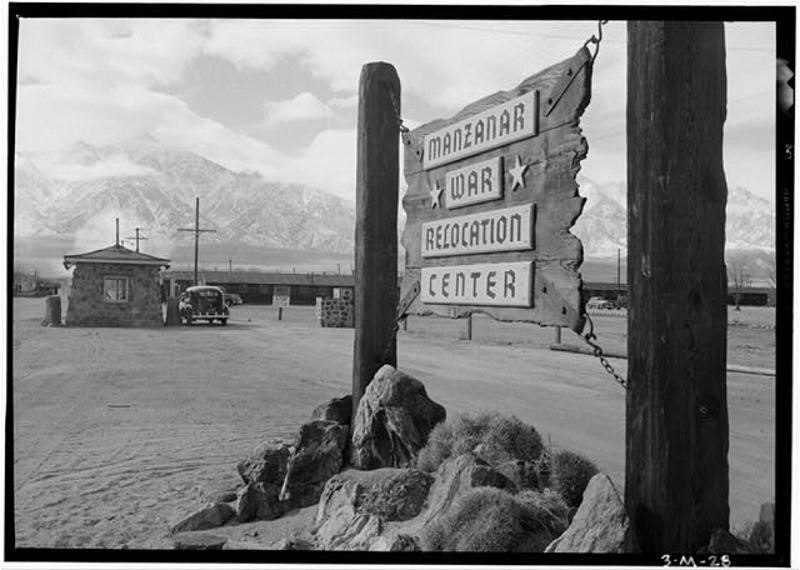
Much of that information was conveyed to the public visually by photographers hired by the War Relocation Authority to document the camps. Among them were Clem Albers, Francis Stewart, and Dorothea Lange—well known for her photographs of the Great Depression. All three visited the camp called Manzanar in the foothills of the Sierra mountains. Another famous photographer, Ansel Adams, gained access to Manzanar by virtue of his friendship with its director, Ralph Merritt.
Image by Dorothea Lange
Their photographs, for the most part, show busily working men and women, smiling schoolchildren, and lots of patriotic leisure activities, like Stewart’s photo of sixth grade boys playing softball, further up. The photographers were strictly prohibited from photographing guards, watchtowers, searchlights, or barbed wire, and the heavy military presence at the camp is nearly always out of frame, with some very rare exceptions, like Albers’ photograph above of military police.
Image by Ansel Adams
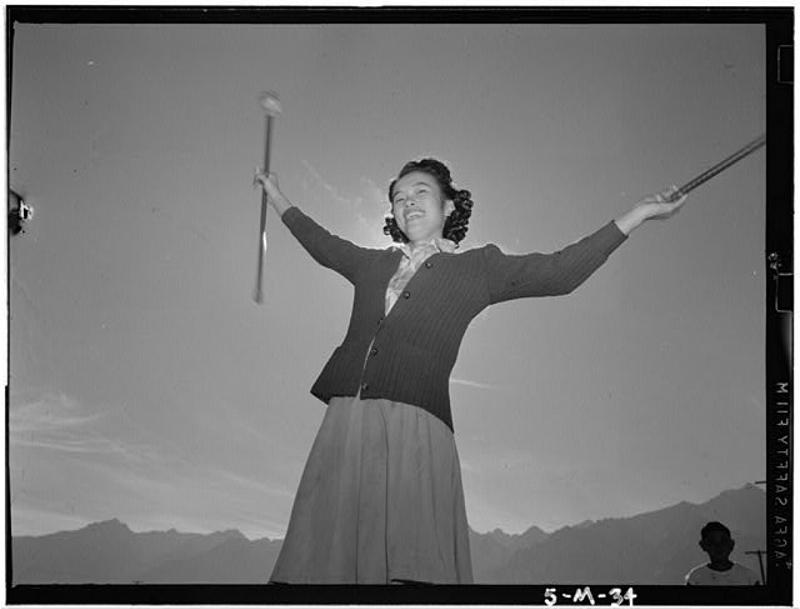
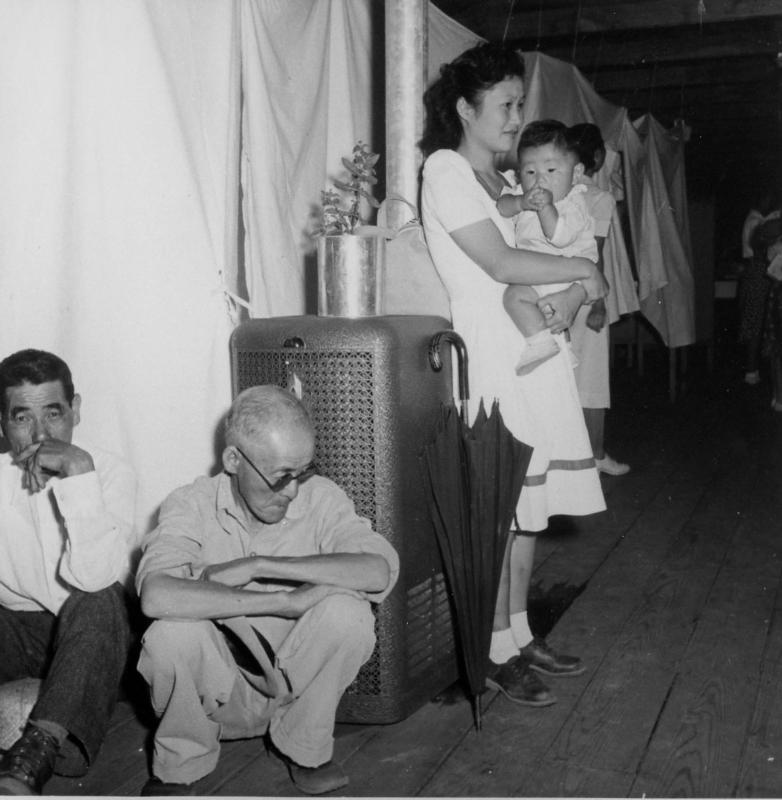
Adams worked under these prohibitions as well, but his photos captured camp life as honestly as he could. The stunning landscapes sometimes compete, even in the background, with the real subject of some of his images (as in the photo at the top). But he also conveyed the harsh barrenness of the region. He tried to intimate the oppressive police apparatus by capturing its shadow. “The purpose of my work,” he wrote to the Library of Congress in 1965 upon donating his collection, “was to show how these people, suffering under a great injustice, and loss of property, business and professions, had overcome a sense of defeat and despair [sic].” His images often show internees “in heroic poses,” writes Dinitia Smith, as above, in order to ennoble their conditions. Lange’s photographs, on the other hand, like that of a young girl below, “seemingly unstaged and unlighted… bear the hallmarks” of her “distinctively documentary style.” Her pictures “compress intense human emotion into carefully composed frames.” Some of her photos show smiling, relaxed subjects. Many others, like the photograph of a barracks interior further down, show the faces of weary, uncertain, and despondent civilian prisoners of war.
Image by Dorothea Lange
Perhaps because of her refusal to sentimentalize the camps, or because of her left-wing politics and opposition to internment (both known before she was hired), Lange’s work was censored, not only through restricted access, but through the impoundment of over 800 photographs she took at 21 locations. Those photos were recently published in a book called Impounded: Dorothea Lange and the Censored Images of Japanese American Internment and hundreds of them are free to view online at the Densho Digital Repository’s Dorothea Lange Collection. The National Park Service’s collection features 16 pictures from Lange’s visit to Manzanar. At the NPS site, you’ll also find collections of photographs from that camp by Adams, Albers, and Stewart. Each, to one degree or another, faced a form of censorship in what they could photograph or whether their work would be shown at all. What most ordinary people saw at the time did not tell the whole story. For all practical purposes, writes Oberlin Library, “life at a Japanese internment camp was comparable to the life of a prisoner behind bars.”
Graphic and motion designer Henning M. Lederer surfs that wave on the most unexpected of boards—a collection of abstract mid-century covers drawn from the Instagram feed of artist Julian Montague, who shares his enthusiasm for vintage minimalism.
His latest effort, above, continues his explorations in the subjects which most frequently traded in these sorts of geometric covers—science, psychotherapy, philosophy and sociology.
No word on what inspired him to toss in the first cover, which features a cheerful, Playmobil-esque mushroom gatherer. It’s endearing, but—to quote Sesame Street—is not like the others. Those of us who can’t decipher Cyrillic script get the fun of imagining what sort of text this is—a mycology manual? A children’s tale? A psychological examination—and ultimately rejection—of midcentury publishers’ fascination for spirals, diagonal bars, and other non-narrative graphics?
Whether or not you’d be inclined to pick up any of these titles, you may find yourself wanting to dance to them, compliments of musician Jörg Stierle’s trippy electronics.
We’ve featured the work of many cinema-loving video essayists (myselfincluded) here on Open Culture, none of it more artistic than that of a man who goes by the name of Kogonada. Whether dealing with the films of auteurs like Stanley Kubrick, Andrei Tarkovsky, Alfred Hitchcock, or Wes Anderson, he finds new and striking ways — often free of traditional narration, and sometimes even free of spoken words altogether — to show us how their cinematic visions work, and in so doing to create new cinematic visions of his own. But when, we Kogonada fans have long wondered, would this mysterious fellow make a movie of his own?
The answer arrived at this year’s Sundance Film Festival in the form of Columbus, Kogonada’s feature directorial debut. “Columbus gets its title from the city where it’s set — Columbus, Indiana, home to a remarkable collection of renowned works of modern architecture,” writes the New Yorker’s Richard Brody, one of the many critics to have already lavished praise on the newly released picture.
“Those buildings provide an extraordinary premise for the drama, which is a visionary transformation of a familiar genre: a young adult’s coming-of-age story. For once, that trope doesn’t involve a sexual awakening or a family revelation; it’s the tale of an intellectual blossoming, thanks to a new friendship that arises amid troubled circumstances.”
Those troubled circumstances have to do with the parents of the two main characters: Casey, a recent high-school graduate who’s stayed in town to care for a mother trying to kick a methamphetamine habit, and Jin, a fortysomething translator who’s flown in from his home in Korea (birthplace of both the Midwest-raised Kogonada and the film’s Los Angeles-raised star John Cho) to watch over his father, an architectural theorist plunged into a coma by a stroke. “These parallel lines meet when Casey offers to show the stranger her town,” writes Rolling Stone’s Peter Travers in his review. “ ‘Meth and modernism are really big here,’ she tells Jin, as he becomes increasingly intrigued by this girl who sees the art and the humanity in buildings.”
Soon Jin and Casey take “baby steps toward a relationship, in a manner that recalls Richard Linklater’s Before Sunrise.” That film, and its successors Before Sunset and Before Midnight, figure heavily into Kogonada’s video essay on Linklater, “On Cinema & Time.” Other influences, cited by critics as well as Kogonada himself, include Terence Malick, whose way with the elemental he examined in “Fire & Water,” and Yasujiro Ozu, whose films got him thinking about cinema in the first place. As he put it to Indiewire, he started by thinking he would “try to figure out what it is about his films that initially felt very unimpressive, but kept haunting me,” to understand why Ozu “isn’t easy to just reduce to something — he certainly is not this sort of traditionalist, he’s certainly not a western modernist, he is something else and whatever he was exploring and offering felt so relevant, even today.”
Kogonada’s video essays “Way of Ozu” and “Passageways” reveal not just the Japanese master’s use of architectural spaces, but Kogonada’s interest in such spaces. Columbus brings the depth of that interest to the fore: “The director provokes awareness of the Modernist Columbus by treating it as one of the film’s characters,” writes Architectural Record’s Dante A. Ciampaglia. “It’s both protagonist and nemesis for Casey and Jin as they wander the city, explore its architectural bounty, and find it both reflecting inner struggles and inspiring epiphanies.” As Kogonada himself puts it, “I think that’s the thing that interests me, the relationship between empty spaces and life itself.” May he find many more opportunities to explore it onscreen.
Even those of us who’ve never read Ray Bradbury’s Fahrenheit 451know it as a searing indictment of government censorship. Or at least we think we know it, and besides, what else could the story of a dystopian future where America has outlawed books whose main character burns the few remaining, secreted-away volumes to earn his living be about? It turns out that Bradbury himself had other ideas about the meaning of his best-known novel, and in the last years of his life he tried publicly to correct the prevailing interpretation — and to his mind, the incorrect one.
“Fahrenheit 451 is not, he says firmly, a story about government censorship,” wrote the Los Angeles Weekly’s Amy E. Boyle Johnson in 2007. “Nor was it a response to Senator Joseph McCarthy, whose investigations had already instilled fear and stifled the creativity of thousands.” Rather, he meant his 1953 novel as “a story about how television destroys interest in reading literature.” It’s about, as he puts it above, people “being turned into morons by TV.” Johnson quotes Bradbury describing television as a medium that “gives you the dates of Napoleon, but not who he was,” spreading “factoids” instead of knowledge. “They stuff you with so much useless information, you feel full.”
He didn’t much like radio either: just two years before Fahrenheit 451, Bradbury wrote to his sci-fi colleague Richard Matheson bemoaning its contribution to “our growing lack of attention,” and its creation of a “hopscotching existence” that “makes it almost impossible for people, myself included, to sit down and get into a novel again.” For the abandonment of reading he saw in society, and from which he extrapolated in his book, he blamed not the state but the people, an entertaiment-as-opiate-addicted “democratic society whose diverse population turns against books: Whites reject Uncle Tom’s Cabin and blacks disapprove of Little Black Sambo,” leading to widespread censorship and eventually the burning of all reading material.
But books still do face challenges (and the FBI even had its eye on Bradbury and his genre), challenges only an intelligent, non-numbed public can beat back. “I get letters from teachers all the time saying my books have been banned temporarily,” says Bradbury in the clip above. “I say, don’t worry about it, put ’em back on the shelves. You keep putting them back and they keep taking them off, and you finally win.” The authors, even Bradbury, can’t help, but he would always tell these literarily-minded people who wrote to him in distress the same thing: “You do the job. You’re the librarian. You’re the teacher. Stand firm and you’ll win. And they always do.”
If you would like to support the mission of Open Culture, consider making a donation to our site. It’s hard to rely 100% on ads, and your contributions will help us continue providing the best free cultural and educational materials to learners everywhere. You can contribute through PayPal, Patreon, and Venmo (@openculture). Thanks!
Antti Lipponen, a researcher at the Finnish Meteorological Institute, gathered historical data from NASA and produced a short video effectively showing that, from 1900 through 2016, the temperature has steadily gotten warmer worldwide. Each spoke of the wheel represents one of 191 different countries. And the hotter the color (e.g. oranges and reds), the warmer the temperature. You can get a closer look at the historical progression here. The materials have been released under a Creative Commons license on Flickr.
If you would like to support the mission of Open Culture, consider making a donation to our site. It’s hard to rely 100% on ads, and your contributions will help us continue providing the best free cultural and educational materials to learners everywhere. You can contribute through PayPal, Patreon, and Venmo (@openculture). Thanks!
Apocalypses have always been popular as mass belief and entertainment. Maybe it’s a collective desire for retribution or redemption, or a kind of vertigo humans experience when staring into the abyss of the unknown. Better to end it all than live in neurotic uncertainty. Maybe we find it impossible to think of a future world existing hundreds, thousands, millions of years after our deaths. As Rebecca Solnit observes in Hope in the Dark: Untold Histories, Wild Possibilities, “people have always been good at imagining the end of the world, which is much easier to picture than the strange sidelong paths of change in a world without end.” What if the world never ends, but goes on forever, changing and evolving in unimaginable ways?
This is the bailiwick of science fiction, but also the domain of history, a hindsight view of centuries past when wars, tyrannical conquests, famines, and diseases nearly wiped out entire populations—when it seemed to them a near certainty that nothing would or could survive the present horror. And yet it did.
This may be no consolation to the victims of violence and plague, but the world has gone on for the living, people have adapted and survived, even under the current, very real threats of nuclear war and catastrophic climate change. And throughout history, both small and large groups of people have changed the world for the better, though it hardly seemed possible at the time. Solnit’s book chronicles these histories, and last year, she released a playlist as a companion for the book.
Hope in the Dark makes good on its title through a collection of essays about “everything,” writes Alice Gregory at The New York Times, “from the Zapatistas to weather forecasting to the fall of the Berlin Wall.” The book is “part history of progressive success stories, part extended argument for hope as a catalyst for action.” Solnit wrote the book in 2004, during the reelection of George W. Bush—a time when progressives despaired of ever seeing the end of chickenhawk sabre-rattling, wars for profit, privatization of the public sphere, environmental degradation, theocratic political projects, curtailing of civil rights, or the disaster capitalism the administration wholeheartedly embraced (as Naomi Klein’s The Shock Doctrine detailed). Plus ça change.…
In March of last year, Haymarket Books reissued Hope in the Dark, and on November 10th, Solnit posted a link to a free download of the book on Facebook. It was downloaded over 30,000 times in one week. Along with other progressive intellectuals like Klein and Richard Rorty, Solnit—who became internationally known for the term “mansplaining” in her essay, then book, Men Explain Things to Me—has now been cast as a “Cassandra figure of the left,” Gregory writes. But she rejects the disastrous futility inherent in that analogy:
If you think of a kind of ecology of ideas, there are more than enough people telling us how horrific and terrible and bad everything is, and I don’t really need to join that project. There’s a whole other project of trying to counterbalance that — sometimes we do win and this is how it worked in the past. Change is often unpredictable and indirect. We don’t know the future. We’ve changed the world many times, and remembering that, that history, is really a source of power to continue and it doesn’t get talked about nearly enough.
If we don’t hear enough talk about hope, maybe we need to hear more hopeful music, Solnit suggests in her Hope in the Dark playlist. Thirteen songs long, it moves between Beyoncé and The Clash, Iggy Pop and Stevie Nicks, Black Flag and Big Freedia.
While the selections speak for themselves, she offers brief commentary on each of her choices in a post at Powell’s. Beyoncé’s “Formation,” Solnit writes, “reformulates, digging deep into the past of sorrow and suffering and injustice and pulling us all with her into a future that could be different.” Patti Smith’s anthem “People Have the Power” feels like hope, Solnit says: “it’s right about the power we have, which obliges us to act, and which many duck by pretending we’re helpless.” Maybe that’s what apocalypses are all about—making us feel small and powerless in the face of impending doom. But there are other kinds of religion, like that of Lee Williams’ “Steal My Joy.” It’s a “gorgeous gospel song,” writes Solnit. “Joystealers are everywhere. Never surrender to them.” That sounds like an ideal exhortation to imagine and fight for a better future.
“Videotape” ends Radiohead’s 2007 album In Rainbows, and like many of their albums, it tends towards the funereal. (Think of the drunken “Life in a Glasshouse” from Amnesiac or “Motion Picture Soundtrack” from Kid A). And at first, it does sound very simple, four plaintive descending chords and Thom Yorke’s high melody over the top of it.
But in this 10 minute video essay from Vox Pop: Earworm, the song’s structure is peeled back to reveal a secret–that the chord sequence is not on the downbeat, but shifted a half-beat earlier. Hence, it is a heavily syncopated song that removes all clues to its syncopation.
Advanced musicians out there might not be blown away by any of this, but for fans of Radiohead and those just coming to music theory, the video is a good introduction to complex rhythm ideas. The fun comes from the backwards way in which Vox and Warren Lain–who devoted a whole 30 minutes to exploring the song–came across the secret.
It starts with video of Thom Yorke trying to play a live version along to a click track, and then to Phil Selway’s drums. For some reason Yorke can’t do it. And that’s because his brain is wanting to put the chords on the downbeat, the most natural, obvious choice. To play off beat, without further rhythmic information, shows the band “fighting against not just their own musical instincts, but their own brainwaves” as the Vox host explains.
There is much discussion in the YouTube comments over whether these 10 minutes are worth the analysis. It’s not that Radiohead invented anything new here–check out the off-beat opening of something like XTC’s “Wake Up”–but more that the band goes through the whole song (at least in the recorded version) without revealing the real rhythm, like playing in a certain key and never touching the root note.
To sum up: Radiohead push themselves in the studio and take those experiments into the live experience and challenge themselves. Which is way more than the majority of rock bands ever do. And bless ‘em, Yorke and co., for doing so.
Ted Mills is a freelance writer on the arts who currently hosts the artist interview-based FunkZone Podcast and is the producer of KCRW’s Curious Coast. You can also follow him on Twitter at @tedmills, read his other arts writing at tedmills.com and/or watch his films here.
If you ask a few of today’s youngsters what they want to do when they grow up, the word “design” will almost certainly come up more than once. Ask them what design itself means to them, and you’ll get a variety of answers from the vaguely general to the ultra-specialized. The concept of design — and of designing, and of being a designer — clearly holds a strong appeal, but how to define it in a useful way that still applies in as many cases as possible?
One set of answers comes from the 90-minute “Crash Course in Design Thinking” above, a production of Stanford University’s Hasso Plattner Institute of Design, or d.school. The Interaction Design Foundation defines design thinking as “an iterative process in which we seek to understand the user, challenge assumptions we might have, and redefine problems in an attempt to identify alternative strategies and solutions that might not be instantly apparent with our initial level of understanding.” In a brief history of the subject there, Rikke Dam and Teo Siang write that “business analysts, engineers, scientists and creative individuals have been focused on the methods and processes of innovation for decades.”
Stanford comes into the picture in the early 1990s, with the formation of the Design Thinking-oriented firm IDEO and its ” design process modelled on the work developed at the Stanford Design School.” In other words, someone using design thinking, on the job at IDEO or elsewhere, knows how to approach new, vague, or otherwise tricky problems in various sectors and work step-by-step toward solutions. D.school, with their mission to “build on methods from across the field of design to create learning experiences that help people unlock their creative potential and apply it to the world,” aims to instill the principles of design thinking in its students. And this crash course, through an activity called “The Gift-Giving Project,” offers a glimpse of how they do it.
You can just watch the video and get a sense of the “design cycle” as d.school teaches it, or you can get hands-on by assembling the simple required materials and a group of your fellow design enthusiasts (make sure you add up to an even number). Youngster or otherwise, you may well emerge from the experience, a mere hour and a half later, with not just new problem-solving habits of mind but a newfound zeal for design, however you define it.
You don’t have to be a gearhead to instantly recognize the sound of the Roland TR-808. Introduced in 1980, the legendary drum machine is all over the 80s, 90s, and the retro 2000s, from dance progenitors like Afrika Bambaataa’s “Planet Rock” to formative Def Jam releases like Run DMC’s debut and the Beastie Boy’s Licensed to Ill (one of the original machines used on such classics recently went on sale). The 808 provides the backbeat for Marvin Gaye’s “Sexual Healing,” New Order’s “Shellshock,” and LL Cool J’s “Going Back to Cali”… track after era-defining track pulses with the iconic drum machine’s deep, thudding kick drum and comically synthetic congas, claves, maracas, handclaps, and cowbells.
Roland has obviously felt the pop cultural winds blowing its way. Yesterday, on 808 Day, the company announced a new iteration, now called the TR-08, as part of its Boutique line. (A previous revival, the TR‑8, saw Roland combine the 808 with the classic 909, renowned in rave circles.) The video at the top features some of the 808’s original adopters—producer Jimmy Jam, rapper Marley Marl, and DJs Jazzy Jeff and Juan Atkins—marveling over the new product. Just above, in case you’ve somehow forgotten, we have a demonstration of famous TR-808 beats from tracks like “Planet Rock” and Cybotron’s “Clear,” songs that made innovative use of samples and which themselves became choice material for dozens of sample-based productions.
The 808 was the choice of drum machine for tinkerers. Its sound was “crowd-sourced,” writes Chris Norris, “with artists building on one another’s modifications of the device. One of the first major innovations came about in 1984,” with the “fine tuning of the 808’s low frequencies and further widening of its bass kick drum to create the sound of an underground nuke test” heard on producer Strafe’s club hit “Set it Off.” The new TR-08 has a much smaller footprint and expands the machine’s capabilities with contemporary features like an LED screen, controls over gain and tuning, battery or USB power, and audio or MIDI through a USB connection.
Arguably “one of the most impactful pieces of modern music hardware,” writes The Verge, upon its debut the 808 “received mixed reviews and was considered a commercial failure as its analog circuitry didn’t create the ‘traditional’ drum sounds” most producers expected. This meant that 808s could be picked up relatively cheaply by bedroom producers and local DJs. As a result, “the trembling feeling of that sound,” Norris writes, “booming down boulevards in Oakland, the Bronx, and Detroit are part of America’s cultural DNA, the ghost of Reagan-era blight” and the renaissance of creativity born in its midst. To get a sense of the breadth of the 808’s musical contributions, listen to the playlist above, with everyone from Talking Heads to 2 LIVE CREW, Phil Collins, and Whitney Houston putting in an appearance.
We're hoping to rely on loyal readers, rather than erratic ads. Please click the Donate button and support Open Culture. You can use Paypal, Venmo, Patreon, even Crypto! We thank you!
Open Culture scours the web for the best educational media. We find the free courses and audio books you need, the language lessons & educational videos you want, and plenty of enlightenment in between.