Little known fact, during his high school days, Stephen Colbert was the front man of a Rolling Stones cover band. And, appearing on Howard Stern on Tuesday, just weeks before taking over The Late Show, Colbert proved it, singing and doing a jig to “Brown Sugar.” He moves like Jagger, and it’s fun to watch.
The Late Show with Stephen Colbert starts Tuesday, September 8th — right after Labor Day.
Punk rock and its accoutrements—including the handmade, Xeroxed ‘zine—pass into history, replaced by Taylor Swift and Snapchat, or whatever. But as a piece of history, the ‘zine will always stand as a marker of a particular era, of the 80s/early 90s explosion of critical consciousness fostered by young kids reading Nietzsche, Foucault, and Camus, then forming their own bands, labels, and networks. Crucial to the period is the emergence of Riot Grrrl bands like Bikini Kill and their assault on oppressive gender politics, in punk rock and everywhere else. And crucial to many such punks’ understanding of gender was the work of critical theorist Judith Butler.
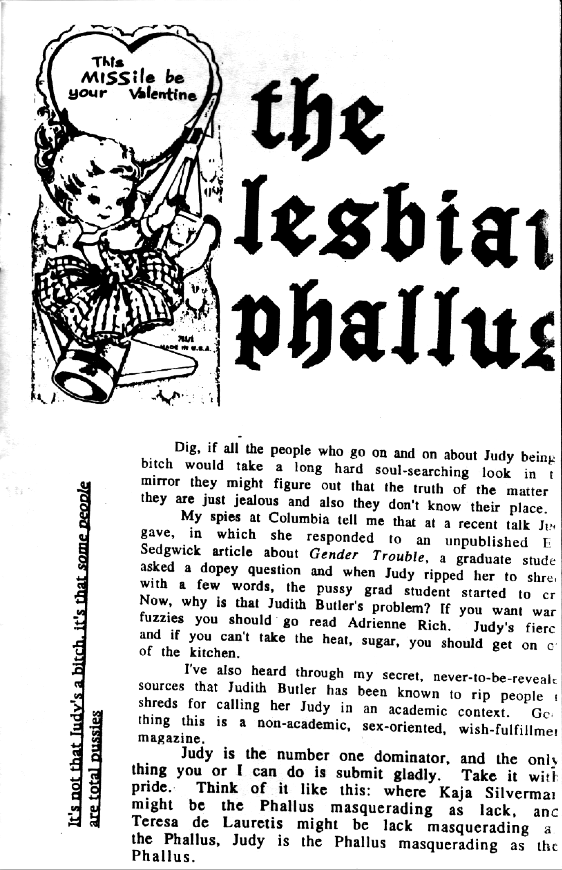
“Riot Grrrl didn’t herald the beginnings of third wave feminism,” writes Sophia Satchell Baeza in Canvas, “we’ll give that to the emergence of post-structuralist Queer theory, and the work of Judith Butler—but it did help define it aesthetically as much as formally for a new generation of indignant feminists.” An essential part of that aesthetic—the ‘zine—spread the tenets of Riot Grrrl anger, determination, and irony to cities far and wide. And, in 1993, a group of intellectual scenesters created the ultimate punk homage to Butler’s undeniable influence: Judy!, an honest-to-goodness Judith Butler fanzine, complete with murky, mimeographed photo spreads and serial killer typescript. (See the cover at the top, with photo of Judy Garland.) “Let’s talk about that real glamour gal of theory, Judy Butler,” begins one free-form introductory essay.
She’s especially good to see live, if you can. Her performances are rife with witty repartee about her mom or whatever and the three times I’ve seen her, she’s been sporting little tailored black jackets. She’s a bit Gap but she’s still a fox.
This cavalier hipster tone hides the voice of a likely grad student, who mentions M.L.A. (the Modern Language Association’s conference), and other post-structuralist theorists like Gayatri Spivak, Eve Sedgwick, and Julia Kristeva. There are footnotes and references to Butler’s classic Gender Trouble amidst much more irreverent, catty rhetoric like “Judy is the number one dominator, and the only thing you or I can do is submit gladly.” It’s great fun, if that’s what you’re into—and if you get the combo of ‘zine aesthetic and academic feminist theory. There’s even a quiz to test your knowledge of the latter’s high priestess professors and inscrutable argot: “are you a theory-fetishizing biscuithead?”
As much as it knowingly pokes fun at itself, in both form and content the artifact represents a perfect hybridization of streetwise mid-nineties punk rock and challenging mid-nineties high feminist theory. Central to the latter, Judith Butler challenges cultural norms in ways that very much inform our popular understanding of gender and sexuality today. And ‘zine culture, though it may appear mostly in museums and retrospectives these days, lives on in spirit in the work of hip, cultural mavens like Rookie’s Tavi Gevinson. Above, see Butler discuss her theory of gender performativity. And Read the entire issue of Judy!, the fanzine, here.
One often hears lamented the lack of well-spoken public intellectuals in America today. Very often, the lamenters look back to James Baldwin, who in the 1950s and 1960s wrote such powerful race‑, class‑, and sex-examining books as Go Tell It on the Mountain, Giovanni’s Room, and The Fire Next Time, as one of the greatest figures in the field.Though Baldwin expatriated himself to France for much of his life, he seems never to have let the state of his homeland drift far from his mind, and his opinions on it continued to put a charge into the grand American debate.
Upon one return from Paris in 1957, Baldwin found himself wrapped up in the controversy around the Civil Rights Act and the related movements across the south. He wrote several high-profile essays on the subject, even ending up himself the subject of a 1963 Time magazine cover story on his views. That same year, he went on a lecture tour on race in America which put him in close contact with a variety of student movements and other protests, whose efficacy he and Malcolm X debated in the broadcast above.
“While Malcolm X criticized the sit-in movement as passive,” writes Rhonda Y. Williams in Concrete Demands: The Search for Black Power in the 20th Century, “Baldwin argued that ‘maintaining calm in the face of vitriol demands a tremendous amount of power.’ ” He goes on to say that “when the sit-in movement started or when a great many things started in the western world, I think it had a great deal less to do with equality than with power.” This got him wondering about what he saw as the all-important distinction between “power and equality” and “power and freedom.”
Two years later, Baldwin appeared in another high-profile debate with about as different an interlocutor from Malcolm X as one can imagine: Firing Line host William F. Buckley, across from whom every well-spoken public intellectual in America of that era must have sat at one time or another. They discussed whether the American Dream comes “at the expense of the American negro.” Buckley, as Josh Jones wrote here in 2012, “had come out four years earlier against desegregation and Civil Rights legislation” and could ably defend his positions, but “Baldwin proved the more persuasive voice.”
Dissecting the skills of Baldwin the debater, John Warner of Inside Higher Education writes that “Baldwin’s remarks display all the skill and moves of an expert persuader” such as “the attendance to audience, the acknowledgement of their needs, the combination of both emotional and logical argument.” His arguments also have their roots not in “attitudes or beliefs, which are varied and changeable, but values, which are widely shared and immutable.”
Baldwin, Warner continues, “reminds us that America is the land of the free, the home of the brave, that all men are created equal, that we are here to pursue life, liberty, happiness,” but “while these values are powerful and timeless, our understanding of how they may be best achieved, the conditions under which they can be fostered change all the time.” Whether on the air or in text, against Malcolm X, William F. Buckley, or anyone else, his performance in debate shows that “the best and most lasting persuasion is simply the act of reminding people of what they already believe to be true.”
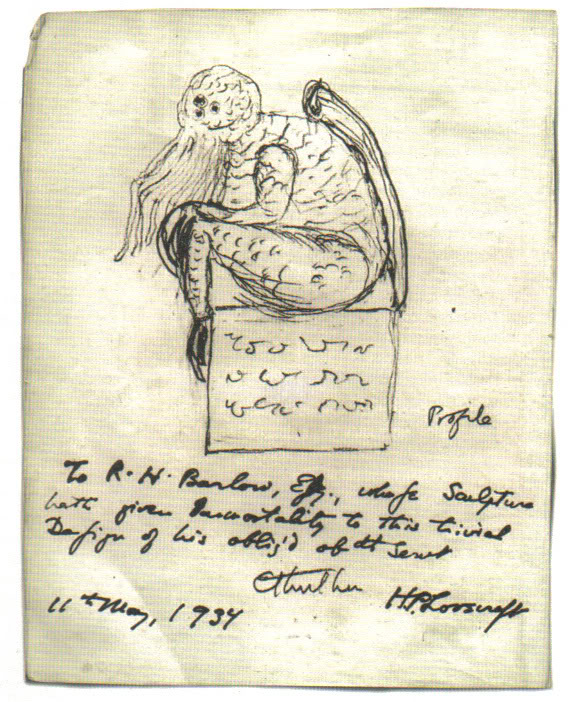
Horror writer Howard Phillips Lovecraft was a man who lived his life in fear—of people of other races and nationalities, of women, of reality itself. In a recent New York Review of Books write-up, Charles Baxter somewhat derisively characterizes Lovecraft as a disenchanted adolescent (and favorite of disenchanted adolescents), who “never really grew up. ‘Adulthood is hell,’ he once wrote in a letter.” Yet his fiction depicts more than a tormented adult world, but an entire universe brimming with nameless ancient horrors—and occasionally named ones like the creature Cthulhu, whose likeness he once sketched out in a letter to a friend.
The cephalopod-faced monster crystalizes Lovecraft’s disgust with reality in all its strangeness and, for him, all its variety. It’s a perfect image of alienation (just this past week we saw tongue-in-cheek speculation over whether octopuses are aliens; a plausible conceit) and presents us with an elemental uncanniness that characterizes his entire body of work. “Fiction like Lovecraft’s can be brutally hypnotic,” writes Baxter, “the young reader, intellectually undefended and easily shaken enters the writer’s fear-drenched universe and can’t easily get out of it.”
The Call of Cthulhu — Part 1
The Call of Cthulhu — Part 2
Whether you discovered Lovecraft as a young reader or an older one, you may have found yourself similarly entrapped by the horrors of his imagination. And you could count yourself in the company of not only hermetic, misanthropic, death-obsessed young men in punk bands but also of media friendly, death-obsessed writers like Stephen King and Joyce Carol Oates. And, of course, thousands upon thousands of horror fans across the world, including a great many actors, writers, and directors who over the years have adapted Lovecraft’s fiction as old-fashioned radio drama of the kind the author himself might have consumed while isolated from the wicked world in his New England home.
You can hear some choice examples here: at the top of the post we have Richard Coyle’s reading of the novella At the Mountains of Madness. (You can also hear his reading of “The Shadow Over Innsmouth”here.) Next, we have a 1945 dramatization of “The Dunwich Horror,” performed by Academy Award-winning actor Ronald Colman. And then hear the infamous “Call of Cthulhu,” parts one and two, produced by the Atlanta Radio Theatre Company, who have recorded no small number of Lovecraft radio plays. Just above, listen to a reading of “Behind the Wall of Sleep” from old-time radio sci-fi readings archive Mind Webs (which we’ve covered in a previous post). Finally, below, listen on Spotify to the HP Lovecraft Radio Hour Vol 1, a collection of dramatized Lovecraft stories.
Should you happen to tear through these recordings and find yourself in desperate need of more to feed your Lovecraft obsession, fear not; you would have a very hard time exhausting all the options. The World’s Largest H.P. Lovecraft Audio Links Gateway, for example, delivers exactly what it promises. Should that expansive database somehow leave out a reading or dramatization, you’ll perhaps find it over at the H.P. Lovecraft Archive’s sizeable collection. And you must, if you’re a Lovecraft fan, visit the H.P. Lovecraft Historical Society, who host plenty of Lovecraft merch, and links to much more Lovecraft audio, including albums inspired by his work and a podcast.
And on the off chance you knew little or not at all of Lovecraft before reading this post, beware. You may, after listening to some of his weird tales of horror, come away a devoted Lovecraft cultist.
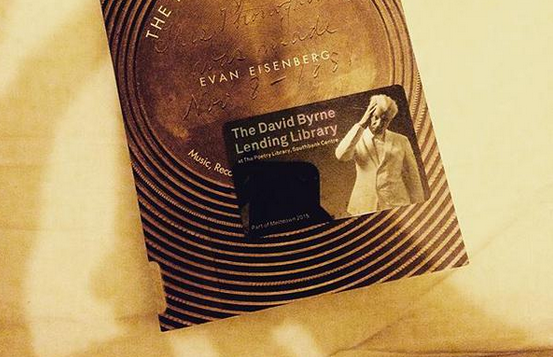
Just yesterday we were musing on perusing rock stars’ bookshelves, and today we learn it has become a reality, if you live in London. Polymath and all-around swell person David Byrne opened the 22nd annual Meltdown Festival this last Monday, and in the spirit of London’s Poetry Library (which is hosting this part of the event), the former Talking Heads frontman has shipped over 250 books to stock his own lending library for the duration of the festival, until August 30.
In his Guardian essay explaining his decision to let you rifle through his collection of music books—some of which were used as research for his own How Music Works—Byrne waxes about the library he loved in his teenage years in suburban Baltimore:
We were desperate to know what was going on in the cool places, and, given some suggestions and direction, the library was one place where that wider exciting world became available. In my little town, the library also had vinyl that one could check out and I discovered avant-garde composers such as Xenakis and Messiaen, folk music from various parts of the world and even some pop records that weren’t getting much radio play in Baltimore. It was truly a formative place.
Byrne has set up a free-to-borrow system with a credit card on file just in case you abscond with the book, although he does admit it may happen and “so be it.” There’s also an added thrill:
Some of my books may have highlighted bits or notes scrawled in the margins. I hope nothing embarrassing.
Byrne’s programming for the Meltdown Festival can be seen here. Highlights include an a cappella workshop by Petra Haden, a showing of There Will Be Blood with live score by Jonny Greenwood and the London Contemporary Orchestra, the reappearance of Young Marble Giants, Young Jean Lee’s band Future Wife performing We’re Gonna Die with David Byrne as special guest; and many other selections of “Things David Thinks You Should Hear.”
Ted Mills is a freelance writer on the arts who currently hosts the FunkZone Podcast. You can also follow him on Twitter at @tedmills, read his other arts writing at tedmills.com and/or watch his films here.
How did everything begin?What makes us human?What is the self?How do I live a good life?What is love? We’ve all asked these questions, if only within our heads, and recently a series of BBC animations written by philosopher Nigel Warburton and narrated by a variety of celebrities have done their level best to answer them–or at least to point us in the direction of answering them for ourselves by not just telling but wittily showing us what great minds have thought and said on the issues before we came along. Most recently, they’ve taken on that eternal conundrum, “How can I know anything at all?”
The already philosophically inclined will have recognized this as the foundational question of epistemology, that formidable branch of philosophy concerned with what we know, how we know, and whether we can know in the first place. Many familiar names in the history of philosophy have stepped onto this field, including Ludwig Wittgenstein, with whose thoughts this series of extremely brief explanatory videos begins. It lays out his analogy of the beetle in a box, wherein each person holds a box containing what they call a “beetle,” but nobody can look inside another’s box to confirm whether their idea of a beetle aligns with anyone else’s.
In Wittgenstein’s view, says actor Aidan Turner, “there can’t be more to the public meaning of a language than we’re capable of teaching each other, and the private ‘something’—the ‘beetle’—can’t have a role in that teaching, because we can’t get at it.” The next video, in asking whether we should believe in miracles, brings in Scottish Enlightenment thinker David Hume, who thought that “if we follow the rule of proportioning our beliefs to the available evidence, there will always be more evidence that the eyewitness accounts were mistaken than not.” Hume’s predecessor George Berkeley makes an appearance to weigh in on whether anything exists—or, more precisely, whether anything exists besides our minds, which convince us that we experience real things out there in the world.
Finally, the series lands on a method we can use to know, one science has relied on, with seeming success, for quite some time now: Karl Popper’s idea of falsification. “Rather than looking for supporting evidence, Popper argued that scientists go out of their way to refute their own hypotheses, testing them to destruction,” leaving those that remain, at least provisionally, as knowledge. Though none of these videos exceed two minutes in length, each one, dense with both philosophical and pop-cultural references, will leave you with more knowledge about epistemology than you went in with—assuming they don’t leave you disbelieving in knowledge itself.
Neil Gaiman might just be the most beloved fantasy author out there. He writes weird, twisted, exhilarating tales about hidden realities and the bizarre, fanciful creatures that live in them. His works, like Sandman, Fragile Things and American Gods, are pure escapism and a blast to read. No doubt, that’s the major reason why the author has developed such a rabid fan base.
But perhaps another reason is that he is simply more available than most writers. Sure, other authors, like J. K. Rowling for instance, might have inspired an entire generation with her Harry Potterseries but she prefers to keep a certain remove from her readership. Though she has a Twitter account, she uses it sparingly.
Gaiman, on the other hand, is seemingly always on Twitter — he has, as of this writing, tweeted at least nine times in the past 24 hours, interacting with fans, publishers and the press. This is the guy who once reportedly signed 75,000 copies of his book The Ocean at the End of the Lane, after all.
He has also posted a lot of his work for free up on the internet. Below is a list of Gaiman’s work that you can read, see or hear online. Many are read by Neil himself. If you know of any missing texts, please let us know and we’ll get them added to our list ASAP.
Jonathan Crow is a Los Angeles-based writer and filmmaker whose work has appeared in Yahoo!, The Hollywood Reporter, and other publications. You can follow him at @jonccrow. And check out his blog Veeptopus, featuring lots of pictures of vice presidents with octopuses on their heads. The Veeptopus store is here.
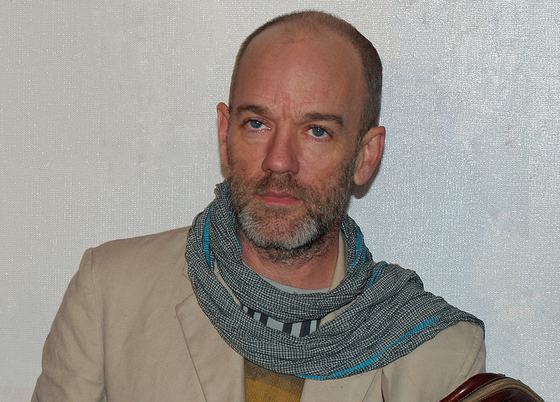
Michael Stipe’s tenure as frontman and lyricist for R.E.M. certainly revealed a literate mind. A former art major at the University of Georgia and current art teacher at NYU, his best lyrics scan well as poetry. One can imagine being invited over for a dinner party to Mr. Stipe’s place, and, glass of wine in hand, absolutely having to nose through his bookshelf. What does the writer of “Nightswimming” read? With the historical references that course through those early albums, would he have socio-political books about America? Would he pull a book off the shelf and say, here, “You have to read this. It will change your life”?
Wonder no more, because Stipe was recently asked to write down his Top Ten list of books to take to a desert island. The list was published in The New York Times. Find a skeletal version here:
Some of these are classics—for example Kerouac’s On the Road, which Stipe calls “my band’s template”—and the one poet on the list, Rimbaud, is very much an early influence on his writing. Dhalgren was also a favorite of David Bowie’s, who based a lot of Diamond Dogs on the novel. The Copeland and Didion choices stand out, mostly by being less obvious selections from their bibliographies. And as he says that he’s currently reading the Patti Smith book (now being turned into a series on Showtime), we can’t take the selection too seriously. Maybe he just wants to take it to the desert island to finish it.
Stipe has included a few sentences on each book to explain his choices. Find them here.
Ted Mills is a freelance writer on the arts who currently hosts the FunkZone Podcast. You can also follow him on Twitter at @tedmills, read his other arts writing at tedmills.com and/or watch his films here.
For some years now linguist Daniel Everett has challenged the orthodoxy of Noam Chomsky and other linguists who believe in an innate “universal grammar” that governs human language acquisition. A 2007 New Yorker profile described his work with a reclusive Amazonian tribe called the Piraha, among whom Everett found a language “unrelated to any other extant tongue… so confounding to non-natives that” until he arrived in the 70s, “no outsider had succeeded in mastering it.” And yet, for all its extraordinary differences, at least one particular feature of Piraha is shared by humans across the globe—“its speakers can dispense with their vowels and consonants altogether and sing, hum, or whistle conversations.”
In places as far flung as the Brazilian rainforest, mountainous Oaxaca, Mexico, the Canary Islands, and the Black Sea coast of Turkey, we find languages that sound more like the speech of birds than of humans. “Whistled languages,” writes Michelle Nijhuis in a recent New Yorker post, “have been around for centuries. Herodotus described communities in Ethiopia whose residents ‘spoke like bats,’ and reports of the whistled language that is still used in the Canary Islands date back more than six hundred years.”
In the short video from UNESCO at the top of the post, you can hear the whistled language of Canary Islanders. (See another short video from Time magazine here.) Called Silbo Gomero, the language “replicates the islanders’ habitual language (Castilian Spanish) with whistling,” replacing “each vowel or consonant with a whistling sound.” Spoken (so to speak) among a very large community of over 22,000 inhabitants and passed down formally in schools and ceremonies, Silbo Gomero shows no signs of disappearing. Other whistled languages have not fared as well. As you will see in the documentary above, when it comes to the whistled language of northern Oaxacan peoples in a mountainous region of Mexico, “only a few whistlers still practice their ancient tongue.” In a previous Open Culture post on this film, Matthias Rascher pointed us toward some scholarly efforts at preservation from the Summer Institute of Linguistics in Mexico, who recorded and transcribed a conversation between two native Oaxacan whistlers.
Whistled languages evolved for much the same reason as birdcalls—they enable their “speakers” to communicate across large distances. “Most of the forty-two examples that have been documented in recent times,” Nijhuis writes, “arose in places with steep terrain or dense forests—the Atlas Mountains, in northwest Africa; the highlands of northern Laos, the Brazilian Amazon—where it might otherwise be hard to communicate at a distance.” Such is the case for the Piraha, the Canary Islanders, the Oaxacan whistlers, and another group of whistlers in a mountainous region of Turkey. As Nijhuis documents in her post, these several thousand speakers have learned to transliterate Turkish into “loud, lilting whistles” that they call “bird language.” New Scientist brings us the example of whistled Turkish above (with subtitles), and you can hear more recorded examples at The New Yorker.
As with most whistled languages, the Turkish “bird language” makes use of similar structures—though not similar sounds—as human speech, making it a bit like semaphore or Morse code. As such, whistled languages are not likely to offer evidence against the idea of a universal grammar in the architecture of the brain. Yet according to biopsychologist Onur Güntürkün—who conducted a study on the Turkish whistlers published in the latest Current Biology—these languages can show us that “the organization of our brain, in terms of its asymmetrical structure, is not as fixed as we assume.”
Where we generally process language in the left hemisphere and “pitch, melody, and rhythm” in the right, Nijhuis describes how the whistled Turkish study suggests “that both hemispheres played significant roles” in comprehension. The opportunities to study whistled languages will diminish in the years to come, as cell phones take over their function and more of their speakers lose regional distinctiveness. But the work of Güntürkün and other biological researchers may have fascinating implications for linguists as well, creating further connections between speech and music—and perhaps even between the speech of humans and that of other animals.
If you’ve ever played Call of Cthulhu, the tabletop role-playing game based on the writing of H.P. Lovecraft, you’ve felt the frustration of having character after painstakingly-created character go insane or simply drop dead upon catching a glimpse of one of the many horrific beings infesting its world. But as the countless readers Lovecraft has posthumously accumulated over nearly eighty years know, that just signals faithfulness to the source material: Lovecraft’s characters tend to run into the same problem, living, as they do, in what French novelist Michel Houellebecq (one of his notable fans, a group that also includes Stephen King, Joyce Carol Oates, and Jorge Luis Borges) calls “an open slice of howling fear.”
Read enough of Lovecraft’s middle-class east-coast professional narrators’ mortal struggles for the words to convey what he called “the boundless and hideous unknown” that suddenly confronts them, and you start to wonder what these creatures actually look like. The clearest word-picture comes in the 1928 story “The Call of Cthulhu,” whose narrator describes the titular ancient malevolence—avoiding instantaneous mental breakdown by looking at an idol rather than the being itself—as “a monster of vaguely anthropoid outline, but with an octopus-like head whose face was a mass of feelers, a scaly, rubbery-looking body, prodigious claws on hind and fore feet, and long, narrow wings behind.”
And so modern Lovecraftians have enjoyed a new variation of that giant octopus-dragon-man form on “Cthulhu for President” shirts each and every election year. (You can find one for 2016 here.) While that phenomenon would surely have surprised Lovecraft himself, constantly and fruitlessly as he struggled in life, I like to think he’d have approved of the designs, which align in fearsome spirit with the sketches he made. At the top of the post you can see one sketch of the Cthulhu idol, drawn in 1934 on a piece of correspondence with writer R.H. Barlow, Lovecraft’s friend and the eventual executor of his estate.
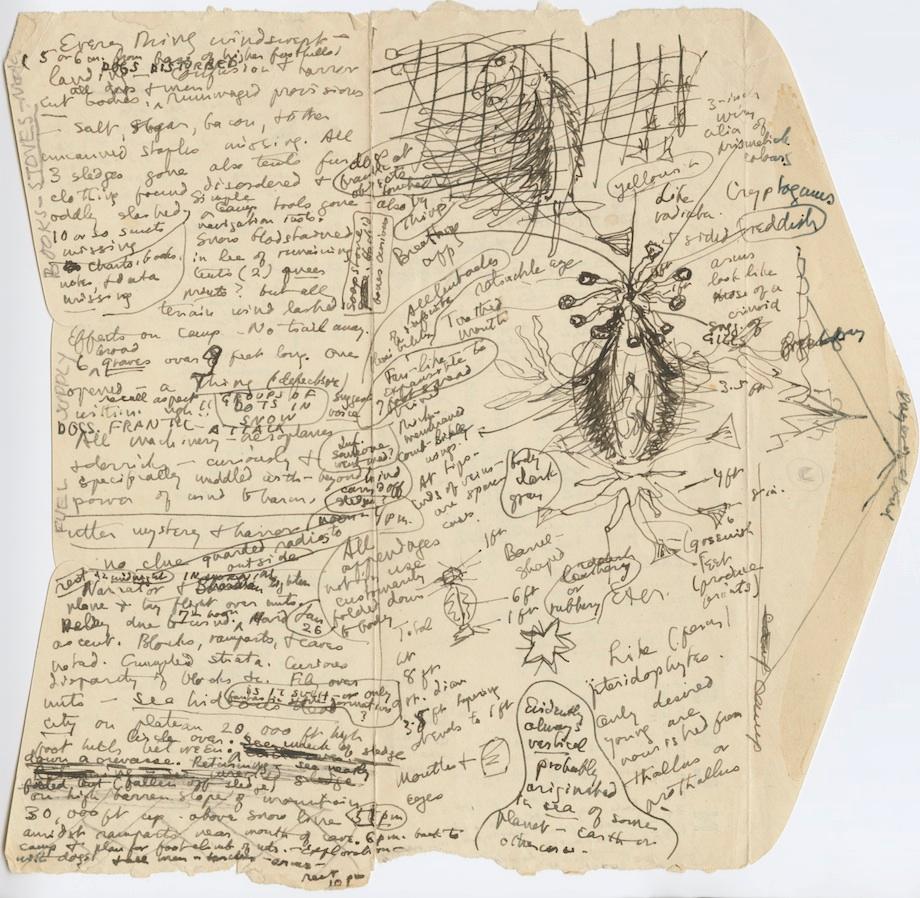
If “The Call of Cthulhu” ranks as Lovecraft’s best-known work, his 1936 novella At the Mountains of Madness surely comes in a close second. Just above, we have an illustrated page of the writer’s plot notes for this unforgettable cautionary tale of an Antarctic expedition that happens disastrously upon the mind-bending ruins of a city previously thought only a myth – and the monsters that inhabit it. It exemplifies the defining quality of Lovecraft’s mythology, where, as Slate’s Rebecca Onion puts it, “ancient beings of profound malevolence lurk just below the surface of the everyday world.”
“Mountains featured several species of forgotten, intelligent beings, including the ‘Elder Things.’ The sketch on the right side of this page of notes (click here to view it in a larger format), with its annotations (‘body dark grey’; ‘all appendages not in use customarily folded down to body’; ‘leathery or rubbery’) represents Lovecraft working out the specifics of an Elder Thing’s anatomy.” That such things lurked in Lovecraft’s imagination have made his state of mind a subject of decades and decades of rich discussion among his enthusiasts. But just the body count racked up by Cthulhu, the Elder Things, and the other denizens of this unfathomable realm should make us thankful that Lovecraft saw them in his mind’s eye so we wouldn’t have to.
Last year, we revisited the high school days of Neil deGrasse Tyson. Growing up in New York City during the 1970s, Tyson attended Bronx Science (class of ’76), ran an impressive 4:25 mile, captained the school’s wrestling team, and, he fondly recalls, wore basketball sneakers belonging to the Knick’s Walt “Clyde” Frazier. Tyson was, of course, also a precocious student. Famously, Carl Sagan recruited Tyson to study with him at Cornell. But Tyson politely declined and went to Harvard for his undergraduate studies. Then, he headed off to Texas, to start his PhD at UT-Austin. That’s where the photo, taken circa 1980, captures him above — hanging out with friends, and looking hipper than your average astrophysics student.
This photo (now making the rounds on Reddit) originally appeared in a 2012 article published in the Alcalde, the alumni magazine of The University of Texas. To the magazine’s credit, the article takes an unvarnished look at Tyson’s “failed experiment” in Texas. The piece starts with the lede “Neil deGrasse Tyson, MA ’83, is the public face of science. But he says his success has nothing to do with UT.” And, from there, it recounts how professors and university police immediately stereotyped him.
The first comment directed to me in the first minute of the first day by a faculty member I had just met was, ‘You must join the department basketball team!
or
I was stopped and questioned seven times by University police on my way into the physics building. Seven times. Zero times was I stopped going into the gym—and I went to the gym a lot. That says all you need to know about how welcome I felt at Texas.
But the real problem wasn’t race. According to Tyson, “there was simply no room for me to be the full person that I was.” “An obsessive focus on one thing at a time; a strong connection to pop culture, from the moonwalk to the Rubik’s cube; and a refusal to put research first: these traits contributed to Tyson’s failure at UT,” concludes the Alcalde. They also allowed him to flourish later in life.
After his “advisors dissolved his dissertation committee—essentially flunking him,” Tyson transferred to Columbia, earned his PhD in 1988, and became the greatest popularizer of science since Carl Sagan. We like stories with happy endings.
Read more about Tyson’s experience in Texas at the Alcalde.
We're hoping to rely on loyal readers, rather than erratic ads. Please click the Donate button and support Open Culture. You can use Paypal, Venmo, Patreon, even Crypto! We thank you!
Open Culture scours the web for the best educational media. We find the free courses and audio books you need, the language lessons & educational videos you want, and plenty of enlightenment in between.

 ,
 , and
 , “Baldwin argued that ‘maintaining calm in the face of vitriol demands a tremendous amount of power.’ ” He goes on to say that “when the sit-in movement started or when a great many things started in the western world, I think it had a great deal less to do with equality than with power.” This got him wondering about what he saw as the all-important distinction between “power and equality” and “power and freedom.”
 . Squinting our eyes at the
 , which Stipe calls “my band’s template”—and the one poet on the list, Rimbaud, is very much an early influence on his writing. Dhalgren was also a favorite of David Bowie’s, who based a lot of