John Lennon was an inveterate archivist of sound and image, documenting his life in whatever medium he had available to him and leaving behind acres of tape for friends and fans to discover. Lennon’s tapes comprise hundreds of hours of song sketches, full demos, conversations, jokes, and, as Yoko Ono puts it in her intro to The Lost Lennon Tapes, some “pretty personal stuff.” The Lost Lennon Tapes was a radio series that aired between 1988 and 1992, presenting over two hundred hours of archival Lennon audio in 219 episodes. Hosted by Lennon’s friend Elliot Mintz, the series gave listeners an intimate look into John’s creative process through demos like that above, a 1966 series of sketches that would become Revolver’s “She Said, She Said.”
In this recording, Lennon, alone with a jangly guitar, works out the now-familiar chord progressions and vocal melodies of the song in several different iterations—and with some quirky lyrical variants (“She’s making me feel like my trousers are torn”). We get to hear the song evolve in several stages, from its bouncy two-chord beginnings to its final, Eastern-inspired form. The demo also provides evidence of the song’s conceptual origins; in the first couple versions, you can hear Lennon sing “he said” instead of “she.” The “he” refers to Peter Fonda, who inspired the song by freaking Lennon out during an acid trip, uttering what became the song’s first line, “I know what it’s like to be dead.”
Just above you can hear several different 1966 home demo takes of “Strawberry Fields Forever,” with John singing over a lone electric guitar. Lennon stops and starts several times, then, at 1:55, finds his groove and plays the whole song through. Next, we hear a run-through with added Mellotron, that odd early proto-synthesizer that lent the final George Martin-produced version so much of its distinctive sound. Finally, at 6:15, hear one of the very first demo recordings of the song—a beautiful solo acoustic version recorded in Almeria, Spain. In the prominent guitar, we hear the strange, serpentine chord pattern that gives the song such a haunting feel. Lennon began composing the song in Spain while filming his scenes for Richard Lester’s How I Won the War.
Paul McCartney once called Lennon’s “Don’t Let Me Down” a “genuine plea” to Yoko, interpreting the song as John saying “I’m really just letting my vulnerability be seen, so you must not let me down.” The Beatles recorded several versions of the song for the Let it Be sessions and released it as a B side to the “Get Back” single in 1969, though Phil Spector eventually dropped the song from Let it Be. McCartney restored it to his re-release of the album, Let it Be… Naked, in which he stripped the songs of Spector’s studio effects. Above, hear “Don’t Let Me Down” at its most stripped-down in a 1968 home demo. Just Lennon with his acoustic guitar, quietly strumming out his bluesy love tune, a stark contrast to the screaming rocker the song would become.
Making the rounds on the internet is this performance by the German string quartet Salut Salon. Featuring Angelika Bachmann (violin), Iris Siegfried (violin and vocals), Anne-Monika von Twardowski (piano) and Sonja Lena Schmid (cello), the quartet knows “better than any other chamber music ensemble how to seduce their audience with passionate virtuosity, instrumental acrobatics, charm and a great sense of fun.” Above you can get your week started by watching them perform a mash-up of Vivaldi, Mozart, and Kurt Weill. And to keep your day going, you can always watch 2Cellos banging out a version of Guns N’ Roses “Welcome to the Jungle” and this 14-year-old girl playing a blistering heavy metal performance of Vivaldi. Enjoy.
If you would like to support the mission of Open Culture, consider making a donation to our site. It’s hard to rely 100% on ads, and your contributions will help us continue providing the best free cultural and educational materials to learners everywhere. You can contribute through PayPal, Patreon, and Venmo (@openculture). Thanks!
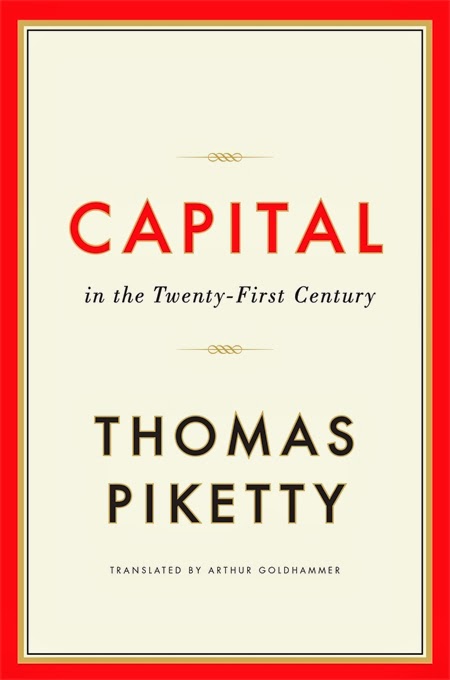
The distribution of wealth is one of today’s most widely discussed and controversial issues. But what do we really know about its evolution over the long term? Do the dynamics of private capital accumulation inevitably lead to the concentration of wealth in ever fewer hands, as Karl Marx believed in the nineteenth century? Or do the balancing forces of growth, competition, and technological progress lead in later stages of development to reduced inequality and greater harmony among the classes, as Simon Kuznets thought in the twentieth century? What do we really know about how wealth and income have evolved since the eighteenth century, and what lessons can we derive from that knowledge for the century now under way?
Capital (which by Piketty’s definition is pretty much the same thing as wealth) has tended over time to grow faster than the overall economy. Income from capital is invariably much less evenly distributed than labor income. Together these amount to a powerful force for increasing inequality. Piketty doesn’t take things as far as Marx, who saw capital’s growth eventually strangling the economy and bringing on its own collapse, and he’s witheringly disdainful of Marx’s data-collection techniques. But his real beef is with the mainstream economic teachings that more capital and lower taxes on capital bring faster growth and higher wages, and that economic dynamism will automatically keep inequality at bay. Over the two-plus centuries for which good records exist, the only major decline in capital’s economic share and in economic inequality was the result of World Wars I and II, which destroyed lots of capital and brought much higher taxes in the U.S. and Europe. This period of capital destruction was followed by a spectacular run of economic growth. Now, after decades of peace, slowing growth, and declining tax rates, capital and inequality are on the rise all over the developed world, and it’s not clear what if anything will alter that trajectory in the decades to come.
On this side of the Atlantic, wealth and income were less concentrated in the 19th century than in Europe. After a spike in top incomes that topped out in the late 1920s, the income distribution flattened out here again, albeit in less dramatic fashion than in Europe. Since the 1970s, though, the U.S. has seen a sharp and unparalleled increase in the percentage of income going to the top 1% and especially 0.1%. This has not been driven by the capital and inheritance dynamics at the heart of Piketty’s story. He attributes it instead to the rise of what he calls “supermanagers.” Piketty cites recent research that shows managers and financial professionals making up 60% of the top 0.1% of the income distribution in the U.S., and proposes that their skyrocketing pay is mainly the product of sharp declines in top marginal tax rates that made it worth managers’ while to bargain harder for raises. This isn’t the only explanation available, and Piketty’s discussion of U.S. inequality doesn’t carry the same historical authority as other parts of the book. But it surely is interesting that, as he and several co-authors report in a new article in the American Economic Journal: Economic Policy, the rise in the top-percentile income share in 13 countries was almost perfectly correlated with declines in top marginal tax rates in those countries. It’s also interesting that this huge rise in relative income inequality has brought no discernible economic benefit. Yes, the U.S. economy has grown a bit faster than those of other developed economies, but that’s purely because of population growth. Per-capita economic growth has been almost identical in the U.S. and Western Europe since 1980, and because of the skew towards the top here, U.S. median income has actually lost ground relative to other nations.
But why let HBR give you insight into Piketty’s thinking when Piketty can do it himself. Below we have a talk he gave at the Economic Policy Institute earlier this month. He starts speaking at the 5:30 mark.
And finally Paul Krugman’s review in the New York Review of Books — “We’re in a New Gilded Age” — is worth a read.
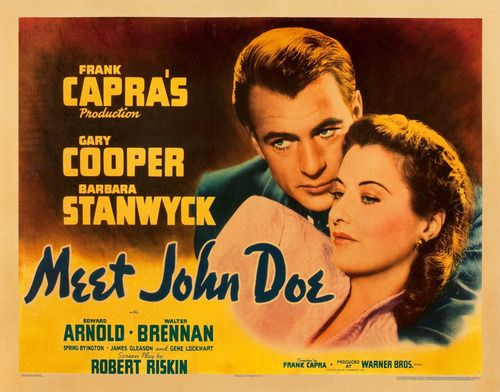
In 2006, a jury of 1,500 filmmakers, actors, actresses, critics and historians created a list of the 100 Most Inspiring Films of All Time. It’s a Wonderful Life, Frank Capra’s 1946 Christmas tale starring Jimmy Stewart, took top honors. And perhaps you know that the film fell into the public domain for some years, before being yanked back out. But another Frank Capra film, Meet John Doe, remains in the commons. And it ranks 49th on the same list of Inspirational Films.
Called “a fable that deals with the dangers of home grown fascism, and the power of the ordinary man and little people to prevent the triumph of dark forces,” Meet John Doe can be “grouped into a populist trilogy of Capra films about American individualism,” along with Mr. Deeds Goes to Town (1936) and Mr. Smith Goes to Washington (1939). Starring Gary Cooper and Barbara Stanwyck, Meet John Doe (1941) was nominated for the Academy Award for Best Story.
If you would like to support the mission of Open Culture, consider making a donation to our site. It’s hard to rely 100% on ads, and your contributions will help us continue providing the best free cultural and educational materials to learners everywhere. You can contribute through PayPal, Patreon, and Venmo (@openculture). Thanks!
“The best reason to hate Bach’s Goldberg Variations,” writes pianist Jeremy Denk, “is that everybody loves them.” As part of Denk’s iconoclastic challenge to this universal love, he cites another reason: “everyone asks you all the time which of the two Glenn Gould recordings you prefer.” Without a doubt the most celebrated pianist of the twentieth century, and perhaps the greatest interpreter of Bach’s keyboard compositions, the eccentric genius Gould famously opened and closed his career with the Goldberg Variations, Bach’s “annoyingly unimpeachable” (in Denk’s words) Baroque piece, written originally for the harpsichord. Gould made his first recording of the piece in 1955, and it immediately launched him to stardom, becoming “what may well be the best known of all piano recordings,” Colin Fleming tells us, with its “masterful showing of command, balance, [and] vigor.”
Twenty-six years later, Gould made his second recording, in 1981, a year before his untimely death at the age of 50. Gould had already retired from public performance 18 years earlier, due in part to his stage fright, but also to a devotion to studio recording techniques that allowed him total control over his musical output. The filmed recording session of Gould’s second Variations, above, opens with a shot not of the pianist and his instrument, but of the bank of analogue dials and switches inside the studio’s control booth. As the camera pans over and pushes in to Gould himself at the piano, we hear the familiar melody of the Goldberg aria, slowed to a snail’s pace. Gould sits in his familiar hunched-over posture, looking aged beyond his years, his body swaying over the keys in an expressive genuflection to the piece that made him more famous—and more controversial—than perhaps any other classical musician.
The shift in Gould’s style between the two Goldberg recordings is remarkable. Revisiting Gould’s legacy thirty years after his death, pianist Steven Osbourne writes in The Guardian of the 1981 performance above:
The contrapuntal detail he finds in every bar is amazing; no one has equalled the way he plays the aria. But even more extraordinary is the line he creates that connects the whole piece. I’m not sure I have heard anything where every single note is placed so carefully, is so carefully thought about. For some people, it’s too controlled, but I don’t find that.
“And yet,” says Osbourne, “I prefer his 1955 recording of the piece. I can’t think of a single artist who made such a profound change in their approach to a piece throughout their whole career.” Certainly Gould’s first Goldberg recording—fueled, as the liner notes inform us, by five bottles of pills, “all different colors and prescriptions”—stands as perhaps the most idiosyncratic, and memorable, rendering of Bach’s composition. But while the first performance has “speed and lightness going for it,” writes Erik Tarloff in Slate, the second has “an autumnal grace and the marvelous clarity Gould seems to privilege above all other qualities.” Luckily for us, Gould, who “never recorded the same piece twice,” but for this “significant exception,” left us these two career bookends to debate, and enjoy, endlessly.
If you’re a regular OC reader, you’re familiar with John Green, the bestselling author who has produced a series of educational videos — most notably, A Crash Course in World History, A Crash Course on Literature, and the new PBS video series, The Art Assignment. John often produces videos with his brother Hank — a musician, biochemist and vlogger — who put his talents together to produce this new song, “I F***ing Love Science.” Be warned, the version above is uncensored. As are the lyrics, found below the jump. A clean, tame, censored version of the song can be found here.
Ever since he was first published in The New Yorker back in 1992, George Saunders has been crafting a string of brilliant short stories that have reinvented the form. His stories are dark, funny, and satirical that then turn on a dime and become surprisingly moving. And the maddening thing about him is that he makes such tonal dexterity look easy. Over the course of his career, he has won piles of awards including a MacArthur “Genius” Fellowship in 2006. In 2013, his collection of short stories The Tenth of December was selected by the New York Times as one of the best books of the year. You can read 10 stories by Saunders free online here.
Last year, Saunders delivered the convocation speech for Syracuse University where he teaches writing. Most such speeches are dull and forgettable or, as was the case when Ross Perot spoke at my graduation, incoherent and churlish. Saunders’s speech, however, was something different — a quiet, self-effacing plea for empathy. When it was reprinted by the New York Times last July, the speech seemingly popped up on every third person’s Facebook feed.
Brooklyn-based group Serious Lunch has created an animated version of Saunders’ speech, voiced by the author himself. You can watch it above and read along below. You’ll probably want to call your mom or help an old lady across the street afterward.
I’d say, as a goal in life, you could do worse than try to be kinder.
In seventh grade, this new kid joined our class. In the interest of confidentiality, her name will be “ELLEN.” ELLEN was small, shy. She wore these blue cat’s‑eye glasses that, at the time, only old ladies wore. When nervous, which was pretty much always, she had a habit of taking a strand of hair into her mouth and chewing on it.
So she came to our school and our neighborhood, and was mostly ignored, occasionally teased (“Your hair taste good?” – that sort of thing). I could see this hurt her. I still remember the way she’d look after such an insult: eyes cast down, a little gut-kicked, as if, having just been reminded of her place in things, she was trying, as much as possible, to disappear. After awhile she’d drift away, hair-strand still in her mouth.
Sometimes I’d see her hanging around alone in her front yard, as if afraid to leave it.
And then – they moved. That was it. One day she was there, next day she wasn’t.
End of story.
Now, why do I regret that? Why, forty-two years later, am I still thinking about it? Relative to most of the other kids, I was actually pretty nice to her. I never said an unkind word to her. In fact, I sometimes even (mildly) defended her. But still, it bothers me.
What I regret most in my life are failures of kindness.
Those moments when another human being was there, in front of me, suffering, and I responded…sensibly. Reservedly. Mildly.
Or, to look at it from the other end of the telescope: Who, in your life, do you remember most fondly, with the most undeniable feelings of warmth?
Those who were kindest to you, I bet.
But kindness, it turns out, is hard — it starts out all rainbows and puppy dogs, and expands to include … well, everything.
Jonathan Crow is a Los Angeles-based writer and filmmaker whose work has appeared in Yahoo!, The Hollywood Reporter, and other publications. You can follow him at @jonccrow.
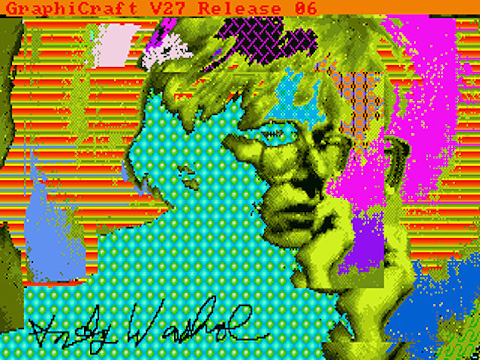
If you saw our post on Andy Warhol digitally painting Debbie Harry at the 1985 launch of the Commodore Amiga 1000, you know how effusively — effusively by the impassive Warholian standard, anyway — the artist praised the computer’s artistic power. Now, thanks to a recent discovery by members of Carnegie Mellon University’s Computer Club, we know for sure that the mastermind behind the Factory didn’t simply shill for Commodore; he actually spent time creating work with their then-graphically advanced machine, a few pieces of which, unseen for nearly thirty years, just came back to light on monitors everywhere. Above we have the 1985 self-portrait Andy2. The 27 other finds include a mouse-drawn rendition of his signature Campbell’s soup can and a three-eyed Venus, surely one of the eerier early uses of cut-and-paste functionality, all products, explains the press release from The Frank-Ratchye STUDIO for Creative Inquiry at Carnegie Mellon,” of a commission by Commodore International to demonstrate the graphic arts capabilities of the Amiga 1000 personal computer.”
1980s electronics-loving artist Cory Arcangel, upon watching the video of Warhol at the launch, contacted the Andy Warhol Museum “regarding the possibility of restoring the Amiga hardware in the museum’s possession.” The effort necessitated acts of “forensic retrocomputing” — a delicate process, since “even reading the data from the diskettes entailed significant risk to the contents.” The CMU Computer Club team even had to reverse-engineer the “completely unknown file format” in which Warhol had saved his images. “By looking at these images, we can see how quickly Warhol seemed to intuit the essence of what it meant to express oneself, in what then was a brand-new medium: the digital,” Arcangel says in the press release. “FYI, it was the most fun project I ever worked on,” he says on his blog — a meaningful statement indeed, since so much of his other work involves old Nintendo games. The Hillman Photography Initiative captured it all in a film called Trapped: Andy Warhol’s Amiga Experiments, which premieres Saturday, May 10, at Pittsburgh’s Carnegie Library Lecture Hall, thereafter becoming viewable at nowseethis.org.
The Reagan presidency was probably the golden age of anti-drug messaging. America’s school kids were told that a brain was like an egg and drugs were like a frying pan. The First Lady told America’s school kids simply to “Just Say No.” The message was stupefyingly simple. Drugs, like Communism and taxes, are bad.
During the early 1970s, however, that anti-drug message was much more confused. Take for example Curious Alice, a visually stunning, deeply odd movie about the perils of drug abuse that makes the stuff look like a lot of fun. Created by the National Institute of Mental Health in 1971, the film shows young Alice reading Lewis Carroll’s Alice in Wonderland in a sunny dappled meadow before nodding off. She soon finds herself plunging down the rabbit hole and in a wonderland … of drugs. The King of Hearts is hawking heroin. The Mad Hatter is tripping balls on LSD. The hookah-smoking Caterpillar is stoned out of his gourd. The Dormouse is in a barbiturate-induced stupor and the March Hare, who looks like the Trix Bunny’s ne’er-do-well brother, is a fidgeting tweaker. “You oughta have some pep pills! Uppers!” he exclaims. “Amphetamines! Speed! You feel super good.”
The movie was reportedly intended for eight year-olds. While it’s unlikely that your average third grader is going to absorb Alice’s moralizing about acid, they will almost certainly respond to the film’s trippy, Monty Pythonesque animation. The animators clearly had a blast making this movie, but their efforts didn’t exactly translate into an effective message. After the movie came out, the National Coordinating Council on Drug Education slammed the movie, calling it confusing and counterproductive.
As an adult, however, the movie is a lot of fun. So check it out above. And if you live in either Colorado or Washington, feel free to enjoy the movie in a state that it is probably best appreciated.
Jonathan Crow is a Los Angeles-based writer and filmmaker whose work has appeared in Yahoo!, The Hollywood Reporter, and other publications. You can follow him at @jonccrow.
Over at his blog Leiter Reports, UC Chicago professor of philosophy Brian Leiter is currently conducting a very interesting poll, asking his readers to rank the 25 philosophers of “the modern era” (the last 200 years) who “have had the most pernicious influence on philosophy.” The pool of candidates comes from an earlier survey of influential philosophers, and Leiter has imposed some conditions on his respondents, asking that they only rank philosophers they have read, and only include “serious philosophers”–“no charlatans like Derrida or amateurs like Rand.” While I personally wince at Leiter’s Derrida jab (and cheer his exclusion of Rand), I think his question may be a little too academic, his field perhaps too narrow.
But the polemical idea is so compelling that I felt it worth adopting for a broader informal survey: contra Leiter, I’ve ranked five philosophers who I think have had a most pernicious influence on the world at large. I’m limiting my own choices to Western philosophers, with which I’m most familiar, though obviously by my first choice, you can tell I’ve expanded the temporal parameters. And in sporting listicle fashion, I’ve not only made a ranking, but I’ve blurbed each of my choices, inspired by this fun Neatorama post, “9 Bad Boys of Philosophy.”
While that list uses “bad” in the Michael Jackson sense, I mean it in the sense of Leiter’s “pernicious.” And though I would also include the proviso that only “serious” thinkers warrant inclusion, I don’t think this necessarily rules out anyone on the basis of academic canons of taste. One might as well include C.S. Lewis as Jean Baudrillard, both of whom tend to get dismissed in most philosophy departments. My own list surely reveals my anti-authoritarian biases, just as some others may rail at fuzzy thinking with a list of postmodernists, or socialism with a list of Marxists. This is as it should be. Defining the “bad,” after all, is bound to be a highly subjective exercise, and one about which we can and should disagree, civilly but vigorously. So with no more ado, here are my five choices for “Most Pernicious Western Philosophers.” I invite—nay urge you—to make your own lists in the comments, with explanations terse or prolix as you see fit.
The Dominican friar and author of the near-unreadably dense Summa Theologica made it his life’s work to harmonize logical Aristotelian thought and mystical Christian theology, to the detriment of both. While for Aquinas and his medieval contemporaries, natural theology represents an early attempt at empiricism, the emphasis on the “theology” meant that the West has endured centuries of spurious “proofs” of God’s existence and completely incomprehensible rationalizations of the Trinity, the virgin birth, and other miraculous tales that have no analogue in observable phenomena.
Like many church fathers before him, Thomas’s employment as a kind of Grand Inquisitor of heretics and a codifier of dogma makes me all the more averse to his thought, though much of it is admittedly of great historical import.
Schmitt was a Nazi, which—as in the case of Martin Heidegger—strangely hasn’t disqualified his thought from serious appraisal across the political spectrum. But some of Schmitt’s ideas—or at least their application—are particularly troubling even when fully divorced from his personal politics. Schmitt theorized that sovereign rulers, or dictators, emerge in a “state of exception”—a security crisis with which a democratic society cannot seem to cope, but which is ripe for exploitation by domineering individuals. These “states” can legitimately appear at any time, or can be ginned up by unscrupulous rulers. The crucial insight has inspired such leftist thinkers as Walter Benjamin and theorists on the right like Leo Strauss. Its political effects are something altogether different. Writes Scott Horton in Harper’s:
It was Schmitt who, as the crown jurist of the new Nazi regime, provided the essential road map for Gleichschaltung – the leveling of opposition within Germany’s vast bureaucracy – and it was he who provided the legal tools used to transform the Weimar democracy into the Nazi nightmare that followed it.
This same road map—many have alleged—guided the unilateral suspensions of constitutional protections and human rights protocols machinated by Bush and Cheney’s Neoconservative legal advisors after 9/11, who read Schmitt thoroughly. (I intend here no direct comparison whatever between these two regimes, Godwin willing.)
Though he wrote copiously on epistemology, religious toleration, education, and all sorts of other important topics, Locke is often remembered as everyone’s favorite liberal political philosopher. His anonymously published Two Treatises of Government has had an outsized influence on most modern democratic constitutions, and given his primary antagonist in the first part of that work—Sir Robert Filmer, staunch defender of the divine right of kings and natural hierarchies—Locke seems positively progressive, what with his defense of a civil society based on respect for labor and private property against the unwarranted power and abuse of the aristocracy.
But Locke’s Filmer works as something of a straw man. Examined critically, Locke is no democratic champion but an apologist for the petty tyranny of landowners who gradually eroded the commons, displaced the commoners, and seized greater and greater tracts of land in England and the colonies under the Lockean justification that a man is entitled to as much property as he can make use of. Of course, in Locke’s time, and in our own, proprietors and landowners seize and “make use of” the resources and labor of others—slaves, indigenous people, and exploited, landless workers—in order to make their extravagant claims to private property. This kind of appropriation is also enabled by Locke’s thought, since property only justly belongs to the “industrious and the rational”— characteristics that tend to get defined against their opposites (“lazy and stupid”) in any way that suits those in power.
Another darling of Enlightenment tradition, Descartes gets all the credit for founding a philosophy on radical doubt, and thereby doing away with the presuppositional theological baggage imposed on thought by scholastics like Aquinas. And yet, like Locke, Descartes gets too easy a pass for reducing his method to terms that are by no means unequivocal or universally meaningful, though he pretends that they are.
Descartes explains his method as a means of eliminating from his mind all conceptual clutter but those ideas that seem to him “clear and distinct.” Oddly the two bedrock concepts he’s left with are an unshakeable faith in his own individual ego—or soul—and the existence of a monotheistic creator-God. Thus, Descartes’ method of radical doubt leads him to reaffirm the two most core concepts of classical Western philosophy, concepts he more or less assumes on the basis of intuition—or perhaps unexamined ideological commitments.
This is a tough one, because I actually adore Kierkegaard, but I love him as a writer, not as a philosopher. His critiques of Hegel are scathing and hilarious, his takedowns of the self-satisfied Danish petit-bourgeoisie are epic, and the tonal range and ironic deftness of his numerous literary voices—personae as diverse as desert saints and scheming seducers—are unequalled.
But I recoil from the ethical philosophy of Søren Kierkegaard, as so many people recoil from Nietzsche’s brinksmanship with traditional Christian morality. Kierkegaard’s reduction of the human experience to a false choice paradigm—“Either/Or”—, his ethics of blind irrationalism couched as a justifiable leap of faith, exemplified by his glorification of Abraham’s willingness to kill his son Isaac… these things I can’t help but find abhorrent, and if I’ve ever been tempted to read them as ironic expressions of the author’s many masks, further study has robbed me of this balm. Kierkegaard the writer offers us a great deal; Kierkegaard the moral philosopher, not so much.
So there you have my list—riddled, to be sure, with inaccuracies, prejudice, and superficial misreadings, but an honest attempt nonetheless, given my inadequate philosophical training. Again I’ll say that the inclusion of any of these five names in a list of philosophers, pernicious or no, means that I believe they are all thinkers worth reading and taking seriously to some degree, even if one violently disagrees with them or finds glaring and grievous error in the midst of seas of brilliance.
Now that you’ve read my “Five Most Pernicious Philosophers,” please tell us readers, who are yours, and why? Your griping explanations can be as short or long as you see fit, and feel free to violently disagree with my hasty judgments above. Ad hominem attacks aside, it’s all within the spirit of the enterprise.
Take Forrest Gump, the 1994 film directed by Robert Zemeckis and starring Tom Hanks. Now let’s give it a Wes Anderson makeover. That’s the exercise Louis Paquet went through above, in making a short Andersonion version of Forrest Gump’s opening credits. If you need an introduction to Anderson’s signature style, we’ve got a few helpful posts for you below.
We're hoping to rely on loyal readers, rather than erratic ads. Please click the Donate button and support Open Culture. You can use Paypal, Venmo, Patreon, even Crypto! We thank you!
Open Culture scours the web for the best educational media. We find the free courses and audio books you need, the language lessons & educational videos you want, and plenty of enlightenment in between.