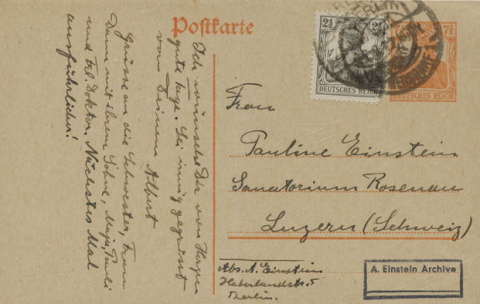
It’s not hard to jump online and learn about Albert Einstein’s intellectual contributions. Thanks to Yale, you can get a 60 minute primer on Einstein’s theoretical work. It’s called Einstein for the Masses. Or you can embark upon a longer, 10-lecture exploration of Einstein’s groundbreaking ideas (iTunes – YouTube) with Leonard Susskind, a Stanford professor known for his own groundbreaking work on String Theory.
And then there’s this: Starting this week, the Hebrew University of Jerusalem is bringing online an extensive archive of papers and letters belonging to the great humanist and scientist. The collection currently features 2,000 documents and will eventually surpass 80,000. And it all gives a rounded view of Einstein’s life and work. The documents shed light on his personal relationship with his mother, wife and many mistresses; his views on the Arab-Israeli conflict; and his work on physics itself. A quick way to sample the archive is to enter this gallery, where, among other things, you’ll find Einstein’s manuscript introducing his famous equation, e=mc2.
We’ve always had the desire to leave our earth-bound bodies and take flight with the birds. We achieved the miracle of flight over a century ago. But only recently did we create a robot that can mechanically reproduce the beauty of birds in flight. And now we’ve taken the next step, actually joining birds high in the air. Above you can watch ParaHawking in action, a fusion between falconry and paragliding that lets you interact with birds of prey in their own environment. It all takes place in Nepal. And it’s all part of an effort to conserve Asia’s threatened vulture population. Learn more about these conservation efforts and ParaHawking itself at, of course, Parahawking.com.
And if you want to see what happens when a paraglider (not affiliated with this project) accidentally runs into an eagle, watch below:
Eons ago, we brought you Tom Waits reading Charles Bukowski’s poem “The Laughing Heart” in his ever so distinctive gravelly voice. Today, we’re heading to the other end of the rock audio spectrum. We’re bringing you Bono — short, of course, for the Latin “Bonovox,” or “Good Voice” — reading two poems by Bukowski, the poet once called the “laureate of American lowlife” by Pico Iyer. That’s because Bukowski made the ordinary lives of poor Americans and their many travails the subject of his poetry.
First up comes “Roll the Dice,” a poem from the collection, What Matters Most is How Well You Walk Through the Fire (1999). Next, “The Crunch,” published in Love is a Dog From Hell (1977). Both Bono readings originally appeared in the 2003 Bukowski documentary Born Into This. You can find the film listed in our collection of Free Movies Online (in the Documentary section), and also more Bukowski readings in our big list of Free Audio Books.
If you would like to support the mission of Open Culture, consider making a donation to our site. It’s hard to rely 100% on ads, and your contributions will help us continue providing the best free cultural and educational materials to learners everywhere. You can contribute through PayPal, Patreon, and Venmo (@openculture). Thanks!
Earlier this month, we posted a pair of Wes Anderson-directed television commercials advertising the Hyundai Azera. While I understood that, at one time, a known auteur using his cinematic powers to pitch sensible sedans would have raised hackles, I didn’t realize that it could still spark a lively debate today. Seeing as Open Culture has already featured commercials by the likes of David Lynch, Frederico Fellini, Ingmar Bergman, and Jean-Luc Godard — and I couldn’t resist linking to Errol Morris’ when discussing El Wingador — I assumed any issues surrounding this sort of business had already been settled. On Twitter, the New Yorker’s Richard Brody, author of a hefty tome on Godard, seemed to corroborate this conclusion: “Bergman made commercials, so did Godard; the more distinctive the artist, the less the artist need worry about it.” “Also,” the Chicago Sun-Times’ Jim Emerson tweeted, “the, concept of “sellout” no longer exists.”
From all the ensuing back-and-forth between critics and cinephiles emerged Brody’s New Yorker blog post, “Wes Anderson: Classics and Commercials.” Pointing out that “so many great paintings were made for popes and kings and patrons, and great buildings sponsored by tycoons and corporations,” Brody finds that “the better and stronger and more distinctive the artist, the more likely it is that anything he or she does will bear the artist’s mark and embody the artist’s essence. Those who are most endangered by the making of commercials (of whatever sort in whatever medium) are those whose abilities are more fragile, more precarious, more incipient, less developed.” But a dissenting voice appears in the comment section: “The reason that Godard and Anderson can make commercials that feel more like short films is not so much because their talents are more developed; it’s because their reputation is more secure. [ … ] It would be better to regard these commercials as short films financed by a company’s patronage (with a few strings attached) than as commercials proper.”
An even more forceful objection comes from Chris Michael in the Guardian: “Is it worth remaining sceptical about art made in the direct service of a sales pitch? I think it is. Does it cheapen your talent to consistently sell its actual goals to the highest bidder? I think it does. When the goal or persuasive intent does not ‘resonate with audience in meaningful way’, but rather ’employ style to conflate love for artist with love for product’, there’s a genuine, full-frontal, non-imaginary assault on the integrity of the art’s meaning. Better to ask: What meaning? What art? Taking it further, can a car ad ever be art?” When Slate’s Forrest Wickman entered the fray, he hauled a Darren Aronofsky-directed Kohl’s spot in with him to demonstrate that “that there is such a thing as selling out,” comparing it unfavorably with Anderson’s ads as “nothing more than a second-rate ripoff, a cheap copy of ads and music videos past.”
Michael remains unimpressed: “Aronofsky really sold out least: by not prostituting his style and delivery, by not wrapping anything of himself around a dull car or department store, by just doing the job for the money like a professional. That, I can respect.” Responding, Brody holds fast in defense of Anderson’s ads, one of which he calls “a feat of astonishing psychological complexity. “These little films, which happen to be commercials for a car,” he writes, “share not only the style but also the content, the theme, and the emotional and personal concerns, of Anderson’s feature films. Yes, they’re short. Yes, there’s a difference between what can be developed in two hours and what can be developed in thirty seconds—it’s the difference between a poem and a novel, between a song and an opera.” Has Wes Anderson sold out? Is selling out still be possible? As in everything, dear reader, the task of weighing the evidence and making the decision falls ultimately to you.
“Nobody’s dreaming about tomorrow anymore,” says astrophysicist Neil deGrasse Tyson in this compelling little video on the decline of the American space program. “After we stopped going to the moon, it all ended. We stopped dreaming.” The video was put together by Evan Schurr with material from various sources. In it, Tyson asks us to imagine the possibilities for tomorrow if NASA’s budget were increased to just one penny for every tax dollar. It’s a point he raised earlier this month before a U.S. Senate committee (read the full testimony here), when he said:
The 2008 bank bailout of $750 billion was greater than all the money NASA had received in its half-century history; two years’ U.S. military spending exceeds it as well. Right now, NASA’s annual budget is half a penny on your tax dollar. For twice that–a penny on a dollar–we can transform the country from a sullen, dispirited nation, weary of economic struggle, to one where it has reclaimed its 20th century birthright to dream of tomorrow.
We know that Bruce Springsteen can put on an amazing show. We saw him do that last weekend at the Apollo Theater in Harlem. (Watch it here.) Now, you’ll discover that the Boss can give a damn fine speech too. Presenting the keynote address at SXSW yesterday, Springsteen took his audience on a personal journey through rock ’n’ roll, remembering the bands that gave birth to the musical form and that provided inspiration for a young musician growing up in New Jersey. Elvis, The Beatles, Bob Dylan, The Animals, and James Brown get their due. As does Woody Guthrie. The talk, which features Springsteen playing some guitar along the way, runs 51 minutes. And it has a few NSFW words sprinkled in, though they don’t feel gratuitous, at least not to me. Sit back and enjoy.
It’s a simple recipe for happiness. Eliminate all negative emotions, anything that creates bad feelings and distracts from the project at hand. Clear it all away, and what’s left? The space for creativity pure and simple. That’s happiness for Hitch. Watch 20 Free Hitchcock Films online here.
Follow us on Facebook, Twitter and now Google Plus and share intelligent media with your friends! They’ll thank you for it.
Last December, we featured the documentary Portrait of a Bookstore as an Old Man in tribute to its recently passed subject, noted bookseller and eccentric George Whitman. His store Shakespeare and Company has sent a beacon from Paris’ Left Bank to writers and bibliophiles the world over for sixty years, and it continues to do so under Whitman’s daughter, Sylvia Beach Whitman. While practically every bookstore in business today takes pains to set itself apart as something “more than just a bookstore,” Shakespeare and Company has been hip to that plan since its inception, offering a reading library, Sunday tea, a storied makeshift writers’ colony, and a taste of the early twentieth-century’s expatriate-filled Parisian literary scene. Readers well-versed in the history of that scene will notice a clever bit of attempted predestination on George Whitman’s part in naming his daughter after Sylvia Beach, the American founder of another famous bookstore called Shakespeare and Company, which operated from 1921 to 1941.
You can learn more about Sylvia Beach Whitman — much more than you’d expect to in under four minutes — from art-world documentarian Chiara Clemente’s profile of her on the Sundance Channel’s documentary series Beginnings. Whitman remembers her days as Shakespeare and Company’s official moppet, when its writers in residence — her “hundreds of brothers and sisters” — would tell her custom-made bedtime stories before flopping down on their own beds built atop the book piles. She’s since grown up and gone on to do big things with the store, including starting a biennial literary festival which has brought in the likes of Jung Chang, Paul Auster, David Hare, and Persepolis author Marjane Satrapi, who features in a Beginnings short of her own (see above). When not hard at work on a page of comic art, Satrapi lights up a cigarette and remembers how, due to the last forty years of constant political churn in her native Iran, no Iranian of her generation has lived anything like a “normal” life. The series also covers the early lives and first inspirations of creators including shoe designer Christian Louboutin, Blue Hill chef Dan Barber, and… well, you can’t describe Yoko Ono as anything but Yoko Ono. But you can watch her episode of Beginnings on NYTimes.com and hear about her struggle to find her way to the avant-garde after emerging from her family’s artistic traditionalism. H/T New Yorker
Yesterday we featured a video of Lynyrd Skynyrd’s “Sweet Home Alabama” being played on a pair of Tesla coils. Today we keep the music going with something perhaps even more amazing: a swarm of autonomous flying robots playing the theme from the James Bond movies.
The robots were developed at the University of Pennsylvania’s General Robotics, Automation, Sensing and Perception (GRASP) lab by graduate students Daniel Mellinger and Alex Kushleyev, founders of KMel Robotics, under the supervision of Professor Vijay Kumar. The researchers are working to develop agile, autonomous flying robots that can mimic the swarming behaviors of birds, fish and insects. In the video above, which was created specially for Kumar’s February 29 TED talk, a swarm of nine quadrotor helicopters play musical instruments. An article on the UPenn website explains:
In this demonstration, the “stage” is in a room fitted with infrared lights and cameras. The nano quads all have reflectors on their struts, which allows the camera system to plot their exact position and relay that information wirelessly to each unit.
Lab members can then assign each unit a series of waypoints in three-dimensional space that must be reached at an exact time. In this case, those times and places translate into notes on a keyboard or a strum of a guitar. Figuring out how to get from waypoint to waypoint most efficiently and without disturbing their neighbors is up to the robots.
The robots are remarkably agile, and may someday be useful for a wide variety of applications. To learn more, watch Kumar’s 17-minute TED talk, below, which includes several astonishing video demonstrations of the robots in action.
You can create music with Tesla coils if you know how to modulate their “break rate” with MIDI data and a control unit. Case in point. Here we have two solid state musical Tesla coils, using a combined 24KW of power, to play a version of Lynyrd Skynyrd’s 1974 classic “Sweet Home Alabama” (listen to the original here). Also enjoy electrified versions of House of The Rising Sun and Dueling Banjos. via @webacion
We're hoping to rely on loyal readers, rather than erratic ads. Please click the Donate button and support Open Culture. You can use Paypal, Venmo, Patreon, even Crypto! We thank you!
Open Culture scours the web for the best educational media. We find the free courses and audio books you need, the language lessons & educational videos you want, and plenty of enlightenment in between.