John Hughes films. The Who. Now you’ve got the backdrop for my teenage years. This is for me, and perhaps even for you… (Sorry to those who can’t relate. We’ll be back on track soon enough.)
John Hughes films. The Who. Now you’ve got the backdrop for my teenage years. This is for me, and perhaps even for you… (Sorry to those who can’t relate. We’ll be back on track soon enough.)
Straight from Metafilter. Seemed worth passing along to our readers:
The Rijksmuseum in Amsterdam invites you to compare Caravaggio and Rembrandt. For an overview of Rembrandt’s work here are Rembrandt van Rijn: Life and Work and A Web Catalogue of Rembrandt Paintings. For Caravaggio there’s caravaggio.com which makes use of the Italian website Tutta l’opera del Caravaggio.
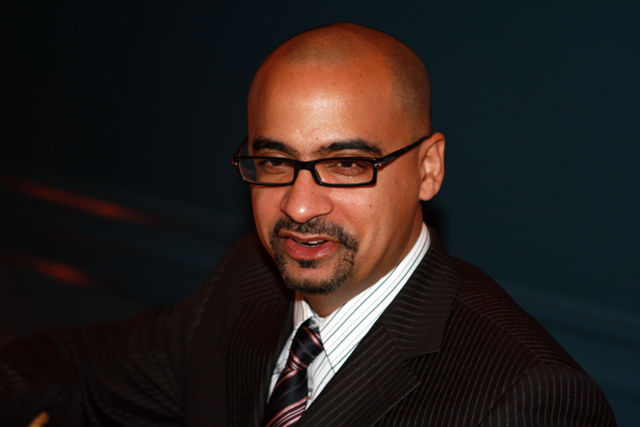
Image by Christopher Peterson, via Wikimedia Commons
I first heard about Junot Díaz in the early 90s. He was only in his 20s, already publishing in The New Yorker, and getting a lot of wunderkind talk. By 1996, he published, Drown, a bestselling collection of short stories that earned high praise. And then, things slowed down. It took a good eleven years for him to publish The Brief Wondrous Life of Oscar Wao. But the patience paid off. The novel won him a Pulitzer in fact. And it’s an excellent read. Really.
Having said this, I want to highlight Díaz reading one of his early New Yorker stories that also found its way into Drown. It’s called How to Date a Brown Girl (Black Girl, White Girl, or Halfie). The free audio clip, which is listed in our collection of Free Audio Books (and produced by The New Yorker), has some colorful language, but it’s not gratuitous.
Looking for free, professionally-read audio books from Audible.com? Here’s a great, no-strings-attached deal. If you start a 30 day free trial with Audible.com, you can download two free audio books of your choice. Get more details on the offer here.
On the lighter side. Thanks Rachel for sending this along…
Find the link to the original video here.
Chris Anderson, the author of Free: The Future of a Radical Price (download a free audio file of the book here) is making the rounds, promoting his new book. Of course, it was only natural that Anderson (also the author of The Long Tail and editor-in-chief of Wired) should pay a visit to Google, a company that generates billions of dollars by serving free content and services. With the talk above, you get an introduction to Anderson’s take on “free” and some good Q&A. The presentation runs about 53 minutes in total.
Thomas Pynchon’s new book, Inherent Vice, is on sale today. Check it out. Below we have, yes, a video trailer for the new book, and it sounds like Pynchon (who has famously stayed out of the public eye) is actually narrating the thing.
Become of a Fan of Open Culture on FaceBook here or follow us on Twitter
Arthur Benjamin is a self-proclaimed “mathemagician.” He’s also a professor of mathematics at Harvey Mudd College. No need to say more. Watch him go. We’re adding this one to our list of YouTube favorites.
via The Teaching Company’s Facebook Page.
A new addition to our popular and still growing collection: Intelligent Video: The Top Cultural & Educational Video Sites … (The list now has close to 50 intelligent video sites.)
Big Ideas, a program that comes out of Canada, features a “variety of thought-provoking topics which range across politics, culture, economics, art history, science…. The program has introduced Ontario viewers to the impressive brainpower of people like Niall Ferguson on American empire, Daniel Libeskind on architecture, George Steiner on the demise of literacy, Camille Paglia on aesthetic education, and Noam Chomsky on U.S. politics.” You will also find talks here by Umberto Eco, Margaret Atwood, Richard Florida, Steven Pinker, Lewis Lapham. See the full list of videos here.
via Metafilter
Oliver Sacks, the famous neurologist and author of Musicophilia, a study that looks at the human brain and music, speaks in Harpers about the landscape altering iPod:
As Daniel Levitin has pointed out, passive listening has largely replaced active music-making. Now that we can listen to anything we like on our iPods, we have less motivation to go to concerts or churches or synagogues, less occasion to sing together. This is unfortunate, because music-making engages much more of our brains than simply listening. Partly for this reason, to celebrate my 75th birthday last year, I started taking piano lessons (after a gap of more than sixty years). I still have my iPod (it contains the complete works of Bach), but I also need to make music.
via The Daily Dish
What if The Godfather had been shot without Marlon Brando? (It almost happened.) Or without Al Pacino? (It almost happened too .) Or without Francis Ford Coppola? (Yup, even that almost happened as well.) Then, what if Robert De Niro had played the role of Sonny, which eventually went to James Caan? Here’s what it would have looked like (and, by the way, we’ve added this clip to our list of YouTube favorites):
It’s not often that The New Yorker does the gadget review. But here we have one — Nicholson Baker breaking down the Kindle. The upshot? He’s not a big fan. Why? Let me give you some of the money quotes. And also note the iPhone/iPod Touch recommendations at the end (where I added some useful links):
“The problem was not that the screen was in black-and-white; if it had really been black-and-white, that would have been fine. The problem was that the screen was gray. And it wasn’t just gray; it was a greenish, sickly gray. A postmortem gray. The resizable typeface, Monotype Caecilia, appeared as a darker gray. Dark gray on paler greenish gray was the palette of the Amazon Kindle [DC note: This is why I returned my Kindle].”
“Despite its smoother design, the Kindle 2 is, some say, harder to read than the Kindle 1. “I immediately noticed that the contrast was worse on the K2 than on my K1,” a reviewer named T. Ford wrote. One Kindler, Elizabeth Glass, began an online petition, asking Amazon to fix the contrast. “Like reading a wet newspaper,” according to petition-signer Louise Potter.”
“Amazon, with its listmania lists and its sometimes inspired recommendations and its innumerable fascinating reviews, is very good at selling things. It isn’t so good, to date anyway, at making things. But, fortunately, if you want to read electronic books there’s another way to go. Here’s what you do. Buy an iPod Touch (it costs seventy dollars less than the Kindle 2, even after the Kindle’s price was recently cut), or buy an iPhone, and load the free “Kindle for iPod” application onto it.”
“There are other ways to read books on the iPod, too. My favorite is the Eucalyptus application, by a Scottish software developer named James Montgomerie: for $9.99, you get more than twenty thousand public-domain books whose pages turn with a voluptuous grace. There’s also the Iceberg Reader, by ScrollMotion, with fixed page numbers, and a very popular app called Stanza. In Stanza, you can choose the colors of the words and of the page, and you can adjust the brightness with a vertical thumb swipe as you read… Forty million iPod Touches and iPhones are in circulation, and most people aren’t reading books on them. But some are. The nice thing about this machine is (a) it’s beautiful, and (b) it’s not imitating anything. It’s not trying to be ink on paper. It serves a night-reading need, which the lightless Kindle doesn’t.”


Open Culture scours the web for the best educational media. We find the free courses and audio books you need, the language lessons & educational videos you want, and plenty of enlightenment in between.

©2006-2026 Open Culture, LLC.
All rights reserved.

